Easy Clean Sanitary Coatings Market (2026-2036)
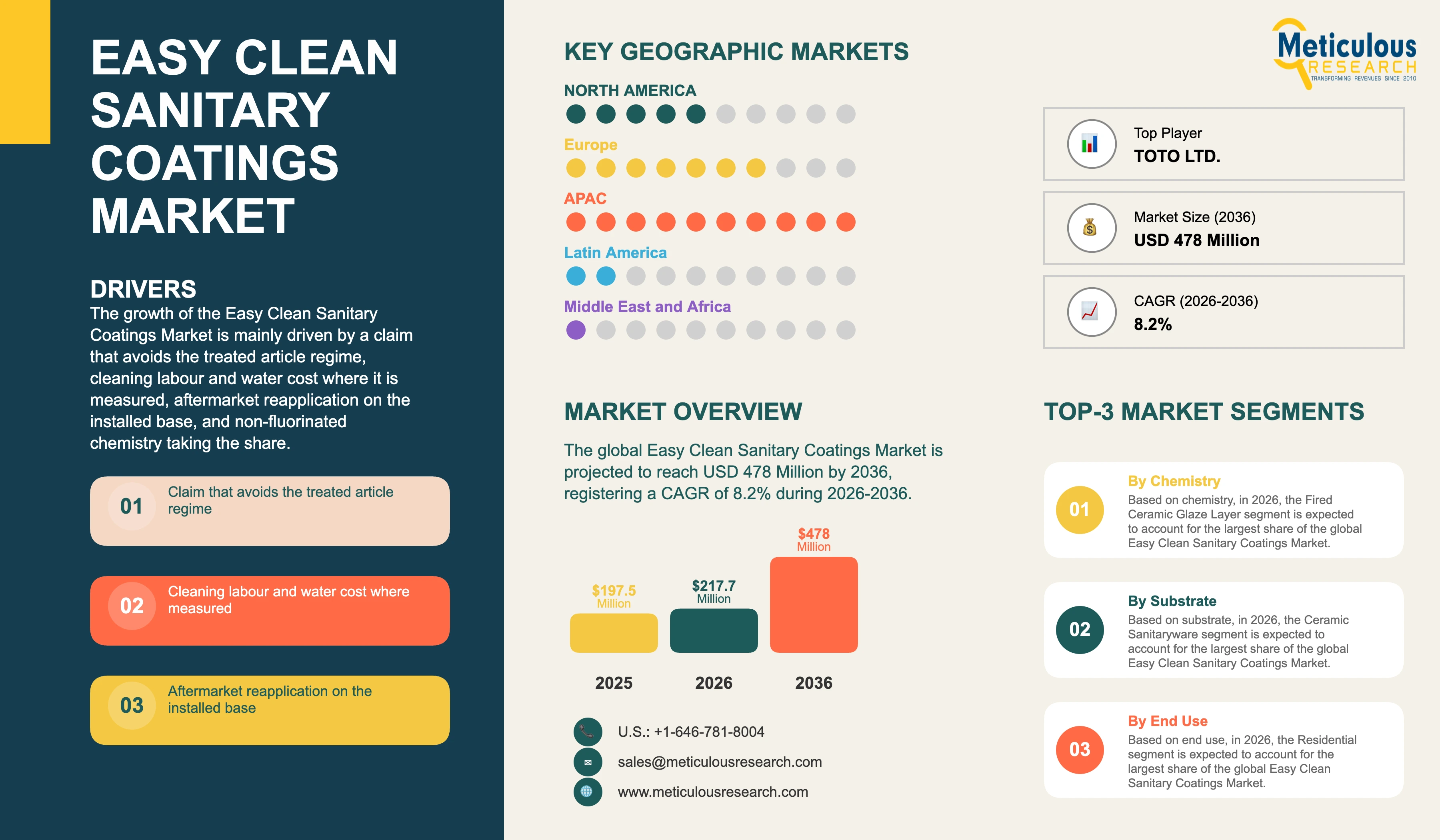
The easy clean sanitary coatings market is valued at USD 217.7 million in 2026 and is projected to reach USD 478.0 million by 2036, at a CAGR of 8.2% during the forecast period. The market was valued at USD 197.5 million in 2025 and at USD 180.3 million in 2024.
- Published
- Nov 2026
- Pages
- 259
- Format
- PDF + Excel
- Report ID
- MRCHM - 1042769
- Base year
- 2025
- 2024 · HISTORICAL
- $180.3M
- 2036
- $478.0M
- CAGR 2026–2036
- 8.2%
2024–2025 baseline · 2026–2036 forecast at 8.2% CAGR · hover a bar for the value
Key highlights
This market measures coatings, glaze layers and surface treatments sold to reduce soil adhesion and ease cleaning on sanitary, hygienic and high-touch surfaces, taken at the material supplier gate on a tonne basis as supplied.
Excluded are coatings placed on the market on a biocidal or antimicrobial claim, cleaning chemicals and detergents, exterior self-cleaning facade coatings, anti-graffiti systems, the ceramic body and base glaze, the sanitaryware itself, and sealants and grouts.
An easy clean claim is a claim about soil adhesion and cleanability, which is a physical property, and it therefore falls outside the treated article regime in Chapter XIII of Regulation (EU) No 528/2012 altogether.
Article 58(2) of that regulation provides that a treated article may not be placed on the market unless every active substance in the biocidal products used to treat it is approved for the relevant product type and use or listed in Annex I.
Article 58(3) requires labelling where the manufacturer makes a claim about biocidal properties or where the conditions of approval of the active substance require it.
That label must name the active substances, state that the article incorporates biocidal products, carry any substantiated property claimed and the word nano in brackets after any nanomaterial, and give instructions and precautions.
Article 58(4) requires safety instructions regardless of that trigger where needed, and Article 58(6) requires labels to be visible, legible and durable in the official language or languages of the member state of introduction.
Article 58(5) requires a supplier to provide information on the biocidal treatment of an article to a consumer who requests it, within 45 days and free of charge.
Selling on cleanability rather than on antimicrobial performance therefore avoids active substance approval, label content and the 45-day duty together, which is why this category exists separately from antimicrobial coatings.
The universal restriction proposal on per- and polyfluoroalkyl substances went to consultation from 22 March 2023 to 25 September 2023 and remains on the register of restrictions under consideration at the European Chemicals Agency.
Fluoropolymer and fluorosilane chemistries deliver the lowest surface energy available and are therefore the technically strongest easy clean route, while carrying the weakest regulatory position of any chemistry in this market.
TOTO describes its fired glaze layer as layers of glass fired onto the conventional glaze, evening out the irregularities of that rough surface.
That technology is hydrophilic rather than hydrophobic, so water spreads and carries waste away, with surface ridges stated to be far smaller than waste particles so soil has nothing to grip.
Illustrated layer heights place the base layer at about 300 microns, the conventional glaze layer at about twice that height, and the easy clean top layer at about half the base layer height.
A fired glaze layer is permanent and sold with the ware, which is why factory application at original manufacture accounts for 61.0% of this market in 2026 and grows at 7.0%.
Field applied and aftermarket systems are consumed and renewed rather than fired once, so aftermarket reapplication records the highest application stage CAGR at 11.2%.
Fired ceramic glaze layers are expected to hold the largest chemistry share of this market in 2026 at 33.0% and to grow at 7.0%, while photocatalytic and hydrophilic systems grow fastest at 12.6% and fluorinated chemistries slowest at 4.8%.
Ceramic sanitaryware is expected to account for the largest substrate share of this market in 2026 at 38.0% and to grow slowest at 6.5%, while worktops and panels grow at 9.6%.
Report summary
| Particulars | Details |
|---|---|
| Base Year | 2025 |
| Actual Years | 2024-2025 |
| Forecast Period | 2026-2036 |
| Market Size in 2024 | USD 180.3 million |
| Market Size in 2025 | USD 197.5 million |
| Market Size in 2026 | USD 217.7 million |
| Market Size in 2036 | USD 478.0 million |
| Value CAGR (2026-2036) | 8.2% |
| Volume in 2025 | 20.90 kilotons |
| Volume in 2026 | 22.40 kilotons |
| Volume in 2036 | 39.50 kilotons |
| Volume CAGR (2026-2036) | 5.8% |
| Average Selling Price, 2026 | USD 9,720 per tonne |
| Average Selling Price, 2036 | USD 12,100 per tonne |
| Units | Value in USD million; volume in kilotons of coating and glaze material as supplied; price in USD per tonne |
| Measurement Basis | Coatings, glaze layers and surface treatments sold to reduce soil adhesion and ease cleaning on sanitary, hygienic and high-touch surfaces, taken at the material supplier gate on a tonne basis as supplied |
| Historical Value Growth | Value grew at 9.9% a year between 2024 and 2026 on volume growth of 6.9% a year and price growth of 2.8% a year; the forecast of 8.2% carries volume growth of 5.8% and price growth of 2.2%, with value growing ahead of volume throughout on the shift toward field and aftermarket application and toward sol-gel, silicone and photocatalytic chemistries |
| Price Increase Note | The average selling price rises on mix rather than on repricing, because a bulk glaze additive fired in a sanitaryware plant is priced far below a sol-gel or silicone system applied in the field, so a shift of share toward the latter lifts the blended figure without either repricing |
| Claim Boundary Basis | An easy clean claim concerns soil adhesion and cleanability, which is a physical property, and therefore falls outside the treated article regime in Chapter XIII of Regulation (EU) No 528/2012; this is the principal commercial reason the category exists separately from antimicrobial coatings |
| Treated Article Basis | Article 58(2) of Regulation (EU) No 528/2012 provides that a treated article may not be placed on the market unless every active substance contained in the biocidal products used to treat it, or incorporated in it, is approved for the relevant product type and use or listed in Annex I, with any attached conditions met; Article 58(3) requires labelling where the manufacturer claims biocidal properties or where the conditions of approval of the active substance require it, with the label carrying a statement that the article incorporates biocidal products, the substantiated property claimed, the names of the active substances, the word nano in brackets after any nanomaterial, and instructions and precautions |
| Information Duty Note | Article 58(4) requires safety instructions regardless of the labelling trigger where needed to protect humans, animals or the environment; Article 58(5) requires a supplier to provide information on the biocidal treatment of an article to a consumer who requests it within 45 days and free of charge; Article 58(6) requires labels to be clearly visible, easily legible and durable and in the official language or languages of the member state of introduction |
| Fluorine Position Note | Fluoropolymer and fluorosilane chemistries deliver the lowest surface energy available and are therefore the technically strongest easy clean route, while the universal restriction proposal on per- and polyfluoroalkyl substances went to consultation from 22 March 2023 to 25 September 2023 and remains the entry recorded in the submitted restrictions under consideration register of the European Chemicals Agency; fluorinated chemistry accordingly grows slowest among chemistries at 4.8% |
| Fired Glaze Basis | TOTO describes its fired ceramic glaze layer as layers of glass fired onto the conventional glaze, sitting on the rough conventional surface and evening out its irregularities, hydrophilic rather than hydrophobic so that water spreads and carries waste away, with microscopic surface ridges stated to be far smaller than waste particles; illustrated layer heights place the base layer at about 300 microns, the conventional glaze at about twice that height and the easy clean layer at about half of it |
| Performance Argument Note | The leading technologies in this market are argued on surface mechanism rather than on a standardised cleanability metric, which keeps the specification decision with designers and brand owners rather than with the facilities functions that hold the cleaning budget |
| Permanence Note | A fired ceramic glaze layer lasts as long as the ware and generates no repeat demand, while field applied and aftermarket systems are consumed and renewed on a maintenance cycle and track the installed base rather than manufacturing output; factory application accordingly holds 61.0% of this market in 2026 and grows slowest at 7.0% while aftermarket reapplication grows fastest at 11.2% |
| Overlap Note | Exterior self-cleaning and photocatalytic facade coatings are counted in the Self Cleaning Coatings Market title and anti-graffiti systems in the Anti Graffiti Coatings Market title, so those titles are non-additive with this one on products carrying both claims |
| Exclusions | Coatings placed on the market on a biocidal or antimicrobial claim and treated articles within Chapter XIII of Regulation (EU) No 528/2012; cleaning chemicals, detergents, descalers and disinfectants; exterior self-cleaning facade coatings; anti-graffiti systems; the ceramic body, engobe and base glaze; the sanitaryware, glass, panel or fitting itself; sealants, grouts and jointing compounds |
| Segments: Chemistry | Fired Ceramic Glaze Layer; Sol-Gel and Silica; Fluoropolymer and Fluorosilane; Silicone and Siloxane; Photocatalytic and Hydrophilic Other |
| Segments: Substrate | Ceramic Sanitaryware; Glass and Shower Enclosure; Stainless Steel and Metal; Worktop, Panel and Solid Surface; Other Substrates |
| Segments: Application Stage | Factory Applied at Original Manufacture; Field Applied at Installation; Aftermarket Reapplication and Maintenance |
| Segments: End Use | Residential; Commercial and Hospitality; Healthcare and Laboratory; Food Processing and Catering; Transport and Public Facilities |
| Largest Segment by Chemistry, 2026 | Fired Ceramic Glaze Layer, at 33.0% |
| Fastest-Growing Segment by Chemistry | Photocatalytic and Hydrophilic Other, at 12.6% |
| Slowest-Growing Segment by Chemistry | Fluoropolymer and Fluorosilane, at 4.8% |
| Largest Segment by Substrate, 2026 | Ceramic Sanitaryware, at 38.0% |
| Fastest-Growing Segment by Substrate | Other Substrates, at 10.8% |
| Slowest-Growing Segment by Substrate | Ceramic Sanitaryware, at 6.5% |
| Largest Segment by Application Stage, 2026 | Factory Applied at Original Manufacture, at 61.0% |
| Fastest-Growing Segment by Application Stage | Aftermarket Reapplication and Maintenance, at 11.2% |
| Largest Segment by End Use, 2026 | Residential, at 42.0% |
| Fastest-Growing Segment by End Use | Healthcare and Laboratory, at 10.4% |
| Slowest-Growing Segment by End Use | Residential, at 7.0% |
| Largest Region, 2026 | Asia-Pacific, at 40.0% |
| Fastest-Growing Region | Middle East & Africa, at 9.4% |
| Fastest-Growing Country | India, at 10.6% |
| Slowest-Growing Country | Japan, at 6.0% |
| Regions Covered | Asia-Pacific; Europe; North America; Latin America; Middle East & Africa |
| Countries Covered | China; Japan; India; South Korea; Germany; Italy; France; U.K.; U.S.; Canada; Mexico; Brazil |
| Key Players | TOTO LTD.; LIXIL Corporation; Villeroy & Boch AG; Duravit AG; Roca Sanitario, S.A.; Kohler Co.; Evonik Industries AG; Vibrantz Technologies Inc.; Altadia Group |
| Supply Structure Note | Supply comes from two groups selling to different buyers: sanitaryware manufacturers own the fired glaze technologies and sell them as branded features of their own ware, while glaze, frit and specialty chemistry suppliers sell the materials behind those features and serve the field and aftermarket routes directly; the glaze and frit layer has consolidated, with Vibrantz Technologies Inc. formed from the combination of Prince, Ferro and Chromaflo and Altadia Group formed from the Esmalglass-Itaca business |
| Top Five Share, 2026 | 51.5% |
| Profiled Companies Share, 2026 | 67.0% |
| Currency | USD |
Report overview
Market value is measured in in USD million; volume in kilotons of coating and glaze material as supplied; price in USD per tonne. Segments covered: chemistry, substrate, application stage, end use.
The growth of this market is mainly driven by a cleanability claim that can be made without the active substance approval and labelling obligations that a biocidal claim triggers, cleaning labour and water cost in commercial and institutional buildings, healthcare and laboratory demand growing at 10.4%, and aftermarket reapplication growing at 11.2%. However, factors such as the hygiene half of the purchase argument being the half that cannot legally be claimed, a performance case resting on surface mechanism rather than on a standardised cleanability metric, fluorinated chemistries under a universal restriction proposal despite performing best, and 61.0% of the market captive to sanitaryware production volumes are expected to restrain the growth of this market to some extent.
An easy clean coating works by making soil fail to stick. Either the surface energy is lowered so that water and oil bead and carry contamination away, or the surface is made so smooth and so uniformly wetting that water spreads into a film and lifts soil off mechanically. Both routes reduce the work needed to clean a surface, and neither kills anything.
That last point is the commercial foundation of this market and it is a regulatory one. A coating sold on antimicrobial performance becomes a treated article, and Article 58(2) of Regulation (EU) No 528/2012 provides that such an article may not be placed on the market unless every active substance contained in the biocidal products used to treat it, or incorporated in it, is approved for the relevant product type and use or listed in Annex I.
The obligations that follow are substantial. Article 58(3) triggers labelling where the manufacturer claims biocidal properties, requiring a statement that the article incorporates biocidal products, the substantiated property claimed, the names of the active substances, the word nano after any nanomaterial, and instructions and precautions, with Article 58(5) requiring a supplier to answer a consumer request about the treatment within 45 days free of charge.
A cleanability claim avoids all of it, because soil adhesion is a physical property rather than a biocidal one and sits outside Chapter XIII entirely. This category therefore exists separately from antimicrobial coatings not because the technology is unrelated but because the claim is the only hygiene-adjacent claim a manufacturer can make without an authorisation.
The named demand driver for this title is hygiene and cleaning cost, and the regulation has already removed half of it. A supplier cannot tell the buyer the surface is more hygienic in any biocidal sense without becoming a treated article, so the marketable argument collapses to the cost of cleaning: labour hours, water and detergent.
Those are real costs and they are measurable, but only where somebody measures them. A hospital, a food plant or a hotel group with a cleaning labour budget and a validated cleaning protocol can compare, which is why healthcare and laboratory applications record the highest end use CAGR in this market at 10.4% and food processing and catering grow at 9.2%.
A residential buyer has no such budget. Residential applications hold the largest end use share at 42.0% in 2026 and grow slowest at 7.0%, because the purchase is made once, bundled into the price of a bathroom fitting, and judged on an impression rather than on an avoided cost.
How the performance is argued follows from that. TOTO describes its fired ceramic glaze as layers of glass fired onto the conventional glaze, sitting on the rough conventional surface and evening out its irregularities, hydrophilic so that water spreads and carries waste away, with microscopic surface ridges far smaller than waste particles so that soil has nothing to grip.
That is a mechanism argument rather than a metric, and it is how the leading technologies in this market are sold. The illustrated construction places the base layer at about 300 microns, the conventional glaze at about twice that height and the easy clean layer at about half of it.
Chemistry choice splits on permanence. A fired ceramic glaze layer goes on in the sanitaryware plant, is fired with the ware and lasts as long as the ware, which is why factory application at original manufacture holds 61.0% of this market in 2026 and grows at 7.0%, close to the rate of bathroom fitting output rather than ahead of it.
Everything applied after the kiln is consumable. Field applied systems go on at installation and aftermarket systems are reapplied on a maintenance cycle, so both track the installed base rather than new production, and aftermarket reapplication and maintenance record the highest application stage CAGR at 11.2%.
Fluorinated chemistry sits in the same position it occupies in every low surface energy market. Fluoropolymer and fluorosilane systems deliver the lowest surface energy available and are therefore the technically strongest easy clean route, and the universal restriction proposal on per- and polyfluoroalkyl substances went to consultation from 22 March 2023 to 25 September 2023.
Fluorinated systems accordingly hold 19.0% of this market in 2026 and grow slowest among chemistries at 4.8%, while sol-gel and silica grow at 9.8%, silicone and siloxane at 10.2% and photocatalytic and hydrophilic systems fastest at 12.6%.
Photocatalytic systems carry their own claim boundary, because a titanium dioxide surface activated by light decomposes organic soil and would be straying toward a biocidal claim if sold on microbial reduction, so it is sold on soil breakdown and on the hydrophilicity that follows activation instead.
Substrate mix reflects where new surfaces are specified rather than where cleaning is hardest. Ceramic sanitaryware holds 38.0% of this market in 2026 and grows slowest at 6.5% on a mature fitting market, while worktop, panel and solid surface applications grow at 9.6% and glass and shower enclosures at 9.0% on refurbishment as much as new build.
Price rises 2.2% a year across the forecast period, from USD 9,720 per tonne in 2026 to USD 12,100 per tonne in 2036, and the rise is mix. A bulk glaze additive fired in a sanitaryware plant is priced far below a sol-gel or silicone system applied in the field, so a shift of share toward the latter lifts the blended figure without either repricing.
Asia-Pacific holds 40.0% of this market in 2026 because the sanitaryware industry and the ceramic glaze supply base sit there, with China the largest country position and India the fastest-growing. The Middle East & Africa grows fastest at 9.4% from the smallest base, on hotel, airport and institutional construction where cleaning labour is a specified operating cost.
Report infographic
Market dynamics
17 factors across 5 forcesA Claim That Avoids the Treated Article Regime
Article 58(2) of Regulation (EU) No 528/2012 provides that a treated article may not be placed on the market unless every active substance contained in the biocidal products used to treat it, or incorporated in it, is approved for the relevant product type and use or listed in Annex I.
Article 58(3) then triggers labelling where the manufacturer claims biocidal properties, and Article 58(5) requires a supplier to answer a consumer request about the biocidal treatment within 45 days free of charge, so a biocidal claim carries approval, label and information duties together.
A cleanability claim concerns soil adhesion, which is a physical property, and therefore sits outside Chapter XIII altogether, which allows a manufacturer to address hygiene-adjacent buyer concern without an authorisation and is the principal commercial reason this category exists.
No authorisation, no active substance dossier and no label content obligation stand between a cleanability claim and the market, so a formulator can take a sol-gel or silicone system from laboratory to specification without the multi-year approval timetable a biocidal claim would impose.
Cleaning Labour and Water Cost Where It Is Measured
A building operator with a cleaning labour budget and a validated cleaning protocol can compare the cost of a coated surface against the hours, water and detergent it displaces, which converts an aesthetic preference into an operating cost calculation.
Institutional and regulated environments carry those budgets as a matter of course, and the cleaning regime is already documented because it has to be auditable rather than because the surface is coated.
Healthcare and laboratory applications record the highest end use CAGR in this market at 10.4% and food processing and catering grow at 9.2%, against 7.0% for residential applications on the largest share at 42.0%.
Water consumption enters the same calculation where it is metered, because a surface that needs less rinsing reduces a volume that appears on a utility invoice rather than in a subjective judgement of cleanliness.
Aftermarket Reapplication on the Installed Base
A fired ceramic glaze layer lasts as long as the ware and generates no repeat demand, while a field applied or aftermarket system is consumed and renewed on a maintenance cycle, so the two halves of this market have entirely different demand profiles.
Aftermarket demand also tracks the installed base of bathrooms, kitchens and washrooms rather than the rate of new construction, which decouples it from building cycles and from sanitaryware output.
Aftermarket reapplication and maintenance record the highest application stage CAGR in this market at 11.2% from a 16.0% share in 2026, and field applied systems grow at 9.4%, against 7.0% for factory application at original manufacture.
Non-Fluorinated Chemistry Taking the Share
Sol-gel and silica systems build a thin dense inorganic film that smooths surface irregularities without relying on fluorine, and silicone and siloxane systems deliver low surface energy from a chemistry with no restriction proposal against it.
Photocatalytic and hydrophilic systems work differently again, decomposing organic soil under light and becoming more wetting as they do so, which suits glazing, panels and sanitary surfaces that receive daylight or installed lighting.
Sol-gel and silica systems grow at 9.8% in this market, silicone and siloxane at 10.2% and photocatalytic and hydrophilic systems fastest at 12.6%, against 4.8% for fluoropolymer and fluorosilane chemistry.
Table of contents
12 chapters · 134 sections · 259 pages · click to expandSegmental analysis
| Segment | Largest share (2026) | Fastest growth (2026–2036) |
|---|---|---|
| By Chemistry | Fired ceramic glaze layers | Photocatalytic and hydrophilic other chemistries |
| By Substrate | Ceramic sanitaryware | Other substrates |
| By Application Stage | Factory application at original manufacture | Aftermarket reapplication and maintenance |
| By End use | Residential | Healthcare and laboratory |
By Chemistry
- Easy Clean Sanitary Coatings Market Analysis by Chemistry
- This market is segmented into fired ceramic glaze layer, sol-gel and silica, fluoropolymer and fluorosilane, silicone and siloxane, and photocatalytic and hydrophilic other chemistries.
- Fired ceramic glaze layers are expected to account for the largest share of this market in 2026.
- The layer is applied in the sanitaryware plant and fired with the ware, evening out the irregularities of the conventional glaze so that soil has nothing to grip, and it lasts as long as the product, which makes it the default on mid and upper tier fittings.
- Sol-gel and silica systems hold the second position and grow above the market rate, building a thin dense inorganic film that smooths surface irregularities without fluorine and curing at temperatures low enough for field application as well as factory application.
- Fluoropolymer and fluorosilane chemistry is the slowest-growing chemistry in this market.
- The route delivers the lowest surface energy available and is therefore the technically strongest, and the universal restriction proposal on per- and polyfluoroalkyl substances that went to consultation from 22 March 2023 to 25 September 2023 has moved specifications away from it ahead of any decision.
- Silicone and siloxane systems grow well above the market rate, delivering low surface energy from a chemistry with no restriction proposal against it and tolerating a wider range of substrates than an inorganic film, which suits field and aftermarket application.
- Photocatalytic and hydrophilic other chemistries are projected to register the highest CAGR among chemistries during the forecast period, decomposing organic soil under light and becoming more wetting as they do so, which reduces the frequency of cleaning rather than only the effort.
By Substrate
- Easy Clean Sanitary Coatings Market Analysis by Substrate
- This market is segmented into ceramic sanitaryware, glass and shower enclosure, stainless steel and metal, worktop, panel and solid surface, and other substrates.
- Ceramic sanitaryware is expected to hold the largest share of this market in 2026 and is also the slowest-growing substrate.
- The surface is the one the category was built on, the fired glaze route is established across mid and upper tier fittings, and growth now tracks sanitaryware output on a mature replacement-driven fitting market.
- Glass and shower enclosures hold the second position and grow above the market rate, where limescale and soap residue are the soils that matter and where the alternative to a coating is frequent chemical descaling that attacks the seals and fittings around the glass.
- Worktop, panel and solid surface applications grow above the market rate, covering kitchen and washroom surfaces, hygienic wall panels and laminate and solid surface materials where the substrate is porous or microporous and therefore holds soil that a coating can seal out.
- Stainless steel and metal grow close to the market rate on sanitary fittings, washroom hardware, food contact equipment and lift and door furniture, where fingerprint and water mark visibility rather than soil retention is often the complaint being addressed.
- Other substrates are projected to register the highest CAGR among substrates during the forecast period, covering composite, polymer and coated panel surfaces specified in modular washroom, transport interior and prefabricated bathroom construction.
By Application Stage
- Easy Clean Sanitary Coatings Market Analysis by Application Stage
- This market is segmented into factory applied at original manufacture, field applied at installation, and aftermarket reapplication and maintenance.
- Factory application at original manufacture is expected to account for the largest share of this market in 2026 and is also the slowest-growing stage.
- The coating is applied and fired in the sanitaryware or panel plant, it is bundled into the price of the product, and the volume is therefore captive to manufacturing output rather than responsive to the installed base.
- Field application at installation grows above the market rate, applied to glass, worktops and panels that cannot be treated in a kiln and specified by the installer or the fit-out contractor rather than by the product manufacturer.
- Aftermarket reapplication and maintenance is projected to register the highest CAGR among application stages during the forecast period, because the system is consumed and renewed on a maintenance cycle and the addressable surface is the whole installed base rather than the annual output of manufacturing plants.
By End use
- Easy Clean Sanitary Coatings Market Analysis by End Use
- This market is segmented into residential, commercial and hospitality, healthcare and laboratory, food processing and catering, and transport and public facilities.
- Residential applications are expected to account for the largest share of this market in 2026 and are also the slowest-growing end use.
- The coating is bought once, bundled into the price of a bathroom or kitchen fitting, and judged on an impression of cleanliness rather than against a cleaning cost the household has never costed.
- Commercial and hospitality applications hold the second position and grow above the market rate, where housekeeping labour is the largest controllable operating cost in a washroom or guest bathroom and where surface appearance is part of the service being sold.
- Healthcare and laboratory applications are projected to register the highest CAGR among end uses during the forecast period, because the cleaning regime is documented to be auditable, the labour hours and detergent volumes a coating displaces are already recorded, and the cleaning is frequent and aggressive enough for the difference to appear within a maintenance cycle.
- Food processing and catering grow above the market rate on equipment, wall and floor-adjacent surfaces subject to wash-down regimes, while transport and public facilities grow close to the market rate on washroom and interior surfaces in stations, airports and vehicles where cleaning frequency is high and dwell time for cleaning is short.
Geographic analysis
Asia-Pacific
Largest shareAsia-Pacific is expected to account for the largest share of this market in 2026. The sanitaryware industry and the ceramic glaze and frit supply base that serves it are concentrated in the region, and factory application at original manufacture is the largest application stage in this market, so the coating is consumed where the ware is made rather than where it is installed. China holds the largest country position on sanitaryware and panel production for domestic use and for export, Japan carries the highest-specification fired glaze technology and is the slowest-growing country in this market on a mature domestic fitting base, South Korea holds a smaller high-specification position, and India is the fastest-growing country on sanitaryware capacity and urban bathroom construction together.
Europe
Europe holds the second regional position and grows below the market rate. The region carries the premium sanitaryware brands that established the category and the glaze and chemistry supply base behind them, with Germany and Italy the largest country positions and France and the U.K. following on refurbishment rather than new build. Europe also carries the regulatory framework that defines the category, since the treated article regime in Chapter XIII of Regulation (EU) No 528/2012 is what makes a cleanability claim commercially distinct from an antimicrobial one, and the restriction proposal on per- and polyfluoroalkyl substances is shaping chemistry choice across the region.
North America
North America grows below the market rate, with the U.S. carrying almost all of the regional position across residential fittings, commercial washrooms and healthcare construction, and Canada following on a smaller base. Specification runs on brand and on building standards rather than on a biocidal claims regime equivalent to the European one.
Middle East & Africa
Fastest growthThe Middle East & Africa is projected to register the highest CAGR among regions during the forecast period, on hotel, airport and institutional construction where cleaning labour is specified as an operating cost at design stage and where water scarcity adds a rinsing argument that does not apply in most markets.
Latin America
Latin America grows close to the market rate, with Mexico and Brazil carrying sanitaryware manufacture and commercial construction.
Competitive landscape
Supply in this market comes from two groups that sell to different buyers. Sanitaryware manufacturers own the fired glaze technologies and sell them as branded features of their own ware, while glaze, frit and specialty chemistry suppliers sell the materials behind those features and also serve the field and aftermarket routes directly.
The top five participants in this market account for a combined share of 51.5% in 2026 and the companies profiled in this report account for 67.0%, concentration that follows from the fired glaze position being held inside a small number of sanitaryware groups rather than contested on the open market.
Competitive position in the factory route rests on brand rather than on measured performance, because a named glaze technology is marketed to the end consumer as a feature of the fitting and the technology is not available to a competing manufacturer.
The field and aftermarket routes are contested quite differently, on applicator training, on renewal interval and on the ability to treat substrates a kiln cannot reach, which is where the specialty chemistry suppliers rather than the ware manufacturers hold the position.
Glaze and frit suppliers have consolidated substantially, with Vibrantz Technologies Inc. formed from the combination of Prince, Ferro and Chromaflo and Altadia Group formed from the Esmalglass-Itaca business, so the materials layer behind the branded technologies now sits with fewer and larger participants.
Specialty chemistry groups sit alongside both, with Evonik Industries AG supplying the silica, silane and silicone intermediates from which sol-gel and siloxane systems are formulated, which puts part of the supply base one step behind the companies that sell the finished treatment.
Market share in this title therefore measures two different positions at once, a branded glaze feature captured in the price of a fitting and a treatment sold as a material, and the top five hold 51.5% of the market in 2026 with the profiled companies at 67.0%.
Some of the key players operating in the easy clean sanitary coatings market are TOTO LTD., LIXIL Corporation, Villeroy & Boch AG, Duravit AG, Roca Sanitario, S.A., Kohler Co., Evonik Industries AG, Vibrantz Technologies Inc., and Altadia Group, among others.
- TOTO LTD.
- LIXIL Corporation
- Villeroy & Boch AG
- Duravit AG
- Roca Sanitario, S.A.
- Kohler Co.
- Evonik Industries AG
- Vibrantz Technologies Inc.
- Altadia Group
Expert perspectives
The named demand driver for this title is hygiene and cleaning cost, and the regulation has already taken one of those two words away. Article 58(2) of Regulation (EU) No 528/2012 provides that a treated article may not be placed on the market unless every active substance used to treat it is approved for the relevant product type and use or listed in Annex I.
Article 58(3) adds label content obligations wherever a manufacturer claims biocidal properties, and Article 58(5) requires a supplier to answer a consumer request about the treatment within 45 days free of charge. A cleanability claim avoids all of it, because soil adhesion is a physical property that sits outside Chapter XIII entirely.
That is the commercial foundation of this category and it is worth stating plainly: easy clean exists as a market because it is the hygiene-adjacent claim a manufacturer can make without an authorisation. The technology is interesting; the claim boundary is what makes it a separate market from antimicrobial coatings.
The consequence is that the sales argument reduces to the cost of cleaning rather than the outcome of it, and that argument only works in front of a buyer who measures cleaning. Healthcare and laboratory applications grow at 10.4% and food processing at 9.2% because those buyers hold an auditable cleaning regime, while residential applications hold the largest share at 42.0% and grow slowest at 7.0%.
Chemistry is moving against performance for the second reason. Fluoropolymer and fluorosilane systems deliver the lowest surface energy available and are the technically strongest route, and the universal restriction proposal on per- and polyfluoroalkyl substances that went to consultation from 22 March 2023 to 25 September 2023 has pushed specifications to sol-gel at 9.8%, silicone at 10.2% and photocatalytic systems at 12.6% while fluorinated chemistry grows at 4.8%.
The structural opportunity is the maintenance cycle rather than the kiln. Factory application holds 61.0% of this market and grows at 7.0% because a fired glaze lasts as long as the ware and generates no repeat demand, while aftermarket reapplication grows at 11.2% on the installed base. Value compounds at 8.2% against volume at 5.8% on that mix and on the move to field-applied chemistries priced well above bulk glaze.
Customer perspectives
A sanitaryware manufacturer buys a glaze technology as a branded feature of its own ware, so the purchase is a marketing asset as much as a material and the value is captured in the price of the fitting rather than recovered from the buyer of the coating.
That manufacturer needs the layer to survive firing with the ware and to last as long as the product, because a feature that degrades becomes a warranty claim against the fitting rather than against the coating.
A hospital or laboratory estates function buys against a documented cleaning regime, with labour hours, water volume and detergent use already recorded because the regime has to be auditable, which makes it the one buyer able to value the coating against a number.
A food processing operator buys against a wash-down regime rather than a cleaning schedule, where the surface is subjected to high pressure, heat and chemistry far beyond anything a domestic bathroom imposes.
A hotel or facilities operator buys housekeeping productivity, since labour is the largest controllable cost in servicing a washroom and surface appearance is part of the service being sold rather than an operational detail.
A specifier or architect buys the named technology of a sanitaryware brand rather than a coating, and the decision is made on the fitting schedule long before any cleaning budget holder is consulted.
A household buys the coating without knowing it, bundled into the price of a bathroom fitting and judged on an impression of cleanliness rather than against a cleaning cost it has never costed.
Any buyer told the surface is antimicrobial is being sold a treated article, which brings active substance approval, label content obligations and a 45-day consumer information duty with it, and the careful suppliers in this market keep well clear of that line.
An aftermarket buyer treats the coating as a consumable with a renewal interval and compares it against the cleaning products and labour it displaces over that interval rather than against the purchase price alone.
Across every buyer the purchase is of reduced cleaning effort rather than of a surface property, and the buyers who can measure that effort are the ones driving the growth in this market.
Frequently asked questions
The market is valued at USD 217.7 million in 2026 and is projected to reach USD 478.0 million by 2036, at a CAGR of 8.2%. It was valued at USD 197.5 million in 2025 and USD 180.3 million in 2024.
Coatings, glaze layers and surface treatments sold to reduce soil adhesion and ease cleaning on sanitary, hygienic and high-touch surfaces, taken at the material supplier gate on a tonne basis. The ceramic body and base glaze are excluded, as are the fitting itself, cleaning chemicals, and coatings placed on the market on a biocidal claim.
A coating sold on antimicrobial performance becomes a treated article under Chapter XIII of Regulation (EU) No 528/2012, which brings active substance approval, prescribed label content and a consumer information duty. A cleanability claim concerns soil adhesion, a physical property, and sits outside that chapter.
Article 58(2) provides that a treated article may not be placed on the market unless every active substance in the biocidal products used to treat it is approved for the relevant product type and use or listed in Annex I. Article 58(3) requires labelling where biocidal properties are claimed, and Article 58(5) requires a supplier to give a consumer who asks information on the biocidal treatment within 45 days and free of charge.
The cost of cleaning rather than its outcome. That argument only closes in front of a buyer who already measures cleaning, which is why healthcare and laboratory surfaces grow fastest among end uses at 10.4% and food processing at 9.2%, while residential remains the largest end use at 42.0% in 2026 and the slowest at 7.0%.
Fluoropolymer and fluorosilane chemistry delivers the lowest surface energy available but carries the weakest regulatory position because of the universal PFAS restriction proposal. Fluorinated systems hold 19.0% of this market in 2026 and grow at 4.8%, with share moving to sol-gel at 9.8%, silicone at 10.2% and photocatalytic routes at 12.6%.
TOTO describes its glaze technology as layers of glass fired onto the conventional glaze, evening out the irregularities of that rough surface. It is hydrophilic rather than hydrophobic, so water spreads and carries waste away, and the surface ridges are far smaller than waste particles.
Because it is permanent: a layer fired with the ware lasts as long as the product and generates no repeat demand, so it tracks sanitaryware output. Fired glaze layers hold 33.0% of the market by chemistry in 2026 and grow at 7.0%, while aftermarket reapplication grows fastest at 11.2%.
Ceramic sanitaryware is the largest substrate at 38.0% of the market in 2026 and the slowest at 6.5%. Glass and shower enclosures follow at 21.0% and 9.0%, worktops and panels at 17.0% and 9.6%, metal at 15.0% and 8.4%, and other substrates grow fastest at 10.8%.
On mix rather than on repricing: a bulk glaze additive fired in a sanitaryware plant is priced far below a sol-gel or silicone system applied in the field. The blended figure rises from USD 9,720 per tonne to USD 12,100 per tonne, and volume grows at 5.8% against value growth of 8.2%.
Asia-Pacific is the largest region at 40.0% of the market in 2026 and grows at 8.8%, followed by Europe at 29.0% and 7.6% and North America at 20.0% and 7.8%. The Middle East and Africa grows fastest among regions at 9.4%, and India fastest among countries at 10.6% while Japan grows slowest at 6.0%.
Sanitaryware manufacturers own the fired glaze technologies, while glaze, frit and specialty chemistry suppliers sell the materials behind them. Key players include TOTO LTD., LIXIL Corporation, Villeroy & Boch AG, Duravit AG, Roca Sanitario, S.A., Kohler Co., Evonik Industries AG, Vibrantz Technologies Inc., and Altadia Group; the top five hold 51.5% in 2026.
Vibrantz Technologies Inc. was formed from the combination of Prince, Ferro and Chromaflo, and Altadia Group from the Esmalglass-Itaca business. That leaves a short supplier list, which keeps supplier bargaining power high.
The hygiene half of the argument cannot be claimed without entering the treated article regime; the performance case rests on surface mechanism rather than a standardised cleanability metric; and the best-performing chemistry carries the weakest regulatory position. Durability is judged by the occupant, and claim boundaries have to be policed in marketing material.
Healthcare, laboratory and food processing surfaces where cleaning is already measured and audited; field and aftermarket application on the installed base; photocatalytic and hydrophilic systems growing at 12.6%; and hospitality construction in the Middle East and Africa at 9.4%.
By choosing which buyer to sell to and building the evidence that buyer needs, whether through sanitaryware brands or through facilities and estates functions with a renewal-cycle revenue model. Non-fluorinated chemistry is the safer technical bet, and every claim has to stay on the cleanability side of the Chapter XIII line.
Cite this report
Meticulous Research. (2026). Easy Clean Sanitary Coatings Market - Global Opportunity Analysis and Industry Forecast (2026-2036) (Report No. MRCHM - 1042769). Meticulous Market Research Pvt. Ltd. https://www.meticulousresearch.com/product/easy-clean-sanitary-coatings-market-7452