Drill Bits Market (2026-2036)
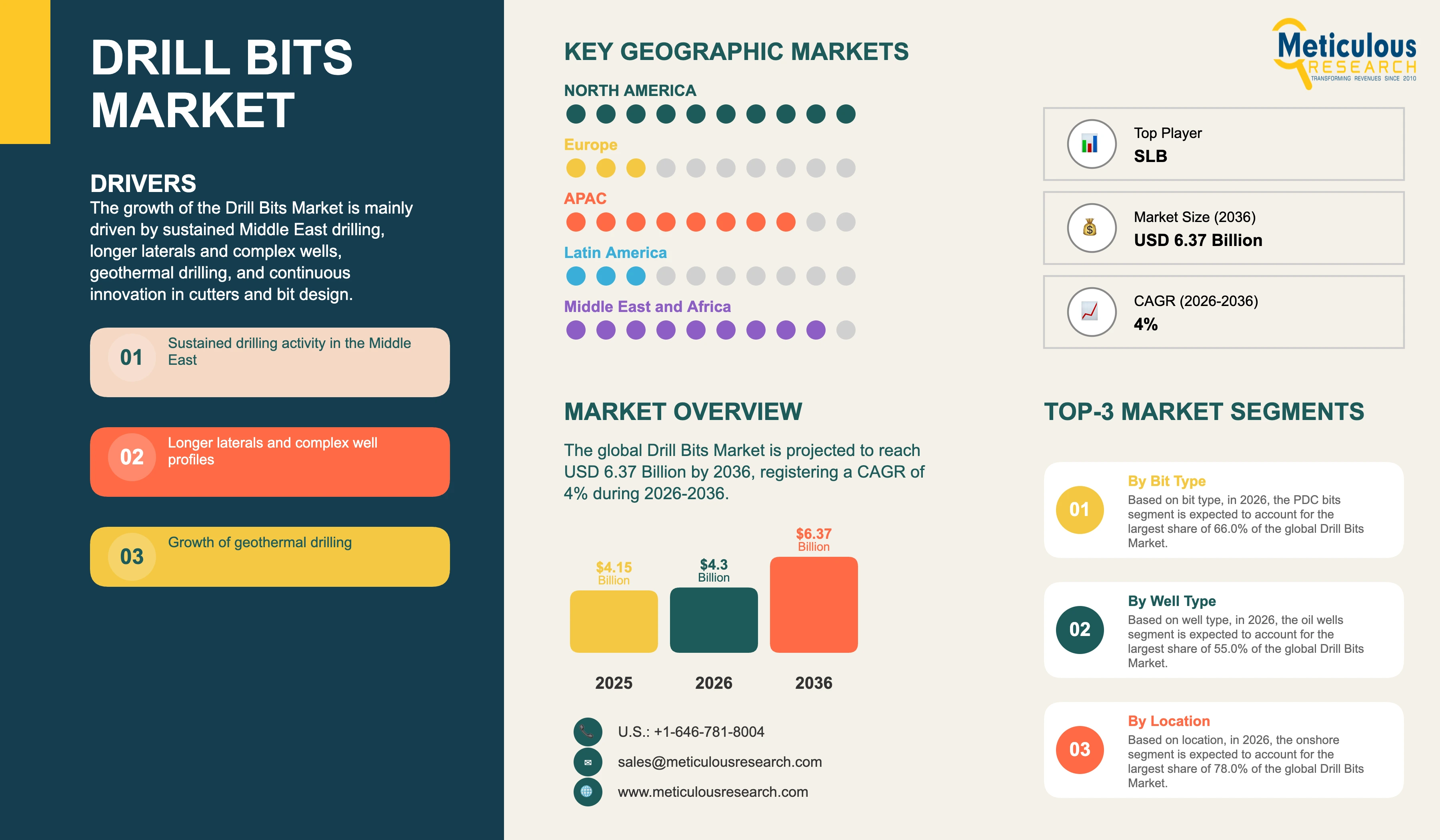
The global drill bits market was valued at USD 4.15 billion in 2025. This market is expected to reach USD 6.37 billion by 2036 from an estimated USD 4.30 billion in 2026, registering a CAGR of 4.0% during the forecast period (2026-2036).
- Published
- Nov 2026
- Pages
- 268
- Format
- PDF + Excel
- Report ID
- MREP - 1042704
- Base year
- 2025
- 2025 · BASELINE
- $4.15B
- 2036
- $6.37B
- CAGR 2026–2036
- 4.0%
2025 baseline · 2026–2036 forecast at 4.0% CAGR · hover a bar for the value
Key highlights
Baker Hughes introduced its PermaFORCE Elite line of polycrystalline diamond compact bits in 2025 to deliver simultaneous gains in rate of penetration and durability, and in early 2026 launched the PermaFORCE-TRU variant optimized for rotary steerable systems.
In the third quarter of 2026, Baker Hughes received an award from Kuwait Oil Company to provide hybrid Kymera drill bits as well as polycrystalline diamond compact and tricone bits, and secured multiple drill bit awards in Türkiye, one of the world's largest geothermal power markets.
Halliburton introduced the HyperSteer MX directional drill bit in January 2026, a shankless matrix-body bit designed for longer drilling runs and fewer trips in abrasive, high-flow environments such as the Permian Basin. The bit extends Halliburton's HyperSteer directional bits, which are part of its Hedron line of fixed cutter bits designed for maximum steerability in lateral sections.
NOV's ReedHycalog introduced its Evolve performance product line with ION+ high-exposure cutters and has developed new cutter sizes such as 14.5 millimeters, and reported record-low sliding of 2.5% in a four-mile lateral using its ION+ cutters.
According to Baker Hughes, the U.S. rig count rose from 551 in early March 2026 to 593 in mid-August 2026, while the international rig count, which excludes North America, was 1,096 in July 2026.
SLB introduced its DualHelix multiformation fixed-cutter bit, which uses the geometry of its cutter placement to change how cutters engage the rock depending on depth of cut, while Baker Hughes uses in-bit sensors such as its MultiSense dynamics mapping system and computer vision for automated dull grading to improve bit designs.
Global offshore rig activity declined from about 300 active rigs in 2024 to 251 in 2025 and averaged around 250 rigs in the first five months of 2026, with Asia-Pacific recording the highest offshore rig count of any region, which reduced demand for high-value offshore bits in 2025.
By bit type, PDC bits account for the largest share of 66.0% in 2026, while hybrid bits register the highest CAGR.
By well type, oil wells account for the largest share in 2026, while geothermal wells register the highest CAGR.
By location, onshore accounts for the larger share of 78.0% in 2026, while offshore registers the higher CAGR.
By geography, North America accounts for the largest share of 30.0% in 2026, while Middle East & Africa registers the highest CAGR of 5.5%.
Report summary
| Particulars | Details |
|---|---|
| Forecast Period | 2026-2036 |
| Base Year | 2025 |
| Estimated Year | 2026 |
| CAGR (Value) | 4.0% |
| Format | PDF, Excel & Cloud Portal · 268 pages |
| Market Size (Value) in 2025 | USD 4.15 billion |
| Market Size (Value) in 2026 | USD 4.30 billion |
| Market Size (Value) in 2036 | USD 6.37 billion |
| Largest Segment by Bit Type (2026) | PDC Bits (66.0%) |
| Largest Segment by Location (2026) | Onshore (78.0%) |
| Largest Region (2026) | North America (30.0%) |
| Fastest-Growing Region | Middle East & Africa (CAGR 5.5%) |
| Segments Covered | Bit Type, Well Type, Location, Geography |
| Countries Covered | U.S., Canada, Saudi Arabia, UAE, Kuwait, Qatar, Oman, Iraq, Kenya, Rest of Middle East & Africa, China, India, Indonesia, Malaysia, Australia, Rest of Asia-Pacific, Russia, Türkiye, Norway, U.K., Rest of Europe, Argentina, Brazil, Mexico, Guyana, Rest of Latin America |
| Key Companies | 12 companies and other companies |
Report overview
Segments covered: bit type, well type, location.
The growth of this market is mainly driven by sustained drilling activity in the Middle East, particularly for gas development, recovering drilling activity in North America, the trend toward longer laterals and more complex well profiles that require high-performance bits, the growth of geothermal drilling, which uses hard-rock bits, offshore drilling in Brazil, Guyana, West Africa, and the Middle East, and continuous innovation in polycrystalline diamond compact cutters, bit designs, and hybrid bits that improve drilling speed and durability. However, factors such as consolidation and capital discipline among U.S. shale producers, the decline in offshore rig activity from its 2024 level, longer bit life that reduces the number of bits needed per well, pricing pressure, and geopolitical disruptions in the Middle East in 2026 are expected to restrain the growth of this market to some extent.
Drill bits are the cutting tools at the bottom of the drill string that break rock to create a wellbore. They are consumable products, because they wear out as they drill and must be replaced, and the number and type of bits used in a well depend on the depth, rock types, well profile, and drilling conditions. The choice of bit has a major effect on drilling speed, the number of trips needed to replace worn bits, and the overall cost of a well, so operators and drilling contractors place great emphasis on selecting and optimizing bits for each section of a well.
This report covers global revenue from drill bits used in oil, gas, and geothermal wells, including polycrystalline diamond compact bits, roller cone bits, which include tungsten carbide insert and milled tooth bits, hybrid bits that combine fixed cutters and rolling cones, and diamond-impregnated and other bits. Revenue includes sales of new bits, bit rentals, and performance-based bit services, as well as bit repair and refurbishment. Coring bits sold as part of coring services, mining and construction drill bits, downhole motors, rotary steerable systems, drilling services, and bottomhole assembly tools other than bits are excluded from the scope of this report, as they are covered in separate studies.
Polycrystalline diamond compact bits, which use synthetic diamond cutters bonded to tungsten carbide, have become the dominant bit type in oil and gas drilling, especially in shale and other horizontal wells, because they drill faster and last longer than roller cone bits in most formations. Advances in cutter materials, cutter shapes, and bit designs have allowed polycrystalline diamond compact bits to drill harder and more abrasive formations that were once drilled only with roller cone bits. Roller cone bits are still used in some hard, interbedded, or large-diameter sections, and hybrid bits combine the strengths of both technologies in difficult formations.
Bit demand is closely linked to drilling activity, measured by rig counts and footage drilled. According to Baker Hughes, the U.S. rig count was in the 530s to 550s through most of the second half of 2025 and early 2026 before rising to 593 in August 2026, while the international rig count, which excludes North America, was about 1,100 rigs in 2026. Canada, China, and Russia also have large drilling markets. Offshore drilling uses more expensive bits per well because of deeper wells, larger hole sizes, and the high cost of rig time, which makes bit performance especially valuable.
Drilling efficiency has improved significantly over the past decade, with operators drilling longer laterals faster and with fewer bits. This means that bit demand does not grow in line with footage drilled, but the value of each bit has increased as operators pay for higher performance. Many bits are now supplied under rental or performance-based arrangements, in which the bit company is paid based on footage drilled or performance, and bit companies provide engineering support to optimize bit selection and drilling parameters.
The market is dominated by a small number of large oilfield service companies, including SLB through its Smith Bits business, Baker Hughes, Halliburton, and NOV through ReedHycalog, along with independent bit companies such as Varel Energy Solutions, Ulterra Drilling Technologies, Taurex Drill Bits, Shear Bits, and Drilformance, and Chinese manufacturers such as Kingdream. Suppliers of polycrystalline diamond compact cutters, such as US Synthetic and Element Six, are also important to the value chain, as cutter quality largely determines bit performance and durability.
Over the forecast period, the market is expected to grow steadily, supported by Middle East and international drilling, recovering North American activity, offshore drilling, and geothermal drilling. Hybrid bits are expected to be the fastest-growing bit type, and geothermal wells are expected to be the fastest-growing well type, while polycrystalline diamond compact bits remain dominant. North America remains the largest region, while the Middle East & Africa is expected to grow fastest.
We want to drill the curve and the whole lateral in one run, so we choose bits that are proven with our rotary steerable systems. A faster run saves far more than the cost of the bit.
This comment explains why polycrystalline diamond compact bits dominate and why high-performance bits command premium prices in the Permian Basin.
Our hard and interbedded formations require hybrid and specialized bits, and we work closely with suppliers to optimize performance across our drilling programs.
This comment explains why hybrid bits are the fastest-growing bit type and why the Middle East & Africa is growing fastest in the drill bits market.
Geothermal wells are among the hardest rock we drill, and bit life is a major factor in our well costs.
This comment shows why geothermal wells are the fastest-growing well type and why premium hard-rock bits are in demand among geothermal developers.
Report infographic
Market dynamics
21 factors across 5 forcesSustained drilling activity in the Middle East
National oil companies in Saudi Arabia, the UAE, Kuwait, Qatar, Oman, and Iraq are drilling large numbers of wells to sustain and expand oil production capacity and to develop gas resources, including unconventional gas. These programs require large volumes of drill bits, including high-performance bits for hard carbonate and clastic formations, deep gas wells, and extended-reach wells. Baker Hughes' award from Kuwait Oil Company in 2026 for hybrid, polycrystalline diamond compact, and tricone bits illustrates the scale and diversity of bit demand in the region.
Middle Eastern drilling programs are typically managed under long-term contracts with national oil companies, which provide stable demand for bit suppliers. The region is expected to account for a growing share of global bit demand over the forecast period, although short-term disruptions from the 2026 conflict may delay some activity.
Gas drilling, in particular, is expected to grow strongly in the region as countries seek to increase gas supply for power generation, industry, and exports. Deep gas wells in Saudi Arabia, the UAE, and Qatar often encounter hard, abrasive formations at high temperatures, which require premium bits and frequent bit runs, increasing bit spending per well.
Longer laterals and complex well profiles
Operators in North America and other shale plays are drilling longer laterals, often three to four miles, and more complex well profiles to improve well economics. These wells require bits that can drill the curve and the entire lateral in a single run, steer accurately with rotary steerable systems or motors, and withstand vibration and abrasive formations. Bit companies are responding with new designs, such as Baker Hughes' PermaFORCE-TRU optimized for rotary steerable systems, Halliburton's HyperSteer MX matrix-body directional bit, and NOV's ION+ cutters.
These high-performance bits command higher prices than conventional bits, which increases the value of the bit market even when the number of wells drilled is stable. Operators are willing to pay more for bits that save rig time, because rig and service costs per day are much higher than the cost of a bit. Halliburton has noted that crews in the Permian and other shale basins are pumping more fluid and sand than ever, which creates abrasive, high-flow conditions that demand more durable bits. NOV has reported record-low sliding of 2.5% in a four-mile lateral using its ION+ cutters, which shows how bit technology can improve drilling efficiency in long laterals.
Growth of geothermal drilling
Geothermal energy is growing as countries seek reliable, low-carbon baseload power, and new technologies such as enhanced geothermal systems are expanding the potential for geothermal development. Geothermal wells are drilled into hard, hot, and abrasive igneous and metamorphic rocks, which are very demanding for drill bits and require specialized polycrystalline diamond compact, hybrid, and roller cone bits. Baker Hughes secured multiple drill bit awards in Türkiye, one of the world's largest geothermal power markets, in 2026.
Enhanced geothermal projects in the U.S. and other countries are adapting oil and gas drilling techniques, including horizontal drilling and advanced polycrystalline diamond compact bits, which creates new demand for high-performance bits. Geothermal drilling is expected to be the fastest-growing well type over the forecast period. Geothermal wells typically require more bits per well than oil and gas wells of similar depth because of the hardness of the rock, which increases bit spending per well.
Continuous innovation in cutters and bit design
Bit companies continuously develop new cutter materials, cutter shapes, bit body materials, and cutting structure layouts to increase drilling speed and durability. Recent innovations include new cutter sizes, high-exposure cutters, shaped cutters, matrix and steel bodies optimized for specific applications, and designs that reduce damaging vibrations such as high-frequency torsional oscillations. Digital tools, including simulation software and machine learning for bit design and dull grading, are accelerating innovation.
Operators adopt new bit technologies quickly when they deliver measurable performance gains, which supports demand for premium bits and allows bit companies to maintain pricing. Sensors placed in bits, such as Baker Hughes' MultiSense system, provide data on downhole dynamics that help improve bit designs and drilling practices. Computer vision and machine learning are also used to grade worn bits automatically, which helps engineers understand failure modes and design better bits for the next well.
Table of contents
11 chapters · 135 sections · 268 pages · click to expandSegmental analysis
| Segment | Largest share (2026) | Fastest growth (2026–2036) |
|---|---|---|
| By Bit Type | PDC bits | Hybrid bits |
| By Well Type | Oil wells | Geothermal wells |
| By Location | Onshore | Offshore |
By Bit Type
- The PDC bits segment is expected to account for the largest share of 66.0% of the global drill bits market.
- The large share of this segment is mainly attributed to the dominance of polycrystalline diamond compact bits in oil and gas drilling, especially in shale and other horizontal wells in North America, the Middle East, China, and Argentina, where they drill faster and last longer than roller cone bits in most formations.
- Advances in cutter technology have expanded the range of formations that can be drilled with polycrystalline diamond compact bits, and new designs optimized for rotary steerable systems and directional drilling continue to drive demand.
- Polycrystalline diamond compact bits are used in most sections of modern horizontal wells, from the vertical section through the curve and lateral, and leading suppliers offer both steel-body and matrix-body designs for different applications.
- As a result, polycrystalline diamond compact bits are gradually replacing roller cone bits in applications where roller cone bits were previously the only option.
- However, the hybrid bits segment is projected to register the highest CAGR during the forecast period.
- The rapid growth of this segment is primarily driven by the need to drill hard, interbedded, and abrasive formations in the Middle East, deep gas wells, and geothermal wells, where hybrid bits combine the cutting efficiency of polycrystalline diamond compact cutters with the stability of roller cones.
- Awards such as Baker Hughes' 2026 Kuwait Oil Company contract for Kymera hybrid bits show growing adoption.
- Hybrid bits are typically priced higher than conventional bits, which increases their contribution to market value.
- Meanwhile, the roller cone bits and diamond-impregnated and other bits segments are expected to witness steady growth, supported by hard, interbedded, and large-diameter sections, geothermal and vertical wells, markets with lower-cost drilling operations, and very hard and abrasive formations that require diamond-impregnated bits used with turbines.
By Well Type
- The oil wells segment is expected to account for the largest share of 55.0% of the global drill bits market.
- The large share of this segment is mainly attributed to the large number of oil wells drilled in North America, the Middle East, China, Russia, and Latin America, including shale oil wells in the Permian Basin and Argentina's Vaca Muerta.
- Oil-directed rigs account for most of the U.S. rig count, and national oil companies in the Middle East drill large numbers of oil wells to sustain capacity.
- Growth in this segment is expected to be moderate, reflecting capital discipline among oil producers and continued drilling efficiency gains in shale plays.
- However, the geothermal wells segment is projected to register the highest CAGR during the forecast period.
- The rapid growth of this segment is primarily driven by the expansion of conventional geothermal power in Türkiye, Indonesia, Kenya, and other countries, the development of enhanced geothermal systems in the U.S. and elsewhere, and the very demanding hard-rock drilling conditions that require premium bits.
- Enhanced geothermal developers are using horizontal drilling and advanced polycrystalline diamond compact bits adapted from shale drilling, which creates demand for high-value bits.
- Geothermal wells are typically drilled in hard, hot, and abrasive rock, which shortens bit life and increases the number of premium bits used per well.
- Meanwhile, the gas wells segment is expected to witness steady growth, supported by gas development in the Middle East, North America, and Asia to supply LNG exports, power generation, and industry, including deep gas wells that require high-performance bits for hard formations.
By Location
- The onshore segment is expected to account for the largest share of 78.0% of the global drill bits market.
- The large share of this segment is mainly attributed to the very large number of onshore wells drilled in North America, the Middle East, China, Russia, and Latin America, where most of the world's drilling rigs operate.
- Onshore shale drilling in North America and Argentina and onshore drilling by national oil companies in the Middle East account for most bit demand.
- China's large onshore drilling market, served mainly by domestic bit manufacturers, is also a major contributor.
- However, the offshore segment is projected to register the highest CAGR during the forecast period.
- The rapid growth of this segment is primarily driven by the expected recovery of offshore drilling in Brazil, Guyana, Suriname, West Africa, the Middle East, and other regions after the decline in 2025, the higher value of offshore bits, and the importance of bit performance in reducing expensive offshore rig time.
- Offshore wells often involve larger hole sizes and deeper sections, which require larger and more expensive bits.
- Brazil's pre-salt wells, for example, require drilling through thick salt and hard carbonate formations.
- The onshore segment is expected to account for the larger share of the drill bits market, while the offshore segment is projected to register the higher CAGR during the forecast period.
Geographic analysis
North America
Largest shareIn 2026, North America is expected to account for the largest share of 30.0% of the global drill bits market. The large share of this region is mainly due to the large number of horizontal wells drilled in U.S. and Canadian shale plays, which use large volumes of high-performance polycrystalline diamond compact bits, the presence of leading bit manufacturers and independent bit companies, and the rapid adoption of new bit technologies. The U.S. rig count rose to 593 in August 2026, and Canada also has an active drilling market. Independent bit companies such as Ulterra, Varel, Taurex, and Shear Bits have strong positions in North America. Growth in the region is expected to be slower than the global average because of drilling efficiency gains and capital discipline. However, rising gas drilling for LNG exports and enhanced geothermal development provide new sources of demand.
Middle East & Africa
The Middle East & Africa is the second-largest market and is projected to register the highest CAGR of 5.5% during the forecast period. The rapid growth of this region is mainly due to large and sustained drilling programs by national oil companies in Saudi Arabia, the UAE, Kuwait, Qatar, Oman, and Iraq, growing gas drilling, including unconventional gas, demanding formations that require premium and hybrid bits, and offshore drilling in the region and in West Africa. Saudi Arabia is expected to remain the largest country market in the region, followed by the UAE and Kuwait. National oil companies in the region often award multi-year bit contracts to leading suppliers, such as Kuwait Oil Company's 2026 award to Baker Hughes.
Asia-Pacific
Asia-Pacific is the third-largest market, driven by China's large domestic drilling market, served mainly by Chinese manufacturers, as well as drilling in India, Indonesia, Malaysia, and Australia, and geothermal drilling in Indonesia and the Philippines.
Latin America
Latin America is supported by Argentina's Vaca Muerta and offshore drilling in Brazil and Guyana.
Europe
Fastest growthEurope, including Russia and Türkiye, is supported by Russian drilling and geothermal drilling in Türkiye and Iceland, although sanctions limit international participation in Russia. Türkiye is expected to be one of the fastest-growing geothermal bit markets.
Competitive landscape
The global drill bits market is relatively consolidated, with the top five players estimated to account for about 65% of the market in 2025. The market includes large oilfield service companies, independent bit companies, Chinese manufacturers, and polycrystalline diamond compact cutter suppliers.
SLB through Smith Bits, Baker Hughes, Halliburton, and NOV through ReedHycalog are the leading bit suppliers globally, offering full ranges of polycrystalline diamond compact, roller cone, hybrid, and specialty bits along with engineering services. They continuously introduce new technologies, such as Baker Hughes' PermaFORCE and Kymera bits, Halliburton's HyperSteer and Hedron lines, SLB's DualHelix, and NOV's ION+ cutters and Evolve bits.
Independent bit companies such as Varel Energy Solutions, Ulterra Drilling Technologies, Taurex Drill Bits, Shear Bits, and Drilformance compete on performance and responsiveness, particularly in North America. Kingdream, part of Sinopec's oilfield equipment group, is a major Chinese bit manufacturer. US Synthetic, part of Dover, and Element Six are leading suppliers of polycrystalline diamond compact cutters.
Companies compete on drilling performance, durability, engineering support, price, and the ability to customize bits for specific applications. Key strategies include developing new cutter and bit technologies, using digital design tools, offering performance-based contracts, expanding in the Middle East and geothermal markets, and providing bit repair and refurbishment.
The competitive landscape is expected to remain relatively consolidated, as the leading service companies have strong technology, global manufacturing, and engineering networks. Independent bit companies will continue to compete effectively in North America and selected international markets by focusing on performance and responsiveness. Chinese manufacturers are expanding exports, particularly in Asia, Africa, and the Middle East, and are improving their technology. Cutter suppliers play an important role in enabling performance improvements for all bit companies. Competition in the Middle East is intense, with leading suppliers competing for large multi-year contracts with national oil companies. Local manufacturing and repair facilities in the region are increasingly important to win these contracts. Pricing in North America is highly competitive, with independent bit companies offering strong alternatives to the large service companies. Bit companies also compete for talent in bit design engineering and materials science, which is critical for continued innovation.
Some of the key players operating in the drill bits market are SLB, Baker Hughes Company, Halliburton Company, NOV Inc., Varel Energy Solutions, Ulterra Drilling Technologies, L.P., Taurex Drill Bits, Shear Bits Ltd., Drilformance, Sinopec Oilfield Equipment Corporation (Kingdream), US Synthetic Corporation, and Element Six, among others.
- —
Baker Hughes received a Kuwait Oil Company award for hybrid, polycrystalline diamond compact, and tricone bits and multiple geothermal bit awards in Türkiye in 2026, Halliburton launched HyperSteer MX in January 2026, and Baker Hughes launched PermaFORCE-TRU in early 2026.
- Varel Energy Solutions
- Ulterra Drilling Technologies
- Taurex Drill Bits
- Shear Bits
- Drilformance
Expert perspectives
The drill bits market is closely linked to global drilling activity, but its value is increasingly driven by bit performance and technology rather than volume. We expect steady growth over the forecast period, led by the Middle East, geothermal drilling, and premium bit technologies.
Over the forecast period, the market is expected to grow at a CAGR of 4.0%, from USD 4.30 billion in 2026 to USD 6.37 billion in 2036. Growth will be supported by Middle East drilling, longer laterals, geothermal drilling, and offshore recovery, while capital discipline, longer bit life, pricing pressure, and geopolitical disruptions will moderate growth.
In terms of segments, polycrystalline diamond compact bits remain the largest bit type, while hybrid bits grow fastest. Oil wells remain the largest well type, while geothermal wells grow fastest. North America remains the largest region, while the Middle East & Africa grows fastest at a CAGR of 5.5%.
For bit companies, the key priorities are to continue innovating in cutters and bit designs, to develop solutions for hard-rock, geothermal, and deep gas drilling, to use digital tools for design and optimization, and to strengthen positions in the Middle East. Performance-based business models and engineering support will be increasingly important. Bit companies should also prepare for growing demand from geothermal developers, which have different requirements from oil and gas operators, including higher temperatures and harder rock. We also expect consolidation among smaller independent bit companies, as research and development costs rise and as large customers favor suppliers with global reach. Our forecast also assumes a moderate recovery in offshore drilling after 2026 and a gradual recovery of Middle East activity after the 2026 disruptions. Downside risks include lower oil prices and further consolidation among shale producers, while upside risks include faster geothermal growth. We expect the value of bits per well to rise as operators drill longer and more complex wells. In our view, geothermal drilling is the most promising new market for premium bits over the next decade.
Our estimates are based on rig counts and drilling activity by region, bit consumption and average bit values by well type and location, and the reported activity of leading bit suppliers. We note that 2025 bit spending declined compared with 2024 because of lower North American and offshore activity, and we expect a recovery from 2026 supported by rising U.S. rig counts, Middle East gas drilling, and offshore activity. Longer bit life will continue to limit volume growth, but higher value per bit will support market value.
Customer perspectives
Buyers of drill bits include oil and gas operators, national oil companies, drilling contractors, and geothermal developers. Their decisions depend mainly on drilling speed, durability, steerability, reliability, cost per foot, and engineering support. Many buyers also value suppliers that can provide data-driven bit selection, real-time optimization, and repair programs that lower the cost per foot. Consistent quality across large numbers of bits is also important for national oil companies and large shale operators that drill hundreds of wells each year across several basins.
Frequently asked questions
The global drill bits market was valued at USD 4.15 billion in 2025, down from USD 4.25 billion in 2024 because of lower North American and offshore activity, and is estimated at USD 4.30 billion in 2026. The market includes polycrystalline diamond compact, roller cone, hybrid, and diamond-impregnated bits for oil, gas, and geothermal wells.
The global drill bits market is expected to reach USD 6.37 billion by 2036, supported by Middle East drilling, geothermal drilling, offshore recovery, and premium bit technologies.
The market is expected to register a CAGR of 4.0% from 2026 to 2036, with the fastest growth in hybrid bits, geothermal wells, offshore drilling, and the Middle East & Africa.
According to Baker Hughes, the U.S. rig count rose from 551 in March 2026 to 593 in August 2026, the international rig count was 1,096 in July 2026, and global offshore rig activity fell from about 300 rigs in 2024 to 251 in 2025.
Market growth is mainly driven by sustained drilling activity in the Middle East, longer laterals and complex well profiles, the growth of geothermal drilling, and continuous innovation in cutters and bit design.
Capital discipline and consolidation among U.S. producers, longer bit life, and declining offshore activity restrain growth, while pricing pressure, performance-based contracts, and geopolitical disruptions are key challenges.
Key opportunities include hybrid and specialized bits for hard formations, geothermal and enhanced geothermal systems, digital bit design and performance optimization, and offshore and deepwater drilling recovery.
PDC bits are expected to account for the largest share of 66.0% of the market in 2026, while hybrid bits are projected to register the highest CAGR.
Geothermal wells are projected to register the highest CAGR, driven by conventional and enhanced geothermal development, while oil wells account for the largest share of 55.0% and gas wells account for a growing share.
North America is expected to account for the largest share of 30.0% of the market in 2026, mainly due to the large number of horizontal shale wells drilled in the U.S. and Canada and the rapid adoption of premium bit technologies.
The Middle East & Africa is projected to register the highest CAGR of 5.5% during the forecast period, driven by national oil company drilling programs and gas development.
Recent launches include Baker Hughes' PermaFORCE Elite and PermaFORCE-TRU bits, Halliburton's HyperSteer MX matrix-body directional bit, SLB's DualHelix bit, and NOV's ION+ cutters and Evolve performance bits.
The report profiles 12 companies, including SLB, Baker Hughes Company, Halliburton Company, NOV Inc., Varel Energy Solutions, Ulterra Drilling Technologies, L.P., Taurex Drill Bits, Shear Bits Ltd., Drilformance, Sinopec Oilfield Equipment Corporation (Kingdream), US Synthetic Corporation, and Element Six.
Baker Hughes received a Kuwait Oil Company award for hybrid, polycrystalline diamond compact, and tricone bits and multiple geothermal bit awards in Türkiye in 2026, Halliburton launched HyperSteer MX in January 2026, and Baker Hughes launched PermaFORCE-TRU in early 2026.
In 2026, the onshore segment is expected to account for the larger share of the drill bits market, while the offshore segment is projected to register the higher CAGR during the forecast period.
Cite this report
Meticulous Research. (2026). Drill Bits Market - Global Opportunity Analysis and Industry Forecast (2026-2036) (Report No. MREP - 1042704). Meticulous Market Research Pvt. Ltd. https://www.meticulousresearch.com/product/drill-bits-market-7387