Coiled Tubing Services Market (2026-2036)
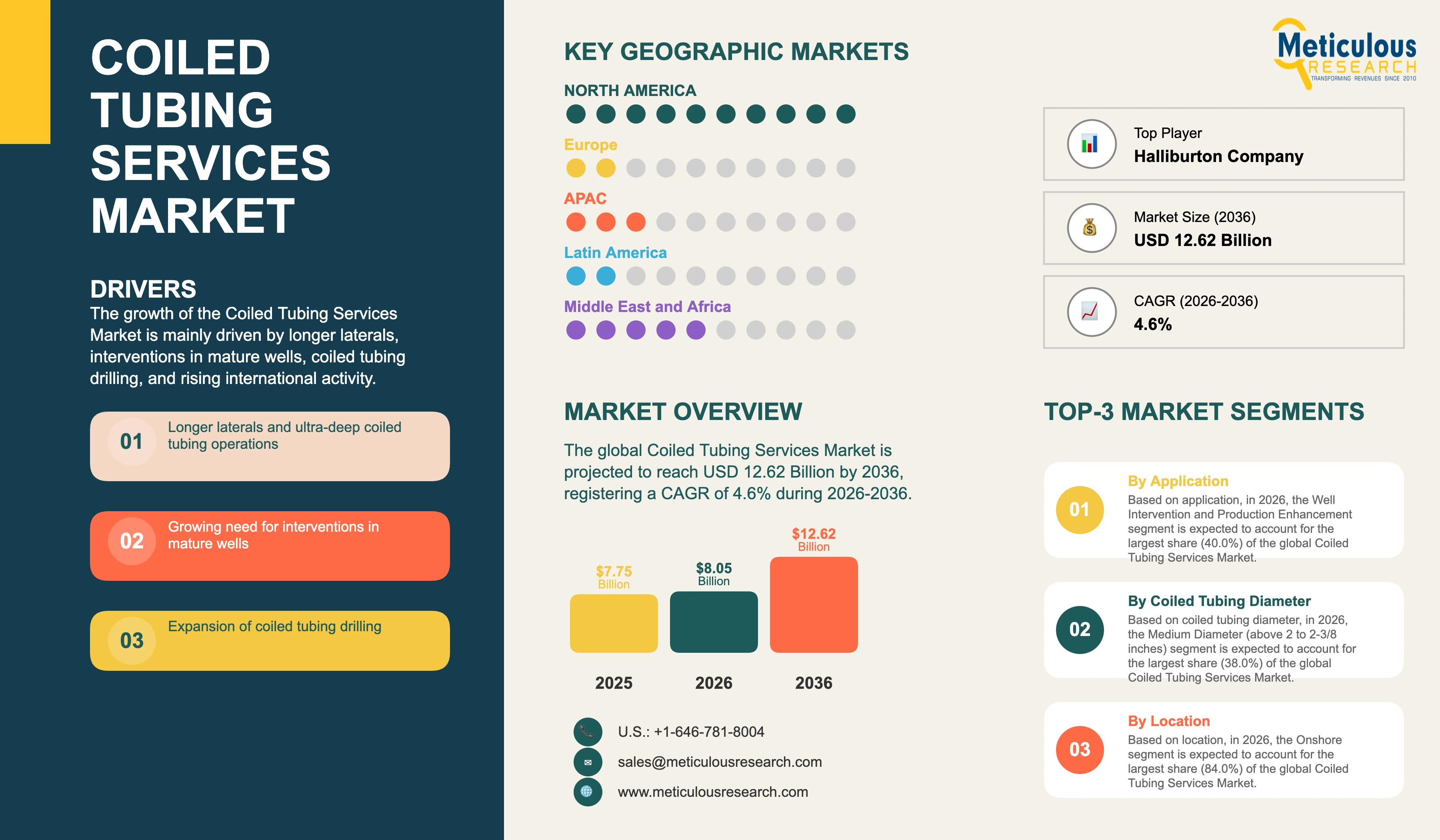
The global coiled tubing services market was valued at USD 7.75 billion in 2025. This market is expected to reach USD 12.62 billion by 2036 from an estimated USD 8.05 billion in 2026, registering a CAGR of 4.6% during the forecast period (2026-2036).
- Published
- Nov 2026
- Pages
- 261
- Format
- PDF + Excel
- Report ID
- MREP - 1042697
- Base year
- 2025
- 2025 · BASELINE
- $7.75B
- 2036
- $12.62B
- CAGR 2026–2036
- 4.6%
2025 baseline · 2026–2036 forecast at 4.6% CAGR · hover a bar for the value
Key highlights
STEP Energy Services operated 21 active coiled tubing units across Canada and the U.S. at the end of 2024 and recorded 5,193 coiled tubing operating days that year, which illustrates the scale of activity for a mid-sized provider.
Ranger Energy Services agreed in August 2026 to acquire STEP Energy Services' U.S. coiled tubing assets for about USD 27.5 million, including 13 full coiled tubing spreads and five facilities from the Bakken to South Texas, a transaction that positions Ranger as the second-largest coiled tubing provider in the U.S. Lower 48.
Baker Hughes secured a multi-year agreement from Aramco, booked in the third quarter of 2025, to expand its integrated underbalanced coiled tubing drilling operations across Saudi Arabia's natural gas fields, increasing its active fleet from four to ten units beginning in 2026.
STEP Energy Services deployed its UDx ultra-deep capacity coiled tubing reel trailer for the first time in 2026, setting a company depth record of 31,023 feet on a milling operation in Howard County, Texas. The trailer can carry up to about 37,500 feet of 2-5/8 inch coiled tubing.
Nine Energy Service reported that two of its large-diameter coiled tubing units, representing about 17% of its large-diameter fleet, were taken out of service for maintenance in the second quarter of 2026, and that coiled tubing costs for consumables, labor, repairs, and maintenance rose by an average of about 12% from the first quarter.
RPC reported that coiled tubing is the largest service line within its Cudd Pressure Control business, with its new 2-7/8 inch unit well utilized and an existing unit being upgraded to handle 2-7/8 inch tubing by mid-2026.
Nine Energy Service reported growing demand for dissolvable plugs in international markets such as Argentina's Vaca Muerta and the UAE, where they help operators avoid drill-out challenges, which illustrates both the competition coiled tubing faces from dissolvable technology and the growth of international unconventional activity in these markets.
By application, well intervention and production enhancement accounts for the largest share of 40.0% in 2026, while coiled tubing drilling registers the highest CAGR.
By coiled tubing diameter, medium diameter (above 2 to 2-3/8 inches) accounts for the largest share in 2026, while large diameter (2-5/8 inches and above) registers the highest CAGR.
By location, onshore accounts for the larger share of 84.0% in 2026, while offshore registers the higher CAGR.
By geography, North America accounts for the largest share of 45.0% in 2026, while Middle East & Africa registers the highest CAGR of 6.4%.
Report summary
| Particulars | Details |
|---|---|
| Forecast Period | 2026-2036 |
| Base Year | 2025 |
| Estimated Year | 2026 |
| Market Size in 2025 | USD 7.75 billion |
| Market Size in 2026 | USD 8.05 billion |
| Market Size by 2036 | USD 12.62 billion |
| CAGR (2026-2036) | 4.6% |
| Format | PDF, Excel & Cloud Portal · 261 pages |
| Largest Segment by Application (2026) | Well Intervention and Production Enhancement (40.0%) |
| Largest Segment by Location (2026) | Onshore (84.0%) |
| Largest Region (2026) | North America (45.0%) |
| Fastest-Growing Region | Middle East & Africa (CAGR 6.4%) |
| Companies Profiled | 12 companies and other companies |
| Segments Covered | Application, Coiled Tubing Diameter, Location, Geography |
| Countries Covered | U.S., Canada, Saudi Arabia, UAE, Kuwait, Oman, Algeria, Rest of Middle East & Africa, China, India, Indonesia, Malaysia, Australia, Rest of Asia-Pacific, Argentina, Mexico, Brazil, Colombia, Rest of Latin America, Norway, U.K., Russia, Rest of Europe |
Report overview
Segments covered: application, coiled tubing diameter, location.
The growth of this market is mainly driven by longer horizontal laterals in U.S. shale wells, which require large-diameter and ultra-deep coiled tubing for drill-outs and cleanouts, the growing number of mature wells that need coiled tubing interventions such as cleanouts, stimulation, and nitrogen lifting, the expansion of underbalanced coiled tubing drilling in Saudi Arabia's gas fields and other markets, rising activity in the Middle East, Argentina's Vaca Muerta, and other international markets, and the efficiency and safety advantages of coiled tubing compared with jointed pipe for many well operations. However, factors such as volatile U.S. completion activity, the growing use of dissolvable frac plugs that reduce the need for drill-outs, cost inflation for consumables, labor, and repairs, and pricing pressure in competitive markets are expected to restrain the growth of this market to some extent.
Coiled tubing is a long, continuous length of steel pipe, typically between 1 and 3.5 inches in diameter, that is wound on a large reel and run into and out of wells using an injector head. Because it is continuous, coiled tubing can be run into live, pressurized wells quickly without the need to connect and disconnect joints of pipe, which makes it faster and safer than jointed pipe for many operations. Coiled tubing can also circulate fluids, nitrogen, and acids while it is in the well, and it can push tools along horizontal sections that wireline cannot reach. Coiled tubing services are also used throughout the well life cycle, from completion to abandonment. A typical coiled tubing spread includes the reel, injector head, power pack, control cabin, pressure control equipment, and pumping and nitrogen units, operated by a crew of specialists.
This report covers global revenue from coiled tubing services, including coiled tubing operations for completion support, such as milling out frac plugs, wellbore cleanouts after fracturing, and tubing-conveyed perforating, well intervention and production enhancement, such as cleanouts, acid stimulation, nitrogen lifting, scale removal, and water shutoff, coiled tubing drilling, including underbalanced coiled tubing drilling and re-entry drilling, and logging, fishing, and other operations. Revenue includes the services of coiled tubing units, crews, pumping and nitrogen equipment supplied as part of coiled tubing operations, and associated tools rented as part of the service. Sales of coiled tubing units and coiled tubing pipe, wireline and slickline services, workover rigs, and hydraulic fracturing are excluded from the scope of this report, as they are covered in separate studies.
North America is the largest market for coiled tubing services, driven by the U.S. shale industry. In plug-and-perf completions, operators place composite or dissolvable plugs between frac stages, and after fracturing, coiled tubing units are commonly used to mill out the plugs and clean out the wellbore so that the well can produce. As horizontal laterals have grown longer, often exceeding two or three miles, operators require larger-diameter coiled tubing, longer reels, and more powerful equipment to reach the end of the well. STEP Energy Services, for example, set a company depth record of 31,023 feet in the Permian Basin in 2026 using its ultra-deep capacity reel trailer.
Outside North America, coiled tubing is widely used for well intervention and production enhancement in the Middle East, Latin America, Asia, Russia, and offshore fields. In Saudi Arabia, coiled tubing is used for acid stimulation and other interventions, and Baker Hughes operates underbalanced coiled tubing drilling units for Aramco in its gas fields, with the fleet expanding from four to ten units beginning in 2026. In Argentina's Vaca Muerta and in unconventional plays in the UAE, coiled tubing supports growing shale-style completions.
The coiled tubing services market is closely linked to drilling and completion activity in North America, which makes it cyclical, while international markets provide more stable demand linked to production maintenance and long-term contracts. The intervention and production enhancement segment provides a base of demand that is less sensitive to new drilling, because existing wells require regular cleanouts, stimulation, and other coiled tubing operations.
The market includes large integrated oilfield service companies and specialized coiled tubing providers. Leading companies include Halliburton, SLB, Baker Hughes, Weatherford, Nine Energy Service, RPC through its Cudd Pressure Control business, Ranger Energy Services, STEP Energy Services, KLX Energy Services, Superior Energy Services, China Oilfield Services, and Sinopec Oilfield Service. The U.S. market has seen consolidation, with Ranger's acquisition of STEP's U.S. coiled tubing assets making it the second-largest provider in the Lower 48.
Over the forecast period, the market is expected to grow steadily, supported by longer laterals, mature well interventions, coiled tubing drilling, and international activity. Coiled tubing drilling is expected to be the fastest-growing application, large-diameter coiled tubing is expected to be the fastest-growing size category, and the Middle East & Africa is expected to be the fastest-growing region, while North America remains the largest.
Our laterals are now over three miles long, so we need contractors with large-diameter coiled tubing and deep-reach capability. Reaching the toe reliably saves us days on every well.
This comment explains why large-diameter coiled tubing is the fastest-growing size category and why operators value deep-reach capability in the Permian Basin.
Underbalanced coiled tubing drilling has improved the productivity of our gas wells, and we are expanding the program to more fields.
This comment explains why coiled tubing drilling is the fastest-growing application and why the Middle East & Africa is growing fastest in the coiled tubing services market.
Coiled tubing cleanouts and acid treatments are our main tools for restoring production in mature wells, and we use them every year.
This comment shows why well intervention and production enhancement is the largest application in the market, particularly outside North America.
Report infographic
Market dynamics
19 factors across 5 forcesLonger laterals and ultra-deep coiled tubing operations
U.S. shale operators continue to drill longer horizontal laterals to improve well economics, with many wells now exceeding three miles of lateral length. Longer laterals increase the number of frac stages and plugs per well and make it harder for coiled tubing to reach the end of the well, which requires larger-diameter tubing, longer reels, extended-reach tools such as agitators, and more powerful injector heads. These requirements increase the value and complexity of coiled tubing services per well.
Service providers are investing heavily in new equipment to serve these longer and deeper wells. STEP Energy Services deployed its UDx ultra-deep reel trailer, which can carry up to about 37,500 feet of 2-5/8 inch coiled tubing, and set a company depth record of 31,023 feet in the Permian Basin in 2026. RPC has added a new 2-7/8 inch coiled tubing unit and is upgrading another unit to handle the larger tubing, and Nine Energy Service operates 12 specialized deep-reach coiled tubing units. Operators are willing to pay premium rates for this capability, because it reduces the time and risk of drill-outs on long laterals. The shift toward large-diameter coiled tubing is expected to continue as laterals grow longer, supporting growth in the value of coiled tubing services even if the number of wells completed does not increase significantly.
Growing need for interventions in mature wells
The global inventory of producing wells is aging, and many wells require coiled tubing interventions to remove sand, scale, and debris, stimulate the formation with acid, lift fluids with nitrogen, or perform water shutoff treatments. These interventions are often the fastest and most cost-effective way to restore or increase production from existing wells. Coiled tubing is particularly valuable for horizontal wells, where it can reach sections that wireline cannot access.
In mature fields in the Middle East, Latin America, Asia, and North America, coiled tubing interventions are a regular part of production maintenance programs, which provides a stable base of demand that is less dependent on new drilling. Operators' focus on maximizing production from existing assets further supports this demand. As U.S. shale wells age, many require cleanouts to remove sand and debris that accumulate in the lateral, as well as interventions to install or repair artificial lift, which increases coiled tubing demand from the existing well base. In the Middle East, carbonate reservoirs often require repeated acid stimulation, which is commonly delivered through coiled tubing to place acid precisely in the target zones.
Expansion of coiled tubing drilling
Coiled tubing drilling allows operators to drill new laterals, sidetracks, and re-entry wells from existing wellbores, often in underbalanced conditions that reduce formation damage and improve productivity. In Saudi Arabia, Baker Hughes has provided underbalanced coiled tubing drilling for Aramco for nearly two decades, and its new multi-year agreement will expand the fleet from four to ten units beginning in 2026 to support gas production from new and established fields.
Coiled tubing drilling is well suited to mature fields where re-entry drilling can access bypassed reserves at lower cost than new wells, and to gas fields where underbalanced drilling improves well performance. The expansion of the Saudi program is expected to drive strong growth in this application, and other national oil companies may adopt similar programs. Coiled tubing drilling units are more specialized and expensive than standard coiled tubing units, and they generate higher revenue per unit, which increases their contribution to market value. Offshore coiled tubing work is concentrated in a few regions. Platform wells in the Arabian Gulf, Southeast Asia, and the North Sea are frequent candidates for coiled tubing stimulation and cleanouts, and offshore coiled tubing units must meet strict space, weight, and safety requirements.
Rising international activity
International markets, particularly the Middle East, Argentina, and parts of Asia, are expected to see rising coiled tubing activity. National oil companies in Saudi Arabia, the UAE, Kuwait, and Oman are investing in production capacity and gas development, which requires coiled tubing for stimulation, cleanouts, and drilling. Argentina's Vaca Muerta shale play is growing rapidly and uses North American-style completions, which require coiled tubing support. Unconventional development in the UAE also creates new demand.
International contracts are often longer-term and less volatile than U.S. spot market work, which makes them attractive for service providers. Large integrated service companies have strong positions in these markets, often under multi-year contracts with national oil companies. Supply security concerns after the 2026 disruptions have also encouraged several countries to accelerate domestic production programs, which is expected to support international coiled tubing demand once conditions stabilize.
Table of contents
11 chapters · 130 sections · 261 pages · click to expandSegmental analysis
| Segment | Largest share (2026) | Fastest growth (2026–2036) |
|---|---|---|
| By Application | Well intervention and production enhancement | Coiled tubing drilling |
| By Coiled Tubing Diameter | Medium diameter (above 2 to 2-3/8 inches) | Large diameter |
| By Location | Onshore | Offshore |
By Application
- Coiled Tubing Services Market Analysis by Application
- The well intervention and production enhancement segment is expected to account for the largest share of 40.0% of the global coiled tubing services market.
- The large share of this segment is mainly attributed to the widespread use of coiled tubing for cleanouts, acid stimulation, nitrogen lifting, scale removal, water shutoff, and other interventions in mature wells around the world, particularly in the Middle East, Latin America, Asia, and North America.
- These interventions are needed throughout the life of a well and are less dependent on new drilling than completion support, which provides a stable base of demand.
- National oil companies in the Middle East run large coiled tubing stimulation and intervention programs.
- In carbonate reservoirs, coiled tubing is used to place acid treatments accurately along long horizontal sections, which significantly improves well productivity.
- Growth in this segment is supported by the aging global well base and operator focus on production maintenance.
- However, the coiled tubing drilling segment is projected to register the highest CAGR during the forecast period.
- The rapid growth of this segment is primarily driven by the expansion of underbalanced coiled tubing drilling in Saudi Arabia's gas fields, where Baker Hughes is increasing its fleet from four to ten units, the use of coiled tubing for re-entry drilling and sidetracks in mature fields, and the potential adoption of coiled tubing drilling by other national oil companies.
- Coiled tubing drilling allows operators to drill underbalanced sidetracks and laterals in depleted reservoirs, which reduces formation damage and improves well productivity.
- Meanwhile, the completion support and logging, fishing, and other segments are expected to witness steady growth, supported by drill-outs and cleanouts after fracturing in U.S. shale and Argentina, the use of coiled tubing to convey logging tools in horizontal wells, the recovery of stuck equipment, and well abandonment operations.
By Coiled Tubing Diameter
- Coiled Tubing Services Market Analysis by Coiled Tubing Diameter
- The medium diameter (above 2 to 2-3/8 inches) segment is expected to account for the largest share of 38.0% of the global coiled tubing services market.
- The large share of this segment is mainly attributed to the widespread use of 2 inch to 2-3/8 inch coiled tubing for a broad range of interventions, stimulation, and completion operations in conventional and unconventional wells worldwide.
- Medium-diameter coiled tubing offers a balance of reach, strength, and fluid capacity, and it can be handled with standard equipment and logistics.
- Many international interventions and stimulation programs use medium-diameter coiled tubing, and it remains the most common size in many markets.
- However, the large diameter segment is projected to register the highest CAGR during the forecast period.
- The rapid growth of this segment is primarily driven by longer laterals in U.S. shale and Argentina, which require 2-5/8 inch and 2-7/8 inch coiled tubing to reach the end of the well, investments by providers such as STEP, RPC, and Nine in deep-reach units, and the premium rates that operators pay for this capability.
- Large-diameter coiled tubing also allows higher circulation rates, which improves cleanout efficiency in long laterals, and it provides the strength needed to mill plugs at the toe of the well.
- Providers with large-diameter fleets have reported strong utilization, and new units are being added as laterals extend beyond three miles.
- Meanwhile, the small diameter (up to 2 inches) segment is expected to witness steady growth, supported by interventions in conventional wells and offshore operations, where weight and space are limited, and in wells with small-bore completions.
By Location
- Coiled Tubing Services Market Analysis by Location
- The onshore segment is expected to account for the largest share of 84.0% of the global coiled tubing services market.
- The large share of this segment is mainly attributed to the very large number of onshore wells in North America, the Middle East, Latin America, Russia, and China that require coiled tubing for completions and interventions, and the dominance of U.S. shale completions in coiled tubing demand.
- Onshore coiled tubing operations are less expensive and easier to deploy than offshore operations, so they are performed more frequently and in much larger numbers.
- U.S. shale completions, Middle Eastern onshore stimulation programs, and Argentina's Vaca Muerta are expected to account for most onshore coiled tubing spending throughout the forecast period.
- However, the offshore segment is projected to register the highest CAGR during the forecast period.
- The rapid growth of this segment is primarily driven by aging offshore fields in the Middle East, Southeast Asia, the North Sea, Brazil, and West Africa that require coiled tubing stimulation and cleanouts, growing offshore activity, and long-term offshore intervention contracts.
- Offshore operations command higher prices per job, which increases their contribution to market value.
- The onshore segment is expected to account for the larger share of the coiled tubing services market, while the offshore segment is projected to register the higher CAGR during the forecast period.
Geographic analysis
North America
Largest shareIn 2026, North America is expected to account for the largest share of 45.0% of the global coiled tubing services market. The large share of this region is mainly due to the large U.S. shale industry, where coiled tubing is used extensively for drill-outs and cleanouts after hydraulic fracturing, the trend toward longer laterals that require large-diameter coiled tubing, and the large number of mature wells in the U.S. and Canada that require interventions. Leading providers include Halliburton, SLB, Nine Energy Service, RPC, Ranger, KLX Energy Services, and others, and Canada also has a significant coiled tubing market, where STEP Energy Services is a leading provider. Growth in North America is expected to be slower than in international markets because of moderate drilling activity and the adoption of dissolvable plugs, but the value per well will continue to rise with longer laterals. Mexico's national oil company also uses coiled tubing extensively for interventions in mature onshore and offshore fields, and Colombia uses it for production enhancement in heavy oil fields and mature onshore assets.
Middle East & Africa
The Middle East & Africa is the second-largest market and is projected to register the highest CAGR of 6.4% during the forecast period. The rapid growth of this region is mainly due to large production capacity and gas development programs in Saudi Arabia, the UAE, Kuwait, and Oman, the expansion of underbalanced coiled tubing drilling in Saudi Arabia, coiled tubing stimulation in carbonate reservoirs, unconventional development in the UAE, and offshore activity. Saudi Arabia is expected to remain the largest country market in the region, supported by gas development and coiled tubing drilling. Short-term disruptions from the 2026 conflict may delay some activity, but long-term growth is expected to be strong.
Asia-Pacific
Asia-Pacific is the third-largest market, supported by China's large domestic market, served mainly by Chinese service companies, and by interventions in Southeast Asia and Australia.
Latin America
Fastest growthLatin America is supported by the rapid growth of Argentina's Vaca Muerta, which uses North American-style completions, and by interventions in Mexico, Colombia, and Brazil. Argentina is expected to be one of the fastest-growing country markets globally, driven by Vaca Muerta development and the entry of international and North American service providers.
Europe
Europe is a smaller market, with offshore interventions in the North Sea and onshore activity in Russia, which is served mainly by domestic service companies.
Competitive landscape
The global coiled tubing services market is moderately fragmented, with the top five players estimated to account for about 40% of the market in 2025. The market includes large integrated oilfield service companies, specialized coiled tubing providers, and national service companies.
Halliburton, SLB, and Baker Hughes are leading providers of coiled tubing services worldwide, with strong positions in the Middle East and other international markets. Baker Hughes is a leader in underbalanced coiled tubing drilling through its long-term work with Aramco. Weatherford also provides coiled tubing and related intervention services.
In the U.S., Nine Energy Service, RPC through Cudd Pressure Control, Ranger Energy Services, KLX Energy Services, and Superior Energy Services are important coiled tubing providers, and Ranger has become the second-largest provider in the Lower 48 after acquiring STEP's U.S. coiled tubing assets. STEP Energy Services remains a major coiled tubing provider in Canada. China Oilfield Services and Sinopec Oilfield Service are major providers in China. Companies compete on equipment capability, especially large-diameter and deep-reach units, safety, crew quality, reliability, and price. Key strategies include investing in large-diameter fleets, consolidating through acquisitions, adopting automation and digital technologies, and securing long-term international contracts.
The competitive landscape is expected to evolve as U.S. consolidation continues and as international markets grow. Large integrated service companies benefit from their ability to combine coiled tubing with stimulation, completion tools, and other services in integrated contracts, while specialized providers compete on equipment capability, responsiveness, and price. Equipment availability, especially for large-diameter and deep-reach units, is becoming an important competitive factor in the U.S. Chinese service companies dominate their domestic market and are expanding in the Middle East and other regions. In Canada, STEP Energy Services remains a leading coiled tubing provider after selling its U.S. assets, and it continues to invest in deep-reach capabilities. Pricing in the U.S. market is expected to remain competitive, although consolidation and limited availability of large-diameter units may support pricing for the most capable fleets. Smaller regional providers continue to compete for less complex intervention work, often on price, local relationships, and fast response times.
Some of the key players operating in the coiled tubing services market are Halliburton Company, SLB, Baker Hughes Company, Weatherford International plc, Nine Energy Service, Inc., RPC, Inc., Ranger Energy Services, Inc., STEP Energy Services Ltd., KLX Energy Services Holdings, Inc., Superior Energy Services, Inc., China Oilfield Services Limited, and Sinopec Oilfield Service Corporation, among others.
- —
Ranger agreed to acquire STEP's U.S. coiled tubing assets in August 2026, Baker Hughes expanded its coiled tubing drilling program with Aramco, STEP set a company depth record of 31,023 feet with its UDx reel trailer, and RPC added large-diameter coiled tubing capacity.
- Halliburton Company
- SLB
- Baker Hughes Company
- Weatherford International plc
- Nine Energy Service, Inc.
- RPC, Inc.
- Ranger Energy Services, Inc.
- STEP Energy Services Ltd.
- KLX Energy Services Holdings, Inc.
- Superior Energy Services, Inc.
- China Oilfield Services Limited
- Sinopec Oilfield Service Corporation
Expert perspectives
The coiled tubing services market is supported by two distinct sources of demand: completion support in U.S. and international shale plays, which is cyclical, and interventions and drilling in mature fields, which are more stable. We expect steady growth over the forecast period, with the fastest growth in coiled tubing drilling, large-diameter services, and the Middle East.
Over the forecast period, the market is expected to grow at a CAGR of 4.6%, from USD 8.05 billion in 2026 to USD 12.62 billion in 2036. Growth will be supported by longer laterals, mature well interventions, coiled tubing drilling, and international activity, while volatile U.S. activity, dissolvable plugs, cost inflation, and pricing pressure will moderate growth.
In terms of segments, well intervention and production enhancement remains the largest application, while coiled tubing drilling grows fastest. Medium-diameter coiled tubing remains the largest size category, while large-diameter coiled tubing grows fastest. North America remains the largest region, while the Middle East & Africa grows fastest at a CAGR of 6.4%.
For service providers, the key priorities are to invest in large-diameter and deep-reach equipment, to manage costs and equipment reliability, to expand in international markets, and to adopt automation and digital fatigue management. Consolidation in the U.S. is likely to continue, as smaller providers struggle with cost inflation and the capital needed for large-diameter equipment. We expect the value of coiled tubing services per well to rise as laterals lengthen, even if U.S. completion activity remains flat. In our view, the expansion of coiled tubing drilling in the Middle East is the most important new growth driver.
Our estimates are based on the active coiled tubing fleet by region, utilization and revenue per operating day, the reported coiled tubing activity of leading providers, and the number of wells completed and intervened by region. In addition, we note that the growing use of dissolvable plugs represents a long-term risk to completion support revenue, but we expect this to be offset by longer laterals, interventions, and international growth. We also expect cost inflation to keep pressure on margins in the near term, particularly for smaller U.S. providers without the scale to negotiate better supply terms. We expect international markets to account for a growing share of global coiled tubing revenue over the forecast period, led by Saudi Arabia, the UAE, and Argentina, and we expect large integrated service companies to capture most of this international growth through long-term contracts with national oil companies.
Customer perspectives
Buyers of coiled tubing services include independent producers, international oil companies, and national oil companies. Their decisions depend mainly on equipment capability, safety record, reliability, crew experience, and price, in roughly that order for many operators today. Many buyers, especially large shale operators, also value providers that can reliably reach the end of long laterals and that have strong maintenance practices to avoid equipment downtime. Responsiveness and the ability to deploy units quickly between well pads are also important for completion schedules, especially for large operators running multiple frac fleets.
Frequently asked questions
The global coiled tubing services market was valued at USD 7.75 billion in 2025, up from USD 7.60 billion in 2024, and is estimated at USD 8.05 billion in 2026. The market includes coiled tubing services for completion support, well intervention and production enhancement, coiled tubing drilling, and logging, fishing, and other applications.
Cite this report
Meticulous Research. (2026). Coiled Tubing Services Market - Global Opportunity Analysis and Industry Forecast (2026-2036) (Report No. MREP - 1042697). Meticulous Market Research Pvt. Ltd. https://www.meticulousresearch.com/product/coiled-tubing-services-market-7380