Biorefineries Market (2026-2036)
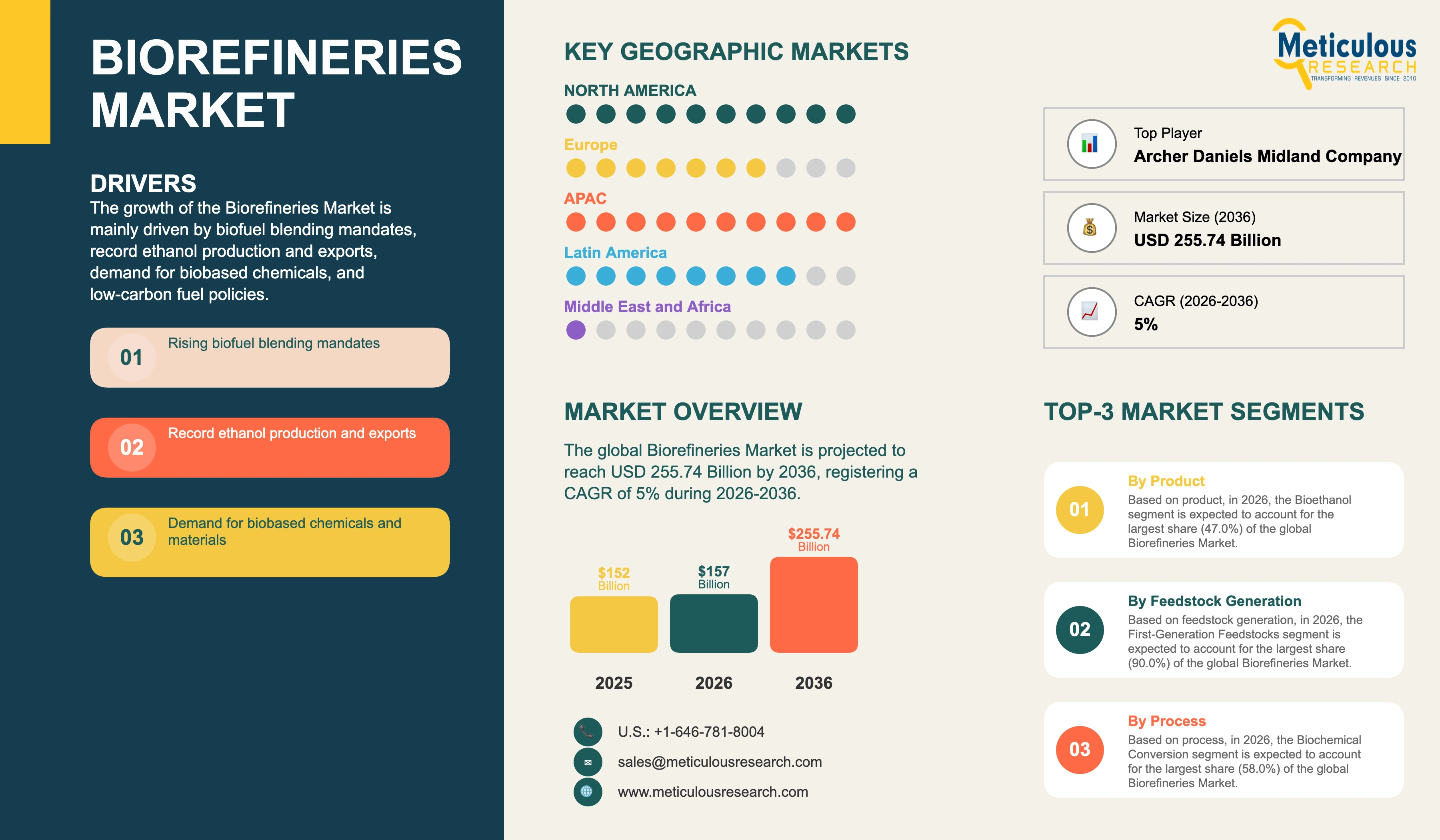
The global biorefineries market was valued at USD 152.00 billion in 2025. This market is expected to reach USD 255.74 billion by 2036 from an estimated USD 157.00 billion in 2026, registering a CAGR of 5.0% during the forecast period (2026-2036).
- Published
- Nov 2026
- Pages
- 233
- Format
- PDF + Excel
- Report ID
- MREP - 1042691
- Base year
- 2025
- 2025 · BASELINE
- $152.0B
- 2036
- $255.7B
- CAGR 2026–2036
- 5.0%
2025 baseline · 2026–2036 forecast at 5.0% CAGR · hover a bar for the value
Key highlights
U.S. ethanol production rose to a record 16.49 billion gallons in 2025, according to the Energy Information Administration, with domestic ethanol use increasing to 14.34 billion gallons and the national average ethanol blend rate in gasoline reaching a record 10.51%.
U.S. ethanol exports reached a record 2.18 billion gallons in 2025, up 13% from the previous record, and the value of U.S. ethanol exports reached a record USD 4.8 billion, with a record 13% of U.S. production exported, according to the Renewable Fuels Association.
Brazil's total ethanol production for the 2025/26 season is projected at a record 37.5 billion liters, according to Conab, with corn ethanol output estimated at 10.17 billion liters, up 29.8% and accounting for just over 27% of total ethanol production.
Brazil increased its mandatory ethanol blending rate in gasoline from 27% to 30% on August 1, 2025, which is expected to increase domestic ethanol demand by about 1 billion liters per year.
Brazil's corn ethanol industry operates 31 facilities with a theoretical capacity of 12.93 billion liters, with 20 additional plants under construction, which shows the rapid expansion of grain-based biorefineries in the country.
Brazil's ethanol exports were about 1.7 billion liters in 2025, valued at about USD 977 million, while domestic consumption reached about 19 billion liters of hydrated ethanol and 13 billion liters of anhydrous ethanol, which shows that the Brazilian market is driven mainly by domestic demand.
Brazil's sugarcane crush for the 2025/26 season is estimated at 673.2 million tonnes, down 0.5%, while sugarcane ethanol output is projected to decline 6.9% to 27.33 billion liters as more cane is directed to sugar, which shows how corn ethanol is offsetting lower cane-based output.
The value of U.S. ethanol industry exports, including ethanol and distillers grains, reached a record USD 7.6 billion in 2025, which shows the importance of co-products such as distillers grains to biorefinery revenue.
By product, bioethanol accounts for the largest share of 47.0% in 2026, while biobased chemicals and materials register the highest CAGR.
By feedstock generation, first-generation feedstocks account for the larger share of 90.0% in 2026, while advanced feedstocks register the higher CAGR.
By process, biochemical conversion accounts for the largest share in 2026, while thermochemical conversion registers the highest CAGR.
By geography, North America accounts for the largest share of 28.0% in 2026, while Asia-Pacific registers the highest CAGR of 6.5%.
Report summary
| Particulars | Details |
|---|---|
| Base Year | 2025 |
| Estimated Year | 2026 |
| Forecast Period | 2026-2036 |
| Market Size in 2025 | USD 152.00 billion |
| Market Size in 2026 | USD 157.00 billion |
| Market Size by 2036 | USD 255.74 billion |
| CAGR (2026-2036) | 5.0% |
| Format | PDF, Excel & Cloud Portal · 233 pages |
| Largest Segment by Product (2026) | Bioethanol (47.0%) |
| Largest Segment by Feedstock Generation (2026) | First-Generation Feedstocks (90.0%) |
| Largest Region (2026) | North America (28.0%) |
| Fastest-Growing Region | Asia-Pacific (CAGR 6.5%) |
| Companies Profiled | 12 companies and other companies |
| Segments Covered | Product, Feedstock Generation, Process, Geography |
| Countries Covered | U.S., Canada, China, India, Indonesia, Thailand, Malaysia, Rest of Asia-Pacific, Brazil, Argentina, Colombia, Rest of Latin America, Germany, France, Netherlands, Spain, Poland, Rest of Europe, South Africa, Rest of Middle East & Africa |
Report overview
Segments covered: product, feedstock generation, process.
The growth of this market is mainly driven by rising biofuel blending mandates in the U.S., Brazil, India, Indonesia, the European Union, and other countries, record ethanol production and exports from the U.S. and the rapid expansion of corn ethanol in Brazil, the growing demand for biobased chemicals and materials as companies seek to reduce fossil carbon in their products, government incentives for low-carbon fuels and rural economic development, the development of advanced biorefineries that use agricultural residues, wastes, and lignocellulosic biomass, and the use of biorefinery products in sustainable aviation fuel and other low-carbon applications. However, factors such as feedstock price volatility and food-versus-fuel concerns, dependence on government policies and incentives, the high cost and technical challenges of advanced biorefineries, and competition from electrification in road transport are expected to restrain the growth of this market to some extent.
A biorefinery is a facility that converts biomass, such as sugarcane, corn, wheat, vegetable oils, agricultural residues, wood, and organic wastes, into a range of products, including fuels, chemicals, materials, animal feed, food ingredients, heat, and power. Similar to a petroleum refinery, a biorefinery aims to make full use of its feedstock by producing multiple products from different fractions of the biomass, which improves its economics and sustainability. Biorefineries range from large first-generation plants producing ethanol from corn or sugarcane and biodiesel from vegetable oils to advanced plants that convert lignocellulosic biomass and wastes into fuels and chemicals.
This report covers global revenue from products of biorefineries, including bioethanol, biodiesel produced by transesterification, biobased chemicals and materials, such as bio-ethylene, bio-propanediol, lactic acid and polylactic acid, succinic acid, lignin products, and specialty cellulose, and co-products, such as distillers grains, corn oil, glycerin, and power, from first-generation and advanced feedstocks, produced by biochemical, physicochemical, and thermochemical conversion processes. Hydrotreated renewable diesel and hydroprocessed esters and fatty acids sustainable aviation fuel are excluded from the scope of this report, as they are covered in a separate study on renewable diesel. Biogas and biomethane plants, pulp and paper production other than specialty biorefinery products, the sale of biorefinery equipment and technology, and food processing are also excluded.
Bioethanol is the largest biorefinery product by value and by volume in most regions of the world. It is produced mainly by fermenting sugars from sugarcane in Brazil and starch from corn in the U.S., Brazil, and China, and from wheat, sugar beet, and other crops in Europe and Asia. Ethanol is blended with gasoline to increase octane and reduce greenhouse gas emissions, and blending mandates such as E10 and E15 in the U.S., E30 in Brazil, E20 in India, and E10 in the European Union drive demand. Corn ethanol plants also produce distillers grains, which are sold as high-protein animal feed, and corn oil, which is used in biodiesel and renewable diesel production, while sugarcane mills produce sugar, ethanol, and electricity from bagasse.
Biodiesel, also known as fatty acid methyl ester, is produced by transesterification of vegetable oils, animal fats, and used cooking oil, and it is blended with diesel fuel. Indonesia, Brazil, the European Union, the U.S., and Argentina are major producers, and Indonesia's high blending mandates make it one of the largest biodiesel markets in the world. Biodiesel plants also produce glycerin as a co-product, which is used in chemicals, pharmaceuticals, and personal care products.
Biobased chemicals and materials are a smaller but fast-growing part of the market. Examples include bio-ethylene and biobased polyethylene produced from sugarcane ethanol, lactic acid and polylactic acid produced by fermentation, bio-propanediol, succinic acid, and specialty products from lignin and cellulose produced by integrated wood biorefineries. These products allow companies to reduce the fossil carbon content and greenhouse gas footprint of their products, and demand is supported by consumer brands and sustainability commitments.
Advanced biorefineries use non-food feedstocks, such as agricultural residues, forestry residues, energy crops, and municipal and industrial wastes, to produce fuels and chemicals. They use technologies such as enzymatic hydrolysis and fermentation, gasification, pyrolysis, and hydrothermal processing. Advanced biorefineries have faced technical and economic challenges, and several commercial plants have closed or been delayed, but policies that reward lower carbon intensity and the growing demand for sustainable aviation fuel are supporting continued investment.
Over the forecast period, the market is expected to grow steadily, supported by blending mandates, ethanol expansion in Brazil and India, biodiesel mandates in Indonesia and Brazil, and growth in biobased chemicals. Bioethanol is expected to remain the largest product, while biobased chemicals and materials grow fastest. First-generation feedstocks are expected to remain the largest feedstock generation, while advanced feedstocks grow fastest. Biochemical conversion is expected to remain the largest process, while thermochemical conversion grows fastest. North America is expected to remain the largest region, while Asia-Pacific is expected to grow fastest.
Report infographic
Market dynamics
16 factors across 5 forcesRising biofuel blending mandates
Governments around the world use blending mandates to increase the use of biofuels, reduce greenhouse gas emissions, support farmers, and reduce dependence on imported oil. Brazil increased its mandatory ethanol blend in gasoline from 27% to 30% in August 2025 and has increased its biodiesel blend, India has reached its target of 20% ethanol blending in gasoline and is considering higher blends, and Indonesia has implemented a 40% biodiesel blend with plans to increase it further. The U.S. Renewable Fuel Standard and state programs, the European Union's Renewable Energy Directive, and mandates in many other countries also support biofuel demand.
Higher blending mandates directly increase demand for biorefinery products, and they encourage investment in new production capacity. In Brazil, the increase to E30 is expected to increase domestic ethanol demand by about 1 billion liters per year, and in India, the ethanol blending program has driven rapid growth in ethanol production from sugarcane and grains. The U.S. national average ethanol blend rate reached a record 10.51% in 2025, reflecting growing sales of E15, and broader approval of year-round E15 sales could further increase U.S. ethanol demand.
Indonesia's biodiesel program, which blends palm-based biodiesel into diesel fuel, is one of the largest in the world, and the country has announced plans to move toward higher blends, which would require significant new biodiesel capacity. Argentina, Thailand, Malaysia, and Colombia also have biodiesel or ethanol mandates that support regional biorefinery production. In many countries, biofuel mandates are also supported by energy security goals, as domestic biofuels reduce imports of crude oil and petroleum products.
Record ethanol production and export growth
U.S. ethanol production reached a record 16.49 billion gallons in 2025, driven by stronger domestic consumption and record exports of 2.18 billion gallons. Exports to Canada, the European Union, India, the U.K., and other markets have grown as these countries increase their use of low-carbon fuels. Brazil's ethanol production is projected at a record 37.5 billion liters in the 2025/26 season, supported by the rapid growth of corn ethanol.
Corn ethanol in Brazil is one of the fastest-growing segments of the global biorefinery industry, with 31 facilities in operation and 20 more under construction. Corn ethanol plants in Brazil's Center-West region use second-crop corn and produce ethanol, distillers grains, and corn oil, which supports the region's agricultural economy.
U.S. ethanol exports have grown because many countries are increasing their use of ethanol to reduce fuel costs and emissions, and U.S. ethanol is often among the most competitively priced sources of supply. Canada has increased imports of U.S. ethanol following the implementation of its Clean Fuel Regulations, and the European Union, India, and the U.K. accounted for about a third of U.S. ethanol exports in 2025.
Demand for biobased chemicals and materials
Consumer brands, chemical companies, and governments are seeking to reduce the use of fossil carbon in chemicals, plastics, and materials, which is creating demand for biobased alternatives. Biobased polyethylene, polylactic acid, bio-propanediol, and other biobased products are used in packaging, textiles, personal care, and other applications. Companies are setting targets for renewable or recycled content in their products, and some governments are supporting biobased products through procurement policies and incentives. Integrated biorefineries that produce multiple high-value chemicals and materials from biomass, such as lignin-based products and specialty cellulose, can achieve better economics than plants producing only fuels, which encourages investment in biobased chemicals.
Braskem's production of biobased polyethylene from sugarcane ethanol in Brazil is one of the largest commercial examples of biobased chemicals production, and other companies produce biobased chemicals such as lactic acid, propanediol, and succinic acid through fermentation. Wood-based biorefineries in Scandinavia produce specialty cellulose, lignin products, vanillin, and bioethanol from the same feedstock, which shows how integrated biorefineries can create value from multiple product streams.
Low-carbon fuel policies and sustainable aviation fuel
Low-carbon fuel standards in California, Oregon, Washington, and Canada, tax credits for clean fuel production in the U.S., and greenhouse gas reduction requirements in the European Union reward biofuels with lower carbon intensity. Biorefineries are reducing their carbon intensity through energy efficiency, renewable power, carbon capture and storage, and climate-smart agricultural practices, which increases the value of their products under these programs.
Ethanol is also a potential feedstock for sustainable aviation fuel through alcohol-to-jet technology, and several projects are being developed to convert ethanol into jet fuel, which could create a large new market for ethanol producers. Brazil and the U.S. are particularly interested in ethanol-based sustainable aviation fuel. U.S. tax credits for clean fuel production, which reward fuels based on their carbon intensity, encourage ethanol producers to reduce emissions through carbon capture, renewable energy, and low-carbon farming practices. These incentives are reshaping investment decisions at many U.S. ethanol plants.
Table of contents
11 chapters · 124 sections · 233 pages · click to expandSegmental analysis
| Segment | Largest share (2026) | Fastest growth (2026–2036) |
|---|---|---|
| By Product | Biochemical conversion | Thermochemical conversion |
By Product
- The biochemical conversion segment is expected to account for the largest share of the biorefineries market, while the thermochemical conversion segment is projected to register the highest CAGR during the forecast period.
Geographic analysis
North America
Largest shareIn 2026, North America is expected to account for the largest share of 28.0% of the global biorefineries market. The large share of this region is mainly due to the very large U.S. corn ethanol industry, which produced a record 16.49 billion gallons in 2025, U.S. biodiesel production, and record ethanol exports. Within North America, the U.S. is the largest country market, with a large corn ethanol industry concentrated in the Midwest, biodiesel production from soybean oil and other feedstocks, and record ethanol exports. Canada is a growing market, supported by its Clean Fuel Regulations and increasing imports of U.S. ethanol. North America is expected to grow at a moderate pace, supported by E15 expansion and exports, while Europe is expected to grow slowly.
Asia-Pacific
Asia-Pacific is the second-largest market and is projected to register the highest CAGR of 6.5% during the forecast period. The rapid growth of this region is mainly due to India's ethanol blending program, Indonesia's biodiesel mandates, and growing biofuel use in Southeast Asia and China. In Asia-Pacific, India's ethanol blending program has driven rapid growth in ethanol production from sugarcane and grains, Indonesia's biodiesel program has made it one of the world's largest biodiesel producers, and China produces large volumes of ethanol from corn and cassava.
Latin America
Latin America is the third-largest market, supported by Brazil's ethanol and biodiesel production. In Latin America, Brazil is the largest market, with the world's second-largest ethanol industry and a large biodiesel industry, and Argentina and Colombia also have significant biofuel production. Latin America is expected to grow faster than the global average, supported by Brazil's increase to E30, the rapid expansion of corn ethanol, and Brazil's Fuel of the Future program.
Europe
In Europe, biofuel production is supported by the Renewable Energy Directive, but limits on crop-based biofuels and the growth of renewable diesel constrain growth, while biobased chemicals and wood-based biorefineries are important in Northern Europe.
Middle East & Africa
The Middle East & Africa is a small market, but countries such as South Africa and several East African countries are developing biofuel programs based on sugarcane, molasses, and other feedstocks, which are expected to support growth over the forecast period.
Competitive landscape
The global biorefineries market is fragmented, with the top five players estimated to account for about 15% of the market in 2025. The market includes large agribusiness companies, ethanol producers, biodiesel producers, sugar and ethanol mills, chemical companies, and technology providers.
Archer Daniels Midland, POET, Valero, and Green Plains are leading U.S. ethanol producers, and Raízen is a leading producer of sugarcane ethanol in Brazil. Wilmar International is a leading biodiesel producer in Asia, Cargill produces ethanol and biodiesel in several regions, Braskem produces biobased polyethylene from sugarcane ethanol, Borregaard operates an advanced wood biorefinery, CropEnergies is a leading European ethanol producer, Avril is a leading European biodiesel producer, and Praj Industries supplies biorefinery technologies. Companies compete on feedstock access, production costs, carbon intensity, product diversification, and scale. Key strategies include capacity expansion, carbon capture, diversification into chemicals and aviation fuel, and expansion in growing markets.
Feedstock access and cost are the most important competitive factors for first-generation biorefineries, which is why large agribusiness companies such as Archer Daniels Midland, Cargill, and Wilmar, which control grain and oilseed supply chains, are major players. Ethanol producers such as POET, Valero, and Green Plains compete on plant efficiency, scale, and carbon intensity, and many are investing in carbon capture and high-protein feed products. In Brazil, sugar and ethanol mills such as Raízen and a growing number of corn ethanol producers compete in a large domestic market. Recent developments include record U.S. ethanol production and exports in 2025, Brazil's increase to E30, the rapid expansion of corn ethanol in Brazil, and continued investment in carbon capture and alcohol-to-jet projects. We expect consolidation among smaller producers and continued diversification into higher-value products.
Technology providers such as Praj Industries play an important role by supplying ethanol and advanced biorefinery technologies to producers in India and other countries, while enzyme and yeast suppliers support improvements in conversion efficiency. Plant engineering and enzyme suppliers are not counted in market revenue but shape industry competitiveness. Competition varies by region. In the U.S., the ethanol industry is relatively consolidated among large producers, while in Brazil and India many mills and distilleries compete.
Some of the key players operating in the biorefineries market are Archer Daniels Midland Company, POET, LLC, Valero Energy Corporation, Green Plains Inc., Raízen S.A., Wilmar International Limited, Cargill, Incorporated, Braskem S.A., Borregaard ASA, CropEnergies AG, Avril Group, and Praj Industries Limited, among others.
- —
U.S. ethanol production and exports reached records in 2025, Brazil increased its ethanol blend to 30%, and Brazil's corn ethanol industry expanded rapidly with 20 plants under construction.
- Archer Daniels Midland Company
- POET, LLC
- Valero Energy Corporation
- Green Plains Inc.
- Raízen S.A.
- Wilmar International Limited
- Cargill, Incorporated
- Braskem S.A.
- Borregaard ASA
- CropEnergies AG
- Avril Group
- Praj Industries Limited
Expert perspectives
The biorefineries market is large and growing, supported by blending mandates, record ethanol production, and growing demand for biobased products. We expect steady growth over the forecast period, with the fastest growth in Asia-Pacific and in biobased chemicals.
Over the forecast period, the market is expected to grow at a CAGR of 5.0%, from USD 157.00 billion in 2026 to USD 255.74 billion in 2036. Growth will be supported by mandates, exports, biobased chemicals, and low-carbon fuel policies, while feedstock volatility, policy dependence, advanced biorefinery challenges, and electrification will moderate growth.
In terms of segments, bioethanol remains the largest product, while biobased chemicals and materials grow fastest. First-generation feedstocks remain the largest feedstock generation, while advanced feedstocks grow fastest. Biochemical conversion remains the largest process, while thermochemical conversion grows fastest. North America remains the largest region, while Asia-Pacific grows fastest at a CAGR of 6.5%.
For biorefinery operators, the key priorities are to reduce carbon intensity, diversify products, secure feedstocks, and expand in growing markets. We believe that ethanol-to-jet and carbon capture will be important sources of value for biorefineries over the forecast period.
We expect the market to grow steadily, supported by higher blending mandates in Brazil, India, and Indonesia, continued growth in U.S. ethanol exports, and the expansion of corn ethanol in Brazil. Growth in Europe is expected to be slower, reflecting limits on crop-based biofuels and the shift toward renewable diesel and advanced fuels. Our forecast assumes that blending mandates remain in place and gradually increase, that feedstock prices remain within historical ranges, and that low-carbon fuel incentives continue to support investment in carbon capture and advanced biorefineries. A reduction in mandates or incentives could slow growth, while faster commercialization of ethanol-to-jet technology could add significant upside. In our view, producers with low-cost feedstock access, low carbon intensity, and diversified product portfolios will be best positioned over the forecast period.
We also believe that the integration of biorefineries with carbon capture, renewable power, and higher-value co-products will become standard practice for leading producers, as these measures improve both economics and carbon intensity. We expect corn ethanol in Brazil and grain and sugarcane ethanol in India to be among the fastest-growing segments of the industry over the next five years. We also see Indonesia's biodiesel program as an important growth driver, although its expansion depends on palm oil supply and government budgets for biodiesel subsidies. Overall, we view the market outlook as positive but policy-dependent.
Customer perspectives
Fuel Procurement Manager - oil marketing company, India
We need large volumes of ethanol to meet our blending targets, and we are contracting supply from both sugar and grain-based plants.
Sustainability Director - consumer goods company, Europe
We are switching to biobased packaging materials to reduce the fossil carbon footprint of our products.
Supply Manager - fuel blender, Canada
Low-carbon ethanol from the U.S. helps us meet our clean fuel requirements.
Frequently asked questions
The global biorefineries market was valued at USD 152.00 billion in 2025, up from USD 148.00 billion in 2024, and is estimated at USD 157.00 billion in 2026. The market includes bioethanol, biodiesel, biobased chemicals and materials, and co-products from biorefineries.
Cite this report
Meticulous Research. (2026). Biorefineries Market - Global Opportunity Analysis and Industry Forecast (2026-2036) (Report No. MREP - 1042691). Meticulous Market Research Pvt. Ltd. https://www.meticulousresearch.com/product/biorefineries-market-7374