Digital PCR Market (2026-2036)
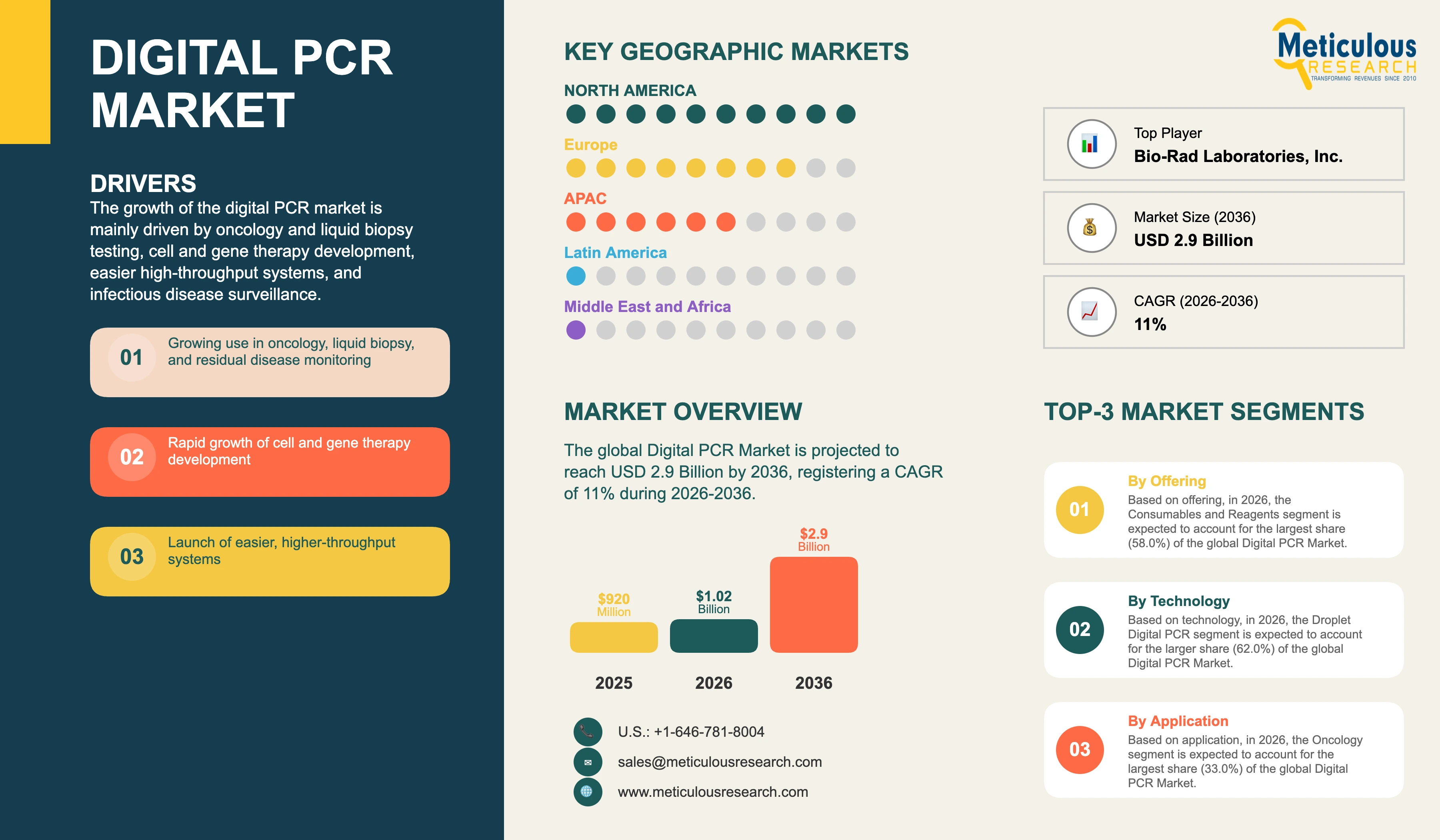
The global digital PCR market was valued at USD 920 million in 2025. This market is expected to reach USD 2.90 billion by 2036 from an estimated USD 1.02 billion in 2026, registering a CAGR of 11.0% during the forecast period (2026-2036).
- Published
- Nov 2026
- Pages
- 258
- Format
- PDF + Excel
- Report ID
- MRHC - 1042592
- Base year
- 2025
- 2025 · BASELINE
- $920.0M
- 2036
- $2.90B
- CAGR 2026–2036
- 11.0%
2025 baseline · 2026–2036 forecast at 11.0% CAGR · hover a bar for the value
Key highlights
Bio-Rad Laboratories, the market leader in digital PCR, completed its USD 275 million acquisition of Stilla Technologies in 2025 and launched four new Droplet Digital PCR platforms, including the plate-based QX Continuum system and the QX700 series, expanding its portfolio to more than 400,000 assays for research and diagnostic applications; in the first quarter of 2026, Bio-Rad reported that its ddPCR instrument revenue grew 24% year-on-year and that more than 99% of its digital PCR assays were available on the new QX700 platform.
QIAGEN reported double-digit constant-currency sales growth for its QIAcuity digital PCR system in both the first and second quarters of 2026, driven mainly by strong consumables demand from its installed base, even as its overall PCR product group declined because of weaker OEM demand.
Bio-Rad's management has highlighted that its QX Continuum system, a 96-well plate-based digital PCR platform with a qPCR-like workflow, is designed to take share from qPCR by offering similar speed and cost with higher sensitivity and absolute quantification, and the company is refocusing research and development on high-growth clinical digital PCR applications, including oncology assays.
Bio-Rad has also started manufacturing selected life science instruments in China for the Chinese market, which improves local responsiveness, reduces tariff exposure, and allows participation in public tenders, while local Chinese digital PCR manufacturers continue to expand their presence in the domestic market.
Digital PCR is widely used in public health wastewater surveillance programs, including the U.S. CDC National Wastewater Surveillance System and national programs in Europe and Asia-Pacific, for monitoring SARS-CoV-2, influenza, mpox, and other pathogens, creating a steady source of consumables demand for public health and environmental laboratories, which value digital PCR for its tolerance of inhibitors in wastewater samples.
By offering, consumables and reagents account for the largest share of 58.0% in 2026 and also register the highest CAGR.
By technology, droplet digital PCR accounts for the larger share in 2026, while chip-based and nanoplate-based digital PCR registers the higher CAGR.
By application, oncology accounts for the largest share in 2026, while cell and gene therapy registers the highest CAGR.
By end user, academic and research institutes account for the largest share of 36.0% in 2026, while pharmaceutical and biotechnology companies and CDMOs register the highest CAGR.
By geography, North America accounts for the largest share of 40.0% in 2026, while Asia-Pacific registers the highest CAGR of 13.5%.
Report summary
| Particulars | Details |
|---|---|
| Forecast Period | 2026-2036 |
| Base Year | 2025 |
| Estimated Year | 2026 |
| CAGR (Value) | 11.0% |
| Format | PDF, Excel & Cloud Portal · 258 pages |
| Market Size (Value) in 2025 | USD 920 million |
| Market Size (Value) in 2026 | USD 1.02 billion |
| Market Size (Value) by 2036 | USD 2.90 billion |
| Largest Segment by Offering (2026) | Consumables and Reagents (58.0%) |
| Largest Segment by End User (2026) | Academic and Research Institutes (36.0%) |
| Largest Region (2026) | North America (40.0%) |
| Fastest-Growing Region | Asia-Pacific (CAGR 13.5%) |
| Segments Covered | Offering, Technology, Application, End User, Geography |
| Countries Covered | U.S., Canada, Germany, U.K., France, Italy, Spain, Netherlands, Switzerland, Belgium, Sweden, Denmark, Rest of Europe, China, Japan, South Korea, India, Australia, Singapore, Taiwan, Thailand, Rest of Asia-Pacific, Brazil, Mexico, Argentina, Rest of Latin America, Saudi Arabia, U.A.E., Israel, Turkey, South Africa, Rest of Middle East & Africa |
| Key Companies | 13 companies and other companies |
Report overview
Segments covered: offering, technology, application, end user.
The growth of this market is mainly driven by the need for highly sensitive and absolute quantification of nucleic acids in oncology, especially liquid biopsy and measurable residual disease monitoring, the rapid growth of cell and gene therapy development, where digital PCR is used for vector titer, copy number, residual DNA, and biodistribution testing, the use of digital PCR in infectious disease and wastewater surveillance, the launch of new plate-based and nanoplate-based systems with qPCR-like workflows that make digital PCR easier to adopt, and the growing number of validated clinical assays. However, factors such as the higher cost per sample compared with qPCR, limited multiplexing in some systems, limited reimbursement for clinical digital PCR tests, and constrained academic research budgets are expected to restrain the growth of this market to some extent.
Digital PCR is a method for detecting and quantifying DNA and RNA with very high sensitivity and precision. In digital PCR, a sample is divided into thousands to millions of separate partitions, such as droplets or microchambers, so that each partition contains either zero or a small number of target molecules. PCR amplification is carried out in all partitions, and the number of positive and negative partitions is counted to calculate the absolute number of target molecules in the original sample, without the need for a standard curve. This report covers digital PCR consumables and reagents, instruments, and software and services across droplet-based and chip-based or nanoplate-based technologies.
Compared with quantitative PCR (qPCR), digital PCR offers absolute quantification, higher precision, better tolerance of PCR inhibitors, and the ability to detect very rare mutations against a large background of normal DNA. These advantages make digital PCR particularly useful for detecting circulating tumor DNA in blood, monitoring measurable residual disease in leukemia, measuring copy number variations, quantifying viral loads, and measuring the quantity of gene therapy vectors and contaminants. Digital PCR is also used as a reference method for calibrating other tests and for certifying reference materials.
The technology has evolved through two main approaches, as droplet digital PCR, pioneered by Bio-Rad, divides the sample into thousands of oil-emulsion droplets, while chip-based and nanoplate-based systems, such as QIAGEN's QIAcuity, Thermo Fisher's Absolute Q, and Roche's Digital LightCycler, use fixed microchambers or nanowells. Early systems required several separate steps and instruments, but newer systems integrate partitioning, amplification, and reading in a single instrument with a workflow similar to qPCR, which has made digital PCR easier to adopt.
Partition numbers vary widely between systems, from about 20,000 droplets per well in standard droplet systems to hundreds of thousands of partitions in some nanoplate and chip formats, and higher partition numbers generally improve precision and dynamic range. Multiplexing capability has also improved, as newer systems offer five or more fluorescence channels, allowing several targets to be measured in a single reaction.
The market has become more competitive over the past few years, as QIAGEN, Thermo Fisher Scientific, and Roche have entered the market with integrated systems, and Bio-Rad has expanded its portfolio through the acquisition of Stilla Technologies and the launch of the QX Continuum and QX700 platforms. Chinese manufacturers such as TargetingOne, Pilot Gene Technologies, and Sniper (Suzhou) Life Technology have also launched digital PCR systems, mainly for the domestic market. This competition has lowered prices, improved ease of use, and expanded the range of available assays.
Consumables and reagents, including partitioning cartridges, plates, oils, master mixes, and assays, account for the largest share of market revenue, since they are used in every run, and the installed base of digital PCR instruments generates recurring consumables demand. Vendors offer large libraries of predesigned assays for mutation detection, copy number analysis, gene expression, and pathogen detection, and many users design and validate their own assays for specific research and testing needs.
Digital PCR is used across academic research, pharmaceutical and biotechnology development, clinical diagnostics, and applied testing. Pharmaceutical companies and CDMOs use digital PCR for cell and gene therapy quality control and bioanalysis, clinical laboratories use it for oncology and infectious disease testing, and applied testing laboratories use it for GMO detection, food authenticity testing, and environmental monitoring, including wastewater surveillance.
The market includes digital PCR instrument manufacturers, reagent and assay suppliers, and service providers. Leading companies include Bio-Rad Laboratories, QIAGEN, Thermo Fisher Scientific, Roche, Sysmex, Standard BioTools, JN Medsys, TargetingOne, Pilot Gene Technologies, Sniper (Suzhou) Life Technology, Precigenome, Optolane Technologies, and Countable Labs.
Over the forecast period, the digital PCR market is expected to grow strongly, as digital PCR replaces qPCR in applications that need higher sensitivity and precision, as cell and gene therapy development expands, as liquid biopsy and measurable residual disease testing grow in oncology, and as validated clinical assays support adoption in diagnostic laboratories.
Academic and research institutes are expected to account for the largest share of 36.0% of the market in 2026, while pharmaceutical and biotechnology companies and CDMOs are projected to register the highest CAGR.
North America is expected to account for the largest share of 40.0% of the market in 2026, mainly due to strong research, cell and gene therapy, and clinical oncology activity in the U.S.
Asia-Pacific is projected to register the highest CAGR of 13.5% during the forecast period, driven by expanding molecular diagnostics and cell and gene therapy in China and the growth of local manufacturers.
The report profiles 13 companies, including Bio-Rad Laboratories, QIAGEN, Thermo Fisher Scientific, Roche, Sysmex, Standard BioTools, JN Medsys, TargetingOne, Pilot Gene Technologies, Sniper (Suzhou) Life Technology, Precigenome, Optolane Technologies, and Countable Labs.
Report infographic
Market dynamics
16 factors across 5 forcesGrowing use in oncology, liquid biopsy, and residual disease monitoring
Digital PCR is well suited to oncology applications that require the detection of rare mutations in blood or tissue. In liquid biopsy, digital PCR can detect and quantify circulating tumor DNA carrying known mutations, such as EGFR, KRAS, and other cancer-related mutations, at very low levels, which helps doctors select targeted therapies, monitor treatment response, and detect relapse earlier. Compared with next-generation sequencing, digital PCR offers faster turnaround, lower cost per test, and simpler data analysis for tracking known mutations.
Digital PCR is also used to monitor measurable residual disease in blood cancers, such as chronic myeloid leukemia, where Bio-Rad's FDA-cleared QXDx BCR-ABL %IS kit is used to measure BCR-ABL transcript levels, and in acute leukemias and lymphomas. As more patients are treated with targeted therapies and immunotherapies, the need for sensitive monitoring tests increases. Research on tumor-informed and personalized digital PCR assays for monitoring solid tumors is also expanding.
The rising incidence of cancer worldwide and the growing use of precision oncology increase demand for digital PCR instruments and assays in cancer centers, hospital laboratories, and clinical research.
Pharmaceutical companies also use digital PCR in oncology clinical trials to measure changes in circulating tumor DNA during treatment, which can provide early signals of drug response. This use in trials helps build the evidence base for clinical adoption and creates demand from central laboratories and CROs that run testing for trial sponsors.
Rapid growth of cell and gene therapy development
Cell and gene therapy developers and manufacturers use digital PCR for many critical tests, including measuring the titer of AAV and lentiviral vectors, determining vector copy number in modified cells, quantifying residual host cell DNA and plasmid DNA, testing for replication-competent viruses, and measuring the biodistribution and persistence of therapies in patients. Digital PCR's absolute quantification and high precision make it the preferred method for many of these tests, and regulators increasingly expect well-validated quantitative methods.
The number of cell and gene therapy programs in development and the number of approved products continue to grow, and many of these programs use digital PCR from early development through commercial quality control. CDMOs that manufacture viral vectors and cell therapies are also major users. This is one of the fastest-growing application areas for digital PCR and supports demand for GMP-compliant instruments, validated assays, and data integrity software. Bioanalytical laboratories that support gene therapy clinical trials also run large numbers of digital PCR tests to measure vector levels in blood and tissue samples from patients.
Launch of easier, higher-throughput systems
Earlier digital PCR systems were often seen as complex and slow compared with qPCR, which limited adoption. New systems from Bio-Rad, QIAGEN, Thermo Fisher Scientific, Roche, and others have integrated partitioning, thermal cycling, and imaging into single instruments with plate-based formats and workflows similar to qPCR, which makes digital PCR much easier to use and allows higher throughput. Bio-Rad's QX Continuum and QX700 systems and QIAGEN's QIAcuity are examples of this trend.
These systems allow laboratories to run digital PCR alongside or instead of qPCR without major changes to their workflows, and they expand the potential market to the very large base of qPCR users. Vendors are also porting large assay libraries to the new systems, which reduces the effort needed to adopt them, and they offer instruments at a range of price points to suit different budgets. Integration with laboratory automation and liquid handling systems also allows higher-throughput users, such as gene therapy manufacturers and public health laboratories, to process large numbers of samples with less manual work.
Infectious disease testing and wastewater surveillance
Digital PCR is used to quantify viral loads, detect low levels of pathogens, and monitor drug resistance mutations in infectious diseases. The COVID-19 pandemic increased awareness of digital PCR and expanded its use in public health laboratories, especially for wastewater surveillance, where digital PCR's tolerance of inhibitors and absolute quantification are important advantages. Many national wastewater surveillance programs, including the U.S. CDC National Wastewater Surveillance System, use digital PCR to track SARS-CoV-2, influenza, RSV, mpox, and other pathogens.
Digital PCR is also used for viral load monitoring in transplant patients, detection of hepatitis B and HIV reservoirs, and research on antimicrobial resistance. As public health agencies maintain and expand surveillance programs, demand for digital PCR consumables in infectious disease and environmental testing is expected to remain steady, and the expansion of surveillance to new pathogens and to more countries could increase testing volumes over the forecast period.
Table of contents
12 chapters · 161 sections · 258 pages · click to expandSegmental analysis
| Segment | Largest share (2026) | Fastest growth (2026–2036) |
|---|---|---|
| By Offering | Consumables and reagents | Consumables and reagents |
By Offering
- The droplet digital PCR segment is expected to account for the larger share of the digital PCR market, while the chip-based and nanoplate-based digital PCR segment is projected to register the higher CAGR during the forecast period.
- The oncology segment is expected to account for the largest share of the digital PCR market, while the cell and gene therapy segment is projected to register the highest CAGR during the forecast period.
Geographic analysis
North America
Largest shareIn 2026, North America is expected to account for the largest share of 40.0% of the global digital PCR market. The large share of this region is mainly due to the large number of academic research institutions, cancer centers, and pharmaceutical and biotechnology companies in the U.S., the concentration of cell and gene therapy developers and CDMOs, the early adoption of digital PCR for liquid biopsy and measurable residual disease testing, the use of digital PCR in the CDC National Wastewater Surveillance System and other public health programs, and the presence of leading suppliers such as Bio-Rad and Thermo Fisher Scientific. Canada also has active research and clinical use of digital PCR in universities and hospitals, including wastewater surveillance programs run by federal and provincial public health agencies.
Europe
Europe is the second-largest market, supported by strong research institutions and clinical laboratories in Germany, the U.K., France, Italy, Spain, the Netherlands, Switzerland, Belgium, Sweden, and Denmark, a growing cell and gene therapy industry, the use of digital PCR in national wastewater monitoring and food and GMO testing under EU regulations, and the presence of QIAGEN and Roche. The IVDR has increased regulatory requirements for clinical assays, while research budgets have been under some pressure. Germany and the U.K. are the largest markets in the region, supported by large research communities and pharmaceutical industries.
Asia-Pacific
Fastest growthAsia-Pacific is projected to register the highest CAGR of 13.5% during the forecast period. The rapid growth of this region is mainly driven by rising research investment and expanding molecular diagnostics in China, Japan, South Korea, India, Australia, and Singapore, the rapid growth of the cell and gene therapy industry in China, the presence of local digital PCR manufacturers that offer lower-cost systems, and policies that favor domestic products in China. Japan has strong research and clinical use of digital PCR, while India, Taiwan, and Thailand are expanding their molecular testing infrastructure in both public and private hospitals.
Latin America
Latin America and the Middle East & Africa account for small shares of the market but are expected to grow. Brazil, Mexico, and Argentina use digital PCR in research, clinical, and agricultural testing laboratories, while Saudi Arabia, the U.A.E., Israel, Turkey, and South Africa are investing in molecular diagnostics, cancer care, and public health laboratories, often supported by national health transformation programs and partnerships with international suppliers.
Competitive landscape
The global digital PCR market is relatively consolidated, with the top five players estimated to account for about 75% of the market in 2025. The market includes large life science and diagnostics companies that offer digital PCR systems and assays, and a number of smaller and regional manufacturers that focus on specific technologies, applications, or countries.
Bio-Rad Laboratories is the market leader, with its Droplet Digital PCR portfolio, including the QX200, QX600, QX Continuum, and QX700 series, a very large assay library, and FDA-cleared clinical assays. Bio-Rad strengthened its position through the USD 275 million acquisition of Stilla Technologies in 2025. QIAGEN is the second major player with its QIAcuity nanoplate-based system, which has shown double-digit growth, while Thermo Fisher Scientific offers the Absolute Q digital PCR system and a large range of assays, and Roche offers the Digital LightCycler system.
Sysmex offers digital PCR-based liquid biopsy testing through its BEAMing technology, which combines emulsion PCR with flow cytometry to detect rare mutations, while Standard BioTools offers microfluidic digital PCR capabilities. Chinese manufacturers, including TargetingOne, Pilot Gene Technologies, and Sniper (Suzhou) Life Technology, compete mainly in China, while JN Medsys, Precigenome, Optolane Technologies, and Countable Labs offer specialized and next-generation digital PCR systems, such as compact, high-partition, or highly multiplexed platforms for research and clinical users.
Companies compete on sensitivity and precision, ease of use, throughput, multiplexing, assay menus, regulatory clearances, software, price, and customer support. Key strategies adopted by these companies include product launches of integrated and plate-based systems, expansion and porting of assay libraries, acquisitions, partnerships with pharmaceutical and diagnostics companies, development of clinical assays, and local manufacturing in key markets.
We expect competition to intensify as more suppliers offer integrated systems at lower prices, and as Chinese manufacturers expand. Clinical assay menus and validated workflows for cell and gene therapy are likely to become the most important differentiators. Vendors with large installed bases and assay libraries, such as Bio-Rad and QIAGEN, have an advantage, but new entrants with lower-cost or more automated systems could win share in price-sensitive and high-throughput segments.
Some of the key players operating in the digital PCR market are Bio-Rad Laboratories, Inc., QIAGEN N.V., Thermo Fisher Scientific Inc., F. Hoffmann-La Roche Ltd., Sysmex Corporation, Standard BioTools Inc., JN Medsys Pte. Ltd., TargetingOne Corporation, Pilot Gene Technologies (Hangzhou) Co., Ltd., Sniper (Suzhou) Life Technology Co., Ltd., Precigenome LLC, Optolane Technologies, Inc., and Countable Labs, Inc., among others.
- —
Bio-Rad acquired Stilla Technologies and launched the QX Continuum and QX700 platforms, reporting 24% ddPCR instrument growth in early 2026, QIAGEN's QIAcuity delivered double-digit growth in 2026, and Bio-Rad began local instrument manufacturing in China while Chinese manufacturers expanded their domestic presence.
- QX200
- QX600
- QX Continuum
- QX700 series
Expert perspectives
Digital PCR has moved over the past decade from a specialized research tool to an essential technology for applications that require precise and sensitive nucleic acid quantification. The launch of integrated, qPCR-like systems, the growth of cell and gene therapy, and the expansion of oncology testing are driving a new phase of growth.
Over the forecast period, the market is expected to grow at a CAGR of 11.0%, from USD 1.02 billion in 2026 to USD 2.90 billion in 2036. Growth will be supported by the steady expansion of oncology and liquid biopsy testing, cell and gene therapy, infectious disease and wastewater testing, and the conversion of qPCR applications.
Consumables and reagents are the largest and fastest-growing offering segment, while droplet digital PCR is the larger technology, while chip-based and nanoplate-based digital PCR grows faster. Oncology is the largest application, while cell and gene therapy grows fastest. Academic and research institutes are the largest end user, while pharmaceutical and biotechnology companies and CDMOs grow fastest. North America remains the largest region, and Asia-Pacific is the fastest-growing region at a CAGR of 13.5%.
In the near term, the market is experiencing mixed conditions, with strong instrument demand for new and upgraded platforms, such as Bio-Rad's QX700, but softer consumables demand from some research and biopharmaceutical customers and pressure from constrained academic budgets. We expect consumables growth to recover from 2027 as new instruments are installed and as testing volumes grow in cell and gene therapy and clinical applications.
For vendors, the key priorities over the forecast period are to expand clinically validated assay menus, support cell and gene therapy customers with GMP-compliant workflows, reduce cost per sample to convert qPCR users, and compete effectively in Asia-Pacific against fast-growing local manufacturers. Vendors with large installed bases and assay libraries will benefit from recurring consumables revenue.
Competition from qPCR and next-generation sequencing will remain, but we see digital PCR as complementary to both: it is better than qPCR for precise quantification and rare targets, and faster and cheaper than sequencing for tracking known mutations. In our view, this positions digital PCR well in the growing areas of patient monitoring and gene therapy quality control.
In the longer term, we see clinical oncology applications, especially measurable residual disease and liquid biopsy monitoring, as the largest opportunity, provided that reimbursement and regulatory pathways support routine clinical use. Asia-Pacific, led by China, is also likely to become a much larger part of the global market, with local manufacturers playing an important role.
Customer perspectives
Molecular Pathology Laboratory Director - Cancer center, U.S.
We use digital PCR to track known mutations in patients' blood and to monitor residual disease. It is faster and cheaper than sequencing for following a patient over time, and the consumables and assays are our main ongoing cost.
“Vector titer, copy number, and residual DNA testing all run on digital PCR in our manufacturing process. We need validated assays, robust precision, and software that meet GMP requirements.”
“The new plate-based systems fit easily into our existing qPCR workflow, and the precision is much better for low-abundance and rare targets. Price has become much more competitive as more suppliers enter the market.”
Frequently asked questions
The global digital PCR market was valued at USD 920 million in 2025, up from USD 830 million in 2024, and is estimated at USD 1.02 billion in 2026. The market includes all digital PCR consumables and reagents, instruments, and software and services.
Cite this report
Meticulous Research. (2026). Digital PCR Market - Global Opportunity Analysis and Industry Forecast (2026-2036) (Report No. MRHC - 1042592). Meticulous Market Research Pvt. Ltd. https://www.meticulousresearch.com/product/digital-pcr-market-7275