U.S. Lead Service Line Replacement Market (2026-2036)
Federal funding has supported the early years of lead service line replacement in communities across the country. The Infrastructure Investment and Jobs Act provided USD 15 billion for lead service line replacement through the Drinking Water State Revolving Fund in five annual installments from fiscal year 2022 to fiscal year 2026, with a large share provided as grants or principal forgiveness to disadvantaged communities. In November 2025, the EPA announced USD 3 billion in new funding and redistributed USD 1.1 billion in previously awarded but unused funds to states with greater needs, and in May 2026, it announced about USD 2.9 billion in fiscal year 2026 allotments.
- Published
- Nov 2026
- Pages
- 198
- Format
- PDF + Excel
- Report ID
- MRSE - 1042556
- Base year
- 2025
- 2025 · BASELINE
- $3.15B
- 2036
- $6.18B
- CAGR 2026–2036
- 7.8%
2025 baseline · 2026–2036 forecast at 7.8% CAGR · hover a bar for the value
Key highlights
The EPA's Lead and Copper Rule Improvements (LCRI), finalized in October 2024, take effect for compliance on November 1, 2027, and require water systems to replace lead service lines at a rate of about 10% per year over 10 years, compared with about 3% per year under the previous rule, according to Bloomberg Government. Most water systems therefore have until about 2037 to replace all of their lead service lines.
In November 2025, the EPA reported that updated state inventory data show about 4 million active lead service lines in the U.S., and the Environmental Policy Innovation Center noted that this is likely significantly lower than the 9.2 million estimate used in the rule's earlier economic analysis. The EPA also launched a public dashboard of state lead service line inventory data at the same time.
On May 20, 2026, the EPA announced about USD 2.9 billion in fiscal year 2026 funding for lead service line replacement, the final year of the USD 3 billion annual installments provided under the Infrastructure Investment and Jobs Act, according to the National Association of Counties. WaterWorld reported that a minimum allocation floor of 1% resulted in many states receiving about USD 27.5 million each, and that USD 57.5 million was reserved for American Indian and Alaska Native water systems.
In April 2026, the EPA issued draft guidance on service line inventories and replacement access. According to ALL4, the guidance explicitly encourages the use of artificial intelligence and predictive modeling to classify unknown service lines and indicates that water systems that document access barriers in good faith will remain in compliance while continuing to replace accessible lines.
The Washington State Department of Health adopted rule changes in July 2026 to incorporate the federal LCRI requirements, and it lists December 1, 2026, as the date for annual consumer notifications to customers served by lead, galvanized requiring replacement, or unknown service lines, illustrating how states are preparing water systems for the 2027 compliance date.
By offering, replacement construction services account for the largest share of 59.0% in 2026, while inventory, identification, and inspection services register the highest CAGR.
By replacement scope, full replacement accounts for the largest share of 70.0% in 2026 and also registers the highest CAGR.
By funding source, federal funding (DWSRF and other programs) accounts for the largest share in 2026, while utility rate and bond funding registers the highest CAGR.
By water system size, large systems (above 50, 000 people) accounts for the largest share in 2026, while small systems (10,000 people or fewer) registers the highest CAGR.
By geography, Midwest accounts for the largest share of 43.0% in 2026, while South registers the highest CAGR of 7.8%.
Report summary
| Particulars | Details |
|---|---|
| Base Year | 2025 |
| Estimated Year | 2026 |
| Forecast Period | 2026-2036 |
| Market Size in 2025 | USD 3.15 billion |
| Market Size in 2026 | USD 3.45 billion |
| Market Size by 2036 | USD 6.18 billion |
| CAGR (2026-2036) | 6.0% |
| Format | PDF, Excel & Cloud Portal · 198 pages |
| Largest Segment by Offering (2026) | Replacement Construction Services (59.0%) |
| Largest Segment by Replacement Scope (2026) | Full Replacement (70.0%) |
| Largest Region (2026) | Midwest (43.0%) |
| Fastest-Growing Region | South (CAGR 7.8%) |
| Companies Profiled | 16 companies and other companies |
| Segments Covered | Offering, Replacement Scope, Funding Source, Water System Size, Region |
| States Covered | Illinois, Ohio, Michigan, Wisconsin, Indiana, Minnesota, Missouri, Iowa, Rest of Midwest, New York, New Jersey, Pennsylvania, Massachusetts, Connecticut, Rest of Northeast, Florida, Texas, Tennessee, Georgia, North Carolina, Virginia, Maryland, Kentucky, Rest of South, California, Colorado, Washington, Oregon, Rest of West |
Report overview
Segments covered: offering, funding source, water system size.
Lead service lines are the pipes that connect water mains to homes and other buildings and are made wholly or partly of lead. Many U.S. cities installed lead service lines from the late 19th century through the middle of the 20th century, and some continued to install them until Congress banned the use of lead pipes in public water systems and plumbing in 1986. These pipes remain the largest source of lead in drinking water in communities where they are present, and the EPA has stated that lead service lines are the primary source of lead exposure from drinking water. Since there is no known safe level of lead exposure for children, federal and state regulators now require water systems to remove these pipes entirely rather than relying only on corrosion control.
This report covers the U.S. market for products and services used to identify, plan, and replace lead service lines and galvanized service lines that require replacement. It includes construction services for the physical replacement of service lines, inventory development, material identification, and inspection services, pipes, fittings, and other materials, and engineering, program management, customer engagement, and software services. The market is analyzed by offering, replacement scope, funding source, water system size, and region, with coverage of the Midwest, Northeast, South, and West and of leading states in each region. Spending is measured on a revenue basis and includes work funded by federal programs, water utilities, state and local governments, and property owners.
The Lead and Copper Rule Improvements are the central regulatory driver of the U.S. lead service line replacement market. Finalized in October 2024, the rule requires water systems with lead, galvanized requiring replacement, or lead-status unknown service lines to prepare service line replacement plans and to replace all lead and galvanized requiring replacement lines under their control within 10 years of the compliance date of November 1, 2027. The rule lowers the lead action level from 15 micrograms per liter to 10 micrograms per liter, requires the addition of lead connectors to inventories, requires water systems to validate a sample of their non-lead service lines within seven years, and expands customer notification and public education requirements. Systems that would need to replace more than 39 lines per 1,000 service connections each year can qualify for a longer deadline.
Service line inventories have changed the understanding of the size of the task. All community and non-transient non-community water systems were required to submit initial inventories by October 16, 2024, and the EPA's November 2025 analysis of state data identified about 4 million active lead service lines. Illinois has one of the largest counts of lead service lines in the country, driven by legacy infrastructure in Chicago and other urban systems, and the Great Lakes states, the Northeast, and older cities in other regions account for most of the remaining lead lines. Many water systems still report large numbers of service lines of unknown material, which must be investigated and may add to replacement needs.
States such as Wisconsin received significant allocations, including USD 94 million announced in May 2026, according to Urban Milwaukee.
Because the LCRI requires replacement to continue until about 2037 while the supplemental federal funding ends with fiscal year 2026, water rates, municipal bonds, state programs, and property owner contributions are expected to fund a growing share of replacement work over the forecast period. This shift is an important feature of the market, since it affects the pace of replacement in different communities and the way water systems structure their programs.
Replacement construction services account for the largest share of the market by offering, while inventory, identification, and inspection services are the fastest-growing offering. Full replacement of both the public and private portions of service lines is the largest and fastest-growing replacement scope, since the LCRI does not count partial replacement toward a system's replacement requirements. The Midwest is the largest regional market, while the South is the fastest-growing region, supported by the resolution of large numbers of unknown service lines and the start of replacement programs in fast-growing states.
Over the forecast period, the U.S. lead service line replacement market is expected to grow steadily as water systems move from inventory development to large-scale replacement, peak replacement activity occurs in the late 2020s and early 2030s, and funding sources shift from federal grants toward local financing. At the same time, affordability, access to private property, workforce capacity, and potential legal and policy changes will shape the pace of replacement.
The Midwest is expected to account for the largest share of 43.0% of the market in 2026, mainly due to the high concentration of lead service lines in Illinois, Ohio, Michigan, and Wisconsin, state replacement mandates, and large city programs in Chicago, Detroit, Cleveland, and Milwaukee.
The South is projected to register the highest CAGR of 7.8% during the forecast period, driven by the resolution of unknown service lines, the start of replacement programs in many water systems, federal funding for disadvantaged communities, and population growth.
The report profiles 16 companies, including Jacobs, Stantec, AECOM, Black & Veatch, CDM Smith, Hazen and Sawyer, Michels, Garney, Mueller Industries, Mueller Water Products, Ford Meter Box, A.Y. McDonald, Toro (HammerHead Trenchless), TT Technologies, 120Water, and BlueConduit.
The compliance date for the LCRI is November 1, 2027, when water systems must have service line replacement plans in place, and most systems must then replace all lead and galvanized requiring replacement service lines within 10 years, by about 2037.
Report infographic
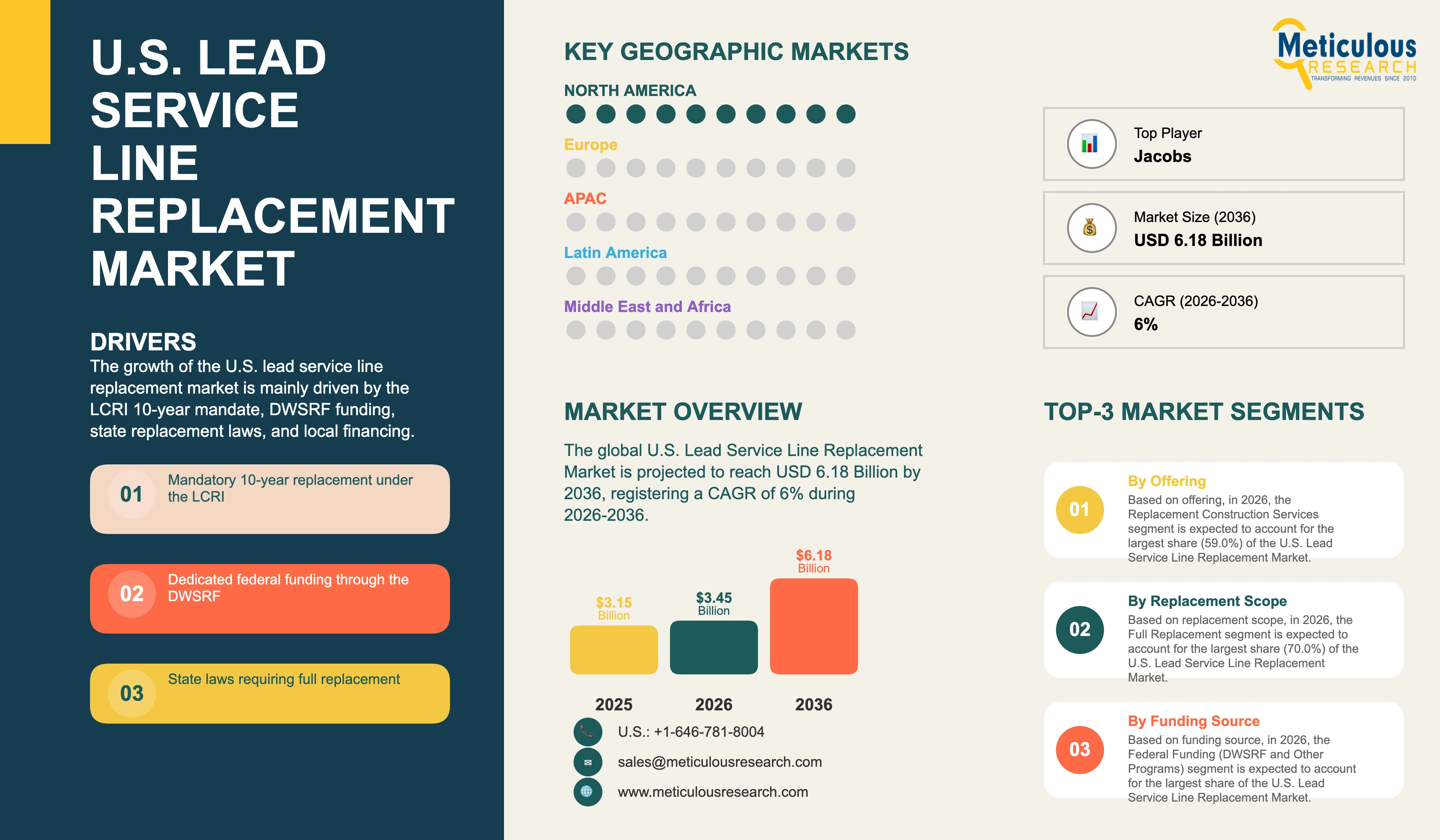
Market dynamics
18 factors across 5 forcesMandatory 10-year replacement under the lead and copper rule improvements
The LCRI is the most important driver of the U.S. lead service line replacement market. Earlier federal rules required lead service line replacement only when a water system exceeded the lead action level, and they allowed partial replacement, which led to slow and uneven progress. The LCRI requires all water systems with lead or galvanized requiring replacement service lines to replace them within 10 years, regardless of their lead sampling results, and it requires full replacement of lines under the system's control. According to Bloomberg Government, this raises the pace of replacement from about 3% per year to about 10% per year beginning in 2027.
The rule also requires water systems to submit service line replacement plans by November 1, 2027, describing their strategies for identification, prioritization, funding, customer outreach, and construction. These plans are encouraging water systems to procure engineering and construction services in advance and to create multi-year replacement programs. Because each system's annual replacement requirement is calculated from its inventory, the rule creates a predictable volume of work across thousands of water systems.
The lower lead action level of 10 micrograms per liter is also expected to increase the number of systems that exceed the action level and must take additional actions, such as optimizing corrosion control, distributing filters, and expanding public education. These requirements give systems further reasons to accelerate replacement.
Dedicated federal funding through the drinking water state revolving fund
The Infrastructure Investment and Jobs Act created the largest dedicated federal funding program for lead service line replacement in U.S. history, providing USD 3 billion per year from fiscal year 2022 through fiscal year 2026. These funds are distributed to states through the Drinking Water State Revolving Fund, and a significant share must be provided to disadvantaged communities as grants or forgivable loans, which has allowed many smaller and low-income communities to begin replacement programs without large increases in water rates.
In November 2025, the EPA began using updated state inventory data to distribute funding based on the location of the approximately 4 million active lead service lines, which directs more funding toward states with large replacement needs. The EPA also redistributed USD 1.1 billion in unused funds to other eligible states and issued a memorandum giving states more flexibility, including allowing the replacement of integrated components directly connected to lead service lines. In May 2026, it announced about USD 2.9 billion in fiscal year 2026 allotments.
Many states have also used their general DWSRF capitalization grants and other federal programs, such as grants under the Water Infrastructure Improvements for the Nation Act, to support lead service line inventories and replacement in schools, childcare facilities, and small communities.
State laws requiring full replacement
Several states adopted laws requiring the replacement of all lead service lines before the LCRI was finalized. Illinois requires water systems to replace all lead service lines on a schedule based on their inventories, Michigan requires water systems to replace lead service lines at an average rate of 5% per year, and New Jersey required replacement of all lead service lines within 10 years under a law passed in 2021. Other states, including Rhode Island and Wisconsin, have adopted their own requirements or funding programs.
These state laws create additional demand and in some cases require faster replacement than the federal rule. They also often prohibit partial replacement, require water systems to replace the private side of service lines, or limit the costs that can be charged to property owners, which increases the scope of work for water systems and contractors.
Completion and refinement of service line inventories
Service line inventories are the foundation of replacement programs, since they identify where lead and galvanized lines are located and how many unknown lines remain. The EPA's November 2025 dashboard of state inventory data provides a national picture of remaining lead lines and helps target funding. As water systems refine their inventories by investigating unknown lines, they generate a steady flow of confirmed lead lines that must be replaced. The LCRI requires systems to update their inventories annually until no lead, galvanized requiring replacement, or unknown lines remain, which creates long-term demand for identification and data management services.
Inventories also support funding applications, since states use them to prioritize projects for DWSRF assistance, and they help utilities estimate program costs and prepare bid packages for contractors.
Use of water rates and municipal bonds to fund multi-year programs
Many large water utilities are funding lead service line replacement through water rates and municipal bonds, in addition to federal and state assistance. Cities with large numbers of lead lines, such as Chicago, Milwaukee, Detroit, Cleveland, Newark, Pittsburgh, Cincinnati, and Denver, have created multi-year capital programs to replace lead lines, and many cover all or most of the cost of private-side replacement for homeowners.
Local funding provides more stable long-term financing than annual federal appropriations, which helps utilities award multi-year contracts and build contractor capacity. As the supplemental federal funding ends, local financing is expected to become the largest source of funding growth in the market.
Table of contents
12 chapters · 152 sections · 198 pages · click to expandSegmental analysis
| Segment | Largest share (2026) | Fastest growth (2026–2036) |
|---|---|---|
| By Offering | Federal funding (DWSRF and other programs) | Utility rate and bond funding |
By Offering
- The federal funding (DWSRF and other programs) segment is expected to account for the largest share of the U.S. lead service line replacement market, while the utility rate and bond funding segment is projected to register the highest CAGR during the forecast period.
- The large systems (above 50, 000 people) segment is expected to account for the largest share of the U.S. lead service line replacement market, while the small systems (10,000 people or fewer) segment is projected to register the highest CAGR during the forecast period.
Geographic analysis
North America
Largest shareThe U.S. lead service line replacement market was valued at USD 3.15 billion in 2025. This market is expected to reach USD 6.18 billion by 2036 from an estimated USD 3.45 billion in 2026, registering a CAGR of 6.0% during the forecast period (2026-2036). The growth of this market is mainly driven by the U.S. Environmental Protection Agency's Lead and Copper Rule Improvements, which require most water systems to replace all lead and galvanized requiring replacement service lines within 10 years, dedicated lead service line replacement funding through the Drinking Water State Revolving Fund, state laws that mandate full replacement in Illinois, Michigan, New Jersey, and other states, the completion and refinement of service line inventories, and the growing use of water rates and municipal bonds to fund multi-year replacement programs. However, factors such as the high cost of replacement relative to the budgets of small and disadvantaged water systems, difficulties in obtaining homeowner consent for private-side work, contractor and labor shortages, and the end of supplemental federal funding after fiscal year 2026 are expected to restrain the growth of this market to some extent. In 2026, the Midwest is expected to account for the largest share of 43.0% of the U.S. lead service line replacement market. The large share of this region is mainly due to the high concentration of lead service lines in Illinois, Ohio, Michigan, Wisconsin, Indiana, Minnesota, and Missouri, state replacement mandates in Illinois and Michigan, large replacement programs in Chicago, Detroit, Cleveland, Milwaukee, Cincinnati, Minneapolis, and St. Louis, and the significant share of federal funding allocated to Great Lakes states based on updated inventory data. WaterWorld reported that Illinois has one of the highest lead service line counts in the country, driven largely by Chicago and other urban systems, and the Great Lakes and St. Lawrence Cities Initiative commended the EPA's use of updated state data for allocating funding. Milwaukee's program, which has reduced its unit costs, is often cited as a model for other cities. The South is projected to register the highest CAGR of 7.8% during the forecast period. The rapid growth of this region is mainly driven by the resolution of large numbers of unknown service lines in states such as Florida, Texas, Tennessee, Georgia, and North Carolina, the start of replacement programs by many water systems that had limited replacement activity before the LCRI, federal funding for disadvantaged communities in the region, and population growth that increases the capacity of utilities to finance infrastructure investment. Older cities in Kentucky, Maryland, Virginia, and Louisiana also have significant numbers of lead and galvanized lines. The Northeast accounts for a significant share of the market, supported by large numbers of lead service lines in New York, New Jersey, Pennsylvania, Massachusetts, Connecticut, and Rhode Island, New Jersey's state law requiring replacement of all lead service lines, and large programs in cities such as Newark, which replaced its lead service lines after a lead crisis, Pittsburgh, Philadelphia, Boston, and New York City. The West accounts for the smallest share of the market, since lead service lines were less commonly installed in many western cities, although Denver, parts of California, Colorado, Washington, and other states have replacement programs. The Washington State Department of Health adopted rule changes in July 2026 to incorporate the federal requirements. Regional differences in housing age, state laws, utility finances, and the share of unknown service lines shape the pace of replacement across the country. States with their own mandates and dedicated funding are expected to make the fastest progress over the forecast period. U.S. Lead Service Line Replacement Market Size Geographic Analysis
Competitive landscape
The U.S. lead service line replacement market is highly fragmented, with the top five players estimated to account for less than 20% of the market in 2025. The market includes engineering and program management firms, national and regional underground utility contractors, local plumbing contractors, manufacturers of pipes, service brass, and meter setters, trenchless equipment manufacturers, and inventory and data analytics providers. Water utilities also perform a significant share of replacement work using their own crews.
Engineering firms such as Jacobs, Stantec, AECOM, Black & Veatch, CDM Smith, and Hazen and Sawyer support water systems with inventories, replacement plans, funding applications, design, and program management. Construction firms such as Michels and Garney deliver large replacement programs, often under progressive design-build contracts. Mueller Industries supplies copper tubing, while Mueller Water Products, The Ford Meter Box Company, and A.Y. McDonald supply service brass, curb stops, and meter setters. TT Technologies and The Toro Company, through HammerHead Trenchless, supply trenchless replacement equipment, and 120Water and BlueConduit provide inventory management, predictive modeling, and compliance software.
Companies in this market compete on cost per replacement, productivity, local presence, experience with large programs, customer engagement capabilities, regulatory expertise, compliance with domestic sourcing requirements, and the ability to help water systems obtain funding. Key strategies include winning multi-year program contracts, forming partnerships between engineering firms and contractors, investing in trenchless equipment and digital tools, expanding domestic manufacturing capacity, and offering bundled services for small water systems.
Since replacement work is performed locally and requires familiarity with local permitting, plumbing codes, and utilities, regional contractors hold strong positions in many markets, while national firms compete for the largest programs. Software and analytics providers are increasingly partnering with engineering firms and state agencies. We expect competition to intensify as more water systems award contracts ahead of the November 2027 compliance date, and we expect consolidation among contractors and service providers seeking scale and geographic coverage. Workforce availability is likely to become an important competitive factor. Contractors that can recruit, train, and retain skilled crews will be able to bid on more work and deliver more replacements each year.
Some of the key players operating in the U.S. lead service line replacement market are Jacobs Solutions Inc., Stantec Inc., AECOM, Black & Veatch Holding Company, CDM Smith Inc., Hazen and Sawyer, Michels Corporation, Garney Holding Company, Mueller Industries, Inc., Mueller Water Products, Inc., The Ford Meter Box Company, Inc., A.Y. McDonald Mfg. Co., The Toro Company (HammerHead Trenchless), TT Technologies, Inc., 120Water, and BlueConduit, among others.
- —
The EPA announced about USD 2.9 billion in fiscal year 2026 funding in May 2026, issued draft guidance on inventories and access in April 2026, and announced USD 3 billion in new funding, USD 1.1 billion in redistributed funds, and a national inventory dashboard in November 2025. Washington State adopted rule changes to incorporate the LCRI in July 2026.
- Jacobs Solutions Inc.
- Stantec Inc.
- AECOM
- Black & Veatch Holding Company
- CDM Smith Inc.
- Hazen and Sawyer
- Michels Corporation
- Garney Holding Company
- Mueller Industries, Inc.
- Mueller Water Products, Inc.
- Ford Meter Box Company, Inc.
- A.Y. McDonald Mfg. Co.
- Toro Company (HammerHead Trenchless)
- TT Technologies, Inc.
- 120Water
- BlueConduit
Expert perspectives
The U.S. lead service line replacement market is entering its most important period. After several years of inventory development and early replacement funded by the Infrastructure Investment and Jobs Act, water systems must begin replacing lead lines at about 10% per year after November 2027 under the LCRI. This creates a large and predictable pipeline of work through the mid-2030s.
Over the forecast period, the market is expected to grow at a CAGR of 6.0%, from USD 3.45 billion in 2026 to USD 6.18 billion in 2036. Growth will be supported by the LCRI mandate, state replacement laws, inventory refinement, and the growing use of local financing, while federal funding will become a smaller share of total spending.
Among the market segments, replacement construction services are the largest offering, while inventory, identification, and inspection services grow fastest. Full replacement is the largest and fastest-growing replacement scope. Federal funding is the largest funding source in 2026, while utility rate and bond funding grows fastest, and large systems are the largest water system size, while small systems grow fastest. The Midwest is the largest region, and the South is the fastest-growing region at a CAGR of 7.8%.
In our view, the most important issue for the market will be how water systems fund replacement after the supplemental federal funding ends. Large utilities with strong finances are likely to sustain their programs through rates and bonds, while small and disadvantaged systems will depend on continued DWSRF support, state programs, and technical assistance. Policymakers' decisions on future federal appropriations will therefore have a significant effect on the pace of replacement in these communities.
We also expect productivity to become a key competitive factor, since the number of replacements required each year will test the capacity of contractors and the workforce. Trenchless methods, standardized designs, efficient consent processes, and multi-year contracts will be essential for keeping costs under control. Identification of unknown lines will remain an important activity, supported by predictive modeling and AI, and each confirmed lead line will add to replacement workloads.
Overall, we believe the U.S. lead service line replacement market will grow steadily over the forecast period, with spending rising through the late 2020s and early 2030s as water systems work toward their 10-year deadlines. The market will remain highly local and fragmented, and companies that combine program management, efficient construction, and data capabilities will be best positioned to benefit. Manufacturers of copper tubing, plastic service pipes, and service brass that can meet domestic sourcing requirements and deliver reliably during peak years are also likely to benefit.
Customer perspectives
Utility Director - large water utility, Midwest
Our replacement plan covers tens of thousands of lead lines, and we pay for the private side because homeowner cost sharing was holding the program back. Federal funds helped us start, but rates and bonds will carry most of the program.
General Manager - small community water system, South
Our inventory showed many unknown lines, so we are first finding out which ones are lead. We could not do this without state technical assistance and principal forgiveness.
Project Executive - underground utility contractor, U.S.
The challenge is volume. Utilities want hundreds of replacements a month, so we use pipe pulling wherever we can and invest in more crews.
Frequently asked questions
The U.S. lead service line replacement market was valued at USD 3.15 billion in 2025, up from USD 2.85 billion in 2024, and is estimated at USD 3.45 billion in 2026. The market includes replacement construction services, inventory, identification, and inspection services, pipes, fittings, and materials, and engineering, program management, and software.
Cite this report
Meticulous Research. (2026). U.S. Lead Service Line Replacement Market - Global Opportunity Analysis and Industry Forecast (2026-2036) (Report No. MRSE - 1042556). Meticulous Market Research Pvt. Ltd. https://www.meticulousresearch.com/product/us-lead-service-line-replacement-market-7239