Crypto Exchanges Market (2026-2036)
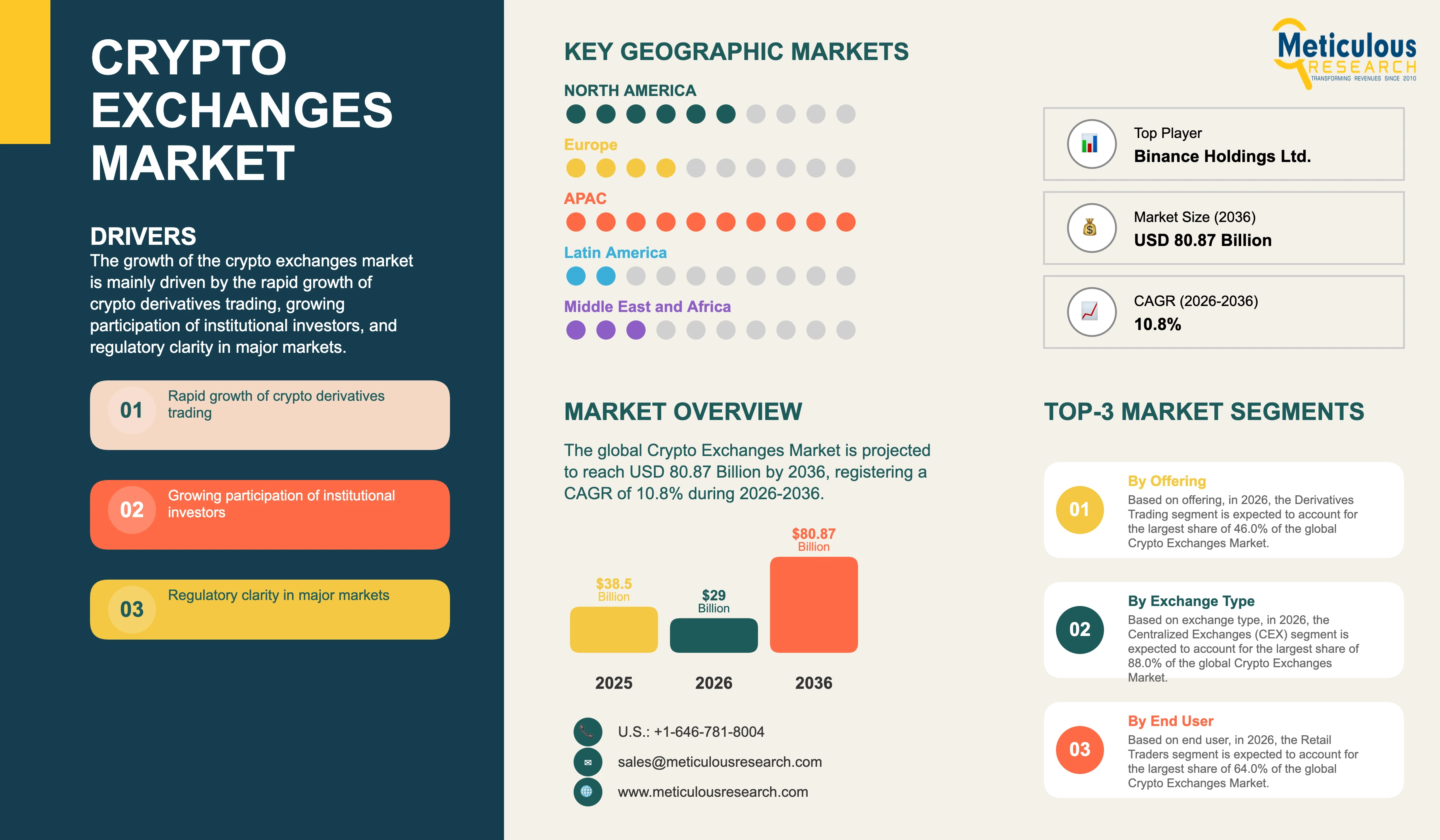
The global crypto exchanges market was valued at USD 38.50 billion in 2025. This market is expected to reach USD 80.87 billion by 2036 from an estimated USD 29.00 billion in 2026, registering a CAGR of 10.8% during the forecast period (2026-2036).
- Published
- Nov 2026
- Pages
- 285
- Format
- PDF + Excel
- Report ID
- MRICT - 1042493
- Base year
- 2025
- 2024 · HISTORICAL
- $17.00T
- 2036
- $80.87B
- CAGR 2026–2036
- 10.8%
2024–2025 baseline · 2026–2036 forecast at 10.8% CAGR · hover a bar for the value
Key highlights
Spot trading volume on centralized crypto exchanges reached about USD 18.6 trillion in 2025, up 9% from about USD 17 trillion in 2024, according to CryptoQuant, while perpetual futures volume on centralized exchanges rose 47.4% to a record of about USD 86.2 trillion, according to CoinGecko Research.
Derivatives accounted for about 75.7% of combined trading activity on centralized exchanges in August 2025, according to CCData, which shows how far exchange activity has shifted from spot trading toward futures and perpetual contracts.
Robinhood completed its acquisition of the Bitstamp exchange, Kraken acquired the U.S. futures platform NinjaTrader, and Coinbase acquired the crypto options exchange Deribit in 2025, showing how exchanges and brokerages are consolidating to add licenses, products, and customers.
Binance reported more than 300 million registered users and about USD 34 trillion in spot and derivatives trading volume in 2025, and said it held about USD 162.8 billion in user assets verified through proof-of-reserves disclosures.
Coinbase reported total revenue of about USD 7.2 billion in 2025, up 9%, with transaction revenue of about USD 4.06 billion and total trading volume of about USD 5.2 trillion, up 156%, according to its annual filing with the U.S. SEC.
Trading activity weakened sharply in 2026 as crypto prices and volatility fell; Coinbase reported transaction revenue of about USD 590 million in the third quarter of 2026, down 44% from a year earlier, while its new prediction markets business passed USD 200 million in annualized revenue.
The U.S. House passed the CLARITY Act in July 2025 and the Senate Banking Committee advanced its version by a 15-9 vote in May 2026, although the bill had not become law by the second half of 2026.
In the EU, the transition period for crypto-asset service providers under the Markets in Crypto-Assets Regulation ends by July 2026, after which exchanges serving EU users must hold a MiCA license.
By offering, derivatives trading accounts for the largest share of 46.0% in 2026, while staking and earn services register the highest CAGR.
By exchange type, centralized exchanges account for the largest share in 2026, while decentralized exchanges register the highest CAGR.
By end user, retail traders account for the largest share of 64.0% in 2026, while institutional investors register the higher CAGR.
By geography, Asia-Pacific accounts for the largest share of 40.0% in 2026, while the Middle East and Africa registers the highest CAGR of 13.2%.
Report summary
| Particulars | Details |
|---|---|
| Forecast Period | 2026-2036 |
| Base Year | 2025 |
| Estimated Year | 2026 |
| CAGR (Value) | 10.8% |
| Format | PDF, Excel & Cloud Portal · 285 pages |
| Market Size (Value) in 2025 | USD 38.50 billion |
| Market Size (Value) in 2026 | USD 29.00 billion |
| Market Size (Value) by 2036 | USD 80.87 billion |
| Largest Segment by Offering (2026) | Derivatives Trading (46.0%) |
| Largest Segment by End User (2026) | Retail Traders (64.0%) |
| Largest Region (2026) | Asia-Pacific (40.0%) |
| Fastest-Growing Region | Middle East and Africa (CAGR 13.2%) |
| Segments Covered | Offering, Exchange Type, End User, and Geography |
| Countries Covered | Asia-Pacific, North America, Europe, Middle East and Africa, and Latin America |
| Key Companies | Binance, Coinbase, OKX, Bybit, Bitget, Upbit, Kraken, Gate, Crypto.com, Robinhood (Bitstamp), Gemini, Bullish, Uniswap Labs, and Hyperliquid |
Report overview
Segments covered: offering, exchange type, end user.
The growth of this market is mainly driven by the rapid rise of crypto derivatives trading, growing participation of institutional investors, clearer regulation through the EU's Markets in Crypto-Assets Regulation and the progress of U.S. market structure legislation, the expansion of exchanges into new products such as staking, tokenized stocks, and prediction markets, and rising crypto ownership in Asia-Pacific, the Middle East, Africa, and Latin America. However, factors such as the strong dependence of exchange revenue on crypto prices and trading volatility, falling trading fees due to intense competition, high compliance and licensing costs, and security risks such as hacks and fraud are expected to restrain the growth of this market to some extent.
Crypto exchanges are trading platforms that allow users to buy, sell, and trade crypto assets, such as Bitcoin, Ether, stablecoins, and other tokens, either against fiat currencies or against other crypto assets. Centralized exchanges, such as Binance, Coinbase, OKX, Bybit, and Upbit, hold customer funds and match buy and sell orders on their own order books, while decentralized exchanges, such as Uniswap and Hyperliquid, allow users to trade directly from their own wallets through smart contracts on blockchain networks.
This market covers the global revenue generated by crypto exchanges from trading and related platform services, measured in value. It includes fees from spot trading, derivatives trading such as futures, perpetual contracts, and options, staking and earn services, margin and lending services, and listing, data, and other exchange services, and it includes the protocol and front-end fee revenue of decentralized exchanges. It is segmented by offering, exchange type, end user, and geography. Revenue from stablecoin reserve interest, gains on crypto assets held for investment, and non-exchange businesses is not included, and fees paid to liquidity providers on decentralized exchanges are excluded because they are not revenue of the exchange operator.
Exchange revenue is closely linked to crypto prices and trading volatility, because most revenue comes from fees charged as a percentage of trading volume. Revenue rose strongly in 2024 and 2025, when Bitcoin reached new highs, total crypto market capitalization passed USD 4 trillion, and trading volumes increased, but it fell sharply in 2026 as crypto prices declined and volatility dropped to multi-year lows. As a result, the market is estimated to be smaller in 2026 than in 2025, which provides a lower base for growth over the forecast period.
The structure of exchange revenue has changed significantly over the past few years. Derivatives trading, particularly perpetual futures, now accounts for most trading volume on centralized exchanges and a growing share of revenue, while spot trading fees have fallen as competition has increased. Exchanges have diversified into staking, earn products, lending, payment cards, custody, tokenized stocks, and prediction markets to reduce their dependence on trading volumes. Coinbase, for example, reported that subscription and services revenue accounted for close to half of its net revenue in 2026.
Customer acquisition and retention are central to exchange economics, because exchanges spend heavily on marketing, sponsorships, referral programs, and trading rewards to attract users during bull markets, and they try to retain users during downturns through staking, earn products, payment cards, and loyalty programs. Exchange tokens, such as BNB, which give holders fee discounts and other benefits, are also used to build loyalty and support exchange ecosystems.
Fee levels differ widely across the market, because retail users on simple buy-and-sell interfaces in the U.S. and Europe often pay fees of more than 1% per trade, while active traders on advanced platforms and institutional clients pay a few basis points, and market makers may receive rebates. Derivatives fees per trade are lower than spot fees, but derivatives volumes are much larger, and exchanges also earn funding and liquidation-related revenue. These differences mean that changes in the mix of users, products, and regions have a large effect on total market revenue.
Regulation is reshaping the competitive landscape of the crypto exchanges market, as the EU's Markets in Crypto-Assets Regulation requires exchanges serving EU users to obtain a license, the U.S. is working on market structure legislation through the CLARITY Act, and countries such as the UAE, Singapore, Hong Kong, Japan, South Korea, Brazil, and India have introduced or tightened licensing rules. Large, well-capitalized exchanges that can meet these requirements are expected to gain share, while smaller unlicensed platforms may exit some markets or consolidate.
Over the forecast period, the market is expected to recover from the 2026 downturn and grow steadily, supported by derivatives trading, institutional adoption, new products, decentralized exchanges, and rising crypto ownership in emerging markets. Growth is expected to remain cyclical, with periods of strong growth during bull markets and declines during bear markets, but the long-term trend is expected to be positive as crypto assets become more widely held and integrated with traditional finance.
Report infographic
Market dynamics
16 factors across 5 forcesRapid growth of crypto derivatives trading
Derivatives trading, particularly perpetual futures, has become the largest source of trading activity on crypto exchanges. Perpetual futures allow traders to take long or short positions with leverage without an expiry date, which makes them attractive for speculation, hedging, and arbitrage. According to CoinGecko Research, perpetual futures volume on centralized exchanges rose 47.4% in 2025 to a record of about USD 86.2 trillion, several times larger than spot trading volume, and CCData reported that derivatives accounted for about three-quarters of combined centralized exchange activity in August 2025.
Exchanges earn trading fees on each derivatives trade, as well as revenue related to funding, liquidations, and margin, and derivatives trading tends to be more resilient than spot trading in falling markets because traders can profit from price declines. Leading exchanges, such as Binance, OKX, Bybit, and Bitget, earn a large share of their revenue from derivatives, and Coinbase expanded its derivatives business through the acquisition of the options exchange Deribit in 2025. Derivatives trading accounts for the largest share of the market by offering.
Regulated derivatives are also growing in the U.S. and Europe, where exchanges such as Coinbase, Kraken, and CME Group offer crypto futures under CFTC or EU supervision. U.S. regulators have allowed perpetual-style futures on regulated venues, which is expected to bring more U.S. retail and institutional derivatives trading onto licensed exchanges over the forecast period.
Growing participation of institutional investors
Institutional investors, such as hedge funds, proprietary trading firms, market makers, asset managers, family offices, and corporations, are trading crypto assets in larger volumes, supported by the approval of spot Bitcoin and Ether exchange-traded funds in the U.S., improved custody and prime brokerage services, and clearer regulation. Bitget reported that institutional trading accounted for a sharply higher share of its volume by the end of 2025, and exchanges have built dedicated institutional platforms, prime brokerage, and over-the-counter desks to serve these clients.
Institutional clients trade large volumes and require deep liquidity, reliable technology, strong custody, and regulatory compliance, which favors large, licensed exchanges. Although institutional fees per trade are lower than retail fees, the growth in institutional volume adds significant revenue, and institutions also use custody, financing, and data services. Institutional investors are the faster-growing end user in this market.
Regulatory clarity in major markets
Clearer regulation is making it easier for exchanges to operate and for banks, asset managers, and mainstream investors to participate in crypto trading. In the EU, the Markets in Crypto-Assets Regulation provides a single licensing regime for crypto-asset service providers across all member states, allowing licensed exchanges to serve the whole EU market. In the U.S., the GENIUS Act created a framework for stablecoins in 2025, and the CLARITY Act, which would define the roles of the SEC and CFTC and set rules for exchanges, brokers, and custodians, passed the House in July 2025 and advanced in the Senate Banking Committee in May 2026.
Countries in Asia-Pacific and the Middle East, such as Japan, Singapore, Hong Kong, South Korea, and the UAE, have also built licensing regimes that allow regulated exchanges to grow. Regulatory clarity reduces legal risks for exchanges, encourages banks and brokers to offer crypto trading, and increases trust among users, which is expected to support trading volumes and attract new users to licensed exchanges over the forecast period.
Expansion into new products and rising crypto ownership
Exchanges are expanding beyond crypto trading into new products, such as staking, earn programs, crypto-backed loans, payment cards, tokenized stocks and commodities, and prediction markets, which attract new users and increase revenue per user. Coinbase reported that its prediction markets business, launched in 2026, reached more than USD 200 million in annualized revenue within a few quarters, and several exchanges have launched trading in tokenized U.S. stocks for international users.
At the same time, crypto ownership continues to grow, particularly in emerging markets in Asia-Pacific, the Middle East, Africa, and Latin America, where young, mobile-first populations use crypto for investment, savings, and payments. Binance alone reported that its registered users grew from about 270 million at the start of 2025 to more than 300 million by the end of the year. Rising ownership expands the user base for exchanges and supports long-term growth in trading volumes.
Table of contents
11 chapters · 127 sections · 285 pages · click to expandSegmental analysis
| Segment | Largest share (2026) | Fastest growth (2026–2036) |
|---|---|---|
| By Offering | Derivatives trading | Staking and earn services |
| By Exchange Type | Centralized exchanges | Rapid growth of this |
| By End User | Retail traders | Rapid growth of this |
By Offering
- Crypto Exchanges Market Analysis by Offering
- The derivatives trading segment is expected to account for the largest share of 46.0% of the market.
- The large share of this segment is mainly due to the very high trading volumes of perpetual futures, futures, and options on centralized exchanges, which are several times larger than spot trading volumes, and the additional revenue exchanges earn from funding, margin, and liquidations.
- Perpetual futures are the most traded product in the crypto market, used by retail traders for leveraged speculation and by institutional traders and market makers for hedging and arbitrage.
- Leading derivatives exchanges, such as Binance, OKX, Bybit, and Bitget, earn most of their revenue from derivatives, and Coinbase, Kraken, and other exchanges have expanded their derivatives offerings, including regulated futures in the U.S. and the EU.
- Options trading, led by Deribit, is also growing as institutional investors use options to manage risk.
- Derivatives trading tends to be more resilient than spot trading during market downturns because traders can profit from falling prices, and it is expected to remain the largest offering over the forecast period.
- However, the staking and earn services segment is projected to register the highest CAGR during the forecast period.
- The rapid growth of this segment is driven by the growth of proof-of-stake blockchains, supportive regulation for staking, and demand from users for yield on their crypto holdings.
- Spot trading holds a significant share, supported by retail buying and selling of crypto, while margin and lending services and listing, data, and other services make up the rest of the market.
- Spot trading generates the highest fees per trade, particularly for retail users who buy and sell through simple app interfaces, but its share of revenue has declined as derivatives trading has grown and fees have fallen.
- Spot trading is also the most sensitive to retail sentiment and crypto prices, which made it the segment most affected by the 2026 downturn.
- Margin and lending services generate interest income from users who borrow to trade, while listing, data, and other services include token listing fees, market data, and API services.
- Within derivatives trading, perpetual futures account for most volume and revenue, while traditional futures and options account for smaller but growing shares.
- Options trading is used mainly by institutional investors and sophisticated traders to hedge risk and generate income, and it is expected to grow as more exchanges launch options and regulated options products become available in the U.S. and Europe.
- The growth of derivatives on tokenized stocks, commodities, and indexes is also expected to expand this segment beyond crypto assets over the forecast period.
By Exchange Type
- Crypto Exchanges Market Analysis by Exchange Type
- The centralized exchanges segment is expected to account for the largest share of the market.
- The large share of this segment is mainly due to the ease of use, deep liquidity, fiat on- and off-ramps, customer support, and wide product range that centralized exchanges offer, which make them the main entry point for retail and institutional users.
- Centralized exchanges handle most crypto trading volume and hold most customer assets in the industry.
- Binance alone reported very large cumulative trading volume in trading volume and more than 300 million registered users in 2025.
- Centralized exchanges also offer regulated services, such as licensed trading, custody, and fiat payments, which are required by institutional investors and mainstream users, and they are expected to remain the largest exchange type throughout the forecast period.
- Within centralized exchanges, global offshore exchanges, such as Binance, OKX, Bybit, and Bitget, account for most derivatives volume, while regulated domestic exchanges, such as Coinbase, Kraken, Upbit, and bitFlyer, serve users in specific countries under local licenses.
- The share of regulated exchanges is expected to increase as licensing requirements tighten in major markets.
- However, the decentralized exchanges segment is projected to register the higher CAGR during the forecast period.
- The rapid growth of this segment is driven by improved blockchain performance, the success of decentralized perpetual futures platforms, and user demand for self-custody.
- Decentralized exchanges earn revenue through protocol fees and front-end fees, which are usually a small part of the total fees paid by traders, because most trading fees go to liquidity providers.
- Decentralized perpetual futures platforms, such as Hyperliquid, retain a larger share of fees and have grown rapidly.
- As decentralized exchanges improve their user experience, liquidity, and speed, and as regulation of decentralized finance becomes clearer, they are expected to take a growing share of trading activity, particularly in derivatives and in trading of newly launched tokens.
By End User
- Crypto Exchanges Market Analysis by End User
- The retail traders segment is expected to account for the largest share of 64.0% of the market.
- The large share of this segment is mainly due to the very large number of individual users on crypto exchanges, the higher fees that retail users pay compared with institutional clients, and the strong participation of retail traders in derivatives and altcoin trading.
- Retail traders range from occasional buyers of Bitcoin to highly active traders who use leverage and derivatives.
- Exchanges serve them through mobile apps, simple buy-and-sell interfaces, advanced trading platforms, and products such as staking, earn, and payment cards.
- Retail activity is highly sensitive to crypto prices and market sentiment, which makes it the main driver of revenue swings during market cycles.
- Retail traders are expected to remain the largest end user over the forecast period, supported by rising crypto ownership in emerging markets.
- Retail activity is concentrated in Asia-Pacific, Turkey, Latin America, and the U.S., and younger users increasingly trade through mobile apps and use crypto exchanges alongside brokerage and payment apps.
- Retail users also contribute to staking, earn, and card revenue, which provides some revenue during periods of low trading activity.
- However, the institutional investors segment is projected to register the higher CAGR during the forecast period.
- The rapid growth of this segment is driven by crypto exchange-traded funds, improved custody and prime brokerage, and clearer regulation.
- Institutional investors include hedge funds, proprietary trading firms, market makers, asset managers, family offices, and corporations.
- Market makers and proprietary trading firms account for a large share of institutional trading volume on derivatives exchanges, while asset managers and family offices are increasing their crypto allocations through regulated exchanges and custody providers.
- The approval of crypto exchange-traded funds has increased institutional demand for regulated trading, custody, and hedging, and exchanges are building prime brokerage, financing, and portfolio margin services to serve these clients.
- Institutional revenue is also less sensitive to retail sentiment, which helps stabilize exchange revenue during downturns.
Geographic analysis
Asia-Pacific
Largest shareIn 2026, Asia-Pacific is expected to account for the largest share of 40.0% of the global crypto exchanges market. The large share of this region is mainly due to the presence of many of the largest global exchanges, such as Binance, OKX, Bybit, Bitget, and Gate, which have strong user bases and operations in Asia, the very large retail trading markets in South Korea, Japan, India, Vietnam, Indonesia, and the Philippines, and the popularity of derivatives trading in the region. South Korea has one of the most active retail crypto markets in the world, served mainly by Upbit and Bithumb, while Japan has a mature, regulated exchange market. Hong Kong and Singapore have introduced licensing regimes for exchanges, and India, Vietnam, Indonesia, and the Philippines have large and growing populations of crypto users. Asia-Pacific is expected to remain the largest region throughout the forecast period.
Middle East & Africa
Fastest growthThe Middle East and Africa is projected to register the highest CAGR of 13.2% during the forecast period. Growth is driven by the UAE's licensing regime, which has attracted major exchanges such as Binance, OKX, Bybit, and Crypto.com, rising crypto adoption in Turkey, Nigeria, South Africa, and Kenya, and young, mobile-first populations.
North America
North America holds a significant share, led by the U.S., where Coinbase, Kraken, Gemini, Robinhood, and CME serve retail and institutional traders. In North America, the U.S. is one of the most valuable markets because of high fees paid by retail users, strong institutional participation, and the presence of crypto exchange-traded funds. Clarity from the GENIUS Act and possible passage of the CLARITY Act are expected to support growth, while Canada has a smaller, regulated exchange market in which domestic platforms compete with global exchanges that hold local registrations.
Europe
Europe is growing under MiCA, while Latin America is supported by crypto adoption in Brazil, Argentina, and Mexico. In Europe, MiCA licensing is expected to concentrate the market among licensed exchanges, such as Coinbase, Kraken, Bitstamp, Bitpanda, and OKX, which can serve all EU countries from a single license. Germany, France, the U.K., and the Netherlands are among the largest markets, supported by high crypto ownership and active retail and institutional trading.
Latin America
In Latin America, Brazil has one of the largest crypto markets and is introducing rules for crypto service providers, while Argentina and Mexico have high retail adoption driven by inflation and remittances.
Competitive landscape
The crypto exchanges market is concentrated among a few large global exchanges, with a long tail of regional and smaller exchanges and a growing number of decentralized exchanges. Leading companies include Binance, Coinbase, OKX, Bybit, Bitget, Upbit, Kraken, Gate, Crypto.com, Robinhood through Bitstamp, Gemini, Bullish, Uniswap Labs, and Hyperliquid.
Exchanges compete on liquidity, trading fees, product range, security, regulatory licenses, user experience, and geographic coverage. Large exchanges benefit from network effects, because deeper liquidity attracts more traders, which in turn attracts more liquidity. Regulatory licenses have become increasingly important for access to markets such as the EU, U.S., Japan, and the UAE.
Binance is the largest exchange by trading volume and users, followed by a group of large global exchanges, such as OKX, Bybit, Bitget, and Gate, which focus on derivatives, and regulated exchanges, such as Coinbase, Kraken, and Upbit, which lead in their home markets. Coinbase earns some of the highest revenue in the industry because of its large U.S. retail customer base and diversified revenue, while decentralized exchanges, such as Uniswap and Hyperliquid, compete on self-custody and transparency. Brokerages, such as Robinhood, compete for retail users with low-cost trading, while fintech apps and banks are adding crypto trading to their existing services.
The top five players are estimated to account for 55.0% of the crypto exchanges market in 2025, reflecting the strong position of Binance and other leading global exchanges, as well as the presence of many regional exchanges.
Players use several strategies to grow in this market, including obtaining licenses in new jurisdictions, acquiring regulated platforms and derivatives exchanges, launching new products such as tokenized stocks, prediction markets, and staking, building institutional services, and expanding payment and card offerings. Recent examples include Coinbase's acquisition of Deribit, Kraken's acquisition of NinjaTrader, and Robinhood's acquisition of Bitstamp.
Competition is expected to center on regulation, derivatives, institutional services, product diversification, and cost. Exchanges with strong licenses, deep liquidity, and diversified revenue are expected to gain share, while consolidation is expected to continue as smaller exchanges struggle with compliance costs, licensing requirements, and the revenue declines that come with market downturns.
Some of the key players operating in the crypto exchanges market are Binance Holdings Ltd., Coinbase Global, Inc., OKX, Bybit Fintech Limited, Bitget Limited, Dunamu Inc. (Upbit), Payward, Inc. (Kraken), Gate Technology Inc., Foris DAX, Inc. (Crypto.com), Robinhood Markets, Inc. (Bitstamp), Gemini Space Station, Inc., Bullish, Universal Navigation Inc. (Uniswap Labs), and Hyperliquid.
- —
Coinbase acquired Deribit, Kraken acquired NinjaTrader, Robinhood acquired Bitstamp, Gemini and Bullish listed on U.S. stock exchanges, Binance passed 300 million users, and several exchanges launched prediction markets and tokenized stock trading.
- Binance
- Coinbase
- OKX
- Bybit
- Bitget
- Upbit
- Kraken
- Gate
- Crypto.com
- Robinhood · Bitstamp
- Gemini
- Bullish
- Uniswap Labs
- Hyperliquid
Expert perspectives
The crypto exchanges market is cyclical, and 2026 has been a weak year, with lower crypto prices and volatility reducing trading activity and exchange revenue compared with 2025. However, the long-term drivers of the market, including derivatives trading, institutional adoption, regulation, new products, and rising crypto ownership, remain strong.
Over the forecast period, the market is expected to grow at about 10.8% per year from the lower 2026 base, with periods of strong growth during bull markets and slower growth or declines during downturns. Growth will depend on crypto prices, regulatory developments in the U.S. and other major markets, and the ability of exchanges to diversify revenue.
Derivatives trading remains the largest offering, and staking and earn services are the fastest-growing offering. Centralized exchanges remain dominant, but decentralized exchanges are growing faster. Retail traders remain the largest end user, while institutional investors grow faster.
Asia-Pacific remains the largest region, while the Middle East and Africa is the fastest-growing region at a CAGR of 13.2%. The main swing factors are crypto prices and volatility, U.S. market structure legislation, MiCA implementation, and competition from brokerages and decentralized exchanges.
For exchanges, the key priorities are obtaining licenses, building derivatives and institutional businesses, diversifying into recurring revenue, and maintaining strong security and compliance. Exchanges that rely mainly on retail spot trading fees are most exposed to market cycles and fee compression, and they are likely to face strong pressure to diversify or consolidate.
The 2026 downturn has also shown the value of diversified business models. Exchanges with large derivatives, institutional, staking, and subscription businesses have proved more resilient than those relying on retail spot trading, and they are expected to gain share during the recovery. At the same time, regulation is expected to reshape the market, as licensing in the EU, U.S., and Asia-Pacific favors well-capitalized exchanges and pushes trading toward regulated venues.
The most important uncertainties for the outlook are the timing and strength of the next crypto market upturn, the outcome of U.S. market structure legislation, and the speed at which tokenized assets and prediction markets grow. A strong market recovery or faster adoption of tokenized assets could push growth above the base case, while a prolonged bear market, major exchange failure, or restrictive regulation in major markets could slow growth and delay the recovery in exchange revenue.
Overall, crypto exchanges are expected to become more regulated, more diversified, and more integrated with traditional finance over the forecast period, while remaining sensitive to crypto market cycles.
Customer perspectives
Head of Digital Assets - Hedge fund, U.S.
We trade mainly perpetual futures and options, and we choose exchanges based on liquidity, custody arrangements, and regulatory standing, not just fees.
Institutional demand for liquidity and regulated venues explains why derivatives trading accounts for 46.0% of the market and why institutional investors are the faster-growing end user.
This kind of retail behavior drives the cyclical nature of exchange revenue and also supports the growth of staking and earn services, while Asia-Pacific accounts for 40.0% of the market.
Licensing is becoming a key competitive advantage for exchanges in Europe and is expected to drive consolidation in the market, as smaller platforms without licenses exit or sell their businesses.
Corporate and institutional demand for regulated custody, reporting, and audit services supports the growth of institutional investors as an end user and favors licensed, well-capitalized exchanges with strong and trusted custody partners.
“I trade almost every day on my phone when prices are moving, but when the market is quiet, I trade much less and keep most of my coins in staking to earn rewards while I wait.”
“Getting our MiCA license took more than a year and significant investment, but it now lets us serve customers across the EU from one license.”
“We use a regulated exchange to buy and hold Bitcoin for our treasury, and we need institutional-grade custody, reporting, and audit support before we increase our allocation.”
Frequently asked questions
The market was valued at USD 38.50 billion in 2025 and USD 34.00 billion in 2024, and is estimated at USD 29.00 billion in 2026, measured as revenue from trading and related exchange services.
Crypto prices and trading volatility fell in 2026, reducing trading volumes and fee revenue across exchanges. Coinbase, for example, reported a 44% year-on-year decline in transaction revenue in the third quarter of 2026.
The market is expected to reach USD 80.87 billion by 2036, supported by derivatives trading, institutional adoption, regulation, new products, and rising crypto ownership.
The market is expected to register a CAGR of 10.8% from 2026 to 2036.
Growth is driven by the rapid growth of crypto derivatives trading, growing participation of institutional investors, regulatory clarity in major markets, and expansion into new products along with rising crypto ownership.
Dependence on crypto prices and trading volatility and fee compression restrain growth, while security risks, hacks, and fraud and compliance costs and regulatory fragmentation remain key challenges.
Key opportunities include tokenized stocks and real-world assets, staking, earn, and on-chain yield services, the growth of decentralized exchanges, and emerging markets and regional licensing.
Spot trading volume on centralized exchanges reached about USD 18.6 trillion in 2025, according to CryptoQuant, while perpetual futures volume reached about USD 86.2 trillion, according to CoinGecko Research.
Derivatives trading is expected to account for the largest share of 46.0% of the market in 2026, while staking and earn services are projected to register the highest CAGR.
Decentralized exchanges are projected to register the higher CAGR, while centralized exchanges hold the largest share.
Retail traders are expected to account for the largest share of 64.0% of the market in 2026, while institutional investors are projected to register the higher CAGR.
Asia-Pacific is expected to account for the largest share of 40.0% of the market in 2026.
The Middle East and Africa is projected to register the highest CAGR of 13.2% during the forecast period.
The CLARITY Act is proposed U.S. legislation that would set a federal market structure for crypto assets, define the roles of the SEC and CFTC, and establish rules for exchanges, brokers, and custodians. It passed the House in July 2025 and advanced in the Senate Banking Committee in May 2026.
The report profiles 14 companies, including Binance, Coinbase, OKX, Bybit, Bitget, and Upbit. The top five players account for an estimated 55.0% of the market in 2025.
Crypto exchanges earn revenue mainly from trading fees on spot and derivatives trades, as well as from staking commissions, margin and lending interest, listing fees, data services, subscriptions, payment cards, and newer products such as prediction markets.
Centralized exchanges hold customer funds and match orders on their own platforms, while decentralized exchanges allow users to trade directly from their own wallets through smart contracts on blockchains.
Coinbase acquired Deribit, Kraken acquired NinjaTrader, Robinhood acquired Bitstamp, Gemini and Bullish listed on U.S. stock exchanges, Binance passed 300 million users, and several exchanges launched prediction markets and tokenized stock trading.
Cite this report
Meticulous Research. (2026). Crypto Exchanges Market - Global Opportunity Analysis and Industry Forecast (2026-2036) (Report No. MRICT - 1042493). Meticulous Market Research Pvt. Ltd. https://www.meticulousresearch.com/product/crypto-exchanges-market-7176