Cross-Border Payments Market (2026-2036)
The global cross-border payments market was valued at USD 241.00 billion in 2025. This market is expected to reach USD 458.46 billion by 2036 from an estimated USD 256.00 billion in 2026, registering a CAGR of 6.0% during the forecast period (2026-2036).
- Published
- Nov 2026
- Pages
- 290
- Format
- PDF + Excel
- Report ID
- MRICT - 1042495
- Base year
- 2025
- 2024 · HISTORICAL
- $685.0B
- 2036
- $458.5B
- CAGR 2026–2036
- 6.0%
2024–2025 baseline · 2026–2036 forecast at 6.0% CAGR · hover a bar for the value
Key highlights
According to the World Bank, remittance flows to low- and middle-income countries reached an estimated USD 685 billion in 2024, up 5.8%, with India the largest recipient at about USD 129 billion.
The global average cost of sending USD 200 as a remittance was 6.36% in the third quarter of 2025, according to the World Bank's Remittance Prices Worldwide database, more than double the UN Sustainable Development Goal target of 3%, with banks charging an average of nearly 15%.
The G20 has set targets to make cross-border payments faster, cheaper, more transparent, and more accessible by 2027, including an average cost of no more than 1% for retail payments and 3% for remittances, although the Financial Stability Board has acknowledged that many targets are unlikely to be met by the deadline.
Swift completed the end of its coexistence period for cross-border payment messages in November 2025, making the ISO 20022 standard the norm for cross-border payments between banks, which provides richer and more structured payment data.
The U.S. introduced a 1% excise tax on certain cash-funded remittances from January 2026, which is expected to encourage the use of digital and account-based remittance channels.
Visa Direct and Mastercard Cross-Border Services allow businesses and payment providers to send payments to accounts, cards, and digital wallets in many countries, often within minutes, competing with traditional correspondent banking.
India has linked its UPI instant payment system with Singapore's PayNow and with payment systems in several other countries, and the BIS Project Nexus is being implemented to connect multiple instant payment systems through a single platform.
Stablecoins are increasingly used for cross-border payments, particularly business payments and remittances in emerging markets, and the U.S. GENIUS Act, signed in July 2025, created a federal framework for payment stablecoins.
Digital remittance providers, such as Wise and Remitly, continue to gain share from cash-based money transfer operators, supported by lower prices, faster delivery, and mobile apps.
By transaction type, B2B accounts for the largest share of 58.0% in 2026, while B2C registers the highest CAGR.
By payment channel, bank transfers and correspondent banking account for the largest share in 2026, while stablecoin and blockchain-based rails register the highest CAGR.
By end user, large enterprises account for the largest share of 52.0% in 2026, while small and medium-sized enterprises register the highest CAGR.
By geography, North America accounts for the largest share of 31.0% in 2026, while Asia-Pacific registers the highest CAGR of 7.4%.
Report summary
| Particulars | Details |
|---|---|
| Base Year | 2025 |
| Estimated Year | 2026 |
| Forecast Period | 2026-2036 |
| Market Size in 2025 | USD 241.00 billion |
| Market Size in 2026 | USD 256.00 billion |
| Market Size by 2036 | USD 458.46 billion |
| CAGR (2026-2036) | 6.0% |
| Format | PDF, Excel & Cloud Portal · 290 pages |
| Largest Segment by Transaction Type (2026) | B2B (58.0%) |
| Largest Segment by End User (2026) | Large Enterprises (52.0%) |
| Largest Region (2026) | North America (31.0%) |
| Fastest-Growing Region | Asia-Pacific (CAGR 7.4%) |
| Segments Covered | Transaction Type, Payment Channel, End User, and Geography |
| Geographic Scope | North America, Europe, Asia-Pacific, Middle East and Africa, and Latin America |
| Key Companies Profiled | JPMorgan Chase, Citigroup, HSBC, Visa, Mastercard, Western Union, Euronet Worldwide (Ria), Wise, Remitly, PayPal, Payoneer, Airwallex, Ripple, and dLocal |
Report overview
Segments covered: transaction type, payment channel, end user, channel.
The growth of this market is mainly driven by the growth of international trade, global supply chains, and cross-border e-commerce, rising migration and remittance flows, the expansion of small and medium-sized businesses into international markets, the growth of digital payment providers and fintech platforms that offer faster and cheaper cross-border payments, and global initiatives led by the G20 and the Financial Stability Board to make cross-border payments faster, cheaper, more transparent, and more accessible. However, factors such as falling fees and foreign exchange margins due to competition, complex and costly compliance with anti-money laundering and sanctions rules, the decline of correspondent banking relationships in some regions, and geopolitical tensions and trade barriers are expected to restrain the growth of this market to some extent.
Cross-border payments are payments in which the payer and the payee are located in different countries, often involving different currencies. They include payments between businesses for goods and services, payments by consumers to foreign merchants and for travel, remittances sent by migrants to their families, and payouts by businesses to workers, sellers, and creators in other countries. Cross-border payments are essential for international trade, investment, tourism, and migration, and they are much more complex than domestic payments, because they involve multiple banks, payment systems, currencies, and regulatory regimes. Each payment must comply with the rules of at least two countries, including foreign exchange controls, anti-money laundering and sanctions requirements, and data protection laws, and it often requires currency conversion, which adds cost and risk.
This market covers the global revenue generated from cross-border payments, measured in value, including transaction fees, foreign exchange margins, and related service fees earned by banks, money transfer operators, card networks, payment service providers, fintech platforms, and stablecoin and blockchain-based payment providers. It is segmented by transaction type, payment channel, end user, and geography. The value of the payments themselves, wholesale foreign exchange trading, and securities settlement are not included.
Most cross-border payments between businesses are processed through correspondent banking, in which banks hold accounts with each other in different countries and send payment instructions through the Swift network. Payments may pass through several intermediary banks, each of which may charge fees and take time to process, which can make cross-border payments slow, expensive, and difficult to track. Swift's gpi service and the move to ISO 20022 have improved speed and transparency, and many payments now reach the recipient's bank within an hour. However, the final leg of a payment, from the recipient's bank to the beneficiary, can still be slow in some countries, and fees deducted by intermediary banks can make the final amount received uncertain. Swift has introduced services such as pre-validation and transaction management to address these problems.
Card networks, such as Visa and Mastercard, process cross-border consumer payments for e-commerce and travel and earn cross-border fees, while money transfer operators, such as Western Union and Euronet's Ria, and digital remittance providers, such as Wise, Remitly, and PayPal's Xoom, serve migrants sending money home. Fintech platforms, such as Wise, Airwallex, Payoneer, and dLocal, offer multi-currency accounts, payments, and payouts for businesses, often at lower cost than traditional banks. Many fintech platforms have built their own networks of local bank accounts and licenses in many countries, which allows them to move money across borders by making local payments at each end, avoiding correspondent banking for many transactions. Payment networks have also launched services, such as Visa Direct and Mastercard Cross-Border Services, that allow fast payments to accounts, cards, and wallets in many countries.
The cost of cross-border payments remains high in many corridors, particularly for small payments and remittances to developing countries. The World Bank reports that the global average cost of sending USD 200 was 6.36% in the third quarter of 2025, with banks charging much more than digital providers. The G20 roadmap for enhancing cross-border payments, coordinated by the Financial Stability Board, aims to reduce costs and improve speed, transparency, and access by 2027, through measures such as interlinking instant payment systems, extending the operating hours of settlement systems, and harmonizing data standards. Progress has been made on speed and transparency, but cost reduction has been slower, particularly for remittances and small business payments in less-developed corridors.
Over the forecast period, the cross-border payments market is expected to grow steadily, supported by trade, e-commerce, migration, and the international expansion of small businesses, while competition and new technologies continue to reduce costs per transaction. Digital wallets, fintech platforms, and stablecoin and blockchain-based rails are expected to gain share from traditional correspondent banking, and the linking of instant payment systems is expected to make cross-border payments faster and cheaper for consumers and small businesses. Revenue growth is expected to be slower than growth in transaction volumes, because costs per transaction are expected to continue falling. Providers are therefore expected to focus on value-added services, such as foreign exchange risk management, embedded payments, and treasury services, to maintain revenue.
Report infographic
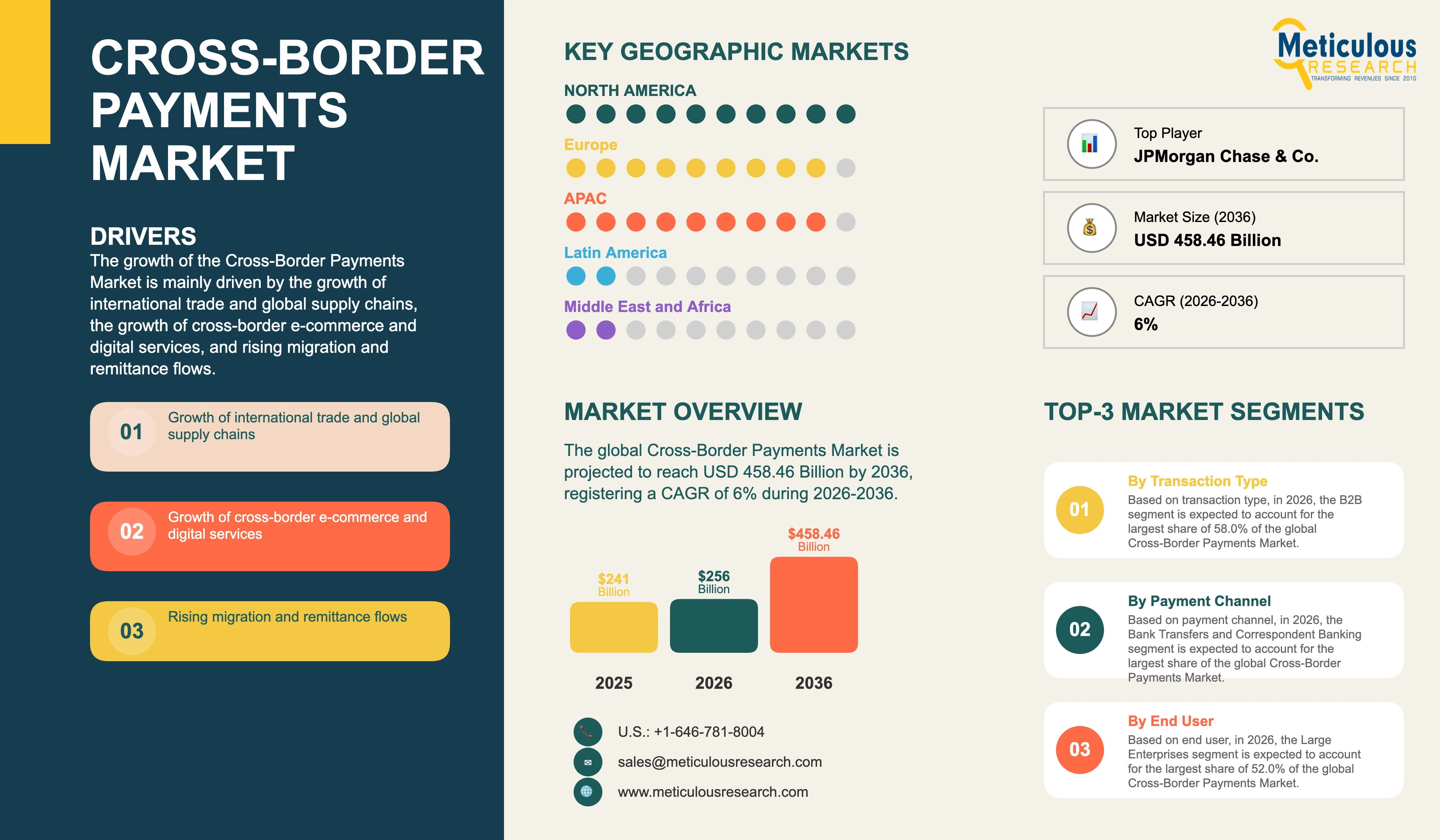
Market dynamics
15 factors across 5 forcesGrowth of international trade and global supply chains
International trade in goods and services involves tens of trillions of dollars in cross-border payments each year, as businesses pay suppliers, receive payments from customers, and move funds between subsidiaries in different countries. Global supply chains, outsourcing, and the growth of services trade, such as software, consulting, and digital services, increase the number and value of cross-border business payments.
Although trade tensions and higher tariffs have affected some trade flows, companies are diversifying their supply chains to new countries, such as India, Vietnam, Mexico, and other emerging markets, which creates new payment corridors. Nearshoring to Mexico and friend-shoring to allied countries are changing the geography of trade payments. B2B accounts for the largest share of the market by transaction type, and large enterprises account for the largest share by end user. The growth of trade between emerging markets, such as trade between China and Africa, the Middle East, and Latin America, is also creating new payment corridors that require local currency and foreign exchange services. Services trade, including software, business process outsourcing, and digital services, is growing faster than goods trade and generates large numbers of cross-border payments.
Growth of cross-border e-commerce and digital services
Consumers in both developed and emerging markets increasingly buy goods and services from foreign websites and marketplaces, such as Amazon, AliExpress, Temu, and Shein, and subscribe to digital services from foreign providers. Online sellers and marketplaces need to accept payments in many currencies and payment methods and to pay sellers and suppliers in different countries.
The rapid growth of the creator economy, freelancing, and the gig economy also creates strong demand for cross-border payouts, as platforms pay creators, freelancers, and workers in many countries. C2B payments are a large and growing part of the market, and B2C payouts form the fastest-growing transaction type. Cross-border travel, which recovered strongly after the pandemic, also generates significant revenue for card networks and payment providers through cross-border card fees and dynamic currency conversion. Merchants increasingly offer local payment methods, such as Pix, UPI, and digital wallets, to foreign customers, which requires cross-border acquiring and settlement services.
Rising migration and remittance flows
The number of international migrants worldwide continues to grow, and remittances are one of the largest sources of external financing for many developing countries, exceeding foreign direct investment and development aid in many cases. According to the World Bank, remittances to low- and middle-income countries reached an estimated USD 685 billion in 2024, with India, Mexico, the Philippines, Egypt, and Pakistan among the largest recipients.
Digital remittance providers, such as Wise, Remitly, and others, are growing quickly by offering lower costs, faster delivery, and mobile apps, and they are taking share from cash-based money transfer operators. Remittances tend to be resilient during economic downturns in receiving countries, because migrants often send more money when their families face difficulties, which supports steady demand. The shift to digital remittances is reducing costs for senders and creating opportunities for providers with efficient payment networks. Remittances are particularly important for countries such as Tajikistan, Tonga, Nepal, and Honduras, where they account for a large share of gross domestic product, and mobile money services have made it easier to receive remittances in many African and Asian countries.
International expansion of small businesses and fintech innovation
Small and medium-sized businesses are increasingly selling to and buying from foreign customers and suppliers, using e-commerce platforms, marketplaces, and digital tools. These businesses need affordable, transparent, and easy-to-use cross-border payment and foreign exchange services, which traditional banks often do not provide. Many small exporters lose a significant part of their margins to bank fees and poor exchange rates, which makes cost a key factor in their choice of provider.
Fintech platforms, such as Wise, Airwallex, Payoneer, and others, offer low-cost multi-currency accounts, payments, cards, and payouts to small businesses at lower cost than banks, and they integrate with accounting and e-commerce software. Small and medium-sized enterprises are the fastest-growing end user segment in this market, and digital wallets and fintech platforms are among the fastest-growing payment channels. Banks are also responding by launching digital services for small business customers and partnering with fintech providers to offer better foreign exchange rates and faster payments.
Table of contents
11 chapters · 118 sections · 290 pages · click to expandGeographic analysis
North America
Largest shareIn 2026, North America is expected to account for the largest share of 31.0% of the global cross-border payments market. The large share of this region is mainly due to the large volume of trade, investment, e-commerce, and remittances involving the U.S., the central role of the U.S. dollar in global payments, and the presence of leading banks, payment networks, and fintech providers. The U.S. is the largest source of remittances in the world, with large flows to Mexico, India, China, the Philippines, and Central America, and it is home to Visa, Mastercard, PayPal, Western Union, Remitly, and large banks that process cross-border payments. U.S. dollar payments are used for a large share of global trade and finance, and many cross-border payments are cleared through U.S. banks. The introduction of a remittance excise tax on cash-funded transfers and new stablecoin regulation are changing the U.S. market. North America is expected to remain the largest region throughout the forecast period. Canada is also a large source of remittances and has growing cross-border trade and e-commerce payments, particularly with the U.S.
Asia-Pacific
Fastest growthAsia-Pacific is projected to register the highest CAGR of 7.4% during the forecast period. Growth is driven by trade and supply chain shifts, the growth of cross-border e-commerce, large remittance flows to India, the Philippines, and other countries, and the interlinking of instant payment systems across the region. China is a major center for cross-border trade payments and is promoting the use of its currency in international trade and its Cross-Border Interbank Payment System. Singapore and Hong Kong are major financial hubs for cross-border payments and fintech companies, and India and the Philippines are among the largest remittance recipients in the world.
Europe
Europe holds a significant share of the market, supported by trade, the euro, and leading fintech providers, such as Wise.
Latin America
The Middle East and Africa and Latin America hold smaller shares but are growing, supported by remittances, trade, and digital payments.
Middle East & Africa
The UAE and Saudi Arabia are major sources of remittances to South Asia and other regions, and Mexico is one of the largest remittance recipients in the world, receiving large flows from the U.S. Brazil, Colombia, and other Latin American countries are also growing markets for cross-border e-commerce and remittances, and African countries are adopting mobile money for cross-border payments. Africa's regional payment systems are also being linked.
Competitive landscape
The cross-border payments market is fragmented, with large banks, card networks, money transfer operators, digital remittance providers, fintech platforms, and blockchain-based providers. Leading companies include JPMorgan Chase, Citigroup, HSBC, Visa, Mastercard, Western Union, Euronet Worldwide, Wise, Remitly, PayPal, Payoneer, Airwallex, Ripple, and dLocal.
Large global banks dominate high-value business payments, card networks dominate consumer card payments, and money transfer operators and digital providers compete in remittances. Fintech platforms compete on price, speed, transparency, and user experience, particularly for small businesses and consumers. Many fintech platforms have built global networks of licenses and local accounts, which allow them to offer low-cost payments in many corridors, while large banks have extensive correspondent networks and corporate client relationships.
The top five players are estimated to account for 25.0% of the cross-border payments market in 2025, reflecting the large number of banks and providers. Concentration is higher in specific segments, such as card-based cross-border payments, where Visa and Mastercard dominate, and in corporate payments, where a few large banks have strong positions. Western Union, Euronet, and digital providers, such as Wise and Remitly, have strong positions in remittances.
Players use several strategies to grow and defend their positions in this market, including building global payment networks, obtaining licenses in more countries, developing APIs and embedded payment services, adopting stablecoins and blockchain technology, partnering with banks and platforms, and acquiring complementary companies. Visa and Mastercard have expanded their account-to-account and payout networks, and JPMorgan has developed its Kinexys blockchain platform.
Competition is expected to center on cost, speed, transparency, coverage, compliance, and the ability to serve small businesses and platforms. Providers with global networks, efficient technology, and strong compliance are expected to gain share. Partnerships between banks and fintech companies, such as banks using Wise's infrastructure for their customers' international payments, are expected to become more common. Fintech platforms are also expanding into larger business payments, while banks are improving their services for smaller customers. Stablecoin issuers and blockchain-based payment companies are emerging competitors, particularly for business payments in emerging markets. Payment networks are also building partnerships with fintech companies and banks to extend their reach.
Some of the key players operating in the cross-border payments market are JPMorgan Chase & Co., Citigroup Inc., HSBC Holdings plc, Visa Inc., Mastercard Incorporated, The Western Union Company, Euronet Worldwide, Inc. (Ria), Wise plc, Remitly Global, Inc., PayPal Holdings, Inc., Payoneer Global Inc., Airwallex Pty Ltd, Ripple Labs, Inc., and DLocal Limited.
- —
Swift completed the move to ISO 20022 for cross-border payments in November 2025, the U.S. introduced a remittance excise tax on cash-funded transfers in 2026, the GENIUS Act created a framework for payment stablecoins, and instant payment systems are being linked across borders.
- JPMorgan Chase
- Citigroup
- HSBC
- Visa
- Mastercard
- Western Union
- Euronet Worldwide · Ria
- Wise
- Remitly
- PayPal
- Payoneer
- Airwallex
- Ripple
- dLocal
Expert perspectives
The cross-border payments market is changing rapidly and in many directions at once, as fintech platforms, digital remittance providers, card networks, and blockchain-based rails challenge traditional correspondent banking. Costs are falling, speed is increasing, and new services are making cross-border payments easier for consumers and small businesses.
Over the forecast period, the market is expected to grow at about 6.0% per year in revenue terms, supported by trade, e-commerce, migration, and small business expansion, while price competition limits value growth. Payment volumes are expected to grow faster than revenue as costs per transaction decline. New technologies, such as stablecoins and linked instant payment systems, are expected to accelerate this trend. However, growing trade, migration, and digital commerce are expected to support steady revenue growth despite lower prices. Value-added services are expected to offset part of the decline in fees.
B2C is the fastest-growing transaction type, stablecoin and blockchain-based rails are the fastest-growing payment channel, and small and medium-sized enterprises are the fastest-growing end user. B2B, bank transfers and correspondent banking, and large enterprises remain the largest segments.
North America remains the largest region, while Asia-Pacific is the fastest-growing region at a CAGR of 7.4%. The main swing factors are trade policies, stablecoin regulation and adoption, the interlinking of instant payment systems, and progress toward the G20 targets.
For businesses and consumers that send money abroad, the key decisions are which providers and channels offer the best combination of cost, speed, and reliability. For providers, success depends on global coverage, efficient technology, strong compliance, and the ability to integrate cross-border payments into platforms and workflows. Banks will need to modernize their services and partner with fintech companies to remain competitive, while fintech platforms will need to strengthen compliance as they grow.
Overall, cross-border payments are expected to become faster, cheaper, and more transparent over the forecast period, with revenue shifting toward providers that combine global reach with digital and blockchain-based capabilities. Remittances and small business payments are expected to see the largest reductions in cost. Large corporations are expected to continue relying on banks for most of their cross-border payments, but they will increasingly use new rails, such as tokenized deposits and real-time payment links, for specific needs. Providers that offer the best combination of cost, speed, transparency, and reliability are expected to win in each segment. The success of the G20 roadmap, the adoption of stablecoins, and the linking of instant payment systems will be the most important factors shaping the market's structure by 2036.
Customer perspectives
Treasury Director - multinational manufacturer, Germany
We pay suppliers in more than 40 countries, and ISO 20022 and payment tracking have made bank payments more transparent, but we are also testing faster options for some corridors.
Large corporations are expected to continue using banks for most payments while adopting new rails, such as blockchain-based platforms, for specific corridors and use cases.
High-value business payments are why B2B accounts for 58.0% of the market and large enterprises account for 52.0%.
Founder - e-commerce business, Vietnam
We sell to customers in the U.S. and Europe and pay suppliers in China. A multi-currency account from a fintech provider saves us money on every transfer compared with our bank, and we receive payments faster. Our suppliers in China also prefer it.
Small businesses in Asia are expected to continue shifting their cross-border payments to fintech platforms that offer lower costs and better foreign exchange rates.
The international expansion of small businesses is why small and medium-sized enterprises are the fastest-growing end user and Asia-Pacific is the fastest-growing region.
Head of Payouts - freelance marketplace, U.S.
We pay freelancers in more than 150 countries, and stablecoin payouts and local instant payments have made it faster and cheaper to reach workers in emerging markets.
Platforms that pay workers and creators globally are expected to adopt new payout options, such as stablecoins and local instant payments, to reduce costs and improve speed.
The growth of cross-border payouts is why B2C is the fastest-growing transaction type and stablecoin rails are the fastest-growing payment channel.
Frequently asked questions
The market was valued at USD 241.00 billion in 2025 and USD 228.00 billion in 2024, and is estimated at USD 256.00 billion in 2026, measured as revenue from fees and foreign exchange margins.
Cite this report
Meticulous Research. (2026). Cross-Border Payments Market - Global Opportunity Analysis and Industry Forecast (2026-2036) (Report No. MRICT - 1042495). Meticulous Market Research Pvt. Ltd. https://www.meticulousresearch.com/product/cross-border-payments-market-7178