Cobalt Market (2026-2036)
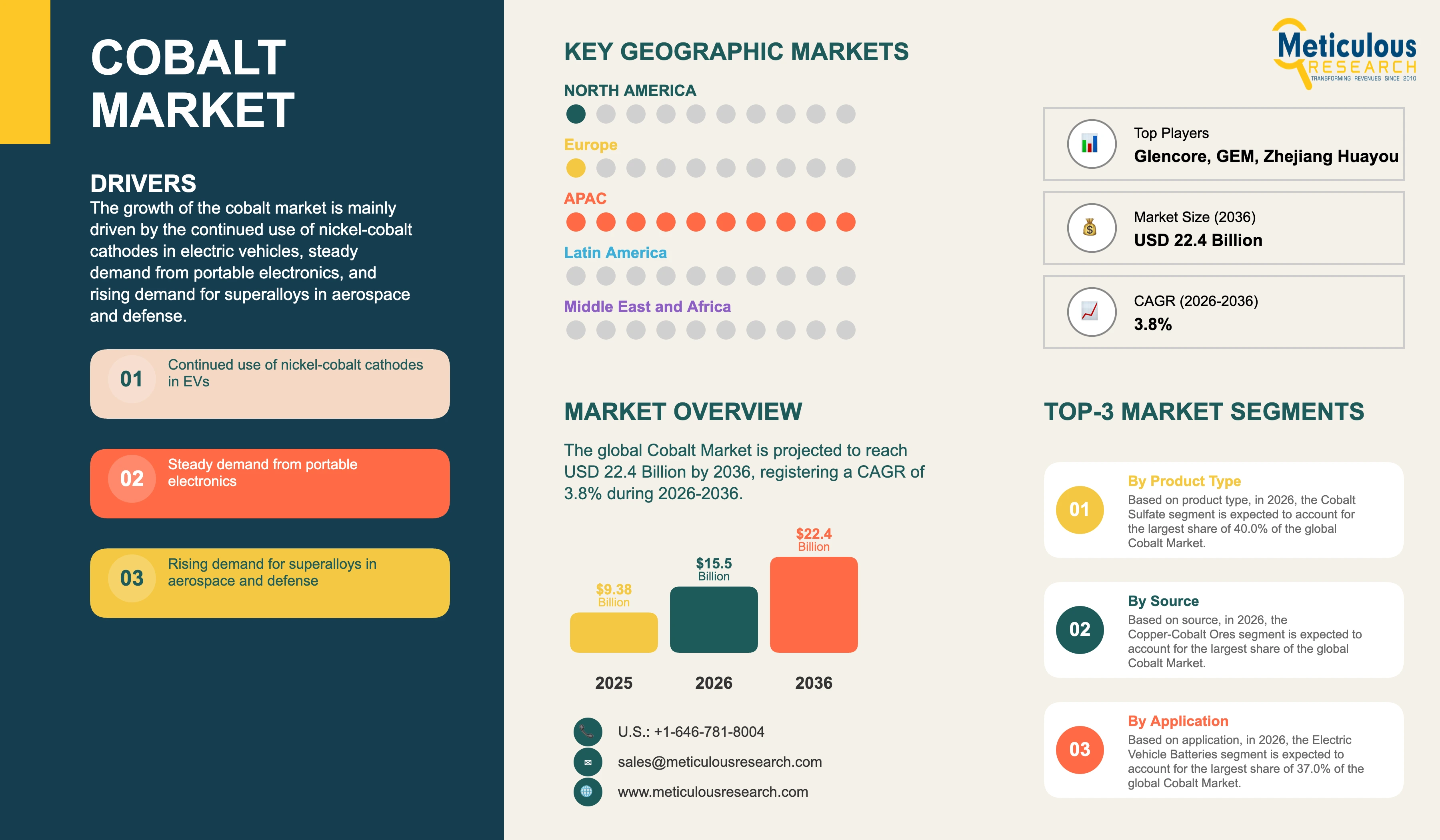
The global cobalt market was valued at USD 9.38 billion in 2025. This market is expected to reach USD 22.40 billion by 2036 from an estimated USD 15.50 billion in 2026, registering a CAGR of 3.8% during the forecast period (2026-2036). In terms of volume, this market is expected to reach 509.0 kilotons by 2036 from an estimated 298.0 kilotons in 2026, registering a CAGR of 5.5% during the forecast period.
- Published
- Nov 2026
- Pages
- 289
- Format
- PDF + Excel
- Report ID
- MRCHM - 1042497
- Base year
- 2025
- 2025 · BASELINE
- $9.38B
- 2036
- $22.40B
- CAGR 2026–2036
- 3.8%
2025 baseline · 2026–2036 forecast at 3.8% CAGR · hover a bar for the value
Key highlights
Total cobalt demand reached 276 kilotons in 2025, up 13% from 2024, while global mined supply was flat at about 270 kilotons, with the DRC accounting for 73% and Indonesia for 14%, according to the Cobalt Institute's Cobalt Market Report 2025.
The DRC banned cobalt exports in February 2025 and replaced the ban with a quota system in October 2025, which limits exports to 96,600 tons per year in 2026 and 2027, including a 9,600-ton strategic reserve, or roughly half of 2024 export volumes.
Cobalt prices rose sharply after the DRC's export restrictions, from about USD 20,000 per ton in February 2025 to more than USD 56,000 per ton in January 2026, while cobalt sulfate prices rose by about 266% during 2025.
CMOC Group produced a record 117, 549 tons of cobalt in 2025 but received a 2026 export quota of only 31,200 tons, while Eurasian Resources Group cut its cobalt hydroxide output by 70% in 2025 because of the export ban and quota system.
The Cobalt Institute estimates that global mine supply will fall to about 225 kilotons in 2026, including yield losses and a disruption allowance, while demand is expected to grow by 8.0% in 2026, and Indonesian supply already exceeded DRC exports in 2025.
Battery applications accounted for about 70% of global cobalt consumption in 2025, with portable electronics and power batteries the two largest uses, while superalloys, hard metals, catalysts, and magnets accounted for most of the rest.
The EU Battery Regulation requires battery passports from 2027 and sets minimum recycled cobalt content targets for new industrial and electric vehicle batteries from 2031, supporting investment in cobalt recycling in Europe.
Cobalt metal is the fastest-growing product type, recycled cobalt is the fastest-growing source, and superalloys are the fastest-growing application.
Glencore became the first company to export cobalt under the DRC quota system in December 2025, and CMOC's Tenke Fungurume Mining began its first quota shipments later that month.
By product type, cobalt sulfate accounts for the largest share of 40.0% in 2026, while cobalt metal registers the highest CAGR.
By source, copper-cobalt ores account for the largest share in 2026, while recycled cobalt registers the highest CAGR.
By application, electric vehicle batteries account for the largest share of 37.0% in 2026, while superalloys register the highest CAGR.
By geography, Asia-Pacific accounts for the largest share of 80.0% in 2026, while North America registers the highest CAGR of 7.1%.
Report summary
| Particulars | Details |
|---|---|
| Base Year | 2025 |
| Estimated Year | 2026 |
| Forecast Period | 2026-2036 |
| Market Size in 2025 | USD 9.38 billion |
| Market Size in 2026 | USD 15.50 billion |
| Market Size by 2036 | USD 22.40 billion |
| CAGR (2026-2036), Value | 3.8% |
| Format | PDF, Excel & Cloud Portal · 289 pages |
| Market Volume (2026 to 2036) | 298.0 kilotons to 509.0 kilotons of contained cobalt (CAGR 5.5%) |
| Largest Segment by Product Type (2026) | Cobalt Sulfate (40.0%) |
| Largest Segment by Application (2026) | Electric Vehicle Batteries (37.0%) |
| Largest Region (2026) | Asia-Pacific (80.0%) |
| Fastest-Growing Region | North America (CAGR 7.1%) |
| Segments Covered | Product Type, Source, Application, and Geography |
| Geographic Scope | Asia-Pacific, Europe, North America, and Rest of the World |
| Key Companies Profiled | Glencore, Huayou Cobalt, GEM, Jinchuan Group, Hanrui Cobalt, Umicore, Sumitomo Metal Mining, Sherritt, Vale Base Metals, Nornickel, Harita Nickel, Lygend Resources, Brunp, and Electra Battery Materials |
Report overview
Segments covered: product type, source, application.
The growth of this market is mainly driven by the continued use of nickel-cobalt cathodes in electric vehicle batteries, particularly in Europe, North America, Japan, and South Korea, steady demand for lithium cobalt oxide batteries in smartphones, laptops, and other portable electronics, rising demand for cobalt-based superalloys in aerospace and defense, and government efforts to secure cobalt supply outside China and the Democratic Republic of the Congo (DRC). However, factors such as the shift to cobalt-free lithium iron phosphate (LFP) batteries, the extreme concentration of supply in the DRC and of refining in China, and the high volatility of cobalt prices caused by DRC export policy are expected to restrain the growth of this market to some extent.
Cobalt is a hard, heat-resistant metal that is used mainly in rechargeable lithium-ion batteries, where it stabilizes the cathode and improves energy density and safety, and in superalloys, hard metals, magnets, catalysts, and other industrial products. Most cobalt is produced as a by-product of copper mining in the DRC and of nickel mining in Indonesia, Australia, Canada, Russia, and other countries, and it is then refined into cobalt sulfate, cobalt oxide, cobalt metal, powders, and other chemicals. This market covers the sale of refined cobalt products, measured in value and in kilotons of contained cobalt, and excludes intermediate products, such as cobalt hydroxide and mixed hydroxide precipitate, which are sold to refiners. Contained cobalt is used as the volume measure so that different products, such as sulfate, oxide, and metal, can be compared on the same basis.
Batteries account for more than two-thirds of cobalt demand, as cobalt sulfate is used to make nickel-cobalt-manganese (NCM) and nickel-cobalt-aluminum (NCA) cathodes for electric vehicles, while cobalt oxide and tetroxide are used to make lithium cobalt oxide (LCO) cathodes for smartphones, laptops, tablets, and wearables. Superalloys for jet engines and gas turbines, hard metals for cutting tools and mining equipment, samarium cobalt and other magnets, catalysts for refining and chemicals, and pigments and ceramics account for most of the remaining demand. Cobalt is also used in tire adhesives, animal feed additives, and medical implants, although these uses are small.
The supply of cobalt is highly concentrated, as the DRC produced about 73% of the world's mined cobalt in 2025, mainly from large copper-cobalt mines operated by CMOC, Glencore, Eurasian Resources Group, and others, while Indonesia has quickly become the second-largest producer through high-pressure acid leach (HPAL) nickel projects that produce cobalt as a by-product. China refines most of the world's cobalt, through companies such as Huayou Cobalt, GEM, Jinchuan Group, and Hanrui Cobalt, and outside China, Umicore, Sumitomo Metal Mining, Glencore, Sherritt, Vale, and Nornickel are major refiners. The DRC's large artisanal mining sector also contributes to supply, although its share has declined as industrial mining has grown.
The market has been through extreme price swings in recent years, as cobalt prices peaked at about USD 82,000 per ton in 2022 and then fell to about USD 20,000 per ton by February 2025 as output from CMOC's DRC mines and Indonesian HPAL projects grew much faster than demand. In response, the DRC banned cobalt exports in February 2025 and replaced the ban in October 2025 with a quota system that limits exports to roughly half of 2024 levels in 2026 and 2027. Prices more than doubled, and the value of the market rose sharply in 2025 and 2026. The Cobalt Institute estimates that the export restrictions reduced the cobalt available to the market to about 183 kilotons in 2025, well below demand of 276 kilotons, which drew down inventories built during the surplus years.
Demand growth is being shaped by battery chemistry choices, as Chinese battery makers have shifted heavily to cobalt-free LFP batteries for electric vehicles and energy storage, and many NCM cathodes now use less cobalt than in the past. However, nickel-rich NCM and NCA batteries remain dominant in Europe, North America, Japan, and South Korea, particularly for long-range vehicles, and LCO batteries remain the standard for most portable electronics. Defense and aerospace demand for superalloys and magnets is also rising. The overall effect is slower but still positive growth in cobalt demand, with batteries remaining the largest use.
Governments in the U.S., the EU, Japan, and other countries have designated cobalt as a critical mineral and are supporting new supply outside the DRC and China, including refineries in Canada, the U.S., Finland, and Australia, and recycling of spent batteries. Over the forecast period, cobalt demand is expected to continue growing, although at a slower pace than other battery materials, while prices are expected to ease from the high levels of 2026 as Indonesian supply and recycling grow, which is why the market's value is expected to grow more slowly than its volume.
Report infographic
Market dynamics
15 factors across 5 forcesContinued use of nickel-cobalt cathodes in electric vehicles
Although LFP batteries have gained share, nickel-cobalt cathodes such as NCM and NCA remain the main chemistry for longer-range electric vehicles, particularly in Europe, North America, Japan, and South Korea. More than 90% of electric vehicle batteries in North America and Europe used cobalt-containing chemistries in recent years, and automakers such as Tesla, BMW, Mercedes-Benz, Volkswagen, Hyundai, and General Motors continue to use NCM or NCA cells in many models.
As electric vehicle production grows in these regions, cobalt demand from batteries is expected to keep rising, even as the cobalt content per kWh falls with high-nickel cathodes. Electric trucks, premium vehicles, and performance models also tend to use nickel-cobalt chemistries because of their higher energy density. Electric vehicle batteries account for the largest share of the market. Hybrid vehicles, which use smaller batteries but are growing quickly in Japan, the U.S., and other markets, often use nickel-based chemistries that contain cobalt. Battery makers such as LG Energy Solution, Samsung SDI, SK On, Panasonic, and CATL buy large volumes of cobalt sulfate for these cathodes. Supply chain rules in the U.S. and EU, which favor batteries made in their regions, are also encouraging NCM cell production outside China, which supports demand for non-Chinese cobalt sulfate.
Steady demand from portable electronics
Lithium cobalt oxide batteries remain the standard for smartphones, laptops, tablets, wearables, and other portable electronics, because they offer high energy density in small, thin cells. Consumer electronics accounted for a large share of cobalt demand in 2025, and new products, such as AI-enabled smartphones and laptops with larger batteries, foldable phones, and wearables, continue to support demand.
Portable electronics demand is less sensitive to the shift to LFP than electric vehicles, because LFP's lower energy density is not suitable for most small devices. Apple and other electronics makers have also committed to using recycled cobalt in their batteries, which supports demand for recycled cobalt oxide. Portable electronics batteries account for a large share of the market. Growing use of AI features is also increasing battery sizes in smartphones and laptops, which raises cobalt use per device. Drones, power tools, and e-bikes also use cobalt-containing batteries. The replacement cycle of hundreds of millions of smartphones and laptops each year provides a large and stable base of demand.
Rising demand for superalloys in aerospace and defense
Cobalt-based and cobalt-containing superalloys are essential for jet engine turbine blades, gas turbines, and other components that must withstand extreme heat and stress. The recovery of commercial aviation, record order backlogs at Airbus and Boeing, growing demand for gas turbines for power generation and data centers, and higher defense spending are all increasing demand for superalloys.
Defense agencies in the U.S. and Europe consider cobalt a strategic material and are increasing stockpiles and supporting domestic supply. Samarium cobalt magnets, used in high-temperature defense and aerospace applications, add further demand. Superalloys are the fastest-growing application in this market. Engine makers such as GE Aerospace, Pratt & Whitney, Rolls-Royce, and Safran are increasing production to meet record aircraft backlogs. Hard metals for cutting tools and mining equipment also provide steady demand linked to industrial activity. Orders for gas turbines have risen sharply as utilities and data center operators add power capacity, which increases demand for cobalt-containing turbine components.
Government efforts to secure cobalt supply
Cobalt is listed as a critical mineral in the U.S., the EU, Japan, the U.K., Canada, Australia, and India, and governments are funding new mines, refineries, recycling plants, and stockpiles to reduce dependence on the DRC and China. The U.S. has supported cobalt refining and recycling projects, the EU's Critical Raw Materials Act sets targets for domestic processing and recycling, and Japan and South Korea maintain strategic stockpiles.
These policies create demand for cobalt from non-Chinese refiners, such as Umicore, Sumitomo Metal Mining, Sherritt, and Electra Battery Materials, and support new refining capacity in North America and Europe. Rules that limit the use of Chinese-processed materials in subsidized products also encourage battery makers to diversify their cobalt supply. North America is the fastest-growing region in this market. Several governments have also signed critical minerals agreements with the DRC, Zambia, and other producing countries to secure supply for their industries.
Table of contents
11 chapters · 112 sections · 289 pages · click to expandSegmental analysis
| Segment | Largest share (2026) | Fastest growth (2026–2036) |
|---|---|---|
| By Product Type | Cobalt sulfate | Cobalt metal |
| By Source | Copper-cobalt ores | Recycled cobalt |
| By Application | Electric vehicle batteries | Superalloys |
By Product Type
- The cobalt sulfate segment is expected to account for the largest share of 40.0% of the global cobalt market.
- The large share of this segment is mainly due to its use as the main cobalt input for NCM and NCA cathodes in electric vehicle batteries, which account for the largest share of cobalt demand.
- Cobalt sulfate is produced mainly in China by refiners such as Huayou Cobalt, GEM, Jinchuan Group, and Hanrui Cobalt, using cobalt hydroxide from the DRC and mixed hydroxide precipitate from Indonesia, and in smaller volumes by Umicore, Sumitomo Metal Mining, and others.
- Integrated Indonesian HPAL projects, such as those of Harita Nickel and Lygend Resources, are also producing cobalt sulfate directly.
- Cathode makers in China, South Korea, and Japan buy cobalt sulfate to produce precursor materials, and battery-grade quality, consistency, and traceability are key factors in supplier selection.
- Cobalt sulfate prices rose by about 266% during 2025 after the DRC's export restrictions, and Chinese refiners have also used cobalt metal as a feedstock for sulfate when hydroxide supply was tight.
- Demand for cobalt sulfate is expected to grow with electric vehicle production in Europe, North America, and Asia, although at a slower pace than overall battery demand because of the shift to LFP and lower-cobalt cathodes.
- However, the cobalt metal segment is projected to register the highest CAGR during the forecast period.
- The rapid growth of this segment is driven by rising demand for superalloys, magnets, and other defense and aerospace applications, government stockpiling, and the use of metal as a flexible feedstock for chemicals, particularly when hydroxide supply is constrained.
- Cobalt oxide and tetroxide and cobalt powders and other chemicals make up the rest of the market.
- Cobalt oxide and tetroxide are used mainly to make lithium cobalt oxide cathodes for portable electronics, with Chinese producers such as Huayou Cobalt and GEM among the largest suppliers, while cobalt powders are used in hard metals, superalloys, and diamond tools.
- Cobalt metal is produced by refiners such as Glencore's Nikkelverk, Umicore, Sherritt, Nornickel, Vale, Jinchuan, and Hanrui Cobalt.
By Source
- The copper-cobalt ores segment is expected to account for the largest share of the market.
- The large share of this segment is mainly due to the DRC's dominant position in cobalt mining, where cobalt is produced as a by-product of large copper mines operated by CMOC, Glencore, Eurasian Resources Group, and others.
- The DRC's copper-cobalt belt contains some of the world's richest cobalt deposits, and mines such as CMOC's Tenke Fungurume and Kisanfu and Glencore's Kamoto and Mutanda produce large volumes of cobalt hydroxide, which is mostly shipped to China for refining.
- Because cobalt is a by-product of copper, DRC cobalt output depends partly on copper economics, which can lead to oversupply when copper production expands.
- The DRC's export quota system limits exports to about 96, 600 tons per year in 2026 and 2027, which reduces this segment's share in the short term.
- Artisanal mining also contributes a meaningful share of DRC output.
- The DRC government has also created a state-owned entity to buy artisanal cobalt, with the aim of formalizing this part of the supply chain.
- Copper-cobalt ores are expected to remain the largest source over the forecast period, although their share will decline as other sources grow.
- Large new copper-cobalt projects in the DRC, such as expansions at Kisanfu and Kamoto, could add cobalt supply if export quotas allow.
- However, the recycled cobalt segment is projected to register the highest CAGR during the forecast period.
- The rapid growth of this segment is driven by growing volumes of spent batteries, EU recycled content requirements, higher cobalt prices, and new recycling capacity in China, Europe, and North America.
- Recycling from portable electronics and battery production scrap already provides a meaningful share of cobalt supply in China.
- Nickel laterite ores and nickel sulfide and other ores make up the rest of the market.
- Nickel laterite ores processed through HPAL in Indonesia are the fastest-growing primary source, while nickel sulfide ores in Canada, Russia, and Australia provide smaller but steady volumes.
- Morocco also produces cobalt from primary cobalt arsenide ores.
By Application
- The electric vehicle batteries segment is expected to account for the largest share of 37.0% of the market.
- The large share of this segment is mainly due to the large volume of NCM and NCA batteries used in electric vehicles, particularly in Europe, North America, Japan, and South Korea.
- Electric vehicles became the largest source of cobalt demand in recent years, as NCM and NCA batteries were used in most electric vehicles outside China and in many vehicles in China.
- Each NCM battery pack contains several kilograms of cobalt, although the amount per vehicle has fallen as cathodes have moved to higher nickel content.
- Long-term supply agreements between battery makers and refiners, often linked to cobalt price indices, are common in this segment.
- Automakers in Europe and North America continue to rely on nickel-cobalt chemistries for long-range models, and battery makers such as LG Energy Solution, Samsung SDI, SK On, and Panasonic are major users of cobalt sulfate.
- Growth in this segment is expected to be moderate, as the shift to LFP in China and in lower-cost models elsewhere offsets growth in total electric vehicle production.
- Plug-in hybrid vehicles, which have grown strongly in China, also use a mix of chemistries.
- Battery makers are also developing new NCM chemistries for lower-cost vehicles, such as mid-nickel high-voltage cathodes, which could support cobalt demand in segments where LFP is currently gaining share.
- However, the superalloys segment is projected to register the highest CAGR during the forecast period.
- The rapid growth of this segment is driven by strong demand for jet engines, gas turbines, and defense equipment.
- Superalloy producers such as Precision Castparts, Howmet Aerospace, ATI, Haynes International, and VDM Metals are major buyers of high-purity cobalt metal, and their order books have grown strongly with aircraft and turbine demand.
- Portable electronics batteries, hard metals and cutting tools, catalysts, magnets, and ceramics, pigments, and other applications make up the rest of the market.
- Portable electronics batteries are the second-largest application and provide a large, stable base of demand for cobalt oxide, while hard metals, catalysts, and magnets are smaller industrial uses.
Geographic analysis
Asia-Pacific
Largest shareIn 2026, Asia-Pacific is expected to account for the largest share of 80.0% of the global cobalt market. The large share of this region is mainly due to China's dominant position in cobalt refining, cathode production, and battery manufacturing, as well as large battery and electronics industries in South Korea and Japan. China refines most of the world's cobalt and produces most of its cathode materials and lithium-ion batteries, making it by far the largest consumer of refined cobalt. Chinese refiners, such as Huayou Cobalt, GEM, Jinchuan Group, and Hanrui Cobalt, process cobalt hydroxide from the DRC and mixed hydroxide precipitate from Indonesia, and Chinese companies control many of the largest mines in both countries. South Korea and Japan are major users of cobalt for NCM and NCA cathodes made by companies such as POSCO Future M, EcoPro, L&F, and Sumitomo Metal Mining, and for batteries made by LG Energy Solution, Samsung SDI, SK On, and Panasonic. Indonesia is a growing producer and is building a domestic battery industry, while India is developing battery manufacturing. Asia-Pacific's share is expected to decline slightly over the forecast period as refining and battery production grow in North America and Europe. Japan and South Korea also maintain national cobalt stockpiles to protect their industries from supply disruptions.
North America
Fastest growthNorth America is projected to register the highest CAGR of 7.1% during the forecast period. Growth is driven by new battery plants in the U.S. and Canada, government support for domestic cobalt refining and recycling, defense demand, and supply chain rules that favor non-Chinese materials. Canada has cobalt production from nickel mines in Ontario and Quebec and is developing new refining capacity, which supports regional supply.
Europe
Europe holds a smaller share of the market, supported by Umicore's operations, refineries in Finland and Norway, battery plants in Poland, Hungary, and Germany, and demand from aerospace and industrial users, along with the EU's Battery Regulation and Critical Raw Materials Act. Belgium is home to Umicore's headquarters and research operations, and Germany, France, and the U.K. have large aerospace and industrial users of cobalt. The Rest of the World includes the Middle East and Africa and Latin America, where the DRC and Morocco are producers but consumption is small. Finland hosts one of the largest cobalt refineries in Europe at Kokkola, which supplies European cathode makers. Europe also has growing recycling capacity.
Competitive landscape
The cobalt market is moderately concentrated at the refining stage, with Chinese refiners holding a large share and a smaller group of refiners in Europe, Japan, Canada, and Russia. Leading refined cobalt producers include Zhejiang Huayou Cobalt, GEM Co., Jinchuan Group, Nanjing Hanrui Cobalt, Umicore, Sumitomo Metal Mining, Glencore, Sherritt International, Vale, and Nornickel. Mining is dominated by CMOC Group and Glencore in the DRC, followed by Eurasian Resources Group and Indonesian HPAL producers.
Many refiners are integrated upstream into mining or intermediates and downstream into cathode precursors and recycling. Huayou Cobalt and GEM own or partner in Indonesian HPAL projects, Glencore operates both mines and the Nikkelverk refinery in Norway, and Umicore combines refining, cathode production, and recycling. Indonesian producers such as Harita Nickel and Lygend Resources produce cobalt sulfate from their HPAL operations, and recyclers such as Brunp produce cobalt chemicals from spent batteries.
The top five players are estimated to account for 38.5% of the market in 2025, reflecting the strong positions of leading Chinese refiners and integrated producers. Competition among refiners in China is intense, particularly when feedstock is scarce, as during the DRC export restrictions. Mining companies such as CMOC and Glencore have a strong influence on the market through their control of feedstock, even though most of their cobalt is sold as intermediates.
Players use several strategies to grow in this market, including securing feedstock through mine investments and long-term offtake agreements, expanding refining and recycling capacity, integrating into cathode precursors, building operations outside China to meet supply chain rules, and investing in responsible sourcing and traceability. Competition is expected to center on feedstock security, cost, product quality, ESG performance, and the ability to supply customers in different regions under evolving trade rules. Smaller refiners often compete by focusing on specialty products, such as cobalt powders and high-purity metal for aerospace and defense. New entrants in North America and Europe are seeking government support and long-term offtake agreements to compete with established Chinese refiners.
Some of the key players operating in the cobalt market are Glencore plc, Zhejiang Huayou Cobalt Co., Ltd., GEM Co., Ltd., Jinchuan Group Co., Ltd., Nanjing Hanrui Cobalt Co., Ltd., Umicore SA, Sumitomo Metal Mining Co., Ltd., Sherritt International Corporation, Vale Base Metals, PJSC MMC Norilsk Nickel, PT Trimegah Bangun Persada Tbk (Harita Nickel), Lygend Resources & Technology Co., Ltd., Guangdong Brunp Recycling Technology Co., Ltd., and Electra Battery Materials Corporation.
- —
The DRC introduced export quotas of 96,600 tons per year for 2026 and 2027, CMOC produced a record 117,549 tons in 2025 but received a 2026 quota of 31,200 tons, cobalt prices exceeded USD 56,000 per ton in January 2026, and Indonesian supply exceeded DRC exports in 2025.
- Glencore
- Huayou Cobalt
- GEM
- Jinchuan Group
- Hanrui Cobalt
- Umicore
- Sumitomo Metal Mining
- Sherritt
- Vale Base Metals
- Nornickel
- Harita Nickel
- Lygend Resources
- Brunp
- Electra Battery Materials
Expert perspectives
The cobalt market is defined by a tension between steady long-term demand growth and an extremely concentrated, policy-driven supply side. The DRC's export ban in 2025 and its quota system for 2026 and 2027 turned a large surplus into a tight market and more than doubled prices, showing how much influence a single producing country can have. Indonesian supply growth and recycling are expected to reduce this dependence over time, but the DRC will remain the largest source for many years. The DRC's experience may also encourage other producing countries to manage supply more actively, which could make cobalt prices more policy-driven in the future.
On the demand side, the shift to LFP batteries and lower-cobalt cathodes has slowed cobalt demand growth compared with other battery materials, but nickel-cobalt batteries remain essential for long-range vehicles in Western markets, LCO batteries remain the standard for portable electronics, and aerospace and defense demand is rising. As a result, demand is expected to grow steadily in volume terms, while prices are expected to ease from 2026 levels as supply diversifies, which limits value growth.
Cobalt metal is the fastest-growing product type, recycled cobalt is the fastest-growing source, and superalloys are the fastest-growing application, reflecting the importance of aerospace, defense, and recycling. Cobalt sulfate, copper-cobalt ores, and electric vehicle batteries remain the largest segments.
Asia-Pacific remains the dominant region, while North America is the fastest-growing region at a CAGR of 7.1%. The main swing factors are DRC export policy after 2027, the pace of Indonesian HPAL growth, battery chemistry choices in electric vehicles, the adoption of sodium-ion and other cobalt-free technologies, and government supply chain policies. Responsible sourcing requirements will also continue to shape which suppliers can serve key customers. The development of new cobalt-free battery chemistries is the largest downside risk to long-term demand.
For battery makers, automakers, and electronics companies, the key decision is how to secure responsibly sourced cobalt at manageable cost while reducing exposure to a single country, through diversification, long-term contracts, recycling, and chemistry choices. For producers, success depends on feedstock security, refining capability, ESG performance, and access to customers outside China, particularly as trade rules tighten. Recycling will become an increasingly important part of supply strategies in the second half of the forecast period.
Overall, the cobalt market is expected to grow steadily in volume, supported by electric vehicles, electronics, and aerospace, while prices and supply will remain closely tied to policy decisions in the DRC and supply growth in Indonesia. Recycling will gradually add supply.
Customer perspectives
The continued use of nickel-cobalt batteries in Western electric vehicles is why electric vehicle batteries account for 37.0% of the market and why cobalt sulfate accounts for 40.0% of the market by product type.
Procurement Director - Aerospace engine supplier, U.S.
Aircraft engine demand is at record levels, and our superalloys depend on high-purity cobalt. We have moved to multi-year contracts with non-Chinese suppliers and are supporting domestic refining where we can.
Strong aerospace and defense demand is driving the fast growth of the superalloys segment and of cobalt metal, and supply chain policies are supporting rapid growth in North America, the fastest-growing region at a CAGR of 7.1%.
China's central role in refining and battery production is why Asia-Pacific holds 80.0% of the market, while Indonesian supply is becoming an increasingly important feedstock for Chinese refiners. Chinese refiners have also invested heavily in Indonesian HPAL projects to secure this feedstock. Western buyers increasingly seek non-Chinese supply options.
“Our long-range models still need nickel-cobalt cells, so cobalt remains essential for us. The DRC quota showed how fragile supply is, so we are adding Indonesian and recycled sources and asking for full traceability from every supplier.”
“When the DRC stopped exports, we turned to Indonesian MHP and cobalt metal to keep our lines running. Our customers in China, Korea, and Japan still account for most of our sales, and that is unlikely to change soon. We are also adding recycling lines to secure more feedstock.”
Frequently asked questions
The market was valued at USD 9.38 billion in 2025 and USD 5.86 billion in 2024, and is estimated at USD 15.50 billion in 2026, reflecting the sharp rise in cobalt prices after the DRC's export restrictions.
The market is expected to reach USD 22.40 billion by 2036, supported by electric vehicle batteries, portable electronics, superalloys, and government supply security efforts.
The market is expected to register a CAGR of 3.8% from 2026 to 2036 in value terms and 5.5% in volume terms, with volume rising from 298.0 kilotons in 2026 to 509.0 kilotons in 2036.
Cobalt prices in 2026 are elevated by the DRC's export quotas, and prices are expected to ease over the forecast period as Indonesian supply and recycling grow, so the market's value is expected to grow more slowly than its volume.
Growth is driven by the continued use of nickel-cobalt cathodes in electric vehicles, steady demand from portable electronics, rising demand for superalloys in aerospace and defense, and government efforts to secure cobalt supply.
The shift to cobalt-free LFP batteries and cobalt thrifting and the concentration of supply and refining restrain growth, while price volatility driven by DRC policy and responsible sourcing and ESG requirements remain key challenges.
Key opportunities include battery recycling, Indonesian supply growth, refining capacity outside China, and defense stockpiles and high-performance applications.
The DRC banned cobalt exports in February 2025 and replaced the ban with quotas from October 2025 that limit exports to 96,600 tons per year in 2026 and 2027, about half of 2024 levels. Prices rose from about USD 20,000 per ton in February 2025 to more than USD 56,000 per ton in January 2026.
LFP batteries contain no cobalt and now dominate electric vehicles in China and energy storage worldwide, which slows cobalt demand growth. However, nickel-cobalt batteries remain the main chemistry for long-range vehicles in Europe, North America, Japan, and South Korea, and lithium cobalt oxide remains the standard for portable electronics, so cobalt demand is still expected to grow.
Cobalt sulfate is expected to account for the largest share of 40.0% of the market in 2026, while cobalt metal is projected to register the highest CAGR.
Recycled cobalt is projected to register the highest CAGR among sources, while copper-cobalt ores hold the largest share.
Electric vehicle batteries are expected to account for the largest share of 37.0% of the market in 2026, while superalloys are projected to register the highest CAGR.
Asia-Pacific is expected to account for the largest share of 80.0% of the market in 2026.
North America is projected to register the highest CAGR of 7.1% during the forecast period.
The report profiles 14 companies, including Glencore, Huayou Cobalt, GEM, Jinchuan Group, Umicore, and Sumitomo Metal Mining. The top five players account for an estimated 38.5% of the market in 2025.
The DRC introduced export quotas of 96,600 tons per year for 2026 and 2027, CMOC produced a record 117,549 tons in 2025 but received a 2026 quota of 31,200 tons, cobalt prices exceeded USD 56,000 per ton in January 2026, and Indonesian supply exceeded DRC exports in 2025.
Cite this report
Meticulous Research. (2026). Cobalt Market - Global Opportunity Analysis and Industry Forecast (2026-2036) (Report No. MRCHM - 1042497). Meticulous Market Research Pvt. Ltd. https://www.meticulousresearch.com/product/cobalt-market-7180