Chrome Free Conversion Coatings Market (2026-2036)
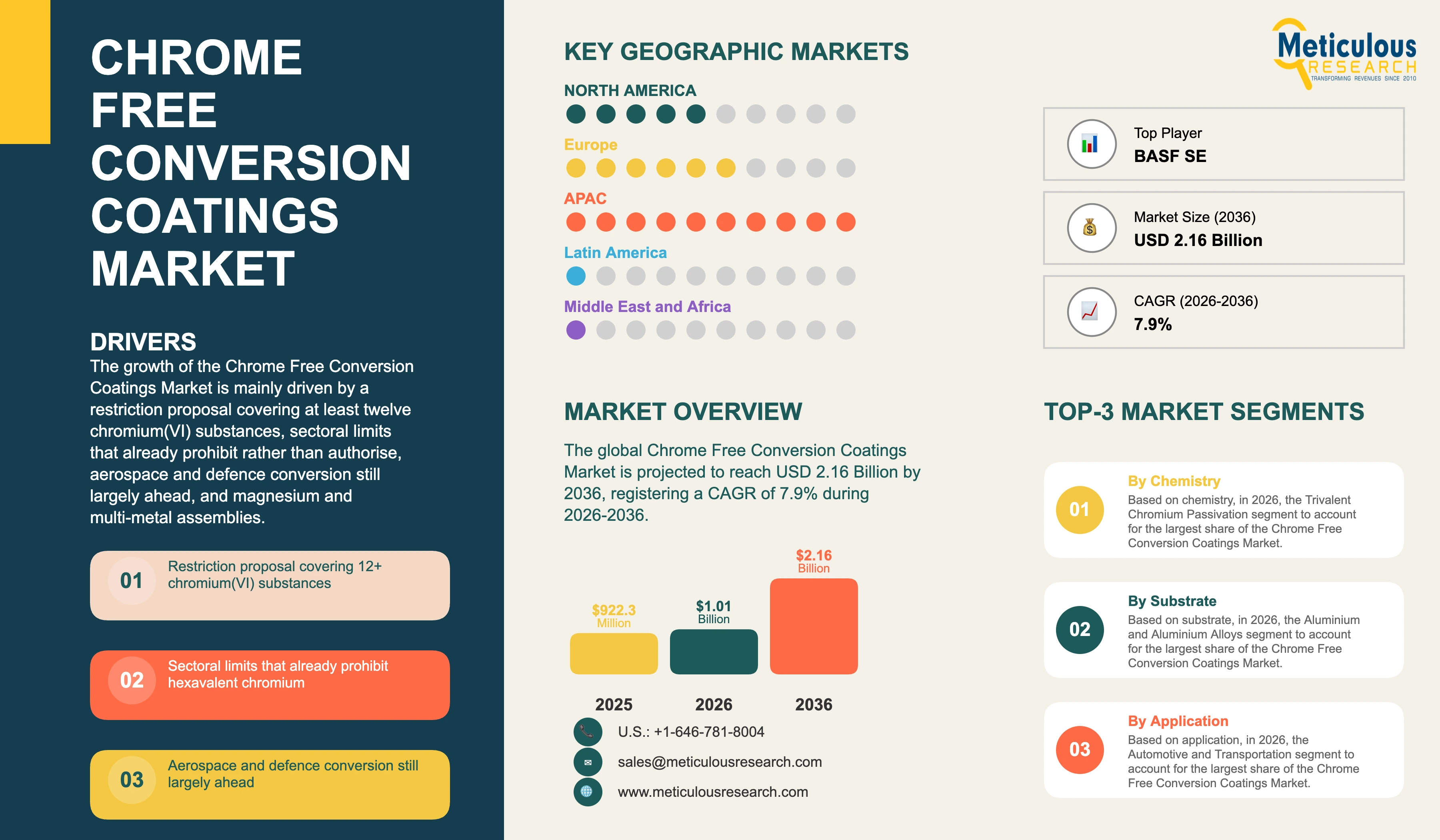
The chrome free conversion coatings market is valued at USD 1.01 billion in 2026 and is projected to reach USD 2.16 billion by 2036, at a CAGR of 7.9% during the forecast period. The market was valued at USD 922.3 million in 2025 and at USD 843.7 million in 2024.
- Published
- Nov 2026
- Pages
- 271
- Format
- PDF + Excel
- Report ID
- MRCHM - 1042774
- Base year
- 2025
- 2024 · HISTORICAL
- $843.7M
- 2036
- $2.16B
- CAGR 2026–2036
- 7.9%
2024–2025 baseline · 2026–2036 forecast at 7.9% CAGR · hover a bar for the value
Key highlights
This market measures conversion coating chemistry formulated without hexavalent chromium for aluminium, zinc, magnesium and steel substrates, taken at the chemical supplier gate on a tonne basis of product as supplied.
Excluded are hexavalent chromium conversion coatings, zinc and iron phosphate pretreatments, anodising and plating chemistry, paints and primers applied over a conversion coating, process equipment and rinse water treatment, and sealers sold without a conversion function.
The European Chemicals Agency recorded an intention dated 5 October 2023, first published on 11 October 2023, to restrict chromium trioxide, the acids generated from it and their oligomers.
Those substances are chromium trioxide at CAS 1333-82-0, dichromic acid at 13530-68-2 and chromic acid at 7738-94-5, together with oligomers of chromic and dichromic acid.
A first call for evidence ran from 13 December 2023 to 27 February 2024, and the intention was amended on 8 May 2024 at the request of the Commission to extend both scope and timeline.
The amended scope covers Authorisation List entries 16 to 22 and 28 to 31 together with barium chromate at EC 233-660-5, giving at least 12 substances against the two entries in the original September 2023 request.
The stated purpose of extending the scope is to address the risk that the authorised substances are replaced by other chromium(VI) substances that are not themselves subject to authorisation.
The date for submission of the Annex XV dossier moved from 4 October 2024 to 11 April 2025 because of that wider scope, with a second call for evidence launched in June 2024 covering alternatives and the use of chromium(VI) in spraying applications and a stakeholder webinar held on 6 June 2024.
No derogations had been proposed at the registry stage, with the agency stating that derogations may be proposed where supported by well-evidenced risk and socio-economic information and that stakeholders may propose them during consultation.
All of the substances concerned sit on the Authorisation List, so their continued use is lawful under a granted authorisation, and the agency has drawn on its experience of processing authorisation applications for exactly these substances.
Outside the chemicals regime, the restriction of hazardous substances directive limits hexavalent chromium to 0.1% by weight in homogeneous materials in electrical and electronic equipment, and the end-of-life vehicles directive restricts it in vehicles placed on the European market.
A study of four commercial trivalent chromium process coatings on aluminium alloy 2024-T3 recorded salt fog testing to MIL-DTL-5541 and MIL-DTL-81706 in 5 plus or minus 1 weight per cent sodium chloride at 35 plus or minus 2 degrees Celsius.
Failure in that protocol is defined as one panel with more than five pits or more than fifteen pits across five panels, and two of the four processes reached 336 hours with a measurable spread between all four.
The authors of that study, affiliated with a trivalent process supplier, state that hexavalent coatings can self-heal through hexavalent chromium forming trivalent oxides at damaged sites, and that trivalent conversion coatings do not exhibit that behaviour and provide barrier protection instead.
Electrochemical impedance, open circuit potential and Tafel measurements in that work ranked the four trivalent processes in the same order as the salt fog results, with two of them not statistically separated at 90% confidence.
Chrome free chemistry is estimated at 71% of all conversion coating chemistry in 2026, rising to 93% by 2036, against a total conversion coatings market growing at about 3.2% a year.
Trivalent chromium passivation is expected to hold the largest chemistry share of this market in 2026 at 31.0% and to grow slowest at 6.8%, while silane and organosilane chemistry grows fastest at 9.6%.
Aerospace and defence hold 15.0% of this market in 2026 and record the highest application CAGR at 10.4%, against 7.0% for automotive and transportation on the largest share at 29.0%.
Report summary
| Particulars | Details |
|---|---|
| Base Year | 2025 |
| Actual Years | 2024-2025 |
| Forecast Period | 2026-2036 |
| Market Size in 2024 | USD 843.7 million |
| Market Size in 2025 | USD 922.3 million |
| Market Size in 2026 | USD 1.01 billion |
| Market Size in 2036 | USD 2.16 billion |
| Value CAGR (2026-2036) | 7.9% |
| Format | PDF, Excel & Cloud Portal · 271 pages |
| Volume in 2025 | 126.00 kilotons |
| Volume in 2026 | 135.00 kilotons |
| Volume in 2036 | 243.00 kilotons |
| Volume CAGR (2026-2036) | 6.1% |
| Average Selling Price, 2026 | USD 7,480 per tonne |
| Average Selling Price, 2036 | USD 8,900 per tonne |
| Units | Value in USD million; volume in kilotons of conversion coating chemistry as supplied; price in USD per tonne |
| Measurement Basis | Conversion coating chemistry formulated without hexavalent chromium for aluminium, zinc, magnesium and steel substrates, taken at the chemical supplier gate on a tonne basis of product as supplied |
| Penetration Basis | Chrome free chemistry is estimated at 71% of all conversion coating chemistry in 2026, rising to 93% by 2036, against a total conversion coatings market growing at about 3.2% a year, so the share available to take runs down across the forecast period |
| Historical Value Growth | Value grew at 9.4% a year between 2024 and 2026 on volume growth of 7.0% a year and price growth of 2.3% a year; the forecast of 7.9% carries volume growth of 6.1% and price growth of 1.8%, the deceleration reflecting that the applications converting on a design decision have largely converted while those converting on qualification do so on programme timescales |
| Price Increase Note | The average selling price rises across the forecast period on mix rather than on repricing, as demand shifts toward trivalent chromium and multi-metal chemistries and toward aerospace qualification, all of which carry a higher price a tonne than the zirconium chemistry that converted automotive and coil volume |
| Regulatory Status Note | The chromium(VI) substances concerned sit on the REACH Authorisation List rather than under a prohibition, so continued use is lawful under a granted authorisation, and the European Chemicals Agency has drawn on its experience of processing authorisation applications for exactly these substances; the restriction that would close that route is not yet in force |
| Restriction Timeline Basis | An intention dated 5 October 2023 was first published on 11 October 2023 covering chromium trioxide at CAS 1333-82-0, dichromic acid at 13530-68-2, chromic acid at 7738-94-5 and their oligomers; a first call for evidence ran from 13 December 2023 to 27 February 2024; the intention was amended on 8 May 2024 at the request of the Commission to extend scope and timeline; a second call for evidence was launched in June 2024 covering alternatives and the use of chromium(VI) in spraying applications, with a stakeholder webinar on 6 June 2024; the Annex XV submission date moved from 4 October 2024 to 11 April 2025 |
| Restriction Scope Note | The amended scope covers Authorisation List entries 16 to 22 and 28 to 31 together with chromium(VI) substances outside Annex XIV carrying a potential for regrettable substitution, specifically barium chromate at EC 233-660-5, giving at least 12 substances against the two entries in the original September 2023 request; no derogations had been proposed at the registry stage |
| Regrettable Substitution Note | The stated purpose of extending the scope is to address the risk that the authorised substances are replaced by other chromium(VI) substances that are not themselves subject to authorisation, so the restriction closes routes rather than accelerating a substitution already under way |
| Sectoral Legislation Basis | The restriction of hazardous substances directive limits hexavalent chromium to 0.1% by weight in homogeneous materials in electrical and electronic equipment, and the end-of-life vehicles directive restricts it in vehicles placed on the European market; neither operates an authorisation route, which is why automotive, appliance and electronics pretreatment converted ahead of the chemicals regime |
| Performance Gap Basis | A study of four commercial trivalent chromium process coatings on aluminium alloy 2024-T3, whose authors are affiliated with a trivalent process supplier, states that hexavalent coatings can self-heal through hexavalent chromium forming trivalent oxides at damaged sites and that trivalent conversion coatings do not exhibit that behaviour, providing barrier protection instead |
| Qualification Test Basis | The same study recorded salt fog testing to MIL-DTL-5541 and MIL-DTL-81706 in 5 plus or minus 1 weight per cent sodium chloride at 35 plus or minus 2 degrees Celsius, with failure defined as one panel with more than five pits or more than fifteen pits across five panels; two of the four processes reached 336 hours, and open circuit potential, electrochemical impedance and Tafel measurements ranked the four in the same order as salt fog, with two not statistically separated at 90% confidence |
| Overlap Note | Zirconium chemistries counted here are also counted in the Zirconium Pretreatment Chemicals Market title and silane chemistries in the Silane Pretreatment Chemicals Market title, so those titles are non-additive subsets of this one; trivalent chromium electroplating is a different process counted in the Trivalent Chromium Plating Market title, hard chrome replacement in the Hard Chrome Alternatives Market title, and anodising chemistry in the Anodising Chemicals Market title |
| Exclusions | Hexavalent chromium conversion coatings; zinc and iron phosphate pretreatments; anodising, electroplating and electroless plating chemistry; cleaners, deoxidisers and etchants sold without a conversion function; paints, primers and powder coatings applied over a conversion coating; process tanks, spray tunnels, roll coaters and rinse water treatment equipment; zinc flake and sacrificial coating systems |
| Segments: Chemistry | Trivalent Chromium Passivation; Zirconium and Titanium Based; Silane and Organosilane; Permanganate, Cerium, Vanadium and Molybdate; Phosphate-Free Organic and Hybrid |
| Segments: Substrate | Aluminium and Aluminium Alloys; Zinc and Zinc-Coated Steel; Carbon Steel; Magnesium and Other Light Alloys; Multi-Metal |
| Segments: Application | Automotive and Transportation; Coil and Architectural; Aerospace and Defence; Appliances and Electrical; Fasteners and General Metal Finishing; Other Applications |
| Segments: Process Type | Immersion and Dip; Spray; Roll Coat and No-Rinse; Brush and Touch-Up |
| Largest Segment by Chemistry, 2026 | Trivalent Chromium Passivation, at 31.0% |
| Fastest-Growing Segment by Chemistry | Silane and Organosilane, at 9.6% |
| Slowest-Growing Segment by Chemistry | Trivalent Chromium Passivation, at 6.8% |
| Largest Segment by Substrate, 2026 | Aluminium and Aluminium Alloys, at 36.0% |
| Fastest-Growing Segment by Substrate | Magnesium and Other Light Alloys, at 10.2% |
| Slowest-Growing Segment by Substrate | Zinc and Zinc-Coated Steel, at 7.2% |
| Largest Segment by Application, 2026 | Automotive and Transportation, at 29.0% |
| Fastest-Growing Segment by Application | Aerospace and Defence, at 10.4% |
| Slowest-Growing Segment by Application | Automotive and Transportation, at 7.0% |
| Largest Segment by Process Type, 2026 | Immersion and Dip, at 44.0% |
| Fastest-Growing Segment by Process Type | Roll Coat and No-Rinse, at 9.2% |
| Largest Region, 2026 | Asia-Pacific, at 42.0% |
| Fastest-Growing Region | Europe, at 8.6% |
| Fastest-Growing Country | Germany, at 9.2% |
| Slowest-Growing Country | Brazil, at 6.4% |
| Regions Covered | Asia-Pacific; Europe; North America; Latin America; Middle East & Africa |
| Countries Covered | China; Japan; South Korea; India; Germany; France; Italy; U.K.; U.S.; Canada; Mexico; Brazil |
| Key Players | BASF SE; Henkel AG & Co. KGaA; Nippon Paint Holdings Co., Ltd.; PPG Industries, Inc.; Element Solutions Inc; MKS Instruments, Inc.; Nihon Parkerizing Co., Ltd.; Okuno Chemical Industries Co., Ltd.; Chemeon Surface Technology, LLC |
| Top Five Share, 2026 | 58.0% |
| Profiled Companies Share, 2026 | 76.5% |
| Currency | USD |
Report overview
Market value is measured in in USD million; volume in kilotons of conversion coating chemistry as supplied; price in USD per tonne. Segments covered: chemistry, substrate, application, process type.
The growth of this market is mainly driven by a European restriction proposal covering at least 12 chromium(VI) substances across Authorisation List entries 16 to 22 and 28 to 31, a hexavalent chromium limit of 0.1% by weight in homogeneous materials under the restriction of hazardous substances directive, aerospace and defence conversion still largely unconverted at 15.0% of this market, and magnesium and light alloy substrates growing at 10.2%. However, factors such as hexavalent chromium remaining lawful under authorisation rather than prohibited, a restriction in preparation since an intention dated 5 October 2023 with no derogations yet defined, chrome free penetration already at 71% of all conversion coating chemistry, and trivalent coatings that do not self-heal are expected to restrain the growth of this market to some extent.
A conversion coating is a few hundred nanometres of inorganic film grown chemically on a metal surface so that paint will stick to it and corrosion will not creep under the paint when the film is scratched. Hexavalent chromium did that job better than anything discovered since, and the reason is specific: a chromate film carries soluble hexavalent chromium that migrates to a damaged site and reduces to a trivalent oxide, repairing the defect.
That mechanism is why the substitution is hard rather than merely expensive. A study of four commercial trivalent chromium process coatings states plainly that hexavalent coatings can self-heal through hexavalent chromium forming trivalent oxides at damaged sites, and that trivalent conversion coatings do not exhibit that behaviour and provide barrier protection instead. The authors are affiliated with a trivalent process supplier.
Barrier protection is adequate where the part is painted, dry and undamaged, and insufficient where it is bare, cut or abraded in service. The same study, testing to MIL-DTL-5541 and MIL-DTL-81706 in 5 plus or minus 1 weight per cent sodium chloride at 35 plus or minus 2 degrees Celsius, found two of four processes reaching 336 hours against a failure criterion of more than five pits on one panel, with a measurable spread between all four.
The named demand driver for this title is hexavalent chromium restrictions, and the direction is correct while the mechanism is commonly misread. Hexavalent chromium is not prohibited for surface treatment in Europe. The substances sit on the Authorisation List, which means continued use is lawful under a granted authorisation, and the agency has processed authorisation applications for exactly these substances.
The instrument that would actually prohibit them has been in preparation for three years. An intention dated 5 October 2023 was first published on 11 October 2023, a first call for evidence ran to 27 February 2024, and the intention was amended on 8 May 2024 at the request of the Commission to extend both scope and timeline.
That amendment widened the proposal from the two original entries, chromium trioxide and the chromic acids, to Authorisation List entries 16 to 22 and 28 to 31 plus barium chromate, at least 12 substances in total, and moved the Annex XV submission date from 4 October 2024 to 11 April 2025. Opinions from the risk assessment and socio-economic analysis committees and a Commission decision follow after that.
The reason the scope was widened is the most useful finding in this market. The agency extended the proposal to chromium(VI) substances outside Annex XIV that carry a potential for regrettable substitution, specifically barium chromate, because the behaviour observed under authorisation was movement between chromium(VI) substances rather than away from chromium altogether.
That is the opposite of what a chrome free demand driver assumes. Where a plant could stay within chromium(VI) and escape the authorisation obligation, some of it did, and the restriction exists to close that route rather than to accelerate a substitution already under way.
What has driven real conversion is the sectoral legislation rather than the chemicals regime. The restriction of hazardous substances directive limits hexavalent chromium to 0.1% by weight in homogeneous materials in electrical and electronic equipment, and the end-of-life vehicles directive restricts it in vehicles, and those two instruments moved automotive, appliance and electronics pretreatment to zirconium chemistry over the last fifteen years.
Which is why the volume in this market is mature rather than emerging. Automotive and transportation hold the largest application share at 29.0% in 2026 and grow slowest at 7.0%, coil and architectural work holds 22.0% at 7.4%, and chrome free chemistry already accounts for 71% of all conversion coating chemistry against 93% by 2036.
The remaining conversion sits where qualification rather than chemistry is the obstacle. Aerospace and defence hold 15.0% of this market and grow fastest at 10.4%, because a conversion coating on a structural aluminium part is qualified against airframe specifications, adhesive bond performance and filiform corrosion behaviour over programmes measured in years.
Magnesium is the other unconverted position, growing fastest among substrates at 10.2%. The metal corrodes galvanically against almost everything it is assembled to, chromate conversion was the established answer, and the chrome free alternatives are newer and less proven than on aluminium.
Chemistry choice follows the substrate rather than a single best answer. Trivalent chromium passivation holds the largest share at 31.0% and serves zinc and zinc-coated steel and aerospace aluminium, zirconium and titanium chemistry holds 27.0% and carries automotive and coil, and silane and organosilane chemistry grows fastest at 9.6% on multi-metal lines.
Price moves upward rather than downward, from USD 7,480 per tonne in 2026 to USD 8,900 per tonne in 2036 at 1.8% a year. The mix is shifting toward trivalent and multi-metal chemistries and toward aerospace qualification, both of which carry a higher price a tonne than the zirconium chemistry that converted automotive volume.
Process type is shifting with the application mix as well. Immersion and dip holds the largest share at 44.0% and grows at 7.4%, while roll coat and no-rinse processes grow fastest at 9.2% because a no-rinse chemistry removes a rinse stage and the associated chromium-free wastewater treatment duty from the line.
Asia-Pacific holds 42.0% of this market in 2026 on the weight of metal processed in the region, with China the largest country position. Europe grows fastest at 8.6% because the restriction proposal is European and because the aerospace and defence conversion that carries the highest value per tonne is concentrated there and in North America.
Report infographic
Market dynamics
17 factors across 5 forcesA Restriction Proposal Covering at Least Twelve Chromium(VI) Substances
An intention dated 5 October 2023 was amended on 8 May 2024 at the request of the Commission to cover Authorisation List entries 16 to 22 and 28 to 31 together with barium chromate at EC 233-660-5, at least 12 substances against the two entries originally requested.
The Annex XV submission date moved from 4 October 2024 to 11 April 2025 because of that wider scope, and the stated purpose of the extension is to address the risk that authorised substances are replaced by other chromium(VI) substances not themselves subject to authorisation.
A restriction closes the authorisation route rather than renewing it, so a plant currently operating under a granted authorisation faces a different question from the one it answered when the authorisation was obtained.
Sectoral Limits That Already Prohibit Rather Than Authorise
The restriction of hazardous substances directive limits hexavalent chromium to 0.1% by weight in homogeneous materials in electrical and electronic equipment, and the end-of-life vehicles directive restricts it in vehicles placed on the European market, with neither operating an authorisation route.
Those instruments carry no application process and no renewal, so compliance is a design decision taken once rather than a dossier maintained continuously, which is why appliance, electronics and automotive pretreatment converted ahead of the chemicals regime.
Appliances and electrical applications hold 13.0% of this market in 2026 and automotive and transportation 29.0%, together more than two-fifths of the market on legislation that predates the restriction proposal by more than a decade.
Aerospace and Defence Conversion Still Largely Ahead
A conversion coating on a structural aluminium part is qualified against airframe specifications, adhesive bond performance and filiform corrosion behaviour, so the substitution runs on programme timescales rather than on procurement cycles and very little of it has been completed.
Qualification protocols give the sector a measurable basis for comparison, with salt fog testing to MIL-DTL-5541 and MIL-DTL-81706 defining failure as one panel with more than five pits or more than fifteen pits across five panels, and commercial trivalent processes reaching 336 hours in published testing.
Aerospace and defence record the highest application CAGR in this market at 10.4% from a 15.0% share in 2026, and carry the highest realised value a tonne of any application.
Magnesium and Multi-Metal Assemblies
Magnesium corrodes galvanically against almost every metal it is assembled to, chromate conversion was the established protection, and the chrome free alternatives are newer and less proven on that substrate than on aluminium.
Multi-metal assemblies create a second requirement, because a single line has to treat aluminium, zinc-coated steel and bare steel in the same pass, and silane and zirconium chemistries are the routes that do that without a chromate.
Magnesium and other light alloys record the highest substrate CAGR in this market at 10.2% and multi-metal at 9.4%, against 7.2% for zinc and zinc-coated steel.
Silane chemistry carries most of that multi-metal position, growing fastest among chemistries at 9.6%, because the film bonds reactively to the metal below and to the organic coating above and does not depend on a single substrate chemistry to build.
Table of contents
12 chapters · 136 sections · 271 pages · click to expandSegmental analysis
| Segment | Largest share (2026) | Fastest growth (2026–2036) |
|---|---|---|
| By Chemistry | Trivalent chromium passivation | Silane and organosilane chemistry |
| By Substrate | Aluminium and aluminium alloys | Magnesium and other light alloys |
| By Application | Automotive and transportation | Aerospace and defence |
| By Process Type | Immersion and dip | Roll coat and no-rinse |
By Chemistry
- Chrome Free Conversion Coatings Market Analysis by Chemistry
- This market is segmented into trivalent chromium passivation, zirconium and titanium based, silane and organosilane, permanganate, cerium, vanadium and molybdate, and phosphate-free organic and hybrid chemistries.
- Trivalent chromium passivation is expected to account for the largest share of this market in 2026 and is also the slowest-growing chemistry.
- The route is the closest analogue to what it replaces, it dominates zinc and zinc-coated steel passivation and holds the qualified aerospace aluminium position, but it is an established position rather than an expanding one and it still carries chromium in the bath.
- Zirconium and titanium based chemistry holds the second position and grows above the market rate, built on hexafluorozirconic and hexafluorotitanic chemistry, applied at a few tens of nanometres, and it is the route that carried automotive and coil conversion under the vehicle and electronics directives.
- Silane and organosilane chemistry is projected to register the highest CAGR among chemistries during the forecast period, because the film carries a reactive bond to both the metal and the organic coating above it and tolerates the mixed substrate chemistry that a conventional conversion bath handles poorly.
- Permanganate, cerium, vanadium and molybdate chemistries grow well above the market rate from a smaller base, pursued where an inhibitor that offers some active protection is needed to narrow the gap against a self-healing chromate film.
- Phosphate-free organic and hybrid chemistries grow close to the market rate, covering the zirconium-organic and polymer-modified systems used where adhesion rather than standalone corrosion performance is the controlling requirement.
By Substrate
- Chrome Free Conversion Coatings Market Analysis by Substrate
- This market is segmented into aluminium and aluminium alloys, zinc and zinc-coated steel, carbon steel, magnesium and other light alloys, and multi-metal.
- Aluminium and aluminium alloys are expected to account for the largest share of this market in 2026 and grow above the market rate.
- The metal is where chromate conversion was most entrenched, it carries the aerospace, architectural and heat exchanger positions, and a conversion coating on it has to deliver paint adhesion, filiform corrosion resistance and in some cases adhesive bond performance together.
- Zinc and zinc-coated steel holds the second position and grows below the market rate, where trivalent passivation replaced hexavalent passivation on galvanised sheet, fasteners and electroplated parts, and the conversion is largely complete so growth tracks galvanised volume.
- Carbon steel grows close to the market rate, treated where a phosphate-free alternative is specified for effluent or sludge reasons rather than for chromium, so the demand driver differs from the rest of this market.
- Magnesium and other light alloys are projected to register the highest CAGR among substrates during the forecast period.
- The metal corrodes galvanically against almost every metal it is assembled to, chromate conversion was the established protection, and the chrome free alternatives are newer and less proven than on aluminium.
- Multi-metal grows well above the market rate as vehicle and appliance structures mix metals and a single line has to treat aluminium, zinc-coated steel and bare steel in the same pass.
By Application
- Chrome Free Conversion Coatings Market Analysis by Application
- This market is segmented into automotive and transportation, coil and architectural, aerospace and defence, appliances and electrical, fasteners and general metal finishing, and other applications.
- Automotive and transportation are expected to account for the largest share of this market in 2026 and are also the slowest-growing application.
- The end-of-life vehicles directive restricted hexavalent chromium in vehicles more than a decade ago and the sector converted to zirconium chemistry on a design decision taken once, so the position is established and growth now tracks vehicle build.
- Coil and architectural work holds the second position and grows close to the market rate, applied continuously on flat strip ahead of coil coating, and it is the application where no-rinse roll coat chemistry has the clearest economic argument.
- Aerospace and defence are projected to register the highest CAGR among applications during the forecast period.
- A conversion coating on a structural aluminium part is qualified against airframe specifications, adhesive bond performance and filiform corrosion behaviour over programme timescales, so very little of that substitution has been completed and the value a tonne is the highest in this market.
- Fasteners and general metal finishing grow above the market rate on trivalent passivation of electroplated and galvanised parts across a fragmented job-shop base, while appliances and electrical grow below the market rate on a conversion largely completed under the hazardous substances directive.
By Process Type
- Chrome Free Conversion Coatings Market Analysis by Process Type
- This market is segmented into immersion and dip, spray, roll coat and no-rinse, and brush and touch-up.
- Immersion and dip is expected to hold the largest share of this market in 2026 and grows close to the market rate, giving complete coverage of complex and hollow parts and remaining the route for fasteners, castings and assembled components where every surface has to be treated.
- Spray holds the second position and grows close to the market rate, used on vehicle bodies and large fabrications in multi-stage tunnels where immersion tankage would be impractical, and it is where free fluoride and pH control are hardest to hold across a long line.
- Roll coat and no-rinse is projected to register the highest CAGR among process types during the forecast period, because the chemistry is dried in place rather than rinsed and therefore removes a rinse stage, its effluent and the associated wastewater treatment duty from a coil or strip line.
- Brush and touch-up grows above the market rate from the smallest base, used for repair of machined or damaged areas in aerospace maintenance and defence depot work, where the alternative is rejection of the part rather than reprocessing.
Geographic analysis
Asia-Pacific
Largest shareAsia-Pacific is expected to account for the largest share of this market in 2026. The region processes the largest tonnage of galvanised sheet, coil, fasteners, appliances and vehicles in the world, and conversion coating demand follows metal area treated rather than the location of the legislation. China holds the largest country position by a wide margin on coil, fastener and appliance processing and on vehicle build, with Japan and South Korea carrying the higher-specification automotive, electronics and chemistry supply positions, and India growing ahead of the regional rate on new coil, appliance and two-wheeler capacity.
Europe
Fastest growthEurope is projected to register the highest CAGR among regions during the forecast period, with Germany the fastest-growing country in this market. The restriction proposal covering at least 12 chromium(VI) substances is European, the aerospace and defence conversion that carries the highest value a tonne is concentrated in the region, and the vehicle and electronics directives were applied there first. France and Italy follow Germany on aerospace, automotive and general metal finishing, while the U.K. converts on the same commercial and airframe specifications without being within the European chemicals regime.
North America
North America holds the third regional position and grows below the market rate, with the U.S. carrying almost all of the regional position on aerospace, defence, coil and general metal finishing, where conversion runs on military and airframe qualification specifications rather than on a chemicals restriction, and Canada following on a smaller base.
Latin America
Latin America grows below the market rate, with Mexico the larger position on vehicle and appliance manufacture for the North American market and Brazil the slowest-growing country in this market, while the Middle East & Africa holds the smallest regional share on coil, construction and general fabrication and converts on the specifications of the equipment makers it supplies rather than on any domestic requirement.
Competitive landscape
Supply in this market sits with the metal pretreatment chemistry houses rather than with coatings companies, because the product is a bath chemistry sold with dosing control, bath analysis, effluent advice and on-site technical service, and the customer buys a managed process rather than a drum of liquid.
The top five participants in this market account for a combined share of 58.0% in 2026 and the companies profiled in this report account for 76.5%, with concentration highest in automotive and coil, where a global account requires the same chemistry and the same control regime at every plant of the customer.
Qualification defines position in the higher-value applications, since an aerospace conversion coating is approved against airframe specifications and adhesive bond performance on a named process at a named supplier, and published testing of four commercial trivalent processes showed measurable differences between them on salt fog and on electrochemical measurement.
That spread between nominally equivalent products is the central competitive fact in this market, because it means a plant cannot treat chrome free chemistry as interchangeable and a supplier displaced from a line is displaced from a qualification rather than from a purchase order.
Specialist independents hold durable positions alongside the large houses in trivalent aerospace conversion and in defence maintenance work, where the volume is small, the qualification is specific and the service requirement is technical rather than logistical.
Ownership in this market has consolidated through the surface treatment sector rather than through coatings, with several of the leading positions now held inside larger chemical and electronics materials groups, so the competitive set is a mix of divisions of diversified parents and independent process houses rather than a single peer group.
Some of the key players operating in the chrome free conversion coatings market are BASF SE, Henkel AG & Co. KGaA, Nippon Paint Holdings Co., Ltd., PPG Industries, Inc., Element Solutions Inc, MKS Instruments, Inc., Nihon Parkerizing Co., Ltd., Okuno Chemical Industries Co., Ltd., and Chemeon Surface Technology, LLC, among others.
- BASF SE
- Henkel AG & Co. KGaA
- Nippon Paint Holdings Co., Ltd.
- PPG Industries, Inc.
- Element Solutions Inc
- MKS Instruments, Inc.
- Nihon Parkerizing Co., Ltd.
- Okuno Chemical Industries Co., Ltd.
- Chemeon Surface Technology, LLC
Expert perspectives
The named demand driver for this title is hexavalent chromium restrictions, and the direction is right while the mechanism is commonly misread. Hexavalent chromium is not prohibited for surface treatment in Europe. The substances sit on the Authorisation List, continued use is lawful under a granted authorisation, and the agency has processed authorisation applications for exactly the substances now proposed for restriction.
The instrument that would prohibit them has taken three years to reach a dossier. An intention dated 5 October 2023 was amended on 8 May 2024 at the request of the Commission, the scope widened from two Authorisation List entries to at least 12 substances, the submission date moved from 4 October 2024 to 11 April 2025, no derogations were defined at the registry stage, and committee opinions and a Commission decision follow after that.
Why the scope was widened is the most useful finding here. The proposal was extended to chromium(VI) substances outside Annex XIV carrying a potential for regrettable substitution, specifically barium chromate, because the behaviour observed under authorisation included movement between chromium(VI) substances rather than away from chromium. The restriction closes routes rather than accelerating a substitution already running.
What actually drove conversion was sectoral law, not the chemicals regime. The vehicle and electronics directives prohibit rather than authorise, with a limit of 0.1% by weight in homogeneous materials in electrical and electronic equipment, and they moved automotive, appliance and electronics pretreatment to zirconium chemistry over fifteen years. That is why automotive holds the largest application share at 29.0% and grows slowest at 7.0%.
The technical gap is real and is conceded by the alternative suppliers themselves. A study of four commercial trivalent processes states that hexavalent coatings self-heal through hexavalent chromium forming trivalent oxides at damaged sites and that trivalent coatings do not, providing barrier protection instead, with a measurable spread between the four on salt fog and electrochemical measurement.
That combination sets the shape of the forecast. Chrome free chemistry is already 71% of all conversion coating chemistry against 93% by 2036, so the remaining growth sits where qualification rather than chemistry is the obstacle: aerospace and defence at 10.4%, magnesium at 10.2%, silane chemistry at 9.6%, multi-metal at 9.4% and no-rinse roll coat at 9.2%. Value compounds at 7.9% against a historical 9.4%.
Customer perspectives
A pretreatment line operator buys a managed process rather than a chemistry, with bath analysis, dosing control, effluent advice and on-site service inside the price, because the failure mode is paint adhesion loss discovered weeks after the part has shipped.
That buyer treats bath control as the real cost of conversion, since a chromate bath tolerated wide swings in concentration and pH while a zirconium or silane bath depends on tight control of free fluoride, pH and conductivity.
An automotive plant settled the question more than a decade ago under the vehicle directive and now buys on delivered cost a body and on line uptime, which is why automotive is the largest and slowest-growing application in this market.
A coil coater buys a chemistry that can be applied and dried in place rather than rinsed, because removing a rinse stage removes effluent and wastewater treatment duty from a continuous line running at high speed.
An aerospace prime buys a named process from a named supplier approved against airframe specifications, adhesive bond performance and filiform corrosion behaviour, so the purchase is a qualification held for the life of a platform rather than an annual contract.
That buyer also knows the processes are not equivalent, since published testing of four commercial trivalent coatings showed a measurable spread on salt fog and on electrochemical measurement with two of them not statistically separated at 90% confidence.
A magnesium part maker has the hardest requirement and the fewest options, because the metal corrodes galvanically against almost everything it is assembled to and chrome free alternatives are less proven on it than on aluminium.
Any buyer still operating under an authorisation faces an open question rather than a deadline, since no derogations were defined at the registry stage of the restriction proposal and the committee opinions and Commission decision are still to come.
Across every buyer the conversion is judged on what happens to a painted part after it is scratched, which is the one property the replaced chemistry delivered and the replacements do not, and that is why the substitution has tracked legal compulsion rather than performance preference.
Frequently asked questions
The market is valued at USD 1.01 billion in 2026 and is projected to reach USD 2.16 billion by 2036, at a CAGR of 7.9%. It was valued at USD 922.3 million in 2025 and USD 843.7 million in 2024.
It measures conversion coating chemistry formulated without hexavalent chromium for aluminium, zinc, magnesium and steel substrates, at the chemical supplier gate on a tonne basis as supplied. Excluded are hexavalent chromium conversion coatings, phosphate pretreatments, anodising and plating chemistry, paints over conversion coatings, and process equipment.
The direction is right and the mechanism is commonly misread. Hexavalent chromium is not prohibited for surface treatment in Europe: the substances sit on the Authorisation List, so continued use is lawful under a granted authorisation.
The intention of 5 October 2023 covered chromium trioxide, dichromic acid, chromic acid and their oligomers. It was amended on 8 May 2024 to cover Authorisation List entries 16 to 22 and 28 to 31 plus barium chromate, at least 12 substances, and the Annex XV submission date moved from 4 October 2024 to 11 April 2025.
The stated purpose was to address the risk that authorised substances are replaced by other chromium(VI) substances not themselves subject to authorisation, with barium chromate named. The restriction therefore closes routes rather than accelerating a substitution already running.
The sectoral directives rather than the chemicals regime. The restriction of hazardous substances directive limits hexavalent chromium to 0.1% by weight in homogeneous materials, and the end-of-life vehicles directive restricts it in vehicles; neither operates an authorisation route.
Self-healing. Hexavalent coatings can self-heal through hexavalent chromium forming trivalent oxides at damaged sites, while trivalent conversion coatings do not and provide barrier protection instead. Barrier protection suffices on a painted, undamaged part and not on a bare, cut or abraded one.
Because the easy conversions are done. Chrome free chemistry is already 71% of all conversion coating chemistry in 2026 against 93% by 2036, and value grew 9.4% a year between 2024 and 2026 against a forecast of 7.9%.
On mix rather than on repricing. Demand is shifting toward trivalent chromium and multi-metal chemistries and toward aerospace qualification, so the blended price rises 1.8% a year across the forecast period against 2.3% between 2024 and 2026.
Trivalent chromium passivation holds the largest share at 31.0% in 2026 and grows slowest at 6.8%. Silane and organosilane chemistry grows fastest at 9.6%, because the film bonds reactively to both the metal and the organic coating above and tolerates mixed substrates.
Aerospace and defence, at 15.0% of this market in 2026 and the highest application CAGR at 10.4%. Conversion coatings there are qualified against airframe specifications over programme timescales, so little has been completed and the value a tonne is the highest in this market.
Magnesium, which records the highest substrate CAGR at 10.2% from an 8.0% share in 2026. The metal corrodes galvanically against almost every metal it is assembled to, and chrome free alternatives are less proven than on aluminium.
Bath control and verification. A zirconium or silane bath depends on tight control of free fluoride, pH and conductivity, and most chrome free films are clear, so the plant loses the visual check a chromate film provided.
Asia-Pacific holds the largest share in 2026 at 42.0%, because conversion demand follows metal area treated. Europe grows fastest at 8.6% and Germany is the fastest-growing country at 9.2%.
Key players include BASF SE, Henkel AG & Co. KGaA, Nippon Paint Holdings Co., Ltd., PPG Industries, Inc., Element Solutions Inc, MKS Instruments, Inc., Nihon Parkerizing Co., Ltd., Okuno Chemical Industries Co., Ltd., and Chemeon Surface Technology, LLC. The top five hold an estimated 58.0% in 2026 and the profiled companies 76.5%.
Hexavalent chromium remains lawful under authorisation, trivalent coatings do not self-heal, and penetration is already 71%. Tighter bath control and the loss of a visible film also transfer operating cost and risk to the plant.
Cite this report
Meticulous Research. (2026). Chrome Free Conversion Coatings Market - Global Opportunity Analysis and Industry Forecast (2026-2036) (Report No. MRCHM - 1042774). Meticulous Market Research Pvt. Ltd. https://www.meticulousresearch.com/product/chrome-free-conversion-coatings-market-7457