Hard Chrome Alternatives Market (2026-2036)
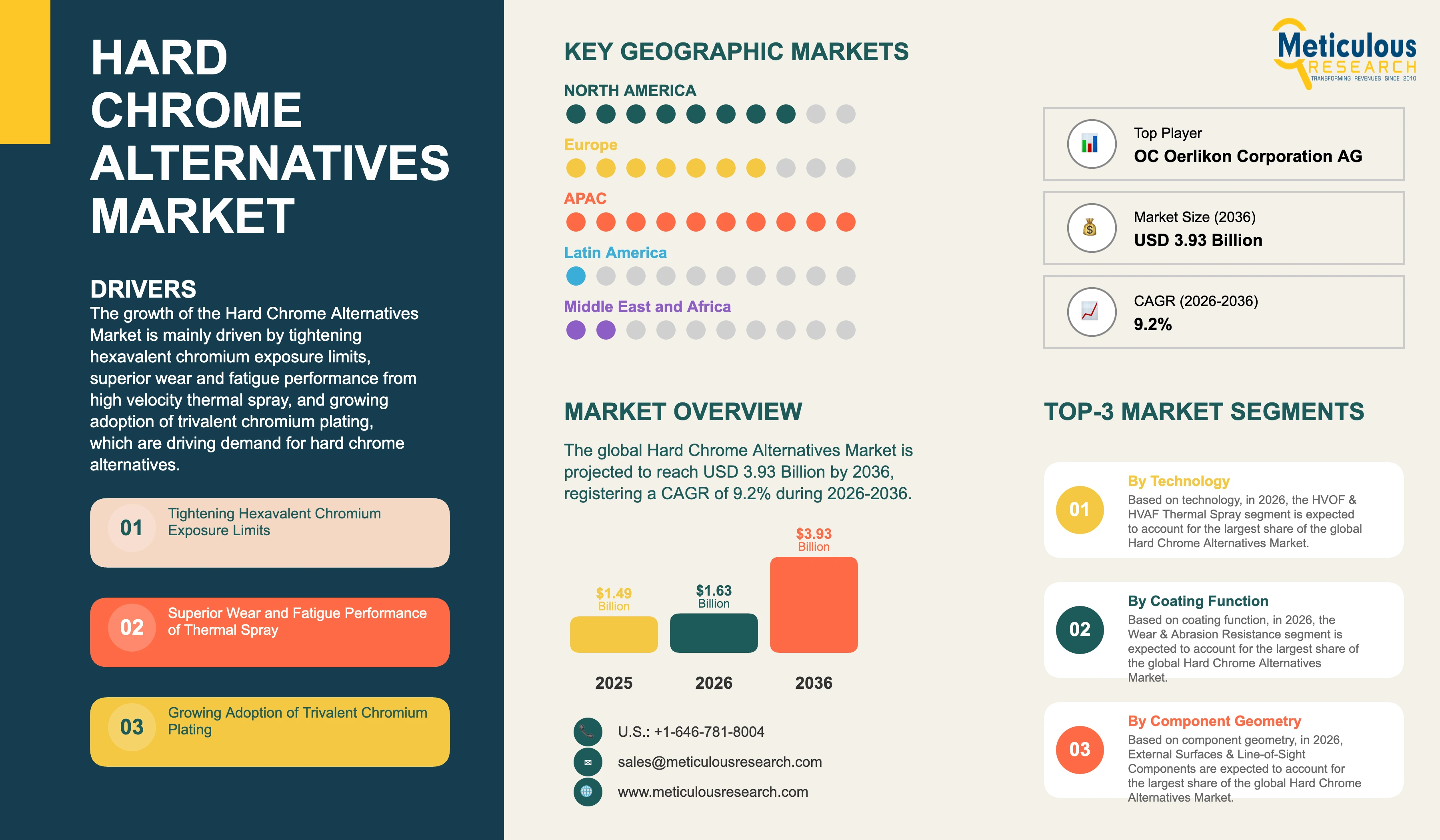
The global Hard Chrome Alternatives Market was valued at USD 1.49 billion in 2025. This market is expected to reach USD 3.93 billion by 2036 from an estimated USD 1.63 billion in 2026, registering a CAGR of 9.2% during the forecast period (2026-2036).
- Published
- Nov 2026
- Pages
- 265
- Format
- PDF + Excel
- Report ID
- MRCHM - 1042783
- Base year
- 2025
- 2025 · BASELINE
- $1.49B
- 2036
- $3.93B
- CAGR 2026–2036
- 9.2%
2025 baseline · 2026–2036 forecast at 9.2% CAGR · hover a bar for the value
Key highlights
The global Hard Chrome Alternatives Market is projected to reach USD 3.93 billion by 2036, driven by tightening hexavalent chromium exposure limits, superior wear performance from thermal spray, trivalent chromium plating adoption, and dimensional restoration demand.
Asia-Pacific is expected to account for the largest market share in 2026 and is also projected to register the fastest growth during the forecast period, supported by the concentration of industrial machinery, hydraulics and component manufacturing capacity in the region together with the fastest growth in qualified thermal spray capacity.
By technology, HVOF & HVAF Thermal Spray systems are expected to account for the largest market share, whereas Trivalent Chromium Functional Plating systems are projected to witness the fastest growth through 2036.
By coating function, Wear & Abrasion Resistance applications are expected to account for the largest market share, whereas Dimensional Restoration & Repair applications are projected to witness the fastest growth through 2036.
By component geometry, External Surfaces & Line-of-Sight Components are expected to account for the largest market share, whereas Internal Diameters & Complex Geometries are projected to witness the fastest growth through 2036.
The occupational exposure limit for hexavalent chromium stands at 0.005 milligrams per cubic meter following the expiry of a transitional limit of 0.010 milligrams per cubic meter on 17 January 2025, with 0.025 milligrams per cubic meter applying to welding and plasma cutting processes.
Regulatory authorizations for continued hard chrome use have been granted on an explicit finding that no suitable alternative substances or technologies are available, with one decision of 12 June 2024 setting a review period to 15 February 2033 and another of 16 September 2024 setting a review period to 6 May 2034.
Tungsten carbide cobalt coatings applied by high velocity oxygen fuel deliver fatigue strength of approximately 180 thousand pounds per square inch, some 95% above electrolytic hard chrome and 35% above a cobalt-molybdenum alloy at 133 thousand pounds per square inch.
Electrolytic hard chrome reduces base metal fatigue strength by 38% to 51%, and by approximately 75% where the substrate is not peened, which is the performance gap that qualified alternatives are specified against.
Wear rates for tungsten carbide cobalt coatings are reported at 7.5 times lower than electrolytic hard chrome and 15.5 times lower than a cobalt-molybdenum alloy, with friction coefficients of 0.11 to 0.18, 0.07 to 0.25 and 0.04 to 0.06 respectively.
Salt fog exposure of 552 hours produced coating removal of 22% to 25% for nickel, 55% for tungsten carbide cobalt chromium, 55% to 100% for the cobalt-molybdenum alloy and 66% to 100% for tungsten carbide cobalt, which indicates that corrosion rather than wear is the limiting property for thermal spray alternatives.
Thermal spray cannot coat internal diameters and requires a spray angle of 45 to 90 degrees, and applied thickness runs at approximately 0.003 inches for original equipment work and 0.015 inches for rebuild, at deposition rates of around 900 square inches per hour with 30 minute cycle times against 12 hours for plating.
Report summary
| Particulars | Details |
|---|---|
| Forecast Period | 2026-2036 |
| Base Year | 2025 |
| Estimated Year | 2026 |
| CAGR (Value) | 9.2% |
| Format | PDF, Excel & Cloud Portal · 265 pages |
| CAGR (Volume) | 7.3% |
| Market Size (Value) in 2026 | USD 1.63 billion |
| Market Size (Value) in 2036 | USD 3.93 billion |
| Market Size (Volume) in 2026 | 27.00 kilotons of coating material as supplied |
| Market Size (Volume) in 2036 | 54.50 kilotons |
| Average Selling Price, 2026 | USD 60,370 per ton |
| Average Selling Price, 2036 | USD 72,110 per ton |
| Segments Covered | By Technology: HVOF & HVAF Thermal Spray, Electroless Nickel & Nickel Composite, Trivalent Chromium Functional Plating, PVD, PECVD & Diamond-Like Carbon, Laser Cladding & Weld Overlay, Cold Spray & Other Technologies. By Coating Function: Wear & Abrasion Resistance, Corrosion & Wear Combined, Dimensional Restoration & Repair. By Component Geometry: External Surfaces & Line-of-Sight Components, Internal Diameters & Complex Geometries. By End Use: Aerospace & Defense, Oil, Gas & Energy, Industrial Machinery & Hydraulics, Automotive & Transport, Printing, Textile & Plastics Processing Rolls, Other End Uses. |
| Countries Covered | Asia-Pacific: China, India, Japan, South Korea, Rest of Asia-Pacific. North America: U.S., Canada. Europe: Germany, France, Italy, U.K., Rest of Europe. Middle East & Africa: Rest of Middle East & Africa. Latin America: Brazil, Mexico, Rest of Latin America. |
| Key Companies | OC Oerlikon Corporation AG, Höganäs AB, Kennametal Inc., Linde plc, Element Solutions Inc, MKS Instruments, Inc., and IHI Corporation |
Report overview
Segments covered: technology, coating function, component geometry, end use.
In volume terms, the market is estimated at 27.00 kilotons of coating material as supplied in 2026 and is expected to reach 54.50 kilotons by 2036, registering a CAGR of 7.3% during the forecast period. The average selling price is estimated at USD 60,370 per ton in 2026 and USD 72,110 per ton in 2036.
The growth of this market is mainly driven by the reduction of the occupational exposure limit for hexavalent chromium to 0.005 milligrams per cubic meter after a transitional limit expired on 17 January 2025, superior wear performance from high velocity thermal spray coatings, growing adoption of trivalent chromium functional plating, and rising demand for dimensional restoration of high-value components. However, factors such as continued authorization of hard chrome plating on an explicit finding that no suitable alternatives are available, the inability of thermal spray to coat internal diameters and the requirement for a 45 to 90 degree spray angle, corrosion performance that falls short of hard chrome in salt fog testing, and the capital intensity of converting a plating shop to spray or vapor deposition are expected to restrain the growth of this market to some extent.
Among end uses, Aerospace & Defense applications are expected to account for the largest market share in 2026, while Other End Uses are projected to register the highest CAGR during the forecast period. Geographically, Asia-Pacific is expected to account for the largest share of this market in 2026 and is also expected to register the highest CAGR during the forecast period.
The Hard Chrome Alternatives Market comprises coating materials and process chemistries specified in place of electrolytic hard chrome plating for wear, corrosion and dimensional restoration applications. The market includes high velocity oxygen fuel and high velocity air fuel thermal spray powders, electroless nickel and nickel composite chemistry, trivalent chromium functional plating chemistry, physical and plasma-enhanced vapor deposition and diamond-like carbon, laser cladding and weld overlay consumables, and cold spray and other technologies. The market ecosystem extends from powder and chemistry producers through equipment suppliers and qualified coating service providers to aerospace, energy, hydraulics, automotive and industrial machinery manufacturers and their maintenance organizations.
Demand is driven primarily by occupational exposure regulation rather than by product performance. The occupational exposure limit for hexavalent chromium stands at 0.005 milligrams per cubic meter following the expiry of a transitional limit of 0.010 milligrams per cubic meter on 17 January 2025, with 0.025 milligrams per cubic meter applying to welding and plasma cutting. Meeting that limit requires enclosure, ventilation, monitoring, medical surveillance and personal protective equipment programs whose cost scales with the size of the plating operation, and one defense compliance assessment estimated initial costs of approximately 22 million United States dollars and annual costs of 46 million at a 0.5 microgram limit against 3 million and 5 million respectively at 5.0 micrograms.
Market access for hard chrome has not been withdrawn, which shapes the competitive dynamic. Regulatory authorizations for continued use have been granted on an explicit finding that no suitable alternative substances or technologies are available, with one decision of 12 June 2024 setting a review period to 15 February 2033 and another of 16 September 2024 setting a review period to 6 May 2034 with a report due by 6 November 2032 and a feasibility study by 16 September 2025. Alternatives therefore compete against a legal incumbent whose constraint is worker exposure cost rather than prohibition.
On wear and fatigue performance the alternatives are clearly superior. Tungsten carbide cobalt coatings applied by high velocity oxygen fuel deliver fatigue strength of approximately 180 thousand pounds per square inch, some 95% above electrolytic hard chrome and 35% above a cobalt-molybdenum alloy at 133 thousand pounds per square inch, while electrolytic hard chrome reduces base metal fatigue strength by 38% to 51% and by approximately 75% where the substrate is not peened. Wear rates are reported at 7.5 times lower than hard chrome and 15.5 times lower than the cobalt-molybdenum alloy, with friction coefficients of 0.11 to 0.18, 0.07 to 0.25 and 0.04 to 0.06 respectively.
Corrosion performance is where thermal spray remains at a disadvantage and where segmentation follows. Salt fog exposure of 552 hours produced coating removal of 22% to 25% for nickel, 55% for tungsten carbide cobalt chromium, 55% to 100% for the cobalt-molybdenum alloy and 66% to 100% for tungsten carbide cobalt, so applications combining corrosion and wear requirements continue to specify electroless nickel, nickel composite or sealed spray systems rather than carbide coatings alone.
Geometry is the hard constraint on substitution. Thermal spray is a line-of-sight process that cannot coat internal diameters and requires a spray angle of 45 to 90 degrees, which leaves hydraulic cylinder bores, valve internals and deep blind features addressable only by plating or by autocatalytic chemistry. External Surfaces & Line-of-Sight Components accordingly hold 76.0% of this market, while Internal Diameters & Complex Geometries grow faster at 9.8% as nickel and trivalent chromium chemistry extends into applications that spray cannot reach.
Process economics favor spray where geometry permits. Applied thickness runs at approximately 0.003 inches for original equipment work and 0.015 inches for rebuild at deposition rates of around 900 square inches per hour, with cycle times of approximately 30 minutes against 12 hours for plating, which transforms turnaround on high-value components. The qualification history is long: a joint program began in November 1999, specifications were issued in 1998 and 2003, depot implementation ran from 1996 to early 1998, and the program completed in 2006 with a fifteen-year net present value of 0.5 to 3 million United States dollars.
Asia-Pacific is expected to account for the largest regional share at 36.0% in 2026, reflecting the largest industrial machinery, hydraulics and component manufacturing base and the fastest addition of qualified thermal spray and vapor deposition capacity.
Europe is expected to hold 26.0% of the market and to grow at 8.2%. The region operates the 0.005 milligrams per cubic meter exposure limit following expiry of the transitional limit on 17 January 2025, while also authorizing continued hard chrome use on a finding of no suitable alternatives with review periods to 15 February 2033 and 6 May 2034, with Germany carrying the largest national position.
The Middle East & Africa is expected to grow fastest of all regions at 10.8% from a 5.5% share on energy component refurbishment where dimensional restoration carries the strongest value case. Latin America is expected to grow at 8.8% from a 3.5% share, with Brazil and Mexico carrying the regional machinery and energy component positions.
Some of the key players operating in the hard chrome alternatives market are OC Oerlikon Corporation AG, Höganäs AB, Kennametal Inc., Linde plc, Element Solutions Inc, MKS Instruments, Inc., and IHI Corporation, among others.
Leading companies are focusing on carbide formulations and sealed or duplex schemes that close the corrosion gap, trivalent chromium chemistry that converts an existing plating shop without capital replacement, and qualification histories with aerospace, defense and energy customers, while pairing powder and chemistry supply with equipment, operator training and coating service capacity.
Report infographic
Market dynamics
10 factors across 4 forcesTightening Hexavalent Chromium Occupational Exposure Limits
Occupational exposure regulation is the principal factor driving the Hard Chrome Alternatives Market. The exposure limit for hexavalent chromium stands at 0.005 milligrams per cubic meter following the expiry of a transitional limit of 0.010 milligrams per cubic meter on 17 January 2025, with 0.025 milligrams per cubic meter applying to welding and plasma cutting. Compliance requires enclosure, local exhaust ventilation, air monitoring, medical surveillance and personal protective equipment programs whose cost scales with the size of the operation, and one defense compliance assessment estimated initial costs of approximately 22 million United States dollars and annual costs of 46 million at a 0.5 microgram limit against 3 million and 5 million respectively at 5.0 micrograms. Because that cost falls on the plating shop rather than on the component, it is progressively making alternatives the lower total cost route and is expected to continue driving conversion throughout the forecast period.
Superior Wear and Fatigue Performance of High Velocity Thermal Spray
Measured performance advantages are significantly increasing specification of thermal spray coatings in demanding applications. Tungsten carbide cobalt coatings applied by high velocity oxygen fuel deliver fatigue strength of approximately 180 thousand pounds per square inch, some 95% above electrolytic hard chrome and 35% above a cobalt-molybdenum alloy at 133 thousand pounds per square inch, while hard chrome reduces base metal fatigue strength by 38% to 51% and by approximately 75% on unpeened substrates. Wear rates are 7.5 times lower than hard chrome and 15.5 times lower than the cobalt-molybdenum alloy. For aerospace landing gear, actuators and rotating components where fatigue life governs certification, these differences are decisive, and HVOF & HVAF Thermal Spray accordingly holds the largest technology share in this market at 41.0%.
Growing Adoption of Trivalent Chromium Functional Plating
Trivalent chromium functional plating is the fastest-growing technology in this market at 12.6%, because it preserves the process geometry of hexavalent plating while removing the regulated substance. A plating shop converting to trivalent chemistry retains its tank layout, racking and handling and continues to coat internal diameters and complex features that line-of-sight thermal spray cannot reach, which avoids the capital conversion that a move to spray or vapor deposition requires. As the exposure limit of 0.005 milligrams per cubic meter makes hexavalent operation progressively more expensive to control, trivalent systems offer the shortest conversion path for the installed plating base and are expected to take an increasing share of substitution.
Table of contents
12 chapters · 132 sections · 265 pages · click to expandSegmental analysis
| Segment | Largest share (2026) | Fastest growth (2026–2036) |
|---|---|---|
| By Technology | HVOF & HVAF Thermal Spray systems | Trivalent Chromium Functional Plating systems |
| By Coating Function | Wear & Abrasion Resistance | Dimensional Restoration & Repair |
| By Component Geometry | External Surfaces & Line-of-Sight Components | Internal Diameters & Complex Geometries |
| By End use | Aerospace & Defense | Other End Uses |
| Other segments | Wear & Abrasion Resistance | Dimensional Restoration & Repair |
By Technology
- HVOF & HVAF Thermal Spray systems are expected to account for the largest share of the global Hard Chrome Alternatives Market.
- The large share of this segment is mainly due to fatigue strength of approximately 180 thousand pounds per square inch, some 95% above electrolytic hard chrome, together with wear rates 7.5 times lower and deposition rates of around 900 square inches per hour.
- However, Trivalent Chromium Functional Plating systems are projected to register the highest CAGR during the forecast period.
- The rapid growth of this segment is attributed to the retention of existing plating tanks, racking and handling and the continued ability to coat internal diameters, which avoids the capital conversion a move to spray or vapor deposition requires.
- HVOF & HVAF Thermal Spray systems are expected to account for the largest market share in 2026.
- Trivalent Chromium Functional Plating systems are projected to register the highest CAGR during the forecast period, owing to the retention of existing plating tanks, racking and handling and the continued ability to coat internal diameters, which avoids the capital conversion a move to spray or vapor deposition requires.
By Coating Function
- Wear & Abrasion Resistance applications are expected to account for the largest market share.
- The large share of this segment is mainly due to the clear performance advantage of carbide coatings on wear and fatigue, where hard chrome reduces base metal fatigue strength by 38% to 51% and by approximately 75% on unpeened substrates.
- However, Dimensional Restoration & Repair applications are projected to register the highest CAGR during the forecast period.
- The rapid growth of this segment is attributed to rebuild thickness of approximately 0.015 inches against 0.003 inches for original equipment work and cycle times of approximately 30 minutes against 12 hours for plating, assessed against the replacement value of a certified component.
By Component Geometry
- External Surfaces & Line-of-Sight Components are expected to account for the largest market share.
- The large share of this segment is mainly due to thermal spray being a line-of-sight process requiring a spray angle of 45 to 90 degrees, which confines it to accessible external surfaces.
- However, Internal Diameters & Complex Geometries are projected to register the highest CAGR during the forecast period.
- The rapid growth of this segment is attributed to electroless nickel, nickel composite and trivalent chromium chemistry extending into hydraulic bores, valve internals and deep blind features that spray cannot reach.
By End use
- Aerospace & Defense applications are expected to account for the largest market share.
- The large share of this segment is mainly due to fatigue-critical certification requirements on landing gear, actuators and rotating components, together with the longest qualification history for alternatives, dating from a joint program begun in November 1999 and completed in 2006.
- However, Other End Uses are projected to register the highest CAGR during the forecast period.
- The rapid growth of this segment is attributed to the extension of qualified alternatives into medical, semiconductor, food processing and renewable energy components where exposure control costs are prompting conversion from plating.
Other segments
- Wear & Abrasion Resistance applications are expected to account for the largest market share in 2026.
- Dimensional Restoration & Repair applications are projected to register the highest CAGR during the forecast period, owing to rebuild thickness of approximately 0.015 inches against 0.003 inches for original equipment work and cycle times of approximately 30 minutes against 12 hours for plating, assessed against the replacement value of a certified component.
- External Surfaces & Line-of-Sight Components are expected to account for the largest market share in 2026.
- Internal Diameters & Complex Geometries are projected to register the highest CAGR during the forecast period, owing to electroless nickel, nickel composite and trivalent chromium chemistry extending into hydraulic bores, valve internals and deep blind features that spray cannot reach.
- Aerospace & Defense applications are expected to account for the largest market share in 2026.
- Other End Uses are projected to register the highest CAGR during the forecast period, owing to the extension of qualified alternatives into medical, semiconductor, food processing and renewable energy components where exposure control costs are prompting conversion from plating.
Geographic analysis
Asia-Pacific
Largest shareIn 2026, Asia-Pacific is expected to account for the largest share of the global Hard Chrome Alternatives Market at 36.0% and is also projected to register a high rate of growth during the forecast period. The region holds the largest industrial machinery, hydraulics and component manufacturing base and is adding qualified thermal spray and vapor deposition capacity faster than any other region, which allows substitution to take place at the point of original manufacture rather than through conversion of an existing plating operation. China holds the largest country position across hydraulics, machinery and automotive components, India is projected to register the fastest country growth at 12.6% on industrial and aerospace component manufacturing, and South Korea and Japan contribute precision machinery and automotive work. Japan is expected to record the slowest country growth at 6.8% on a mature installed base. India is the fastest-growing country at 12.6% and Japan the slowest at 6.8%.
North America
North America is expected to account for the second-largest share of the market at 29.0%. The region holds the longest qualification history for hard chrome alternatives, originating in a joint program begun in November 1999 with specifications issued in 1998 and 2003, depot implementation from 1996 to early 1998 and completion in 2006 at a fifteen-year net present value of 0.5 to 3 million United States dollars. The United States carries almost all of the regional position across aerospace and defense, oil and gas and industrial hydraulics, and exposure control cost assessments in the defense sector have been a principal driver of conversion.
Europe
Europe is expected to account for 26.0% of the market and to grow at 8.2%. The region operates the exposure limit of 0.005 milligrams per cubic meter following expiry of the transitional limit on 17 January 2025 and is also where continued hard chrome use is authorized on an explicit finding that no suitable alternatives are available, with review periods running to 15 February 2033 and 6 May 2034. Germany carries the largest national position across machinery, hydraulics and automotive components, with France and Italy contributing aerospace and industrial demand.
Middle East & Africa
The Middle East & Africa region is expected to record the highest regional CAGR at 10.8% from a 5.5% share, supported by oil, gas and energy component refurbishment where dimensional restoration carries the strongest value case. The Middle East & Africa is expected to register the highest regional CAGR at 10.8% on oil, gas and energy component refurbishment, while Asia-Pacific grows at 10.2% from the largest base.
Latin America
Latin America is expected to grow at 8.8% from a 3.5% share, with Brazil and Mexico carrying the regional machinery, automotive and energy component positions.
Competitive landscape
The global Hard Chrome Alternatives Market is moderately fragmented, with competition among thermal spray powder and consumable producers, surface treatment chemistry suppliers, coating equipment manufacturers and qualified coating service providers. Market participants compete primarily on fatigue and wear performance against hard chrome baselines, corrosion resistance in salt fog exposure, ability to coat internal and complex geometries, deposition rate and component turnaround time, qualification and specification approval history, and total cost against exposure control requirements.
Leading companies are investing in carbide powder formulations that close the corrosion gap revealed by 552 hour salt fog exposure, in trivalent chromium functional plating chemistry that converts an existing plating shop without capital replacement, and in sealed and duplex schemes that combine a corrosion-resistant underlayer with a carbide wear surface. Suppliers are building specification and qualification histories with aerospace, defense and energy customers, since conversion requires component requalification rather than simple material substitution, and are pairing powder and chemistry supply with equipment, operator training and coating service capacity. Positioning against exposure control cost rather than against regulatory prohibition remains the central commercial strategy, given that continued hard chrome use is authorized with review periods running to 2033 and 2034.
The report provides a comprehensive competitive assessment of the leading companies operating in the global Hard Chrome Alternatives Market. The key players profiled in the report include OC Oerlikon Corporation AG (Switzerland), Höganäs AB (Sweden), Kennametal Inc. (U.S.), Linde plc (U.K.), Element Solutions Inc (U.S.), MKS Instruments, Inc. (U.S.), and IHI Corporation (Japan).
- OC Oerlikon Corporation AG
- Höganäs AB
- Kennametal Inc.
- Linde plc
- Element Solutions Inc
- MKS Instruments, Inc.
- IHI Corporation
Expert perspectives
The Hard Chrome Alternatives Market is driven by worker exposure cost rather than by loss of market access, and reading it the other way leads to the wrong forecast. The exposure limit for hexavalent chromium stands at 0.005 milligrams per cubic meter after a transitional limit expired on 17 January 2025, and compliance requires enclosure, ventilation, monitoring and surveillance programs whose cost scales with operation size, estimated in one defense assessment at approximately 22 million United States dollars initially and 46 million annually at a 0.5 microgram limit. But hard chrome itself remains authorized on an explicit finding that no suitable alternatives are available, with review periods running to 15 February 2033 and 6 May 2034.
On wear and fatigue the alternatives win decisively, and on corrosion and geometry they do not. Tungsten carbide cobalt coatings reach approximately 180 thousand pounds per square inch fatigue strength, 95% above hard chrome, with wear rates 7.5 times lower, while hard chrome reduces base metal fatigue strength by 38% to 51%. Against that, 552 hour salt fog exposure produced 66% to 100% coating removal for tungsten carbide cobalt against 22% to 25% for nickel, and thermal spray cannot coat internal diameters and needs a 45 to 90 degree spray angle. Substitution therefore proceeds by geometry and by failure mode, not by application sector.
For companies planning entry or expansion, the most attractive positions over the forecast period are likely to be found in trivalent chromium plating growing at 12.6% as the shortest conversion path for the installed plating base, dimensional restoration growing at 10.6% where the coating is assessed against the replacement value of a certified part, internal and complex geometries growing at 9.8% through nickel and plating chemistry, and sealed or duplex systems addressing the corrosion gap where substitution has advanced least. The principal caution is timescale: the aerospace precedent ran from a program begun in November 1999 to completion in 2006, and component requalification rather than material performance sets the pace of conversion.
Customer perspectives
“We would convert tomorrow if spray could reach a cylinder bore, but it cannot, and that is most of our work. So for us the real question is whether trivalent chemistry will hold the hardness and the wear life, because that lets us keep the tanks and the racking and just change what is in them. Moving to spray would mean new capital and requalifying every part number.”
“On landing gear the fatigue numbers decide it. Chrome takes thirty-eight to fifty percent off the base metal fatigue strength and more if the part is not peened, and the carbide coating gives us the opposite. What slowed us down was never the coating, it was requalifying each part number, and that work took the better part of a decade across the fleet.”
“For us it is restoration. A worn shaft or a pump component that we can build back up and return to service in half an hour of spray time is worth far more than the coating costs, because the alternative is a long lead time on a replacement. Corrosion is where we are careful, and on wet service we still specify nickel rather than a straight carbide.”
Frequently asked questions
The global Hard Chrome Alternatives Market is estimated at USD 1.63 billion in 2026.
The market is projected to reach USD 3.93 billion by 2036.
The market is expected to grow at a CAGR of 9.2% during 2026-2036.
The market is driven by the hexavalent chromium exposure limit of 0.005 milligrams per cubic meter following expiry of the transitional limit on 17 January 2025, superior wear and fatigue performance from high velocity thermal spray, growing adoption of trivalent chromium functional plating, and rising demand for dimensional restoration of high-value components.
No. Continued use has been authorized on an explicit finding that no suitable alternative substances or technologies are available, with review periods to 15 February 2033 and 6 May 2034. The constraint on hard chrome is worker exposure control cost rather than market access.
Tungsten carbide cobalt coatings applied by high velocity oxygen fuel deliver fatigue strength of approximately 180 thousand pounds per square inch, some 95% above electrolytic hard chrome, with wear rates 7.5 times lower. Hard chrome reduces base metal fatigue strength by 38% to 51%, and by approximately 75% where the substrate is not peened.
On internal diameters and complex geometries, since thermal spray is a line-of-sight process requiring a spray angle of 45 to 90 degrees. Corrosion performance is a second limit, with 552 hour salt fog exposure producing 66% to 100% coating removal for tungsten carbide cobalt against 22% to 25% for nickel.
Continued authorization of hard chrome on a finding of no suitable alternatives, the inability of thermal spray to coat internal diameters, corrosion performance shortfalls in salt fog exposure, the capital cost of converting a plating shop, and component requalification timescales measured in years remain the major market challenges.
High velocity oxygen fuel and high velocity air fuel carbide coatings, trivalent chromium functional plating, electroless nickel composite deposits, physical and plasma-enhanced vapor deposition and diamond-like carbon, laser cladding, and cold spray are transforming the market.
Suppliers must support compliance with the hexavalent chromium occupational exposure limit of 0.005 milligrams per cubic meter, and 0.025 milligrams per cubic meter for welding and plasma cutting, following expiry of the transitional limit on 17 January 2025. They must also address the authorization and review framework with periods running to 2033 and 2034, and aerospace and defense coating specifications.
HVOF & HVAF Thermal Spray systems are expected to account for the largest market share in 2026.
Trivalent Chromium Functional Plating systems are projected to register the highest CAGR during the forecast period, owing to the retention of existing plating tanks, racking and handling and the continued ability to coat internal diameters, which avoids the capital conversion a move to spray or vapor deposition requires.
Wear & Abrasion Resistance applications are expected to account for the largest market share in 2026.
Dimensional Restoration & Repair applications are projected to register the highest CAGR during the forecast period, owing to rebuild thickness of approximately 0.015 inches against 0.003 inches for original equipment work and cycle times of approximately 30 minutes against 12 hours for plating.
External Surfaces & Line-of-Sight Components are expected to account for the largest market share in 2026.
Internal Diameters & Complex Geometries are projected to register the highest CAGR during the forecast period, owing to electroless nickel, nickel composite and trivalent chromium chemistry extending into hydraulic bores, valve internals and deep blind features that spray cannot reach.
Aerospace & Defense applications are expected to account for the largest market share in 2026.
Other End Uses are projected to register the highest CAGR during the forecast period, owing to the extension of qualified alternatives into medical, semiconductor, food processing and renewable energy components where exposure control costs are prompting conversion from plating.
Asia-Pacific is expected to account for the largest regional share at 36.0% in 2026, reflecting the largest industrial machinery, hydraulics and component manufacturing base and the fastest addition of qualified thermal spray and vapor deposition capacity.
The Middle East & Africa is expected to register the highest regional CAGR at 10.8% on oil, gas and energy component refurbishment, while Asia-Pacific grows at 10.2% from the largest base. India is the fastest-growing country at 12.6% and Japan the slowest at 6.8%.
Europe is expected to hold 26.0% of the market and to grow at 8.2%. The region operates the 0.005 milligrams per cubic meter exposure limit while also authorizing continued hard chrome use on a finding of no suitable alternatives, with Germany carrying the largest national position.
The Middle East & Africa is expected to grow fastest of all regions at 10.8% from a 5.5% share on energy component refurbishment. Latin America is expected to grow at 8.8% from a 3.5% share, with Brazil and Mexico carrying the regional machinery and energy component positions.
Some of the key players operating in the hard chrome alternatives market are OC Oerlikon Corporation AG, Höganäs AB, Kennametal Inc., Linde plc, Element Solutions Inc, MKS Instruments, Inc., and IHI Corporation, among others.
Leading companies are focusing on carbide formulations and sealed or duplex schemes that close the corrosion gap, trivalent chromium chemistry that converts an existing plating shop without capital replacement, and qualification histories with aerospace, defense and energy customers. They also pair powder and chemistry supply with equipment, operator training and coating service capacity.
Cite this report
Meticulous Research. (2026). Hard Chrome Alternatives Market - Global Opportunity Analysis and Industry Forecast (2026-2036) (Report No. MRCHM - 1042783). Meticulous Market Research Pvt. Ltd. https://www.meticulousresearch.com/product/hard-chrome-alternatives-market-7466