Can Coatings Without Bisphenol Market (2026-2036)
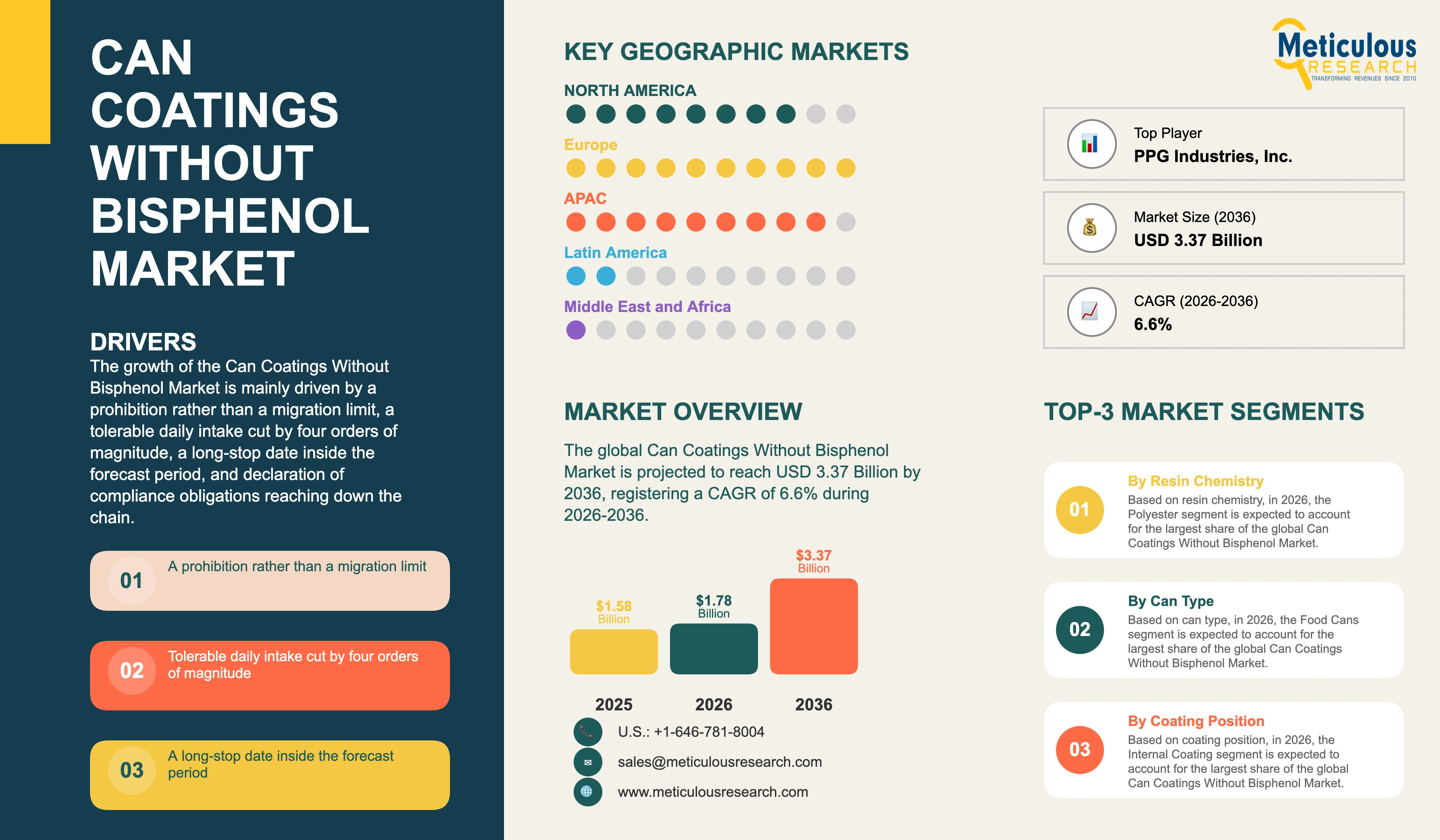
The can coatings without bisphenol market is valued at USD 1.78 billion in 2026 and is projected to reach USD 3.37 billion by 2036, at a CAGR of 6.6% during the forecast period. The market was valued at USD 1.58 billion in 2025 and at USD 1.39 billion in 2024.
- Published
- Nov 2026
- Pages
- 264
- Format
- PDF + Excel
- Report ID
- MRCHM - 1042777
- Base year
- 2025
- 2024 · HISTORICAL
- $1.39B
- 2036
- $3.37B
- CAGR 2026–2036
- 6.6%
2024–2025 baseline · 2026–2036 forecast at 6.6% CAGR · hover a bar for the value
Key highlights
This market measures internal and external coatings for metal food and beverage cans, ends and closures formulated without bisphenol A or other restricted bisphenols, at the coating manufacturer gate on a tonne basis as supplied.
Excluded are coatings still built on bisphenol A, metal substrate and coil, can making and coating equipment, printing inks and sealing compounds sold without a coating function, and coatings for non-food metal packaging such as paint cans.
Commission Regulation (EU) 2024/3190 was adopted on 19 December 2024 and entered into force on 20 January 2025, repealing Regulation (EU) 2018/213.
Article 1(2) applies the prohibition across adhesives, rubbers, ion-exchange resins, plastics, printing inks, silicones, and varnishes and coatings, so can coatings are reached directly rather than by implication.
Article 3(1) prohibits the use of bisphenol A and the placing on the market of articles made with it, Article 4 prohibits residual bisphenol A in materials made with another bisphenol, and Article 5(1) extends the prohibition to bisphenols carrying a harmonised classification as category 1A or 1B mutagenic, carcinogenic or toxic for reproduction, or category 1 endocrine disrupting.
The former specific migration limit of 0.05 milligrams a kilogram under Regulation (EU) 2018/213 was removed by repeal, and Article 9(2) instead sets a detection limit of 1 microgram a kilogram unless Annex II provides otherwise, with an extraction method required.
The only derogation touching varnishes and coatings covers liquid epoxy resins applied to self-supporting articles above 1,000 litres, which reaches tanks rather than cans.
Single-use final articles made with bisphenol A could be first placed on the market until 20 July 2026 under Article 11(1), a date that has now passed.
Article 11(2) extends that date to 20 January 2028 for single-use articles preserving fruits or vegetables other than those listed in Annex I to Directive 2001/112/EC, for fishery products under Regulation (EC) No 853/2004, and where a coating is applied only to the exterior metal surface.
Article 11(3) allows articles first placed on the market within a transitional period to be filled and sealed for a further 12 months, after which the packaged food may remain on the market until stocks run out.
Repeat-use final articles could be first placed on the market until 20 July 2026 under Article 12(1) and professional food production equipment until 20 January 2028 under Article 12(2).
Commission Regulation (EU) 2026/250, adopted on 2 February 2026, corrects Regulation (EU) 2024/3190, removing the words "and its salts" from Article 3 and setting the end of market presence for repeat-use articles at 20 July 2027 in the first transitional category and 20 January 2029 in the second.
Article 7 requires large businesses using bisphenol A or the listed bisphenols to report on alternatives after four years and at the latest five years.
Article 8 and Annex III require the declaration of compliance to list any bisphenols used, and Article 6(4) requires assessment information to be published before 20 January 2027.
That authority published its re-evaluation in April 2023, setting a tolerable daily intake of 0.2 nanograms of bisphenol A a kilogram of body weight a day against the temporary tolerable daily intake of 4 micrograms set in 2015, a reduction of four orders of magnitude.
The reference point was a human equivalent dose benchmark dose lower confidence limit of 8.2 nanograms a kilogram a day with an overall uncertainty factor of 50, based on an increase in T helper 17 cells as the most sensitive effect.
The same opinion concluded that dietary exposure to bisphenol A is a health concern for all age groups.
Non-bisphenol coatings are estimated at 62% of all can coatings in 2026, rising to 93% by 2036, against an underlying can coatings market growing at about 0.8% a year.
Report summary
| Particulars | Details |
|---|---|
| Base Year | 2025 |
| Actual Years | 2024-2025 |
| Forecast Period | 2026-2036 |
| Market Size in 2024 | USD 1.39 billion |
| Market Size in 2025 | USD 1.58 billion |
| Market Size in 2026 | USD 1.78 billion |
| Market Size in 2036 | USD 3.37 billion |
| Value CAGR (2026-2036) | 6.6% |
| Format | PDF, Excel & Cloud Portal · 264 pages |
| Volume in 2025 | 290.00 kilotons |
| Volume in 2026 | 320.00 kilotons |
| Volume in 2036 | 520.00 kilotons |
| Volume CAGR (2026-2036) | 5.0% |
| Average Selling Price, 2026 | USD 5,560 per tonne |
| Average Selling Price, 2036 | USD 6,480 per tonne |
| Units | Value in USD million; volume in kilotons of coating as supplied; price in USD per tonne |
| Measurement Basis | Internal and external coatings for metal food and beverage cans, can ends and closures formulated without bisphenol A or other restricted bisphenols, taken at the coating manufacturer gate on a tonne basis as supplied |
| Penetration Basis | Non-bisphenol coatings are estimated at 62% of all can coatings in 2026, rising to 93% by 2036, against an underlying can coatings market growing at about 0.8% a year, so this market grows by taking share from a category that is not itself expanding and the share available runs out inside the forecast period |
| Historical Value Growth | Value grew at 13.0% a year between 2024 and 2026 on volume growth of 10.5% a year and price growth of 2.2% a year; the forecast of 6.6% carries volume growth of 5.0% and price growth of 1.5%, the deceleration reflecting that the historical window contains the general deadline of 20 July 2026 and the forecast window contains the run-off |
| Price Increase Note | The average selling price rises across the forecast period, which is the reverse of most coating markets, because polyester, acrylic and laminate systems cost more a tonne than the epoxy-phenolic they displace and frequently require a heavier film or a second coat to reach the same barrier; the cost is absorbed by the can maker and filler inside a pack priced by its contents |
| Regulatory Basis | Commission Regulation (EU) 2024/3190 was adopted on 19 December 2024 and entered into force on 20 January 2025, repealing Regulation (EU) 2018/213 and amending Regulation (EU) No 10/2011; Article 1(2) applies it across adhesives, rubbers, ion-exchange resins, plastics, printing inks, silicones, and varnishes and coatings |
| Prohibition Scope Note | Article 3(1) prohibits the use of bisphenol A in the manufacture of covered materials and the placing on the market of articles made with it; Article 4 prohibits residual bisphenol A in materials made with another bisphenol; Article 5(1) extends the prohibition to bisphenols and bisphenol derivatives carrying a harmonised classification as category 1A or 1B mutagenic, carcinogenic or toxic for reproduction, or category 1 endocrine disrupting |
| Migration Basis | The former specific migration limit of 0.05 milligrams a kilogram under Regulation (EU) 2018/213 was removed by repeal; Article 9(2) sets a detection limit of 1 microgram a kilogram unless Annex II provides otherwise and requires an extraction method, so compliance is demonstrated by absence rather than against a limit |
| Derogation Note | The only derogation reaching varnishes and coatings covers liquid epoxy resins applied to self-supporting articles above 1,000 litres, conditional on migration into food not being detectable and on the article being cleaned and flushed before first food contact, so no can format qualifies |
| Transition Basis | Single-use final articles made with bisphenol A could be first placed on the market until 20 July 2026 under Article 11(1); Article 11(2) extends that to 20 January 2028 for single-use articles preserving fruits or vegetables other than the products listed in Annex I to Directive 2001/112/EC, for fishery products under Regulation (EC) No 853/2004, and for articles where a bisphenol A varnish or coating is applied only to the exterior metal surface; Article 11(3) allows filling and sealing for a further 12 months, after which the packaged food may remain on the market until stocks run out |
| Repeat-Use Transition Note | Repeat-use final articles could be first placed on the market until 20 July 2026 under Article 12(1) and professional food production equipment until 20 January 2028 under Article 12(2); Commission Regulation (EU) 2026/250, adopted on 2 February 2026 and published on 3 February 2026, corrects Regulation (EU) 2024/3190 and sets the end of market presence for repeat-use articles at 20 July 2027 in the first transitional category and 20 January 2029 in the second, and removes the words "and its salts" from Article 3 |
| Documentation Basis | Article 8 and Annex III require the declaration of compliance to list any bisphenols used, with Regulation (EU) 2026/250 amending that annex so the declaration identifies the intermediate material or the final article rather than requiring both; Article 7 requires large businesses using bisphenol A or the listed bisphenols to report on alternatives after four years and at the latest five years, with reporting voluntary for small and medium-sized enterprises; Article 6(4) requires the European Food Safety Authority to publish the information needed for assessment before 20 January 2027 |
| Toxicological Basis | The European Food Safety Authority published its re-evaluation in April 2023, setting a tolerable daily intake of 0.2 nanograms of bisphenol A a kilogram of body weight a day against the temporary tolerable daily intake of 4 micrograms set in 2015; the reference point was a human equivalent dose benchmark dose lower confidence limit of 8.2 nanograms a kilogram of body weight a day with an overall uncertainty factor of 50, based on an increase in the percentage of T helper 17 cells as the most sensitive effect, and the opinion concluded that dietary exposure is a health concern for all age groups |
| Second Substitution Note | A coating built on an alternative bisphenol is compliant only until that substance acquires a harmonised classification under Article 5(1), so non-bisphenol epoxy and epoxy-acrylic hybrid systems are the slowest-growing resin chemistry in this market despite being the nearest technical analogue to what they replace |
| Overlap Note | Coatings still built on bisphenol A are excluded from this title and counted in the broader can and packaging coatings titles, and coil coatings sold without a food contact function in the relevant coil coatings titles, so those titles are non-additive with this one |
| Exclusions | Coatings built on bisphenol A; metal substrate, coil and tinplate; can making, coating and curing equipment; printing inks and decorative systems without a protective function; sealing compounds sold without a coating function; coatings for non-food metal packaging such as paint and chemical cans; closures and caps made wholly of plastic |
| Segments: Resin Chemistry | Polyester; Acrylic; Non-Bisphenol Epoxy and Epoxy-Acrylic Hybrid; Polyolefin and Polyethylene Terephthalate Laminate; Oleoresin, Vinyl and Other Resin Chemistries |
| Segments: Can Type | Food Cans; Beverage Cans; Ends and Closures; Aerosol and General Line Cans |
| Segments: Coating Position | Internal Coating; External Coating and Overvarnish; End and Seam Compound Coating |
| Segments: Food Contact Severity | Low-Acid Foods; High-Acid and Tomato-Based Foods; Fish and Seafood; Beverages; Other Food Categories |
| Largest Segment by Resin Chemistry, 2026 | Polyester, at 34.0% |
| Fastest-Growing Segment by Resin Chemistry | Polyolefin and Polyethylene Terephthalate Laminate, at 9.4% |
| Slowest-Growing Segment by Resin Chemistry | Non-Bisphenol Epoxy and Epoxy-Acrylic Hybrid, at 5.2% |
| Largest Segment by Can Type, 2026 | Food Cans, at 41.0% |
| Fastest-Growing Segment by Can Type | Aerosol and General Line Cans, at 8.2% |
| Slowest-Growing Segment by Can Type | Beverage Cans, at 4.8% |
| Largest Segment by Coating Position, 2026 | Internal Coating, at 58.0% |
| Fastest-Growing Segment by Coating Position | Internal Coating, at 7.2% |
| Largest Segment by Food Contact Severity, 2026 | Low-Acid Foods, at 32.0% |
| Fastest-Growing Segment by Food Contact Severity | High-Acid and Tomato-Based Foods, at 8.2% |
| Largest Region, 2026 | Europe, at 34.0% |
| Fastest-Growing Region | Europe, at 7.8% |
| Fastest-Growing Country | Italy, at 8.6% |
| Slowest-Growing Country | Japan, at 4.4% |
| Regions Covered | Europe; Asia-Pacific; North America; Latin America; Middle East & Africa |
| Countries Covered | Germany; France; Italy; Spain; U.K.; China; Japan; India; U.S.; Canada; Mexico; Brazil |
| Key Players | PPG Industries, Inc.; The Sherwin-Williams Company; Akzo Nobel N.V.; ALTANA AG; Toyo Ink SC Holdings Co., Ltd.; Kansai Paint Co., Ltd.; Nippon Paint Holdings Co., Ltd. |
| Corporate Development Note | Akzo Nobel N.V. and Axalta Coating Systems Ltd. agreed an all-share merger of equals to be named Axanzo, approved by shareholders of both companies on 5 August 2026, with the companies continuing to operate independently until a closing expected in early 2027; the current legal entity name is used in this report |
| Top Five Share, 2026 | 72.5% |
| Profiled Companies Share, 2026 | 86.0% |
| Currency | USD |
Report overview
Market value is measured in in USD million; volume in kilotons of coating as supplied; price in USD per tonne. Segments covered: resin chemistry, can type, coating position, food contact severity.
The growth of this market is mainly driven by a prohibition on bisphenol A in varnishes and coatings under Regulation (EU) 2024/3190 in force since 20 January 2025, a tolerable daily intake set by the European Food Safety Authority at 0.2 nanograms a kilogram of body weight a day against 4 micrograms previously, a long-stop date of 20 January 2028 for fruit, vegetable and fishery product cans, and the removal of the former specific migration limit in favour of a prohibition tested to a detection limit of 1 microgram a kilogram. However, factors such as a general deadline of 20 July 2026 that has already passed, an underlying can coatings market growing at about 0.8% a year, non-bisphenol penetration already at 62% in 2026, and replacement chemistries that are not like-for-like on acidic and high-protein packs are expected to restrain the growth of this market to some extent.
A can is a steel or aluminium container holding an aggressive foodstuff for up to three years at ambient temperature, through a thermal sterilisation cycle, with the metal protected from the food and the food protected from the metal by a film of a few microns. Epoxy-phenolic chemistry built on bisphenol A did that job for six decades because nothing else combined the same flexibility through forming, adhesion to bare metal and resistance to acid, sulphur and protein.
The named demand driver for this title is a food contact regulation shift, and in this case the shift is absolute rather than directional. Commission Regulation (EU) 2024/3190, adopted on 19 December 2024 and in force since 20 January 2025, prohibits bisphenol A in varnishes and coatings among seven material categories, and the former specific migration limit of 0.05 milligrams a kilogram was removed by repeal rather than tightened.
What replaced the limit is a prohibition. Article 9(2) sets a detection limit of 1 microgram a kilogram unless Annex II provides otherwise, so compliance is demonstrated by absence rather than by a number, and the only derogation touching coatings covers liquid epoxy resins on self-supporting articles above 1,000 litres, which is tank lining rather than can making.
The science behind that is what makes reversal unlikely. The European Food Safety Authority published a re-evaluation in April 2023 setting a tolerable daily intake of 0.2 nanograms a kilogram of body weight a day against the temporary 4 micrograms set in 2015, a reduction of four orders of magnitude, on a reference point of 8.2 nanograms a kilogram with an overall uncertainty factor of 50 and an increase in T helper 17 cells as the most sensitive effect.
Where the driver needs qualification is in timing, because the conversion is largely behind rather than ahead. The general date for first placing single-use articles made with bisphenol A on the market was 20 July 2026, which has passed, and the long-stop is 20 January 2028 for fruit, vegetable and fishery product cans and for coatings applied only to the exterior metal surface.
Those dates are reflected in the growth profile of this market. Value grew at 13.0% a year between 2024 and 2026 on volume growth of 10.5% a year, and the forecast carries 6.6% on volume growth of 5.0%, because the historical window contains the deadline and the forecast window contains the run-off.
Penetration arithmetic sets the ceiling. Non-bisphenol coatings are estimated at 62% of all can coatings in 2026 rising to 93% by 2036, against an underlying can coatings market growing at about 0.8% a year, so this title grows by taking share from a category that is not itself expanding and the share available to take runs out inside the forecast period.
The categories the Commission gave three years rather than eighteen months identify where the technical difficulty actually sits. Fruits and vegetables and fishery products are the acidic and high-protein packs on which polyester and acrylic systems are least like-for-like, and the carve-out is an admission that like-for-like substitution was not available when the Regulation was written.
High-acid and tomato-based foods accordingly grow fastest among food contact severity classes in this market at 8.2% and fish and seafood at 7.8%, while beverages, converted years ago on a relatively benign pack, grow slowest at 4.8%.
A second qualification is that the absence of bisphenol A is not the absence of bisphenols. Article 5(1) reaches any bisphenol or bisphenol derivative carrying a harmonised classification as category 1A or 1B mutagenic, carcinogenic or toxic for reproduction or as a category 1 endocrine disruptor, and Article 4 prohibits residual bisphenol A in a material made with another bisphenol.
That exposes the industry to a second round of substitution rather than one. A coating built on an alternative bisphenol is compliant only until that substance acquires a harmonised classification, and the European Food Safety Authority is required to publish the information needed for assessment before 20 January 2027, which is inside the transitional period for the hardest categories.
Non-bisphenol epoxy and epoxy-acrylic hybrid systems are therefore the slowest-growing resin chemistry in this market at 5.2%, despite being the nearest technical analogue to what they replace, while polyolefin and polyethylene terephthalate laminate systems grow fastest at 9.4% because they avoid the question of bisphenols altogether.
Price moves the opposite way to most coating markets as a result. The average selling price rises from USD 5,560 per tonne in 2026 to USD 6,480 per tonne in 2036, an increase of 1.5% a year, because polyester, acrylic and laminate systems cost more a tonne than the epoxy-phenolic they displace and frequently require a heavier film or a second coat to reach the same barrier.
That is a genuine cost transfer rather than a pricing opportunity. The can maker and the filler absorb it inside a pack whose retail price is set by the food rather than by the container, which is why the conversion has been driven by a legal deadline rather than by any commercial pull.
Reformulation is also not a single project. Industry commentary on the deadline notes that the market has relied on numerous application-specific bisphenol A epoxy formulations, so the substitution is a portfolio of qualifications against individual food packs rather than one replacement product, and each one carries its own shelf-life trial.
Internal coatings hold 58.0% of this market in 2026 and grow at 7.2%, because the internal surface is where the food contact prohibition bites, while external coatings and overvarnish hold 27.0% and grow at 5.4%, aided by the transitional allowance for coatings applied only to the exterior metal surface running to 20 January 2028.
Europe holds 34.0% of this market in 2026 and is also the fastest-growing region at 7.8%, because the binding instrument is European and because the food canning industry affected by the longer transitional categories is concentrated there. Asia-Pacific follows at 29.0% and North America at 27.0%, converting on customer specification and retailer policy rather than on a comparable prohibition.
Report infographic
Market dynamics
17 factors across 5 forcesA Prohibition Rather Than a Migration Limit
Regulation (EU) 2024/3190 prohibits the use of bisphenol A in varnishes and coatings and the placing on the market of articles made with it, and the former specific migration limit of 0.05 milligrams a kilogram under Regulation (EU) 2018/213 was removed by repeal rather than tightened.
Compliance is now demonstrated by absence, with Article 9(2) setting a detection limit of 1 microgram a kilogram unless Annex II provides otherwise and requiring an extraction method, so a coating cannot be brought into compliance by reducing migration below a threshold.
The only derogation reaching varnishes and coatings covers liquid epoxy resins on self-supporting articles above 1,000 litres, conditional on migration not being detectable and on cleaning and flushing before first food contact, so no can format qualifies.
A Tolerable Daily Intake Cut by Four Orders of Magnitude
The European Food Safety Authority published a re-evaluation in April 2023 setting a tolerable daily intake of 0.2 nanograms of bisphenol A a kilogram of body weight a day against the temporary tolerable daily intake of 4 micrograms set in 2015.
The reference point was a human equivalent dose benchmark dose lower confidence limit of 8.2 nanograms a kilogram of body weight a day with an overall uncertainty factor of 50, based on an increase in the percentage of T helper 17 cells as the most sensitive effect, and the opinion concluded that dietary exposure is a health concern for all age groups.
A reduction of that scale cannot be met by process control on an epoxy-phenolic coating, which is why the regulatory response was substitution of the chemistry rather than a tighter limit on it.
A Long-Stop Date Inside the Forecast Period
Article 11(2) allows single-use articles preserving fruits or vegetables other than the products listed in Annex I to Directive 2001/112/EC, fishery products under Regulation (EC) No 853/2004, and articles coated only on the exterior metal surface to be first placed on the market until 20 January 2028.
Article 11(3) then allows those articles to be filled and sealed for a further 12 months, with the packaged food remaining on the market until stocks run out, and Regulation (EU) 2026/250 sets the end of market presence for repeat-use articles at 20 July 2027 in the first category and 20 January 2029 in the second.
High-acid and tomato-based foods record the highest CAGR among food contact severity classes in this market at 8.2% and fish and seafood at 7.8%, because those are the categories the longer transitional period covers.
Declaration of Compliance Obligations Reaching Down the Chain
Article 8 and Annex III require the declaration of compliance to list any bisphenols used, so a filler or retailer can establish the status of a coating from documentation rather than from testing, and a non-compliant coating cannot be carried quietly through the supply chain.
Article 7 requires large businesses using bisphenol A or the listed bisphenols to report on alternatives after four years and at the latest five years, which converts continued use into a reporting obligation rather than a settled position.
Those obligations extend the effect of the prohibition beyond the European Union, because a declaration naming bisphenols has to be given for every article placed on the European market whatever the location of the coating supplier or the can maker.
Brand owners and retailers operating across several regions also tend to maintain a single specification rather than two, so the documentation requirement reaches packs that will never be sold in Europe and converts the prohibition into a global commercial standard.
Table of contents
12 chapters · 131 sections · 264 pages · click to expandSegmental analysis
| Segment | Largest share (2026) | Fastest growth (2026–2036) |
|---|---|---|
| By Resin Chemistry | Polyester | Polyolefin and polyethylene terephthalate laminate systems |
| By Can Type | Food cans | Aerosol and general line cans |
| By Coating Position | Internal coating | — |
| By Food Contact Severity | Low-acid foods | High-acid and tomato-based foods |
By Resin Chemistry
- Can Coatings Without Bisphenol Market Analysis by Resin Chemistry
- This market is segmented into polyester, acrylic, non-bisphenol epoxy and epoxy-acrylic hybrid, polyolefin and polyethylene terephthalate laminate, and oleoresin, vinyl and other resin chemistries.
- Polyester is expected to account for the largest share of this market in 2026.
- The chemistry offers the closest combination of flexibility through forming, adhesion to bare metal and resistance to the thermal sterilisation cycle without a bisphenol backbone, and it has carried the bulk of the food can conversion as a result.
- Acrylic holds the second position and grows close to the market rate, used where colour retention, resistance to sulphur staining or a white internal finish is specified, and often applied over or alongside a polyester system rather than instead of it.
- Non-bisphenol epoxy and epoxy-acrylic hybrid systems are the slowest-growing resin chemistry in this market.
- They are the nearest technical analogue to what they replace, but Article 5(1) reaches any bisphenol carrying a harmonised classification as category 1A or 1B mutagenic, carcinogenic or toxic for reproduction or as a category 1 endocrine disruptor, so the position is provisional rather than settled.
- Polyolefin and polyethylene terephthalate laminate systems are projected to register the highest CAGR among resin chemistries during the forecast period, removing the bisphenol question rather than answering it, applied to flat coil before forming and eliminating the solvent and cure energy of a liquid coating line.
- Oleoresin, vinyl and other resin chemistries grow above the market rate from a long-established base, retained in specific closures, ends and dry-pack applications where the duty is light and the chemistry is already free of bisphenols.
By Can Type
- Can Coatings Without Bisphenol Market Analysis by Can Type
- This market is segmented into food cans, beverage cans, ends and closures, and aerosol and general line cans.
- Food cans are expected to account for the largest share of this market in 2026 and grow above the market rate.
- The format carries the full range of aggressive contents, from acidic tomato to high-protein fish, and it is the format for which the Commission granted the longer transitional period to 20 January 2028, so the remaining conversion is concentrated here.
- Beverage cans hold the second position and are the slowest-growing can type in this market.
- The format converted years ago on a relatively benign pack of carbonated and still drinks, so the bisphenol question was settled in beverage well before the Regulation, and growth now tracks beverage can volume rather than substitution.
- Ends and closures grow above the market rate, and they are the component where the coating has to survive forming, scoring, compound application and seaming without a break, which makes the substitution harder per square metre of metal than on a can body.
- Aerosol and general line cans are projected to register the highest CAGR among can types during the forecast period, converting last because the format carries food and non-food contents on shared lines and was not the first priority of either the regulation or the converters.
By Coating Position
- Can Coatings Without Bisphenol Market Analysis by Coating Position
- This market is segmented into internal coating, external coating and overvarnish, and end and seam compound coating.
- Internal coating is expected to hold the largest share of this market in 2026 and grow above the market rate.
- The internal surface is where the food contact prohibition bites, it carries the barrier duty against the contents and the metal, and it is applied at the heaviest film weight of the three positions.
- External coating and overvarnish holds the second position and grows below the market rate, because Article 11(2) allows articles where a bisphenol A varnish or coating is applied only to the exterior metal surface to be first placed on the market until 20 January 2028, which defers rather than removes the conversion.
- End and seam compound coating grows close to the market rate, covering the coating applied to ends and the lining of the seam area, where continuity through scoring and seaming is the controlling requirement rather than chemical resistance alone.
By Food Contact Severity
- Can Coatings Without Bisphenol Market Analysis by Food Contact Severity
- This market is segmented into low-acid foods, high-acid and tomato-based foods, fish and seafood, beverages, and other food categories.
- Low-acid foods are expected to account for the largest share of this market in 2026, covering vegetables, pulses, soups and ready meals, where the sterilisation cycle rather than the acidity is the principal duty and where polyester systems have qualified most readily.
- High-acid and tomato-based foods are projected to register the highest CAGR among food contact severity classes during the forecast period.
- The acidity attacks the coating from the inside, these are the fruit and vegetable packs for which the Commission granted until 20 January 2028, and the conversion is therefore still ahead rather than behind.
- Fish and seafood grows well above the market rate, covered by the same longer transitional period under Regulation (EC) No 853/2004, and the high-protein content generates sulphur staining against the metal that requires barrier performance beyond acid resistance alone.
- Beverages are the slowest-growing food contact severity class in this market, converted years ago on a relatively benign pack, so the segment now grows with beverage can volume and contributes none of the substitution.
Geographic analysis
Europe
Largest shareEurope is expected to account for the largest share of this market in 2026 and is also projected to register the highest CAGR during the forecast period. Regulation (EU) 2024/3190 is the only binding prohibition on bisphenol A in can coatings anywhere, and the food canning industry affected by the longer transitional categories is concentrated in the region. Italy holds the fastest-growing country position in this market, on a canning industry weighted toward tomato and fruit and vegetable packs that fall within the transitional period running to 20 January 2028. Spain follows on fruit, vegetable and fishery product canning, Germany and France carry the broadest can and closure manufacturing base, and the U.K. converts on the same commercial specification without being subject to the Regulation.
Asia-Pacific
Asia-Pacific holds the second regional position and grows close to the market rate, with China the largest country position on can manufacture for domestic consumption and for export, and India growing ahead of the regional rate on food canning and aerosol capacity. Japan is the slowest-growing country in this market, on a mature can market and an early domestic move away from bisphenol A.
North America
North America holds the third regional position and grows below the market rate. The U.S. carries almost all of the regional position and converts on retailer and brand owner policy rather than on a comparable federal prohibition, with Canada following on the same commercial specifications. A declaration of compliance naming any bisphenols used is required for every article placed on the European market whatever the location of the coating supplier or the can maker, which is the mechanism carrying the European requirement into the regions that have not legislated.
Latin America
Latin America grows below the market rate, with Mexico the larger position on can manufacture for the North American market and Brazil on domestic food and beverage canning, while the Middle East & Africa holds the smallest regional share and grows close to the regional pattern on imported coatings and a narrower can manufacturing base.
Competitive landscape
Can coatings is one of the most concentrated positions in industrial coatings, because a supplier has to hold food contact regulatory capability, a portfolio of application-specific formulations validated against individual food packs, and technical service inside can plants running at several hundred cans a minute across several continents.
The top five participants in this market account for a combined share of 72.5% in 2026 and the companies profiled in this report account for 86.0%, and the bisphenol conversion has reinforced rather than loosened that structure because the cost of requalifying a portfolio against every pack falls hardest on a small supplier.
Competitive position rests on qualification against specific food packs rather than on a general product, since industry commentary on the deadline notes that the market has relied on numerous application-specific bisphenol A epoxy formulations, and each replacement carries its own shelf-life trial with the filler and the brand owner.
The laminate route is contested differently, because a polyolefin or polyethylene terephthalate film applied to flat coil before forming moves the purchase from the can plant to the coil coater or laminator, which brings film and coil converters into a market that liquid coating suppliers have held.
Akzo Nobel N.V. and Axalta Coating Systems Ltd. agreed an all-share merger of equals to be named Axanzo, approved by shareholders of both companies on 5 August 2026, with the companies continuing to operate independently until a closing expected in early 2027, so the current legal entity name is used in this report.
Regional suppliers hold position in closures, ends and general line work where the validation burden is lighter and the customer base is domestic, but the food can portfolio has consolidated further through the conversion because a filler replacing a coating prefers to do it once with a supplier able to cover every pack in its range.
Some of the key players operating in the can coatings without bisphenol market are PPG Industries, Inc., The Sherwin-Williams Company, Akzo Nobel N.V., ALTANA AG, Toyo Ink SC Holdings Co., Ltd., Kansai Paint Co., Ltd., and Nippon Paint Holdings Co., Ltd., among others.
- PPG Industries, Inc.
- Sherwin-Williams Company
- Akzo Nobel N.V.
- ALTANA AG
- Toyo Ink SC Holdings Co., Ltd.
- Kansai Paint Co., Ltd.
- Nippon Paint Holdings Co., Ltd
Expert perspectives
The named demand driver for this title is a food contact regulation shift, and it is the hardest driver in this batch. Regulation (EU) 2024/3190 prohibits bisphenol A in varnishes and coatings rather than limiting it, the former specific migration limit of 0.05 milligrams a kilogram was removed by repeal, and compliance is now demonstrated by absence against a detection limit of 1 microgram a kilogram.
The science makes reversal improbable. A tolerable daily intake of 0.2 nanograms a kilogram of body weight a day against the 4 micrograms set in 2015 is a reduction of four orders of magnitude, resting on a reference point of 8.2 nanograms a kilogram with an overall uncertainty factor of 50 and a conclusion of health concern for all age groups.
What needs qualifying is timing rather than direction, because most of the conversion has already happened. The general date for first placing single-use articles made with bisphenol A on the market was 20 July 2026, which has passed, and value accordingly grew 13.0% a year between 2024 and 2026 against a forecast of 6.6%.
Penetration arithmetic closes the question. Non-bisphenol coatings move from 62% of all can coatings in 2026 to 93% by 2036 against an underlying can coatings market growing at about 0.8% a year, so this title grows by taking share from a category that is not expanding and the share available runs out inside the forecast period.
The categories the Commission gave until 20 January 2028 rather than 20 July 2026 are where the remaining value sits, and they identify the technical problem precisely. Fruits and vegetables and fishery products are the acidic and high-protein packs on which substitution was not like-for-like, which is why high-acid and tomato-based foods grow at 8.2% and fish and seafood at 7.8%.
Two further features separate this title from most coating markets. Price rises rather than falls, at 1.5% a year, because the replacements cost more and often need a heavier film. And the absence of bisphenol A is not the absence of bisphenols, so a coating built on an alternative is compliant only until that substance acquires a harmonised classification, which is why laminate systems that avoid the question grow fastest at 9.4% and non-bisphenol epoxy slowest at 5.2%.
Frequently asked questions
The market is valued at USD 1.78 billion in 2026 and is projected to reach USD 3.37 billion by 2036, at a CAGR of 6.6%. It was valued at USD 1.58 billion in 2025 and USD 1.39 billion in 2024.
It measures internal and external coatings for metal food and beverage cans, ends and closures formulated without bisphenol A or other restricted bisphenols, at the coating manufacturer gate on a tonne basis. Excluded are coatings still built on bisphenol A, metal substrate and coil, can making equipment, printing inks and sealing compounds, and coatings for non-food metal packaging.
It holds absolutely on direction and needs qualifying only on timing. Regulation (EU) 2024/3190 prohibits bisphenol A in varnishes and coatings rather than limiting it, but the general deadline of 20 July 2026 has already passed, so most of the conversion is behind rather than ahead.
Article 3(1) prohibits the use of bisphenol A in the manufacture of covered materials and the placing on the market of articles made with it, Article 4 prohibits residual bisphenol A in materials made with another bisphenol, and Article 5(1) extends the prohibition to bisphenols with a harmonised classification as category 1A or 1B or category 1 endocrine disrupting. Article 1(2) applies it to varnishes and coatings among seven material categories.
Single-use final articles made with bisphenol A could be first placed on the market until 20 July 2026, extended to 20 January 2028 for single-use articles preserving fruits or vegetables other than those listed in Annex I to Directive 2001/112/EC, for fishery products, and where a coating is applied only to the exterior metal surface. Filling and sealing may continue for a further 12 months, after which packaged food may remain on the market until stocks run out.
Adopted on 2 February 2026 and published on 3 February 2026, it corrects Regulation (EU) 2024/3190 by removing the words "and its salts" from Article 3 and setting the end of market presence for repeat-use articles at 20 July 2027 and 20 January 2029. It also amends Annex III so the declaration of compliance identifies the intermediate material or the final article rather than requiring both.
The European Food Safety Authority published a re-evaluation in April 2023 setting a tolerable daily intake of 0.2 nanograms of bisphenol A a kilogram of body weight a day against the temporary 4 micrograms set in 2015, a reduction of four orders of magnitude. The opinion concluded that dietary exposure is a health concern for all age groups.
No. The only derogation reaching varnishes and coatings covers liquid epoxy resins applied to self-supporting articles above 1,000 litres, which reaches tank lining rather than can making, so no can format qualifies.
Because the historical window contains the deadline. Value grew 13.0% a year between 2024 and 2026 against a forecast of 6.6%, and non-bisphenol coatings move from 62% of all can coatings in 2026 to 93% by 2036, so the share available to take runs out inside the forecast period.
Because the replacements cost more than what they replace. Polyester, acrylic and laminate systems carry a higher price a tonne than epoxy-phenolic and frequently require a heavier film or a second coat, and the can maker and filler absorb the cost.
No, and that is the second substitution risk. Non-bisphenol epoxy and epoxy-acrylic hybrid systems are the nearest technical analogue, but a coating built on an alternative bisphenol is compliant only until that substance is classified, which is why the segment grows slowest at 5.2%.
Polyolefin and polyethylene terephthalate laminate systems, at 9.4% from a 14.0% share in 2026. A film applied to flat coil before forming removes the bisphenol question rather than answering it and eliminates the solvent and cure energy of a liquid line.
In the categories the Commission gave until 20 January 2028 rather than 20 July 2026. High-acid and tomato-based foods grow fastest among food contact severity classes at 8.2% and fish and seafood at 7.8%, while beverages grow slowest at 4.8%.
Europe on both counts, at 34.0% in 2026 and 7.8% growth, with Italy the fastest-growing country at 8.6%. Regulation (EU) 2024/3190 is the only binding prohibition on bisphenol A in can coatings anywhere.
Key players include PPG Industries, Inc., The Sherwin-Williams Company, Akzo Nobel N.V., ALTANA AG, Toyo Ink SC Holdings Co., Ltd., Kansai Paint Co., Ltd., and Nippon Paint Holdings Co., Ltd., among others. The top five hold an estimated 72.5% in 2026 and the profiled companies 86.0%.
Penetration is already 62% and the underlying can coatings market grows at about 0.8% a year, the general deadline has passed, replacement chemistries are not like-for-like on acidic and high-protein packs, and a coating built on an alternative bisphenol faces a second round of substitution.
Cite this report
Meticulous Research. (2026). Can Coatings Without Bisphenol Market - Global Opportunity Analysis and Industry Forecast (2026-2036) (Report No. MRCHM - 1042777). Meticulous Market Research Pvt. Ltd. https://www.meticulousresearch.com/product/can-coatings-without-bisphenol-market-7460