Wood Adhesives Without Formaldehyde Market (2026-2036)
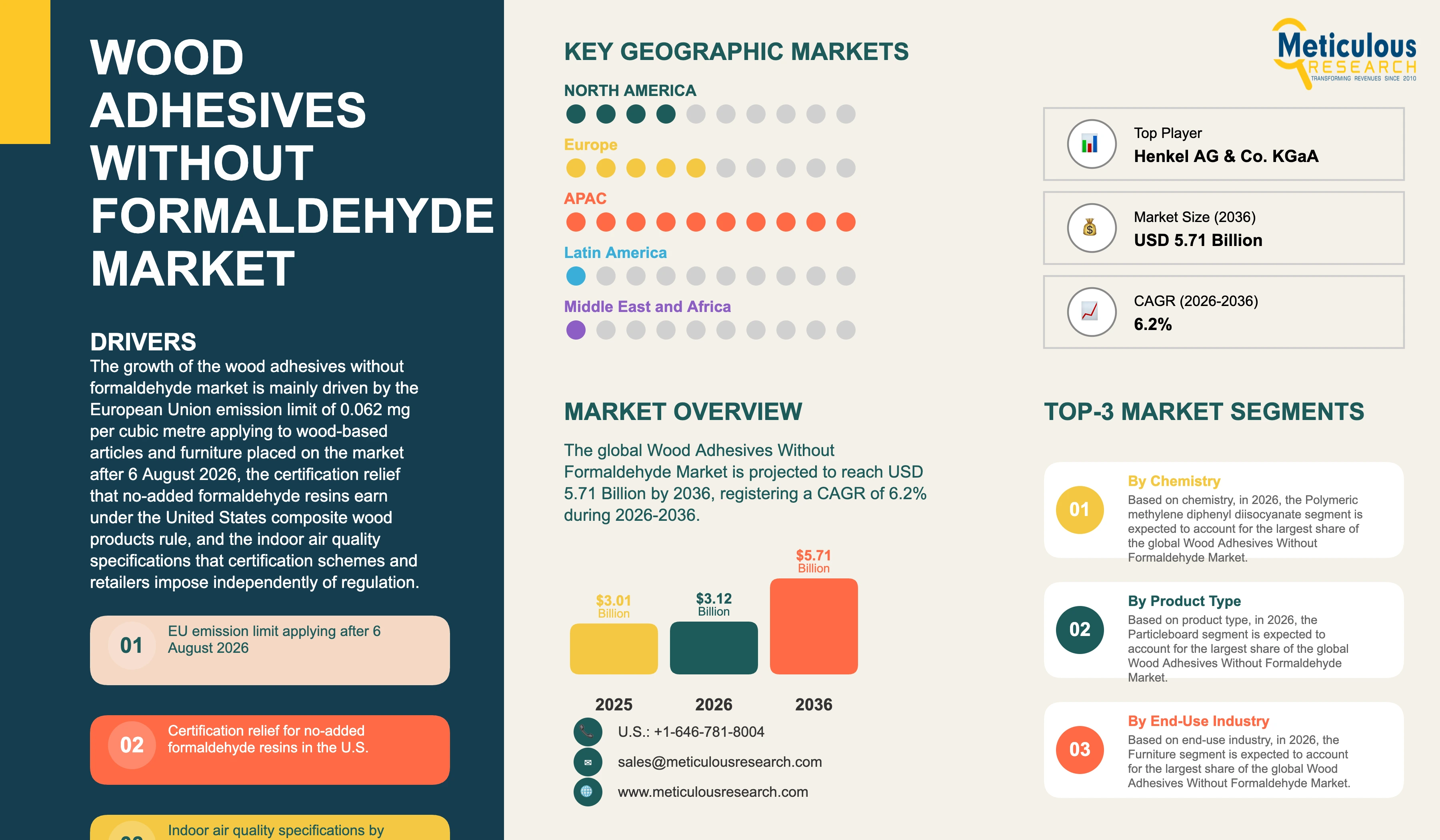
The global wood adhesives without formaldehyde market was valued at USD 3.01 billion in 2025. This market is expected to reach USD 5.71 billion by 2036 from an estimated USD 3.12 billion in 2026, registering a CAGR of 6.2% during the forecast period (2026-2036).
- Published
- Nov 2026
- Pages
- 249
- Format
- PDF + Excel
- Report ID
- MRCHM - 1042659
- Base year
- 2025
- 2025 · BASELINE
- $3.01B
- 2036
- $5.71B
- CAGR 2026–2036
- 6.2%
2025 baseline · 2026–2036 forecast at 6.2% CAGR · hover a bar for the value
Key highlights
The global wood adhesives without formaldehyde market is estimated at USD 3.12 billion in 2026 and is projected to reach USD 5.71 billion by 2036.
Market volume is estimated at 1, 860.00 kilotons in 2026 and is projected to reach 3,658.90 kilotons by 2036 at a CAGR of 7.0%.
The average selling price is estimated at USD 1.68 per kg in 2026 and is projected to reach USD 1.56 per kg by 2036.
Polymeric methylene diphenyl diisocyanate is expected to account for the largest chemistry share in 2026, while soy protein and other bio-based binders are projected to register the highest CAGR of 11.4%.
Particleboard is expected to hold the largest product type share in 2026, while plywood is projected to grow fastest at a CAGR of 7.8%.
Dry interior bond class is expected to be the largest in 2026, while exterior and load-bearing bond class is projected to register the highest CAGR of 8.2%.
Bio-based content below 20% is expected to account for the largest share in 2026, while content above 50% is projected to grow fastest at a CAGR of 12.6%.
Furniture is expected to be the largest end-use industry in 2026, while building and construction are projected to register the highest CAGR of 7.4%.
Asia-Pacific is expected to hold the largest regional share in 2026, while Europe is projected to register the highest CAGR of 7.4%.
Commission Regulation (EU) 2023/1464 amended entry 77 of Annex XVII to REACH, was published on 17 July 2023 and entered into force on 6 August 2023.
That entry sets a formaldehyde emission limit of 0.062 mg per cubic metre for wood-based articles and furniture, and 0.080 mg per cubic metre for other articles.
A separate limit of 0.062 mg per cubic metre applies to formaldehyde in road vehicle interiors.
The restriction applies to articles placed on the market after 6 August 2026 and to road vehicles placed on the market after 6 August 2027.
Compliance is measured at steady-state concentration in a test chamber at 23 plus or minus 0.5 degrees Celsius and 45 plus or minus 3% relative humidity, at a loading factor of 1 plus or minus 0.02 square metres per cubic metre and an air exchange rate of 1 plus or minus 0.05 per hour, over a test not exceeding 28 days.
Derogations cover articles where formaldehyde occurs only naturally in the materials, articles exclusively for outdoor use, construction articles used only outside the building shell and vapour barrier, articles exclusively for industrial or professional use, and second-hand articles.
United States emission standards under the composite wood products rule are 0.05 ppm for hardwood plywood, 0.09 ppm for particleboard, 0.11 ppm for medium-density fibreboard and 0.13 ppm for thin medium-density fibreboard at 8 mm thickness or below.
A no-added formaldehyde resin is defined under that rule as one with no added formaldehyde as part of its cross-linking structure that meets the applicable emission standard.
Qualifying a no-added formaldehyde resin requires one chamber test plus at least three months of quality control results, against two tests and at least six months of results for an ultra low-emitting formaldehyde resin.
Those exemptions provide reduced testing or limited third-party certification relief, last two years and can be renewed, with third-party certifiers allowed 90 days to review an application.
Report summary
| Particulars | Details |
|---|---|
| Base Year | 2025 |
| Forecast Period | 2026-2036 |
| Market Size in 2025 | USD 3.01 billion |
| Market Size in 2026 | USD 3.12 billion |
| Market Size by 2036 | USD 5.71 billion |
| Value CAGR (2026-2036) | 6.2% |
| Format | PDF, Excel & Cloud Portal · 249 pages |
| Volume in 2026 | 1,860.00 kilotons |
| Volume by 2036 | 3,658.90 kilotons |
| Volume CAGR (2026-2036) | 7.0% |
| Average Selling Price in 2026 | USD 1.68 per kg |
| Average Selling Price by 2036 | USD 1.56 per kg |
| Measurement Basis | Formaldehyde-free wood adhesive consumed in engineered panel production and in wood product assembly, excluding urea-formaldehyde, melamine-urea-formaldehyde, phenol-formaldehyde and resorcinol-formaldehyde resins, structural laminated timber adhesives for cross laminated timber and glulam, wood coatings and finishes, paper and foil laminating adhesives, and adhesives for non-wood substrates |
| Largest Chemistry Segment | Polymeric methylene diphenyl diisocyanate |
| Fastest-Growing Chemistry Segment | Soy protein and other bio-based (CAGR 11.4%) |
| Largest Product Type | Particleboard |
| Fastest-Growing Product Type | Plywood (CAGR 7.8%) |
| Largest Bond Class | Dry interior |
| Fastest-Growing Bond Class | Exterior and load-bearing (CAGR 8.2%) |
| Largest Bio-Based Content Segment | Below 20% |
| Fastest-Growing Bio-Based Content Segment | Above 50% (CAGR 12.6%) |
| Largest End-Use Industry | Furniture |
| Fastest-Growing End-Use Industry | Building and construction (CAGR 7.4%) |
| Largest Region | Asia-Pacific |
| Fastest-Growing Region | Europe (CAGR 7.4%) |
| Segments Covered | Chemistry, Product Type, Bond Class, Bio-Based Content, End-Use Industry, and Geography |
| Geographies Covered | Asia-Pacific, Europe, North America, Latin America, and Middle East & Africa |
| Companies Profiled | 11 companies, including Henkel AG & Co. KGaA, H.B. Fuller Company, Huntsman Corporation, Covestro AG, BASF SE, and Wanhua Chemical Group Co., Ltd. |
Report overview
Segments covered: chemistry, product type, bond class, bio-based content, end-use industry.
In volume terms, this market is estimated at 1,860.00 kilotons in 2026 and is projected to reach 3,658.90 kilotons by 2036, registering a CAGR of 7.0% during the same period. The average selling price is estimated at USD 1.68 per kg in 2026 and is projected to decline to USD 1.56 per kg by 2036 as isocyanate capacity expands in Asia-Pacific and bio-based binder content displaces a share of the petrochemical resin per tonne of panel bonded.
The growth of this market is mainly driven by the European Union emission limit of 0.062 mg per cubic metre that applies to wood-based articles and furniture placed on the market after 6 August 2026, the reduced testing and third-party certification relief that no-added formaldehyde resins earn under the United States composite wood rule, the indoor air quality specifications that building certification schemes and furniture retailers impose independently of regulation, and the classification of formaldehyde as a carcinogen, which places it on corporate substitution lists. However, factors such as the cost per tonne of panel of an isocyanate binder against a urea-formaldehyde resin, and the press cycle, release and handling changes an isocyanate system requires on an existing panel line, are expected to restrain the growth of this market to some extent.
Polymeric methylene diphenyl diisocyanate accounts for the largest share of this market because it bonds wood without added formaldehyde at the press times and moisture tolerances that industrial panel production requires. Soy protein and other bio-based binders grow faster because panel producers and furniture brands are specifying renewable carbon content alongside emission performance, and those systems are the only route that delivers both.
Wood adhesives without formaldehyde are binders and assembly adhesives that bond wood without formaldehyde as part of their cross-linking chemistry, used in engineered panel manufacture and in furniture, flooring and joinery assembly. Market sizing in this report is on both a value basis in USD and a volume basis in kilotons, with average selling price derived from the two. The measurement basis is formaldehyde-free wood adhesive consumed in panel production and in wood product assembly, and it excludes urea-formaldehyde, melamine-urea-formaldehyde, phenol-formaldehyde and resorcinol-formaldehyde resins, structural laminated timber adhesives for cross laminated timber and glulam, wood coatings and finishes, paper and foil laminating adhesives, and adhesives for non-wood substrates.
What distinguishes this market from wood adhesives generally is that the absence of a substance rather than the presence of a performance property defines it. A urea-formaldehyde resin releases formaldehyde from the finished panel across its service life through hydrolysis of the cured network, so emission is a property of the chemistry and not of the manufacturing quality. Removing formaldehyde from the cross-linking structure removes the release mechanism rather than reducing it, which is why regulation and procurement have converged on no-added formaldehyde systems rather than on lower-emitting formaldehyde resins.
Commission Regulation (EU) 2023/1464, which amended entry 77 of Annex XVII to REACH, was published on 17 July 2023 and entered into force on 6 August 2023, and it sets the limit that reshapes European demand. The entry imposes a formaldehyde emission limit of 0.062 mg per cubic metre for wood-based articles and furniture and 0.080 mg per cubic metre for other articles, with a further limit of 0.062 mg per cubic metre for formaldehyde in road vehicle interiors. The restriction applies to articles placed on the market after 6 August 2026 and to road vehicles placed on the market after 6 August 2027, which places the panel and furniture deadline inside the base year of this forecast.
The measurement conditions are prescribed rather than left to the producer. Compliance is established at steady-state concentration in a test chamber at 23 plus or minus 0.5 degrees Celsius and 45 plus or minus 3% relative humidity, at a loading factor of 1 plus or minus 0.02 square metres per cubic metre and an air exchange rate of 1 plus or minus 0.05 per hour, over a test not exceeding 28 days. Loading factor rather than panel emission alone therefore determines whether an article complies, since the same panel tested at a different ratio of surface to room volume produces a different concentration. Furniture makers assembling several panels into one article consequently face a tighter effective requirement than a panel producer.
Derogations define where formaldehyde resins remain usable and therefore where this market does not grow. The entry exempts articles in which formaldehyde or releasing substances occur only naturally in the materials, articles exclusively for outdoor use, construction articles used only outside the building shell and vapour barrier that do not emit into indoor air, articles exclusively for industrial or professional use unless they expose the general public under foreseeable use, and second-hand articles. Structural sheathing behind a vapour barrier is therefore treated differently from a furniture panel in the same building, which splits demand along the position of the product in the construction rather than along the product type.
The United States operates a different instrument that reaches the same result through certification economics. Emission standards under the composite wood products rule are 0.05 ppm for hardwood plywood, 0.09 ppm for particleboard, 0.11 ppm for medium-density fibreboard and 0.13 ppm for thin medium-density fibreboard at 8 mm thickness or below, measured by a prescribed chamber method. A no-added formaldehyde resin is defined as one with no added formaldehyde as part of its cross-linking structure that meets the applicable standard, and qualifying one requires a single chamber test plus at least three months of quality control results.
That qualification earns relief rather than merely compliance. The exemptions provide reduced testing or limited third-party certification, last two years and can be renewed, with certifiers allowed 90 days to review an application, against two tests and at least six months of quality control results for an ultra low-emitting formaldehyde resin. A panel producer running a no-added formaldehyde system therefore carries a lower ongoing certification cost than one running a compliant formaldehyde resin, which offsets part of the higher binder price. Labelling a product as no-added formaldehyde is optional under the rule, so the benefit accrues as cost avoided rather than as a marketing claim.
Isocyanate chemistry carries most of the industrial volume because it meets the process conditions rather than because it is the cheapest route. Polymeric methylene diphenyl diisocyanate reacts with the moisture and hydroxyl groups in wood, tolerates higher furnish moisture than a condensation resin, cures at commercial press times and produces panels with better internal bond and thickness swell at lower resin loading. The trade-offs are cost per tonne of panel, adhesion to press platens that requires release agents or barrier films, and handling controls for an isocyanate in a plant that previously handled an aqueous resin.
Bio-based binders are being specified for a second attribute that formaldehyde-free chemistry alone does not deliver. Soy protein, lignin and other renewable systems satisfy an emission requirement and a renewable carbon requirement at the same time, which matters where a furniture brand or a building certification scheme asks for both. Those binders generally need longer press times, tighter moisture control or partial co-reaction with an isocyanate to reach the bond performance a panel line requires, so they are adopted where the specification pays for the process penalty rather than across the board.
Particleboard is expected to hold the largest share in 2026.
Plywood is projected to register the highest CAGR of 7.8% during the forecast period.
Dry interior bond class is expected to account for the largest share in 2026.
Exterior and load-bearing bond class is projected to register the highest CAGR of 8.2% during the forecast period.
Furniture is expected to account for the largest share in 2026, sitting inside the European Union article limit with no applicable derogation.
Building and construction are projected to register the highest CAGR of 7.4% during the forecast period.
Asia-Pacific is expected to account for the largest share in 2026, supported by the engineered panel and furniture production concentrated in China, Vietnam, Malaysia, Indonesia and India. China is projected to grow at 5.8% and India at 9.2%.
Europe is projected to register the highest CAGR of 7.4% during the forecast period, with Germany at 7.0% and Poland at 8.4%.
Europe is projected to grow at a CAGR of 7.4% and is the fastest-growing region, driven by the 0.062 mg per cubic metre limit applying to wood-based articles and furniture placed on the market after 6 August 2026 under entry 77 of Annex XVII to REACH and by compliance being measured on the finished article at a prescribed loading factor. Germany is projected at 7.0% and Poland at 8.4%.
The Middle East & Africa is projected to grow at a CAGR of 6.6% from a smaller base as panel and furniture capacity is added. Latin America is projected to grow at a CAGR of 6.2%, with Brazil at 6.4%.
Henkel AG & Co. KGaA, H.B. Fuller Company, Huntsman Corporation, Covestro AG and BASF SE together accounted for an estimated 46.5% of this market in 2026. The 11 companies profiled in this report together accounted for an estimated 71.0%.
Report infographic
Market dynamics
15 factors across 5 forcesEuropean Union Emission Limit Applying to Articles Placed on the Market After 6 August 2026
Entry 77 of Annex XVII to REACH, as amended by Commission Regulation (EU) 2023/1464, sets a formaldehyde emission limit of 0.062 mg per cubic metre for wood-based articles and furniture and 0.080 mg per cubic metre for other articles, applying to articles placed on the market after 6 August 2026. Compliance is measured at steady-state concentration in a chamber at 23 degrees Celsius and 45% relative humidity at a loading factor of 1 square metre per cubic metre, so an article combining several panels faces a tighter effective requirement than a single panel. Panel producers and furniture makers supplying the European Union have reformulated ahead of the date rather than after it, because a panel line conversion runs on a longer cycle than a compliance deadline. The deadline falls inside the base year of this forecast, which is why European growth leads the market. Imported articles are caught on the same date as domestic ones, so the requirement reaches every panel entering the market rather than only those pressed inside it.
Certification Relief Earned by No-Added Formaldehyde Resins in the United States
A no-added formaldehyde resin is defined under the United States composite wood products rule as one with no added formaldehyde as part of its cross-linking structure that meets the applicable emission standard, which is 0.05 ppm for hardwood plywood, 0.09 ppm for particleboard, 0.11 ppm for medium-density fibreboard and 0.13 ppm for thin medium-density fibreboard. Qualifying one requires a single chamber test plus at least three months of quality control results, against two tests and six months for an ultra low-emitting formaldehyde resin, and the resulting exemption provides reduced testing or limited third-party certification for two years with renewal available. A producer running a no-added formaldehyde system therefore carries lower ongoing certification cost than one running a compliant formaldehyde resin. The relief offsets part of the binder price premium, which changes the economics rather than only the compliance position, and it applies across every line a producer runs rather than to a single product.
Indoor Air Quality Specifications Imposed by Certification Schemes and Retailers
Building certification schemes award credits for low-emitting interior materials and furniture retailers operate their own emission specifications, both of which sit below the regulatory limits rather than at them, and both of which apply in markets with no formaldehyde restriction at all. A specification written by a retailer reaches every panel in its supply chain regardless of where it was pressed, which extends the requirement beyond the European Union and United States into the exporting production base. Those specifications are revised faster than regulation and are enforced through supplier audits rather than market surveillance. Panel producers serving export furniture programmes therefore convert lines ahead of any legal obligation in their own market, and they hold the converted line afterwards because the specification outlasts any single order.
Classification of Formaldehyde as a Carcinogen Placing It on Substitution Lists
Formaldehyde is a classified carcinogen, which brings it onto corporate restricted substance lists, into occupational exposure assessments at the panel plant, and into the substance declarations that customers now require with a delivery. A resin containing a classified carcinogen requires exposure controls, labelling and worker monitoring in manufacture that a formaldehyde-free binder does not, so the substitution removes a compliance burden inside the plant as well as an emission from the product. Procurement policies written around classification apply irrespective of whether the finished article would pass an emission test. The classification therefore drives substitution independently of the emission limits and continues to do so after they are met.
Table of contents
13 chapters · 149 sections · 249 pages · click to expandSegmental analysis
| Segment | Largest share (2026) | Fastest growth (2026–2036) |
|---|---|---|
| By Chemistry | Polymeric methylene diphenyl diisocyanate | Soy protein and other bio-based |
| By Product Type | Particleboard | Plywood |
| By Bond Class | Dry interior bond class | Exterior and load-bearing bond class |
| By Bio-Based Content | Below 20% bio-based content | Above 50% |
| By End-Use Industry | Furniture | Building and construction |
| Other segments | Polymeric methylene diphenyl diisocyanate | — |
By Chemistry
- Wood Adhesives Without Formaldehyde Market Analysis by Chemistry
- The polymeric methylene diphenyl diisocyanate segment is expected to account for the largest share of the global wood adhesives without formaldehyde market.
- The large share of this segment is mainly due to the reaction with moisture and hydroxyl groups in wood that allows bonding without added formaldehyde at commercial press times, the tolerance of higher furnish moisture than a condensation resin offers, and the internal bond and thickness swell performance delivered at lower resin loading, which partly offsets the higher cost per kilogram.
- However, the soy protein and other bio-based segment is projected to register the highest CAGR of 11.4% during the forecast period.
- The rapid growth of this segment is attributed to the renewable carbon content that building certification schemes and furniture brands specify alongside emission performance and that an isocyanate binder cannot provide, the availability of protein and other renewable feedstocks at industrial scale, and the position of these binders as the only route satisfying both requirements with a single material.
- Polyvinyl acetate dispersions hold the assembly adhesive position in furniture, joinery and flooring where bonding is carried out at or near ambient temperature rather than in a press, and emulsion polymer isocyanate systems serve the higher bond class assembly joints that a dispersion alone cannot reach.
- Lignin-based binders occupy a growing position supported by availability from pulping operations.
- Chemistry selection in practice follows whether the bond is made in a press or in an assembly operation and what bond class the application requires, since every chemistry here is formaldehyde-free by definition.
- Soy protein and other bio-based binders are projected to register the highest CAGR of 11.4% during the forecast period.
- Bio-based content below 20% is expected to hold the largest share in 2026.
- Bio-based content above 50% is projected to register the highest CAGR of 12.6% during the forecast period.
By Product Type
- Wood Adhesives Without Formaldehyde Market Analysis by Product Type
- The particleboard segment is expected to account for the largest share of the global wood adhesives without formaldehyde market.
- The large share of this segment is mainly due to the global particleboard production volume that exceeds any other engineered panel, the furniture and interior fitout applications that consume most of it and that fall squarely inside the European Union article limit, and the resin quantity a particle furnish requires against a veneer construction.
- However, the plywood segment is projected to register the highest CAGR of 7.8% during the forecast period.
- The rapid growth of this segment is attributed to the United States emission standard for hardwood plywood of 0.05 ppm, which is the tightest of the four product categories, the veneer bonding geometry that allows the adhesive to be spread on a continuous surface at a controlled rate rather than blended into a furnish, and the veneer moisture content that is easier to control than particle furnish moisture, which removes a constraint on bio-based and dispersion systems.
By Bond Class
- Wood Adhesives Without Formaldehyde Market Analysis by Bond Class
- The dry interior bond class segment is expected to account for the largest share of the global wood adhesives without formaldehyde market.
- The large share of this segment is mainly due to the furniture and interior fitout panels that make up most formaldehyde-free demand and that operate in conditioned indoor environments, the suitability of polyvinyl acetate dispersions and standard isocyanate loadings for those conditions, and the position of interior articles inside the European Union restriction where outdoor articles are derogated.
- However, the exterior and load-bearing bond class segment is projected to register the highest CAGR of 8.2% during the forecast period.
- The rapid growth of this segment is attributed to the moisture and temperature resistance that isocyanate and emulsion polymer isocyanate systems deliver where a dispersion cannot, the engineered wood construction products that carry structural duty in humid service conditions, and the higher adhesive value per cubic metre those bond classes command over interior grades.
By Bio-Based Content
- Wood Adhesives Without Formaldehyde Market Analysis by Bio-Based Content
- The below 20% bio-based content segment is expected to account for the largest share of the global wood adhesives without formaldehyde market.
- The large share of this segment is mainly due to the predominance of isocyanate and synthetic dispersion chemistry in industrial panel bonding, the press times and moisture tolerances those systems deliver that higher bio-based loadings do not, and the absence of any renewable content requirement in the emission regulations themselves.
- However, the above 50% segment is projected to register the highest CAGR of 12.6% during the forecast period.
- The rapid growth of this segment is attributed to the renewable carbon requirements that building certification schemes and furniture brands write alongside emission class, the protein and lignin feedstocks available at industrial scale from agricultural and pulping operations, and the premium those specifications support, which pays for the longer press times and tighter moisture control the systems require.
By End-Use Industry
- Wood Adhesives Without Formaldehyde Market Analysis by End-Use Industry
- The furniture segment is expected to account for the largest share of the global wood adhesives without formaldehyde market.
- The large share of this segment is mainly due to the position of furniture squarely inside the European Union article limit of 0.062 mg per cubic metre with no applicable derogation, the retailer emission specifications that reach furniture supply chains worldwide irrespective of local regulation, and the multi-panel articles that face a tighter effective requirement at the prescribed loading factor than the panels they are built from.
- However, the building and construction segment is projected to register the highest CAGR of 7.4% during the forecast period.
- The rapid growth of this segment is attributed to the interior fitout, flooring and joinery products that fall inside the restriction while structural sheathing outside the vapour barrier is derogated, the building certification schemes that award credits for low-emitting interior materials, and the engineered wood construction growth that raises panel consumption in interior applications.
Other segments
- Polymeric methylene diphenyl diisocyanate is expected to account for the largest share in 2026, bonding wood without added formaldehyde at commercial press times and moisture tolerances.
Geographic analysis
Asia-Pacific
Largest shareIn 2026, Asia-Pacific is expected to account for the largest share of the global wood adhesives without formaldehyde market. The large share of this region is mainly due to the engineered panel and furniture production capacity concentrated in China, Vietnam, Malaysia, Indonesia and India, the export furniture programmes that carry European Union and United States emission requirements into those plants irrespective of local regulation, and the isocyanate capacity established in the region. China is projected to register a CAGR of 5.8% and India a CAGR of 9.2% during the forecast period.
Europe
Fastest growthHowever, Europe is projected to register the highest CAGR of 7.4% during the forecast period. The rapid growth of this region is attributed to the emission limit of 0.062 mg per cubic metre applying to wood-based articles and furniture placed on the market after 6 August 2026 under entry 77 of Annex XVII to REACH, the measurement of compliance on the finished article at a prescribed loading factor rather than on the panel, and the furniture and interior fitout production base that falls inside the restriction with no applicable derogation. Germany is projected to register a CAGR of 7.0% and Poland a CAGR of 8.4%.
North America
North America is projected to grow at 5.0%, with the United States at 5.0%, on the certification economics of the composite wood products rule rather than on an outright prohibition, since a compliant formaldehyde resin remains usable while a no-added formaldehyde system earns reduced testing and limited third-party certification relief.
Latin America
Latin America is projected to grow at 6.2%, with Brazil at 6.4% as panel production serving both domestic and export furniture demand expands.
Middle East & Africa
The Middle East & Africa is projected to grow at 6.6% from a smaller base as panel and furniture capacity is added. Regulation in one region reaches production in another through the customer rather than through the authority. A furniture programme supplying the European Union has to meet the article limit wherever the panels were pressed, and a retailer emission specification applies across a supply chain regardless of local law, which is why Asia-Pacific plants convert lines against requirements that do not apply in their own market. Adhesive supply is nonetheless regional, since an isocyanate binder is moisture-sensitive and a dispersion is roughly half water, and both are delivered in bulk to the panel plant rather than shipped between regions. Conversion therefore follows the export order book while supply follows the press line.
Competitive landscape
The global wood adhesives without formaldehyde market is characterised by the presence of isocyanate producers supplying binder directly to panel plants, formulated adhesive companies serving panel and assembly customers, and wood adhesive specialists with furniture and joinery positions. Competition is contested on binder cost per tonne of panel together with the press performance and certification position a system delivers, rather than on adhesive properties alone, since conversion requires press, handling and release changes the supplier has to support. Henkel AG & Co. KGaA, H.B. Fuller Company, Huntsman Corporation, Covestro AG and BASF SE together accounted for an estimated 46.5% of this market in 2026, while the companies profiled in this report together accounted for an estimated 71.0%.
Commission Regulation (EU) 2023/1464 amended entry 77 of Annex XVII to REACH with effect for articles placed on the market after 6 August 2026 and road vehicles after 6 August 2027, setting 0.062 mg per cubic metre for wood-based articles and furniture and 0.080 mg per cubic metre for other articles. In the United States, no-added formaldehyde resin exemptions under the composite wood products rule provide reduced testing or limited third-party certification for two years on the basis of one chamber test and three months of quality control results. Bio-based binder systems, article-level emission data for furniture customers and parallel binder operation on single sites accounted for most competitive activity through 2026.
Isocyanate producers hold a position formulated adhesive suppliers do not, because polymeric methylene diphenyl diisocyanate is supplied as a binder directly into panel production and the same producers control the capacity behind it. Wanhua Chemical Group Co., Ltd., Covestro AG, BASF SE and Huntsman Corporation occupy that position, while Jowat SE, KLEIBERIT SE & Co. KG, Franklin International Ltd. and Pidilite Industries Limited compete in furniture, joinery and flooring assembly. Some of the key players operating in the wood adhesives without formaldehyde market are Henkel AG & Co. KGaA (Germany), H.B. Fuller Company (U.S.), Huntsman Corporation (U.S.), Covestro AG (Germany), BASF SE (Germany), Wanhua Chemical Group Co., Ltd. (China), Arkema S.A. (France), Jowat SE (Germany), KLEIBERIT SE & Co. KG (Germany), Franklin International Ltd. (U.S.), and Pidilite Industries Limited (India), among others.
- —
Commission Regulation (EU) 2023/1464 amended entry 77 of Annex XVII to REACH, was published on 17 July 2023 and entered into force on 6 August 2023, setting 0.062 mg per cubic metre for wood-based articles and furniture and 0.080 mg per cubic metre for other articles, applying to articles placed on the market after 6 August 2026 and to road vehicles after 6 August 2027. In the United States, no-added formaldehyde resin exemptions under the composite wood products rule continue to provide reduced testing or limited third-party certification for renewable two-year terms.
- Henkel AG & Co. KGaA
- H.B. Fuller Company
- Huntsman Corporation
- Covestro AG
- BASF SE
- Wanhua Chemical Group Co., Ltd
Expert perspectives
Volume grows at 7.0% against 6.2% in value over the forecast period, and the average selling price falls from USD 1.68 per kg in 2026 to USD 1.56 per kg by 2036 as isocyanate capacity expands in Asia-Pacific and bio-based content displaces a share of the petrochemical resin per tonne of panel bonded. The decline reflects feedstock substitution and regional capacity rather than margin erosion, since the binder is sold against a compliance requirement rather than against an alternative that performs the same function.
What defines this market is the absence of a substance rather than a performance property. A urea-formaldehyde resin releases formaldehyde across the service life of a panel through hydrolysis of the cured network, so emission is a property of the chemistry and not of manufacturing quality. Removing formaldehyde from the cross-linking structure removes the mechanism rather than reducing it, which is why both the European and United States instruments converge on no-added formaldehyde systems.
The loading factor in the European test is the detail that does most of the commercial work. Compliance with the 0.062 mg per cubic metre limit is measured at 1 square metre per cubic metre on the finished article, so a wardrobe or kitchen containing several panels reaches a higher chamber concentration than a single board of the same class. Furniture makers therefore need panels below the limit rather than at it, which is why furniture is the largest end-use industry and why demand sits with no-added formaldehyde rather than low-emitting formaldehyde panels.
The United States instrument works through certification cost instead of prohibition. A no-added formaldehyde exemption requires one chamber test and three months of quality control results against two tests and six months for an ultra low-emitting resin, lasts two years and provides reduced testing or limited third-party certification. That difference is quantifiable per line per year and offsets part of the binder premium, which is the argument a supplier can make today without a new formulation.
Derogations rather than cost are what slow European conversion. Outdoor articles, construction articles outside the building shell and vapour barrier, and industrial or professional articles remain compliant in formaldehyde chemistry, so a producer serving both furniture and sheathing runs two binder systems on one site rather than converting a line. That configuration is becoming normal rather than transitional, and it caps how fast the addressable volume converts even where the economics work.
Bio-based binders grow fastest because they answer a second question. Renewable carbon content is being specified alongside emission class, and an isocyanate answers only the emission half, so a single bio-based binder avoids running two systems for two requirements. The constraint is press time, which is the throughput limit on a panel line, and co-reacting with an isocyanate recovers the performance while reducing the renewable content that motivated the choice.
Customer perspectives
Line conversion involves press, release and moisture changes rather than a material substitution alone, and the derogations have led producers to operate two binder systems on one site.
Article-level compliance at the prescribed loading factor rather than board certification governs furniture sourcing, and retailer specifications carry the requirement into production outside the regulated market.
Renewable content and emission class are being specified together, and the press time penalty of bio-based binders sets a direct trade-off between throughput and the renewable content that justified the selection.
“Converting a line to isocyanate is not a resin change, it is a press project. The binder sticks to our platens as well as it sticks to the wood, so we need release systems, and our moisture window and press schedule both move. We are running both resin systems on the site because our sheathing grades are still derogated and our furniture grades are not.”
“The limit applies to the finished article, and our wardrobes carry a lot of board in a small room volume, so a panel that just passes at board level does not help us. We ask for emission data on the article, not a board certificate, and in practice that means no added formaldehyde. Our specification applies to every supplier we use, wherever they press.”
“We are now asked for renewable content and low emission in the same specification, and an isocyanate only answers one of them. The bio-based binders answer both but they cost us press time, which is our output. If we blend with isocyanate to get the cycle back we lose the renewable content we were buying.”
Frequently asked questions
This market was valued at USD 2.91 billion in 2024 and USD 3.01 billion in 2025, and is estimated at USD 3.12 billion in 2026. In volume terms it is estimated at 1,860.00 kilotons in 2026.
This market is projected to reach USD 5.71 billion by 2036 in value and 3,658.90 kilotons in volume.
This market is projected to register a value CAGR of 6.2% and a volume CAGR of 7.0% during the forecast period 2026-2036. The average selling price is projected to move from USD 1.68 per kg in 2026 to USD 1.56 per kg by 2036.
Growth is driven by the emission limit of 0.062 mg per cubic metre that entry 77 of Annex XVII to REACH applies to wood-based articles and furniture placed on the market after 6 August 2026, the certification relief that no-added formaldehyde resins earn under the United States composite wood products rule, the indoor air quality specifications imposed by certification schemes and retailers, and the classification of formaldehyde as a carcinogen.
An isocyanate binder costs several times a urea-formaldehyde resin per kilogram, and conversion requires release systems, handling controls and press schedule changes. Derogations keep formaldehyde resins compliant in some applications so producers run two systems on one site, and bio-based binders cost press time.
Furniture and multi-panel articles face a tighter effective requirement at the prescribed loading factor, and bio-based binders satisfy emission and renewable carbon requirements with one material. Plywood conversion is favoured by the 0.05 ppm United States standard, and certification cost reduction is a commercial argument available immediately.
Polymeric methylene diphenyl diisocyanate is expected to account for the largest share in 2026, bonding wood without added formaldehyde at commercial press times and moisture tolerances.
Soy protein and other bio-based binders are projected to register the highest CAGR of 11.4% during the forecast period.
Particleboard is expected to hold the largest share in 2026.
Plywood is projected to register the highest CAGR of 7.8% during the forecast period.
Dry interior bond class is expected to account for the largest share in 2026.
Exterior and load-bearing bond class is projected to register the highest CAGR of 8.2% during the forecast period.
Bio-based content below 20% is expected to hold the largest share in 2026.
Bio-based content above 50% is projected to register the highest CAGR of 12.6% during the forecast period.
Furniture is expected to account for the largest share in 2026, sitting inside the European Union article limit with no applicable derogation.
Building and construction are projected to register the highest CAGR of 7.4% during the forecast period.
Asia-Pacific is expected to account for the largest share in 2026, supported by the engineered panel and furniture production concentrated in China, Vietnam, Malaysia, Indonesia and India. China is projected to grow at 5.8% and India at 9.2%.
Europe is projected to register the highest CAGR of 7.4% during the forecast period, with Germany at 7.0% and Poland at 8.4%.
Europe is projected to grow at a CAGR of 7.4% and is the fastest-growing region, driven by the 0.062 mg per cubic metre limit applying to articles placed on the market after 6 August 2026 under entry 77 of Annex XVII to REACH. Germany is projected at 7.0% and Poland at 8.4%.
The Middle East & Africa is projected to grow at a CAGR of 6.6% from a smaller base as panel and furniture capacity is added. Latin America is projected to grow at a CAGR of 6.2%, with Brazil at 6.4%.
Henkel AG & Co. KGaA, H.B. Fuller Company, Huntsman Corporation, Covestro AG and BASF SE together accounted for an estimated 46.5% of this market in 2026. The 11 companies profiled in this report together accounted for an estimated 71.0%.
Commission Regulation (EU) 2023/1464 amended entry 77 of Annex XVII to REACH, setting 0.062 mg per cubic metre for wood-based articles and furniture placed on the market after 6 August 2026. In the United States, no-added formaldehyde resin exemptions continue to provide reduced testing or limited third-party certification for renewable two-year terms.
Cite this report
Meticulous Research. (2026). Wood Adhesives Without Formaldehyde Market - Global Opportunity Analysis and Industry Forecast (2026-2036) (Report No. MRCHM - 1042659). Meticulous Market Research Pvt. Ltd. https://www.meticulousresearch.com/product/wood-adhesives-without-formaldehyde-market-7342