Botulinum Toxin Market (2026-2036)
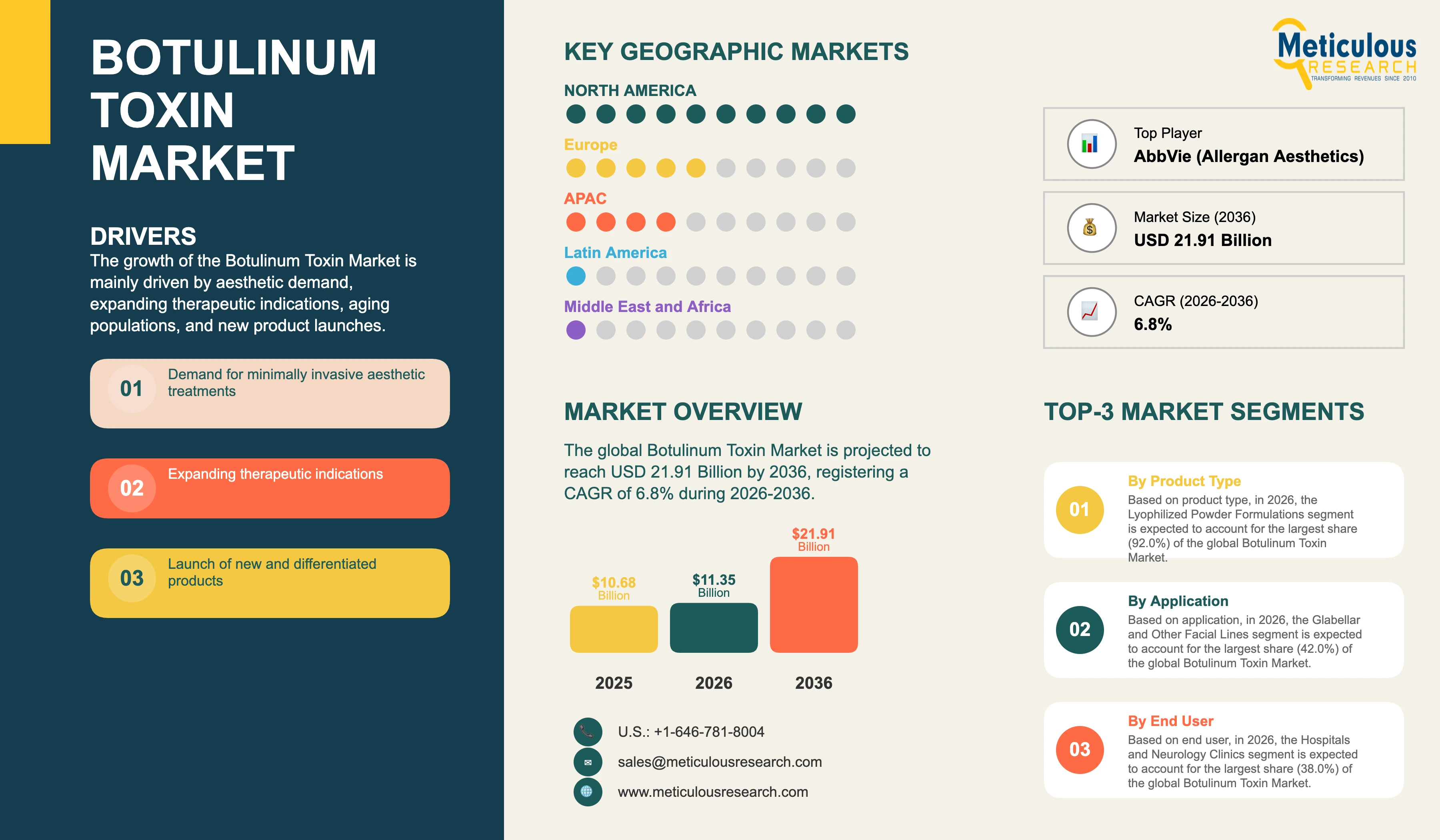
The global botulinum toxin market was valued at USD 10.68 billion in 2025. This market is expected to reach USD 21.91 billion by 2036 from an estimated USD 11.35 billion in 2026, registering a CAGR of 6.8% during the forecast period (2026-2036).
- Published
- Nov 2026
- Pages
- 230
- Format
- PDF + Excel
- Report ID
- MRHC - 1042626
- Base year
- 2025
- 2025 · BASELINE
- $10.68B
- 2036
- $21.91B
- CAGR 2026–2036
- 6.8%
2025 baseline · 2026–2036 forecast at 6.8% CAGR · hover a bar for the value
Key highlights
AbbVie reported global Botox Therapeutic net revenues of USD 3.769 billion and global Botox Cosmetic net revenues of USD 2.602 billion in 2025, while its total aesthetics portfolio declined 6.1% to USD 4.860 billion; fourth-quarter 2025 Botox Cosmetic revenues rose 4.2% to USD 717 million, according to the company's full-year 2025 results released in February 2026.
Galderma reported that its Neuromodulators net sales, which include Dysport and Relfydess, grew 14.3% at constant currency to USD 1.471 billion in 2025, with double-digit growth and market share gains in both of its geographies, according to the company's full-year 2025 results.
On June 30, 2026, Galderma announced that it had received a Complete Response Letter from the FDA for RelabotulinumtoxinA related to observations during a manufacturing site inspection, while Relfydess was already approved in 33 markets and launched in more than 20, including Europe, the U.K., the Middle East, Asia, and Australia, according to Galderma.
Evolus reported 2025 net revenues of USD 297.2 million, up 12%, and said that Jeuveau had captured more than 14% of the U.S. aesthetic neurotoxin market, while noting that 2025 was only the third time in 25 years that U.S. injectable procedure volumes declined, according to the company's fourth-quarter 2025 earnings call.
Hugel's Letybo, which received FDA approval in February 2024 and launched in the U.S. in March 2025 through a partnership with Benev, was adopted by more than 9,000 U.S. practices, and in 2026 Hugel launched a direct sales and medical affairs organization for strategic U.S. accounts, according to Plastic Surgery Practice and Hugel.
Revance announced in September 2025 that it had distributed more than 1 million vials of Daxxify for aesthetic use in the U.S. three years after its FDA approval, and Crown Laboratories completed its acquisition of Revance in 2025, according to ReachMD and Revance. The company noted that it is approaching double-digit toxin market share in the U.K., its most mature international market, and that its international revenue nearly doubled in 2025.
By product type, lyophilized powder formulations account for the largest share of 92.0% in 2026, while ready-to-use liquid formulations register the highest CAGR.
By application, glabellar and other facial lines account for the largest share in 2026, while other aesthetic applications register the highest CAGR.
By gender, female accounts for the larger share in 2026, while male registers the higher CAGR.
By end user, hospitals and neurology clinics account for the largest share of 38.0% in 2026, while medical spas register the highest CAGR.
By geography, North America accounts for the largest share of 48.0% in 2026, while Asia-Pacific registers the highest CAGR of 9.4%.
Report summary
| Particulars | Details |
|---|---|
| Forecast Period | 2026-2036 |
| Base Year | 2025 |
| Estimated Year | 2026 |
| Market Size in 2025 | USD 10.68 billion |
| Market Size in 2026 | USD 11.35 billion |
| Market Size by 2036 | USD 21.91 billion |
| CAGR (2026-2036) | 6.8% |
| Format | PDF, Excel & Cloud Portal · 230 pages |
| Largest Segment by Product Type (2026) | Lyophilized Powder Formulations (92.0%) |
| Largest Segment by End User (2026) | Hospitals and Neurology Clinics (38.0%) |
| Largest Region (2026) | North America (48.0%) |
| Fastest-Growing Region | Asia-Pacific (CAGR 9.4%) |
| Companies Profiled | 14 companies and other companies |
| Segments Covered | Product Type, Application, Gender, End User, Geography |
| Countries Covered | U.S., Canada, Germany, U.K., France, Italy, Spain, Netherlands, Switzerland, Belgium, Sweden, Denmark, Norway, Finland, Austria, Poland, Ireland, Rest of Europe, China, Japan, India, South Korea, Australia, Indonesia, Thailand, Singapore, Malaysia, Vietnam, Philippines, Taiwan, New Zealand, Rest of Asia-Pacific, Brazil, Mexico, Argentina, Colombia, Chile, Peru, Rest of Latin America, Saudi Arabia, U.A.E., Israel, South Africa, Turkey, Egypt, Rest of Middle East & Africa |
Report overview
Segments covered: product type, application, gender, end user.
The growth of this market is mainly driven by the strong and steady demand for aesthetic neuromodulator treatments, the growing use of botulinum toxins for chronic migraine, spasticity, cervical dystonia, overactive bladder, and other therapeutic indications, the aging population and the rising prevalence of neurological disorders, the launch of new products such as ready-to-use liquid formulations and longer-acting toxins, the growing acceptance of aesthetic treatments among men and younger consumers, and the rapid growth of aesthetic markets in Asia-Pacific. However, factors such as the 2025 decline in aesthetic injectable procedure volumes in the U.S., pricing pressure from new competitors and promotional activity, the risk of adverse events, the high cost of repeat treatments, and government drug price negotiation for therapeutic products are expected to restrain the growth of this market to some extent.
Botulinum toxins are biologic drugs derived from the neurotoxin produced by the bacterium Clostridium botulinum. When injected in very small doses into specific muscles or glands, they temporarily block the release of acetylcholine, which relaxes muscles or reduces gland activity for about three to six months. This mechanism makes botulinum toxins useful for both aesthetic treatments, such as smoothing frown lines, crow's feet, and forehead lines, and a wide range of therapeutic uses, such as chronic migraine, spasticity, cervical dystonia, overactive bladder, blepharospasm, and excessive sweating.
This report covers the global botulinum toxin market, including botulinum toxin type A products supplied as lyophilized powder formulations that require reconstitution, new ready-to-use liquid formulations, and botulinum toxin type B products. The market is analyzed by product type, application, gender, end user, and geography. The market is measured on a revenue basis at manufacturer selling prices and does not include the fees charged by physicians and aesthetic practices for treatments. Dermal fillers and other injectable aesthetic products are covered in separate reports.
Botulinum toxin injections are the most popular non-surgical aesthetic procedure in the world. The International Society of Aesthetic Plastic Surgery's global survey reported 7.3 million botulinum toxin procedures performed by plastic surgeons in 2025, more than any other non-surgical procedure, and the total number of treatments is much higher when dermatologists, aesthetic physicians, and nurse injectors are included. In therapeutic medicine, botulinum toxins are established treatments recommended in clinical guidelines for several neurological, urological, and other conditions, and AbbVie's Botox Therapeutic is the largest single product in the market.
The aesthetic segment of the market softened in 2025 as consumers became more cautious about discretionary spending, and AbbVie reported a decline in its total aesthetics portfolio in 2025, although Botox Cosmetic returned to growth in the fourth quarter, while Evolus noted that U.S. injectable procedure volumes declined in 2025 for only the third time in 25 years. Economic pressure on consumers and more cautious spending on discretionary treatments contributed to this slowdown. At the same time, the therapeutic segment continued to grow steadily, with Botox Therapeutic revenues of USD 3.769 billion in 2025, supported by strong demand in chronic migraine and other neurological indications.
Competition in the botulinum toxin market has increased significantly in recent years as new brands have entered major markets. AbbVie's Botox remains the market leader, but Galderma's Dysport and Relfydess, Merz's Xeomin, Evolus's Jeuveau, Revance's Daxxify, Hugel's Letybo, and other products have gained share, particularly in aesthetics. Galderma's neuromodulator sales grew 14.3% at constant currency in 2025, and Jeuveau reached more than 14% of the U.S. aesthetic neurotoxin market. Korean and Chinese manufacturers such as Hugel, Daewoong, Medytox, and Lanzhou Institute of Biological Products have strong positions in Asia and are expanding internationally.
Product innovation is focused on faster onset, longer duration, and greater convenience. Ready-to-use liquid formulations, such as Galderma's Relfydess and Alluzience, remove the need for reconstitution and allow simple volumetric dosing, while Daxxify uses a peptide formulation designed for longer-lasting results. These products give practitioners more choice and are expected to increase competition across the forecast period.
In 2026, lyophilized powder formulations account for the largest share of the market by product type, while ready-to-use liquid formulations are the fastest-growing product type. Glabellar and other facial lines is the largest application, while other aesthetic applications are the fastest-growing application. Female patients account for the larger share by gender, while male patients are the faster-growing group. Hospitals and neurology clinics are the largest end user, while medical spas are the fastest-growing end user. North America accounts for the largest share of the market, while Asia-Pacific is the fastest-growing region.
Over the forecast period, the botulinum toxin market is expected to grow steadily, supported by population aging, the expanding use of botulinum toxins in therapeutic medicine, continued demand for minimally invasive aesthetic treatments, new product launches, and rapid growth in Asia-Pacific. However, growth in aesthetics is expected to be more competitive, with greater price pressure as new products enter major markets. The market also benefits from strong practitioner loyalty and established treatment routines, as many patients receive injections at regular intervals for many years, which gives manufacturers a stable and predictable revenue base in both aesthetics and therapeutic medicine.
North America is expected to account for the largest share of 48.0% of the market in 2026, mainly due to high demand for aesthetic and therapeutic treatments, broad insurance coverage for therapeutic indications, and the presence of major manufacturers.
Asia-Pacific is projected to register the highest CAGR of 9.4% during the forecast period, driven by rising incomes, strong aesthetic culture in South Korea and China, and competitive local manufacturers.
The report profiles 14 companies, including AbbVie (Allergan Aesthetics), Galderma, Ipsen, Merz, Evolus, Revance (Crown Laboratories), Hugel, Daewoong, Medytox, Huons, Lanzhou Institute of Biological Products, Supernus, Jetema, and Croma-Pharma.
Ready-to-use liquid botulinum toxins, such as Galderma's Relfydess and Alluzience, are supplied as solutions that do not need to be reconstituted before injection. They reduce preparation time, support consistent volumetric dosing, and are gaining adoption in Europe and other markets.
Economic pressure on consumers reduced discretionary spending on aesthetic treatments, and Evolus noted that 2025 was only the third time in 25 years that U.S. injectable procedure volumes declined. AbbVie's aesthetics portfolio revenues fell 6.1% in 2025, although Botox Cosmetic returned to growth in the fourth quarter.
In 2026, the female segment is expected to account for the larger share of the botulinum toxin market, while the male segment is projected to register the higher CAGR during the forecast period.
Report infographic
Market dynamics
18 factors across 5 forcesStrong demand for minimally invasive aesthetic treatments
Consumers increasingly prefer minimally invasive aesthetic treatments that offer visible results with little downtime, low risk, and moderate cost. Botulinum toxin injections fit these preferences well, as a treatment session usually takes less than 30 minutes and results appear within a few days. According to ISAPS, botulinum toxin was the most common non-surgical aesthetic procedure performed by plastic surgeons worldwide in 2025, with 7.3 million procedures.
Repeat treatments every three to six months create a recurring and loyal patient base for manufacturers and practices. Patients often begin with frown lines and later add crow's feet, forehead lines, and other areas, which increases the number of units used per patient over time. Manufacturer loyalty programs, such as AbbVie's Allē and Evolus Rewards, encourage repeat visits and support stable demand.
Social media, video calls, and greater openness about aesthetic treatments have also increased public awareness and acceptance of botulinum toxin injections, particularly among younger consumers in their twenties and thirties who use the treatments to prevent the formation of deeper lines.
Expanding use in therapeutic indications
Botulinum toxins are approved and widely used for chronic migraine, upper and lower limb spasticity, cervical dystonia, overactive bladder and neurogenic detrusor overactivity, blepharospasm, strabismus, and severe underarm sweating. These therapeutic uses account for about half of the market's revenue. AbbVie reported Botox Therapeutic net revenues of USD 3.769 billion in 2025, and its fourth-quarter 2025 Botox Therapeutic revenues grew 13.4% to USD 990 million, showing strong demand.
The number of patients eligible for therapeutic botulinum toxin treatment is increasing due to population aging, the rising number of stroke survivors with spasticity, and better diagnosis of migraine and movement disorders. Therapeutic treatments are usually reimbursed by public and private health insurance, which provides stable and less cyclical demand compared to aesthetics. Manufacturers continue to study new therapeutic indications, which could further expand the market.
Aging population and rising prevalence of neurological disorders
The global population is aging rapidly, and the number of people aged 65 and older is expected to grow significantly over the forecast period. Older adults are more likely to experience stroke, spasticity, overactive bladder, and other conditions treated with botulinum toxins. At the same time, consumers in their forties, fifties, and sixties are the core customers for aesthetic treatments, as they seek to reduce wrinkles and maintain a youthful appearance.
Neurological conditions, such as chronic migraine, cervical dystonia, and post-stroke spasticity, affect millions of people worldwide and often require long-term treatment. Botulinum toxin injections every 12 weeks are a standard treatment for many of these patients, which creates sustained demand over many years. The growing number of trained neurologists, physiatrists, and urologists who administer injections is also improving access to therapy.
Launch of new and differentiated products
Manufacturers have launched new botulinum toxin products designed to offer faster onset, longer duration, and greater ease of use. Galderma's Relfydess, a ready-to-use liquid formulation made with PEARL technology, was approved in 33 markets by mid-2026, and Revance's Daxxify uses a peptide formulation designed for longer-lasting results. Hugel's Letybo launched in the U.S. in 2025 and was adopted by more than 9,000 practices, while Evolus's Jeuveau continued to gain share with a beauty-focused strategy.
New products expand patient and practitioner choice, attract new patients through marketing and introductory programs, and stimulate competition and innovation across the market. Although new entrants also increase pricing pressure, their launches raise awareness of neuromodulator treatments and help expand the overall market. Practitioners increasingly stock more than one toxin brand to meet the needs and preferences of different patients.
Rapid growth of aesthetic markets in Asia-Pacific
Asia-Pacific is one of the fastest-growing regions for aesthetic treatments due to rising disposable incomes, strong interest in appearance and skin care, and the large number of aesthetic clinics in countries such as South Korea, China, Japan, and Thailand. South Korea is home to more than 15 competing neuromodulator products, according to Hugel, and has one of the highest rates of aesthetic procedures per capita in the world, while China's large middle class is driving rapid growth in aesthetic spending. Local manufacturers, such as Hugel, Daewoong, Medytox, and Lanzhou Institute of Biological Products, offer competitively priced products, which makes treatments more affordable and expands access. Thailand, Singapore, and Malaysia also attract medical tourists for aesthetic treatments.
Table of contents
12 chapters · 166 sections · 230 pages · click to expandSegmental analysis
| Segment | Largest share (2026) | Fastest growth (2026–2036) |
|---|---|---|
| By Product Type | Lyophilized powder formulations | Ready-to-use liquid formulations |
| By Application | Glabellar and other facial lines | Other aesthetic applications |
| By Gender | Large share of this | Rapid growth of this |
| By End User | Hospitals and neurology clinics | Medical spas |
| Other segments | Hospitals and neurology clinics | Medical spas |
By Product Type
- Botulinum Toxin Market Analysis by Product Type
- The lyophilized powder formulations segment is expected to account for the largest share of 92.0% of the global botulinum toxin market.
- The large share of this segment is mainly due to the long market presence and broad regulatory approvals of the leading powder products, including AbbVie's Botox and Botox Cosmetic, Galderma's Dysport, Merz's Xeomin, Evolus's Jeuveau, Hugel's Letybo, and Revance's Daxxify, their established use across both aesthetic and therapeutic indications, the familiarity of injectors with reconstitution and dosing practices, and the strong brand recognition and loyalty programs that support these products.
- Almost all therapeutic botulinum toxin treatments use powder formulations.
- The growth of this segment is expected to be steady, supported by demand from therapeutic indications and continued adoption of new powder products, such as Letybo and Daxxify in the U.S. However, its share is expected to decline gradually as liquid formulations gain adoption in aesthetics.
- However, the ready-to-use liquid formulations segment is projected to register the highest CAGR during the forecast period.
- The rapid growth of this segment is driven by the convenience of products that do not require reconstitution, the more consistent dosing and reduced preparation time they offer, the launch of Galderma's Relfydess in more than 20 markets by mid-2026 following approvals in 33 markets, the continued use of Alluzience in Europe, and the expected launch of liquid products in the U.S. Practitioners value the time savings and consistency of liquid formulations, particularly in busy aesthetic practices.
- The botulinum toxin type B segment accounts for a small share of the market and mainly includes Myobloc, which is used for cervical dystonia and chronic sialorrhea in patients who may not respond to type A toxins.
By Application
- Botulinum Toxin Market Analysis by Application
- The glabellar and other facial lines segment is expected to account for the largest share of the global botulinum toxin market.
- The large share of this segment is mainly due to the very large number of patients treated for frown lines, crow's feet, and forehead lines, which are the most common reasons for aesthetic botulinum toxin treatment, the approval of most aesthetic products for glabellar lines, the recurring nature of treatments every three to six months, and the strong marketing and loyalty programs of manufacturers.
- According to ISAPS, botulinum toxin was the most common non-surgical aesthetic procedure performed by plastic surgeons worldwide in 2025.
- However, the other aesthetic applications segment is projected to register the highest CAGR during the forecast period.
- This segment includes treatments for the lower face, jawline and masseter muscles, neck bands, gummy smiles, and skin quality, which are growing quickly as practitioners develop new techniques and patients seek more comprehensive facial treatments.
- Masseter reduction and jawline slimming treatments are particularly popular in Asia-Pacific.
- Manufacturers are conducting clinical studies to support approvals for additional aesthetic areas, such as platysma bands, which is expected to further support the growth of this segment.
- The chronic migraine segment is the largest therapeutic application, supported by the strong clinical evidence for Botox in preventing headaches in adults with chronic migraine and its reimbursement by health insurers.
- The spasticity segment includes upper and lower limb spasticity in adults and children, often after stroke, brain injury, or cerebral palsy, and is treated with Botox, Dysport, and Xeomin.
- The cervical dystonia segment includes treatment of involuntary neck muscle contractions, for which several products, including Daxxify, are approved.
- The overactive bladder segment includes urinary incontinence due to overactive bladder and neurogenic detrusor overactivity, while the other therapeutic applications segment includes blepharospasm, strabismus, hyperhidrosis, sialorrhea, and other conditions.
- Botox is the only toxin approved for chronic migraine, according to AbbVie, which supports its leading position in therapeutic applications.
- Therapeutic applications together account for about half of the market and are expected to grow steadily, supported by population aging and better access to specialist care.
- Pediatric spasticity is also an important and growing area of therapeutic use.
By Gender
- Botulinum Toxin Market Analysis by Gender
- The female segment is expected to account for the larger share of the global botulinum toxin market.
- The large share of this segment is mainly due to the high use of aesthetic botulinum toxin treatments among women, who account for the large majority of aesthetic neuromodulator patients, the higher prevalence of chronic migraine among women, the focus of manufacturers' marketing and loyalty programs on female consumers, and the common practice of combining toxins with fillers and skin treatments among female patients.
- Women often begin treatments in their late twenties or thirties and continue regular sessions for many years.
- However, the male segment is projected to register the higher CAGR during the forecast period.
- The rapid growth of this segment is driven by the growing acceptance of aesthetic treatments among men, the desire to look rested and competitive in the workplace, the influence of social media, and the development of treatment protocols and marketing tailored to men.
- Men typically require higher doses due to larger facial muscles, which increases revenue per treatment.
- In therapeutic applications, men account for a significant share of patients treated for spasticity after stroke and other neurological conditions, which supports steady demand.
- Practices increasingly offer dedicated treatment protocols and marketing for male patients.
By End User
- Botulinum Toxin Market Analysis by End User
- The hospitals and neurology clinics segment is expected to account for the largest share of 38.0% of the global botulinum toxin market.
- The large share of this segment is mainly due to the large volume of therapeutic botulinum toxin treatments administered by neurologists, physiatrists, urologists, and ophthalmologists in hospitals and specialty clinics, the reimbursement of these treatments by public and private insurers, the need for specialized injection guidance for spasticity and other complex conditions, and the high cost of therapeutic doses, which are often larger than aesthetic doses.
- Hospitals and neurology clinics also treat patients with chronic migraine, cervical dystonia, and overactive bladder on a regular schedule.
- However, the medical spas segment is projected to register the highest CAGR during the forecast period.
- The rapid growth of this segment is driven by the expansion of medical spa chains and franchises in North America and other regions, their convenient locations and consumer-friendly experience, membership programs that encourage regular treatments, and their appeal to younger and first-time patients.
- Dermatology and plastic surgery clinics account for a large share of aesthetic treatments, supported by the trust patients place in physician specialists and the ability of these clinics to offer comprehensive treatment plans.
- The other end users segment includes dental clinics, ophthalmology clinics, and other settings where botulinum toxins are administered.
- Medical spas are increasingly operated by large multi-site groups that negotiate volume pricing with manufacturers.
Other segments
- The hospitals and neurology clinics segment is expected to account for the largest share of 38.0% of the botulinum toxin market, while the medical spas segment is projected to register the highest CAGR during the forecast period.
Geographic analysis
North America
Largest shareIn 2026, North America is expected to account for the largest share of 48.0% of the global botulinum toxin market. The large share of this region is mainly due to the high demand for both aesthetic and therapeutic treatments in the U.S., high disposable incomes, the large number of dermatologists, plastic surgeons, nurse injectors, and medical spas, broad insurance coverage for therapeutic indications such as chronic migraine and spasticity, and the strong presence of major manufacturers such as AbbVie, Galderma, Evolus, Revance, and Merz. The U.S. is also the market where many new products, such as Letybo and Daxxify, have been recently launched. However, the region experienced softer aesthetic demand in 2025, and Medicare price negotiation for Botox is expected to affect therapeutic pricing from 2028.
Asia-Pacific
Fastest growthAsia-Pacific is projected to register the highest CAGR of 9.4% during the forecast period. The rapid growth of this region is mainly driven by rising disposable incomes, strong cultural interest in aesthetic treatments in South Korea, China, Japan, and Thailand, the large and growing number of aesthetic clinics, the popularity of jawline slimming and other treatments, and the presence of competitive local manufacturers such as Hugel, Daewoong, Medytox, and Lanzhou Institute of Biological Products. China represents a large opportunity due to its large middle class, while India, Australia, and Southeast Asian countries are growing rapidly as aesthetic awareness increases and new products are approved.
Europe
Europe accounts for a significant share of the market, supported by strong demand for therapeutic treatments in Germany, the U.K., France, Italy, and Spain, a large number of trained aesthetic practitioners, and the presence of companies such as Galderma, Ipsen, and Merz. Europe is also an early market for ready-to-use liquid formulations, such as Relfydess and Alluzience, which have been adopted by many practitioners for their convenience. Public health systems in Europe cover therapeutic treatments for spasticity, cervical dystonia, and chronic migraine, which provides stable demand, although tenders and reference pricing limit prices. Evolus has reported that it is approaching double-digit toxin market share in the U.K.
Latin America
Latin America and the Middle East & Africa account for smaller shares of the market but offer strong growth potential. Brazil is one of the world's largest aesthetic markets, and Mexico, Colombia, Argentina, and Chile have growing aesthetic sectors that also attract medical tourists.
Middle East & Africa
In the Middle East, Saudi Arabia, the U.A.E., Israel, and Turkey have strong demand for aesthetic treatments, supported by high incomes and medical tourism, and manufacturers are expanding launches of new products such as Relfydess in the region. Regional differences in disposable income, aesthetic culture, insurance coverage for therapeutic indications, injector regulations, and the availability of new products shape the demand for botulinum toxins around the world. Markets with rising incomes, large populations, and expanding numbers of trained injectors are expected to grow fastest over the forecast period, while mature markets such as the U.S. and Western Europe will grow more steadily.
Competitive landscape
The global botulinum toxin market is highly consolidated, with the top five players estimated to account for about 80% of the market in 2025. The market is led by AbbVie's Allergan Aesthetics and Allergan therapeutics business, followed by Galderma, Ipsen, Merz, Evolus, and a growing number of Korean and Chinese manufacturers.
AbbVie's Botox and Botox Cosmetic generated combined net revenues of more than USD 6.3 billion in 2025, making Botox the largest product in the market by a wide margin. Galderma reported neuromodulator net sales of USD 1.471 billion in 2025 from Dysport and Relfydess in aesthetics, while Ipsen markets Dysport for therapeutic uses and in certain aesthetic markets. Merz offers Xeomin for therapeutic and aesthetic uses, Evolus markets Jeuveau and reported 2025 revenues of USD 297.2 million, Revance, now part of Crown Laboratories, markets Daxxify, and Hugel markets Letybo in the U.S. through Benev and its own sales team. Daewoong, Medytox, Huons, and Lanzhou Institute of Biological Products are important manufacturers in Asia, and Supernus Pharmaceuticals markets Myobloc, a type B toxin.
Companies in this market compete on clinical performance, including onset and duration, safety, convenience, brand recognition, breadth of approved indications, loyalty programs, practitioner training, pricing, and regulatory approvals in key markets. Key strategies include launching new formulations, expanding into new geographies, obtaining new therapeutic and aesthetic indications, building direct sales teams, and developing consumer-focused marketing.
Recent competitive activity has focused on new product launches and market entry. Hugel built a direct sales and medical affairs team in the U.S. in 2026, Galderma expanded Relfydess to more than 20 markets while working to resolve the FDA's June 2026 Complete Response Letter, Revance surpassed 1 million Daxxify vials distributed in the U.S., and Evolus expanded internationally, with international revenue nearly doubling in 2025.
We expect competition to intensify in aesthetics as new products such as liquid formulations enter the U.S. market, with continued pricing pressure and heavy promotional activity, while AbbVie maintains its strong position in therapeutic indications. Korean and Chinese manufacturers are expected to expand their international presence over the forecast period.
Some of the key players operating in the botulinum toxin market are AbbVie Inc. (Allergan Aesthetics), Galderma Group AG, Ipsen S.A., Merz Pharma GmbH & Co. KGaA, Evolus, Inc., Revance Therapeutics (Crown Laboratories), Hugel, Inc., Daewoong Pharmaceutical Co., Ltd., Medytox Inc., Huons BioPharma Co., Ltd., Lanzhou Institute of Biological Products Co., Ltd., Supernus Pharmaceuticals, Inc., Jetema Co., Ltd., and Croma-Pharma GmbH, among others.
- —
Galderma received an FDA Complete Response Letter for RelabotulinumtoxinA in June 2026 while Relfydess reached approvals in 33 markets, Hugel launched a direct U.S. sales team for Letybo in 2026, and Revance surpassed 1 million Daxxify vials distributed in the U.S. in 2025.
- AbbVie Inc. · Allergan Aesthetics
- Galderma Group AG
- Ipsen S.A.
- Merz Pharma GmbH & Co. KGaA
- Evolus, Inc.
- Revance Therapeutics · Crown Laboratories
- Hugel, Inc.
- Daewoong Pharmaceutical Co., Ltd.
- Medytox Inc.
- Huons BioPharma Co., Ltd.
- Lanzhou Institute of Biological Products Co., Ltd.
- Supernus Pharmaceuticals, Inc.
- Jetema Co., Ltd.
- Croma-Pharma GmbH
Expert perspectives
The botulinum toxin market is a large and resilient market with two distinct parts. Its therapeutic segment provides stable, reimbursed, and growing demand, while its aesthetic segment is more sensitive to economic conditions and competition. In 2025, aesthetic demand softened in the U.S., but therapeutic demand remained strong and Botox Cosmetic returned to growth in the fourth quarter.
Over the forecast period, the market is expected to grow at a CAGR of 6.8%, from USD 11.35 billion in 2026 to USD 21.91 billion in 2036. Growth will be supported by population aging, the expanding use of botulinum toxins in neurology and urology, steady demand for aesthetic treatments, new product launches, growing demand among men, and rapid growth in Asia-Pacific.
Among the market segments, lyophilized powder formulations are the largest product type, while ready-to-use liquid formulations grow fastest. Glabellar and other facial lines is the largest application, while other aesthetic applications grow fastest, and hospitals and neurology clinics are the largest end user, while medical spas grow fastest. Female patients account for the larger share by gender, while male patients grow faster. North America is the largest region, and Asia-Pacific is the fastest-growing region at a CAGR of 9.4%.
In our view, the most important factor for the aesthetic segment over the forecast period will be the balance between new product launches and pricing. The U.S. aesthetic toxin market now includes several strong brands, and we expect competition to focus increasingly on convenience, duration, practitioner support, and loyalty programs. The approval of ready-to-use liquid formulations in the U.S. would be a significant development that could change how practices prepare and use toxins.
In the therapeutic segment, we expect steady growth driven by the large number of undertreated patients with chronic migraine, spasticity, and overactive bladder. However, government price negotiation and reference pricing will limit price growth, and manufacturers will need to rely on volume growth and new indications. We also expect manufacturers to invest more in physician training and patient support programs to reach undertreated patients.
Overall, we believe the botulinum toxin market will continue to grow steadily, with ready-to-use liquid formulations, medical spas, male patients, and Asia-Pacific providing the fastest growth. Companies that combine innovative products with strong practitioner relationships and effective consumer marketing will be best positioned to succeed. We also expect consolidation among smaller manufacturers and continued partnerships between Asian toxin producers and Western distributors. These partnerships are likely to bring more competitively priced products to North America and Europe, which will further increase competition in aesthetics and benefit patients through lower prices over the next decade.
Customer perspectives
Customers in the botulinum toxin market include neurologists, physiatrists, urologists, and ophthalmologists who use toxins for therapeutic treatments, as well as dermatologists, plastic surgeons, aesthetic physicians, nurse injectors, and medical spas that provide aesthetic treatments. Hospitals and clinics purchase toxins directly from manufacturers or through distributors and specialty pharmacies. Therapeutic customers focus on clinical evidence, approved indications, reimbursement, and dosing flexibility, while aesthetic customers focus on onset, duration, natural results, ease of preparation, pricing, loyalty programs, and patient demand. Many aesthetic practices stock more than one toxin brand to meet the preferences of different patients and to benefit from manufacturer promotions. Patients increasingly research products and prices online and ask for specific brands, which encourages manufacturers to invest in consumer marketing and rewards programs.
Neurologist - U.S.
Botulinum toxin has become a standard part of how we manage chronic migraine and spasticity. Patients return every 12 weeks, and many have been on therapy for years.
This comment explains why hospitals and neurology clinics account for 38.0% of the market, why lyophilized powder formulations account for 92.0% of the market, and why North America accounts for 48.0% of the market.
Aesthetic Nurse Injector - U.K.
The ready-to-use liquid toxin saves preparation time and gives consistent dosing. Patients also ask about how fast it works and how long it lasts.
This comment explains why ready-to-use liquid formulations are the fastest-growing product type and why Europe is an early market for liquid formulations.
Medical Spa Owner - U.S.
Our membership program brings patients back every few months, and we are seeing many more men and patients in their twenties than a few years ago.
This comment explains why medical spas are the fastest-growing end user, why male patients are the faster-growing gender segment, and why glabellar and other facial lines is the largest application.
Frequently asked questions
The global botulinum toxin market was valued at USD 10.68 billion in 2025, up from USD 10.12 billion in 2024, and is estimated at USD 11.35 billion in 2026. The market includes aesthetic and therapeutic botulinum toxin products at manufacturer selling prices.
The global botulinum toxin market is expected to reach USD 21.91 billion by 2036, supported by therapeutic demand, aesthetic treatments, new formulations, demand from men, and expansion in Asia-Pacific.
The market is expected to register a CAGR of 6.8% from 2026 to 2036.
Market growth is mainly driven by strong demand for minimally invasive aesthetic treatments, the expanding use of botulinum toxins in therapeutic indications, the aging population and rising prevalence of neurological disorders, the launch of new and differentiated products, and the rapid growth of aesthetic markets in Asia-Pacific.
Softer aesthetic demand and pricing pressure and safety risks and government price controls restrain growth, while intense competition and regulatory and manufacturing complexity are key challenges.
Key growth opportunities include ready-to-use and longer-lasting formulations, untapped therapeutic patient populations, growing demand among men and younger consumers, and expansion in Asia-Pacific, Latin America, and the Middle East.
Lyophilized powder formulations are expected to account for the largest share of 92.0% of the market in 2026, while ready-to-use liquid formulations are projected to register the highest CAGR.
Glabellar and other facial lines is expected to account for the largest share of the market in 2026, while other aesthetic applications, such as jawline, neck, and lower face treatments, are projected to register the highest CAGR.
In 2026, the hospitals and neurology clinics segment is expected to account for the largest share of 38.0% of the botulinum toxin market, while the medical spas segment is projected to register the highest CAGR during the forecast period.
In 2026, the female segment is expected to account for the larger share of the botulinum toxin market, while the male segment is projected to register the higher CAGR during the forecast period.
North America is expected to account for the largest share of 48.0% of the market in 2026, mainly due to high demand for aesthetic and therapeutic treatments, broad insurance coverage for therapeutic indications, and the presence of major manufacturers.
Asia-Pacific is projected to register the highest CAGR of 9.4% during the forecast period, driven by rising incomes, strong aesthetic culture in South Korea and China, and competitive local manufacturers.
The report profiles 14 companies, including AbbVie (Allergan Aesthetics), Galderma, Ipsen, Merz, Evolus, Revance (Crown Laboratories), Hugel, Daewoong, Medytox, Huons, Lanzhou Institute of Biological Products, Supernus, Jetema, and Croma-Pharma.
Galderma received an FDA Complete Response Letter for RelabotulinumtoxinA in June 2026 while Relfydess reached approvals in 33 markets, Hugel launched a direct U.S. sales team for Letybo in 2026, and Revance surpassed 1 million Daxxify vials distributed in the U.S. in 2025.
Ready-to-use liquid botulinum toxins, such as Galderma's Relfydess and Alluzience, are supplied as solutions that do not need to be reconstituted before injection. They reduce preparation time, support consistent volumetric dosing, and are gaining adoption in Europe and other markets.
Economic pressure on consumers reduced discretionary spending on aesthetic treatments, and Evolus noted that 2025 was only the third time in 25 years that U.S. injectable procedure volumes declined. AbbVie's aesthetics portfolio revenues fell 6.1% in 2025, although Botox Cosmetic returned to growth in the fourth quarter.
Cite this report
Meticulous Research. (2026). Botulinum Toxin Market - Global Opportunity Analysis and Industry Forecast (2026-2036) (Report No. MRHC - 1042626). Meticulous Market Research Pvt. Ltd. https://www.meticulousresearch.com/product/botulinum-toxin-market-7309