Biobanking Market (2026-2036)
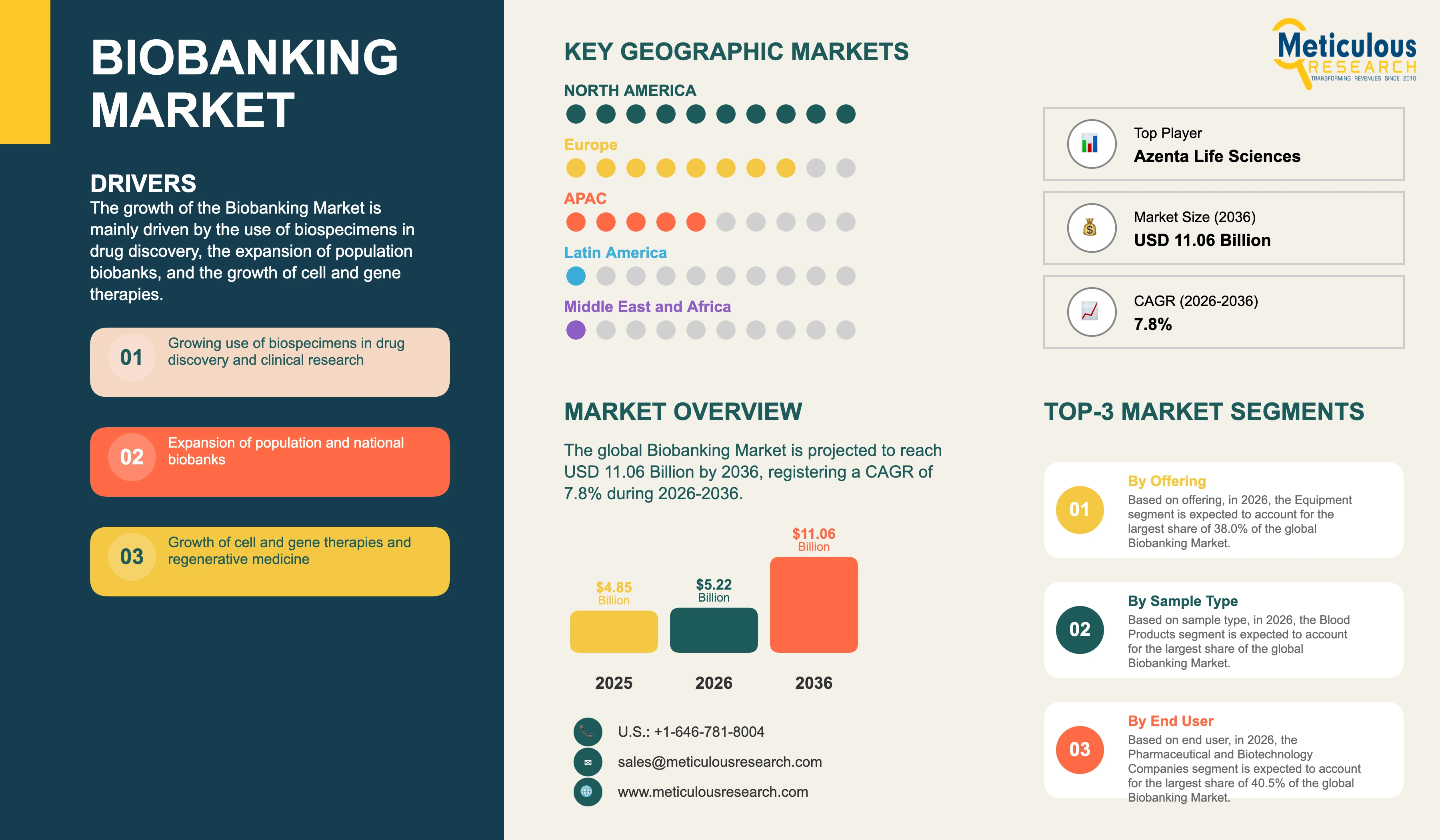
The global biobanking market was valued at USD 4.85 billion in 2025. This market is expected to reach USD 11.06 billion by 2036 from an estimated USD 5.22 billion in 2026, registering a CAGR of 7.8% during the forecast period (2026-2036).
- Published
- Nov 2026
- Pages
- 261
- Format
- PDF + Excel
- Report ID
- MRHC - 1042598
- Base year
- 2025
- 2025 · BASELINE
- $4.85B
- 2036
- $11.06B
- CAGR 2026–2036
- 7.8%
2025 baseline · 2026–2036 forecast at 7.8% CAGR · hover a bar for the value
Key highlights
On March 4, 2026, Azenta, Inc., a leading provider of sample storage equipment and biorepository services, completed the acquisition of UK Biocentre, one of the largest sample processing and storage facilities in the U.K. with annual revenue of about GBP 15.3 million, which expands Azenta's sample management capacity for population health programs and biopharma customers in Europe.
Azenta reported third-quarter fiscal 2026 revenue of USD 161 million, up 12% year-on-year, guided full-year fiscal 2026 revenue of USD 613 million to USD 618 million, and announced the first deployment of an AI-enabled biorepository inventory solution, showing growing demand for automated and data-driven sample management.
UK Biobank, which holds samples and data from about 500,000 participants, launched in 2025 one of the largest protein studies ever undertaken with a consortium of pharmaceutical companies, measuring thousands of proteins in up to 600,000 samples, including repeat samples, to support drug discovery and disease research.
Our Future Health, the U.K. population health research program, aims to recruit up to 5 million adults who provide blood samples and health information, which makes it one of the largest population cohorts in the world and creates large demand for sample processing, storage, and genotyping services.
National and population biobanks such as FinnGen in Finland, the China Kadoorie Biobank, BioBank Japan, and the U.S. NIH All of Us Research Program continue to expand their sample collections and link them with genomic and health record data, which increases the scientific and commercial value of biobank samples and creates repeat demand for sample retrieval, processing, and analysis.
By offering, equipment accounts for the largest share of 38.0% in 2026, while software registers the highest CAGR.
By sample type, blood products account for the largest share in 2026, while cell lines and stem cells register the highest CAGR.
By biobank type, disease-oriented biobanks account for the largest share in 2026, while virtual and networked biobanks register the highest CAGR.
By application, drug discovery and clinical research accounts for the largest share in 2026, while cell and gene therapy and regenerative medicine registers the highest CAGR.
By end user, pharmaceutical and biotechnology companies account for the largest share of 40.5% in 2026, while CROs, CDMOs, and other end users register the highest CAGR.
By geography, North America accounts for the largest share of 40.5% in 2026, while Asia-Pacific registers the highest CAGR of 10.3%.
Report summary
| Particulars | Details |
|---|---|
| Base Year | 2025 |
| Estimated Year | 2026 |
| Forecast Period | 2026-2036 |
| Market Size in 2025 | USD 4.85 billion |
| Market Size in 2026 | USD 5.22 billion |
| Market Size by 2036 | USD 11.06 billion |
| CAGR (2026-2036) | 7.8% |
| Format | PDF, Excel & Cloud Portal · 261 pages |
| Largest Segment by Offering (2026) | Equipment (38.0%) |
| Largest Segment by End User (2026) | Pharmaceutical and Biotechnology Companies (40.5%) |
| Largest Region (2026) | North America (40.5%) |
| Fastest-Growing Region | Asia-Pacific (CAGR 10.3%) |
| Companies Profiled | 16 companies and other companies |
| Segments Covered | Offering, Sample Type, Biobank Type, Application, End User, Geography |
| Countries Covered | U.S., Canada, U.K., Germany, France, Switzerland, Italy, Spain, Netherlands, Belgium, Sweden, Denmark, Norway, Finland, Estonia, Austria, Rest of Europe, China, Japan, South Korea, India, Australia, Singapore, Taiwan, Malaysia, Rest of Asia-Pacific, Brazil, Mexico, Argentina, Chile, Rest of Latin America, Saudi Arabia, U.A.E., Qatar, Israel, South Africa, Egypt, Rest of Middle East & Africa |
Report overview
Segments covered: offering, sample type, biobank type, application, end user.
The growth of this market is mainly driven by the growing use of human biospecimens in drug discovery, biomarker research, and clinical trials, the expansion of large population and national biobanks that combine samples with genomic, proteomic, and health record data, the rapid growth of cell and gene therapies that require storage of cells and starting materials, rising investment in precision medicine programs, and the adoption of automated storage systems and biobank management software. However, factors such as the high cost of setting up and running biobanks, difficulties in achieving long-term financial sustainability, and complex ethical, consent, and data protection requirements are expected to restrain the growth of this market to some extent.
Biobanking refers to the collection, processing, storage, and distribution of human biological samples, such as blood, tissue, DNA, RNA, cells, and other biospecimens, together with associated clinical, demographic, and molecular data, for use in research, drug development, diagnostics, and therapy. Biobanks range from small collections in hospital departments to large national population biobanks and commercial biorepositories that store millions of samples. This report covers the revenue from biobanking equipment, consumables, services, and software across sample types, biobank types, applications, and end users.
Biobanks play an essential role in modern biomedical research, since well-characterized samples linked to health data allow researchers to study the causes of disease, discover and validate biomarkers, identify drug targets, and develop diagnostic tests. Pharmaceutical and biotechnology companies use biobank samples in early discovery, target validation, and clinical trials, and they store large numbers of samples collected during trials for future research and regulatory needs.
The biobanking field has evolved from small, isolated collections to large, networked resources. Population biobanks such as UK Biobank, FinnGen, the China Kadoorie Biobank, and the NIH All of Us Research Program have collected samples from hundreds of thousands of participants and linked them with genomic, proteomic, imaging, and electronic health record data. These resources are widely used by academic researchers and pharmaceutical companies around the world, and they have become important sources of drug targets and genetic insights.
Biobanking requires specialized equipment and infrastructure, including ultra-low temperature freezers, liquid nitrogen storage systems, automated sample stores, temperature monitoring systems, and backup power. Consumables such as cryogenic tubes, vials, racks, labels, and sample collection kits are used in very large quantities. Many organizations outsource sample processing, storage, and logistics to biorepository service providers, which offer scale, quality systems, and disaster recovery capabilities. Biobank management software, also known as biobank LIMS, tracks samples, consent, data, and chain of custody.
Biobanks follow a common workflow that includes participant recruitment and consent, sample collection, processing into aliquots, labeling and registration, storage at the right temperature, quality control, and distribution to researchers. Each step requires specific equipment, consumables, and procedures, and the large number of samples in modern biobanks makes automation and digital tracking increasingly important. Many biobanks also provide services such as DNA extraction, plasma separation, and cell isolation before storage.
The growth of cell and gene therapies has created a new and fast-growing area of biobanking, as therapy developers and manufacturers must store patient cells, donor cells, cell banks, viral vectors, and finished products under controlled conditions, often in liquid nitrogen vapor phase. Cord blood banks, tissue banks, and IVF clinics also operate specialized biobanks, although these are often treated as separate markets. Pharmaceutical companies and CDMOs that produce these therapies need storage that meets GMP rules, which is more demanding than storage for research samples and requires validated equipment, documented procedures, and full chain of identity records for every unit of material.
Quality and standards are important in biobanking, since sample quality affects research results. Standards such as ISO 20387 for biobanking and the best practices of ISBER guide biobank operations, while regulations on consent, data protection, and the use of human tissue, such as GDPR in Europe and the Human Tissue Act in the U.K., govern how samples and data are collected and shared.
The market includes equipment manufacturers, consumables suppliers, biorepository service providers, biobank software vendors, and specialty biospecimen suppliers. Leading companies include Azenta Life Sciences, Thermo Fisher Scientific, Avantor, PHC Holdings, Hamilton Company, Haier Biomedical, Eppendorf, Corning, Cryoport, BioLife Solutions, Liconic, LabVantage Solutions, Qiagen, Greiner Bio-One, Discovery Life Sciences, and BioIVT.
Over the forecast period, the biobanking market is expected to grow steadily, as precision medicine programs expand, as pharmaceutical companies use more human data and samples to select drug targets, as cell and gene therapies move into larger-scale commercial production, and as biobanks adopt automation, digital tools, and AI to manage growing sample collections more efficiently.
Pharmaceutical and biotechnology companies are expected to account for the largest share of 40.5% of the market in 2026, while CROs, CDMOs, and other end users are projected to register the highest CAGR.
North America is expected to account for the largest share of 40.5% of the market in 2026, mainly due to the large U.S. pharmaceutical industry, high research funding, and the presence of leading suppliers.
Asia-Pacific is projected to register the highest CAGR of 10.3% during the forecast period, driven by government investment in biobanks and genomic medicine in China, Japan, South Korea, Singapore, and Australia.
The report profiles 16 companies, including Azenta Life Sciences, Thermo Fisher Scientific, Avantor, PHC Holdings, Hamilton Company, Haier Biomedical, Eppendorf, Corning, Cryoport, BioLife Solutions, Liconic, LabVantage Solutions, Qiagen, Greiner Bio-One, Discovery Life Sciences, and BioIVT.
Report infographic
Market dynamics
16 factors across 5 forcesGrowing use of biospecimens in drug discovery and clinical research
Pharmaceutical and biotechnology companies increasingly rely on human biospecimens and linked data to identify and validate drug targets, discover biomarkers, select patients for clinical trials, and understand drug response. Drug targets supported by human genetic evidence are more likely to succeed in clinical development, which encourages companies to use large biobank datasets in early research. Companies also collect and store large numbers of samples during clinical trials for biomarker analysis, pharmacogenomics, and future research.
Pharmaceutical companies have formed consortia to fund the genomic and proteomic analysis of samples from population biobanks, such as the UK Biobank exome and whole genome sequencing projects and the more recent large-scale proteomics project, in exchange for early access to data. These projects require large-scale sample retrieval, processing, and analysis, which supports demand for biobanking services and equipment.
The growing number of clinical trials, especially in oncology, immunology, and rare diseases, and the use of biomarker-driven trial designs, increase the volume of samples collected and stored by sponsors, CROs, and central laboratories. Long-term storage of these samples is often outsourced to biorepository service providers.
Sponsors are also keeping trial samples for longer periods, so that they can test new biomarkers or answer regulatory questions years after a study ends. This increases the total number of samples in storage and the need for reliable inventory management and retrieval services.
Expansion of population and national biobanks
Governments in many countries are investing in large population biobanks and genomic medicine programs to support research, improve healthcare, and attract life sciences investment. Examples include UK Biobank and Our Future Health in the U.K., FinnGen in Finland, the All of Us Research Program in the U.S., the China Kadoorie Biobank, BioBank Japan, the Korea Biobank Network, and national genome programs in Saudi Arabia, the U.A.E., and Qatar.
These programs collect and store very large numbers of samples, often millions of aliquots, and require high-capacity automated storage, sample processing laboratories, and data management systems. They also create long-term demand for storage, retrieval, and analysis services as researchers use the samples for new studies. National biobank networks, such as BBMRI-ERIC in Europe, help coordinate biobanks and improve access to samples across countries.
National programs also create demand for new laboratory buildings, sample processing lines, and data centers, and many governments contract with commercial service providers to run parts of these programs. The acquisition of UK Biocentre by Azenta in 2026 shows how commercial providers are building capacity to serve national population health programs.
Growth of cell and gene therapies and regenerative medicine
The rapid growth of cell and gene therapies, including CAR-T cell therapies, stem cell therapies, and gene-modified cell therapies, creates strong demand for cryogenic storage of starting materials, cell banks, intermediates, and final products. Autologous therapies require the collection, cryopreservation, transport, and storage of each patient's cells, while allogeneic therapies require master and working cell banks stored under GMP conditions.
Therapy developers and CDMOs need specialized cryogenic storage, chain of custody tracking, and temperature-controlled logistics, and many use biorepository service providers to store materials securely and with backup capacity. As more cell and gene therapies are approved and move into commercial production, demand for these services is expected to grow rapidly.
Cell and gene therapy developers also store samples from clinical trial patients for long-term follow-up, as regulators require monitoring of gene therapy patients for many years, which adds to the volume of samples that must be stored and tracked.
Adoption of automation and biobank management software
As sample collections grow, biobanks are adopting automated storage systems that can store and retrieve samples at -20 C, -80 C, or in liquid nitrogen without exposing other samples to temperature changes, which improves sample quality and reduces labor. Automated stores from Azenta, Hamilton, Liconic, and others are used by large biobanks, pharmaceutical companies, and research institutes.
Biobank management software is also becoming essential to track samples, consent, data, and quality across large collections and multiple sites, and to support compliance with regulations and standards. Cloud-based software, RFID and 2D barcode tracking, and AI-based inventory tools are improving the efficiency and reliability of biobank operations.
Automation also reduces the risk of human error in sample handling and helps biobanks meet quality standards and audit requirements, which is important for pharmaceutical customers and regulated cell and gene therapy materials.
Table of contents
13 chapters · 182 sections · 261 pages · click to expandSegmental analysis
| Segment | Largest share (2026) | Fastest growth (2026–2036) |
|---|---|---|
| By Offering | Equipment | Software |
| By Sample Type | Blood products | Cell lines and stem cells |
| By Biobank Type | Disease-oriented biobanks | Virtual and networked biobanks |
| By Application | Drug discovery and clinical research | Cell and gene therapy and regenerative medicine |
| By End User | Pharmaceutical and biotechnology companies | Other end users |
| Other segments | Blood products | Cell lines and stem cells |
By Offering
- The equipment segment is expected to account for the largest share of 38.0% of the global biobanking market.
- The large share of this segment is mainly due to the high cost and essential role of storage equipment, such as ultra-low temperature freezers, liquid nitrogen storage systems, automated sample stores, refrigerators, temperature monitoring systems, and sample processing equipment, the need to expand storage capacity as sample collections grow, and the replacement of older freezers with more energy-efficient and automated systems.
- Large population biobanks, pharmaceutical companies, and biorepository service providers invest heavily in high-capacity automated stores and cryogenic systems from companies such as Azenta, Thermo Fisher, PHC Holdings, Haier Biomedical, Hamilton, Liconic, and Cryoport.
- Equipment demand is also supported by the growth of cell and gene therapy programs, which require liquid nitrogen vapor phase storage and controlled-rate freezers, and by the construction of new biobanks in Asia-Pacific and the Middle East.
- Automated storage systems are gaining share within the equipment segment, as they improve sample integrity, traceability, and efficiency, although their high cost limits adoption to larger organizations.
- Temperature monitoring and alarm systems are also essential, since equipment failures can destroy irreplaceable samples.
- However, the software segment is projected to register the highest CAGR during the forecast period.
- The rapid growth of this segment is driven by the need to track growing numbers of samples, consent, and data across multiple sites, the adoption of cloud-based biobank LIMS, the integration of biobank software with laboratory, clinical, and research data systems, and the use of AI for inventory management.
- Services form the second-largest segment and are growing quickly as organizations outsource storage, processing, and logistics, while consumables such as cryogenic tubes, vials, racks, and labels provide steady recurring revenue.
By Sample Type
- Biobanking Market Analysis by Sample Type
- The blood products segment is expected to account for the largest share of the global biobanking market.
- The large share of this segment is mainly due to the widespread collection of blood samples, including whole blood, plasma, serum, buffy coat, and peripheral blood mononuclear cells (PBMCs), in population biobanks, clinical trials, and hospital biobanks, the ease and low cost of blood collection compared with tissue, and the wide use of blood samples for genomic, proteomic, metabolomic, and biomarker research.
- Population biobanks such as UK Biobank and Our Future Health collect blood samples from all participants and store them in multiple aliquots for future analysis.
- Blood samples are also essential in clinical trials, where they are used for pharmacokinetics, biomarker analysis, and safety testing, and in the growing field of liquid biopsy, which analyzes circulating tumor DNA and other markers in plasma.
- Large-scale proteomics projects on biobank plasma samples have increased the scientific value of stored blood samples.
- However, the cell lines and stem cells segment is projected to register the highest CAGR during the forecast period.
- The rapid growth of this segment is driven by the expansion of cell and gene therapy development and manufacturing, the use of induced pluripotent stem cells in disease modeling and drug screening, and the need for GMP-compliant storage of master and working cell banks.
- Human tissue remains an important segment for oncology and pathology research, while nucleic acids are growing with genomic research and sequencing projects.
By Biobank Type
- Biobanking Market Analysis by Biobank Type
- The disease-oriented biobanks segment is expected to account for the largest share of the global biobanking market.
- The large share of this segment is mainly due to the large number of disease-specific biobanks operated by hospitals, academic medical centers, cancer centers, and pharmaceutical companies, the importance of well-characterized patient samples for oncology, neurology, cardiovascular, and rare disease research, and the storage of clinical trial samples by sponsors and CROs.
- Tumor banks and disease registries linked with sample collections are particularly important for cancer research and the development of targeted therapies.
- Disease-oriented biobanks often hold samples with detailed clinical information, treatment history, and outcomes, which makes them valuable for biomarker discovery and validation.
- Pharmaceutical companies frequently purchase or access samples from these biobanks and from commercial biospecimen suppliers, and they maintain their own collections of trial samples for future research.
- However, the virtual and networked biobanks segment is projected to register the highest CAGR during the forecast period.
- The rapid growth of this segment is driven by the growth of biobank networks such as BBMRI-ERIC, the use of federated data platforms that allow researchers to search and access samples and data across multiple biobanks, and the need to improve sample utilization.
- Population-based biobanks also account for a large share and continue to grow with national genomic medicine programs.
By Application
- Biobanking Market Analysis by Application
- The drug discovery and clinical research segment is expected to account for the largest share of the global biobanking market.
- The large share of this segment is mainly due to the extensive use of biospecimens and linked data by pharmaceutical and biotechnology companies for target identification and validation, biomarker discovery, patient stratification, and clinical trials, the large volume of samples collected and stored during clinical trials, and pharmaceutical investment in population biobank data through sequencing and proteomics consortia.
- Clinical trial sample management is a major part of this segment, as sponsors and CROs collect samples from patients in many countries, ship them to central laboratories and biorepositories, and store them for analysis and future research.
- Regulatory requirements for sample retention and the growing use of biomarker-driven trials increase demand for storage and management services.
- However, the cell and gene therapy and regenerative medicine segment is projected to register the highest CAGR during the forecast period.
- The rapid growth of this segment is driven by the increasing number of approved and late-stage cell and gene therapies, the need for cryogenic storage of patient and donor cells, cell banks, and finished products, and the expansion of manufacturing capacity by developers and CDMOs.
- Clinical diagnostics and precision medicine is another important segment, while other applications include forensic, academic, and public health research.
By End User
- The pharmaceutical and biotechnology companies segment is expected to account for the largest share of 40.5% of the global biobanking market.
- The large share of this segment is mainly due to the large investments of pharmaceutical and biotechnology companies in human biology-based drug discovery, the large number of clinical trial samples they collect and store, their use of automated storage systems and outsourced biorepository services, and their growing activity in cell and gene therapies.
- Large pharmaceutical companies operate their own sample management facilities and also work with biorepository service providers for long-term storage and disaster recovery.
- Pharmaceutical and biotechnology companies are also the main funders of genomic and proteomic analysis of population biobank samples, and they purchase samples and data from commercial biospecimen suppliers such as Discovery Life Sciences and BioIVT.
- They have strict requirements for sample quality, chain of custody, and data integrity, which favors suppliers with strong quality systems.
- However, the CROs, CDMOs, and other end users segment is projected to register the highest CAGR during the forecast period.
- The rapid growth of this segment is driven by the outsourcing of clinical trials and cell and gene therapy manufacturing to CROs and CDMOs, which need sample storage and management capacity, and by the growth of central laboratories.
- Academic and research institutes account for a large share, as they operate many disease-oriented and population biobanks, while hospitals and medical centers maintain tumor banks and clinical biobanks.
Other segments
- The blood products segment is expected to account for the largest share of the biobanking market, while the cell lines and stem cells segment is projected to register the highest CAGR during the forecast period.
- The disease-oriented biobanks segment is expected to account for the largest share of the biobanking market, while the virtual and networked biobanks segment is projected to register the highest CAGR during the forecast period.
- The drug discovery and clinical research segment is expected to account for the largest share of the biobanking market, while the cell and gene therapy and regenerative medicine segment is projected to register the highest CAGR during the forecast period.
Geographic analysis
North America
Largest shareIn 2026, North America is expected to account for the largest share of 40.5% of the global biobanking market. The large share of this region is mainly due to the large pharmaceutical and biotechnology industry in the U.S., high research funding from the NIH and other agencies, the NIH All of Us Research Program and other large biobanks, the high number of clinical trials, the strong cell and gene therapy industry, and the presence of leading equipment manufacturers and biorepository service providers such as Thermo Fisher, Azenta, Avantor, Hamilton, and Cryoport. Canada also has well-established biobanks, such as the Canadian Partnership for Tomorrow's Health and provincial tumor banks.
Europe
Europe is the second-largest market, supported by major population biobanks such as UK Biobank and Our Future Health in the U.K., FinnGen in Finland, the Estonian Biobank, and national biobanks in Denmark, Sweden, Norway, and the Netherlands, the BBMRI-ERIC network, and strong pharmaceutical research in Germany, Switzerland, France, Belgium, and Italy. Spain and Austria also have active national biobank networks, and the Estonian Biobank, which covers about a fifth of the adult population, is often cited as an example of a biobank linked with national health records.
Asia-Pacific
Fastest growthAsia-Pacific is projected to register the highest CAGR of 10.3% during the forecast period. The rapid growth of this region is mainly driven by large government investments in biobanks and genomic medicine in China, Japan, South Korea, Singapore, and Australia, the growth of clinical trials and pharmaceutical research in China, India, and South Korea, the expansion of cell and gene therapy industries, and the presence of local equipment manufacturers such as Haier Biomedical and PHC Holdings. The China Kadoorie Biobank, BioBank Japan, the Korea Biobank Network, and India's national genome programs are important regional resources, while Taiwan Biobank and Malaysia's cohort programs add further capacity.
Latin America
Latin America and the Middle East & Africa account for smaller shares of the market but are expected to grow. In Latin America, Brazil, Mexico, Argentina, and Chile have expanding biobanks linked to clinical trials and research institutions, as more global trials enroll patients in the region.
Middle East & Africa
Saudi Arabia, the U.A.E., Qatar, and Israel are investing in national genome programs and biobanks, while South Africa and Egypt have growing research biobanks. The Qatar Biobank and the Saudi Genome Program are among the most advanced population programs in the Middle East.
Competitive landscape
The global biobanking market is fragmented, with the top five players estimated to account for about 30% of the market in 2025. The market includes storage equipment manufacturers, consumables suppliers, biorepository service providers, biobank software vendors, and commercial biospecimen suppliers.
Azenta Life Sciences is one of the leading companies in the market, offering automated sample stores, consumables, biorepository services, and sample management software, and it expanded its European capacity in 2026 through the acquisition of UK Biocentre. Thermo Fisher Scientific offers a broad range of freezers, cryogenic storage, consumables, and biorepository services through its Fisher BioServices business. PHC Holdings and Haier Biomedical are leading manufacturers of ultra-low temperature freezers and storage equipment, while Hamilton Company and Liconic supply automated sample storage systems.
Cryoport, through its MVE Biological Solutions business, supplies cryogenic freezers and dewars and offers temperature-controlled logistics and biostorage services for cell and gene therapies, while BioLife Solutions provides biopreservation media and storage products. Avantor, Corning, Eppendorf, and Greiner Bio-One supply laboratory equipment and consumables used in biobanks, and Qiagen offers sample collection and preparation products for nucleic acids.
LabVantage Solutions and other software vendors provide biobank LIMS and sample management software used by hospital, academic, and pharmaceutical biobanks, while Discovery Life Sciences and BioIVT are leading commercial suppliers of human biospecimens and related services for pharmaceutical and biotechnology companies.
Companies in the biobanking market compete on storage capacity and reliability, automation, sample quality, regulatory compliance, global service networks, software capabilities, and price. Key strategies include acquisitions to expand service capacity and geographic reach, launches of automated and energy-efficient storage systems, investments in GMP-compliant cryogenic storage for cell and gene therapies, and partnerships with population biobanks and pharmaceutical companies.
We expect the market to see continued consolidation among biorepository service providers and specialty biospecimen suppliers, and growing competition from Asian equipment manufacturers in freezers and storage equipment, especially in price-sensitive markets in Asia, Latin America, and the Middle East, where buyers are more sensitive to equipment prices. Software vendors are also likely to partner more closely with equipment and service providers to offer integrated sample management solutions.
Some of the key players operating in the biobanking market are Azenta Life Sciences, Thermo Fisher Scientific Inc., Avantor, Inc., PHC Holdings Corporation, Hamilton Company, Haier Biomedical Co., Ltd., Eppendorf SE, Corning Incorporated, Cryoport, Inc., BioLife Solutions, Inc., Liconic AG, LabVantage Solutions, Inc., Qiagen N.V., Greiner Bio-One International GmbH, Discovery Life Sciences, and BioIVT, among others.
- —
Azenta acquired UK Biocentre in March 2026 and deployed an AI-enabled biorepository inventory solution, UK Biobank expanded its large-scale proteomics project with pharmaceutical partners, and national biobank programs continued to grow in Europe, Asia-Pacific, and the Middle East.
- Azenta Life Sciences
- Thermo Fisher Scientific Inc.
- Avantor, Inc.
- PHC Holdings Corporation
- Hamilton Company
- Haier Biomedical Co., Ltd.
- Eppendorf SE
- Corning Incorporated
- Cryoport, Inc.
- BioLife Solutions, Inc.
- Liconic AG
- LabVantage Solutions, Inc.
- Qiagen N.V.
- Greiner Bio-One International GmbH
- Discovery Life Sciences
- BioIVT
Expert perspectives
Biobanking has become an essential infrastructure for modern biomedical research and drug development. The shift toward human biology-based drug discovery, the expansion of population biobanks with linked multi-omics data, and the growth of cell and gene therapies have increased the value of high-quality, well-managed sample collections.
Over the forecast period, the market is expected to grow at a CAGR of 7.8%, from USD 5.22 billion in 2026 to USD 11.06 billion in 2036. Growth will be supported by pharmaceutical demand for biospecimens and data, national biobank and genomic medicine programs, cell and gene therapy supply chains, and the adoption of automation and software.
Equipment remains the largest offering segment, while software grows fastest and services expand with outsourcing. Blood products are the largest sample type, while cell lines and stem cells grow fastest. Disease-oriented biobanks lead by biobank type, while virtual and networked biobanks grow fastest. Drug discovery and clinical research is the largest application, while cell and gene therapy and regenerative medicine grows fastest. Pharmaceutical and biotechnology companies are the largest end user, while CROs, CDMOs, and other end users grow fastest. North America remains the largest region, and Asia-Pacific is the fastest-growing region at a CAGR of 10.3%.
We believe the value of biobanks is moving steadily from sample storage toward data. Biobanks that link samples with genomic, proteomic, and clinical data and offer secure access to researchers will attract more funding and partnerships, while collections without data or clear consent will be less valuable. Service providers that combine storage, processing, analysis, and data management will be well placed to win long-term contracts.
For equipment suppliers, the key opportunities are automated storage, energy-efficient freezers, and cryogenic systems for cell and gene therapies. For service providers, the main opportunities are clinical trial sample management, cell and gene therapy biostorage, and support for population biobank programs. For software vendors, the opportunity lies in cloud-based LIMS, inventory analytics, and federated data platforms that connect several biobanks and allow researchers to search across collections.
Financial sustainability remains a challenge for many academic and hospital biobanks, and we expect more consolidation, networking, and outsourcing as institutions seek to reduce costs and increase sample use. Governments and research funders are likely to continue supporting national biobanks as strategic research infrastructure, since they see these resources as a way to attract pharmaceutical investment and improve public health. We also expect cell and gene therapy biostorage to become one of the most profitable areas of the market for service providers.
Customer perspectives
Buyers of biobanking products and services include pharmaceutical and biotechnology companies, academic and research institutes, hospitals and medical centers, population biobanks, CROs, CDMOs, and cell and gene therapy developers. Their decisions depend mainly on sample quality, storage reliability, regulatory compliance, capacity, data management, and cost, and many buyers also value long-term partnerships with suppliers that can support them across several regions with consistent quality.
This comment explains why equipment accounts for 38.0% of the market, why pharmaceutical and biotechnology companies account for 40.5% of the market, and why North America accounts for 40.5% of the market.
This comment explains why software is the fastest-growing offering segment and why data-rich population biobanks are important.
VP of Manufacturing - Cell therapy company, U.S.
Every patient's cells must be frozen, tracked, and stored with full chain of identity from collection to infusion back into the patient. We rely on GMP cryogenic storage and logistics partners to protect these materials.
This comment explains why cell lines and stem cells and cell and gene therapy applications are the fastest-growing segments.
“We store millions of clinical trial samples, and losing even a few can affect a study. We use automated stores in-house and outsource long-term storage and disaster recovery to biorepository partners with strong quality systems.”
“Our samples are most valuable when they are linked with genomic and health data. We are investing in automation, sample tracking software, and secure data platforms so more researchers can use the collection.”
Frequently asked questions
The global biobanking market was valued at USD 4.85 billion in 2025, up from USD 4.52 billion in 2024, and is estimated at USD 5.22 billion in 2026. The market includes biobanking equipment, consumables, services, and software.
Cite this report
Meticulous Research. (2026). Biobanking Market - Global Opportunity Analysis and Industry Forecast (2026-2036) (Report No. MRHC - 1042598). Meticulous Market Research Pvt. Ltd. https://www.meticulousresearch.com/product/biobanking-market-7281