Automotive GNSS Positioning Modules Market (2026-2036)
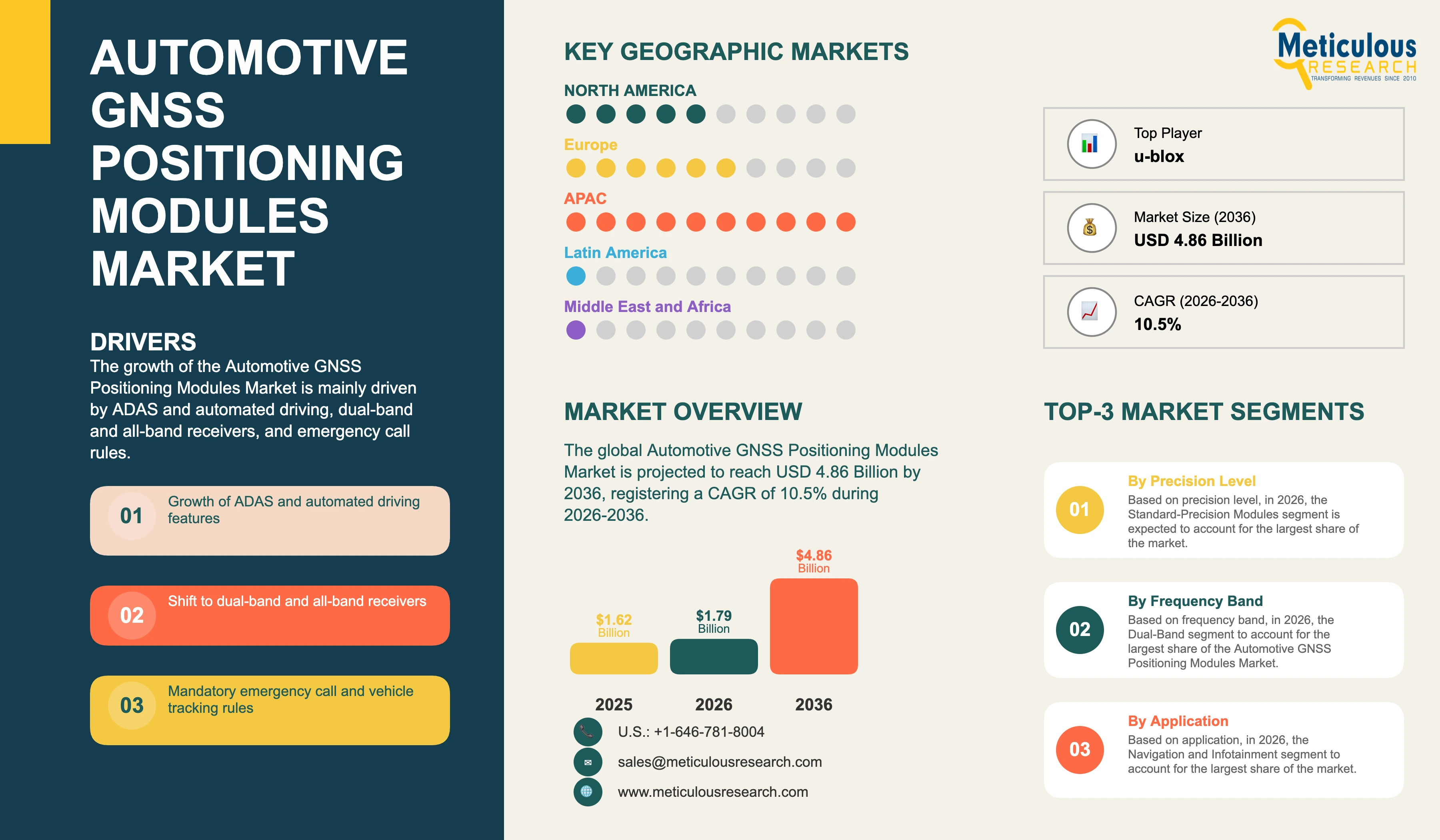
The global automotive GNSS positioning modules market was valued at USD 1.62 billion in 2025. This market is expected to reach USD 4.86 billion by 2036 from an estimated USD 1.79 billion in 2026, registering a CAGR of 10.5% during the forecast period (2026-2036).
- Published
- Nov 2026
- Pages
- 265
- Format
- PDF + Excel
- Report ID
- MRAUTO - 1042887
- Base year
- 2025
- 2025 · BASELINE
- $1.62B
- 2036
- $4.86B
- CAGR 2026–2036
- 10.5%
2025 baseline · 2026–2036 forecast at 10.5% CAGR · hover a bar for the value
Key highlights
u-blox launched the ZED-X20K and ZED-A20K automotive GNSS modules in May 2026, covering driving automation from ADAS L2+ to L4, according to u-blox. The ZED-X20K targets mass-market L3 ADAS and telematics and infotainment applications, providing lane-level accuracy worldwide using all-band GNSS and the native Galileo High Accuracy Service. It supports GPS, Galileo, BeiDou, GLONASS, NavIC, QZSS, and SBAS signals.
u-blox also announced the ZED-X20D in March 2026, a dual-antenna, all-band GNSS heading module that delivers centimeter-level RTK positioning and precise heading even when the vehicle is not moving, according to u-blox. u-blox's automotive revenue reached CHF 52.1 million in the first half of 2025, up 40% year-on-year, led by growth in Asia-Pacific, according to u-blox.
Quectel launched the AR588MA, an automotive-grade 5G-Advanced cellular module, in January 2026, according to Quectel. The module integrates dual-band GNSS supporting L1 and L5 signals with up to 30 Hz output, showing how satellite positioning is increasingly combined with connectivity in telematics control units.
Quectel and Point One Navigation offer the LG69T-AM high-precision GNSS module, which uses STMicroelectronics' Teseo V dual-band L1 and L5 positioning receiver platform with support for GPS, GLONASS, Galileo, BeiDou, QZSS, and NavIC signals, according to Quectel and Point One Navigation.
Global electric car sales topped 20 million units in 2025, according to the IEA. Many electric vehicles, especially Chinese models, include connected services, lane-level navigation, and navigate-on-autopilot features as standard, which increases demand for dual-band and high-precision GNSS modules.
Leading suppliers include u-blox, STMicroelectronics, Quectel, Unicore Communications, Allystar Technology, Hexagon (NovAtel), and Furuno Electric. ADAS and automated driving is the fastest-growing application, and multi-band and all-band receivers are the fastest-growing frequency band, as vehicle makers seek lane-level accuracy everywhere. Unicore Communications and Allystar Technology supply automotive GNSS chips and modules mainly to Chinese vehicle makers, while Hexagon supplies high-precision positioning through NovAtel. Furuno Electric supplies automotive GNSS receivers to vehicle makers in Japan, and STMicroelectronics' Teseo receivers are widely used in telematics and navigation units around the world.
By precision level, standard-precision modules account for the larger share of 74.0% in 2026, while high-precision modules register the higher CAGR.
By frequency band, dual-band accounts for the largest share in 2026, while multi-band and all-band registers the highest CAGR.
By application, navigation and infotainment accounts for the largest share in 2026, while ADAS and automated driving registers the highest CAGR.
By vehicle type, passenger cars account for the larger share of 84.0% in 2026, while commercial vehicles register the higher CAGR.
By geography, Asia-Pacific accounts for the largest share of 45.0% in 2026, while Asia-Pacific registers the highest CAGR of 11.6%.
Report summary
| Particulars | Details |
|---|---|
| Forecast Period | 2026-2036 |
| Base Year | 2025 |
| Estimated Year | 2026 |
| CAGR (Value) | 10.5% |
| Format | PDF, Excel & Cloud Portal · 265 pages |
| Market Size (Value) in 2025 | USD 1.62 billion |
| Market Size (Value) in 2026 | USD 1.79 billion |
| Market Size (Value) by 2036 | USD 4.86 billion |
| Largest Segment by Precision Level (2026) | Standard-Precision Modules (74.0%) |
| Largest Segment by Vehicle Type (2026) | Passenger Cars (84.0%) |
| Largest Region (2026) | Asia-Pacific (45.0%) |
| Fastest-Growing Region | Asia-Pacific (CAGR 11.6%) |
| Segments Covered | Precision Level, Frequency Band, Application, Vehicle Type, Geography |
| Countries Covered | U.S., Canada, Mexico, Germany, France, U.K., Spain, Italy, Sweden, Czech Republic, Poland, Slovakia, Hungary, Netherlands, Rest of Europe, China, Japan, South Korea, India, Thailand, Indonesia, Malaysia, Vietnam, Taiwan, Australia, Rest of Asia-Pacific, Brazil, Argentina, Chile, Colombia, Rest of Latin America, Turkey, Morocco, South Africa, Saudi Arabia, UAE, Israel, Rest of Middle East & Africa |
| Key Companies | 7 companies and other companies |
Report overview
Segments covered: precision level, frequency band, application, vehicle type.
Automotive GNSS positioning modules and receivers use signals from satellite constellations, such as GPS, Galileo, BeiDou, GLONASS, NavIC, and QZSS, to calculate the position, speed, and time of a vehicle. They are used in navigation and infotainment systems, telematics control units, emergency call systems, vehicle-to-everything communication units, and, increasingly, in advanced driver assistance and automated driving systems, where high-precision modules provide lane-level or better accuracy for safe vehicle positioning.
The growth of this market is mainly driven by the rapid growth of ADAS and automated driving features that need lane-level positioning, the shift from single-band to dual-band and all-band receivers, mandatory emergency call and vehicle tracking rules in many regions, the growth of connected vehicles with telematics control units, and the spread of free and low-cost correction services, such as the Galileo High Accuracy Service, that make high-precision positioning affordable for mass-market vehicles. In addition, the growth of electric vehicles, which often come with connected services and navigate-on-autopilot features, supports demand. However, strong price pressure, signal blockage and interference in cities, and growing integration of satellite positioning into connectivity and computing chips are expected to restrain the growth of this market to some extent.
Satellite positioning has been used in vehicles since the 1990s, first in built-in navigation systems and then in telematics units for vehicle tracking, emergency calls, and connected services. Early receivers used only the GPS L1 signal and provided accuracy of several meters, which was enough to show the vehicle on a map but not enough to tell which lane it was in. Today, receivers track signals from several constellations, including GPS, Galileo, BeiDou, GLONASS, and regional systems, such as NavIC and QZSS, on two or more frequency bands, which improves accuracy and reliability, especially in cities where signals are reflected by buildings.
This report covers the global automotive GNSS positioning modules market, including standard-precision and high-precision GNSS modules and receivers supplied for navigation and infotainment, telematics and emergency call, ADAS and automated driving, and vehicle-to-everything and other applications, in single-band, dual-band, and multi-band and all-band versions, for passenger cars and commercial vehicles. The market is valued at the selling price of GNSS modules and receiver chips supplied to vehicle makers and their system suppliers, such as telematics, infotainment, and ADAS computer suppliers. The market is analyzed by precision level, frequency band, application, vehicle type, and geography. GNSS antennas, correction service fees, and complete navigation units are not included.
A modern vehicle can contain one or more GNSS receivers, each serving a different set of functions. The infotainment system typically uses a standard-precision receiver for navigation, the telematics control unit uses a receiver for emergency calls, vehicle tracking, and connected services, and vehicles with advanced driver assistance or automated driving add a high-precision receiver, often with correction services and an inertial measurement unit for dead reckoning. In some newer vehicles, the GNSS receiver is built into the cellular module of the telematics unit, as with Quectel's AR588MA, while in others it is a separate module or chip inside the ADAS computer.
High-precision positioning has become one of the most important changes in the market. High-precision modules use carrier phase measurements on several frequency bands, together with correction data from RTK, PPP, or PPP-RTK services, to reach decimeter-level or centimeter-level accuracy. The Galileo High Accuracy Service provides free correction data worldwide, which reduces the cost of high-precision positioning for vehicle makers. u-blox's ZED-X20K, launched in May 2026, uses all-band GNSS and native support for this service to provide lane-level accuracy worldwide for mass-market L3 ADAS, according to u-blox.
The market is led by specialized positioning companies and large semiconductor companies. u-blox, based in Switzerland, is one of the leading suppliers of automotive GNSS modules, with products ranging from standard modules to the ZED-X20K and ZED-A20K for ADAS and automated driving. STMicroelectronics supplies the Teseo family of automotive GNSS receivers, Quectel supplies GNSS modules and connectivity modules with built-in GNSS, Unicore Communications and Allystar Technology supply GNSS chips and modules mainly to Chinese vehicle makers, Hexagon supplies high-precision positioning through its NovAtel brand, and Furuno Electric supplies GNSS receivers to vehicle makers in Japan.
Functional safety is also becoming a much more important requirement in automotive positioning than it was in the past. When GNSS data is used for automated driving, the receiver must meet functional safety requirements under ISO 26262 and must report how much its position can be trusted, which is known as integrity. Suppliers are developing modules with safety certification and integrity monitoring, such as u-blox's ZED-A20K for higher levels of driving automation. At the same time, vehicles face growing risks from signal jamming and spoofing, which is pushing suppliers to add interference detection and protection features to their receivers.
In 2026, standard-precision modules account for the largest share of the market by precision level, while high-precision modules are the fastest-growing precision level. Dual-band receivers account for the largest share by frequency band, while multi-band and all-band receivers are the fastest-growing frequency band. Navigation and infotainment accounts for the largest share by application, while ADAS and automated driving is the fastest-growing application. Passenger cars account for the largest share by vehicle type, while commercial vehicles are the fastest-growing vehicle type. Asia-Pacific accounts for the largest share of the market and is also the fastest-growing region.
Market growth over the forecast period will depend on vehicle production, the adoption of L2+ and L3 driving features, the share of connected vehicles with telematics control units, the pace of the shift to dual-band and all-band receivers, the availability and cost of correction services, and price trends. Strong price pressure in standard-precision receivers and growing chip integration will limit value growth in that segment, while the spread of high-precision modules for driver assistance and automated driving will add more value per vehicle. Overall, the market is expected to grow faster than vehicle production through 2036.
Passenger cars are expected to account for the largest share of 84.0% of the market in 2026, while commercial vehicles are projected to register the higher CAGR, driven by vehicle tracking rules, smart tachographs, and fleet telematics.
Asia-Pacific is expected to account for the largest share of 45.0% of the market in 2026, mainly due to China's large vehicle production, the fast adoption of navigate-on-autopilot features, and BeiDou requirements for commercial vehicles.
Asia-Pacific is also projected to register the highest CAGR of 11.6% during the forecast period, driven by high-precision positioning in China, vehicle-to-everything deployment, and connected vehicles and tracking rules in India.
The report profiles 7 companies, including u-blox, STMicroelectronics, Quectel, Unicore Communications, Allystar Technology, Hexagon (NovAtel), and Furuno Electric.
Automated driving systems need to know which lane the vehicle is in and where it is on a high-definition map. High-precision GNSS with correction data provides lane-level or better accuracy and helps check positions from cameras and maps.
The Galileo High Accuracy Service is a free service from Europe's Galileo system that sends correction data worldwide, allowing compatible receivers to reach decimeter-level accuracy without paid correction services, which lowers the cost of high-precision positioning in vehicles.
Report infographic
Market dynamics
17 factors across 5 forcesGrowth of ADAS and automated driving features
Vehicle makers are quickly adding L2+ hands-off driving and navigate-on-autopilot features and are starting to offer L3 eyes-off driving in some markets. These features need to know which lane the vehicle is in and where it is on a high-definition map, which requires lane-level or better positioning. High-precision GNSS modules, combined with correction services and inertial measurement units, provide this accuracy and also allow the vehicle to check the positions estimated by cameras and maps. In China, many mainstream electric vehicles now offer navigate-on-autopilot features that rely on high-precision positioning.
u-blox's ZED-X20K and ZED-A20K, launched in May 2026, are designed for driving automation from ADAS L2+ to L4, with the ZED-X20K targeting mass-market L3 ADAS and the ZED-A20K targeting safety-critical deployment at higher levels of automation, according to u-blox. As these features spread from premium vehicles to mainstream models, demand for high-precision modules is expected to grow strongly. ADAS and automated driving is the fastest-growing application in this market, and high-precision modules are the fastest-growing precision level.
Shift to dual-band and all-band receivers
Single-band receivers that use only the L1 signal are being replaced by dual-band receivers that use both L1 and L5 signals, and, in high-precision uses, by all-band receivers that also use L2, L6, and other signals. Dual-band receivers reduce errors caused by signal reflections in cities and by the atmosphere, which improves accuracy from several meters to about one meter or better without correction services. All-band receivers support faster and more reliable high-precision positioning with correction services, including the Galileo High Accuracy Service on the E6 signal.
Vehicle makers are adopting dual-band receivers in new navigation and telematics units, as with Quectel's AR588MA module, which integrates dual-band L1 and L5 GNSS, according to Quectel. The shift to dual-band and all-band receivers raises the value of each receiver, as these receivers need more complex radio and processing designs. Dual-band receivers are the largest frequency band in this market in 2026, while multi-band and all-band receivers are the fastest-growing frequency band, supported by ADAS and automated driving.
Mandatory emergency call and vehicle tracking rules
Many regions require satellite positioning in vehicles for safety and tracking purposes. The EU requires eCall in new passenger cars and light commercial vehicles, which sends the vehicle's location to emergency services after a serious crash, and Russia requires a similar ERA-GLONASS system. India requires vehicle location tracking devices with GNSS in public transport and many commercial vehicles under AIS-140, China requires BeiDou-based positioning in many commercial vehicles, and the EU's smart tachograph rules require GNSS positioning in trucks and buses for recording driving activity.
These rules create a steady base of demand for GNSS receivers in new vehicles, and they are being extended to more vehicle types and countries. Next-generation emergency call systems based on newer cellular networks will also need updated GNSS receivers. Telematics and emergency call is a major and steadily growing application in this market, supported by these rules and by the growth of connected services, and commercial vehicles are the fastest-growing vehicle type, supported by tracking and tachograph rules.
Growth of connected vehicles and telematics
Almost all new vehicles in major markets now come with a telematics control unit that connects the vehicle to the cellular network for services, such as remote control through smartphone apps, stolen vehicle tracking, roadside assistance, over-the-air software updates, usage-based insurance, and fleet management. All of these services depend on accurate vehicle location from a GNSS receiver, which is either a separate module or built into the cellular module. Electric vehicles also use location data to plan charging stops and to show nearby charging stations.
As connected vehicle services spread to more vehicles, including entry-level models in emerging markets, demand for GNSS receivers in telematics control units grows. Global electric car sales topped 20 million units in 2025, according to the IEA, and most electric vehicles come with connected services as standard. Fleet operators are also adopting telematics to track vehicles, plan routes, and monitor drivers, which adds GNSS receivers to commercial vehicles and to aftermarket fleet devices fitted at the factory.
Affordable correction services for high-precision positioning
High-precision positioning needs correction data that removes errors in satellite signals, which used to require costly local reference stations or subscription services. The Galileo High Accuracy Service now provides free correction data worldwide, while commercial providers, such as u-blox with its PointPerfect service and other positioning companies, offer low-cost correction services designed for mass-market vehicles. These services allow vehicle makers to offer lane-level and better positioning across whole countries and regions without building their own infrastructure. u-blox's ZED-X20K uses native support for the Galileo High Accuracy Service to provide lane-level accuracy worldwide, according to u-blox, which reduces the need for paid correction services in many vehicles. Lower correction costs, together with falling prices of high-precision receivers, make it possible to offer high-precision positioning in mainstream vehicles, not only in premium models. This is expected to support strong growth in high-precision modules over the forecast period, especially for ADAS, lane-level navigation, and vehicle-to-everything applications that benefit from knowing the exact lane of the vehicle.
Table of contents
12 chapters · 173 sections · 265 pages · click to expandSegmental analysis
| Segment | Largest share (2026) | Fastest growth (2026–2036) |
|---|---|---|
| By Precision Level | Standard-precision modules | Rapid growth of this |
| By Frequency Band | Dual-band | Multi-band and all-band |
| By Application | Navigation and infotainment | ADAS and automated driving |
| By Vehicle Type | Passenger cars | Rapid growth of this |
| Other segments | Dual-band | Multi-band and all-band |
By Precision Level
- Automotive GNSS Positioning Modules Market Analysis by Precision Level
- The standard-precision modules segment is expected to account for the largest share of 74.0% of the global automotive GNSS positioning modules market.
- The large share of this segment is mainly due to the use of standard-precision receivers in almost all navigation and infotainment systems and telematics control units, mandatory emergency call and vehicle tracking rules in the EU, Russia, India, and China, the large production volumes of these receivers, and the low cost of standard-precision receivers compared with high-precision modules. u-blox, STMicroelectronics, Quectel, Unicore Communications, and Allystar Technology are among the leading suppliers of standard-precision automotive GNSS modules and receivers.
- However, the high-precision modules segment is projected to register the higher CAGR during the forecast period.
- The rapid growth of this segment is driven by the spread of L2+ hands-off driving and navigate-on-autopilot features, especially in China, the start of L3 eyes-off driving in some markets, the availability of free and low-cost correction services, such as the Galileo High Accuracy Service, new products, such as u-blox's ZED-X20K and ZED-A20K, that bring lane-level accuracy to mass-market vehicles, and the higher price of high-precision modules compared with standard receivers.
By Frequency Band
- Automotive GNSS Positioning Modules Market Analysis by Frequency Band
- The dual-band segment is expected to account for the largest share of the global automotive GNSS positioning modules market.
- The large share of this segment is mainly due to the replacement of single-band receivers with dual-band L1 and L5 receivers in new navigation and telematics units, the better accuracy of dual-band receivers in cities, where signals are reflected by buildings, the integration of dual-band GNSS into new cellular modules, such as Quectel's AR588MA, and the moderate cost of dual-band receivers, which makes them suitable for mass-market vehicles.
- STMicroelectronics, u-blox, and Quectel are among the leading suppliers of dual-band automotive receivers.
- However, the multi-band and all-band segment is projected to register the highest CAGR during the forecast period.
- The rapid growth of this segment is driven by the growth of ADAS and automated driving features that need fast and reliable high-precision positioning, the use of the Galileo High Accuracy Service, which uses the E6 signal, new all-band platforms, such as u-blox's X20, the growing need for protection against interference and spoofing, which is easier with more signals, and the falling cost of all-band receivers.
- Single-band receivers are expected to decline as vehicle makers move to dual-band designs.
By Application
- Automotive GNSS Positioning Modules Market Analysis by Application
- The navigation and infotainment segment is expected to account for the largest share of the global automotive GNSS positioning modules market.
- The large share of this segment is mainly due to the use of GNSS receivers in built-in navigation and infotainment systems in a large share of new vehicles, the growing use of lane-level navigation and augmented reality navigation in premium and electric vehicles, the use of location data for charging station search and route planning in electric vehicles, and the large installed base of navigation platforms. u-blox, STMicroelectronics, and Furuno Electric are among the leading suppliers of GNSS receivers for navigation and infotainment.
- However, the ADAS and automated driving segment is projected to register the highest CAGR during the forecast period.
- The rapid growth of this segment is driven by the spread of hands-off highway driving and navigate-on-autopilot features, especially in China, the introduction of L3 driving under rules such as UN R157, the need for lane-level and safety-rated positioning for automated driving, the availability of affordable correction services, and new high-precision modules, such as u-blox's ZED-X20K and ZED-A20K, designed for driving automation from L2+ to L4.
- Telematics and emergency call is also growing steadily, supported by mandatory rules.
- The navigation and infotainment segment is expected to account for the largest share of the automotive GNSS positioning modules market, while the ADAS and automated driving segment is projected to register the highest CAGR during the forecast period.
By Vehicle Type
- Automotive GNSS Positioning Modules Market Analysis by Vehicle Type
- The passenger cars segment is expected to account for the largest share of 84.0% of the global automotive GNSS positioning modules market.
- The large share of this segment is mainly due to the very large number of passenger cars produced each year, the use of navigation and telematics units in a large share of new passenger cars, mandatory eCall in passenger cars in the EU, and the early adoption of hands-off and eyes-off driving in premium and electric passenger cars, which use high-precision modules. u-blox, STMicroelectronics, and Quectel supply GNSS modules used across many passenger car platforms.
- However, the commercial vehicles segment is projected to register the higher CAGR during the forecast period.
- The rapid growth of this segment is driven by vehicle tracking rules for commercial and public transport vehicles, such as India's AIS-140 and China's BeiDou requirements, smart tachograph rules for trucks and buses in the EU, the growing use of fleet telematics for route planning and driver monitoring, and early automated trucking projects in the U.S. and China, which need high-precision positioning on highways and in logistics hubs.
Other segments
- The dual-band segment is expected to account for the largest share of the automotive GNSS positioning modules market, while the multi-band and all-band segment is projected to register the highest CAGR during the forecast period.
Geographic analysis
Asia-Pacific
Largest shareIn 2026, Asia-Pacific is expected to account for the largest share of 45.0% of the global automotive GNSS positioning modules market. The large share of this region is mainly due to China's position as the largest vehicle producer in the world, the fast adoption of navigate-on-autopilot features and connected services by Chinese electric vehicle makers, China's requirements for BeiDou-based positioning in many commercial vehicles, the large vehicle production of Japan, South Korea, and India, and the presence of GNSS chip and module suppliers, such as Unicore Communications, Allystar Technology, Quectel, and Furuno Electric. China is the largest market in the region, followed by Japan and South Korea. Asia-Pacific is also projected to register the highest CAGR of 11.6% during the forecast period. The rapid growth of this region is mainly driven by the continued spread of high-precision positioning for navigate-on-autopilot features in China, the growth of electric vehicle production in China and other countries, the deployment of cellular vehicle-to-everything systems in Chinese cities, the growth of connected vehicles and vehicle tracking rules in India, including AIS-140 and support for NavIC, and the growth of vehicle production in Southeast Asia. India is expected to be one of the fastest-growing countries in the region.
Europe
Europe accounts for a significant share of the market, supported by mandatory eCall in new passenger cars and light commercial vehicles, smart tachograph rules for trucks and buses, the production of premium vehicles with hands-off and eyes-off driving features, and the free Galileo High Accuracy Service, which supports high-precision positioning across the region. Germany is the largest market in the region, followed by France, Spain, and the U.K. The region is also home to leading GNSS suppliers, such as u-blox in Switzerland and STMicroelectronics in Italy and France, which supports close cooperation with European vehicle makers. Eastern European countries, such as the Czech Republic, Slovakia, Poland, and Hungary, are important production hubs for vehicles and telematics units supplied across the region, which adds to GNSS module demand in those countries.
North America
North America accounts for a significant share of the market, supported by the large production of SUVs and pickup trucks with navigation and telematics, the early adoption of hands-off highway driving by U.S. vehicle makers, which use high-precision positioning and correction services, the strong use of fleet telematics in commercial vehicles, and automated trucking and robotaxi projects in the U.S. The U.S. is the largest market in the region, followed by Mexico and Canada. Mexico is also an important production base for vehicles and telematics units exported to the U.S., while the Canadian market is supported by the use of fleet telematics in long-distance trucking and by strong demand for connected services in pickups and SUVs.
Latin America
Latin America and the Middle East and Africa account for smaller shares but are growing as connected vehicles and fleet tracking spread, with Brazil, Turkey, and Saudi Arabia among the larger markets.
Competitive landscape
The global automotive GNSS positioning modules market includes specialized positioning companies that supply GNSS modules and receivers, large semiconductor companies that supply automotive GNSS receiver chips, cellular module makers that supply modules with built-in GNSS, and suppliers of high-precision positioning solutions. The market is moderately concentrated, with a few global suppliers serving vehicle makers in Europe, Japan, South Korea, and North America, while Chinese suppliers have grown quickly with Chinese vehicle makers. Suppliers increasingly compete on high-precision, safety-rated products and on complete positioning solutions that include correction services and dead reckoning.
u-blox is one of the leading suppliers of automotive GNSS modules, with products such as the ZED-X20K, ZED-A20K, and ZED-X20D for ADAS, automated driving, and high-precision applications, along with its PointPerfect correction service, according to u-blox. STMicroelectronics supplies the Teseo family of automotive GNSS receivers, including the Teseo V dual-band platform. Quectel supplies automotive GNSS modules and cellular modules with built-in GNSS, Unicore Communications and Allystar Technology supply GNSS chips and modules mainly in China, Hexagon supplies high-precision positioning through NovAtel, and Furuno Electric supplies GNSS receivers in Japan.
Companies in this market compete mainly on positioning accuracy, reliability in cities and tunnels, support for multiple constellations and frequency bands, functional safety and integrity, protection against interference and spoofing, power use, size, price, and the availability of correction services and dead reckoning. Key strategies in this market include launching all-band and safety-rated high-precision modules, partnering with correction service providers and inertial sensor makers, integrating GNSS with cellular modules, and expanding support for regional constellations, such as NavIC and QZSS, to serve vehicle makers in all major regions.
Recent competitive activity in this market has mainly focused on high-precision modules for ADAS and automated driving and on dual-band GNSS in connectivity modules. u-blox launched the ZED-X20K and ZED-A20K automotive GNSS modules for ADAS L2+ to L4 in May 2026 and the ZED-X20D dual-antenna heading module in March 2026, according to u-blox. Quectel launched the AR588MA automotive 5G-Advanced cellular module with integrated dual-band GNSS in January 2026, according to Quectel, and Quectel and Point One Navigation offer the LG69T-AM module based on STMicroelectronics' Teseo V platform.
We expect competition to increase over the forecast period as Chinese suppliers expand abroad, as cellular module and chip suppliers integrate GNSS into their products, and as more suppliers launch high-precision and safety-rated modules. Suppliers with all-band technology, functional safety capabilities, integrity monitoring, correction services, dead reckoning, and strong relationships with vehicle makers are expected to strengthen their positions, while suppliers of standard receivers face continued price pressure and the risk of being replaced by integrated chips in connectivity and computing platforms.
Some of the key players operating in the automotive GNSS positioning modules market are u-blox AG, STMicroelectronics N.V., Quectel Wireless Solutions Co., Ltd., Unicore Communications, Inc., Allystar Technology Co., Ltd., Hexagon AB (NovAtel), and Furuno Electric Co., Ltd., among others.
- —
u-blox launched the ZED-X20K and ZED-A20K modules for ADAS L2+ to L4 in May 2026 and the ZED-X20D heading module in March 2026, while Quectel launched the AR588MA 5G-Advanced module with dual-band GNSS in January 2026.
- STMicroelectronics N.V.
- Quectel Wireless Solutions Co., Ltd.
- Unicore Communications, Inc.
- Allystar Technology Co., Ltd.
- Hexagon AB (NovAtel)
- Furuno Electric Co., Ltd.
Expert perspectives
Automotive GNSS positioning modules are moving from basic navigation components to a key part of the safety and localization stack for automated driving. While standard-precision receivers for navigation and telematics remain the largest part of the market, the fastest value growth comes from high-precision, all-band, and safety-rated modules that provide lane-level positioning for driver assistance and automated driving. This shift is changing how vehicle makers select positioning suppliers and correction services.
Over the forecast period, the market is expected to grow at a CAGR of 10.5%, from USD 1.79 billion in 2026 to USD 4.86 billion in 2036. Growth will be driven by the growth of ADAS and automated driving features, the shift to dual-band and all-band receivers, mandatory emergency call and vehicle tracking rules, the growth of connected vehicles and telematics, and affordable correction services for high-precision positioning. Price pressure on standard receivers and the integration of GNSS into connectivity and computing chips will limit growth to some extent.
Among the market segments, standard-precision modules are the largest precision level, while high-precision modules grow fastest. Dual-band receivers are the largest frequency band, while multi-band and all-band receivers grow fastest. Navigation and infotainment is the largest application, while ADAS and automated driving grows fastest. Passenger cars are the largest vehicle type, while commercial vehicles grow fastest. Asia-Pacific is the largest region and is also the fastest-growing region, led by China.
In our view, the free Galileo High Accuracy Service and the falling cost of all-band receivers are changing the economics of high-precision positioning in vehicles. Lane-level positioning that once needed costly subscription services and premium hardware is becoming affordable for mainstream vehicles, which opens a much larger market for high-precision modules. Suppliers that combine all-band receivers with native support for free and commercial correction services can win business across many vehicle platforms.
We also see functional safety and integrity as the main factors that will separate suppliers in the high-precision segment. Vehicle makers offering eyes-off driving need positioning they can trust, with certified safety processes and integrity information, and only a few suppliers can deliver this today. At the same time, the integration of standard GNSS into cellular modules and processors will continue to put pressure on standalone receivers, which will push module suppliers toward high-value products.
Overall, we believe that the automotive GNSS positioning modules market will grow strongly over the forecast period, with high-precision modules, multi-band and all-band receivers, ADAS and automated driving, commercial vehicles, and Asia-Pacific providing the fastest growth. Companies with all-band technology, safety-rated products, integrity monitoring, correction services, and integrated GNSS and inertial solutions will be best positioned to capture this growth.
Customer perspectives
Customers in the automotive GNSS positioning modules market are mainly vehicle makers and their system suppliers, including telematics control unit makers, infotainment system suppliers, and ADAS computer suppliers, as well as fleet telematics suppliers for commercial vehicles. They focus on positioning accuracy, reliability in cities and tunnels, support for all major constellations and regional systems, functional safety and integrity, protection against interference and spoofing, size, power use, price, long-term supply, and access to correction services. Vehicle makers developing automated driving features place the highest value on safety-rated, high-precision modules, while buyers of receivers for navigation and telematics focus strongly on price and supply security.
This comment explains why ADAS and automated driving is the fastest-growing application and why high-precision modules are the fastest-growing precision level, led by electric vehicle makers in China.
This comment explains the spread of affordable high-precision positioning, while standard-precision modules account for 74.0% of the market, supported by their use in navigation, telematics, and emergency call systems.
This comment explains why commercial vehicles are the fastest-growing vehicle type, while passenger cars account for 84.0% of the market, supported by their much larger production volumes.
“Our navigate-on-autopilot system needs to know the lane, not just the road. Moving to all-band receivers with correction data gave us lane-level positioning in almost every city.”
“Because every car we sell needs eCall and connected services, positioning is already standard. The free Galileo high accuracy signals now let us offer lane-level navigation without paying for extra correction services.”
“Tracking rules mean every truck and bus we run needs a GNSS device. Accurate location data also helps us plan routes and cut fuel costs across the fleet.”
Frequently asked questions
The global automotive GNSS positioning modules market was valued at USD 1.62 billion in 2025, up from USD 1.46 billion in 2024, and is estimated at USD 1.79 billion in 2026. The market includes standard-precision and high-precision GNSS modules and receivers for passenger cars and commercial vehicles.
The global automotive GNSS positioning modules market is expected to reach USD 4.86 billion by 2036, driven by ADAS and automated driving, the shift to dual-band and all-band receivers, emergency call and tracking rules, and connected vehicles.
The market is expected to register a CAGR of 10.5% from 2026 to 2036, with the fastest growth in high-precision modules, multi-band and all-band receivers, ADAS and automated driving, commercial vehicles, and Asia-Pacific.
Market growth is mainly driven by the growth of ADAS and automated driving features, the shift to dual-band and all-band receivers, mandatory emergency call and vehicle tracking rules, the growth of connected vehicles and telematics, and affordable correction services for high-precision positioning.
Strong price pressure on standard-precision receivers and the integration of GNSS into connectivity and computing chips restrain growth, while signal blockage, reflections, and interference and functional safety and integrity requirements are key challenges.
Key growth opportunities include safety-rated high-precision positioning for L3 and above, integrated GNSS and inertial positioning solutions, vehicle-to-everything communication, and growth in emerging markets and commercial vehicles.
Standard-precision modules are expected to account for the largest share of 74.0% of the market in 2026, while high-precision modules are projected to register the higher CAGR, driven by ADAS and automated driving features.
In 2026, the dual-band segment is expected to account for the largest share of the automotive GNSS positioning modules market, while the multi-band and all-band segment is projected to register the highest CAGR during the forecast period.
In 2026, the navigation and infotainment segment is expected to account for the largest share of the automotive GNSS positioning modules market, while the ADAS and automated driving segment is projected to register the highest CAGR during the forecast period.
Passenger cars are expected to account for the largest share of 84.0% of the market in 2026, while commercial vehicles are projected to register the higher CAGR, driven by vehicle tracking rules, smart tachographs, and fleet telematics.
Asia-Pacific is expected to account for the largest share of 45.0% of the market in 2026, mainly due to China's large vehicle production, the fast adoption of navigate-on-autopilot features, and BeiDou requirements for commercial vehicles.
Asia-Pacific is also projected to register the highest CAGR of 11.6% during the forecast period, driven by high-precision positioning in China, vehicle-to-everything deployment, and connected vehicles and tracking rules in India.
The report profiles 7 companies, including u-blox, STMicroelectronics, Quectel, Unicore Communications, Allystar Technology, Hexagon (NovAtel), and Furuno Electric.
u-blox launched the ZED-X20K and ZED-A20K modules for ADAS L2+ to L4 in May 2026 and the ZED-X20D heading module in March 2026, while Quectel launched the AR588MA 5G-Advanced module with dual-band GNSS in January 2026.
Automated driving systems need to know which lane the vehicle is in and where it is on a high-definition map. High-precision GNSS with correction data provides lane-level or better accuracy and helps check positions from cameras and maps.
The Galileo High Accuracy Service is a free service from Europe's Galileo system that sends correction data worldwide, allowing compatible receivers to reach decimeter-level accuracy without paid correction services, which lowers the cost of high-precision positioning in vehicles.
Cite this report
Meticulous Research. (2026). Automotive GNSS Positioning Modules Market - Global Opportunity Analysis and Industry Forecast (2026-2036) (Report No. MRAUTO - 1042887). Meticulous Market Research Pvt. Ltd. https://www.meticulousresearch.com/product/automotive-gnss-positioning-modules-market-7570