Automotive Camera Modules Market (2026-2036)
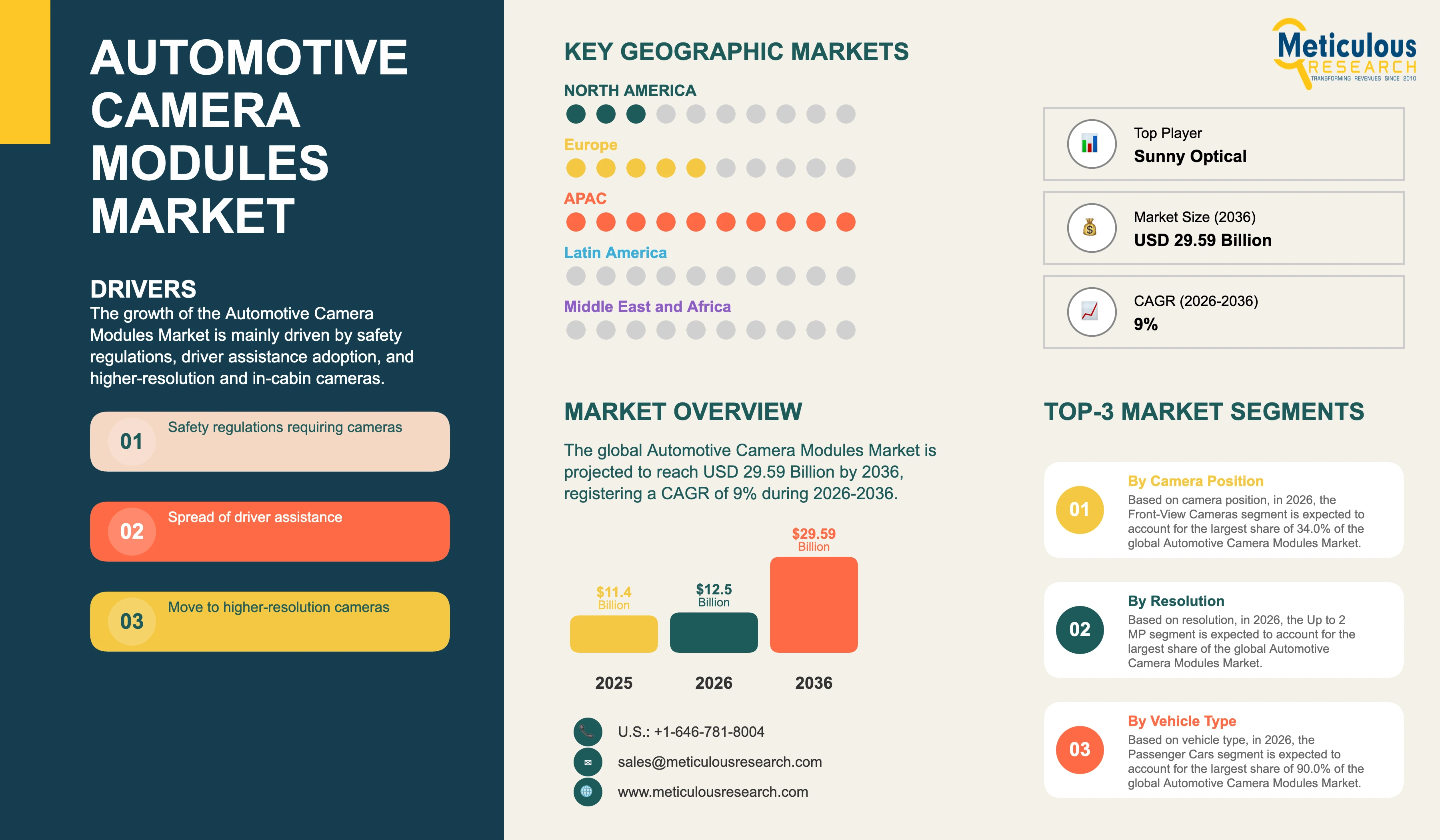
The global automotive camera modules market was valued at USD 11.40 billion in 2025. This market is expected to reach USD 29.59 billion by 2036 from an estimated USD 12.50 billion in 2026, registering a CAGR of 9.0% during the forecast period (2026-2036).
- Published
- Nov 2026
- Pages
- 266
- Format
- PDF + Excel
- Report ID
- MRAUTO - 1042884
- Base year
- 2025
- 2025 · BASELINE
- $11.40B
- 2036
- $29.59B
- CAGR 2026–2036
- 9.0%
2025 baseline · 2026–2036 forecast at 9.0% CAGR · hover a bar for the value
Key highlights
The second phase of the EU General Safety Regulation took effect for all newly registered cars and vans on July 7, 2026, requiring an advanced driver distraction warning system, which uses a camera to monitor the driver's head and eye movements, and advanced emergency braking that detects pedestrians and cyclists, according to the European Commission. These rules make in-cabin and front cameras standard on all new cars and vans sold in the EU.
NHTSA's FMVSS No. 127 requires automatic emergency braking, including pedestrian automatic emergency braking that works in daylight and darkness, on all new passenger cars and light trucks manufactured on or after September 1, 2029. Most vehicle makers meet these requirements with a front camera, often combined with a front radar.
Sunny Optical, the world's leading supplier of vehicle lens sets, secured new projects for 8-megapixel camera products with multiple top-tier vehicle makers in 2025 and started mass production of 17-megapixel camera products, according to Sunny Optical. The company reported total revenue of RMB 43.23 billion in 2025, up 12.9%, with growth supported by its vehicle business.
Valeo has produced more than 30 million smart front cameras and 2 billion ultrasonic sensors, according to Valeo, and its Valeo Smart Safety 360 system, which can control one to four surround-view cameras for parking, was selected by a European premium vehicle maker for production starting in 2026.
Global electric car sales topped 20 million units in 2025, according to the IEA. Electric vehicles, especially those made in China, often carry more cameras than combustion engine vehicles, as vehicle makers use advanced driver assistance and in-cabin features to differentiate their models.
Leading suppliers include Sunny Optical, LG Innotek, Samsung Electro-Mechanics, Magna, Valeo, AUMOVIO, Bosch, Aptiv, ZF, Gentex, Panasonic Automotive Systems, OFILM, and Huizhou Desay SV. In-cabin cameras are the fastest-growing camera position, and cameras of 8 megapixels and above are expected to become the largest resolution segment by 2036. Commercial vehicles are the fastest-growing vehicle type.
By camera position, front-view cameras account for the largest share of 34.0% in 2026, while in-cabin cameras register the highest CAGR.
By resolution, up to 2 MP accounts for the largest share in 2026, while 8 MP and above registers the highest CAGR.
By propulsion type, internal combustion engine vehicles account for the largest share in 2026, while battery electric vehicles register the highest CAGR.
By vehicle type, passenger cars account for the larger share of 90.0% in 2026, while commercial vehicles register the higher CAGR.
By geography, Asia-Pacific accounts for the largest share of 52.0% in 2026, while Asia-Pacific registers the highest CAGR of 9.7%.
Report summary
| Particulars | Details |
|---|---|
| Base Year | 2025 |
| Estimated Year | 2026 |
| Forecast Period | 2026-2036 |
| Market Size in 2025 | USD 11.40 billion |
| Market Size in 2026 | USD 12.50 billion |
| Market Size by 2036 | USD 29.59 billion |
| CAGR (2026-2036) | 9.0% |
| Format | PDF, Excel & Cloud Portal · 266 pages |
| Largest Segment by Camera Position (2026) | Front-View Cameras (34.0%) |
| Largest Segment by Vehicle Type (2026) | Passenger Cars (90.0%) |
| Largest Region (2026) | Asia-Pacific (52.0%) |
| Fastest-Growing Region | Asia-Pacific (CAGR 9.7%) |
| Companies Profiled | 13 companies and other companies |
| Segments Covered | Camera Position, Resolution, Propulsion Type, Vehicle Type, Geography |
| Countries Covered | U.S., Canada, Germany, France, U.K., Spain, Italy, Sweden, Czech Republic, Poland, Slovakia, Hungary, Romania, Netherlands, Belgium, Austria, Rest of Europe, China, Japan, South Korea, India, Thailand, Indonesia, Malaysia, Vietnam, Philippines, Taiwan, Singapore, Australia, Rest of Asia-Pacific, Mexico, Brazil, Argentina, Chile, Colombia, Rest of Latin America, Turkey, Morocco, South Africa, Saudi Arabia, UAE, Israel, Rest of Middle East & Africa |
Report overview
Segments covered: camera position, resolution, propulsion type, vehicle type.
Automotive camera modules combine an image sensor, a lens set, a circuit board, and a housing, and in some cases an image processor, in a sealed unit designed to work for the life of the vehicle in heat, cold, vibration, and moisture. They include front-view cameras used for automatic emergency braking, lane keeping, and traffic sign recognition, surround-view cameras used for parking and low-speed maneuvering, rear-view cameras, in-cabin cameras used for driver and occupant monitoring, and other cameras, such as camera-based mirrors and e-mirrors.
The growth of this market is mainly driven by safety regulations that require rear-view cameras, automatic emergency braking, and driver distraction warning, such as the EU General Safety Regulation and FMVSS No. 127 in the U.S., stricter safety ratings, the spread of advanced driver assistance and automated parking to mainstream vehicles, which increases the number of cameras per vehicle, the move to higher-resolution 8-megapixel and above cameras for Level 2+ and Level 3 automated driving, and the fast growth of in-cabin cameras for driver and occupant monitoring. In addition, the fast adoption of intelligent driving features by Chinese vehicle makers is increasing camera content per vehicle. However, strong price pressure, the long qualification cycles of automotive cameras, and slower growth of vehicle production in some regions are expected to restrain the growth of this market to some extent.
Cameras have become the most widely used sensor for advanced driver assistance and are now fitted to almost every new vehicle in major markets. A camera captures detailed images of the road, which allows the vehicle to recognize vehicles, pedestrians, cyclists, lane markings, traffic signs, and traffic lights, something radar and ultrasonic sensors cannot do. Cameras are also used for parking, to show the driver views around the vehicle, and inside the cabin, to monitor whether the driver is paying attention and to detect occupants. Many vehicles now carry five to twelve cameras or more, and the number continues to rise.
This report covers the global automotive camera modules market, including front-view, surround-view, rear-view, in-cabin, and other cameras, with resolutions of up to 2 megapixels, 3 to 5 megapixels, and 8 megapixels and above, for internal combustion engine, hybrid, and battery electric vehicles, in passenger cars and commercial vehicles. The market is valued at the selling price of complete camera modules supplied to vehicle makers and driver assistance system suppliers, including camera modules sold as part of front camera systems valued at an estimated module price. The market is analyzed by camera position, resolution, propulsion type, vehicle type, and geography. Image sensors and lens sets sold separately, driver assistance processors, and aftermarket dash cameras are not included.
Front-view cameras, mounted behind the windshield, are the most valuable camera modules, as they support automatic emergency braking, lane keeping, adaptive cruise control, and traffic sign recognition and must meet strict performance and reliability requirements. Surround-view cameras, usually four mounted in the front, rear, and side mirrors, provide a bird's-eye view for parking and are increasingly used for automated parking and low-speed driving. Rear-view cameras are required in many markets, including the U.S. In-cabin cameras use infrared sensors to monitor the driver's eyes and head and to detect occupants.
Camera technology is moving to higher resolution, wider dynamic range, and better low-light performance. Front cameras are moving from 1 to 2 megapixels to 8 megapixels and above, which allows the vehicle to detect objects at longer distances and supports Level 2+ and Level 3 automated driving. Sunny Optical started mass production of 17-megapixel camera products in 2025, according to Sunny Optical. High dynamic range and LED flicker mitigation allow cameras to work when driving into tunnels or toward the sun and to read LED traffic signs, and in-cabin cameras increasingly combine driver and occupant monitoring in one wide-angle module.
The market is served by optical and camera module makers, such as Sunny Optical, LG Innotek, Samsung Electro-Mechanics, and OFILM, which make lens sets and camera modules for many system suppliers and vehicle makers, and by tier-one suppliers, such as Magna, Valeo, AUMOVIO, Bosch, Aptiv, ZF, Gentex, Panasonic Automotive Systems, and Huizhou Desay SV, which supply complete camera systems. Image sensors are supplied by companies such as Sony, OmniVision, and onsemi. Chinese camera module makers have grown quickly with Chinese vehicle makers and now supply global vehicle makers.
Regulations are an important driver of this market in all major regions. The U.S. has required rear-view cameras on new light vehicles since 2018, and FMVSS No. 127 requires automatic emergency braking, including pedestrian detection at night, from September 2029. The EU General Safety Regulation requires advanced emergency braking for pedestrians and cyclists and an advanced driver distraction warning system on all new cars and vans from July 2026, which makes in-cabin cameras standard. Safety rating programs, such as Euro NCAP, C-NCAP, and IIHS, also reward camera-based driver assistance and driver monitoring.
In 2026, front-view cameras account for the largest share of the market by camera position, while in-cabin cameras are the fastest-growing camera position. Cameras of up to 2 megapixels account for the largest share by resolution, while cameras of 8 megapixels and above are the fastest-growing resolution. Internal combustion engine vehicles account for the largest share by propulsion type, while battery electric vehicles are the fastest-growing propulsion type. Passenger cars account for the largest share by vehicle type, while commercial vehicles are the fastest-growing vehicle type. Asia-Pacific accounts for the largest share of the market and is also the fastest-growing region.
Market growth over the forecast period will depend on vehicle production, the number of cameras per vehicle, the move to higher-resolution cameras, regulations and safety ratings, and price trends. Strong price pressure, especially in China, will limit growth in value per camera, while rising camera content and the shift to higher-value 8-megapixel and in-cabin cameras will support value growth. Overall, cameras are expected to remain the main sensor for driver assistance and automated driving, supporting steady market growth through 2036.
Passenger cars are expected to account for the largest share of 90.0% of the market in 2026, while commercial vehicles are projected to register the highest CAGR, driven by truck and bus safety rules and camera-based mirrors.
Asia-Pacific is expected to account for the largest share of 52.0% of the market in 2026, mainly due to China's large vehicle production, fast adoption of intelligent driving, and leading camera module makers.
Asia-Pacific is also projected to register the highest CAGR of 9.7% during the forecast period, driven by intelligent driving growth in China, new safety requirements in India, and Southeast Asian vehicle production.
The report profiles 13 companies, including Sunny Optical, LG Innotek, Samsung Electro-Mechanics, Magna, Valeo, AUMOVIO, Bosch, Aptiv, ZF, Gentex, Panasonic Automotive Systems, OFILM, and Huizhou Desay SV.
In-cabin cameras are required for the EU's driver distraction warning rule, rewarded by Euro NCAP, needed by Level 2+ and Level 3 systems to check driver attention, and increasingly used for occupant monitoring.
This report covers camera modules for all vehicle camera positions. Complete driver monitoring systems, occupant monitoring systems, and ADAS systems are analyzed in separate reports.
Report infographic
Market dynamics
17 factors across 5 forcesSafety regulations requiring cameras
Safety regulations in major markets require functions that are usually provided by cameras. The U.S. has required rear-view cameras on new light vehicles since 2018, and FMVSS No. 127 requires automatic emergency braking, including pedestrian automatic emergency braking in daylight and darkness, on all new light vehicles from September 1, 2029. Most vehicle makers meet automatic emergency braking requirements with a front camera, often combined with radar, because cameras can recognize pedestrians and cyclists.
In the EU, the second phase of the General Safety Regulation made advanced emergency braking for pedestrians and cyclists and an advanced driver distraction warning system mandatory on all newly registered cars and vans from July 7, 2026, according to the European Commission. The distraction warning system uses an in-cabin camera to monitor the driver's head and eye movements, which makes in-cabin cameras standard on all new cars and vans in the EU. Similar rules are being introduced in other regions, which supports steady demand for front and in-cabin cameras.
Spread of advanced driver assistance and automated parking
Advanced driver assistance features, such as lane centering, adaptive cruise control, traffic sign recognition, blind spot monitoring, surround view, and automated parking, are spreading from premium vehicles to mainstream and entry-level models. Consumers increasingly expect these features, and vehicle makers use them to differentiate their models, especially in China, where intelligent driving is a key selling point for electric vehicles.
Each of these features relies on cameras, and vehicles with Level 2+ systems and automated parking often use 7 to 12 external cameras, including front, side, rear, and surround-view cameras, which greatly increases camera content per vehicle. Valeo's Smart Safety 360 system, for example, can control one to four surround-view cameras for parking, according to Valeo. The growing number of cameras per vehicle is a key driver of market growth.
Move to higher-resolution cameras for automated driving
Level 2+ and Level 3 systems, which allow hands-free or eyes-off driving, need cameras that can detect vehicles, pedestrians, and small objects at long distances and with high accuracy. Vehicle makers are moving front cameras from 1 to 2 megapixels to 8 megapixels and above, and they are also using higher-resolution side and rear cameras for 360-degree perception. Sunny Optical secured new projects for 8-megapixel camera products with multiple top-tier vehicle makers in 2025 and started mass production of 17-megapixel camera products, according to Sunny Optical.
Higher-resolution cameras are more valuable than lower-resolution cameras, as they use larger image sensors, more complex lens sets, and better thermal management. This increases camera value per vehicle and supports market growth even as prices per camera fall. Cameras of 8 megapixels and above are the fastest-growing resolution in this market and are expected to become the largest resolution segment by 2036.
Fast growth of in-cabin cameras
In-cabin cameras that monitor the driver's attention and detect occupants are growing quickly, driven by the EU General Safety Regulation, Euro NCAP requirements for driver monitoring, and the needs of Level 2+ and Level 3 systems, which must check that the driver is ready to take control. In-cabin cameras use infrared sensors to work in darkness and through sunglasses, and new wide-angle cameras can monitor both the driver and passengers.
In-cabin cameras are also used for occupant detection, child presence detection, gesture control, video calls, and personalization, which increases their value to vehicle makers. In-cabin cameras are the fastest-growing camera position in this market, and suppliers that offer complete driver and occupant monitoring systems are well placed to benefit.
Fast adoption of intelligent driving by Chinese vehicle makers
Chinese vehicle makers are adopting advanced driver assistance and intelligent driving features faster than vehicle makers in other regions, and many new Chinese electric vehicles offer highway and city navigation assistance and automated parking even on mid-priced models. These vehicles often carry 10 or more cameras, including several 8-megapixel cameras, together with radar and, in some cases, lidar. Chinese camera module makers, such as Sunny Optical, OFILM, and Huizhou Desay SV, have grown quickly with these vehicle makers, and Sunny Optical's vehicle business grew 18.2% in the first half of 2025, according to Sunny Optical. As Chinese vehicle makers expand production and exports, and as global vehicle makers respond with similar features, camera content per vehicle is expected to rise in other regions as well. This trend makes Asia-Pacific the largest and fastest-growing region in this market and is pushing camera module makers to increase production capacity and reduce costs.
Table of contents
12 chapters · 186 sections · 266 pages · click to expandSegmental analysis
| Segment | Largest share (2026) | Fastest growth (2026–2036) |
|---|---|---|
| By Camera Position | Front-view cameras | In-cabin cameras |
| By Resolution | Up to 2 MP | 8 MP and above |
| By Propulsion Type | Internal combustion engine vehicles | Battery electric vehicles |
| By Vehicle Type | Passenger cars | Commercial vehicles |
| Other segments | Internal combustion engine vehicles | Battery electric vehicles |
By Camera Position
- Automotive Camera Modules Market Analysis by Camera Position
- The front-view cameras segment is expected to account for the largest share of 34.0% of the global automotive camera modules market.
- The large share of this segment is mainly due to the use of front cameras for automatic emergency braking, lane keeping, adaptive cruise control, and traffic sign recognition in almost all new vehicles in major markets, regulations such as FMVSS No. 127 and the EU General Safety Regulation that require these functions, the higher value of front camera modules, which need high resolution, wide dynamic range, and strict reliability, and the move to 8-megapixel front cameras for Level 2+ systems.
- Valeo, Bosch, AUMOVIO, ZF, Magna, Aptiv, and Sunny Optical are among the leading suppliers of front cameras.
- However, the in-cabin cameras segment is projected to register the highest CAGR during the forecast period.
- The rapid growth of this segment is driven by the EU General Safety Regulation, which requires an advanced driver distraction warning system on all new cars and vans from July 2026, Euro NCAP requirements for driver monitoring, the needs of Level 2+ and Level 3 systems to check driver attention, and the move to wide-angle cameras that monitor both the driver and passengers.
- Gentex, Magna, Valeo, and Bosch are among the leading suppliers of in-cabin cameras.
- Rear-view cameras remain required on new light vehicles in the U.S.
By Resolution
- Automotive Camera Modules Market Analysis by Resolution
- The up to 2 MP segment is expected to account for the largest share of the global automotive camera modules market.
- The large share of this segment is mainly due to the use of 1 to 2 megapixel cameras in most rear-view, surround-view, and in-cabin cameras and in many front cameras in mainstream vehicles, their lower cost, the large installed base of vehicle platforms designed for these cameras, and their sufficient performance for parking and basic driver assistance functions.
- However, the 8 MP and above segment is projected to register the highest CAGR during the forecast period.
- The rapid growth of this segment is driven by the move to Level 2+ and Level 3 automated driving, which requires long-range, high-accuracy detection, the adoption of 8-megapixel front, side, and rear cameras by Chinese and global vehicle makers, new 8-megapixel projects and 17-megapixel mass production at Sunny Optical, and falling costs of high-resolution image sensors.
- This segment is expected to become the largest resolution segment by 2036.
- Mid-range 3 MP to 5 MP cameras are also growing in surround-view and side positions.
- The up to 2 MP segment is expected to account for the largest share of the automotive camera modules market, while the 8 MP and above segment is projected to register the highest CAGR during the forecast period.
By Propulsion Type
- Automotive Camera Modules Market Analysis by Propulsion Type
- The internal combustion engine vehicles segment is expected to account for the largest share of the global automotive camera modules market.
- The large share of this segment is mainly due to the large number of combustion engine vehicles still produced each year, the use of rear-view, front, and surround-view cameras in most of these vehicles to meet regulations and safety ratings, and the large production of combustion engine SUVs and pickup trucks with many driver assistance features in North America and other regions.
- However, the battery electric vehicles segment is projected to register the highest CAGR during the forecast period.
- The rapid growth of this segment is driven by the fast growth of battery electric vehicle production, with global electric car sales topping 20 million units in 2025 according to the IEA, the higher number of cameras in many electric vehicles, especially Chinese models with highway and city navigation assistance, and the early adoption of 8-megapixel and in-cabin cameras in new electric vehicle platforms.
- Hybrid vehicles also add cameras as new hybrid platforms launch.
By Vehicle Type
- Automotive Camera Modules Market Analysis by Vehicle Type
- The passenger cars segment is expected to account for the largest share of 90.0% of the global automotive camera modules market.
- The large share of this segment is mainly due to the very large number of passenger cars produced each year, regulations and safety ratings that require camera-based functions in passenger cars, the use of five to twelve or more cameras in many passenger cars with driver assistance and automated parking, and the fast adoption of in-cabin and high-resolution cameras in passenger cars.
- However, the commercial vehicles segment is projected to register the highest CAGR during the forecast period.
- The rapid growth of this segment is driven by regulations that extend automatic emergency braking, blind spot detection, and driver monitoring requirements to trucks and buses, the use of camera-based mirrors to reduce drag and improve visibility, fleet operators' focus on safety and insurance costs, and the use of cameras for driver coaching and incident recording.
Other segments
- The internal combustion engine vehicles segment is expected to account for the largest share of the automotive camera modules market, while the battery electric vehicles segment is projected to register the highest CAGR during the forecast period.
Geographic analysis
Asia-Pacific
Largest shareIn 2026, Asia-Pacific is expected to account for the largest share of 52.0% of the global automotive camera modules market. The large share of this region is mainly due to China's position as the largest vehicle producer in the world, the fast adoption of intelligent driving features with many cameras by Chinese vehicle makers, the large vehicle production of Japan, South Korea, and India, and the presence of leading camera module and lens makers, such as Sunny Optical, OFILM, Huizhou Desay SV, LG Innotek, Samsung Electro-Mechanics, and Panasonic Automotive Systems, together with the Asian operations of Valeo, Bosch, Magna, and other suppliers. China is also the largest center for camera module production for global markets. Chinese vehicle makers often fit 10 or more cameras to new electric vehicles with navigation assistance, which is well above the global average. Japan and South Korea are important centers for image sensor and camera module development. Asia-Pacific is also projected to register the highest CAGR of 9.7% during the forecast period. The rapid growth of this region is mainly driven by continued growth of vehicle production and intelligent driving in China, the adoption of 8-megapixel cameras and in-cabin monitoring by Chinese vehicle makers, new safety requirements and Bharat NCAP ratings in India, the growth of vehicle production in Southeast Asia, and the expansion of Chinese camera module makers. Sunny Optical's vehicle business grew 18.2% in the first half of 2025, according to Sunny Optical.
Europe
Europe accounts for a significant share of the market, supported by the EU General Safety Regulation, which made advanced emergency braking for pedestrians and cyclists and driver distraction warning mandatory on all new cars and vans from July 2026, strict Euro NCAP ratings, the production of premium vehicles with many cameras, and the presence of leading suppliers, such as Valeo, Bosch, AUMOVIO, ZF, and Magna's European operations. Germany is the largest market in the region, followed by France, Spain, Italy, the U.K., and Central and Eastern European countries, which are important locations for vehicle and camera production. The EU's driver distraction warning rule has made in-cabin cameras one of the fastest-growing products in the region.
North America
North America accounts for a significant share of the market, supported by the U.S. rear-view camera requirement, FMVSS No. 127, which requires automatic emergency braking with pedestrian detection from September 2029, IIHS safety ratings, the large production of SUVs and pickup trucks with surround-view and driver assistance cameras, and the presence of Magna, Gentex, Aptiv, and other suppliers. The U.S. is the largest market in the region, while Mexico is an important production location for camera modules supplied to vehicle plants across North America.
Latin America
Latin America and the Middle East & Africa account for smaller shares, with growth supported by Latin NCAP ratings and vehicle production in Brazil, Mexico, Argentina, Turkey, and Morocco, and by the growing sales of Chinese vehicles with many cameras in these markets.
Competitive landscape
The global automotive camera modules market includes optical and camera module makers, tier-one driver assistance system suppliers, and image sensor makers. Optical and camera module makers, many of them based in China, South Korea, and Japan, supply lens sets and camera modules to system suppliers and vehicle makers, while tier-one suppliers supply complete camera systems with software. Competition is strong, and Chinese suppliers have gained share quickly, both in China and with global vehicle makers.
Sunny Optical is the global leader in vehicle lens sets and a major camera module supplier, with total revenue of RMB 43.23 billion in 2025, according to Sunny Optical. LG Innotek, Samsung Electro-Mechanics, OFILM, and Panasonic Automotive Systems are leading camera module makers, while Valeo, Bosch, AUMOVIO, Magna, Aptiv, ZF, Gentex, and Huizhou Desay SV supply complete front, surround-view, and in-cabin camera systems. Valeo has produced more than 30 million smart front cameras, according to Valeo.
Companies in this market compete on image quality, resolution, low-light and dynamic range performance, reliability, cost, size, functional safety, and software. Key strategies include developing 8-megapixel and above cameras, in-cabin monitoring cameras, and camera-based mirrors, expanding production capacity in China and other low-cost locations, reducing costs through automation, and offering complete camera systems with software for driver assistance and parking.
Recent competitive activity has focused on higher-resolution cameras and new safety rules. Sunny Optical secured new 8-megapixel camera projects with multiple top-tier vehicle makers and started mass production of 17-megapixel camera products in 2025, according to Sunny Optical, and a European premium vehicle maker selected Valeo's Smart Safety 360 system, including surround-view camera control, for production starting in 2026, according to Valeo.
We expect competition to increase over the forecast period as Chinese camera module makers expand abroad, as vehicle makers move image processing to central computers, and as in-cabin and high-resolution cameras become standard. Suppliers with low-cost, high-quality production, strong optical and thermal design capabilities, and complete in-cabin and driver assistance offerings are expected to strengthen their positions, while consolidation among smaller suppliers is likely, especially in Europe and North America.
Some of the key players operating in the automotive camera modules market are Sunny Optical Technology (Group) Company Limited, LG Innotek Co., Ltd., Samsung Electro-Mechanics Co., Ltd., Magna International Inc., Valeo SE, AUMOVIO SE, Robert Bosch GmbH, Aptiv PLC, ZF Friedrichshafen AG, Gentex Corporation, Panasonic Automotive Systems Co., Ltd., OFILM Group Co., Ltd., and Huizhou Desay SV Automotive Co., Ltd., among others.
- —
Sunny Optical secured new 8-megapixel camera projects and started mass production of 17-megapixel cameras in 2025, and the EU made camera-based driver distraction warning mandatory on all new cars and vans from July 2026.
- Sunny Optical Technology (Group) Company Limited
- LG Innotek Co., Ltd.
- Samsung Electro-Mechanics Co., Ltd.
- Magna International Inc.
- Valeo SE
- AUMOVIO SE
- Robert Bosch GmbH
- Aptiv PLC
- ZF Friedrichshafen AG
- Gentex Corporation
- Panasonic Automotive Systems Co., Ltd.
- OFILM Group Co., Ltd.
- Huizhou Desay SV Automotive Co., Ltd.
Expert perspectives
Automotive camera modules are the most widely used sensors for driver assistance, and camera content per vehicle continues to rise as regulations, safety ratings, and consumer demand push more features into more vehicles. The market is also moving to higher-value products, as front and surround cameras move to 8 megapixels and above and in-cabin cameras become standard.
Over the forecast period, the market is expected to grow at a CAGR of 9.0%, from USD 12.50 billion in 2026 to USD 29.59 billion in 2036. Growth will be driven by safety regulations requiring cameras, the spread of driver assistance and automated parking, the move to higher-resolution cameras for automated driving, the fast growth of in-cabin cameras, and the fast adoption of intelligent driving by Chinese vehicle makers.
Among the market segments, front-view cameras are the largest camera position, while in-cabin cameras grow fastest. Cameras of up to 2 megapixels are the largest resolution, while cameras of 8 megapixels and above grow fastest. Internal combustion engine vehicles are the largest propulsion type, while battery electric vehicles grow fastest. Passenger cars are the largest vehicle type, while commercial vehicles grow fastest. Asia-Pacific is both the largest and the fastest-growing region, at a CAGR of 9.7%.
In our view, the move to 8-megapixel and above cameras around the vehicle will be the most important source of value growth in this market. As Level 2+ systems spread and Level 3 systems launch, vehicle makers will need high-resolution cameras around the vehicle, which increases camera value per vehicle even as prices per camera fall, and favors suppliers with strong optical design. We expect cameras of 8 megapixels and above to become the largest resolution segment by 2036, overtaking lower-resolution cameras in market value.
We also see in-cabin cameras as a strong and steady growth area for camera suppliers, driven by the EU General Safety Regulation and safety ratings. Chinese camera module makers will continue to set the cost benchmark and expand abroad, and global suppliers will need to compete on quality, software, and complete system offerings. Partnerships between optical specialists, image sensor makers, and tier-one system suppliers are likely to increase as camera systems become more complex.
Overall, we believe that the automotive camera modules market will grow steadily over the forecast period, with in-cabin cameras, 8-megapixel and above cameras, battery electric vehicles, commercial vehicles, and Asia-Pacific providing the fastest growth. Companies with low-cost, high-quality production, strong optical design, and complete camera systems will be best positioned to capture this growth, while price pressure and long qualification cycles remain the main risks.
Customer perspectives
Customers in the automotive camera modules market are mainly vehicle makers and tier-one driver assistance system suppliers, which buy camera modules for passenger cars and commercial vehicles. They focus on image quality, resolution, low-light and high dynamic range performance, reliability over the life of the vehicle, cost, size, functional safety, and supply security. Vehicle makers increasingly ask for 8-megapixel cameras for Level 2+ systems, wide-angle in-cabin cameras for driver and occupant monitoring, and complete sets of cameras for 360-degree perception. They also value suppliers that can support production in several regions and provide calibration and software support. Commercial vehicle customers focus on durability, wide coverage, and camera-based mirrors that reduce drag. Many want camera modules that can be reused across several platforms and markets to reduce cost and qualification work for each new model.
This comment explains why cameras of 8 megapixels and above are the fastest-growing resolution and why Asia-Pacific is the fastest-growing region, led by China.
This comment explains why in-cabin cameras are the fastest-growing camera position, while front-view cameras account for 34.0% of the market, supported by AEB rules.
This comment explains why commercial vehicles are the fastest-growing vehicle type, while passenger cars account for 90.0% of the market, supported by their much larger production volumes.
“Our new models carry eleven cameras, including 8-megapixel front and side cameras. City navigation assistance is expected even on mid-priced cars.”
“Driver distraction warning is now required on every new car we register. We chose a wide-angle camera that also monitors passengers.”
“Cameras around the truck and camera mirrors have reduced our side-swipe incidents. We now specify them on all new trucks.”
Frequently asked questions
The global automotive camera modules market was valued at USD 11.40 billion in 2025, up from USD 10.30 billion in 2024, and is estimated at USD 12.50 billion in 2026. The market includes front-view, surround-view, rear-view, in-cabin, and other camera modules for passenger cars and commercial vehicles.
The global automotive camera modules market is expected to reach USD 29.59 billion by 2036, driven by safety regulations, driver assistance adoption, higher-resolution cameras, and in-cabin monitoring.
The market is expected to register a CAGR of 9.0% from 2026 to 2036, with the fastest growth in in-cabin cameras, 8-megapixel and above cameras, battery electric vehicles, commercial vehicles, and Asia-Pacific.
Market growth is mainly driven by safety regulations requiring cameras, the spread of driver assistance and automated parking, the move to higher-resolution cameras for automated driving, the fast growth of in-cabin cameras, and the fast adoption of intelligent driving by Chinese vehicle makers.
Strong price pressure and long qualification cycles and reliability requirements restrain growth, while performance in bad weather, darkness, and glare and calibration, data, and cybersecurity are key challenges.
Key growth opportunities include 8-megapixel and above cameras for Level 2+ and Level 3 systems, in-cabin monitoring cameras, camera-based mirrors and e-mirrors, and cameras for commercial vehicles.
Front-view cameras are expected to account for the largest share of 34.0% of the market in 2026, while in-cabin cameras are projected to register the highest CAGR, driven by driver distraction warning rules.
In 2026, the up to 2 MP segment is expected to account for the largest share of the automotive camera modules market, while the 8 MP and above segment is projected to register the highest CAGR during the forecast period.
In 2026, the internal combustion engine vehicles segment is expected to account for the largest share of the automotive camera modules market, while the battery electric vehicles segment is projected to register the highest CAGR during the forecast period.
Passenger cars are expected to account for the largest share of 90.0% of the market in 2026, while commercial vehicles are projected to register the highest CAGR, driven by truck and bus safety rules and camera-based mirrors.
Asia-Pacific is expected to account for the largest share of 52.0% of the market in 2026, mainly due to China's large vehicle production, fast adoption of intelligent driving, and leading camera module makers.
Asia-Pacific is also projected to register the highest CAGR of 9.7% during the forecast period, driven by intelligent driving growth in China, new safety requirements in India, and Southeast Asian vehicle production.
The report profiles 13 companies, including Sunny Optical, LG Innotek, Samsung Electro-Mechanics, Magna, Valeo, AUMOVIO, Bosch, Aptiv, ZF, Gentex, Panasonic Automotive Systems, OFILM, and Huizhou Desay SV.
Sunny Optical secured new 8-megapixel camera projects and started mass production of 17-megapixel cameras in 2025, and the EU made camera-based driver distraction warning mandatory on all new cars and vans from July 2026.
In-cabin cameras are required for the EU's driver distraction warning rule, rewarded by Euro NCAP, needed by Level 2+ and Level 3 systems to check driver attention, and increasingly used for occupant monitoring.
This report covers camera modules for all vehicle camera positions. Complete driver monitoring systems, occupant monitoring systems, and ADAS systems are analyzed in separate reports.
Cite this report
Meticulous Research. (2026). Automotive Camera Modules Market - Global Opportunity Analysis and Industry Forecast (2026-2036) (Report No. MRAUTO - 1042884). Meticulous Market Research Pvt. Ltd. https://www.meticulousresearch.com/product/automotive-camera-modules-market-7567