Automotive Bearings Market (2026-2036)
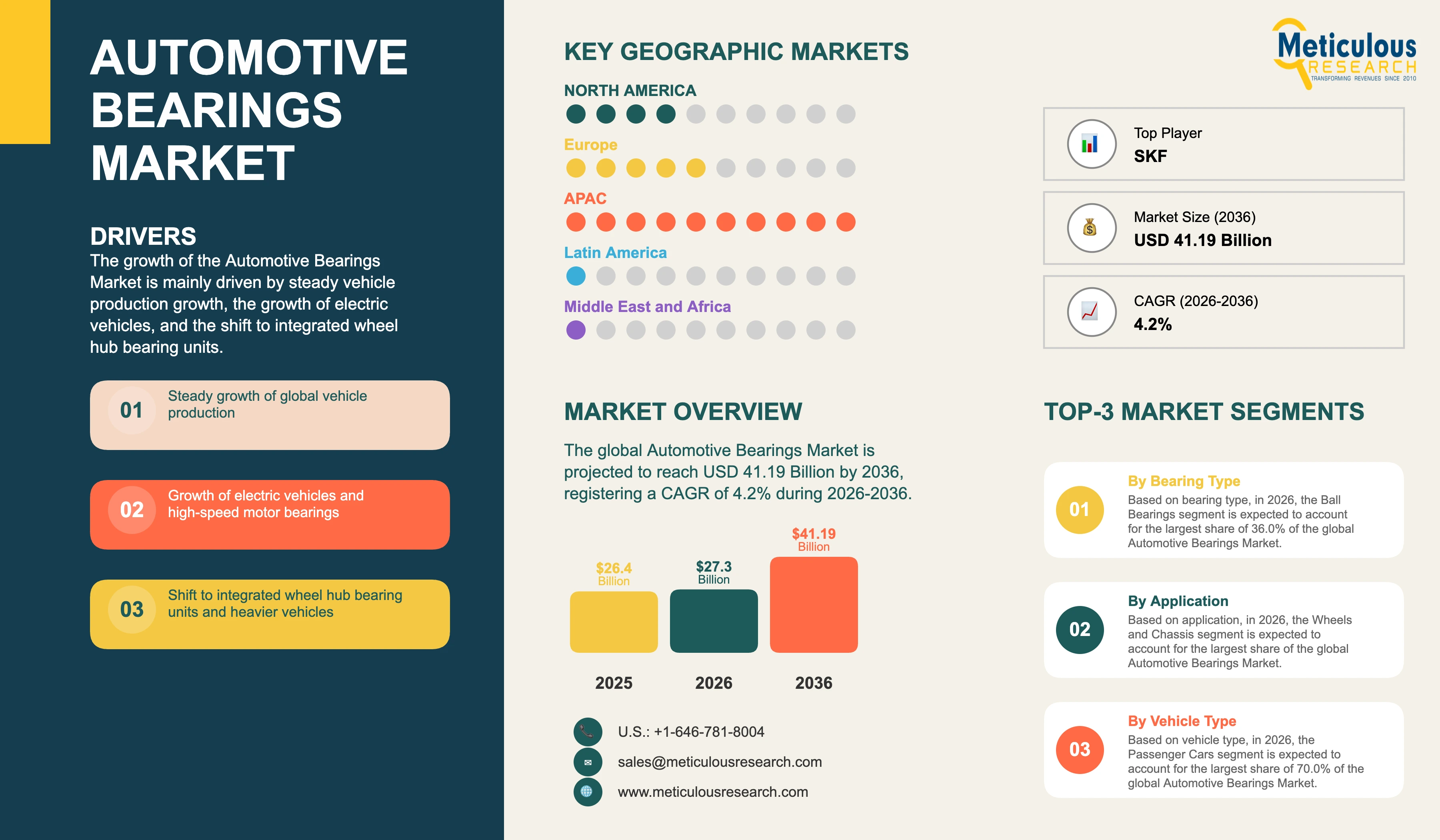
The global automotive bearings market was valued at USD 26.40 billion in 2025. This market is expected to reach USD 41.19 billion by 2036 from an estimated USD 27.30 billion in 2026, registering a CAGR of 4.2% during the forecast period (2026-2036).
- Published
- Nov 2026
- Pages
- 250
- Format
- PDF + Excel
- Report ID
- MRAUTO - 1042861
- Base year
- 2025
- 2025 · BASELINE
- $26.40B
- 2036
- $41.19B
- CAGR 2026–2036
- 4.2%
2025 baseline · 2026–2036 forecast at 4.2% CAGR · hover a bar for the value
Key highlights
SKF is separating its automotive business into a stand-alone company called SKF Vertevo, which is due to list on Nasdaq Stockholm on December 1, 2026, according to Automotive World. SKF Vertevo employs around 7,500 people, serves vehicle makers and the aftermarket in more than 100 countries through more than 9,000 distributors, and is targeting an adjusted operating margin above 6% in the medium term and at least 8% in the long term.
Schaeffler reported 2025 revenue of €23.5 billion after completing its merger with Vitesco, with its Bearings & Industrial Solutions division generating €6,368 million and its Vehicle Lifetime Solutions aftermarket division generating about €3 billion, up 2.6%, according to Schaeffler and S&P Global. Schaeffler is one of the largest suppliers of automotive bearings, including wheel bearings and e-motor bearings.
Global electric car sales grew by 20% to more than 20 million units in 2025, accounting for one in four new cars sold, according to the IEA. Electric motors in these vehicles run at much higher speeds than combustion engines, and BYD's Super e-Platform launched in March 2025 includes a motor that spins at 30,000 rpm, according to BYD, which requires special high-speed bearings.
NSK consolidated its steering business as a subsidiary on September 1, 2025, and added it as a reportable segment, according to NSK. NSK, NTN, and JTEKT are the three leading Japanese bearing makers and major suppliers of wheel hub bearings, transmission bearings, and electric motor bearings to vehicle makers worldwide.
Electric vehicle motors and e-axles can create electrical currents through bearings that damage the bearing surfaces over time, a problem known as electrical erosion. Bearing makers are developing ceramic hybrid bearings and electrically insulated bearings to solve this problem, which are much more valuable than standard bearings.
Leading suppliers include SKF, Schaeffler, NSK, NTN, JTEKT, Timken, NACHI-FUJIKOSHI, ILJIN, C&U Group, and Wanxiang Qianchao. Chinese bearing makers have grown quickly with Chinese vehicle production and are expanding exports, increasing price competition for global suppliers. Its Vehicle Lifetime Solutions business also shows the value of the replacement market for bearing makers.
By bearing type, ball bearings account for the largest share of 36.0% in 2026, while wheel hub bearing units register the highest CAGR.
By application, wheels and chassis account for the largest share in 2026, while electric motors and e-axles register the highest CAGR.
By sales channel, OEM accounts for the larger share in 2026 and also registers the higher CAGR.
By vehicle type, passenger cars account for the largest share of 70.0% in 2026, while two-wheelers register the highest CAGR.
By geography, Asia-Pacific accounts for the largest share of 50.0% in 2026, while Asia-Pacific registers the highest CAGR of 5.3%.
Report summary
| Particulars | Details |
|---|---|
| Forecast Period | 2026-2036 |
| Base Year | 2025 |
| Estimated Year | 2026 |
| CAGR (Value) | 4.2% |
| Format | PDF, Excel & Cloud Portal · 250 pages |
| Market Size (Value) in 2025 | USD 26.40 billion |
| Market Size (Value) in 2026 | USD 27.30 billion |
| Market Size (Value) in 2036 | USD 41.19 billion |
| Largest Segment by Bearing Type (2026) | Ball Bearings (36.0%) |
| Largest Segment by Vehicle Type (2026) | Passenger Cars (70.0%) |
| Largest Region (2026) | Asia-Pacific (50.0%) |
| Fastest-Growing Region | Asia-Pacific (CAGR 5.3%) |
| Segments Covered | Bearing Type, Application, Sales Channel, Vehicle Type, Geography |
| Countries Covered | U.S., Canada, Germany, France, Spain, Italy, U.K., Sweden, Czech Republic, Slovakia, Poland, Hungary, Romania, Belgium, Rest of Europe, China, Japan, India, South Korea, Thailand, Indonesia, Vietnam, Philippines, Malaysia, Taiwan, Australia, Rest of Asia-Pacific, Mexico, Brazil, Argentina, Colombia, Chile, Rest of Latin America, Turkey, Morocco, South Africa, Saudi Arabia, Egypt, Iran, Rest of Middle East & Africa |
| Key Companies | 10 companies and other companies |
Report overview
Segments covered: bearing type, application, sales channel, vehicle type.
Automotive bearings are precision components that allow rotating and moving parts, such as wheels, shafts, gears, motors, and pumps, to turn smoothly with low friction while carrying loads. They are used throughout the vehicle, including in wheel hubs, transmissions, differentials, engines, electric motors, steering systems, water pumps, alternators, and air conditioning compressors, and a typical passenger car contains dozens to more than a hundred bearings.
The growth of this market is mainly driven by steady growth of global vehicle production, especially in Asia-Pacific, the growth of electric vehicles, which need high-speed, low-friction, and electrically insulated bearings for electric motors and e-axles, the need to reduce friction to improve fuel economy and electric vehicle range, the move to integrated wheel hub bearing units, the growth of heavier vehicles, such as SUVs and electric vehicles, which need larger and stronger bearings, and steady aftermarket demand from a large and aging vehicle fleet. In addition, the growth of two-wheeler production in India and Southeast Asia is supporting demand. However, the loss of engine and multi-speed transmission bearings in electric vehicles, strong price competition from Chinese suppliers, and volatile steel prices are expected to restrain the growth of this market to some extent.
Bearings are mechanical parts that support rotating or moving shafts and reduce friction between moving parts. Most automotive bearings are rolling bearings, in which balls or rollers roll between inner and outer rings, separated by a cage and lubricated with grease or oil. The main types are ball bearings, which are used for high speeds and moderate loads, tapered roller bearings, which carry heavy combined radial and axial loads, needle roller bearings, which are compact and used in transmissions and steering, and wheel hub bearing units, which combine bearings with the wheel hub and flange in one assembly. Plain bearings, such as engine bushings, are also used in some applications.
This report covers the global automotive bearings market, including ball bearings, wheel hub bearing units, tapered roller bearings, needle roller bearings, and other bearings used in passenger cars, light commercial vehicles, heavy commercial vehicles, and two-wheelers. The market is valued at the selling price of bearings sold to vehicle makers, tier-1 suppliers, and the aftermarket. The market is analyzed by bearing type, application, sales channel, vehicle type, and geography. Bearings used in off-highway vehicles, rail, aerospace, and industrial machinery are not included, nor are constant velocity joints and other driveline parts sold separately.
Bearings are used in almost every rotating system in a vehicle, from the wheels to the smallest seat motor. Wheel bearings support the vehicle's weight and allow the wheels to turn, transmission and differential bearings support gears and shafts, engine bearings support the crankshaft, camshafts, and timing system, and accessory bearings are used in water pumps, alternators, belt tensioners, air conditioning compressors, and starter motors. Steering systems, seat motors, window motors, and many other small motors also use bearings. In electric vehicles, bearings are used in electric motors, reduction gearboxes, e-axles, and thermal management pumps and compressors.
Bearing quality has a direct effect on vehicle safety, efficiency, noise, and durability. Wheel bearings must carry high loads and resist shocks for the life of the vehicle, transmission and motor bearings must run quietly at high speeds, and all bearings must have low friction to reduce energy losses. Vehicle makers have pushed suppliers to reduce friction in bearings to improve fuel economy and electric vehicle range, which has led to new bearing designs, better seals, and low-friction greases. Bearing makers also integrate sensors, such as wheel speed sensors for anti-lock braking systems, into wheel hub bearing units.
The market is led by a small number of large global bearing makers, including SKF, Schaeffler, NSK, NTN, JTEKT, and Timken, which have long relationships with vehicle makers and strong engineering, materials, and manufacturing capabilities. NACHI-FUJIKOSHI and ILJIN are important suppliers in Japan and Korea, while Chinese bearing makers, such as C&U Group and Wanxiang Qianchao, have grown quickly with Chinese vehicle production. SKF is separating its automotive business as SKF Vertevo, which will become a stand-alone listed company focused on vehicle bearings.
The shift to electric vehicles is changing both the number and the type of bearings used in each vehicle. Electric vehicles do not need engine bearings or most multi-speed transmission bearings, but they need bearings for electric motors and reduction gearboxes that run at much higher speeds, often 15,000 to 30,000 rpm. These bearings must handle high speeds with low noise and low friction and must resist electrical erosion caused by currents passing through the bearing. Electric vehicles are also heavier than similar combustion engine vehicles, which requires stronger wheel hub bearings. As a result, value is shifting toward high-speed motor bearings, insulated bearings, and larger hub units.
In 2026, ball bearings account for the largest share of the market by bearing type, while wheel hub bearing units are the fastest-growing bearing type. Wheels and chassis account for the largest share by application, while electric motors and e-axles are the fastest-growing application. The OEM channel accounts for the larger share by sales channel and is also the faster-growing channel. Passenger cars account for the largest share by vehicle type, while two-wheelers are the fastest-growing vehicle type. Asia-Pacific accounts for the largest share of the market and is also the fastest-growing region.
Market growth over the forecast period will depend on global vehicle production, the pace of electric vehicle adoption, the growth of heavier vehicles, and the size of the vehicle fleet that drives aftermarket demand. Steel prices and price competition from Chinese suppliers will also affect the market. Overall, steady vehicle production growth and higher-value bearings for electric vehicles and heavier vehicles are expected to support moderate growth.
Passenger cars are expected to account for the largest share of 70.0% of the market in 2026, while two-wheelers are projected to register the highest CAGR, driven by production growth and electrification in India and Southeast Asia.
Asia-Pacific is expected to account for the largest share of 50.0% of the market in 2026, mainly due to China's large vehicle production, large two-wheeler production in India and Southeast Asia, and leading Japanese and Chinese bearing makers.
Asia-Pacific is also projected to register the highest CAGR of 5.3% during the forecast period, driven by vehicle and electric vehicle growth in China, passenger car and two-wheeler growth in India, and expanding production in Southeast Asia.
The report profiles 10 companies, including SKF (SKF Vertevo), Schaeffler, NSK, NTN, JTEKT, Timken, NACHI-FUJIKOSHI, ILJIN, C&U Group, and Wanxiang Qianchao.
Electric vehicles do not need engine bearings and need fewer transmission bearings, but they need high-speed, low-friction, and insulated bearings for motors and e-axles, and larger hub units because of their higher weight.
Electrical erosion occurs when currents from an electric motor's power electronics pass through a bearing and damage its surfaces. Ceramic hybrid and insulated bearings prevent this damage and are much more valuable than standard bearings.
In 2026, the OEM segment is expected to account for the larger share of the automotive bearings market, and it is also projected to register the higher CAGR during the forecast period.
Report infographic
Market dynamics
17 factors across 5 forcesSteady growth of global vehicle production
Bearing demand is closely linked to vehicle production, as every vehicle contains dozens to more than a hundred bearings. Global vehicle production is expected to grow steadily over the forecast period, led by China, India, and Southeast Asia, while production in Europe and North America is expected to grow more slowly. Each new vehicle produced adds demand for wheel hub bearings, transmission or gearbox bearings, motor or engine bearings, and accessory bearings, and the growing vehicle fleet also supports aftermarket demand.
The growth of vehicle production in Asia-Pacific is particularly important for bearing makers. China is the largest vehicle producer in the world, and India is one of the fastest-growing vehicle markets, including for two-wheelers, which also use bearings in wheels, engines, and transmissions. Bearing makers are expanding production in China, India, and Southeast Asia to serve this growing demand and to reduce costs.
Growth of electric vehicles and high-speed motor bearings
Electric vehicles need bearings for electric motors, reduction gearboxes, and e-axles that run at much higher speeds than combustion engine parts. Electric motors often spin at 15,000 to 20,000 rpm, and some new motors spin even faster, such as the 30,000 rpm motor in BYD's Super e-Platform launched in March 2025. Bearings for these motors must have very low friction and noise, high-speed cages and greases, and long life at high speeds and temperatures.
Electric motor bearings must also resist electrical erosion, which occurs when currents from the motor's power electronics pass through the bearing and damage the rolling surfaces. Bearing makers offer ceramic hybrid bearings, which use ceramic balls, and bearings with insulating coatings to prevent this damage. These special bearings are much more valuable than standard bearings. Global electric car sales grew by 20% to more than 20 million units in 2025, according to the IEA, and electric motors and e-axles are the fastest-growing application in this market.
Need to reduce friction and improve efficiency
Vehicle makers are under pressure to improve fuel economy for combustion engine vehicles and to extend driving range for electric vehicles. Friction in bearings contributes to energy losses in wheels, transmissions, and engines, so vehicle makers are asking bearing makers for low-friction designs. Bearing makers have responded with optimized raceway shapes, low-friction seals, new cage designs, and low-viscosity greases that reduce rolling resistance.
Low-friction wheel hub bearings can reduce energy losses at every wheel, which is especially valuable in electric vehicles, where every percentage point of efficiency adds driving range. These low-friction bearings often command higher prices than standard bearings, which increases the value of bearings per vehicle. Bearing makers with strong engineering and materials capabilities are well placed to meet these demands.
Shift to integrated wheel hub bearing units and heavier vehicles
Vehicle makers are moving from separate wheel bearings to integrated wheel hub bearing units, which combine the bearing, hub, and flange in one pre-assembled part. These units, especially third-generation hub units, reduce assembly time, improve reliability and stiffness, and allow integration of wheel speed sensors. They are more valuable than separate bearings, and their use is spreading from premium vehicles to mass-market vehicles in all regions.
Vehicles are also getting heavier as consumers buy more SUVs and pickup trucks and as electric vehicles carry heavy battery packs. Heavier vehicles need larger and stronger wheel bearings and hub units that can carry higher loads. Wheel hub bearing units are the fastest-growing bearing type in this market, supported by both the move to integrated units and the growth of heavier vehicles.
Steady aftermarket demand from a large and aging vehicle fleet
Bearings wear over time and must be replaced, especially wheel bearings, which are exposed to road shocks, water, and dirt. The global vehicle fleet is large and growing, and the average age of vehicles is rising in many markets, including the U.S. and Europe, as vehicles last longer and new vehicle prices rise. This supports steady demand for replacement bearings through aftermarket distributors and repair shops. Schaeffler's Vehicle Lifetime Solutions aftermarket division grew revenue by 2.6% to about €3 billion in 2025, according to S&P Global, and SKF Vertevo works with more than 9,000 distributors worldwide, according to Automotive World. The aftermarket offers higher margins than sales to vehicle makers and provides stable demand when new vehicle production slows. Growth in the vehicle fleet in Asia-Pacific, Latin America, and the Middle East & Africa is expected to support aftermarket growth in these regions over the forecast period.
Table of contents
12 chapters · 177 sections · 250 pages · click to expandSegmental analysis
| Segment | Largest share (2026) | Fastest growth (2026–2036) |
|---|---|---|
| By Bearing Type | Ball bearings | Wheel hub bearing units |
| By Application | Wheels and chassis | Electric motors and e-axles |
| By Sales Channel | — | Rapid growth of this |
| By Vehicle Type | Passenger cars | Two-wheelers |
| Other segments | Wheels and chassis | Electric motors and e-axles |
By Bearing Type
- Automotive Bearings Market Analysis by Bearing Type
- The ball bearings segment is expected to account for the largest share of 36.0% of the global automotive bearings market.
- The large share of this segment is mainly due to the very wide use of ball bearings in transmissions, electric motors, alternators, water pumps, air conditioning compressors, belt tensioners, steering systems, and many small motors, their suitability for high speeds and moderate loads, the large number of ball bearings in every vehicle, and the growing use of high-speed and ceramic hybrid ball bearings in electric motors, which are among the most valuable automotive bearings.
- SKF, Schaeffler, NSK, NTN, JTEKT, and NACHI-FUJIKOSHI are among the leading suppliers of automotive ball bearings.
- However, the wheel hub bearing units segment is projected to register the highest CAGR during the forecast period.
- The rapid growth of this segment is driven by the move from separate wheel bearings to integrated hub units, especially third-generation units that combine the bearing, hub, flange, and sensor in one part, the growth of heavier vehicles, such as SUVs, pickup trucks, and electric vehicles, which need larger and stronger hub units, the integration of wheel speed and load sensors, and the need for low-friction hub units to extend electric vehicle range.
- NSK, NTN, JTEKT, SKF, Schaeffler, and ILJIN are among the leading suppliers of wheel hub bearing units.
By Application
- Automotive Bearings Market Analysis by Application
- The wheels and chassis segment is expected to account for the largest share of the global automotive bearings market.
- The large share of this segment is mainly due to the use of wheel bearings or hub units at every wheel of every vehicle, the high value of wheel hub bearing units compared with smaller bearings, the use of bearings in steering systems, suspension parts, and brake systems, and the need for wheel bearings in both combustion engine and electric vehicles.
- Wheel bearings are also among the most frequently replaced bearings in the aftermarket, which adds to demand.
- Heavier vehicles and the move to integrated hub units are increasing the value of wheel bearings per vehicle.
- However, the electric motors and e-axles segment is projected to register the highest CAGR during the forecast period.
- The rapid growth of this segment is driven by the fast growth of electric vehicle production, the need for high-speed bearings for motors that spin at 15,000 to 30,000 rpm, the need for ceramic hybrid and insulated bearings to prevent electrical erosion, especially in 800-volt systems, and the growth of integrated e-axles that combine the motor, inverter, and gearbox.
- Global electric car sales exceeded 20 million units in 2025, according to the IEA, and each electric drive unit needs several high-value bearings.
By Sales Channel
- Automotive Bearings Market Analysis by Sales Channel
- The OEM segment is expected to account for the larger share of the global automotive bearings market.
- The large share of this segment is mainly due to the large number of bearings fitted to new vehicles produced each year, the supply of bearings to tier-1 suppliers of transmissions, motors, e-axles, steering systems, and pumps, the long-term supply contracts between bearing makers and vehicle makers, and the high value of engineered bearings, such as hub units and electric motor bearings, for new vehicle platforms.
- The OEM channel also includes bearings for electric vehicle platforms, which are growing quickly in China and other markets.
- The OEM segment is also projected to register the higher CAGR during the forecast period.
- The rapid growth of this segment is driven by the growth of vehicle production in Asia-Pacific, the fast growth of electric vehicles, which need new high-value motor and e-axle bearings, the move to integrated wheel hub bearing units in new vehicles, and the growth of heavier vehicles that need larger bearings.
- Aftermarket demand is also growing, supported by the large and aging vehicle fleet, but at a slower pace, as many electric vehicle bearings are designed to last the life of the vehicle.
By Vehicle Type
- Automotive Bearings Market Analysis by Vehicle Type
- The passenger cars segment is expected to account for the largest share of 70.0% of the global automotive bearings market.
- The large share of this segment is mainly due to the very large number of passenger cars produced each year, the large number of bearings in each passenger car, the growing use of wheel hub bearing units and low-friction bearings in new cars, and the fast growth of electric passenger cars, which need high-value motor and e-axle bearings.
- Passenger cars also make up most of the global vehicle fleet, which drives aftermarket demand for replacement bearings.
- However, the two-wheelers segment is projected to register the highest CAGR during the forecast period.
- The rapid growth of this segment is driven by the growth of two-wheeler production in India, Indonesia, Vietnam, Thailand, and the Philippines, rising incomes and demand for personal mobility in these markets, the electrification of two-wheelers, which creates demand for motor bearings, and the large and growing two-wheeler fleet that drives aftermarket demand.
- Local bearing makers and global suppliers with plants in India and Southeast Asia are expanding capacity to serve this demand.
Other segments
- The wheels and chassis segment is expected to account for the largest share of the automotive bearings market, while the electric motors and e-axles segment is projected to register the highest CAGR during the forecast period.
Geographic analysis
Asia-Pacific
Largest shareIn 2026, Asia-Pacific is expected to account for the largest share of 50.0% of the global automotive bearings market. The large share of this region is mainly due to China's position as the largest vehicle producer in the world, the large vehicle production of Japan, India, South Korea, and Thailand, China's leadership in electric vehicle production, the very large two-wheeler production of India and Southeast Asia, the presence of leading Japanese bearing makers, such as NSK, NTN, JTEKT, and NACHI-FUJIKOSHI, and the fast growth of Chinese bearing makers, such as C&U Group and Wanxiang Qianchao. Korea's ILJIN is also a major supplier of wheel hub bearings in the region. Asia-Pacific is also projected to register the highest CAGR of 5.3% during the forecast period. The rapid growth of this region is mainly driven by continued growth of vehicle and electric vehicle production in China, the fast growth of passenger car and two-wheeler production in India, the growth of vehicle production in Indonesia, Vietnam, Thailand, and the Philippines, including by Chinese electric vehicle makers, and the growth of the vehicle fleet, which drives aftermarket demand. Global bearing makers are expanding production in China, India, and Southeast Asia to serve this demand and to reduce costs.
Europe
Europe accounts for a significant share of the market, supported by the production of premium and electric vehicles, the presence of leading bearing makers, such as SKF and Schaeffler, and a large and aging vehicle fleet that drives aftermarket demand. Schaeffler's aftermarket division generated about €3 billion in revenue in 2025, according to S&P Global. However, slow growth of vehicle production in Western Europe and restructuring of bearing plants are expected to limit growth in the region. European bearing makers are shifting production to Eastern Europe and focusing on high-value electric vehicle bearings. SKF Vertevo, based in Gothenburg, will be the largest European bearing maker focused only on vehicles after its listing. European rules on vehicle carbon dioxide emissions continue to push vehicle makers to adopt low-friction bearings and electric drive units, which supports demand for higher-value bearings in the region.
North America
North America accounts for a large share of the market, supported by the production of large pickup trucks and SUVs, which need large wheel hub bearing units and tapered roller bearings, the presence of Timken and other suppliers, and a large and aging vehicle fleet. Mexico is an important production location for bearings and bearing-based parts that serve North American vehicle plants. In the U.S., the average age of light vehicles on the road continues to rise, which supports strong aftermarket demand for replacement wheel bearings and hub units. Trade policy and tariffs on imported parts are also encouraging bearing makers to add local production in North America.
Latin America
Latin America and the Middle East & Africa account for smaller shares, with growth supported by vehicle production in Brazil, Mexico, Argentina, Turkey, and Morocco, two-wheeler markets in Latin America and Africa, and growing vehicle fleets that drive aftermarket demand.
Competitive landscape
The global automotive bearings market is moderately concentrated, with a small number of large global bearing makers holding a large share, together with regional suppliers in China, India, Korea, and other countries. Large suppliers compete on engineering, materials, quality, global production networks, and long-term relationships with vehicle makers, while regional suppliers often compete on cost and local service. Competition is especially strong in standard bearings, while high-value bearings, such as hub units and electric motor bearings, require stronger technology capabilities.
SKF, which is separating its automotive business as SKF Vertevo, and Schaeffler are the leading European bearing makers. NSK, NTN, JTEKT, and NACHI-FUJIKOSHI are leading Japanese suppliers, and Timken is a leading U.S. supplier of tapered roller bearings. ILJIN is a major Korean supplier of wheel hub bearings, while C&U Group and Wanxiang Qianchao are leading Chinese bearing makers that have grown with Chinese vehicle production.
Companies in this market compete on bearing performance, such as friction, noise, speed, load capacity, and life, quality and reliability, cost, engineering support for new vehicle platforms, global production close to vehicle plants, and aftermarket distribution networks. Key strategies include developing bearings for electric motors and e-axles, low-friction hub units, and sensor-integrated bearings, expanding production in Asia-Pacific, restructuring plants in high-cost regions, and strengthening aftermarket businesses.
Recent competitive activity in the automotive bearings market has focused on corporate reorganization and electric vehicle bearings. SKF is preparing to list SKF Vertevo on Nasdaq Stockholm on December 1, 2026, Schaeffler completed its merger with Vitesco, and NSK consolidated its steering business in September 2025. Bearing makers are also launching new ceramic hybrid and insulated bearings for electric motors.
We expect competition to increase over the forecast period as Chinese bearing makers expand abroad and as vehicle makers push for lower prices. At the same time, the shift to electric vehicles and the need for high-value bearings will reward suppliers with strong technology capabilities. Further restructuring and partnerships in the industry are likely as companies adjust to these changes. The listing of SKF Vertevo will also give investors a new way to invest directly in automotive bearings and could set a benchmark for valuations in the sector over the coming years.
Some of the key players operating in the automotive bearings market are AB SKF (SKF Vertevo), Schaeffler AG, NSK Ltd., NTN Corporation, JTEKT Corporation, The Timken Company, NACHI-FUJIKOSHI CORP., ILJIN Co., Ltd., C&U Group Ltd., and Wanxiang Qianchao Co., Ltd., among others.
- —
SKF is separating its automotive business as SKF Vertevo, with a Nasdaq Stockholm listing planned for December 1, 2026, Schaeffler reported 2025 revenue of €23.5 billion after merging with Vitesco, and NSK consolidated its steering business in September 2025.
- NTN
- JTEKT
- NACHI-FUJIKOSHI
Expert perspectives
Automotive bearings are essential parts in every vehicle, and the market is closely linked to vehicle production and the size of the vehicle fleet. The shift to electric vehicles is changing bearing demand, reducing demand for engine and transmission bearings while creating demand for high-value motor and e-axle bearings. At the same time, the industry is reorganizing, with SKF separating its automotive business and Schaeffler integrating Vitesco.
Over the forecast period, the market is expected to grow at a CAGR of 4.2%, from USD 27.30 billion in 2026 to USD 41.19 billion in 2036. Growth will be driven by steady vehicle production growth, the growth of electric vehicles, the need to reduce friction, the shift to integrated wheel hub bearing units and heavier vehicles, and steady aftermarket demand.
Among the market segments, ball bearings are the largest bearing type, while wheel hub bearing units grow fastest. Wheels and chassis are the largest application, while electric motors and e-axles grow fastest. The OEM channel is both the larger and the faster-growing sales channel. Passenger cars are the largest vehicle type, while two-wheelers grow fastest. Asia-Pacific is both the largest and the fastest-growing region, at a CAGR of 5.3%.
In our view, the net effect of electric vehicles on bearing value per vehicle is likely to be close to neutral or slightly positive. Electric vehicles lose many engine and transmission bearings but gain high-value motor and e-axle bearings, and they need larger hub units because of their weight. Bearing makers that move quickly into electric vehicle bearings and work closely with electric vehicle makers, especially in China, are expected to gain share.
We also see price competition from Chinese bearing makers as a key challenge for global suppliers. Chinese suppliers have improved their quality and are winning business with Chinese electric vehicle makers and in export markets. Global suppliers will need to focus on high-value bearings, cut costs through automation and local production, and strengthen their aftermarket businesses to protect their margins. The separation of SKF Vertevo may also lead to more focused competition in automotive bearings, as a stand-alone automotive bearing company makes decisions faster and invests more in vehicle bearings and aftermarket services.
Overall, we believe the automotive bearings market will grow steadily over the forecast period, with wheel hub bearing units, electric motor and e-axle bearings, the OEM channel, two-wheelers, and Asia-Pacific providing the fastest growth. Companies with strong technology in high-speed, low-friction, and insulated bearings, global production networks, and strong aftermarket businesses will be best positioned to capture this growth across both new vehicles and the aftermarket.
Customer perspectives
Customers in the automotive bearings market include vehicle makers, tier-1 suppliers of transmissions, e-axles, electric motors, steering systems, and pumps, and aftermarket distributors and repair shops. Vehicle makers and tier-1 suppliers focus on bearing performance, such as friction, noise, speed, and load capacity, quality and reliability over the life of the vehicle, cost, engineering support, and the ability of suppliers to support production in several regions. For electric vehicles, they also focus on high-speed performance and resistance to electrical erosion. Aftermarket customers focus on product range, availability, brand reputation, and price, as they need to serve a wide range of vehicle makes and models, and they value suppliers with strong distribution networks and technical support for mechanics, including training, fitting guides, and online parts catalogs for fast parts selection.
This comment explains why electric motors and e-axles are the fastest-growing application and why Asia-Pacific is the fastest-growing region.
This comment explains why wheel hub bearing units are the fastest-growing bearing type and why wheels and chassis is the largest application.
This comment explains why two-wheelers are the fastest-growing vehicle type and why ball bearings account for 36.0% of the market.
“Our new motor runs at very high speed on an 800-volt system. We need hybrid ceramic bearings that stay quiet and do not suffer from electrical erosion, and we test them very hard.”
“Our trucks and SUVs keep getting heavier, especially the electric ones. We now use larger third-generation hub units with built-in sensors on every new platform.”
“Our production keeps growing, and our electric scooters need new motor bearings. We want local bearing supply with global quality at a competitive price.”
Frequently asked questions
The global automotive bearings market was valued at USD 26.40 billion in 2025, up from USD 25.70 billion in 2024, and is estimated at USD 27.30 billion in 2026. The market includes ball bearings, wheel hub bearing units, tapered roller bearings, needle roller bearings, and other bearings sold to vehicle makers and the aftermarket.
Cite this report
Meticulous Research. (2026). Automotive Bearings Market - Global Opportunity Analysis and Industry Forecast (2026-2036) (Report No. MRAUTO - 1042861). Meticulous Market Research Pvt. Ltd. https://www.meticulousresearch.com/product/automotive-bearings-market-7544