Antimony Market (2026-2036)
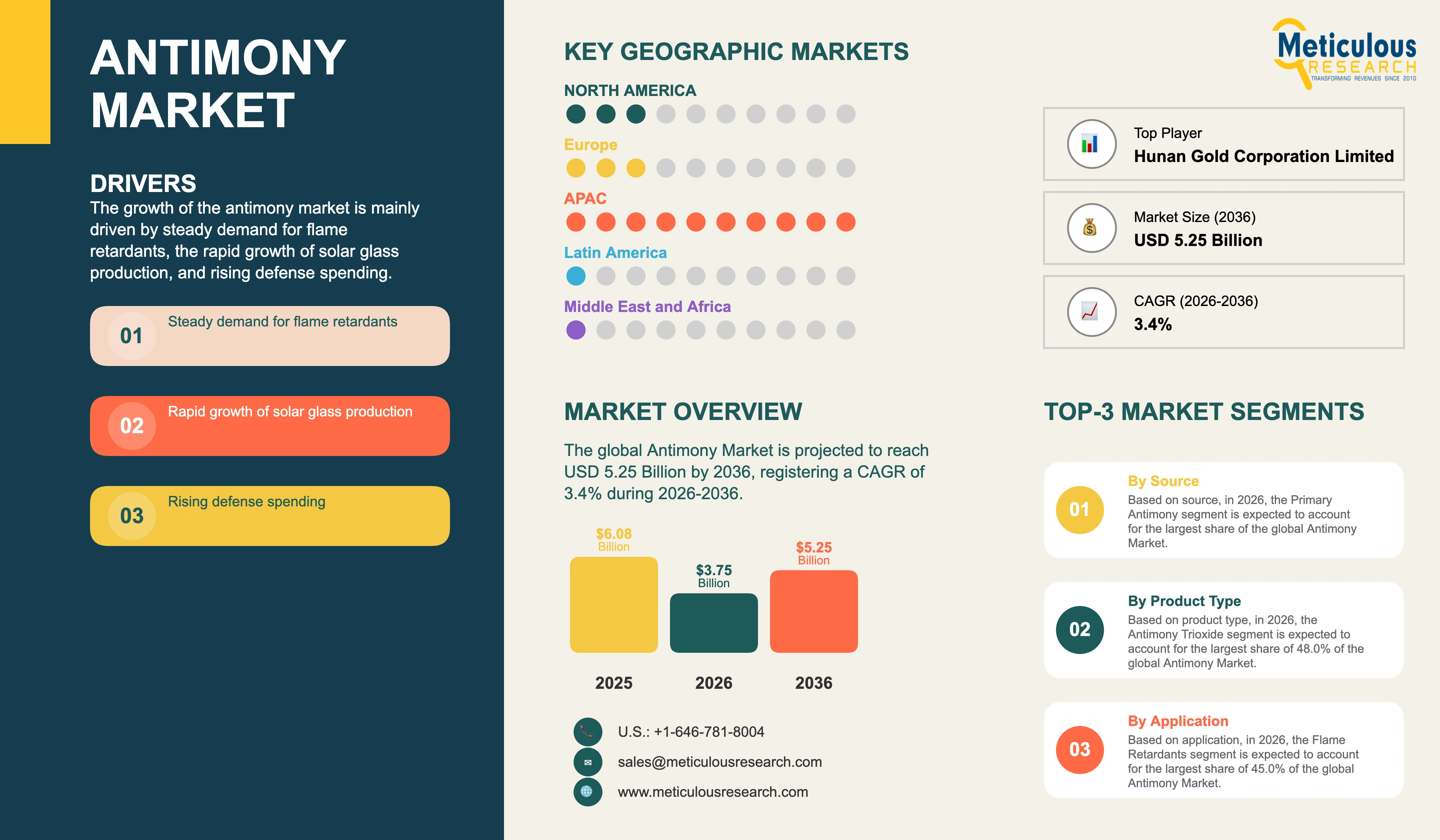
The global antimony market was valued at USD 6.08 billion in 2025. This market is expected to reach USD 5.25 billion by 2036 from an estimated USD 3.75 billion in 2026, registering a CAGR of 3.4% during the forecast period (2026-2036). In terms of volume, this market is expected to reach 190.8 thousand tons of contained antimony by 2036 from an estimated 142.0 thousand tons in 2026, registering a CAGR of 3.0% during the forecast period.
- Published
- Nov 2026
- Pages
- 278
- Format
- PDF + Excel
- Report ID
- MRCHM - 1042502
- Base year
- 2025
- 2025 · BASELINE
- $6.08B
- 2036
- $5.25B
- CAGR 2026–2036
- 3.4%
2025 baseline · 2026–2036 forecast at 3.4% CAGR · hover a bar for the value
Key highlights
According to the U.S. Geological Survey (USGS), global antimony mine production was about 110,000 tons in 2025, down from 119,000 tons in 2024, with China, Russia, and Tajikistan together accounting for about 85% of world output.
The USGS reported that the average antimony price was about USD 25 per pound in 2025, or about USD 55,100 per ton, more than double the 2024 average of USD 10.24 per pound and about four and a half times the 2023 average.
European antimony prices fell sharply from their 2025 peak, and Rotterdam metal prices were assessed at about USD 18,300 to 19,000 per ton in October 2026, as China eased some export restrictions, buyers reduced inventories built during the shortage, and new supply from outside China entered the market.
China introduced export controls on antimony ores, metal, and compounds in September 2024 and banned exports to the U.S. in December 2024, and in November 2025 it suspended the U.S. ban until 27 November 2026, while it added 14 European companies to its export control list in July 2026.
Chinese domestic antimony ingot prices also eased during 2026, with the 1# ingot price at about 105,000 yuan per ton in September 2026, while China reported very low exports of unwrought antimony because of state trading and dual-use controls.
China has become a net importer of antimony ore, and competition for concentrates is linking Chinese and international prices more closely, even as export controls remain in place.
Antimony mining resumed in the U.S. in 2025 for the first time in decades, with United States Antimony Corporation mining in Montana, and the U.S. Defense Logistics Agency awarded a contract of up to USD 245 million for antimony ingots for the national defense stockpile.
Secondary antimony, mainly antimonial lead recovered from spent lead-acid batteries, is an important source of supply, and the USGS estimates U.S. secondary production at about 3,500 tons in 2025.
By source, primary antimony accounts for the largest share in 2026, while secondary antimony registers the highest CAGR.
By product type, antimony trioxide accounts for the largest share of 48.0% in 2026, while sodium antimonate registers the highest CAGR.
By application, flame retardants account for the largest share of 45.0% in 2026, while solar and specialty glass register the highest CAGR.
By geography, Asia-Pacific accounts for the largest share of 58.0% in 2026, while North America registers the highest CAGR of 4.7%.
Report summary
| Particulars | Details |
|---|---|
| Forecast Period | 2026-2036 |
| Base Year | 2025 |
| Estimated Year | 2026 |
| CAGR (Value) | 3.4% |
| Format | PDF, Excel & Cloud Portal · 278 pages |
| Market Size (Value) in 2025 | USD 6.08 billion |
| Market Size (Value) in 2026 | USD 3.75 billion |
| Market Size (Value) by 2036 | USD 5.25 billion |
| Market Volume (2026 to 2036) | 142.0 thousand tons to 190.8 thousand tons of contained antimony (CAGR 3.0%) |
| Largest Segment by Product Type (2026) | Antimony Trioxide (48.0%) |
| Largest Segment by Application (2026) | Flame Retardants (45.0%) |
| Largest Region (2026) | Asia-Pacific (58.0%) |
| Fastest-Growing Region | North America (CAGR 4.7%) |
| Segments Covered | Source, Product Type, Application, and Geography |
| Countries Covered | Asia-Pacific, Europe, North America, Latin America, and Middle East and Africa |
| Key Companies | Hunan Gold Corporation, Hsikwangshan Twinkling Star, Chenzhou Mining Group, Polyus, GeoProMining, Mandalay Resources, Larvotto Resources, United States Antimony Corporation, Perpetua Resources, Campine, Nihon Seiko, and Ecobat |
Report overview
Segments covered: source, product type, application.
The market value in 2026 is lower than in 2025 because antimony prices fell sharply from the record levels reached in mid-2025.
The growth of this market is mainly driven by steady demand for antimony trioxide in flame retardants for plastics, electronics, textiles, and building materials, the rapid growth of solar glass production, rising defense spending and ammunition production, and continued demand for antimonial lead in lead-acid batteries. However, factors such as China's export controls, the concentration of mining and processing in a few countries, extreme price volatility, and the substitution of antimony in some flame retardant and battery applications are expected to restrain the growth of this market to some extent.
Antimony is a brittle, silvery metalloid that is mainly mined from the mineral stibnite and is often recovered as a by-product of gold, lead, and other metal mining. It is used mainly in the form of antimony trioxide, which is combined with halogenated flame retardants in plastics, electronics, cables, textiles, and building materials to slow the spread of fire. Antimony is also alloyed with lead to harden the grids of lead-acid batteries and to make ammunition, cable sheathing, and solder, and it is used as a catalyst in the production of PET plastic, as a clarifying agent in solar and specialty glass, and in semiconductors, ceramics, and pigments.
This market covers the global consumption of antimony in its main products, measured in value and in thousand tons of contained antimony, including antimony trioxide, antimonial lead and alloys, antimony metal, sodium antimonate, and other antimony compounds. It includes antimony produced from mined ores and antimony recovered from scrap, mainly from spent lead-acid batteries, and is segmented by source, product type, application, and geography.
Antimony mine supply is highly concentrated, and according to the USGS, China, Russia, and Tajikistan produced about 85% of the world's mined antimony in 2025, and China also dominates smelting and refining, processing ores from many other countries into antimony metal and trioxide. Other producing countries include Bolivia, Turkey, Myanmar, Australia, Oman, Kyrgyzstan, and Vietnam. World mine production has declined from about 153,000 tons in 2020 to about 110,000 tons in 2025 because of declining ore grades, mine closures, and stricter environmental rules in China.
The market changed dramatically after China introduced export controls on antimony products in September 2024 and banned exports to the U.S. in December 2024. Supplies outside China became very tight, and prices rose to record levels, with European prices reaching about USD 60,000 per ton in mid-2025, compared with about USD 12,000 per ton in 2023. Many users, particularly in Europe and North America, were forced to pay very high prices, draw down inventories, or reduce their use of antimony.
Prices then fell sharply from late 2025 into 2026, after China suspended its ban on exports to the U.S. in November 2025, new supply came from Russia, Tajikistan, Oman, Australia, and other countries, and users who had bought large volumes during the shortage reduced their purchases. By October 2026, Rotterdam prices had fallen to about USD 18,300 to 19,000 per ton, although they remained well above pre-2024 levels. Prices in China also declined but remained lower than international prices, and the gap between the two markets narrowed during 2026 as Chinese smelters competed with smelters outside China for ore. Many market participants expect prices to remain sensitive to Chinese policy decisions, particularly the expiry of the U.S. export ban suspension in November 2026. China continues to restrict exports through licenses and controls on specific companies, and it has become a net importer of antimony ore.
Over the forecast period, antimony demand is expected to grow steadily, supported by flame retardants, solar glass, defense, and batteries. Governments in the U.S., the EU, Japan, Australia, and other countries have listed antimony as a critical or strategic material, and they are supporting new mines, smelters, and stockpiles to reduce dependence on China. New projects in the U.S., Australia, Canada, and other countries are expected to add supply outside China, although many will take several years to reach production. At the same time, demand from solar glass, defense, and electronics is expected to grow faster than demand from traditional uses such as lead-acid batteries and PET catalysts, which will gradually change the mix of antimony products in the market. Supply from outside China is also expected to grow, but China is likely to remain the largest processor of antimony throughout the forecast period. Antimony trioxide is expected to remain the most important product, but sodium antimonate, high-purity antimony, and antimony metal for defense are expected to gain share.
Report infographic
Market dynamics
15 factors across 5 forcesSteady demand for flame retardants
Flame retardants are the largest use of antimony, as antimony trioxide is used together with brominated or chlorinated flame retardants to improve their effectiveness in plastics, rubber, textiles, adhesives, and coatings, which allows manufacturers to meet fire safety standards with lower amounts of additives. These materials are used in electrical and electronic equipment, cables, building materials, vehicles, furniture, and textiles.
Fire safety regulations for electronics, buildings, and transportation continue to drive demand for flame-retardant materials, and growth in electronics, electric vehicles, data centers, and construction in Asia, the Middle East, and other regions supports demand for antimony trioxide. Electric vehicle batteries and charging equipment, in particular, require flame-retardant plastics to reduce fire risks. Flame retardants account for the largest share of the market by application, and antimony trioxide is the largest product type. Wires and cables used in buildings, data centers, and vehicles are among the largest users of antimony-based flame retardants, and stricter fire safety rules for public buildings, transportation, and electrical equipment in many countries continue to support demand. Growth in the production of electronic devices, such as servers, televisions, and household appliances, in China, Southeast Asia, India, and Mexico also adds to demand.
Rapid growth of solar glass production
Antimony, mainly in the form of sodium antimonate, is used as a fining and clarifying agent in the production of ultra-clear rolled glass for solar panels. It removes bubbles from molten glass and improves its light transmission and resistance to discoloration under sunlight. As solar panel production has grown rapidly, particularly in China, solar glass has become one of the fastest-growing uses of antimony.
Global solar installations have reached record levels, and the growth of bifacial and double-glass solar modules, which use two layers of glass, increases the amount of glass and antimony used per panel. Although some producers are developing antimony-free glass formulations, antimony remains widely used. Solar and specialty glass form the fastest-growing application in this market, and sodium antimonate is the fastest-growing product type. Solar glass production capacity in China has expanded rapidly over the past several years, and new solar glass plants are also being built in India, Southeast Asia, the Middle East, and the U.S., which supports antimony demand outside China as well.
Rising defense spending
Antimony is used in many defense applications, including hardened lead alloys for bullets, antimony trisulfide in primers and tracers, flame retardants for military equipment, infrared sensors, and night vision devices. Defense spending has risen sharply in Europe, the U.S., and Asia because of the war in Ukraine and other geopolitical tensions, and governments are rebuilding ammunition stocks and expanding production.
Governments are also stockpiling antimony to protect their defense industries from supply disruptions. The U.S. Defense Logistics Agency awarded United States Antimony Corporation a contract of up to USD 245 million for antimony ingots, and the U.S. Department of Defense has supported Perpetua Resources' Stibnite project in Idaho. Defense and ammunition is one of the fastest-growing applications in this market, and defense demand is one of the main reasons North America is the fastest-growing region. European countries are also expanding ammunition production capacity, which increases demand for antimony in primers and lead alloys, and several European defense companies have sought long-term supply agreements for antimony from non-Chinese sources.
Continued demand for lead-acid batteries
Antimonial lead alloys are used to make the grids of many lead-acid batteries, particularly deep-cycle and industrial batteries, because antimony makes the grids stronger and more durable. Lead-acid batteries are used in vehicles for starting and auxiliary power, in forklifts and other industrial vehicles, in telecommunications and data center backup power, and in energy storage.
Although lead-acid batteries face competition from lithium-ion batteries, they remain widely used because they are low-cost, reliable, and almost completely recyclable. Growth in vehicle fleets in emerging economies, data center backup power, and telecommunications infrastructure supports demand for antimonial lead. Most of the antimony used in batteries is recovered and reused through lead-acid battery recycling. Lead-acid batteries are also used in many hybrid and electric vehicles for auxiliary power, which supports demand even as vehicle markets shift toward electrification. Battery producers in India, Southeast Asia, and Africa are expanding capacity to meet growing demand for vehicles and backup power.
Table of contents
11 chapters · 121 sections · 278 pages · click to expandSegmental analysis
| Segment | Largest share (2026) | Fastest growth (2026–2036) |
|---|---|---|
| By Source | Primary antimony | Secondary antimony |
| By Product Type | Antimony trioxide | Sodium antimonate |
| By Application | Flame retardants | Solar and specialty glass |
By Source
- The primary antimony segment is expected to account for the largest share of the market.
- The large share of this segment is mainly due to the large volume of antimony produced from mined stibnite and gold-antimony ores, which are concentrated and smelted into antimony metal and trioxide, mainly in China.
- Primary antimony production is concentrated in China, Russia, and Tajikistan, which together accounted for about 85% of world mine output in 2025, according to the USGS.
- Russia's output comes largely from gold-antimony mines, such as Polyus' Olimpiada mine, while Tajikistan produces antimony from the Anzob deposit.
- China's own mine production has declined because of depleting resources and environmental rules, and it has become a net importer of ore, processing concentrates from Russia, Tajikistan, Myanmar, Bolivia, Australia, and other countries.
- Outside these countries, new production is coming from the U.S., Australia, Turkey, and Oman, where SPMP operates a roaster at Sohar.
- Primary antimony is expected to remain the largest source over the forecast period, although its share will decline as recycling grows.
- Gold-antimony mines are particularly important, because antimony output from these mines depends on gold production, which has been supported by record gold prices in 2025 and 2026.
- Several new projects, such as Perpetua Resources' Stibnite project in Idaho and Larvotto Resources' Hillgrove project in Australia, will produce both gold and antimony, which improves their economics.
- Mine supply from Tajikistan and Russia is expected to remain important, although sanctions and trade restrictions affect how Russian antimony reaches some markets.
- New supply from Turkey, Bolivia, Kyrgyzstan, and Kazakhstan could also grow if prices remain attractive.
- However, the secondary antimony segment is projected to register the highest CAGR during the forecast period.
- The rapid growth of this segment is driven by high antimony prices, which make recovery more profitable, high recycling rates for lead-acid batteries, investment in recovering antimony from electronic waste and residues, and government policies that support recycling to reduce dependence on China.
- Battery recyclers in North America, Europe, and Asia are increasing their recovery of antimonial lead, and some are refining it into higher-value antimony products.
By Product Type
- The antimony trioxide segment is expected to account for the largest share of 48.0% of the market.
- The large share of this segment is mainly due to its wide use as a synergist with halogenated flame retardants in plastics, electronics, cables, textiles, and building materials, and as a catalyst in PET production.
- Antimony trioxide is produced by oxidizing antimony metal in furnaces or by roasting antimony ores and concentrates, and it is supplied in different grades and particle sizes for specific applications.
- Flame retardant producers, such as Albemarle, ICL, and LANXESS, and plastics compounders are among its largest users, along with PET producers, which use antimony trioxide or antimony triacetate as a polymerization catalyst.
- Leading producers of antimony trioxide include Hsikwangshan Twinkling Star and other Chinese producers, Campine in Belgium, Nihon Seiko in Japan, and United States Antimony Corporation.
- Producers outside China have expanded capacity and secured raw material from non-Chinese sources since export controls were introduced.
- Antimony trioxide is expected to remain the largest product type over the forecast period, although its share will decline slightly as other products grow faster.
- High-purity antimony trioxide for electronics, low-tint grades for engineering plastics, and catalyst-grade products for PET production command higher prices than standard grades, and producers outside China are investing in these specialty products to differentiate themselves from Chinese competition.
- Flame retardant producers are also working with trioxide suppliers to develop low-dust and masterbatch forms that are safer and easier to handle.
- However, the sodium antimonate segment is projected to register the highest CAGR during the forecast period.
- The rapid growth of this segment is driven by its use as a fining agent in solar glass, which is growing with solar panel production, and by its use in specialty glass for displays and other applications.
- Antimonial lead and alloys, antimony metal, and other antimony compounds make up the rest of the market.
- Antimony metal, typically traded as ingots with at least 99.65% purity, is used to make alloys, ammunition, and other products, and it is the main form traded internationally, while antimonial lead is used mainly in lead-acid batteries and is largely supplied through battery recycling.
By Application
- The flame retardants segment is expected to account for the largest share of 45.0% of the market.
- The large share of this segment is mainly due to the wide use of antimony trioxide with halogenated flame retardants to meet fire safety standards for electrical and electronic equipment, cables, building materials, vehicles, and textiles.
- Fire safety standards require many plastics used in electronics, appliances, wires and cables, building insulation, and vehicle interiors to resist ignition and slow the spread of fire, and antimony trioxide improves the performance of brominated and chlorinated flame retardants, allowing manufacturers to use less of these additives.
- Growth in electronics, data centers, electric vehicles, and construction in Asia, the Middle East, and other emerging markets supports demand for flame-retardant materials.
- The high prices of 2025 encouraged some users to reduce antimony content or switch to halogen-free systems, particularly in Europe, but antimony-based systems remain the most cost-effective option for many applications.
- Flame retardants are expected to remain the largest application over the forecast period.
- Electric vehicles and charging infrastructure, energy storage systems, and data center equipment are expected to be important sources of new demand, because these products use large amounts of flame-retardant plastics in battery housings, cables, connectors, and enclosures.
- Textiles and furniture for public buildings, aircraft, trains, and ships also require flame-retardant treatments that often use antimony trioxide.
- However, the solar and specialty glass segment is projected to register the highest CAGR during the forecast period.
- The rapid growth of this segment is driven by the growth of solar panel production, particularly double-glass and bifacial modules that use more glass per panel.
- Lead-acid batteries, plastics and PET catalysts, defense and ammunition, semiconductors and electronics, and ceramics, pigments, and other applications make up the rest of the market.
- Lead-acid batteries are the second-largest application, supported by vehicle, industrial, and backup power batteries, while defense and ammunition is one of the fastest-growing applications.
Geographic analysis
Asia-Pacific
Largest shareIn 2026, Asia-Pacific is expected to account for the largest share of 58.0% of the global antimony market. The large share of this region is mainly due to China's dominant position as the world's largest producer, processor, and consumer of antimony, along with large markets in Japan, South Korea, India, and Southeast Asia. China uses antimony in flame retardants, plastics, PET, solar glass, lead-acid batteries, and many other products, and it is home to the world's largest antimony producers, such as Hunan Gold Corporation, Hsikwangshan Twinkling Star, and Chenzhou Mining Group. It is also the world's largest producer of solar glass, which has made solar glass an important source of antimony demand in the country. Its domestic market is supplied by local mines and growing imports of ore, and its prices are lower than those outside China because of export controls. Japan and South Korea have large electronics, automotive, and chemical industries that use antimony trioxide, and India is one of the fastest-growing antimony markets in the region, supported by growth in electronics, solar glass, and batteries. Asia-Pacific is expected to remain the dominant region throughout the forecast period. Vietnam, Myanmar, Laos, and Australia also supply antimony ore to China and other processors in the region.
North America
Fastest growthNorth America is projected to register the highest CAGR of 4.7% during the forecast period. Growth is driven by rising defense spending, government stockpiling, the restart of antimony mining and smelting in the U.S., new projects in Idaho and Montana, and growing demand for flame retardants and batteries. The U.S. has very limited domestic antimony production and imports most of its needs, so government support for new mines and smelters is expected to drive strong growth in domestic supply and demand. Canada and Mexico also have antimony projects and processing operations that support the region's supply chain. Defense agencies are expected to continue buying antimony for stockpiles over the next several years.
Europe
Europe holds a significant share of the market, with Germany, Belgium, France, and Italy among its largest consumers, supported by its flame retardant, plastics, battery, and defense industries, and by antimony trioxide production in Belgium and other countries, although its supply has been affected by China's export controls.
Latin America
Latin America and the Middle East and Africa hold smaller shares, although Bolivia, Mexico, Turkey, and Oman are important sources of antimony supply.
Competitive landscape
The antimony market is moderately concentrated, with Chinese producers accounting for a large share of smelting and refining and a small number of mining companies in Russia, Tajikistan, Australia, and other countries supplying ore. Leading Chinese companies include Hunan Gold Corporation, Hsikwangshan Twinkling Star, and Chenzhou Mining Group. Leading companies outside China include Polyus and GeoProMining in Russia, Mandalay Resources and Larvotto Resources in Australia, United States Antimony Corporation and Perpetua Resources in the U.S., Campine in Belgium, and Nihon Seiko in Japan.
Many antimony producers are integrated across mining, smelting, and production of antimony trioxide and other compounds, while others focus on specific stages, such as mining gold-antimony ores or producing antimony trioxide from purchased metal. Battery recyclers, such as Ecobat, are major producers of antimonial lead. Chinese producers benefit from large processing capacity and long experience, while producers outside China compete on secure supply, traceability, and service to defense and industrial customers.
The top five players are estimated to account for 30.0% of the antimony market in 2025, reflecting the large number of Chinese smelters, trioxide producers, and battery recyclers. Concentration is much higher in mining and smelting, where a few countries and companies control most of the capacity.
Players use several strategies to grow in this market, including developing new mines and smelters, signing offtake and stockpile agreements with governments and defense customers, expanding antimony trioxide capacity outside China, investing in recycling, and developing specialty products for solar glass, electronics, and semiconductors. United States Antimony Corporation has expanded mining in Montana and processing in Mexico and Montana, while Perpetua Resources is developing the Stibnite project in Idaho with U.S. government support.
Competition is expected to center on access to secure raw material supply, processing capacity outside China, cost, product quality, and the ability to meet the traceability requirements of defense customers. Companies that can offer non-Chinese antimony at competitive prices are expected to gain market share outside China, while Chinese producers are expected to remain dominant in the global market. Producers that combine mining with processing and recycling are expected to have an advantage in supply security and cost.
Some of the key players operating in the antimony market are Hunan Gold Corporation Limited, Hsikwangshan Twinkling Star Co., Ltd., Chenzhou Mining Group Co., Ltd., PJSC Polyus, GeoProMining Group, Mandalay Resources Corporation, Larvotto Resources Limited, United States Antimony Corporation, Perpetua Resources Corp., Campine NV, Nihon Seiko Co., Ltd., and Ecobat.
- —
Antimony mining resumed in the U.S. in 2025, the U.S. Defense Logistics Agency awarded a contract of up to USD 245 million for antimony ingots, China added European companies to its export control list in July 2026, and European prices fell to about USD 18,300 to 19,000 per ton by October 2026.
- Hunan Gold Corporation
- Hsikwangshan Twinkling Star
- Chenzhou Mining Group
- Polyus
- GeoProMining
- Mandalay Resources
- Larvotto Resources
- United States Antimony Corporation
- Perpetua Resources
- Campine
- Nihon Seiko
- Ecobat
Expert perspectives
The antimony market has gone through a dramatic cycle since China introduced export controls in 2024. Prices rose to record levels in 2025 as supply outside China became scarce, then fell sharply in late 2025 and 2026 as China suspended its U.S. ban, new supply arrived from other countries, and users reduced inventories. Even after this decline, prices remain well above pre-2024 levels, and the market remains exposed to further policy changes.
Over the forecast period, antimony volume is expected to grow at about 3.0% per year, supported by flame retardants, solar glass, defense, and batteries. Value is expected to grow at about 3.4% per year from the lower 2026 base, as prices remain structurally higher than before 2024 because of export controls, declining ore grades, and the higher costs of production outside China.
Secondary antimony is the fastest-growing source, sodium antimonate is the fastest-growing product type, and solar and specialty glass is the fastest-growing application, reflecting the importance of recycling and solar energy. Primary antimony, antimony trioxide, and flame retardants remain the largest segments.
Asia-Pacific remains the dominant region, led by China, while North America is the fastest-growing region at a CAGR of 4.7%, supported by defense spending, stockpiling, and new domestic production. The main swing factors are China's export policies, including the expiry of its U.S. export ban suspension in November 2026, supply from Russia and Tajikistan, the pace of new projects outside China, solar panel production, and the extent of substitution in flame retardants and batteries.
For antimony users, the key decisions are how to secure supply from diverse sources, how much inventory to hold, and whether to reduce antimony use through new formulations. For producers outside China, success depends on bringing new mines and smelters into production at competitive costs and securing long-term contracts with customers and governments that value supply security. Governments are likely to remain important partners for these projects through funding, stockpiling, and offtake agreements. Producers that can also offer high-purity and specialty antimony products for electronics, solar glass, and catalysts are expected to earn higher margins than those producing standard grades. The market is also expected to see more regional pricing, with separate price levels for Chinese and non-Chinese antimony, as buyers in defense and other sensitive industries pay premiums for secure supply.
Overall, antimony is expected to remain a critical material for fire safety, solar energy, batteries, and defense, with its market shaped by geopolitics and government policy as much as by industrial demand over the forecast period.
Customer perspectives
Procurement Director - flame retardant producer, Europe
When China restricted exports, our antimony costs went up five times in less than a year. Prices have come down, but we now buy from several countries and keep much larger inventories because we cannot rely on one source.
Supply security has become as important as price for flame retardant producers, which supports demand for antimony from new sources outside China.
Strong demand from flame retardant producers is why antimony trioxide accounts for 48.0% of the market and flame retardants account for 45.0%.
Supply Chain Manager - ammunition manufacturer, U.S.
Antimony is essential for our primers and lead alloys, and defense rules push us to use non-Chinese supply. We are working with new U.S. producers and supporting stockpiling programs to secure our needs.
Defense customers are willing to pay a premium for traceable, non-Chinese antimony, which supports investment in new mines and smelters in the U.S. and allied countries.
Defense demand and government stockpiling are among the main reasons North America is the fastest-growing region in this market.
Technical Manager - solar glass manufacturer, China
Our glass output keeps growing with solar panel production, and sodium antimonate is still the most reliable fining agent for ultra-clear glass. We are testing alternatives, but antimony remains the standard.
Solar glass producers are expanding capacity in China, India, and other countries, which is expected to keep demand for sodium antimonate growing quickly.
Growth in solar glass production is why solar and specialty glass form the fastest-growing application in this market.
Frequently asked questions
The market was valued at USD 6.08 billion in 2025 and USD 3.32 billion in 2024, and is estimated at USD 3.75 billion in 2026, reflecting the sharp fall in antimony prices from their 2025 record.
The market is expected to reach USD 5.25 billion by 2036, supported by demand from flame retardants, solar glass, defense, and lead-acid batteries.
The market is expected to register a CAGR of 3.4% from 2026 to 2036 in value terms and 3.0% in volume terms, with volume rising from 142.0 thousand tons in 2026 to 190.8 thousand tons of contained antimony in 2036.
Antimony prices reached record levels in 2025 after China's export controls, with the USGS reporting an average price of about USD 25 per pound, and then fell sharply as China suspended its U.S. export ban, new supply arrived, and users reduced inventories.
Growth is driven by steady demand for flame retardants, the rapid growth of solar glass production, rising defense spending, and continued demand for lead-acid batteries.
China's export controls and concentrated supply and substitution and regulatory pressure restrain growth, while extreme price volatility and environmental and technical challenges in mining and processing remain key challenges.
Key opportunities include new mines and processing outside China, recycling and secondary supply, growth in solar energy and energy storage, and growth in India, Southeast Asia, and the Middle East.
According to the USGS, China, Russia, and Tajikistan produced about 85% of the world's estimated 110,000 tons of mined antimony in 2025, and China also dominates smelting and refining.
China introduced export controls in September 2024 and banned exports to the U.S. in December 2024, suspended the U.S. ban in November 2025 until 27 November 2026, and added 14 European companies to its export control list in July 2026.
Producers outside China include Polyus and GeoProMining in Russia, Mandalay Resources and Larvotto Resources in Australia, United States Antimony Corporation and Perpetua Resources in the U.S., Campine in Belgium, and Nihon Seiko in Japan.
Secondary antimony, mainly recovered from spent lead-acid batteries, is projected to register the highest CAGR, while primary antimony holds the largest share.
Antimony trioxide is expected to account for the largest share of 48.0% of the market in 2026, while sodium antimonate is projected to register the highest CAGR.
Flame retardants are expected to account for the largest share of 45.0% of the market in 2026, while solar and specialty glass are projected to register the highest CAGR.
Asia-Pacific is expected to account for the largest share of 58.0% of the market in 2026, led by China.
North America is projected to register the highest CAGR of 4.7% during the forecast period.
The report profiles 12 companies, including Hunan Gold Corporation, Hsikwangshan Twinkling Star, Polyus, United States Antimony Corporation, Perpetua Resources, and Campine. The top five players account for an estimated 30.0% of the market in 2025.
Antimony mining resumed in the U.S. in 2025, the U.S. Defense Logistics Agency awarded a contract of up to USD 245 million for antimony ingots, China added European companies to its export control list in July 2026, and European prices fell to about USD 18,300 to 19,000 per ton by October 2026.
Cite this report
Meticulous Research. (2026). Antimony Market - Global Opportunity Analysis and Industry Forecast (2026-2036) (Report No. MRCHM - 1042502). Meticulous Market Research Pvt. Ltd. https://www.meticulousresearch.com/product/antimony-market-7185