Aerogels Market (2026-2036)
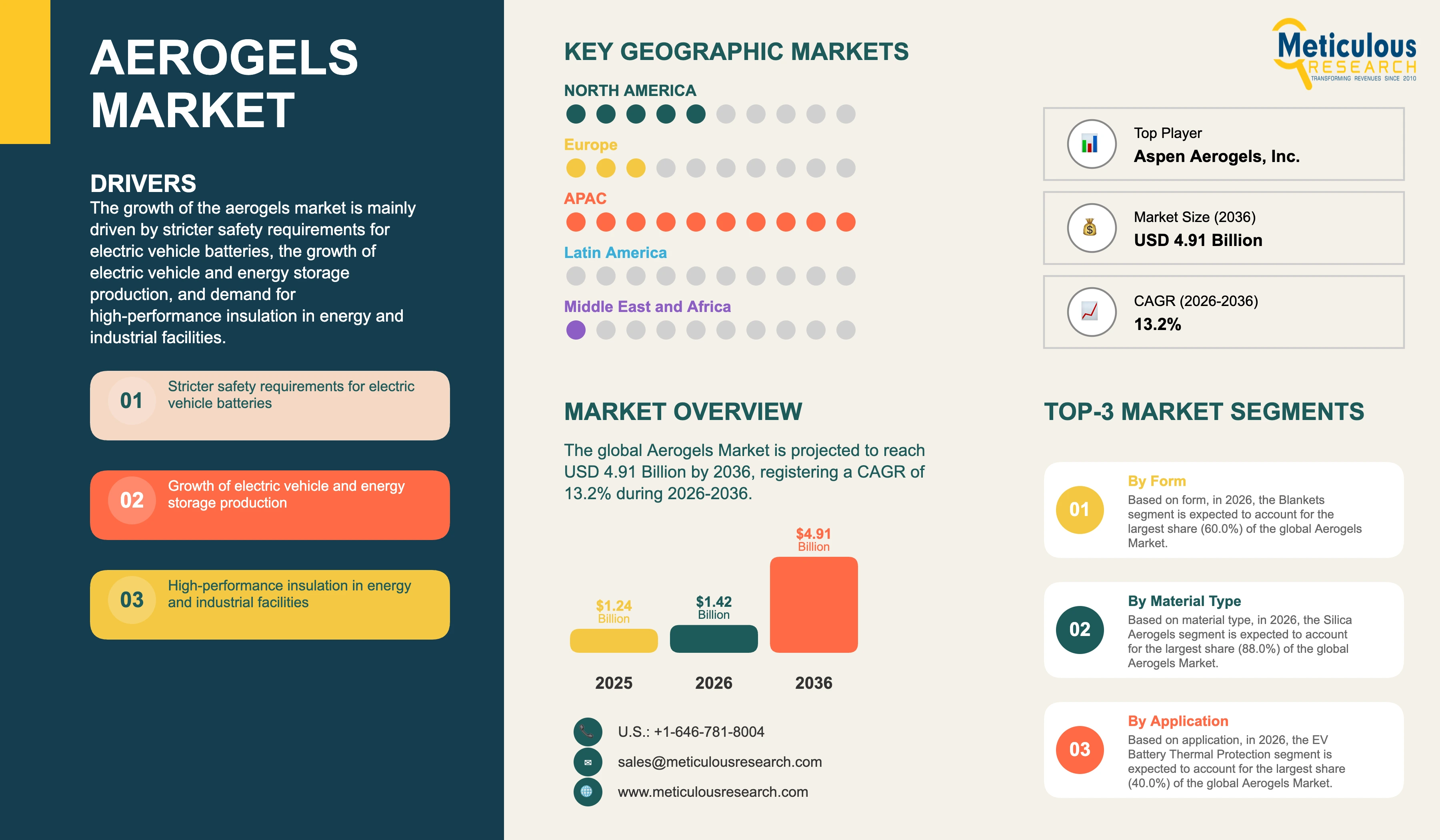
The global aerogels market was valued at USD 1.24 billion in 2025. This market is expected to reach USD 4.91 billion by 2036 from an estimated USD 1.42 billion in 2026, registering a CAGR of 13.2% during the forecast period (2026-2036).
- Published
- Nov 2026
- Pages
- 298
- Format
- PDF + Excel
- Report ID
- MRCHM - 1042509
- Base year
- 2025
- 2024 · HISTORICAL
- $452.7M
- 2036
- $4.91B
- CAGR 2026–2036
- 13.2%
2024–2025 baseline · 2026–2036 forecast at 13.2% CAGR · hover a bar for the value
Key highlights
China's national standard GB 38031-2025, which sets stricter safety requirements for electric vehicle batteries, including requirements that battery packs must not catch fire or explode after thermal runaway in a single cell, took effect in July 2026, increasing demand for thermal runaway barriers such as aerogels.
Aspen Aerogels, the leading aerogel producer outside China, reported 2025 revenue of USD 271.1 million, down from USD 452.7 million in 2024, as thermal barrier sales to a major U.S. automaker fell following changes in U.S. regulations and electric vehicle incentives, while energy industrial revenue was USD 102.2 million.
Aspen Aerogels has won thermal barrier programs with several European automakers, including Volvo Cars, with seven European OEM design wins, and was awarded a North Sea subsea pipeline project for delivery in 2026, showing diversification beyond the U.S. electric vehicle market.
Chinese aerogel producers, such as Guangdong Alison Hi-Tech, IBIH Advanced Materials, and Nano Tech, have expanded capacity rapidly to supply battery makers, such as CATL and BYD, and industrial customers, making China the largest center of aerogel production.
Aspen Aerogels expects energy industrial revenue to grow by about 20% in 2026, supported by LNG and subsea project activity, and it initiated a strategic review in early 2026 to strengthen its long-term competitive position after reducing its fixed cost structure by more than USD 75 million.
Aerogel blankets reduce corrosion under insulation in refineries and petrochemical plants because they repel liquid water while allowing water vapor to escape, which lowers maintenance costs and extends equipment life.
Energy storage systems, electric buses and trucks, and electric aircraft are emerging as new applications for aerogel thermal barriers, as battery fire safety requirements expand beyond passenger cars.
Producers are developing ambient pressure drying and continuous production processes that avoid expensive supercritical drying, which is reducing aerogel production costs and energy use.
Aerogel blankets have some of the lowest thermal conductivities of any commercial insulation material, which allows thinner insulation in pipelines, equipment, battery packs, and buildings.
By form, blankets account for the largest share of 60.0% in 2026, while panels and sheets register the highest CAGR.
By material type, silica aerogels account for the largest share in 2026, while polymer aerogels register the highest CAGR.
By application, EV battery thermal protection accounts for the largest share of 40.0% in 2026 and also registers the highest CAGR.
By geography, Asia-Pacific accounts for the largest share of 55.0% in 2026 and also registers the highest CAGR of 14.9%.
Report summary
| Particulars | Details |
|---|---|
| Base Year | 2025 |
| Estimated Year | 2026 |
| Forecast Period | 2026-2036 |
| Market Size in 2025 | USD 1.24 billion |
| Market Size in 2026 | USD 1.42 billion |
| Market Size by 2036 | USD 4.91 billion |
| CAGR (2026-2036) | 13.2% |
| Format | PDF, Excel & Cloud Portal · 298 pages |
| Largest Segment by Form (2026) | Blankets (60.0%) |
| Largest Segment by Application (2026) | EV Battery Thermal Protection (40.0%) |
| Largest Region (2026) | Asia-Pacific (55.0%) |
| Fastest-Growing Region | Asia-Pacific (CAGR 14.9%) |
| Segments Covered | Form, Material Type, Application, and Geography |
| Geographic Scope | Asia-Pacific, North America, Europe, Middle East and Africa, and Latin America |
| Key Companies Profiled | Aspen Aerogels, Cabot, Armacell, Guangdong Alison Hi-Tech, IBIH Advanced Materials, Nano Tech, Xiamen Nameite, JIOS Aerogel, Enersens, Svenska Aerogel, Active Aerogels, Aerogel Technologies, and Shenzhen Zhongning Technology |
Report overview
Segments covered: form, material type, application.
The growth of this market is mainly driven by stricter safety requirements for electric vehicle batteries, which use aerogel barriers to slow or stop the spread of thermal runaway between cells, continued demand for high-performance insulation in oil and gas, petrochemical, refining, and LNG facilities, growing use of aerogels in energy-efficient buildings, and rapid capacity expansion and cost reduction by producers in China. However, factors such as the high cost of aerogels compared with conventional insulation, dust and handling issues, the dependence of growth on electric vehicle production, which slowed in North America in 2025, and competition from alternative fire protection materials in battery packs are expected to restrain the growth of this market to some extent.
Aerogels are ultralight solid materials made by removing the liquid from a gel without collapsing its structure, leaving a highly porous network that is mostly air. This structure gives aerogels extremely low thermal conductivity, very low density, and a large internal surface area, and silica aerogels are also non-combustible and can withstand high temperatures. In most commercial products, aerogel is combined with fiber mats to form flexible blankets or is supplied as particles, powders, sheets, and panels, because pure aerogel monoliths are fragile and expensive. Aerogels can be made from silica, which is the most common material, as well as from polymers, such as polyimide, and from carbon and metal oxides, each with different properties and uses. The most expensive step in production is usually drying the gel without damaging its structure, which traditionally uses supercritical carbon dioxide and requires high-pressure equipment.
This market covers the global sales of aerogel products, measured in value, including aerogel blankets, particles and powders, panels and sheets, and monoliths and other forms, made from silica, polymer, carbon, and other materials. It is segmented by form, material type, application, and geography. The value of finished battery packs, insulation systems, and installation services is not included.
Aerogels were invented in the 1930s but remained expensive laboratory materials for decades. Commercial production grew in the 2000s, when Aspen Aerogels and Cabot developed processes for making aerogel blankets and particles at scale, mainly for insulating pipelines, refineries, and petrochemical plants, where thin, high-performance insulation saves space and energy and reduces corrosion under insulation. Aerogel blankets are also used in LNG facilities and other cryogenic applications, where they keep very cold fluids from warming. Commercial production also expanded into building products, such as plasters and translucent panels, mainly in Europe.
In the 2020s, electric vehicle batteries became the largest and fastest-growing application for aerogels. Thin aerogel pads are placed between battery cells and modules to slow the transfer of heat if one cell fails and goes into thermal runaway, which helps prevent fires from spreading through the battery pack and gives passengers time to escape. The amount of aerogel used per vehicle depends on battery design, with cell-to-pack and cell-to-body designs often using barriers between every cell or group of cells, which increases the value of aerogel content per vehicle. Aspen Aerogels' PyroThin products were used extensively by General Motors, and Chinese producers supply aerogel pads to CATL, BYD, and other battery makers in large volumes.
Demand from electric vehicles has been volatile, as Aspen Aerogels' thermal barrier revenue fell sharply in 2025 because of lower electric vehicle production in North America following changes in U.S. regulations and incentives, and the company impaired its planned plant in Statesboro, Georgia. In China, however, battery safety rules, including the GB 38031-2025 standard that took effect in July 2026, and continued growth in electric vehicle and energy storage production are driving strong demand, and Chinese producers have expanded capacity rapidly, which has reduced prices. Many Chinese battery makers now consider aerogel barriers a standard part of their battery designs, and some are also using them in energy storage containers.
Over the forecast period, aerogel demand is expected to grow strongly, supported by electric vehicles, energy storage systems, industrial insulation, LNG, and buildings. Lower prices from larger-scale production and new processes, such as ambient pressure drying, are expected to make aerogels more competitive with conventional insulation and open new applications in buildings, appliances, apparel, and electronics. Governments are also tightening building energy codes and battery safety rules, which supports demand for high-performance insulation and fire protection. The balance between battery and industrial applications is expected to shift over time, with battery applications growing faster but industrial insulation remaining an important source of stable demand. At the same time, the market is expected to remain competitive, with Chinese producers gaining share and producers outside China focusing on high-performance industrial and automotive products.
What comes next: Aerogels and the Future of High-Performance Insulation, a Meticulous Next™ foresight brief.
Report infographic
Market dynamics
15 factors across 5 forcesStricter safety requirements for electric vehicle batteries
Thermal runaway, in which a damaged or faulty battery cell overheats and catches fire, can spread to neighboring cells and cause a battery pack fire. Regulators and automakers have introduced stricter requirements to prevent or delay this spread, and China's GB 38031-2025 standard, which took effect in July 2026, requires that battery packs do not catch fire or explode after thermal runaway in a single cell. Similar requirements are being adopted in other countries and by automakers' own safety standards. Insurers, fleet operators, and consumers are also paying more attention to battery fire risks, particularly after high-profile vehicle and parking garage fires, which encourages automakers to add more protection than the minimum required.
Aerogel pads are one of the most effective materials for meeting these requirements, because they are thin, light, compressible, and provide very high thermal resistance and fire protection between cells. Battery makers and automakers in China, Europe, South Korea, Japan, and North America are using aerogel barriers in their battery packs, and Aspen Aerogels has won programs with several European automakers, including Volvo Cars. EV battery thermal protection accounts for the largest share of the market by application and is also its fastest-growing application. Battery designs with higher energy density, such as high-nickel and large-format cells, release more energy during thermal runaway, which increases the need for effective barriers.
Growth of electric vehicle and energy storage production
Global electric vehicle sales continue to grow, led by China and Europe, and battery production for energy storage systems has grown rapidly to support renewable energy and data centers. Each battery pack can use a significant amount of aerogel material, and larger battery packs and higher energy density cells increase the need for thermal protection.
Energy storage systems, which use large numbers of lithium iron phosphate cells in containers, also face fire safety requirements, and some system makers use aerogel barriers between cells and modules. The growth of electric buses, trucks, two-wheelers, and electric aircraft adds further demand. Although electric vehicle growth slowed in North America in 2025, growth in China, Europe, and other regions is expected to keep demand for aerogel barriers rising over the forecast period. Electric vehicle sales in Southeast Asia, India, Latin America, and the Middle East are also growing, supported by Chinese automakers expanding their exports and local production, which carries Chinese battery designs and safety practices to new markets.
Demand for high-performance insulation in energy and industrial facilities
Aerogel blankets are widely used to insulate pipelines, tanks, valves, and equipment in oil and gas, refining, petrochemical, and power plants, because they provide high thermal performance in thin layers, resist moisture, and reduce corrosion under insulation, which is a major cause of equipment failure and maintenance costs. Their thin profile is particularly valuable in offshore platforms and subsea pipelines, where space and weight are limited.
Investment in LNG export terminals in the U.S., Qatar, and other countries, refinery and petrochemical maintenance and upgrades, and subsea pipeline projects supports demand for aerogel insulation. Aspen Aerogels expects energy industrial revenue to grow in 2026, supported by LNG and subsea projects, including a North Sea subsea pipeline award. Oil, gas, and petrochemical remains one of the largest applications of aerogels. Aerogel blankets are also used in power plants, steel mills, and other high-temperature industrial facilities, where they reduce heat loss and improve worker safety by lowering surface temperatures. Maintenance turnarounds at refineries and petrochemical plants provide a steady base of demand, as operators replace damaged or wet insulation with aerogel products.
Rapid capacity expansion and cost reduction in China
Chinese producers have expanded aerogel production capacity rapidly over the past several years, using lower-cost raw materials, larger plants, and improved drying processes. This has reduced the cost of aerogel blankets and pads significantly, making them more competitive with conventional insulation and other battery fire protection materials.
Lower costs are opening new markets, such as building insulation, appliances, and energy storage systems, where price is a key factor. Chinese producers, such as Guangdong Alison Hi-Tech, IBIH Advanced Materials, and Nano Tech, supply domestic battery makers and industrial customers and are increasingly exporting their products. This is one of the main reasons Asia-Pacific is both the largest and the fastest-growing region in this market. Chinese producers are also investing in research and development to improve product performance and reduce dust, which is helping them win customers outside China.
Table of contents
11 chapters · 120 sections · 298 pages · click to expandSegmental analysis
| Segment | Largest share (2026) | Fastest growth (2026–2036) |
|---|---|---|
| By Form | Blankets | Panels and sheets |
| By Material Type | Silica aerogels | Polymer aerogels |
| By Application | EV battery thermal protection | EV battery thermal protection |
By Form
- The blankets segment is expected to account for the largest share of 60.0% of the market.
- The large share of this segment is mainly due to the wide use of flexible aerogel blankets, made by combining aerogel with fiber mats, in industrial insulation for pipelines, equipment, and tanks, LNG and cryogenic insulation, building insulation, and battery thermal barriers.
- Aerogel blankets are produced in continuous rolls of different thicknesses, typically from a few millimeters to about 10 millimeters, and can be cut and wrapped around pipes, equipment, and complex shapes, which makes them easy to install in industrial facilities.
- Aspen Aerogels' Pyrogel and Cryogel products are widely used in refineries, petrochemical plants, and LNG facilities, and Chinese producers supply blankets for industrial and battery applications.
- Blankets are also widely used to make battery barrier pads, which are cut and encapsulated for installation between cells.
- Blankets are expected to remain the largest form over the forecast period.
- Producers offer blankets in a range of grades and different temperature ranges, from cryogenic grades for LNG to high-temperature grades for refineries and power plants, and they are developing thinner, low-dust, and hydrophobic products for battery and building applications.
- Chinese producers have expanded blanket capacity rapidly, which has reduced prices and increased exports.
- Blankets are also sold to insulation contractors and distributors, who install them in industrial projects, and to battery component makers, who convert them into pads.
- However, the panels and sheets segment is projected to register the highest CAGR during the forecast period.
- The rapid growth of this segment is driven by the use of thin, precisely cut aerogel sheets and composite pads in battery packs and by the growing use of aerogel panels and boards in buildings.
- Battery barrier products are increasingly supplied as engineered composite sheets, combining aerogel with encapsulation films, mica, or other layers to meet specific compression, thickness, and fire resistance requirements.
- Panels and boards for buildings are also growing in Europe and China as prices fall.
- Particles and powders and monoliths and other forms make up the rest of the market.
- Aerogel particles and powders, such as those produced by Cabot and Chinese producers, are used in coatings, plasters, translucent panels, and skylights, while monoliths are used mainly in scientific and specialty applications.
- Particles are also used as fillers in paints and coatings to improve thermal insulation and in cosmetics and personal care products as matting agents.
By Material Type
- Aerogels Market Analysis by Material Type
- The silica aerogels segment is expected to account for the largest share of the market.
- The large share of this segment is mainly due to the low thermal conductivity, non-combustibility, and high-temperature resistance of silica aerogels, along with well-established production processes and lower costs than other aerogel types.
- Silica aerogels, which have been produced commercially for more than two decades, are made from silicon-based precursors, such as silicates or silanes, and are used in almost all commercial aerogel blankets, particles, and battery barriers.
- They can withstand temperatures of several hundred degrees Celsius and do not burn, which makes them suitable for fire protection in battery packs and for high-temperature industrial insulation.
- Producers are reducing costs by using lower-cost silica sources, such as sodium silicate and recycled materials, and by improving drying processes.
- Silica aerogels are expected to remain the largest material type over the forecast period.
- Silica aerogels are also the main material used in building insulation products and in particles for coatings and plasters.
- Their main drawbacks are fragility and dust, which producers address by combining them with fibers and coatings.
- However, the polymer aerogels segment is projected to register the highest CAGR during the forecast period.
- The rapid growth of this segment is driven by the development of flexible, durable polyimide and other polymer aerogels for aerospace, electronics, apparel, and battery applications.
- Carbon aerogels and other aerogels make up the rest of the market.
- Carbon aerogels are used in supercapacitor electrodes, battery materials, and filtration, while metal oxide and hybrid aerogels are used in catalysts and specialty applications.
By Application
- The EV battery thermal protection segment is expected to account for the largest share of 40.0% of the market.
- The large share of this segment is mainly due to the use of aerogel pads between battery cells and modules to prevent the spread of thermal runaway in electric vehicle batteries, driven by stricter safety regulations and automaker requirements.
- Battery makers, such as CATL, BYD, CALB, EVE Energy, LG Energy Solution, Samsung SDI, and SK On, and automakers, such as General Motors, Volvo Cars, and Chinese automakers, use aerogel barriers in their battery packs.
- China's GB 38031-2025 standard, which requires that battery packs do not catch fire or explode after thermal runaway in a single cell, has increased the use of aerogel barriers in Chinese electric vehicles.
- In North America, demand fell in 2025 because of lower electric vehicle production, but programs with European automakers are expected to support growth.
- Aerogel barriers are also increasingly used in energy storage systems and electric buses and trucks.
- The value of aerogel content per vehicle depends on battery size, cell format, and pack design, and it is generally higher in large battery packs, in premium vehicles, and in designs with barriers between every cell.
- Competition from alternative materials, such as mica sheets, ceramic papers, and fire-resistant foams, is strong, and automakers often choose materials based on cost, thickness, weight, and performance in their specific designs.
- EV battery thermal protection is expected to remain the largest application over the forecast period, and it is also the fastest-growing application.
- Oil, gas, and petrochemical is the second-largest application, supported by insulation for refineries, petrochemical plants, pipelines, and subsea projects, where aerogels have been used for many years.
- Building and construction, LNG and cryogenic insulation, industrial and power generation, and aerospace, apparel, and other applications make up the rest of the market.
- Building and construction is expected to grow quickly as prices fall, while LNG and cryogenic insulation is supported by new export terminals and carriers.
- Industrial and power generation applications include steam pipes, boilers, and process equipment, while aerospace, apparel, and other applications include aircraft insulation, outdoor clothing, footwear, and electronics.
Geographic analysis
Asia-Pacific
Largest shareIn 2026, Asia-Pacific is expected to account for the largest share of 55.0% of the global aerogels market and is also projected to register the highest CAGR of 14.9% during the forecast period. The large share and fast growth of this region are mainly due to China's position as the largest producer and consumer of aerogels, driven by its large electric vehicle and battery industries. China is home to the world's largest battery makers, such as CATL and BYD, and to many aerogel producers, such as Guangdong Alison Hi-Tech, IBIH Advanced Materials, Nano Tech, and Xiamen Nameite, which have expanded capacity rapidly. China's battery safety standards and its large energy storage and industrial markets support strong demand. South Korea and Japan use aerogels in batteries and industrial applications, with battery makers such as LG Energy Solution, Samsung SDI, SK On, and Panasonic, and JIOS Aerogel supplies aerogel products from its base in the region. India is emerging as a growing market for industrial insulation and electric vehicles. Asia-Pacific is expected to remain the dominant and fastest-growing region throughout the forecast period. Southeast Asian countries, such as Thailand, Indonesia, and Vietnam, are becoming hubs for electric vehicle and battery production, which is expected to increase aerogel demand in the region. Australia uses aerogel insulation in LNG and mining facilities.
North America
North America holds a significant share of the market, supported by Aspen Aerogels' production and sales, oil and gas and LNG insulation, and electric vehicle batteries, although lower electric vehicle production in 2025 reduced demand. The U.S. is a major market for aerogel insulation in LNG export terminals, refineries, and petrochemical plants along the Gulf Coast, and Canada uses aerogels in oil sands and industrial facilities. Aspen Aerogels expects sequential revenue growth through 2026, supported by normalized production at its U.S. automotive customer and energy industrial projects.
Europe
Europe also holds a significant share, supported by electric vehicle programs at European automakers, building insulation, and industrial applications, and by producers such as Enersens, Svenska Aerogel, Active Aerogels, and Armacell.
Latin America
Latin America and the Middle East and Africa hold smaller shares, supported mainly by oil and gas and petrochemical insulation. Brazil's offshore oil industry uses aerogel insulation for subsea pipelines and platforms.
Middle East & Africa
Qatar's LNG expansion and Saudi Arabia's refining and petrochemical projects are important sources of demand in the Middle East.
Competitive landscape
The aerogels market is moderately concentrated, with Aspen Aerogels as the leading producer outside China and a growing number of Chinese producers supplying battery and industrial markets. Leading companies in the market include Aspen Aerogels, Cabot, Armacell, Guangdong Alison Hi-Tech, IBIH Advanced Materials, Nano Tech, JIOS Aerogel, Enersens, and Svenska Aerogel.
Aspen Aerogels has strong positions in energy industrial insulation and electric vehicle thermal barriers, with established products, a large patent portfolio, and long customer relationships, while Chinese producers compete mainly on cost and scale, supplying large volumes to Chinese battery makers. Cabot produces aerogel particles for coatings, building products, daylighting panels, and industrial uses, and Armacell offers aerogel blankets for industrial insulation. Smaller producers, such as Enersens, Svenska Aerogel, Active Aerogels, and Aerogel Technologies, focus on specialty products, building materials, and new aerogel types. Several Chinese producers are listed on Chinese stock exchanges and have raised capital to expand capacity, which has increased competition. Battery component makers also play an important role, as they convert aerogel blankets into finished barrier pads for battery makers.
The top five players are estimated to account for 45.0% of the aerogels market in 2025, reflecting the strong position of Aspen Aerogels and leading Chinese producers.
Players use several strategies to grow and defend their positions in this market, including expanding production capacity, developing new products for battery, building, and cryogenic applications, reducing costs through process improvements, signing supply agreements with automakers and battery makers, and diversifying into new applications. Aspen Aerogels has reduced costs, won new European automotive programs, and initiated a strategic review, while Chinese producers are expanding capacity and exports.
Competition is expected to center on cost, product performance, safety certifications, capacity, and relationships with battery makers and automakers. Producers that can offer high-performance, low-cost products and diversify across applications are expected to perform best. Chinese producers are expected to continue gaining market share, while producers outside China are expected to focus on high-performance industrial and automotive products, technical support, and local supply. Consolidation among Chinese producers is also possible if overcapacity persists.
Some of the key players operating in the aerogels market are Aspen Aerogels, Inc., Cabot Corporation, Armacell International S.A., Guangdong Alison Hi-Tech Co., Ltd., IBIH Advanced Materials Co., Ltd., Nano Tech Co., Ltd., Xiamen Nameite New Materials Technology Co., Ltd., JIOS Aerogel Corporation, Enersens SAS, Svenska Aerogel AB, Active Aerogels, Aerogel Technologies, LLC, and Shenzhen Zhongning Technology Co., Ltd.
- —
China's GB 38031-2025 battery safety standard took effect in July 2026, Aspen Aerogels won programs with European automakers, including Volvo Cars, and a North Sea subsea pipeline project, and Chinese producers continued to expand capacity.
- Aspen Aerogels
- Cabot
- Armacell
- Guangdong Alison Hi-Tech
- IBIH Advanced Materials
- Nano Tech
- Xiamen Nameite
- JIOS Aerogel
- Enersens
- Svenska Aerogel
- Active Aerogels
- Aerogel Technologies
- Shenzhen Zhongning Technology
Expert perspectives
The aerogels market has been transformed by electric vehicles, which have become its largest application, but this has also made the market more volatile. Aspen Aerogels' sharp revenue decline in 2025 shows how changes in electric vehicle production and policy can affect demand, while China's battery safety standards and rapid capacity expansion show the strength of demand in other regions.
Over the forecast period, the market is expected to grow at about 13.2% per year, supported by battery safety requirements, electric vehicle and energy storage growth, industrial and LNG insulation, and buildings. Prices are expected to continue falling as Chinese capacity grows and production processes improve, which will expand the use of aerogels but also increase competition. Energy industrial demand is expected to provide a stable base, while battery applications drive most of the growth. The market's dependence on electric vehicles is expected to decline gradually as energy storage, building, and LNG applications grow.
Panels and sheets form the fastest-growing form, polymer aerogels are the fastest-growing material type, and EV battery thermal protection is both the largest and fastest-growing application. Blankets and silica aerogels remain the largest segments.
Asia-Pacific is both the largest and the fastest-growing region, with a CAGR of 14.9%, supported by China's battery industry and aerogel production. The main swing factors are electric vehicle and energy storage production, battery safety regulations, competition from alternative fire protection materials, Chinese pricing, and energy industrial project activity.
For aerogel users, such as automakers, battery makers, and industrial operators, the key decisions are how to balance cost and performance, which suppliers to qualify, and how to secure supply. For producers, success depends on reducing costs steadily, securing long-term supply agreements, and diversifying across applications and regions. Producers outside China will also need to manage competition from lower-cost Chinese products, which may require partnerships, technology licensing, or local production in key markets. Producers that can combine strong battery positions with industrial and building markets are expected to be best positioned.
Overall, aerogels are expected to become a mainstream material for battery safety and high-performance insulation, with growth increasingly driven by lower costs and new applications. Energy storage, buildings, and LNG could become important sources of growth as electric vehicle demand matures. The pace of cost reduction will be the most important factor in determining how widely aerogels are used beyond batteries and industrial insulation. If prices continue to fall, aerogels could become a common insulation material in buildings and appliances, which would significantly expand the market.
Customer perspectives
European automakers are increasingly specifying aerogel barriers in their new electric vehicle platforms, which supports demand outside China.
Stricter battery safety requirements are why EV battery thermal protection accounts for 40.0% of the market and is its fastest-growing application.
Insulation Specialist - LNG and petrochemical engineering contractor, U.S.
On offshore platforms and LNG trains, space and weight are critical, and corrosion under insulation is one of our biggest maintenance problems. Aerogel blankets let us use thinner layers and reduce those risks.
LNG and subsea projects are expected to support growth in energy industrial demand for aerogel blankets over the next several years.
The performance of aerogel blankets in energy and industrial facilities is why blankets account for 60.0% of the market.
Lower prices and mandatory battery safety rules are expected to keep demand for aerogel barriers growing quickly in China and other Asian markets.
Large battery production and lower aerogel prices in China are why Asia-Pacific accounts for 55.0% of the market and is the fastest-growing region.
“New safety rules require that a single cell failure cannot turn into a pack fire, and our customers expect the same. Aerogel barriers are the thinnest and lightest way we have found to meet that requirement without losing range.”
“Our production volumes for cars and storage keep growing, and the new national standard makes thermal runaway protection mandatory. Local aerogel suppliers have cut prices significantly, which makes aerogels the standard choice in our packs.”
Frequently asked questions
The market was valued at USD 1.24 billion in 2025 and USD 1.18 billion in 2024, and is estimated at USD 1.42 billion in 2026.
The market is expected to reach USD 4.91 billion by 2036, supported by EV battery thermal protection, energy storage, industrial and LNG insulation, and buildings.
The market is expected to register a CAGR of 13.2% from 2026 to 2036.
Growth is driven by stricter safety requirements for electric vehicle batteries, the growth of electric vehicle and energy storage production, demand for high-performance insulation in energy and industrial facilities, and rapid capacity expansion and cost reduction in China.
High cost compared with conventional insulation and dependence on electric vehicle production and policy restrain growth, while dust, handling, and durability issues and competition and overcapacity remain key challenges.
Key opportunities include energy-efficient buildings and retrofits, energy storage systems and electric aircraft, LNG and hydrogen infrastructure, and new aerogel materials and products.
Thin aerogel pads are placed between battery cells and modules to slow the transfer of heat if a cell goes into thermal runaway, which helps prevent fires from spreading through the battery pack and helps meet safety standards such as China's GB 38031-2025.
Aspen Aerogels' revenue fell from USD 452.7 million in 2024 to USD 271.1 million in 2025, mainly because thermal barrier sales to a major U.S. automaker declined following changes in U.S. regulations and electric vehicle incentives.
Most commercial aerogels are made of silica, produced from silicates or silanes, and combined with fiber mats to form blankets, while polymer aerogels, such as polyimide, and carbon aerogels are used in specialty applications.
Aerogels have some of the lowest thermal conductivities of any commercial insulation, which allows much thinner layers, but they cost more per unit volume than mineral wool, fiberglass, or foam, so they are mainly used where space, weight, corrosion, or fire safety requirements justify the cost.
Leading aerogel producers include Aspen Aerogels in the U.S., Cabot, Armacell, Enersens, and Svenska Aerogel in Europe and North America, and Guangdong Alison Hi-Tech, IBIH Advanced Materials, and Nano Tech in China.
Blankets are expected to account for the largest share of 60.0% of the market in 2026, while panels and sheets are projected to register the highest CAGR.
Polymer aerogels are projected to register the highest CAGR, while silica aerogels hold the largest share.
EV battery thermal protection is expected to account for the largest share of 40.0% of the market in 2026 and is also projected to register the highest CAGR.
Asia-Pacific is expected to account for the largest share of 55.0% of the market in 2026, led by China.
Asia-Pacific is projected to register the highest CAGR of 14.9% during the forecast period.
The report profiles 13 companies, including Aspen Aerogels, Cabot, Armacell, Guangdong Alison Hi-Tech, IBIH Advanced Materials, and Nano Tech. The top five players account for an estimated 45.0% of the market in 2025.
China's GB 38031-2025 battery safety standard took effect in July 2026, Aspen Aerogels won programs with European automakers, including Volvo Cars, and a North Sea subsea pipeline project, and Chinese producers continued to expand capacity.
Cite this report
Meticulous Research. (2026). Aerogels Market - Global Opportunity Analysis and Industry Forecast (2026-2036) (Report No. MRCHM - 1042509). Meticulous Market Research Pvt. Ltd. https://www.meticulousresearch.com/product/aerogels-market-7192