
3D Printing PLA Market (2026-2026)
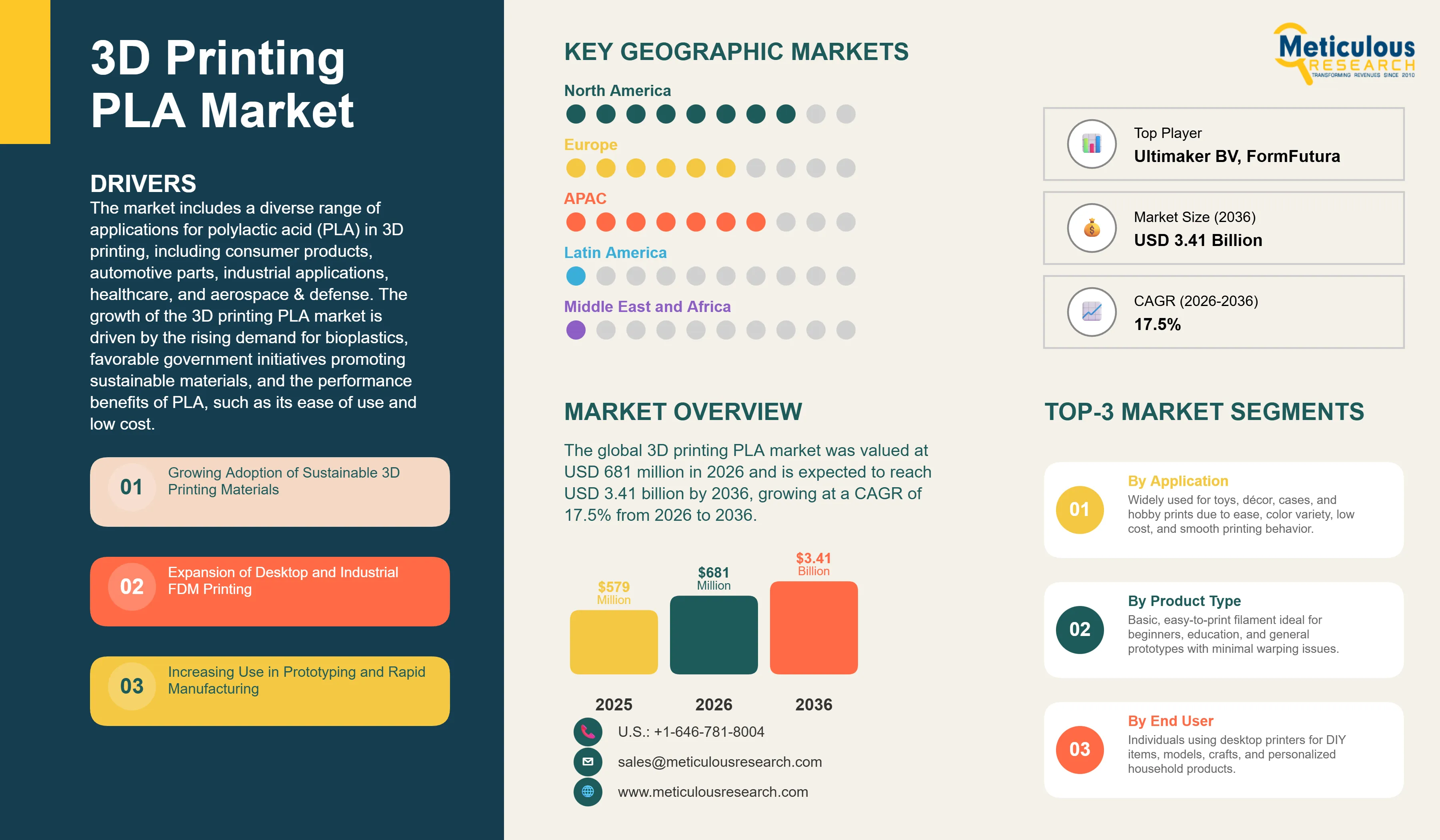
The global 3D printing PLA market was valued at USD 681 million in 2026 and is expected to reach USD 3.41 billion by 2036, growing at a CAGR of 17.5% from 2026 to 2036.
- Published
- Feb 2026
- Pages
- 130
- Format
- PDF + Excel
- Report ID
- MR-456
- Base year
- 2025
- 2026 · ESTIMATED
- $681.0M
- 2036
- $3.41B
- CAGR 2026–2036
- 17.5%
2025 baseline · 2026–2036 forecast at 17.5% CAGR · hover a bar for the value
Key highlights
The global 3D printing PLA market is projected to reach USD 3.41 billion by 2036.
The market is expected to grow at a CAGR of 17.5% from 2026 to 2036.
Consumer products are expected to dominate the market by application, accounting for the largest revenue share in 2026
Healthcare is projected to witness the fastest growth among application segments from 2026 to 2036
North America is expected to hold the largest market share of the global 3D printing PLA market in 2026
Asia-Pacific is projected to experience the fastest growth in the global 3D printing PLA market through 2036
Report summary
| Particulars | Details |
|---|---|
| Market Size by 2036 | USD 3.41 Billion |
| Market Size in 2026 | USD 681 Million |
| Revenue Growth Rate (2026-2036) | CAGR of 17.5% |
| Format | PDF, Excel & Cloud Portal · 130 pages |
| Dominating Application | Consumer Products |
| Fastest Growing Application | Healthcare |
| Leading Geographic Region | North America |
| Fastest Growing Region | Asia-Pacific |
| Base Year | 2025 |
| Forecast Period | 2026 to 2036 |
Report overview
Segments covered: application.
The market includes a diverse range of applications for polylactic acid (PLA) in 3D printing, including consumer products, automotive parts, industrial applications, healthcare, and aerospace & defense. The growth of the 3D printing PLA market is driven by the rising demand for bioplastics, favorable government initiatives promoting sustainable materials, and the performance benefits of PLA, such as its ease of use and low cost. Additionally, the increasing adoption of 3D printing technology across various industries and the growing consumer preference for environmentally friendly products are expected to support market expansion throughout the forecast period.
The global 3D printing PLA market is a rapidly growing segment of the broader 3D printing materials market. Polylactic acid (PLA) is a biodegradable and biocompatible thermoplastic derived from renewable resources such as corn starch and sugarcane, making it an attractive alternative to traditional petroleum-based plastics. The market has experienced substantial growth in recent years, driven by the increasing adoption of 3D printing technology across a wide range of industries and the growing consumer demand for sustainable and environmentally friendly products.
PLA is widely used in 3D printing due to its ease of use, low cost, and minimal warping during the printing process. It is particularly well-suited for prototyping, educational models, and consumer products. The market includes a diverse range of manufacturers and suppliers, from large chemical companies to specialized filament producers. Key players in the market include NatureWorks LLC, Covestro AG, Arkema S.A., and various other companies that offer a wide range of PLA filaments with different properties and colors.
The market is characterized by continuous innovation, with manufacturers developing new PLA formulations that offer improved strength, flexibility, and heat resistance. The development of composite PLA filaments, which incorporate materials such as wood, metal, and carbon fiber, is expanding the range of applications for PLA in 3D printing. The growing emphasis on sustainability and the circular economy is also driving the development of recycled PLA filaments, which offer a more environmentally friendly option for 3D printing enthusiasts and professionals.
A key trend in the 3D printing PLA market is the development of high-performance and composite PLA filaments that offer enhanced mechanical properties and new functionalities. Standard PLA is known for its ease of use but has limitations in terms of strength and heat resistance. To address these limitations, manufacturers are developing new PLA formulations that offer improved toughness, flexibility, and temperature resistance. For example, PLA+ and Tough PLA are modified versions of PLA that offer enhanced durability and impact resistance, making them suitable for functional prototypes and end-use parts. Additionally, the development of composite PLA filaments, which incorporate materials such as wood, metal, and carbon fiber, is expanding the range of applications for PLA in 3D printing. These composite filaments allow users to create parts with unique aesthetic and functional properties, such as wood-like textures or increased stiffness and strength. This trend is driving the adoption of PLA in more demanding applications and expanding the market beyond traditional prototyping and hobbyist use.
The healthcare and medical sector is emerging as a significant growth area for the 3D printing PLA market. PLA is biocompatible and biodegradable, making it an ideal material for a wide range of medical applications, including surgical guides, anatomical models, and custom implants. 3D printing allows for the creation of patient-specific medical devices that are tailored to the individual needs of each patient. For example, surgeons can use 3D printed anatomical models to plan complex surgeries and improve surgical outcomes. PLA is also being used to create custom prosthetics and orthotics that are more comfortable and functional than traditional devices. The COVID-19 pandemic highlighted the potential of 3D printing to address supply chain shortages of critical medical equipment, with many companies and individuals using 3D printers to produce face shields, ventilator components, and other essential items. This has increased awareness of the capabilities of 3D printing and is expected to drive further adoption of PLA in the healthcare sector.
Market dynamics
2 factors across 2 forcesRising Demand for Bioplastics and Favorable Government Initiatives
The primary drivers of the 3D printing PLA market include the rising demand for bioplastics and favorable government initiatives promoting sustainable materials. Growing environmental concerns and the desire to reduce reliance on petroleum-based plastics have led to increased interest in bioplastics such as PLA. Governments around the world are implementing policies and regulations to encourage the use of biodegradable and compostable materials, which is driving the adoption of PLA in a wide range of applications. Additionally, the performance benefits of PLA, such as its ease of use, low cost, and minimal warping, make it an attractive material for 3D printing. The increasing availability of PLA filaments in a wide range of colors and formulations is also contributing to market growth.
Table of contents
9 chapters · 81 sections · 130 pages · click to expandSegmental analysis
| Segment | Largest share (2026) | Fastest growth (2026–2036) |
|---|---|---|
| By Application | Consumer Products | Healthcare sector |
By Application
- Consumer products represent the largest application segment for the 3D printing PLA market, driven by the growing demand for customized and personalized products. 3D printing allows consumers to create unique and personalized items, from phone cases and jewelry to home decor and toys.
- The ease of use and low cost of PLA make it an ideal material for hobbyists and consumers who are new to 3D printing.
- The availability of a wide range of PLA filaments in different colors and finishes allows for a high degree of customization and creativity.
- The rise of online platforms and marketplaces for 3D printed products has also contributed to the growth of this segment, making it easier for consumers to buy and sell custom-made items.
- The healthcare sector is experiencing rapid growth in the adoption of 3D printing PLA, driven by the demand for patient-specific medical devices and anatomical models.
- The biocompatibility of PLA makes it suitable for use in a variety of medical applications, including surgical guides, implants, and prosthetics. 3D printing allows for the creation of custom-made devices that are tailored to the individual needs of each patient, which can improve surgical outcomes and reduce recovery times.
- Anatomical models created using 3D printing can help surgeons to plan complex procedures and to better communicate with patients.
- The ability to quickly and cost-effectively produce these models is a major advantage of 3D printing.
- The ongoing research and development in the field of bioprinting, which involves the use of 3D printing to create living tissues and organs, is expected to create new opportunities for PLA in the healthcare sector.
Geographic analysis
North America
Largest shareNorth America is expected to hold the largest share of the global 3D printing PLA market, driven by the strong adoption of 3D printing technology and the presence of a large number of 3D printing companies and research institutions in the region. The U.S. is the largest market in North America, with a well-established ecosystem of 3D printing manufacturers, service bureaus, and software providers. The region has a strong focus on innovation and research and development, which is driving the development of new 3D printing materials and applications. The growing demand for customized and personalized products in the consumer goods and healthcare sectors is also contributing to the growth of the market in North America. The key companies operating in the North American 3D printing PLA market include NatureWorks LLC, Covestro AG, and various other filament manufacturers and suppliers.
Asia-Pacific
Fastest growthAsia-Pacific is projected to experience the fastest growth in the 3D printing PLA market, driven by the rapid industrialization and the growing adoption of 3D printing technology. China is the largest market in Asia-Pacific, with a large and growing manufacturing sector that is increasingly adopting 3D printing for prototyping and production. The region is also home to a large and growing consumer market, which is driving the demand for customized and personalized products. The governments in the region are actively promoting the adoption of 3D printing technology through various initiatives and policies. The increasing availability of low-cost 3D printers and materials is also contributing to the growth of the market in Asia-Pacific.
Competitive landscape
- NatureWorks LLC
- Covestro AG
- Arkema S.A.
- TotalEnergies Corbion
- Polymaker
- Ultimaker BV
- FormFutura
- Prusament · Prusa Research
- Fillamentum
Frequently asked questions
The global 3D printing PLA market is valued at USD 681 million in 2026 and is expected to reach approximately USD 3.41 billion by 2036.
Cite this report
Meticulous Research. (2026). 3D Printing PLA Market - Global Opportunity Analysis and Industry Forecast (2026-2026) (Report No. MR-456). Meticulous Market Research Pvt. Ltd. https://www.meticulousresearch.com/product/3d-printing-pla-market-5152