Yard Management Systems and Dock Scheduling Software Market (2026-2036)
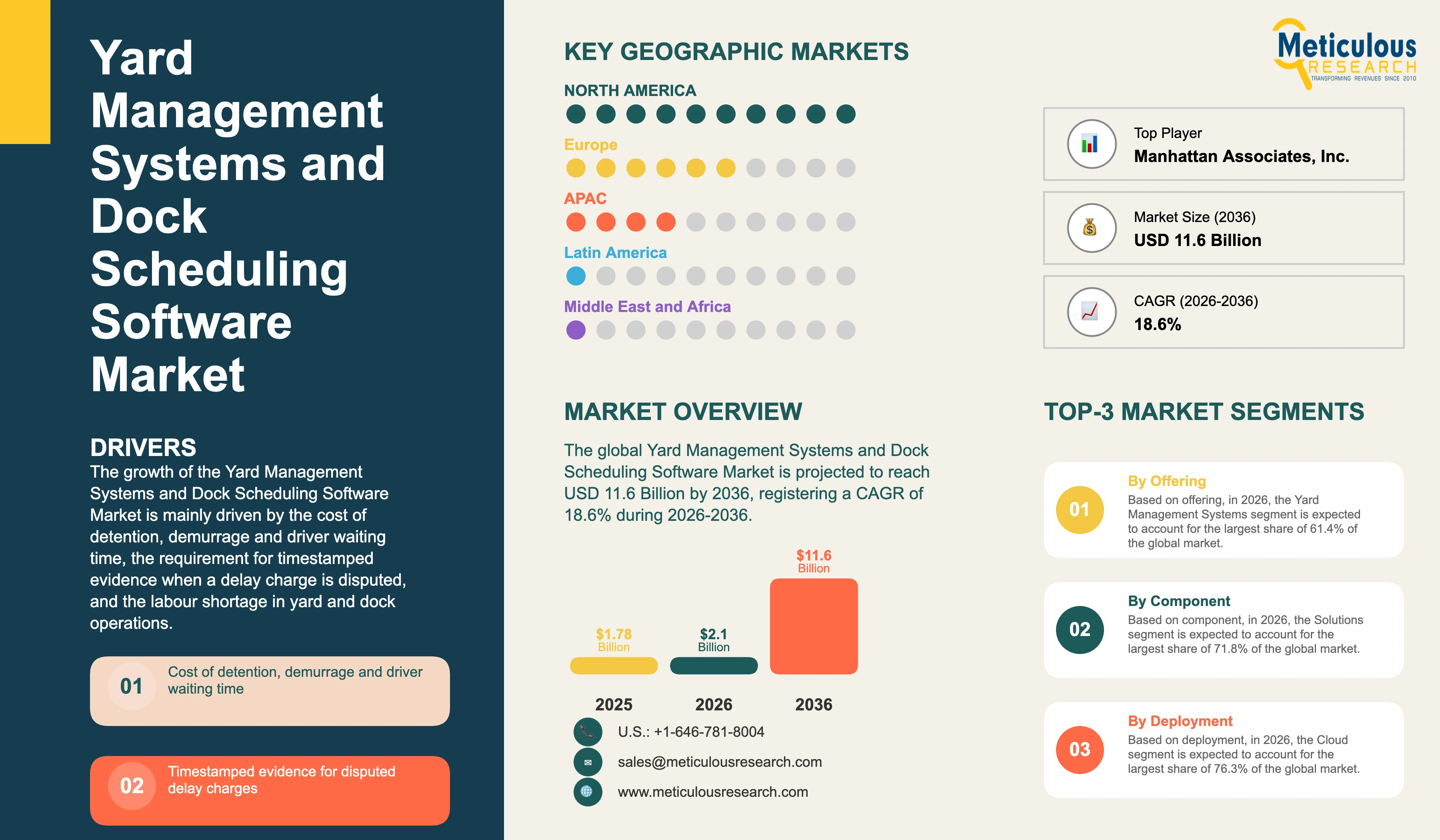
The global yard management systems and dock scheduling software market was valued at USD 1.78 billion in 2025. This market is expected to reach USD 11.60 billion by 2036 from an estimated USD 2.10 billion in 2026, registering a CAGR of 18.6% during the forecast period (2026-2036).
- Published
- Nov 2026
- Pages
- 267
- Format
- PDF + Excel
- Report ID
- MRICT - 1042548
- Base year
- 2025
- 2025 · BASELINE
- $1.78B
- 2036
- $11.60B
- CAGR 2026–2036
- 18.6%
2025 baseline · 2026–2036 forecast at 18.6% CAGR · hover a bar for the value
Key highlights
The global yard management systems and dock scheduling software market is estimated at USD 2.10 billion in 2026 and is projected to reach USD 11.60 billion by 2036.
Yard management systems are expected to account for the largest share of 61.4% in 2026, while dock scheduling software is projected to register the highest CAGR of 20.4%.
Solutions are expected to hold the largest share of 71.8% in 2026, while services are projected to grow fastest at a CAGR of 19.8%.
Cloud deployment is expected to account for the largest share of 76.3% in 2026 and to register the highest CAGR of 20.1%.
Retail and consumer goods is expected to be the largest end user with a share of 26.4% in 2026, while third-party logistics and warehousing providers are projected to grow fastest at a CAGR of 21.3%.
North America is expected to hold the largest share of 46.8% in 2026, while Asia-Pacific is projected to register the highest CAGR of 22.4%.
European Union authorities must accept freight data from certified electronic platforms from 9 July 2027.
ISO 14083:2023 provides the published methodology for quantifying transport chain emissions.
Loadsmart, Inc. holds Opendock, which schedules dock appointments between warehouses and carriers.
Kaleris holds the PINC yard management product alongside its rail and transport software.
Report summary
| Particulars | Details |
|---|---|
| Forecast Period | 2026-2036 |
| Base Year | 2025 |
| Estimated Year | 2026 |
| CAGR (Value) | 18.6% |
| Format | PDF, Excel & Cloud Portal · 267 pages |
| Market Size (Value) in 2025 | USD 1.78 billion |
| Market Size (Value) in 2026 | USD 2.10 billion |
| Market Size (Value) in 2036 | USD 11.60 billion |
| Segments Covered | Offering, Component, Deployment, End User, and Geography |
| Offerings Covered | Yard Management Systems and Dock Scheduling Software |
| Components Covered | Solutions and Services |
| Deployments Covered | Cloud and On-Premise |
| End Users Covered | Retail and Consumer Goods, Food and Beverage, Manufacturing and Industrial, Third-Party Logistics and Warehousing, Automotive, and Other End Users |
| Countries Covered | North America, Europe, Asia-Pacific, Latin America, and Middle East & Africa |
| Key Companies | 10 leading players |
Report overview
Segments covered: offering, component, deployment, end user.
The growth of this market is mainly driven by the cost of detention, demurrage and driver waiting time that accrues when a trailer or container sits longer than the agreed free period, the requirement for timestamped evidence of arrival, appointment and release when a delay charge is disputed, the labour shortage that makes manual yard checks and telephone appointment booking unsustainable, and the extension of dock scheduling from large distribution centres to manufacturing plants and rail terminals. However, factors such as the capital cost of the sensing and identification equipment that a yard management system depends on, the resistance of carriers and drivers to booking appointments through a portal for each facility they visit, the integration effort required to connect yard software to warehouse and transport systems, and the difficulty of proving savings in facilities that do not measure dwell today are expected to restrain the growth of this market to some extent.
A yard management system tracks every trailer, container and chassis on a site, records what each one holds and directs the moves that bring it from the gate to a dock door and back out again. Dock scheduling software controls the other half of the same problem by allocating appointment slots to carriers against dock capacity and labour availability, so that arrivals are spread across the day rather than clustered at opening. The two products are bought together often enough to be treated as one market, because a facility that schedules appointments without knowing what is in its yard cannot honour them, and a facility that tracks its yard without controlling arrivals manages congestion it could have prevented.
Detention charges accrue when carrier equipment is held beyond its free period, demurrage accrues when a container sits at a terminal, and driver waiting time at a dock consumes hours that a driver could otherwise spend moving freight, so the money in this market is not saved inside the yard at all. Those costs are large relative to the software that prevents them, and they move between shipper, carrier and terminal through invoices and disputes rather than appearing on one party balance sheet. A facility that can show the gate arrival time, the appointment it was given and the release time holds the evidence that decides who pays, and a facility running on a clipboard and a telephone log does not.
Reading a trailer number at a gate can be done by a guard, by a camera with optical recognition, by a radio frequency tag on the trailer or by a telematics unit already fitted to it, and the method chosen determines what a yard management system costs to install because each carries a different capital cost and a different rate of error. Sites that already carry gate cameras for security reuse them, while sites that must tag every trailer entering a mixed carrier population face a cost that recurs as carriers change. The equipment share of the deployment is what makes yard management a larger line than dock scheduling, and it is also what makes dock scheduling easier to sell.
A carrier serving many facilities is asked to book appointments on a different portal for each one, maintain credentials for each and accept penalties for missing slots it could not control, and the effort falls on a party that captures none of the saving, which is the constraint neither product removes. Scheduling products that let a carrier see and book across multiple facilities from one place reduce that friction and win adoption faster, which is why network reach matters more than scheduling logic in this part of the market.
Emissions reporting has begun to reach yard operations through the transport chain. Iso 14083:2023, titled greenhouse gases, quantification and reporting of greenhouse gas emissions arising from transport chain operations, was published in march 2023 by iso/tc 207/sc 7 and establishes a common methodology for quantifying and reporting the greenhouse gas emissions of transport chain operations. Dwell, idling and the moves a spotter tractor makes across a site sit inside the operations the methodology addresses, and the yard management system is the only system that records them, so facilities reporting transport emissions find that yard activity has to be measured rather than estimated. The requirement is arriving through customer contracts ahead of any obligation to report.
Regulation (eu) 2020/1056 on electronic freight transport information entered into force in august 2020 and applies in full from 9 july 2027, from which point competent authorities in every member state must accept freight transport data when a business shares it through a certified efti platform, and the first implementing and delegated acts entered into force in January 2025, platforms and service providers can prepare for operation from January 2026, and the remaining implementing specifications are planned for adoption by December 2026. A gate check-in is where the consignment document is presented and signed today, so acceptance of certified electronic data removes the paper step at the point where yard software already records the arrival. The obligation falls on the authority rather than on the operator, which means the gain to a facility is administrative and the adoption decision is commercial.
Facility type rather than company size determines how the software is configured. A retail distribution centre handles high volumes of similar trailers on tight appointment windows, a manufacturing plant sequences inbound components to a production schedule and holds trailers as temporary storage, and a rail or intermodal terminal manages containers and chassis against train departures rather than dock doors. Providers serve these as separate configurations of the same product, and the depth of the configuration library is what shortens a deployment from quarters to weeks.
North America, with a share of 46.8% in 2026 at USD 0.98 billion, with the United States growing at a CAGR of 16.6%.
Asia-Pacific, at a CAGR of 22.4%, with India at 24.1% and China at 22.0%.
Europe holds a share of 27.4% in 2026 at USD 0.58 billion and is projected to grow at a CAGR of 18.9%, with Germany at 19.2%.
The Middle East & Africa holds 3.1% at USD 0.07 billion with a CAGR of 19.1%, and Latin America holds 4.1% at USD 0.09 billion with a CAGR of 20.2%, with Brazil at 20.6%.
The 10 companies profiled accounted for 58.6% of the market in 2025, and the top five players, Manhattan Associates, Inc., Oracle Corporation, SAP SE, The Descartes Systems Group Inc. and Kaleris, accounted for 36.2%.
Yard management systems, with a share of 61.4% in 2026 at USD 1.29 billion.
Dock scheduling software, at a CAGR of 20.4%, from USD 0.81 billion and a share of 38.6% in 2026.
Retail and consumer goods, with a share of 26.4% in 2026 at USD 0.55 billion.
Third-party logistics and warehousing, at a CAGR of 21.3%, from USD 0.37 billion and a share of 17.6% in 2026.
Report infographic
Market dynamics
15 factors across 5 forcesCost of Detention, Demurrage and Driver Waiting Time
Equipment held beyond its free period generates a charge every day it stays, and the amounts involved at a busy facility exceed the annual cost of the software that would prevent them within a single peak season. Driver waiting time compounds the same problem from the carrier side, because hours spent at a dock consume the window in which the driver can legally drive and reduce the revenue the truck can earn that day, which carriers recover through rates or by declining the facility altogether. Facilities that measure dwell find the cost concentrated in a small number of lanes, carriers and hours of the day, and that concentration is what makes the business case straightforward once the measurement exists. The purchase decision in this market is therefore triggered by a charge or a service failure rather than by a productivity review, and the facilities that buy first are those whose charges have become visible enough to reach a finance review, and that visibility usually arrives with a peak season.
Requirement for Timestamped Evidence When a Delay Charge Is Disputed
A delay charge is only as strong as the record behind it, and the record has to show when the vehicle arrived, what appointment it held, when it was called to a door and when it was released. Those four timestamps sit in a yard management system and a dock scheduling system and nowhere else, and a facility without them concedes disputes it would have won. The value rises as the parties on both sides of the invoice automate their own records, because a claim supported by system data cannot be answered by a recollection. Evidence rather than efficiency is now the reason facilities buy, and it is why scheduling software that creates the appointment record sells into facilities that have no intention of optimising yard moves. Insurers and auditors have begun to ask for the same records when a claim or a service level penalty is assessed, which widens the reason to hold them beyond the immediate billing dispute.
Labour Shortage in Yard and Dock Operations
Manual yard checks require someone to walk or drive the site recording trailer numbers and locations, and the result is out of date before it is entered and wrong often enough to send a spotter to an empty slot. Appointment booking by telephone and email occupies staff at the receiving facility through the working day and produces no record that survives the call. Both tasks are performed by roles that are hard to fill and that turn over quickly, so the work is increasingly automated because the labour is unavailable rather than because the automation is cheaper. Facilities that have automated gate check-in and appointment booking redeploy that labour to the dock, where throughput rather than administration determines output. The shortage applies equally to spotter drivers who move trailers across the site, so facilities are also reducing the number of moves required rather than only recording them faster.
Extension From Distribution Centres to Plants and Terminals
Dock scheduling began in large retail and grocery distribution centres, where appointment discipline was already enforced and the volume of arrivals justified a system. Manufacturing plants adopted it as inbound component sequencing moved closer to the production schedule and trailers began to be used as temporary storage, and rail and intermodal terminals adopted it to control truck arrivals against train departures. Each facility type requires a different configuration rather than a different product, so providers have extended into them without rebuilding, and the addressable base has widened faster than distribution centre numbers alone would suggest. Growth in the yard management systems and dock scheduling software market now comes substantially from facilities that are not warehouses, and each new facility type widens the base faster than warehouse construction alone would.
Table of contents
12 chapters · 136 sections · 267 pages · click to expandSegmental analysis
| Segment | Largest share (2026) | Fastest growth (2026–2036) |
|---|---|---|
| By Offering | Yard management systems | Rapid growth of this |
| By Component | Solutions | Rapid growth of this |
| By Deployment | Cloud | Large share and rapid growth of this |
| By End User | Retail and consumer goods | Rapid growth of this |
By Offering
- The yard management systems segment is expected to account for the largest share of 61.4% of the global yard management systems and dock scheduling software market, valued at USD 1.29 billion.
- The large share of this segment is mainly due to the identification and sensing equipment included in a deployment, because gate cameras, tags and the civil works that support them carry capital cost that scheduling software does not, and to the breadth of function a yard system covers across gate check-in, trailer location, move direction and yard audit.
- Facilities with large sites and high trailer populations also hold the strongest case for the product, and those are the facilities with the largest software budgets.
- However, the dock scheduling software segment, valued at USD 0.81 billion in 2026 and accounting for a share of 38.6%, is projected to register the highest CAGR of 20.4% during the forecast period.
- The rapid growth of this segment is attributed to the absence of any site equipment requirement, which allows a facility of any size to deploy it within weeks and brings small and mid-sized warehouses into the market for the first time, and to the appointment record it creates, which is the evidence a facility needs when a detention or demurrage charge is disputed.
- Carrier facing networks that let a carrier book across many facilities from one place are accelerating adoption further, because the administrative load that held carriers back falls as the network grows.
- Scheduling also reaches facilities that will never buy a yard system at all, which makes the segment addressable base several times larger than the yard population.
By Component
- The solutions segment is expected to account for the largest share of 71.8% of the global yard management systems and dock scheduling software market, valued at USD 1.51 billion.
- The large share of this segment is mainly due to the subscription and licence model under which both products are sold, which recognises recurring revenue across the life of each deployment, and to the inclusion of the sensing and identification technology within the solution rather than as a separate service.
- Hosted delivery also keeps maintenance and carrier network operation inside the subscription rather than passing it to a services contract.
- Equipment supplied with the deployment is recognised here as well, which keeps the hardware value inside this segment rather than in services.
- However, the services segment, valued at USD 0.59 billion in 2026 and accounting for a share of 28.2%, is projected to register the highest CAGR of 19.8% during the forecast period.
- The rapid growth of this segment is attributed to the site survey, equipment installation and integration work that each deployment requires, which scales with the size and layout of the yard rather than with the software contract, and to the measurement exercises providers now run before a sale to establish a dwell baseline.
- Facilities without internal capability also buy ongoing operation of the system as a managed service rather than staffing it.
- Solutions, with a share of 71.8% in 2026 at USD 1.51 billion.
- Services, at a CAGR of 19.8%, from USD 0.59 billion and a share of 28.2% in 2026.
By Deployment
- The cloud segment is expected to account for the largest share of 76.3% of the global yard management systems and dock scheduling software market, valued at USD 1.60 billion, and is also projected to register the highest CAGR of 20.1% during the forecast period.
- The large share and rapid growth of this segment are mainly due to the carrier side of the product, because an appointment network has to be reachable by thousands of carriers that have no relationship with the facility information technology function, and a hosted platform is the only practical way to deliver that.
- Hosted delivery also carries the trailer telematics feeds and optical recognition services that newer deployments depend on, and it removes the site server that a distribution centre would otherwise maintain without local technical staff.
- On-premise deployment holds the remaining share at facilities where plant network policy, site security rules or the absence of reliable connectivity prevent a hosted option, which is most common in heavy manufacturing and at remote terminals.
- Those installations are maintained rather than extended, and the segment grows well below the market rate as sites move to hosted platforms at replacement.
- Cloud, with a share of 76.3% in 2026 at USD 1.60 billion.
- Cloud, at a CAGR of 20.1% during the forecast period.
By End User
- The retail and consumer goods segment is expected to account for the largest share of 26.4% of the global yard management systems and dock scheduling software market, valued at USD 0.55 billion.
- The large share of this segment is mainly due to the arrival volumes at retail distribution centres, which receive from hundreds of suppliers and carriers against appointment windows measured in minutes, and to the enforcement culture that already exists in retail inbound operations, where supplier compliance programmes made appointments a condition of delivery before software managed them.
- Trailer populations at these sites are also large enough to justify the yard equipment that smaller facilities cannot approve.
- However, the third-party logistics and warehousing segment, valued at USD 0.37 billion in 2026 and accounting for a share of 17.6%, is projected to register the highest CAGR of 21.3% during the forecast period.
- The rapid growth of this segment is attributed to the contractual basis on which these operators work, because a logistics provider bills its client for throughput and is penalised for delay, so the timestamped record of arrival, appointment and release is the evidence behind both the invoice and the service level claim.
- Operators running multi-client sites also need to attribute dwell and detention to the client that caused it, which manual records cannot support.
Geographic analysis
North America
Largest shareIn 2026, North America is expected to account for the largest share of 46.8% of the global yard management systems and dock scheduling software market, valued at USD 0.98 billion. The region holds this position because trailer pools are used as working storage on a scale not seen elsewhere, which creates the yard populations that make tracking software necessary, and because detention and demurrage charges are billed and disputed actively enough that evidence has commercial value. Retail inbound compliance programmes established appointment discipline here before software existed to manage it, and the installed base of distribution centres large enough to justify yard equipment is the deepest in the world. The United States is projected to register a CAGR of 16.6% during the forecast period, with growth moderated by the share of large distribution centres that already operate both products. Canada contributes cross-border traffic where a trailer may be held at a border facility, which raises the value of knowing where equipment sits at any moment.
Latin America
Mexico sits with Latin America in this analysis, and its cross-border volumes are counted there rather than in North America.
Asia-Pacific
Fastest growthHowever, Asia-Pacific is projected to register the highest CAGR of 22.4% during the forecast period. The rapid growth of this region is attributed to warehouse construction continuing at a pace that brings new facilities into operation with software specified from the start rather than retrofitted, and to port and rail terminal congestion that makes truck arrival control valuable where land for queueing does not exist. Labour cost increases in China and the scale of new distribution capacity in India are moving manual yard checks and telephone booking to systems directly, without the intermediate stage of spreadsheet scheduling that western facilities passed through. India is projected to grow at a CAGR of 24.1% and China at 22.0%. Warehouse developers in the region are also specifying appointment and gate systems as part of the building rather than leaving them to the occupier, which brings software into facilities whose operators would not have bought it independently, and the proportion of new rather than retrofitted deployments is higher here than anywhere else, which produces a higher share of cloud deployments than mature regions record. Terminal congestion at the region largest container ports is also moving truck arrival control from the terminal gate into appointment systems that reach the carrier before the vehicle leaves rather than at the gate itself.
Competitive landscape
The competitive structure of the yard management systems and dock scheduling software market places warehouse and supply chain software vendors that sell yard management as part of a wider platform against specialists built around the yard or the appointment, and against transport software providers that reached the dock from the freight side. Manhattan Associates, Inc. offers Manhattan Yard Management within its warehouse range, Oracle Corporation and SAP SE carry yard capability inside their logistics suites, and Körber AG and Panasonic Holdings Corporation sell it alongside warehouse execution. Kaleris holds the PINC yard management product together with rail and transport software, while The Descartes Systems Group Inc. and Loadsmart, Inc. reached the same buyers through transport software and brokerage, the latter holding Opendock for dock appointment scheduling.
Competition turns on carrier reach and deployment speed rather than on scheduling logic, because a facility gains nothing from a system its carriers will not use and a yard deployment that requires site equipment takes longer to reach value than one that reads telematics already fitted. Providers holding warehouse software have the integration advantage at sites that already run their platform, specialists win where carrier network reach decides adoption, and the firms that sell both yard and appointment products are positioned where facilities want one supplier for the gate and the dock. Acquisition has followed the same logic, with scheduling products bought for the carrier network attached to them rather than for their scheduling engines, and yard products bought to complete a warehouse or transport range. The number of independent specialists has fallen as a result, while the number of platforms offering the capability has risen, and facilities now choose between a specialist network and a module inside software they already run, and the two are priced on different bases.
Some of the key players operating in the yard management systems and dock scheduling software market are Manhattan Associates, Inc. (U.S.), Oracle Corporation (U.S.), SAP SE (Germany), The Descartes Systems Group Inc. (Canada), Trimble Inc. (U.S.), Körber AG (Germany), Panasonic Holdings Corporation (Japan), Kaleris (U.S.), Loadsmart, Inc. (U.S.), and Shipwell, Inc. (U.S.), among others.
- —
Loadsmart, Inc. holds Opendock for dock appointment scheduling, Kaleris holds the PINC yard management product alongside its rail and transport software, and ISO 14083:2023 was published as the methodology for quantifying transport chain emissions.
- Manhattan Associates, Inc. (U.S.)
- Oracle Corporation (U.S.)
- SAP SE · Germany
- Descartes Systems Group Inc. · Canada
- Trimble Inc. (U.S.)
- Körber AG · Germany
- Panasonic Holdings Corporation · Japan
- Kaleris (U.S.)
- Loadsmart, Inc. (U.S.)
- Shipwell, Inc. (U.S.)
Expert perspectives
The purchase in this market is triggered by a disputed invoice rather than by a productivity study. Detention, demurrage and late delivery charges move real money between shipper, carrier and terminal, and the party that can produce the gate arrival time, the appointment granted and the release time wins the argument about who caused the delay. That is why dock scheduling grows faster than yard management despite being the smaller product, because the appointment is where the timestamp originates and the software that creates it needs no equipment to install.
Spending is moving toward the carrier side of the transaction rather than deeper into the yard. A scheduling product succeeds on how little work it asks of a carrier calling at many facilities, and network reach across facilities is the asset that decides adoption, in the same way carrier connectivity decides outcomes in transport software. Providers reaching carriers first hold a position that better scheduling logic does not displace, and the acquisition of scheduling products by freight software and brokerage firms reflects that the network rather than the application is what was bought.
Yard management has been held back by the capital cost of gate cameras and trailer tags rather than by any shortfall in function, and trailer telematics fitted for other reasons now provides location without site equipment at all, which opens facilities that could never approve an installation. The providers that build on those feeds will reach a far larger base of mid-sized warehouses and plants than the equipment based generation reached.
Facilities that do not measure dwell cannot quantify a saving, so the business case often rests on assumptions a finance function discounts, and providers now run measurement exercises before the sale that lengthen the cycle. The charges the software prevents frequently sit with the carrier while the facility buys the system, which splits the benefit from the cost and slows approval. European acceptance of certified electronic freight data from 9 July 2027 falls on authorities rather than on operators, so the gain at a gate is administrative and adoption remains a commercial decision that can run slower than the date implies.
Growth in the yard management systems and dock scheduling software market rests on the volume of facilities that still run the gate and the dock on paper, and it is paced by carrier willingness to use the appointment and by the capital cost of locating equipment. Providers that reach carriers across many facilities, locate trailers without site equipment and produce an auditable dwell record will take a disproportionate share of the increase.
Customer perspectives
Distribution Director - grocery retail industry
In grocery the appointment is the promise, because a missed slot pushes product out of its shelf life window. What we bought was not yard efficiency, it was the ability to show a supplier or a carrier exactly what happened at our gate when the delivery went wrong.
Industries working to shelf life and tight inbound windows buy the record rather than the optimisation, and this is the requirement pulling dock scheduling ahead of yard management across the retail and grocery sector.
Site Logistics Manager - heavy manufacturing sector
Our yard is our warehouse, because trailers hold components we have nowhere else to put. Finding the right trailer is the whole job, and in our sector the plant stops if the sequence breaks.
Manufacturing sites use trailers as working storage, so yard location accuracy carries production consequences rather than administrative ones, which is why this sector buys the equipment based deployment that lighter facilities avoid.
Operations Director - contract logistics sector
We run sites for several clients and we are paid on throughput and penalised on delay. If I cannot attribute a hold-up to the client or the carrier that caused it, our industry absorbs the cost, and that is the argument that got the system approved.
Contract logistics operators need dwell attributed to the party responsible because their commercial terms depend on it, and this is the condition making third-party logistics and warehousing the fastest-growing end user in the yard management systems and dock scheduling software market. Multi-client sites carry the added requirement of separating one client activity from another in the same yard, which manual records cannot do at all, and the attribution is what the client contract is settled against at the end of each period, which is the reason the system was approved.
Frequently asked questions
The market was valued at USD 1.78 billion in 2025 and USD 1.52 billion in 2024, and is estimated at USD 2.10 billion in 2026.
Cite this report
Meticulous Research. (2026). Yard Management Systems and Dock Scheduling Software Market - Global Opportunity Analysis and Industry Forecast (2026-2036) (Report No. MRICT - 1042548). Meticulous Market Research Pvt. Ltd. https://www.meticulousresearch.com/product/yard-management-systems-and-dock-scheduling-software-market-7231