Water Utility Analytics Market (2026-2036)
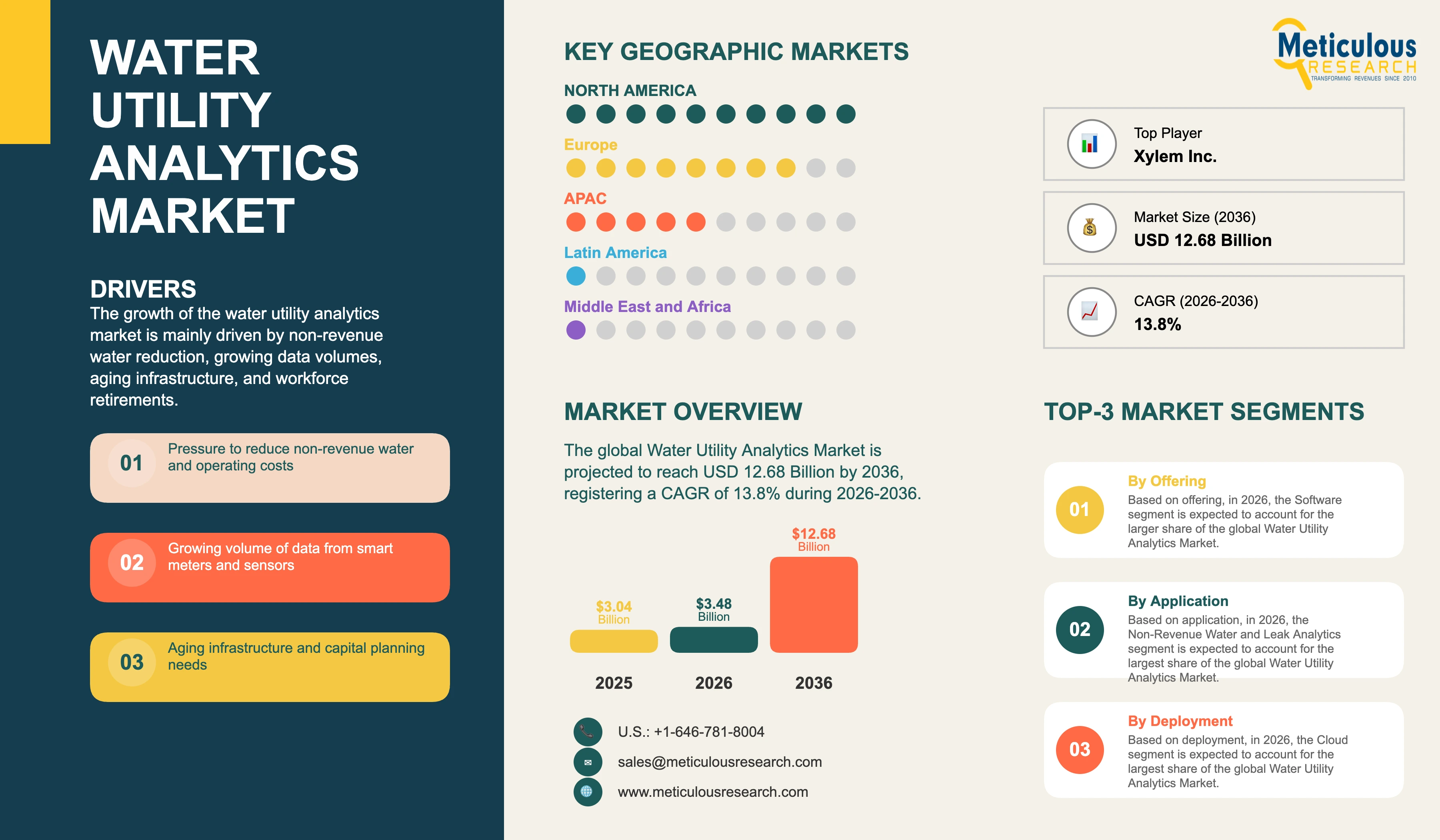
The global water utility analytics market was valued at USD 3.04 billion in 2025. This market is expected to reach USD 12.68 billion by 2036 from an estimated USD 3.48 billion in 2026, registering a CAGR of 13.8% during the forecast period (2026-2036).
- Published
- Nov 2026
- Pages
- 255
- Format
- PDF + Excel
- Report ID
- MRICT - 1042555
- Base year
- 2025
- 2025 · BASELINE
- $3.04B
- 2036
- $12.68B
- CAGR 2026–2036
- 13.8%
2025 baseline · 2026–2036 forecast at 13.8% CAGR · hover a bar for the value
Key highlights
Bluefield Research documented 107 utility-led artificial intelligence initiatives across North America, Europe, Asia-Pacific, the Middle East, and Latin America in 2025, according to a joint discussion by Xylem and Bluefield following the AWWA ACE conference in June 2026, showing that water utilities are actively deploying AI for operations, customer service, and decision-making, rather than treating it only as a future technology, with projects spanning network operations, treatment, and customer service.
Xylem and Bluefield Research highlighted three converging pressures on U.S. water utilities: a projected USD 690 billion infrastructure funding gap for wastewater and stormwater by 2044, the expected retirement of about 30% of the U.S. water workforce by 2030, and growing demand for operational consistency, all of which increase the need for analytics and decision-support tools that help utilities do more with fewer experienced staff and limited capital.
Xylem reports that the City of Richmond, Virginia, reduced combined sewer overflows by 180 million gallons annually and avoided USD 725 million in capital costs using decision intelligence from the Xylem Vue platform, developed in partnership with Idrica, a water data management and analytics company, while Yorkshire Water in the U.K. also implemented Xylem Vue as an integrated water utility management platform.
Badger Meter reported software-as-a-service sales of about USD 74 million in 2025, up 27% year over year, reflecting the growth of cloud-based meter data and analytics services linked to cellular advanced metering infrastructure, while Xylem noted softer analytics revenue in late 2025 due to timing effects and planned portfolio simplification actions.
The ASCE 2025 Report Card kept U.S. drinking water at a grade of C-, wastewater at D+, and stormwater at D, unchanged from 2021, reinforcing the need for data-driven asset management and capital planning tools that help utilities prioritize limited funds.
By offering, software accounts for the larger share in 2026 and also registers the higher CAGR.
By application, non-revenue water and leak analytics account for the largest share of 30.0% in 2026, while network modeling and digital twins register the highest CAGR.
By deployment, cloud accounts for the larger share of 58.0% in 2026 and also registers the higher CAGR.
By utility type, drinking water utilities account for the larger share in 2026, while wastewater and stormwater utilities register the higher CAGR.
By geography, North America accounts for the largest share of 40.0% in 2026, while Asia-Pacific registers the highest CAGR of 16.8%.
Report summary
| Particulars | Details |
|---|---|
| Base Year | 2025 |
| Estimated Year | 2026 |
| Forecast Period | 2026-2036 |
| Market Size in 2025 | USD 3.04 billion |
| Market Size in 2026 | USD 3.48 billion |
| Market Size by 2036 | USD 12.68 billion |
| CAGR (2026-2036) | 13.8% |
| Format | PDF, Excel & Cloud Portal · 255 pages |
| Largest Segment by Application (2026) | Non-Revenue Water and Leak Analytics (30.0%) |
| Largest Segment by Deployment (2026) | Cloud (58.0%) |
| Largest Region (2026) | North America (40.0%) |
| Fastest-Growing Region | Asia-Pacific (CAGR 16.8%) |
| Companies Profiled | 16 companies and other companies |
| Segments Covered | Offering, Application, Deployment, Utility Type, Geography |
| Countries Covered | U.S., Canada, U.K., Spain, France, Germany, Netherlands, Italy, Denmark, Ireland, Belgium, Sweden, Rest of Europe, China, Japan, Australia, Singapore, India, South Korea, Indonesia, Malaysia, Philippines, New Zealand, Rest of Asia-Pacific, Brazil, Mexico, Chile, Colombia, Rest of Latin America, Saudi Arabia, U.A.E., Israel, Qatar, South Africa, Rest of Middle East & Africa |
Report overview
Segments covered: offering, application, deployment, utility type.
The growth of this market is mainly driven by rising pressure on water and wastewater utilities to reduce non-revenue water, prevent pipe failures, and control operating costs, the growing volume of data from smart meters, sensors, SCADA systems, and inspection technologies, aging infrastructure and large investment gaps that require better prioritization of capital spending, workforce retirements that make it important to capture operational knowledge in digital tools, stricter regulatory requirements for leakage, sewer overflows, water quality, and reporting, the maturity of cloud computing, artificial intelligence, and digital twin technologies, and the expansion of software-as-a-service models that make analytics affordable for small and medium-sized utilities. However, factors such as limited budgets and conservative procurement practices at utilities, fragmented and poor-quality data, integration challenges with legacy operational systems, cybersecurity concerns, and shortages of data skills are expected to restrain the growth of this market to some extent.
Water utility analytics refers to software and services that collect, integrate, and analyze data from water and wastewater utility systems to support operational, financial, and strategic decisions. These solutions use data from smart meters, flow and pressure sensors, SCADA systems, geographic information systems, customer information systems, computerized maintenance management systems, laboratory systems, inspection technologies, and weather and hydrological sources, and they apply statistical models, hydraulic models, machine learning, and artificial intelligence to generate insights. Applications include non-revenue water and leak analytics, customer and meter data analytics, asset management and predictive maintenance, network modeling and digital twins, treatment plant optimization, and water quality and other applications. This report covers analytics software and related implementation, integration, and managed services sold to drinking water, wastewater, and stormwater utilities, across offerings, applications, deployment models, utility types, and regions. Smart meters, sensors, and other hardware are excluded and are analyzed in separate reports. The market is measured on a revenue basis.
Water utilities face a growing set of operational, financial, and regulatory challenges that increase the value of analytics. Many networks are old and deteriorating, water losses and main breaks remain high, sewer overflows and flooding are increasing with more intense storms, regulatory requirements are becoming stricter, and experienced staff are retiring. At the same time, utilities generate large and growing amounts of data from meters, sensors, and operational systems, but much of this data has historically been stored in separate systems and used only for limited purposes. Analytics solutions help utilities turn this data into actionable insights, such as identifying leaks, predicting pipe failures, optimizing pumping and treatment, and planning capital investments.
The market has evolved from standalone tools, such as hydraulic modeling software and meter data management systems, toward integrated platforms that combine data from many sources and provide multiple applications. Platforms such as Xylem Vue, Bentley's water infrastructure solutions, Autodesk's Innovyze portfolio, and solutions from Itron, Badger Meter, Mueller, and others offer modules for leak detection, network management, asset management, and plant operations. Specialized providers such as TaKaDu, FIDO Tech, VODA.ai, Fracta, Aquasight, and Idrica focus on specific applications or offer advanced AI capabilities.
Non-revenue water and leak analytics account for the largest share of the market, since water losses are one of the most costly problems for utilities and analytics can identify leaks, bursts, and meter errors from meter, flow, pressure, and acoustic data. Asset management and predictive maintenance analytics help utilities prioritize pipe renewal and equipment maintenance, while network modeling and digital twins allow real-time simulation of networks for operations and planning. Treatment plant optimization uses analytics to reduce energy and chemical use, and customer and meter data analytics support billing, customer service, and demand forecasting.
Cloud deployment accounts for the largest and fastest-growing share of the market, as utilities adopt software-as-a-service models that reduce IT costs and allow faster deployment of new capabilities. However, many utilities still use on-premise systems for critical operational applications due to cybersecurity and regulatory concerns. Drinking water utilities account for the largest share of the market, while wastewater and stormwater utilities are growing faster, driven by sewer overflow regulations, flooding, and treatment optimization.
Services, including implementation, data integration, consulting, training, and managed analytics, are an important part of the market, since utilities often need help to integrate data, configure applications, and change their operating practices. Many utilities also outsource analytics to vendors or consultants, especially small utilities with limited in-house capabilities.
The market includes water technology companies, metering companies, engineering software companies, enterprise software companies, industrial automation companies, engineering consultants, and specialized analytics start-ups. Leading companies include Xylem, Itron, Badger Meter, Mueller Water Products, Bentley Systems, Autodesk (Innovyze), Oracle, AVEVA, Siemens, Arcadis, Idrica, TaKaDu, FIDO Tech, VODA.ai, Fracta, and Aquasight.
Over the forecast period, the water utility analytics market is expected to grow rapidly, supported by digital transformation programs at utilities, the growing installed base of smart meters and sensors, regulatory and financial pressures, and advances in artificial intelligence and cloud computing. North America is expected to remain the largest market, while Asia-Pacific is expected to grow fastest.
With smart meters and sensors across the city, we now have more data than our staff can analyze, so AI-based analytics are essential for reducing water losses.
This comment explains why Asia-Pacific is the fastest-growing region and why AI-based analytics are gaining importance in large cities.
North America is expected to account for the largest share of 40.0% of the market in 2026, mainly due to the large number of utilities, high adoption of smart meters and sensors, aging infrastructure, regulatory requirements, and the presence of leading analytics providers.
Asia-Pacific is projected to register the highest CAGR of 16.8% during the forecast period, driven by urbanization, high non-revenue water, water scarcity, smart city programs, and large-scale smart meter deployments.
The report profiles 16 companies, including Xylem, Itron, Badger Meter, Mueller Water Products, Bentley Systems, Autodesk (Innovyze), Oracle, AVEVA, Siemens, Arcadis, Idrica, TaKaDu, FIDO Tech, VODA.ai, Fracta, and Aquasight.
Report infographic
Market dynamics
18 factors across 5 forcesPressure to reduce non-revenue water and operating costs
Non-revenue water, including physical losses from leaks and bursts and commercial losses from meter errors and unbilled consumption, represents a major financial and environmental cost for water utilities. In many countries, utilities lose a significant share of the water they treat and pump, which increases energy, chemical, and treatment costs and reduces revenue. Analytics solutions use data from smart meters, district metered areas, pressure sensors, and acoustic sensors to identify where losses occur, detect new leaks and bursts quickly, and prioritize repair work, which can significantly reduce water losses.
Utilities also face rising operating costs for energy, chemicals, and labor, and analytics can help reduce these costs by optimizing pumping schedules, pressure management, and treatment processes. Energy is one of the largest operating costs for water and wastewater utilities, and optimization of pumps and aeration systems can produce substantial savings.
The financial benefits of reducing water losses and operating costs are often large enough to justify analytics investments within a few years, which supports adoption even among budget-constrained utilities.
Growing volume of data from smart meters and sensors
The rapid deployment of smart meters, network sensors, smart sewer monitoring, and connected treatment equipment is generating unprecedented volumes of data for utilities. Advanced metering infrastructure provides hourly or more frequent consumption data for every customer, while pressure, flow, level, and water quality sensors provide real-time information on network conditions. Utilities need analytics to manage and use this data effectively, and many view analytics as essential to realizing the value of their investments in smart meters and sensors.
Meter companies are therefore expanding their software and analytics offerings, as shown by Badger Meter's 27% growth in SaaS sales in 2025, and utilities increasingly evaluate metering and analytics together as part of digital transformation programs.
The falling cost of sensors and connectivity is also making it possible for utilities to monitor more of their networks, including sewers and stormwater systems, which further increases the need for analytics to interpret the data.
Aging infrastructure and capital planning needs
Aging infrastructure and large investment gaps require utilities to make better decisions about which assets to renew and when. In the U.S., the ASCE 2025 Report Card kept drinking water at C-, wastewater at D+, and stormwater at D, and Xylem and Bluefield Research cited a projected USD 690 billion funding gap for wastewater and stormwater by 2044. With limited budgets, utilities must prioritize the assets with the highest risk and impact, and analytics tools that combine condition data, failure history, criticality, and hydraulic performance help them make these decisions.
Decision analytics can also help utilities avoid unnecessary capital projects by making better use of existing infrastructure, and Xylem reports that the City of Richmond reduced combined sewer overflows by 180 million gallons annually and avoided USD 725 million in capital costs using decision intelligence, showing how analytics can deliver large financial benefits by optimizing existing infrastructure.
Workforce retirements and knowledge capture
The water sector faces a large wave of retirements, and Xylem and Bluefield Research noted that about 30% of the U.S. water workforce is expected to retire by 2030. Experienced operators and engineers hold valuable knowledge about how networks and plants behave, and utilities need to capture this knowledge and support newer staff. Analytics, digital twins, decision-support tools, and AI assistants help utilities standardize operations, provide guidance to less experienced staff, and maintain service quality as experienced workers leave.
Generative AI tools, such as chatbots for customer service and assistants that help staff search operational documents and data, are also being adopted by utilities to improve productivity and service.
Stricter regulation and reporting requirements
Regulators are setting stricter requirements for leakage reduction, sewer overflows, water quality, environmental performance, and customer service, and utilities must report detailed performance data. In the U.K., for example, water companies face strict targets for leakage, pollution incidents, and storm overflow spills, and they must install monitoring and report data publicly. In the U.S., consent decrees and permits require utilities to reduce sewer overflows, and new drinking water regulations require monitoring and reporting. Analytics solutions help utilities meet these requirements, monitor performance, and demonstrate compliance.
Public reporting of performance data also increases scrutiny from customers, media, and politicians, which encourages utilities to invest in better data and analytics to manage and explain their performance.
Table of contents
12 chapters · 152 sections · 255 pages · click to expandSegmental analysis
By Offering
- The software segment is expected to account for the larger share of the water utility analytics market, and it is also projected to register the higher CAGR during the forecast period.
- The drinking water utilities segment is expected to account for the larger share of the water utility analytics market, while the wastewater and stormwater utilities segment is projected to register the higher CAGR during the forecast period.
Geographic analysis
North America
Largest shareIn 2026, North America is expected to account for the largest share of 40.0% of the global water utility analytics market. The large share of this region is mainly due to the large number of water and wastewater utilities, high adoption of smart meters and sensors, aging infrastructure and funding gaps, regulatory requirements such as consent decrees for sewer overflows, workforce retirements, and the presence of leading analytics providers such as Xylem, Itron, Badger Meter, Mueller Water Products, Bentley Systems, Autodesk, Oracle, and VODA.ai. The U.S. is the largest market in the region, with active digital transformation and AI programs at utilities such as DC Water and Hampton Roads Sanitation District, followed by Canada, where utilities in large cities are investing in digital water programs and smart metering.
Asia-Pacific
Fastest growthAsia-Pacific is projected to register the highest CAGR of 16.8% during the forecast period. The rapid growth of this region is mainly driven by rapid urbanization, high non-revenue water levels, water scarcity, smart city programs, large-scale smart meter deployments in China, and growing investment in digital water solutions in Singapore, Australia, Japan, South Korea, and India. Fracta, part of Kurita Water Industries, offers AI-based pipe failure prediction in Japan and other markets. China, Japan, Australia, Singapore, India, South Korea, Indonesia, Malaysia, and the Philippines are important markets, and Singapore is widely regarded as a global leader in digital water management and smart water networks.
Europe
Europe accounts for a significant share of the global market, supported by strict regulations on leakage, sewer overflows, and environmental performance, especially in the U.K., large smart metering deployments, and strong digital water programs at utilities such as Yorkshire Water and Global Omnium. The U.K., Spain, France, Germany, the Netherlands, Italy, Denmark, and Ireland are important markets in the region, and providers such as Idrica, AVEVA, Siemens, Arcadis, and TaKaDu have a strong presence in the region.
Latin America
Latin America and the Middle East & Africa account for smaller shares of the market but are growing rapidly from a low base, supported by high water losses, water scarcity, and investment in smart water infrastructure in Brazil, Mexico, Chile, Colombia, Saudi Arabia, the U.A.E., Israel, Qatar, and South Africa. In the Gulf countries, desalinated water is very expensive to produce, which makes reducing losses through analytics especially valuable, and Israel has a strong ecosystem of water technology start-ups.
Competitive landscape
The global water utility analytics market is fragmented, with the top five players estimated to account for about 30% of the market in 2025. The market includes water technology companies, metering companies, engineering software providers, enterprise software companies, industrial automation companies, engineering consultants, and specialized analytics start-ups.
Xylem is a leading provider through Xylem Vue, an integrated, vendor-agnostic software and analytics platform developed in partnership with Idrica, and its Sensus analytics solutions. Itron, Badger Meter, and Mueller Water Products offer analytics linked to their metering and network monitoring solutions. Bentley Systems and Autodesk, through its Innovyze portfolio, are leading global providers of hydraulic modeling, digital twin, and asset management software, while Oracle provides utility customer and meter data management software. AVEVA and Siemens offer industrial software for treatment plant operations and data management, and Arcadis provides decision analytics and digital consulting.
Specialized providers include TaKaDu, which offers event management and network analytics, FIDO Tech, which uses AI for acoustic leak detection, VODA.ai, which provides AI-based pipe failure prediction, Fracta, which offers machine learning for pipe condition assessment, and Aquasight, which provides AI-based operational analytics for water and wastewater utilities.
Companies in this market compete on analytics capabilities, data integration, ease of use, proven results, domain expertise, cybersecurity, deployment flexibility, and price. Key strategies include product launches of AI and digital twin capabilities, partnerships between technology companies and utilities, acquisitions of analytics start-ups, bundling of analytics with metering and sensors, and expansion of SaaS offerings.
Partnerships are particularly common in this market, since no single vendor offers all the data sources and applications that utilities need. For example, Xylem partners with Idrica for its Xylem Vue platform, and many analytics vendors partner with meter and sensor companies, engineering consultants, and system integrators to deliver complete solutions.
We expect continued consolidation, as larger water technology and software companies acquire specialized analytics providers, and as companies focus their portfolios, as shown by Xylem's portfolio simplification actions affecting its analytics business in 2026. Engineering consultants and system integrators are also expanding their own analytics capabilities, competing and partnering with software vendors.
Some of the key players operating in the water utility analytics market are Xylem Inc., Itron, Inc., Badger Meter, Inc., Mueller Water Products, Inc., Bentley Systems, Incorporated, Autodesk, Inc. (Innovyze), Oracle Corporation, AVEVA Group Limited, Siemens AG, Arcadis NV, Idrica, TaKaDu Ltd., FIDO Tech Ltd., VODA.ai, Fracta (Kurita Water Industries Ltd.), and Aquasight, among others.
- —
Bluefield Research documented 107 utility-led AI initiatives in 2025, Badger Meter's SaaS sales grew 27% in 2025, and Xylem reported that Richmond avoided USD 725 million in capital costs using its Xylem Vue decision intelligence platform.
- Xylem Inc.
- Itron, Inc.
- Badger Meter, Inc.
- Mueller Water Products, Inc.
- Bentley Systems, Incorporated
- Autodesk, Inc. · Innovyze
- Oracle Corporation
- AVEVA Group Limited
- Siemens AG
- Arcadis NV
- Idrica
- TaKaDu Ltd.
- FIDO Tech Ltd.
- VODA.ai
- Fracta (Kurita Water Industries Ltd.)
- Aquasight
Expert perspectives
Water utility analytics is one of the fastest-growing areas of the water sector, driven by the combination of rising operational and financial pressures on utilities and the growing availability of data and digital technologies. Utilities that use analytics effectively can reduce water losses, avoid failures, optimize operations, and make better investment decisions.
Over the forecast period, the market is expected to grow at a CAGR of 13.8%, from USD 3.48 billion in 2026 to USD 12.68 billion in 2036. Growth will be supported by non-revenue water reduction, growing data volumes, aging infrastructure and capital planning, workforce retirements, regulation, and AI and cloud technologies.
Among the market segments, software is the larger and faster-growing offering, while non-revenue water and leak analytics is the largest application, while network modeling and digital twins grow fastest. Cloud is the larger and faster-growing deployment model. Drinking water utilities are the larger utility type, while wastewater and stormwater utilities grow faster. North America is the largest region, and Asia-Pacific is the fastest-growing region at a CAGR of 16.8%.
In our view, the water utility analytics market is moving from pilots and point solutions to enterprise-wide analytics platforms. Utilities increasingly want integrated solutions that combine data from many systems and support decisions across operations, asset management, and customer service. Vendors that offer open, interoperable platforms and proven applications with measurable results will be best positioned.
Artificial intelligence will be a major growth driver, but adoption will depend on trust, governance, and demonstrated results. Water utilities are accountable for public health and safety, so they will adopt AI tools that are transparent, explainable, and subject to human oversight.
Utilities that build governance frameworks before deploying AI are likely to scale their programs faster, and vendors that support these frameworks with explainable models, audit trails, and strong cybersecurity will gain trust and market share.
We also expect the boundary between metering, sensing, and analytics to blur, as hardware companies expand into software and software companies partner with hardware providers. Over time, utilities will increasingly buy outcomes, such as reduced water losses or avoided overflows, rather than individual products.
Finally, we believe that the many small and medium-sized utilities represent a large untapped opportunity, and vendors that can offer affordable, easy-to-deploy cloud solutions and managed services will capture significant growth.
Overall, we expect water utility analytics to be one of the fastest-growing segments of the water technology market, supported by strong financial, regulatory, and workforce drivers that are unlikely to weaken over the forecast period.
Customer perspectives
Buyers of water utility analytics include municipal water and wastewater utilities, investor-owned water companies, water concession operators, stormwater authorities, and regional water boards. Their purchase decisions depend mainly on proven results, return on investment, ease of integration with existing systems, data security, ease of use, vendor expertise, deployment model, total cost of ownership, and support services.
Director of Operations - mid-sized water utility, U.S.
We started with leak analytics because the savings were easy to measure. Now we want one cloud platform that brings together our meter, SCADA, and maintenance data for the whole utility.
This comment explains why non-revenue water and leak analytics account for 30.0% of the market, why cloud accounts for 58.0% of the market, and why North America is the largest region. It also shows the shift toward integrated platforms that combine data from many systems.
Head of Digital - wastewater utility, U.K.
Storm overflow targets mean we need to predict and manage our network in real time, so we are building a digital twin of our sewer system.
This comment explains why network modeling and digital twins and wastewater and stormwater utilities are the fastest-growing segments, supported by regulatory pressure on storm overflows in the U.K. and Europe.
Frequently asked questions
The global water utility analytics market was valued at USD 3.04 billion in 2025, up from USD 2.65 billion in 2024, and is estimated at USD 3.48 billion in 2026. The market includes analytics software and services for non-revenue water, customer and meter data, asset management, network modeling and digital twins, treatment plant optimization, and water quality.
Cite this report
Meticulous Research. (2026). Water Utility Analytics Market - Global Opportunity Analysis and Industry Forecast (2026-2036) (Report No. MRICT - 1042555). Meticulous Market Research Pvt. Ltd. https://www.meticulousresearch.com/product/water-utility-analytics-market-7238