Smart Water Meters Market (2026-2036)
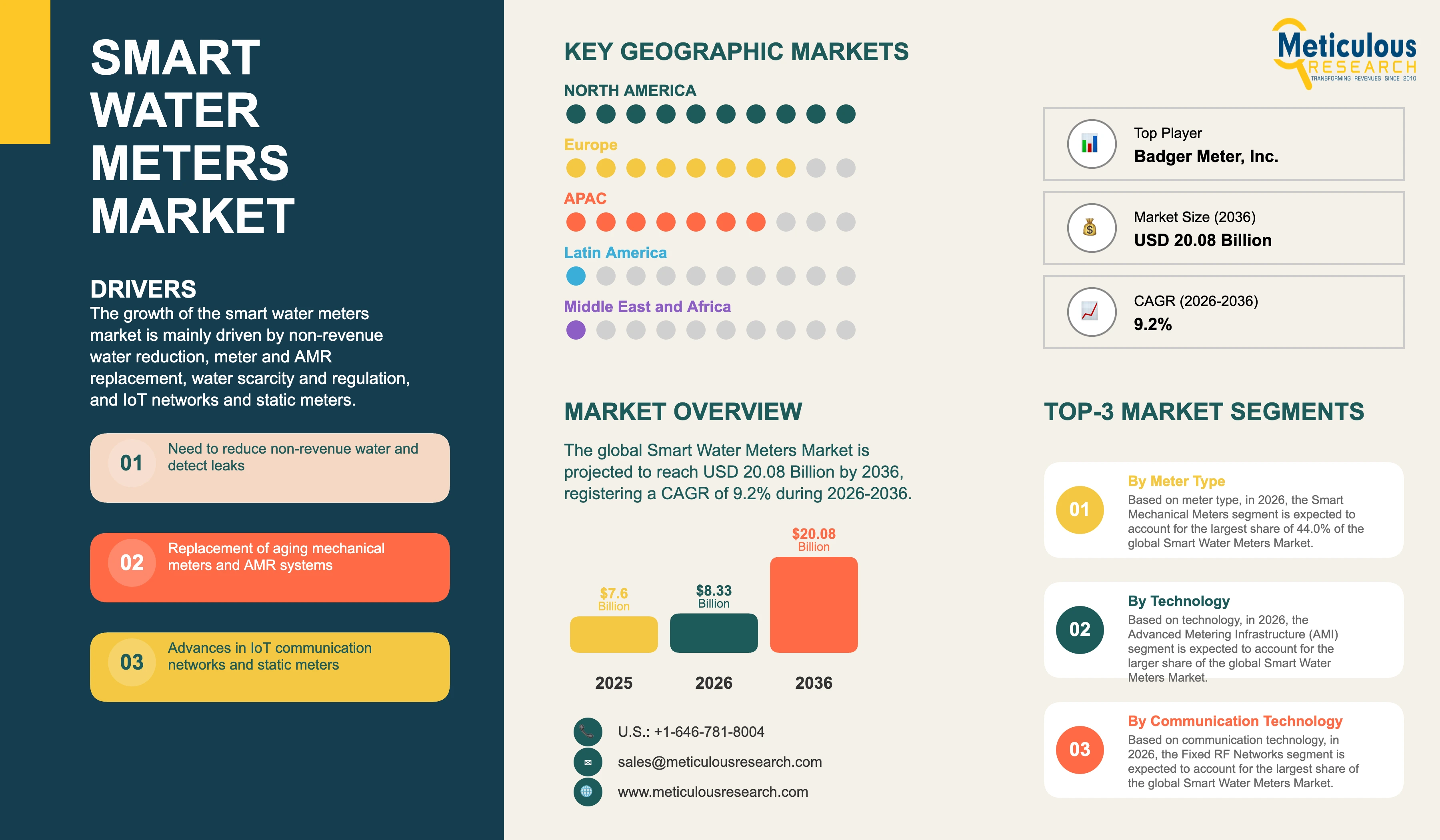
The global smart water meters market was valued at USD 7.60 billion in 2025. This market is expected to reach USD 20.08 billion by 2036 from an estimated USD 8.33 billion in 2026, registering a CAGR of 9.2% during the forecast period (2026-2036).
- Published
- Nov 2026
- Pages
- 290
- Format
- PDF + Excel
- Report ID
- MRSE - 1042559
- Base year
- 2025
- 2025 · BASELINE
- $7.60B
- 2036
- $20.08B
- CAGR 2026–2036
- 9.2%
2025 baseline · 2026–2036 forecast at 9.2% CAGR · hover a bar for the value
Key highlights
Badger Meter reported record sales of USD 916.7 million in 2025, up 11% from the previous year, with software-as-a-service sales of about USD 74 million, up 27%, driven by continued penetration of its cellular AMI solution and the acquisition of SmartCover, and the company was selected by the Puerto Rico Aqueduct and Sewer Authority (PRASA) for one of the world's largest AMI deployments covering about 1.6 million water service connections.
Xylem, which owns the Sensus metering brand, reported that orders in its Measurement and Control Solutions segment increased 22% in the fourth quarter of 2025 on smart metering demand across water and energy, with segment backlog of about USD 1.4 billion at year-end, although management noted that several large smart metering projects shifted into 2026, showing the project-driven nature of the market.
Scottish Water awarded a GBP 50 million contract to Elster Metering in 2026 for advanced metering infrastructure covering its entire non-household customer base, supporting an accelerated national rollout planned for 2026 to 2032, while Southern Water awarded a GBP 338 million, 20-year metering-as-a-service contract to Horizon Water Infrastructure in 2025 covering household and non-household meters.
In France, Veolia and its connected solutions business have deployed more than three million connected water meters, and Pays de Montbéliard Agglomération and Veolia launched a rollout of 48,740 communicating smart meters across 62 communes in 2026, reflecting the growth of remote meter reading under concession models in Europe.
U.S. municipal utilities continue to approve AMI programs, including a USD 26 million contract approved by the City of Denton, Texas, with Badger Meter in April 2026 and a USD 12.4 million program by Loveland Water and Power in Colorado to convert about 30,000 water connections to AMI, which the utility expects will identify abnormal water use within 24 to 48 hours instead of up to 30 days.
By meter type, smart mechanical meters account for the largest share of 44.0% in 2026, while ultrasonic meters register the highest CAGR.
By technology, advanced metering infrastructure (AMI) accounts for the larger share in 2026 and also registers the higher CAGR.
By communication technology, fixed RF networks account for the largest share in 2026, while cellular IoT (NB-IoT and LTE-M) registers the highest CAGR.
By end user, residential accounts for the largest share of 68.0% in 2026, while commercial registers the highest CAGR.
By geography, North America accounts for the largest share of 36.0% in 2026, while Asia-Pacific registers the highest CAGR of 11.7%.
Report summary
| Particulars | Details |
|---|---|
| Base Year | 2025 |
| Estimated Year | 2026 |
| Forecast Period | 2026-2036 |
| Market Size in 2025 | USD 7.60 billion |
| Market Size in 2026 | USD 8.33 billion |
| Market Size by 2036 | USD 20.08 billion |
| CAGR (2026-2036) | 9.2% |
| Format | PDF, Excel & Cloud Portal · 290 pages |
| Largest Segment by Meter Type (2026) | Smart Mechanical Meters (44.0%) |
| Largest Segment by End User (2026) | Residential (68.0%) |
| Largest Region (2026) | North America (36.0%) |
| Fastest-Growing Region | Asia-Pacific (CAGR 11.7%) |
| Companies Profiled | 16 companies and other companies |
| Segments Covered | Meter Type, Technology, Communication Technology, End User, Geography |
| Countries Covered | U.S., Canada, U.K., France, Germany, Spain, Italy, Netherlands, Denmark, Poland, Belgium, Portugal, Sweden, Rest of Europe, China, Japan, India, Australia, South Korea, Singapore, Indonesia, Vietnam, Philippines, Malaysia, Thailand, Rest of Asia-Pacific, Brazil, Mexico, Chile, Colombia, Argentina, Rest of Latin America, Saudi Arabia, U.A.E., Israel, Qatar, South Africa, Rest of Middle East & Africa |
Report overview
Segments covered: meter type, technology, communication technology, end user.
The growth of this market is mainly driven by the need for water utilities to reduce non-revenue water and detect leaks faster, the replacement of aging mechanical meters that under-register consumption, the shift from manual and drive-by meter reading to advanced metering infrastructure (AMI) that provides near real-time data, growing water scarcity and conservation requirements, regulatory programs and national rollouts in Europe and Asia-Pacific, the falling cost and wider availability of cellular IoT and low-power wide-area networks, the growth of ultrasonic and electromagnetic meters with no moving parts, and the increasing use of meter data for billing accuracy, customer engagement, and network analytics. However, factors such as high upfront project costs for utilities, long procurement cycles and project timing variability, limited budgets of small utilities, battery life and network coverage concerns, and data security and privacy requirements are expected to restrain the growth of this market to some extent.
Smart water meters are water meters that measure consumption and transmit data electronically to the utility, either through automated meter reading (AMR) systems, which collect readings using drive-by or walk-by radio receivers, or through advanced metering infrastructure (AMI), which uses fixed networks or cellular and low-power wide-area connections to transmit interval data automatically and enable two-way communication. Smart water meters include smart mechanical meters fitted with electronic registers and radio modules, ultrasonic meters that measure flow using sound waves, and electromagnetic meters that measure flow using magnetic fields. This report covers smart water meters, endpoints and communication modules, and the associated network infrastructure and meter data software sold with metering projects, across meter types, technologies, communication technologies, end users, and regions. Broader water network analytics platforms that are sold separately from metering projects are analyzed in a separate report. The market is measured on a revenue basis.
Water metering is the foundation of utility billing and water management, and the limits of traditional metering are a key reason for the shift to smart meters. Traditional mechanical meters must be read manually, often once a month or less, and they tend to under-register consumption as they age, which reduces utility revenue and makes it harder to identify leaks and water losses. Smart meters allow utilities to read meters remotely, bill customers accurately, detect leaks and abnormal consumption quickly, identify meter tampering and theft, analyze demand patterns, and engage customers with information about their water use.
Non-revenue water, which includes physical losses from leaks and bursts as well as commercial losses from meter inaccuracy, unbilled consumption, and theft, is one of the largest problems facing water utilities. In the U.S., the American Society of Civil Engineers estimated in its 2025 Report Card that there are about 240,000 water main breaks each year and that billions of gallons of treated drinking water are lost every day. Smart meters help reduce both commercial and physical losses by improving measurement accuracy and providing data that supports leak detection and district metered area analysis.
The market is moving steadily from AMR to AMI. Many utilities in North America installed drive-by AMR systems over the past two decades, and these systems are now reaching the end of their life, creating a large replacement opportunity for AMI. In Europe, utilities are deploying AMI using fixed radio networks, LoRaWAN, and NB-IoT, often under national or regional programs, while in Asia-Pacific, utilities in China, Japan, South Korea, Australia, and Southeast Asia are deploying NB-IoT and other smart metering solutions at large scale.
Meter technology is also changing as utilities look for longer-lasting and more accurate meters. Static meters, such as ultrasonic and electromagnetic meters, have no moving parts, maintain accuracy over a longer life, measure low flows better, and can include additional functions such as pressure, temperature, and leak detection sensors. Ultrasonic meters are the fastest-growing meter type, while smart mechanical meters remain widely used because of their lower cost and compatibility with existing installations.
Communication technology is a key choice for utilities, since it affects cost, coverage, and long-term flexibility. Fixed radio frequency networks are widely used in North America, while cellular IoT, including NB-IoT and LTE-M, allows utilities to use public mobile networks without building their own infrastructure, and LoRaWAN and other low-power wide-area networks are widely used in Europe and other regions. Drive-by and walk-by systems remain in use but are gradually being replaced by fixed and cellular networks.
The market includes global metering companies, regional meter manufacturers, communication module providers, and software providers. Leading companies include Badger Meter, Xylem (Sensus), Itron, Kamstrup, Diehl Metering, Honeywell (Elster), Neptune Technology Group, Mueller Water Products, ZENNER International, Arad Group, Sagemcom, Apator, Axioma Metering, B METERS, Ningbo Water Meter, and Suntront Technology.
Over the forecast period, the smart water meters market is expected to grow strongly, supported by AMR-to-AMI replacement in North America, national and regional rollouts in Europe, large-scale deployments in Asia-Pacific, growing adoption in Latin America and the Middle East, and the shift to ultrasonic meters and cellular communication. Software and data services linked to metering are expected to account for a growing share of value.
NB-IoT meters allow us to connect hundreds of thousands of homes quickly using the mobile network, which is essential as our city grows and we try to reduce water losses.
North America is expected to account for the largest share of 36.0% of the market in 2026, mainly due to the replacement of aging meters and AMR systems with AMI, strong adoption of cellular and fixed-network AMI, and the presence of leading suppliers.
Asia-Pacific is projected to register the highest CAGR of 11.7% during the forecast period, driven by large-scale NB-IoT deployments in China, smart city programs, high non-revenue water, and water scarcity.
The report profiles 16 companies, including Badger Meter, Xylem (Sensus), Itron, Kamstrup, Diehl Metering, Honeywell (Elster), Neptune, Mueller Water Products, ZENNER, Arad Group, Sagemcom, Apator, Axioma Metering, B METERS, Ningbo Water Meter, and Suntront Technology.
In 2026, the advanced metering infrastructure (AMI) segment is expected to account for the larger share of the smart water meters market, and it is also projected to register the higher CAGR during the forecast period.
Report infographic
Market dynamics
19 factors across 5 forcesNeed to reduce non-revenue water and detect leaks
Non-revenue water is a major financial and environmental problem for water utilities worldwide. Utilities lose significant volumes of treated water through leaks, bursts, meter inaccuracy, and unbilled consumption, which increases treatment and pumping costs, reduces revenue, and wastes scarce water resources. Smart meters help utilities identify commercial losses by improving meter accuracy and detecting tampering, and they support identification of physical losses by providing data for water balance calculations and district metered area analysis.
Smart meters also detect leaks on the customer side of the meter, such as running toilets, broken irrigation systems, and burst pipes, which allows utilities to alert customers quickly. Loveland Water and Power in Colorado, for example, said in 2026 that leaks on a customer's system may go undetected for up to 30 days under manual reading, but its AMI system is expected to identify abnormal water use within 24 to 48 hours, and it projects that the system will recover about 450 million gallons of water per year once fully deployed.
Growing regulatory pressure to reduce leakage and water losses, such as leakage targets set by regulators in the U.K. and other countries, further encourages utilities to invest in smart metering as part of broader water loss reduction programs.
Replacement of aging mechanical meters and AMR systems
Millions of mechanical water meters installed decades ago are reaching the end of their useful life, and aging meters often under-register consumption, especially at low flows, which reduces utility revenue. Utilities replacing these meters increasingly choose smart meters, since the incremental cost of adding communication capabilities is relatively small compared with the benefits. In addition, many AMR systems installed in North America over the past twenty years are reaching the end of their life, and utilities are replacing them with AMI. For example, Shenandoah, Texas, replaced its end-of-life AMR system with AMI under a contract announced in 2026.
Meter replacement programs often allow utilities to inspect and replace meter boxes, valves, and service lines at the same time, adding further value to smart metering projects. The ongoing replacement cycle provides a steady and predictable source of demand for smart water meters.
Improved accuracy from new static meters can also increase billed volumes, which helps utilities fund smart metering projects through higher revenue recovery.
Water scarcity, conservation, and regulatory programs
Water scarcity is growing in many regions due to population growth, urbanization, and climate change, and governments and utilities are implementing conservation programs that require accurate measurement of water use. Smart meters allow utilities to implement conservation pricing, monitor compliance with water restrictions, and give customers detailed information on their consumption, which has been shown to encourage water savings.
Regulators and governments in many countries are supporting smart metering through national programs, regulatory incentives, and funding. In the U.K., water companies are expanding smart metering under their 2025 to 2030 investment plans, as shown by Scottish Water's GBP 50 million AMI contract and Southern Water's GBP 338 million metering-as-a-service contract. In France and other European countries, concession models and utility programs are driving deployment of connected meters, and in Asia-Pacific, governments in China, India, Australia, and Southeast Asia support smart metering as part of smart city and water management programs.
Advances in IoT communication networks and static meters
The availability of cellular IoT networks, including NB-IoT and LTE-M, and low-power wide-area networks such as LoRaWAN has reduced the cost and complexity of deploying AMI. Utilities can use public cellular networks without building their own infrastructure, which is particularly attractive for small and medium-sized utilities. Battery life of endpoints has improved, allowing meters and radios to operate for 15 to 20 years.
At the same time, ultrasonic and electromagnetic meters have become more affordable and offer better accuracy, longer life, and additional sensing capabilities. Manufacturers such as Badger Meter, Kamstrup, Diehl, Itron, and Xylem continue to launch new ultrasonic meters with integrated communication, leak detection, and pressure and temperature sensing. Badger Meter cited increased sales of ultrasonic meters, cellular radios, and its BEACON software as key drivers of its 2025 growth.
Growing value of meter data for utility operations
Utilities increasingly use meter data not only for billing but also for operational purposes, such as demand forecasting, pressure management, network planning, customer service, and asset management. Meter data management systems and analytics software allow utilities to turn interval data into insights, and software-as-a-service models make these tools more accessible. Badger Meter's SaaS sales grew 27% in 2025, showing the growing importance of software in metering projects. The value of meter data encourages utilities to move to AMI and to invest in higher-resolution data.
Table of contents
12 chapters · 151 sections · 290 pages · click to expandSegmental analysis
| Segment | Largest share (2026) | Fastest growth (2026–2036) |
|---|---|---|
| By Meter Type | Smart mechanical meters | Ultrasonic meters |
| By Technology | — | — |
| By Communication Technology | Fixed RF networks | Cellular IoT (NB-IoT and LTE-M) |
| By End User | Residential | Commercial |
By Meter Type
- Smart Water Meters Analysis by Meter Type
- The smart mechanical meters segment is expected to account for the largest share of 44.0% of the global smart water meters market.
- The large share of this segment is mainly due to the large installed base of mechanical meters that can be upgraded with electronic registers and radio modules, the lower cost of mechanical meters compared with static meters, their proven reliability, and their wide use in residential applications in all regions.
- Many utilities continue to purchase mechanical meters with AMR or AMI endpoints because they offer a cost-effective way to move to smart metering.
- Smart mechanical meters remain particularly important in price-sensitive emerging markets and in utilities that are gradually upgrading their meter fleets.
- Manufacturers continue to improve mechanical meters with better materials, higher accuracy classes, and integrated communication modules.
- Many utilities also retrofit existing mechanical meters with new radio endpoints when moving from AMR to AMI, rather than replacing the meters themselves, which supports continued demand for mechanical meter-based smart metering.
- However, as ultrasonic meter prices continue to fall, more utilities are expected to choose static meters for new installations.
- However, the ultrasonic meters segment is projected to register the highest CAGR during the forecast period.
- The rapid growth of this segment is driven by the long-term accuracy of ultrasonic meters, which have no moving parts and do not lose accuracy as they age, their ability to measure very low flows and detect leaks, their integrated communication and sensing features, and falling prices.
- Badger Meter cited increased sales of ultrasonic meters as one of the drivers of its utility water sales growth in 2025.
- Electromagnetic meters account for the remaining share of the market, mainly in larger commercial and industrial applications and bulk water measurement.
By Technology
- Smart Water Meters Analysis by Technology
- The advanced metering infrastructure (AMI) segment is expected to account for the larger share of the global smart water meters market.
- The large share of this segment is mainly due to the ability of AMI to provide interval data and two-way communication, which supports leak detection, demand analysis, and customer engagement, the replacement of AMR systems with AMI in North America, national and regional AMI rollouts in Europe, large-scale NB-IoT deployments in Asia-Pacific, and the availability of cellular and LPWAN networks that reduce deployment costs.
- AMI projects also include software, network infrastructure, and services, which increase their value compared with AMR projects.
- Utilities increasingly view AMI as a platform for broader smart water management rather than a billing tool alone.
- AMI interval data, often collected hourly or more frequently, allows utilities to calculate water balances for district metered areas, identify customer leaks, detect backflow and tampering, and model demand, which supports both financial and operational benefits for the utility.
- These operational benefits are central to the business case for AMI and help utilities justify the higher investment.
- AMI is also projected to register the higher CAGR during the forecast period, supported by the factors above and by the growing value of meter data for utility operations.
- AMR systems account for the remaining share of the market, and they remain in use in many utilities, especially in regions where AMI investment is limited, but new AMR deployments are declining as utilities move to AMI.
By Communication Technology
- Smart Water Meters Analysis by Communication Technology
- The fixed RF networks segment is expected to account for the largest share of the global smart water meters market.
- The large share of this segment is mainly due to the large installed base of fixed radio frequency networks in North America, where utilities have deployed proprietary networks from suppliers such as Xylem (Sensus), Itron, and Neptune, the reliability and control that fixed networks offer, and the ability to share networks across water, electricity, and gas services in some utilities.
- Fixed networks remain the preferred choice for many large utilities that want full control over their communication infrastructure and long-term cost predictability.
- Fixed networks also provide predictable and reliable performance in dense urban areas and can support high data frequencies without per-device cellular fees, which can make them cost-effective for large deployments over long periods.
- However, the cellular IoT (NB-IoT and LTE-M) segment is projected to register the highest CAGR during the forecast period.
- The rapid growth of this segment is driven by the expansion of NB-IoT and LTE-M networks, the ability of utilities to deploy AMI without building their own networks, which is attractive for small and medium-sized utilities, the strong adoption of cellular AMI in North America by suppliers such as Badger Meter, and large-scale NB-IoT deployments in China and Europe.
- LoRaWAN and other LPWAN networks account for a significant share, especially in Europe, while drive-by and walk-by systems account for a declining share.
- The fixed RF networks segment is expected to account for the largest share of the smart water meters market, while the cellular IoT (NB-IoT and LTE-M) segment is projected to register the highest CAGR during the forecast period.
By End User
- The residential segment is expected to account for the largest share of 68.0% of the global smart water meters market.
- The large share of this segment is mainly due to the very large number of residential water connections, utility-wide meter replacement programs that focus on residential customers, the importance of residential leak detection and customer engagement, and the role of residential metering in water conservation programs.
- Most utility AMI projects, such as those in Denton, Loveland, and Baytown, focus primarily on residential meters.
- Residential smart meters also support customer engagement tools, such as web portals and mobile apps that show consumption and send leak alerts, which help utilities reduce water waste and improve customer satisfaction.
- However, the commercial segment is projected to register the highest CAGR during the forecast period.
- The rapid growth of this segment is driven by the higher consumption and revenue per commercial connection, which makes accurate measurement more valuable, the adoption of ultrasonic and electromagnetic meters for larger commercial meters, non-household metering programs such as Scottish Water's AMI rollout for business customers, and the use of smart meters in commercial buildings for water management and sustainability reporting.
- Industrial users account for the remaining share.
- Industrial users increasingly install smart meters to monitor water use across facilities, detect leaks, and support sustainability and water stewardship goals, especially in water-intensive industries such as food and beverage, chemicals, and electronics, where water costs and regulatory reporting requirements are rising.
Geographic analysis
North America
Largest shareIn 2026, North America is expected to account for the largest share of 36.0% of the global smart water meters market. The large share of this region is mainly due to the replacement of aging mechanical meters and AMR systems with AMI, strong adoption of cellular and fixed-network AMI, the presence of leading suppliers such as Badger Meter, Xylem (Sensus), Itron, Neptune, and Mueller Water Products, high labor costs for manual meter reading, and funding from utility rates, bonds, and federal and state programs. The U.S. is the largest market in the region, with many municipal AMI projects such as those in Denton and Loveland, and PRASA's large AMI project in Puerto Rico. Canada also has strong AMI adoption, while Mexico is an emerging market.
Asia-Pacific
Fastest growthAsia-Pacific is projected to register the highest CAGR of 11.7% during the forecast period. The rapid growth of this region is mainly driven by large-scale smart meter deployments in China, supported by NB-IoT networks and domestic manufacturers such as Ningbo Water Meter and Suntront Technology, smart city programs in India, Southeast Asia, and South Korea, high non-revenue water levels in many countries, water scarcity, and growing investment in urban water infrastructure. Japan, Australia, South Korea, Singapore, Indonesia, Vietnam, the Philippines, Malaysia, and Thailand are important markets.
Europe
Europe accounts for a significant share of the market, supported by utility smart metering programs, regulatory requirements for leakage reduction, water scarcity in Southern Europe, and the presence of suppliers such as Kamstrup, Diehl Metering, ZENNER, Apator, Sagemcom, Axioma Metering, B METERS, and Honeywell (Elster). The U.K. is one of the most active markets, with large contracts from Scottish Water and Southern Water, while France, Spain, Italy, Germany, the Netherlands, Denmark, and Poland also have significant deployments. Belgium, Portugal, and the Nordic countries are also important markets.
Latin America
Latin America and the Middle East & Africa account for smaller shares of the market but are growing. In Latin America, Brazil, Mexico, Chile, Colombia, and Argentina are adopting smart metering to reduce high non-revenue water levels, while in the Middle East & Africa, Saudi Arabia, the U.A.E., Israel, Qatar, and South Africa are investing in smart water metering to address water scarcity and improve utility efficiency. Arad Group in Israel is an important supplier in the region, and utilities in the Gulf countries are integrating smart meters into broader smart city programs.
Competitive landscape
The global smart water meters market is moderately concentrated, with the top five players estimated to account for about 40% of the market in 2025. The market includes global metering companies with complete AMI solutions, regional meter manufacturers, communication module providers, and software providers.
Badger Meter is a leading supplier in North America, with ultrasonic and mechanical meters, ORION cellular and fixed-network endpoints, and BEACON software, and it reported record 2025 sales of USD 916.7 million. Xylem's Sensus brand is a major supplier of meters and FlexNet AMI networks, and Xylem reported strong smart metering orders in 2025, while also announcing the divestiture of an international metering business of about USD 250 million in revenue. Itron, Neptune Technology Group, and Mueller Water Products are other major North American suppliers.
In Europe, Kamstrup is a leading supplier of ultrasonic meters and AMI solutions, and Diehl Metering, ZENNER International, Apator, Sagemcom, Axioma Metering, B METERS, and Honeywell's Elster business are important suppliers. Honeywell's Elster Metering won Scottish Water's GBP 50 million AMI contract in 2026. Arad Group is a leading supplier in Israel and international markets, and Ningbo Water Meter and Suntront Technology are major suppliers in China.
Companies compete on meter accuracy and reliability, communication technology, battery life, software capabilities, total cost of ownership, installation and project management services, and long-term support. Key strategies include product launches of ultrasonic meters and cellular endpoints, expansion of software-as-a-service offerings, acquisitions of complementary technologies such as Badger Meter's acquisition of SmartCover, divestitures of non-core businesses, and partnerships with network operators, system integrators, and service providers.
Competition is increasing from regional manufacturers, especially from China and Europe, and from telecommunications companies and service providers that offer metering-as-a-service. Leading companies are responding by focusing on software, analytics, and complete solutions rather than meters alone.
Long-term relationships with utilities are a key advantage, since utilities usually standardize on one AMI platform for many years, making it difficult for competitors to displace an incumbent once a network is deployed.
We expect continued consolidation, as larger companies acquire software and sensing technology providers and regional manufacturers, and as some companies divest lower-margin businesses.
Some of the key players operating in the smart water meters market are Badger Meter, Inc., Xylem Inc. (Sensus), Itron, Inc., Kamstrup A/S, Diehl Metering GmbH, Honeywell International Inc. (Elster), Neptune Technology Group Inc., Mueller Water Products, Inc., ZENNER International GmbH & Co. KG, Arad Group, Sagemcom, Apator SA, Axioma Metering, B METERS S.r.l., Ningbo Water Meter Group Co., Ltd., and Suntront Technology Co., Ltd., among others.
- —
Badger Meter reported record 2025 sales of USD 916.7 million and was selected for PRASA's AMI project covering 1.6 million connections, Scottish Water awarded a GBP 50 million AMI contract to Elster Metering in 2026, and Xylem reported a 22% increase in fourth-quarter 2025 orders in its metering segment.
- Badger Meter, Inc.
- Xylem Inc. · Sensus
- Itron, Inc.
- Kamstrup A/S
- Diehl Metering GmbH
- Honeywell International Inc. · Elster
- Neptune Technology Group Inc.
- Mueller Water Products, Inc.
- ZENNER International GmbH & Co. KG
- Arad Group
- Sagemcom
- Apator SA
- Axioma Metering
- B METERS S.r.l
- Ningbo Water Meter Group Co., Ltd.
- Suntront Technology Co., Ltd.
Expert perspectives
Smart water meters are becoming the standard for water utilities worldwide, as utilities seek to reduce non-revenue water, improve billing accuracy, detect leaks, and use data to manage their networks more effectively. The market is supported by long-term replacement cycles, regulatory pressure, water scarcity, and advances in communication and meter technology.
Over the forecast period, the market is expected to grow at a CAGR of 9.2%, from USD 8.33 billion in 2026 to USD 20.08 billion in 2036. Growth will be supported by non-revenue water reduction, meter and AMR replacement, water scarcity and regulation, IoT networks and static meters, and the growing value of meter data.
Smart mechanical meters remain the largest meter type, while ultrasonic meters grow fastest. AMI is the larger and faster-growing technology. Fixed RF networks are the largest communication technology, while cellular IoT grows fastest. Residential is the largest end user, while commercial grows fastest. North America is the largest region, and Asia-Pacific is the fastest-growing region at a CAGR of 11.7%.
In our view, the market is shifting from a hardware business to a combined hardware, software, and services business. Meter manufacturers that can provide software, analytics, and recurring services will capture more value, while those that focus only on hardware may face increasing price competition. Badger Meter's growth in SaaS sales and Xylem's focus on digital solutions illustrate this shift.
Project timing will remain a key near-term risk for suppliers, since large AMI projects can be delayed by procurement, funding, and approval processes. However, the long-term demand drivers are strong, and the large installed base of mechanical meters and AMR systems ensures a steady pipeline of projects.
Cellular AMI is likely to gain share, especially among small and medium-sized utilities, because it reduces the need for utility-owned networks and in-house network management skills. However, fixed networks will remain important for large utilities and for multi-utility deployments.
We also expect metering-as-a-service models to spread beyond the U.K. to other European countries and North America, which could accelerate adoption among utilities with limited capital budgets.
Finally, we believe that the integration of meters with leak detection, pressure monitoring, and analytics will make smart meters a central part of utility digital transformation, and that utilities will increasingly measure the value of smart metering by its contribution to water loss reduction and operational efficiency rather than by billing alone.
Overall, we expect the smart water meters market to remain one of the fastest-growing areas of water infrastructure investment, supported by both financial and environmental benefits.
Customer perspectives
Utility Director - mid-sized municipal water utility, U.S.
Our drive-by system is at the end of its life, so we chose cellular AMI with ultrasonic meters. We no longer need meter readers in trucks, and we can alert customers about leaks within a day.
Metering Program Manager - water company, U.K.
We are rolling out smart meters to reduce leakage and meet our regulatory targets, and we are using a long-term service contract so that the provider takes responsibility for installation and performance.
Frequently asked questions
The global smart water meters market was valued at USD 7.60 billion in 2025, up from USD 6.95 billion in 2024, and is estimated at USD 8.33 billion in 2026. The market includes smart mechanical, ultrasonic, and electromagnetic meters, communication endpoints and networks, and meter data software sold with metering projects.
Cite this report
Meticulous Research. (2026). Smart Water Meters Market - Global Opportunity Analysis and Industry Forecast (2026-2036) (Report No. MRSE - 1042559). Meticulous Market Research Pvt. Ltd. https://www.meticulousresearch.com/product/smart-water-meters-market-7242