Aseptic Filling Robots Market (2026-2036)
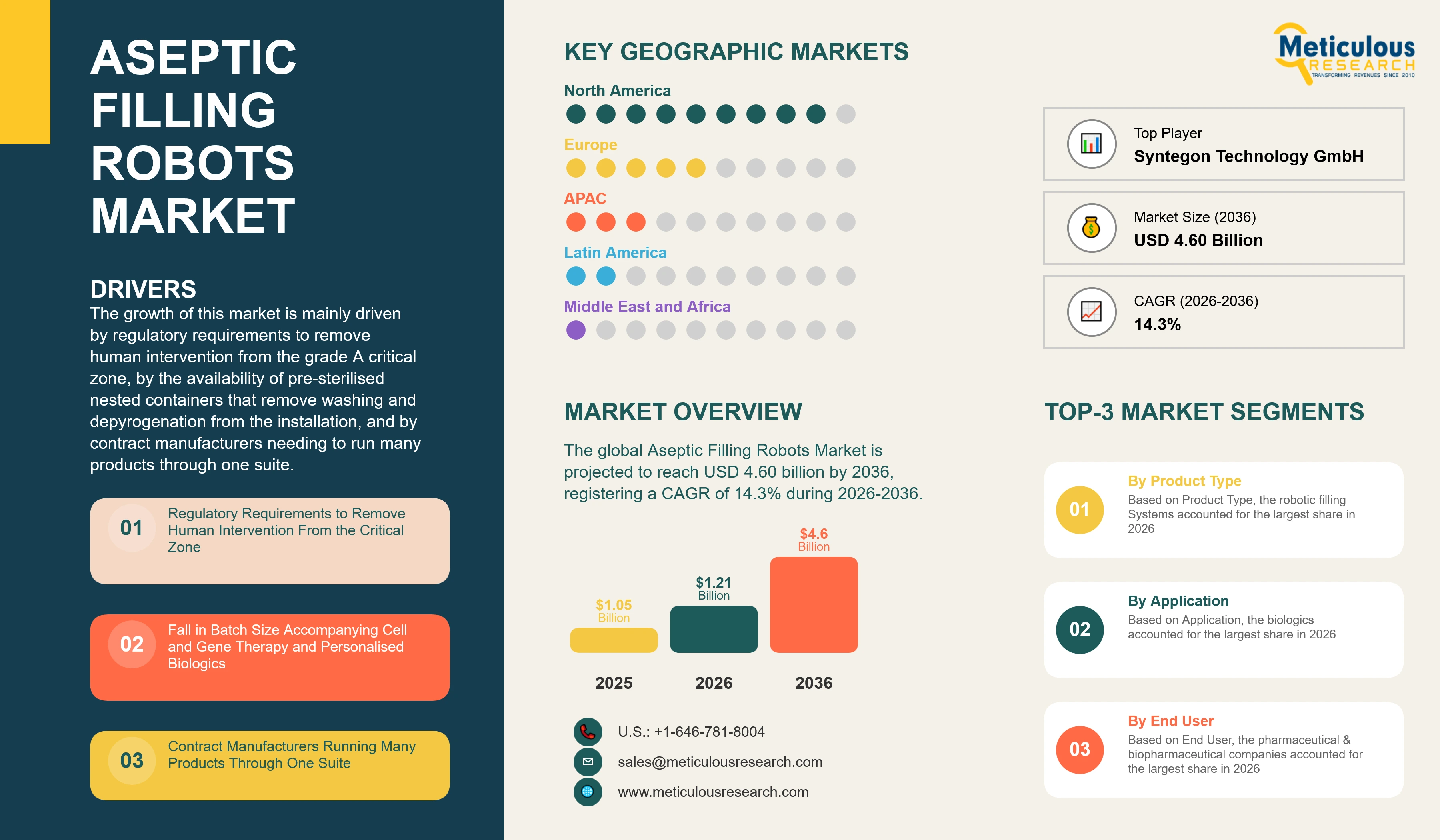
The global Aseptic Filling Robots Market was valued at USD 1.05 billion in 2025. This market is expected to reach USD 4.60 billion by 2036 from an estimated USD 1.21 billion in 2026, registering a CAGR of 14.3% during the forecast period (2026-2036).
- Published
- Nov 2026
- Pages
- 367
- Format
- PDF + Excel
- Report ID
- MRSE - 1042421
- Base year
- 2025
- 2025 · BASELINE
- $1.05B
- 2036
- $4.60B
- CAGR 2026–2036
- 14.3%
2025 baseline · 2026–2036 forecast at 14.3% CAGR · hover a bar for the value
Key highlights
The global Aseptic Filling Robots Market is valued at USD 1.21 billion in 2026 and is projected to reach USD 4.60 billion by 2036, at a CAGR of 14.3%.
Based on product type, the robotic filling systems segment is expected to account for the largest share of the market in 2026, while the gloveless robotic isolators segment is projected to register the highest CAGR during the forecast period.
Based on container type, the vials segment is expected to account for the largest share of the market in 2026, while the prefilled syringes segment is projected to register the highest CAGR during the forecast period.
Based on barrier system, the isolators segment is expected to account for the largest share of the market in 2026 and is also projected to register the highest CAGR during the forecast period.
Based on batch scale, the commercial high volume segment is expected to account for the largest share of the market in 2026, while the clinical and small batch segment is projected to register the highest CAGR during the forecast period.
Based on application, the biologics segment is expected to account for the largest share of the market in 2026, while the cell and gene therapy segment is projected to register the highest CAGR during the forecast period.
Based on end user, the pharmaceutical and biopharmaceutical companies segment is expected to account for the largest share of the market in 2026, while the contract development and manufacturing organizations segment is projected to register the highest CAGR during the forecast period.
Based on geography, North America is expected to account for the largest share of the market in 2026, while Asia-Pacific is projected to register the highest CAGR during the forecast period.
Report summary
| Particulars | Details |
|---|---|
| Base Year | 2025 |
| Estimated Year | 2026 |
| Forecast Period | 2026-2036 |
| Market Size in 2025 | USD 1.05 billion |
| Market Size in 2026 | USD 1.21 billion |
| Market Size by 2036 | USD 4.60 billion |
| CAGR (2026-2036) | 14.3% |
| Format | PDF, Excel & Cloud Portal · 367 pages |
| Largest Segment by Product Type (2026) | Robotic Filling Systems |
| Fastest-growing Segment by Product Type | Gloveless Robotic Isolators |
| Largest Segment by Container Type (2026) | Vials |
| Fastest-growing Segment by Container Type | Prefilled Syringes |
| Largest and Fastest-growing Segment by Barrier System | Isolators |
| Fastest-growing Segment by Batch Scale | Clinical and Small Batch |
| Fastest-growing Segment by Application | Cell and Gene Therapy |
| Largest Region (2026) | North America |
| Fastest-growing Region | Asia-Pacific |
| Segments Covered | Product Type, Container Type, Barrier System, Batch Scale, Application, End User, Geography |
| Company Naming Basis | Registered legal entity, with group capability attributed to its owner |
| Number of Companies Profiled | 20, plus other companies |
Report overview
Segments covered: product type, container type, barrier system, batch scale, application, end user.
The aseptic filling robots market covers robotic systems used to fill and close sterile drug products under grade A conditions, including robotic filling systems, gloveless robotic isolators, robotic transfer and handling systems, robotic capping and closing systems and the cleanroom robot arms supplied into them, across vials, prefilled syringes, cartridges, ampoules and other sterile containers. The growth of this market is driven by regulatory requirements to remove human intervention from the critical zone, by the fall in batch size that accompanies cell and gene therapy and personalised biologics, by the availability of pre-sterilised nested containers, and by contract manufacturers needing to run many products through one suite.
Annex 1 to the European Union guidelines on good manufacturing practice became operational on 25 August 2023, one year after publication in EudraLex Volume 4, with point 8.123 applying from 25 August 2024. Paragraph 8.9 of that Annex states that the use of equipment such as restricted access barrier systems, isolators or other systems should be considered in order to reduce the need for critical interventions into grade A, and that robotics and automation of processes can also be considered to eliminate direct human critical interventions. Paragraph 2.1(i) lists robotic systems among the technologies to be considered for protecting the product from contamination. The regulation therefore names the product category this report covers rather than describing an outcome and leaving the means open, which is unusual and gives the market a defined regulatory basis.
A filling machine has always been bought on output per hour, and that is the wrong measure in this market. Cell and gene therapy products and personalised biologics are filled in batches of tens to hundreds of containers rather than hundreds of thousands, and at that size the cost of a run is dominated by changeover, cleaning validation and media fills rather than by filling speed. A system that fills a few hundred containers an hour but changes format without mechanical change parts will produce more batches in a year than a high speed line that takes days to turn around, so the number that decides the purchase is the time between batches.
Sterile drug products are filled in a grade A environment in which the product is exposed between the point it leaves the sterilising filter and the point the container is closed, and the operator is the largest single source of contamination in that environment. A robotic filling system places the handling, filling and closing operations inside a sealed enclosure and performs them without an operator reaching into the zone, which removes the gloves, the arm movements and the particle shedding that a conventional installation has to be designed around. The enclosure is sealed and decontaminated as a unit, so the environment the product is exposed to is defined by the equipment rather than by the behaviour of the people around it.
Annex 1 to the European Union guidelines on good manufacturing practice became operational on 25 August 2023, one year after publication in EudraLex Volume 4, with point 8.123 applying from 25 August 2024. Paragraph 4.4 requires that direct intervention into the grade A area without the protection of barrier and glove port technology should be minimised by premises, equipment, process and procedural design, and paragraph 8.16 requires that engineering solutions should be used whenever possible to minimise incursion by operators during an intervention. Paragraph 2.3 requires that a contamination control strategy should be implemented across the facility, and Paragraph 4.3 states that restricted access barrier systems or isolators are beneficial in assuring required conditions, and paragraph 8.48 requires that the integrity of the sterile protective barrier system for each sterilised item should be checked prior to use. Paragraph 8.9 of that Annex states that the use of equipment such as restricted access barrier systems, isolators or other systems should be considered in order to reduce the need for critical interventions into grade A, and that robotics and automation of processes can also be considered to eliminate direct human critical interventions. Paragraph 2.1(i) lists robotic systems among the technologies to be considered for protecting the product from contamination. Compliance can be achieved with a glove port isolator alone, so the Annex establishes that robotic filling is an accepted route rather than obliging anyone to buy one, and the commercial case has to be made on something other than the regulation.
Batch size is what makes that case. A cell therapy product manufactured for a single patient fills a handful of containers, an autologous or allogeneic therapy batch fills tens to a few hundred, and a personalised biologic is produced in similarly small quantities, against the hundreds of thousands of units a conventional vial line is designed to fill in a shift. At the smaller size the cost per container is set by the work required to prepare, clean, validate and release the line between batches rather than by the speed at which it runs.
Robotic systems change format without mechanical change parts, handling containers through vision systems and grippers rather than through sized tracks, guides and star wheels. Changeover therefore takes minutes rather than the days a format change requires on a conventional line, and a suite can run several products in a week instead of one campaign in a month, which is what allows a contract manufacturer to put many low volume products through a single installation. The same flexibility allows a developer with one product today and three in two years to install capacity once rather than twice.
Pre-sterilised nested containers supplied in sealed tubs remove a further part of the installation. Vials, syringes and cartridges arriving already washed, depyrogenated and sterilised allow the system to work without a washing machine and a depyrogenation tunnel, which removes a large part of the capital cost, the floor space and the utilities a traditional filling line requires. The requirement at paragraph 8.48 that the integrity of the sterile protective barrier system be checked before use applies directly to those tubs, and the check is performed inside the enclosure by the system itself.
Capital cost sits above a conventional small scale line for the same output, and the comparison that matters is cost per batch released rather than cost per container filled. A buyer running one product at high volume will reach a lower cost per unit on a conventional line, while a buyer running twenty products in clinical quantities will not get the batches through that line at all, which is why the technology has been adopted first by contract manufacturers and by cell and gene therapy developers rather than by large volume vaccine or biologic producers.
Validation remains the longest part of a project and is not shortened by removing the operator. A robotic installation has to demonstrate sterility assurance through media fills, environmental monitoring and decontamination cycle development in the same way as any aseptic process, and the automated bio-decontamination of the enclosure interior has to be validated as paragraph 4.22 requires. Project timelines are therefore set by qualification work rather than by equipment delivery, and a buyer replacing an existing process carries that time twice.
Supply of these systems is concentrated among European pharmaceutical machinery manufacturers, with German and Italian companies holding most of the installed base, alongside a smaller group of life science equipment groups that entered through acquisition and the cleanroom robot manufacturers that supply the arms inside the enclosures. Chinese manufacturers supply the domestic market and have begun to export, and the robot arm itself is bought from a small number of suppliers whose products are qualified for grade A use. Ownership of the enclosure, the handling mechanism and the arm is therefore split across more than one company in most installations, and the machinery manufacturer carries responsibility for the qualification of the whole.
Access to grade A qualified robot arms limits how quickly supply can expand, since an arm used inside the critical zone has to tolerate repeated vaporised hydrogen peroxide exposure, shed no particles and carry the documentation an aseptic process requires, which a standard industrial arm does not. Growth in the clinical and small batch segment also depends on cell and gene therapy approvals converting into routine manufacturing, and those volumes are determined by clinical outcomes rather than by capital equipment availability.
Report infographic
Market dynamics
22 factors across 5 forcesRegulatory Requirements to Remove Human Intervention From the Critical Zone
Annex 1 to the European Union guidelines on good manufacturing practice became operational on 25 August 2023, one year after publication in EudraLex Volume 4, with point 8.123 applying from 25 August 2024, and Paragraph 4.4 requires that direct intervention into the grade A area without the protection of barrier and glove port technology should be minimised by premises, equipment, process and procedural design, and paragraph 8.16 requires that engineering solutions should be used whenever possible to minimise incursion by operators during an intervention. Paragraph 8.9 of that Annex states that the use of equipment such as restricted access barrier systems, isolators or other systems should be considered in order to reduce the need for critical interventions into grade A, and that robotics and automation of processes can also be considered to eliminate direct human critical interventions. Paragraph 2.1(i) lists robotic systems among the technologies to be considered for protecting the product from contamination. The regulation therefore identifies the operator as the contamination risk to be engineered out and names robotics as a means of doing so, which gives a capital proposal a documented regulatory basis rather than an efficiency argument. Manufacturers supplying the European market comply regardless of where they produce, so the requirement reaches installations in North America and Asia-Pacific as well as in Europe. A capital request supported by an inspection finding is also approved more readily than one supported by a throughput calculation.
Fall in Batch Size Accompanying Cell and Gene Therapy and Personalised Biologics
A cell therapy batch fills tens to a few hundred containers against the hundreds of thousands a conventional vial line is designed to fill in a shift, and at that size the cost per container is set by the work required to prepare, clean, validate and release the line between batches rather than by filling speed. Robotic systems change format without mechanical change parts, so changeover takes minutes rather than days and a suite can release several batches in the time a conventional line needs for one. Demand therefore follows the number of products a facility must handle rather than the volume it must produce. That makes the addressable market a count of programmes and suites rather than a function of drug volume, and it grows even where total injectable output does not. The driver therefore strengthens as pipelines broaden rather than as volumes rise.
Availability of Pre-Sterilised Nested Containers
Vials, syringes and cartridges supplied already washed, depyrogenated and sterilised in sealed tubs allow a filling system to operate without a washing machine and a depyrogenation tunnel, which removes a large part of the capital cost, the floor space and the utilities a traditional line requires. The requirement at paragraph 8.48 that the integrity of the sterile protective barrier system be checked before use applies to those tubs and the check is performed inside the enclosure, so the no-touch transfer the Annex expects is achieved without an operator opening the container supply. This makes a complete filling capability viable within a suite rather than a dedicated filling hall. Container manufacturers supplying in this format have consequently become part of the equipment decision rather than a procurement that follows it.
Contract Manufacturers Running Many Products Through One Suite
A contract development and manufacturing organisation earns from the number of programmes it can take on rather than from the volume of any one of them, and a conventional line dedicated to a format and a campaign limits how many it can accept. Format changeover without mechanical change parts allows one installation to serve vials, syringes and cartridges across many clients, and the enclosure keeps those products segregated without a cleaning validation exercise between each. This driver has made contract manufacturers the fastest-growing group of buyers in this market.
Table of contents
14 chapters · 154 sections · 367 pages · click to expandGeographic analysis
North America
Largest shareIn 2026, North America is expected to account for the largest share of the market. The large share of this region is mainly due to the concentration of biologics and cell and gene therapy manufacturing, to the number of contract development and manufacturing organisations serving those developers, and to manufacturers supplying the European market complying with Annex 1 regardless of where they produce, which brings the requirement to United States installations.
Asia-Pacific
Fastest growthHowever, Asia-Pacific is projected to register the highest CAGR during the forecast period. The rapid growth of this region is attributed to investment in biologics and vaccine manufacturing capacity in China, India, South Korea and Japan, to contract manufacturers in the region taking work for export markets that require Annex 1 compliance, and to domestic equipment manufacturers supplying systems at lower cost than imported platforms. Growth is led by China and South Korea, with India concentrated in contract manufacturing for export.
Europe
Europe holds the position in which the regulation originates and in which most of the supply base sits, with German and Italian pharmaceutical machinery manufacturers holding most of the installed base worldwide. Demand across the region comes from established biologics manufacturers bringing facilities into line with the Annex and from cell and gene therapy developers establishing first manufacturing capability, and buyers here generally specify to the Annex directly rather than to a translated national requirement. Germany, Italy and Switzerland hold the largest national positions, reflecting both the supply base and the concentration of contract filling capacity, while Ireland holds a position disproportionate to its size through the biologics plants operated there by international manufacturers.
Latin America
Latin America and the Middle East & Africa remain smaller positions concentrated in vaccine and generic injectable production, with purchases usually forming part of a wider facility project and specified by the engineering contractor rather than by the manufacturer. Access in both regions depends on local service coverage, since a sterility assurance failure cannot wait for a technician to travel, and suppliers without regional service presence are generally excluded at the specification stage. Brazil and the Gulf states account for most of the activity in these regions. Growth in both follows public vaccine and generic injectable programmes rather than private capital investment, which makes the timing of demand dependent on government procurement cycles.
Competitive landscape
German and Italian pharmaceutical machinery manufacturers hold most of the installed base in this market, having built aseptic filling equipment for decades and extended those platforms to robotic handling. Life science equipment groups have entered through acquisition and now offer filling alongside upstream and downstream bioprocess equipment. Cleanroom robot manufacturers supply the arms inside the enclosures rather than complete systems, and Chinese machinery manufacturers supply the domestic market and have begun to export.
Qualification evidence separates suppliers more than specification does, because a buyer adopting robotic filling has to satisfy an inspector and a supplier able to point to comparable installations already approved reduces that exposure. Grade A qualified components matter for the same reason, since an arm inside the critical zone must tolerate repeated vaporised hydrogen peroxide exposure, shed no particles and carry aseptic documentation that a standard industrial arm does not. Regional service coverage also decides projects, because a sterility assurance failure cannot wait for a technician to travel.
Competition now runs across what used to be separate procurements. A buyer establishing cell therapy capability can source filling from the bioprocess supplier it already works with, from a pharmaceutical machinery manufacturer, or from a container manufacturer supplying nested components and the system to fill them, and those three approach the same project from different starting points. Container supply format has consequently become part of the equipment decision rather than a procurement that follows it.
Key players operating in the global Aseptic Filling Robots Market are Syntegon Technology GmbH (Germany), OPTIMA packaging group GmbH (Germany), Groninger & Co. GmbH (Germany), Bausch + Stroebel Maschinenfabrik Ilshofen GmbH + Co. KG (Germany), GEA Group Aktiengesellschaft (Germany), Koerber AG (Germany), IMA S.p.A. (Italy), Stevanato Group S.p.A. (Italy), Steriline S.r.l. (Italy), Marchesini Group S.p.A. (Italy), Fedegari Autoclavi S.p.A. (Italy), Danaher Corporation (U.S.), ATS Corporation (Canada), Staeubli International AG (Switzerland), Kawasaki Heavy Industries, Ltd. (Japan), Yaskawa Electric Corporation (Japan), DENSO Corporation (Japan), Dara Pharmaceutical Equipment, S.L. (Spain), Truking Technology Limited (China), and Shanghai Tofflon Science and Technology Co., Ltd. (China).
Companies are identified at registered legal entity level, and capability held within a group is attributed to the entity that owns it. Vanrx Pharmasystems is not listed separately, because it was acquired by Cytiva in February 2021 and is held within Danaher Corporation, and Comecer S.p.A. is not listed separately, because it joined the ATS group in 2019 and is held within ATS Corporation. The companies profiled were verified as active in the supply of robotic aseptic filling systems, gloveless robotic isolators, robotic handling systems for grade A use or grade A qualified robot arms as of October 2026. Suppliers of isolators and barrier systems without a robotic handling or filling function, sterilisation and depyrogenation equipment manufacturers without a filling product, container and closure manufacturers without a filling system, inspection equipment suppliers, and cleanroom construction and engineering contractors were excluded.
- Syntegon Technology GmbH · Germany
- OPTIMA packaging group GmbH · Germany
- Groninger & Co. GmbH · Germany
- GEA Group Aktiengesellschaft · Germany
- Koerber AG · Germany
- IMA S.p.A · Italy
- Stevanato Group S.p.A · Italy
- Steriline S.r.l · Italy
- Marchesini Group S.p.A · Italy
- Fedegari Autoclavi S.p.A · Italy
- Danaher Corporation (U.S.)
- ATS Corporation · Canada
- Staeubli International AG · Switzerland
- Kawasaki Heavy Industries, Ltd. · Japan
- Yaskawa Electric Corporation · Japan
- DENSO Corporation · Japan
- Dara Pharmaceutical Equipment
- S.L · Spain
- Truking Technology Limited · China
- Shanghai Tofflon Science and Technology Co., Ltd. · China
Expert perspectives
Regulation is where assessment of this market usually begins and it establishes less than it appears to. Annex 1 to the European Union guidelines on good manufacturing practice became operational on 25 August 2023, one year after publication in EudraLex Volume 4, with point 8.123 applying from 25 August 2024, Paragraph 8.9 of that Annex states that the use of equipment such as restricted access barrier systems, isolators or other systems should be considered in order to reduce the need for critical interventions into grade A, and that robotics and automation of processes can also be considered to eliminate direct human critical interventions. Paragraph 2.1(i) lists robotic systems among the technologies to be considered for protecting the product from contamination, so the regulation names this product category rather than describing an outcome. Compliance can equally be achieved with a glove port isolator at lower cost, which means the Annex makes robotic filling an accepted route without obliging anyone to take it. What obliges a buyer is batch size, because cell and gene therapy and personalised biologics fill tens to a few hundred containers per batch and at that size the cost per container is set by changeover, cleaning validation and release work rather than by filling speed. The binding constraint is therefore shifting from output per hour to the time a suite needs between batches.
Enclosures without glove ports are expected to continue displacing glove port isolators through 2036, because the gloves remain the component most likely to fail and removing them removes the testing programme that accompanies them. Pre-sterilised nested containers are expected to become the standard input rather than an alternative, which removes the washing machine and depyrogenation tunnel from new installations and brings a complete filling capability within a manufacturing suite. Competition is expected to continue widening beyond pharmaceutical machinery, since a buyer establishing new capability can now source the filling step from the bioprocess supplier it already works with.
For companies planning entry or expansion, cell and gene therapy developers establishing first manufacturing capability are the most accessible buyers, because they have no conventional line to justify retaining and cannot accept the loss of a batch that may represent one patient treatment. Supplying grade A qualified arms and components into the machinery manufacturers reaches the whole market rather than individual sites, and the qualification work that limits entry also protects the position once held. Buyers should compare cost per batch released across an expected product portfolio rather than cost per container at a single output, since the second measure favours equipment that cannot run the portfolio at all.
Qualification work rather than equipment delivery sets project timelines, and removing the operator does not shorten it, so a manufacturer replacing a running process carries that work while continuing to supply from the existing line and should expect the first installation at a site to take considerably longer than the second. Growth in the clinical and small batch segment also depends on cell and gene therapy approvals converting into routine manufacturing, and those volumes follow clinical outcomes rather than capital equipment availability, so the segment carrying the fastest growth is the segment whose volumes are least within the control of anyone in this market.
Overall, the core of demand through the forecast period will continue to sit in robotic filling systems installed in isolators for vial filling of biologics at commercial volume by pharmaceutical manufacturers in North America, while the fastest growth will come from gloveless robotic isolators, prefilled syringes, clinical and small batch installations, cell and gene therapy applications, contract development and manufacturing organizations and Asia-Pacific facilities.
Customer perspectives
Head of Sterile Manufacturing, Biopharmaceutical Company
This perspective confirms that the regulation establishes robotic filling as an accepted route without compelling the purchase, and that product count rather than compliance decides it. It supports the conclusion that the number of batches a suite can release, rather than output per hour, is the measure on which these systems are bought.
Director of Manufacturing, Cell Therapy Developer
This perspective identifies batch value and the absence of an installed line as the reasons cell and gene therapy developers adopt gloveless enclosures first. It supports the conclusion that this application is the fastest-growing in the market and that buyers establishing capability for the first time face a different decision from manufacturers with approved products.
Operations Manager, Contract Development and Manufacturing Organisation
This perspective confirms that contract manufacturers buy format flexibility rather than throughput, and that segregation between clients is part of the value. It supports the conclusion that these organisations are the fastest-growing group of buyers and that multi-format installations capture larger projects than single format lines.
Frequently asked questions
The market was valued at USD 1.05 billion in 2025 and is estimated at USD 1.21 billion in 2026.
Cite this report
Meticulous Research. (2026). Aseptic Filling Robots Market - Global Opportunity Analysis and Industry Forecasts (2026-2036) (Report No. MRSE - 1042421). Meticulous Market Research Pvt. Ltd. https://www.meticulousresearch.com/product/aseptic-filling-robots-market-7104