Semiconductor ATE Market (2026-2036)
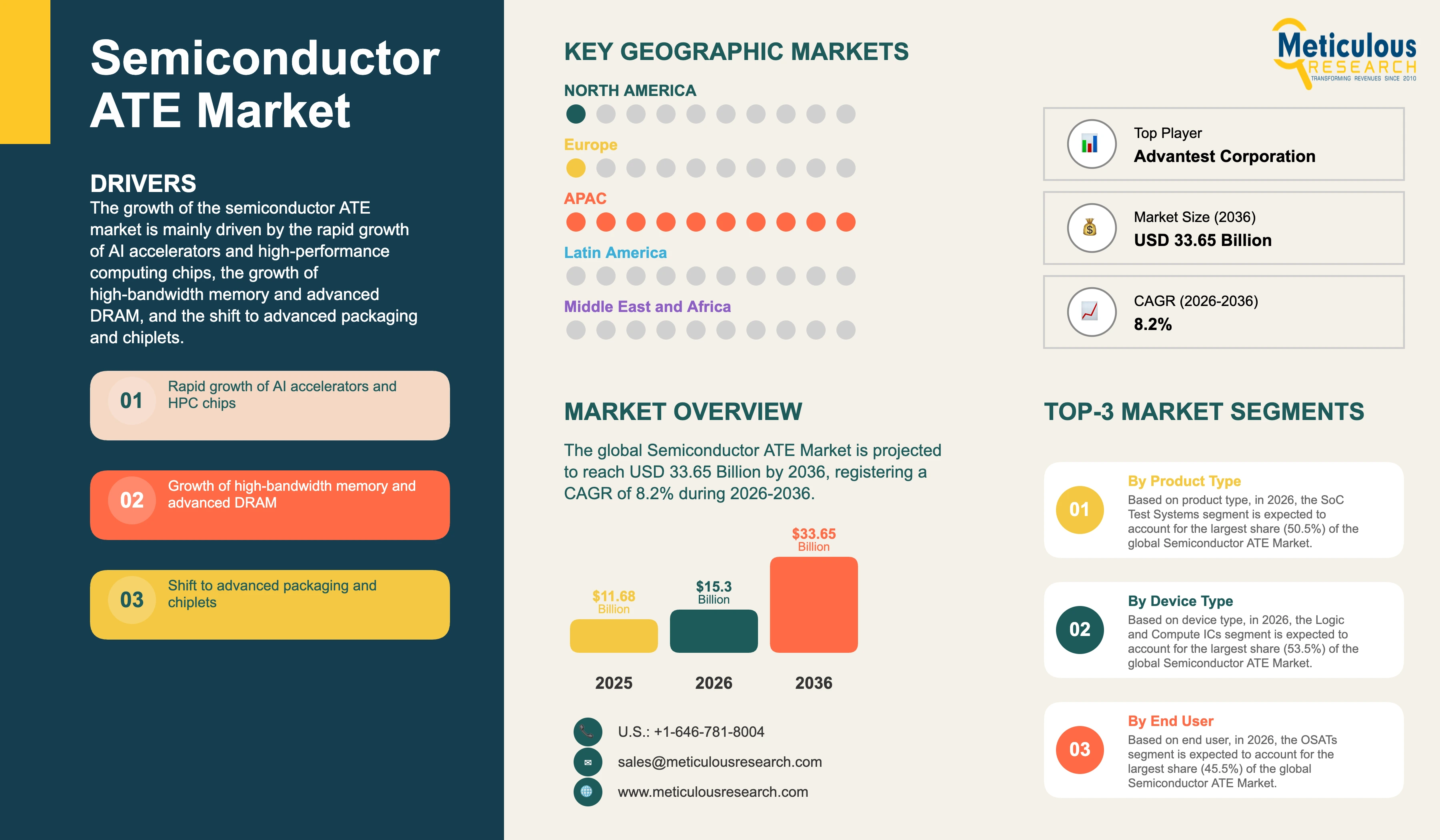
The global semiconductor automated test equipment (ATE) market was valued at USD 11.68 billion in 2025. This market is expected to reach USD 33.65 billion by 2036 from an estimated USD 15.30 billion in 2026, registering a CAGR of 8.2% during the forecast period (2026-2036).
- Published
- Nov 2026
- Pages
- 272
- Format
- PDF + Excel
- Report ID
- MRSE - 1042519
- Base year
- 2025
- 2025 · BASELINE
- $11.68B
- 2036
- $33.65B
- CAGR 2026–2036
- 8.2%
2025 baseline · 2026–2036 forecast at 8.2% CAGR · hover a bar for the value
Key highlights
Semiconductor test equipment sales rose 55.3% in 2025 and are projected to increase another 31.0% to USD 15.3 billion in 2026, according to SEMI, with further growth expected through 2028 to USD 20.8 billion.
Advantest reported record net sales of JPY 1.129 trillion for the fiscal year ended March 2026, up 45%, driven by SoC tester demand for AI-related semiconductors, and forecasts sales of JPY 1.420 trillion for the fiscal year ending March 2027.
Teradyne reported 2025 revenue of USD 3.19 billion, up 13%, with Semiconductor Test revenue up 19% and compute revenue up 90%, and more than half of its SoC product revenue came from compute applications in 2025, compared with about 10% in 2023.
Hangzhou Changchuan Technology, a leading Chinese test equipment supplier, reported 2025 revenue of RMB 5.29 billion, up 45.3%, with testers accounting for about 61% of sales, reflecting rising demand for domestic test equipment in China.
Aehr Test Systems received a USD 22 million follow-on order in August 2026 from its lead AI processor customer for wafer-level burn-in systems, and Cohu reported a 54% year-over-year increase in test handler orders in the first quarter of 2026, driven by AI and high-performance computing.
Teradyne said that AI-related demand accounted for more than 60% of its revenue in the fourth quarter of 2025, and it believes it held about 50% share of the VIP compute test market in 2025, while its memory test revenue rose in a roughly flat memory test market on share gains in HBM and DRAM final test.
Advantest introduced the Pin Scale 5000B digital test solution for its V93000 EXA Scale platform in April 2026 and partnered with OpenLight to develop silicon photonics test solutions for high-volume manufacturing.
System-level test systems are the fastest-growing product type, photonic and other devices are the fastest-growing device type, and foundries are the fastest-growing end user.
By product type, SoC test systems account for the largest share of 50.5% in 2026, while system-level test systems register the highest CAGR.
By device type, logic and compute ICs account for the largest share in 2026, while photonic and other devices register the highest CAGR.
By end application, computing and data center accounts for the largest share in 2026 and also registers the highest CAGR.
By end user, OSATs account for the largest share of 45.5% in 2026, while foundries register the highest CAGR.
By geography, Asia-Pacific accounts for the largest share of 81.5% in 2026, while North America registers the highest CAGR of 10.5%.
Report summary
| Particulars | Details |
|---|---|
| Base Year | 2025 |
| Estimated Year | 2026 |
| Forecast Period | 2026-2036 |
| Market Size in 2025 | USD 11.68 billion |
| Market Size in 2026 | USD 15.30 billion |
| Market Size by 2036 | USD 33.65 billion |
| CAGR (2026-2036) | 8.2% |
| Format | PDF, Excel & Cloud Portal · 272 pages |
| Largest Segment by Product Type (2026) | SoC Test Systems (50.5%) |
| Largest Segment by End User (2026) | OSATs (45.5%) |
| Largest Region (2026) | Asia-Pacific (81.5%) |
| Fastest-Growing Region | North America (CAGR 10.5%) |
| Segments Covered | Product Type, Device Type, End Application, End User, and Geography |
| Geographic Scope | Asia-Pacific, North America, Europe, and Rest of the World |
| Key Companies Profiled | Advantest, Teradyne, Tokyo Electron, Tokyo Seimitsu, Cohu, Chroma ATE, Hangzhou Changchuan Technology, Beijing Huafeng Test & Control Technology, Aehr Test Systems, Emerson (NI), SPEA, Techwing, UniTest, and Exicon |
Report overview
Segments covered: product type, device type, end application, end user.
The growth of this market is mainly driven by the rapid growth of AI accelerators and high-performance computing chips, which need much longer and more complex test, the growth of high-bandwidth memory (HBM), the shift to advanced packaging and chiplets, which adds test steps to ensure known-good die, and the rising semiconductor content of vehicles and data center networking. However, factors such as the cyclical nature of semiconductor capital spending and the very high cost of advanced test systems are expected to restrain the growth of this market to some extent. In addition, export controls on semiconductor equipment and technology and the growing push for domestic test equipment in China are expected to create challenges for global suppliers.
Semiconductor automated test equipment (ATE) is used to test chips at the wafer stage and after packaging to make sure they work correctly and meet their specifications before they are shipped to customers. ATE systems apply electrical signals to each device, measure its responses, and sort good parts from bad ones, and they are used together with wafer probers, which position wafers for testing, and test handlers, which move packaged chips into and out of test sockets. Burn-in and system-level test systems add further screening by stressing devices at high temperature or running them as they would operate in a final system. Together, these systems make up the test cell, and the cost of test is closely watched by chipmakers because it can account for a meaningful share of total manufacturing cost for complex chips.
The ATE market includes several types of test systems that serve different kinds of chips. SoC test systems test processors, AI accelerators, application processors, networking chips, and other complex logic devices, and they account for the largest share of the market. Memory test systems test DRAM, HBM, and NAND flash, analog, mixed-signal, and power test systems test power management chips, sensors, and power devices, and system-level test systems test chips under real operating conditions. Leading suppliers include Advantest and Teradyne in testers, Tokyo Electron and Tokyo Seimitsu in wafer probers, Cohu and Techwing in handlers, and Aehr Test Systems in burn-in.
The market has grown very quickly since 2024, mainly because of AI. AI accelerators and high-performance processors are among the largest and most complex chips ever made, with tens of billions of transistors, high power, and many high-speed interfaces, and they need much longer test times and more powerful testers than mobile or consumer chips. Teradyne's compute revenue grew 90% in 2025, and Advantest's sales grew 45% in its fiscal year ended March 2026, both driven by AI-related demand. SEMI expects test equipment sales to reach USD 15.3 billion in 2026 after growing 55.3% in 2025. This growth has been concentrated in high-end SoC testers, HBM test, and related handlers and probers, while demand for testers used in mobile and consumer chips has been weaker.
The way chips are tested is also changing with advanced packaging, as AI processors are increasingly built from several chiplets and HBM stacks in a single package, such as TSMC's CoWoS, and a single bad die can ruin a very expensive package. This is driving more testing at the wafer stage to find known-good die, more system-level test after packaging, and new uses of wafer-level burn-in. These extra test steps raise test spending per device and create demand for new types of equipment, such as high-power probers, active thermal control handlers, and wafer-level burn-in systems.
Memory is another important source of demand, particularly HBM, which stacks many DRAM dies and requires extra testing at several stages. Although the overall memory test market grew only slightly in 2025, HBM and advanced DRAM test demand grew strongly, and memory makers such as SK hynix, Samsung, and Micron are adding HBM capacity. Automotive and industrial chips, power semiconductors, silicon photonics, and co-packaged optics for data center networking are also creating new test needs over the forecast period. Silicon carbide and gallium nitride power devices, in particular, need high-voltage test and burn-in equipment that differs from traditional silicon test systems.
The market is concentrated, with Advantest and Teradyne holding most of the tester market, and a small number of companies leading in probers and handlers. However, Chinese suppliers such as Hangzhou Changchuan Technology and Beijing Huafeng Test & Control Technology are growing quickly as China seeks to build a domestic semiconductor supply chain. Asia-Pacific, particularly Taiwan, China, South Korea, Japan, and Southeast Asia, accounts for most test equipment demand because most chip packaging and testing takes place there, while new investments in the U.S. and Europe are adding demand in those regions.
HBM has changed our test flow completely. Every die in the stack has to be tested at wafer level, and the stack has to be tested again, often at high speed and temperature, so our test equipment needs have grown much faster than our wafer output.
The growth of HBM is driving demand for advanced memory test systems and inspection equipment, which supports steady growth in memory test systems over the forecast period. Memory makers are also adding burn-in and high-speed final test capacity for each new HBM generation.
Report infographic
Market dynamics
15 factors across 5 forcesRapid growth of AI accelerators and high-performance computing chips
AI accelerators, GPUs, custom AI ASICs, and high-performance CPUs are driving the strongest growth in test equipment demand. These chips are very large, run at high power, and include many high-speed interfaces, which require testers with high pin counts, high power delivery, and advanced thermal control. Test times for AI chips are much longer than for mobile chips, and because each chip is very valuable, manufacturers test them more thoroughly to avoid costly failures.
Teradyne's compute revenue rose 90% in 2025, and more than half of its SoC product revenue came from compute applications by the end of 2025, compared with about 10% in 2023, while Advantest has repeatedly raised its outlook on strong SoC tester demand for AI-related semiconductors. As hyperscalers and chipmakers continue to launch new AI chips each year, demand for advanced SoC testers is expected to remain strong. Computing and data center accounts for the largest share and the highest CAGR among end applications. Each new generation of AI chips also tends to need upgraded testers, which supports replacement demand. Hyperscalers designing their own AI chips, such as custom accelerators, have also become important buyers or specifiers of test capacity, broadening the customer base for advanced testers.
Growth of high-bandwidth memory and advanced DRAM
High-bandwidth memory (HBM) is a key component of AI accelerators, and it requires more test steps than conventional DRAM because it stacks many memory dies on a base die and connects them with through-silicon vias. Each die must be tested at the wafer stage, and the stack must be tested again after assembly, often at high speed and over a range of temperatures, which raises test time and equipment needs. SK hynix, Samsung, and Micron are all expanding HBM capacity, and new HBM generations increase the number of stacked dies and data rates.
Teradyne has gained share in HBM and DRAM final test, Advantest supplies memory testers for HBM, and Cohu's HBM inspection products are growing quickly, with Neon HBM revenue expected to grow about 80% in 2026. Memory test systems account for the second-largest share of the market, and HBM is expected to be the main growth driver within this segment. DRAM equipment sales are also expected to rise strongly in 2026, according to SEMI, which supports demand for memory testers. Memory makers also need more burn-in capacity for HBM, which adds demand for memory burn-in systems from suppliers such as UniTest and Exicon.
Shift to advanced packaging and chiplets
Advanced packaging technologies, such as 2.5D and 3D packaging, chiplets, and hybrid bonding, are changing the test process. When several dies are combined in one package, each die must be known to be good before assembly, because a single bad die can cause the loss of the whole package, which may include costly HBM stacks. This is driving more testing at the wafer stage, more system-level test after packaging, and the adoption of wafer-level burn-in for AI processors.
Aehr Test Systems has received several orders for wafer-level burn-in systems from AI processor customers, including a USD 22 million follow-on order in August 2026, and foundries such as TSMC are adding more test capacity as part of their advanced packaging services. These changes increase the number of test steps per device and create demand for new types of equipment. Foundries are the fastest-growing end user, and system-level test systems are the fastest-growing product type in this market.
Rising semiconductor content in vehicles, networking, and industrial systems
Vehicles, data center networks, and industrial systems are using more and more complex semiconductors. Electric and software-defined vehicles use advanced processors, sensors, power devices, and connectivity chips, which must meet very high reliability standards and often need extra testing and burn-in. Data center networks are moving to faster switches and optical interconnects, including silicon photonics and co-packaged optics, which create new test needs.
Power semiconductors made from silicon carbide and gallium nitride also require special test and burn-in equipment, as they operate at high voltages and temperatures. These applications add to the broad base of test equipment demand beyond AI and memory. Photonic and other devices are the fastest-growing device type in this market. Automotive demand has been uneven in 2025 and 2026, but the long-term trend of rising chip content per vehicle is expected to support steady growth.
Table of contents
12 chapters · 127 sections · 272 pages · click to expandSegmental analysis
| Segment | Largest share (2026) | Fastest growth (2026–2036) |
|---|---|---|
| By Product Type | SoC test systems | System-level test systems |
| By Device Type | Logic and compute ICs | Photonic and other devices |
| By End Application | Computing and data center | Large share and rapid growth of this |
| By End User | OSATs | Foundries |
By Product Type
- Semiconductor ATE Market Analysis by Product Type
- The SoC test systems segment is expected to account for the largest share of 50.5% of the global semiconductor ATE market.
- The large share of this segment is mainly due to the very strong demand for testing AI accelerators, GPUs, custom AI ASICs, high-performance CPUs, and networking chips, which require the most advanced and costly testers.
- SoC test systems test complex logic chips, including processors, application processors, AI accelerators, networking switches, and automotive controllers.
- These chips need testers with very high pin counts, high-speed digital and mixed-signal capability, high power delivery, and advanced thermal control, and each tester can cost several million dollars when fully configured.
- Advantest's V93000 platform and Teradyne's UltraFLEX and J750 families are the most widely used SoC test platforms, and Advantest has reported record SoC tester sales driven by AI-related demand, while Teradyne's SoC test revenue grew 23% in 2025.
- The growth of AI chips has shifted SoC tester demand from mobile toward compute, and longer test times for very large chips mean that more testers are needed for each unit of production.
- Each new generation of AI processors also requires upgraded testers with higher power and more high-speed interfaces, which supports strong replacement and upgrade demand.
- However, the system-level test systems segment is projected to register the highest CAGR during the forecast period.
- The rapid growth of this segment is driven by the growing use of system-level test for AI processors and high-performance chips in advanced packages, where traditional structural tests cannot catch all defects.
- Memory test systems, analog, mixed-signal, and power test systems, test handlers, wafer probers, and burn-in and other test equipment make up the rest of the market.
By Device Type
- Semiconductor ATE Market Analysis by Device Type
- The logic and compute ICs segment is expected to account for the largest share of the market.
- The large share of this segment is mainly due to the high value and complexity of AI accelerators, GPUs, CPUs, and networking chips and the long test times they require.
- Logic and compute ICs include processors, AI accelerators, FPGAs, networking chips, and application processors, which are tested at both the wafer stage and after packaging.
- AI chips in particular require extensive testing because of their size, power, and value, and many are now tested at several stages, including wafer test, final test, system-level test, and burn-in.
- Demand from hyperscalers designing custom AI ASICs has added to demand from GPU makers, and networking chips for AI data centers are also driving tester demand.
- As AI chip volumes and complexity continue to grow, this segment is expected to remain the largest over the forecast period.
- Logic chips for automotive and industrial uses, such as advanced driver assistance processors and microcontrollers, also add steady demand, as they must meet strict quality standards that require extensive test coverage.
- Leading-edge logic chips made at 3 nm and below also need more test patterns and higher test coverage to catch new types of defects, which further raises tester demand per device.
- However, the photonic and other devices segment is projected to register the highest CAGR during the forecast period.
- The rapid growth of this segment is driven by the adoption of silicon photonics and co-packaged optics in AI data center networks.
- Memory ICs, analog and mixed-signal ICs, power and discrete devices, and RF and connectivity ICs make up the rest of the market.
By End Application
- Semiconductor ATE Market Analysis by End Application
- The computing and data center segment is expected to account for the largest share of the market, and this segment is also projected to register the highest CAGR during the forecast period.
- The large share and rapid growth of this segment are mainly due to the strong demand for AI accelerators, HBM, high-performance CPUs, and networking chips used in AI data centers.
- AI data centers are the main source of growth in semiconductor test demand, as hyperscalers and AI companies deploy large numbers of GPUs, custom AI chips, HBM, and high-speed networking and optical components.
- Teradyne reported that AI-related demand accounted for more than 60% of its revenue in the fourth quarter of 2025, and Advantest's record results have been driven by AI-related semiconductors.
- Data center chips also tend to be large, complex, and expensive, which raises test time and spending per device.
- As AI infrastructure investment continues, this segment is expected to increase its share of the market.
- Networking chips for AI clusters, such as high-speed switches and optical transceivers, are also adding new test demand, as data center networks move to 800G and 1.6T speeds.
- Server CPUs, memory interface chips, and power management devices for AI servers further add to test volumes in this segment, and the growing number of custom AI ASICs designed by hyperscalers broadens demand beyond a few GPU makers.
- Mobile and consumer electronics, automotive, communications and networking, and industrial and other applications make up the rest of the market.
By End User
- Semiconductor ATE Market Analysis by End User
- The OSATs segment is expected to account for the largest share of 45.5% of the market.
- The large share of this segment is mainly due to the large share of chip testing that is carried out by outsourced semiconductor assembly and test companies such as ASE, Amkor, JCET, and Powertech Technology on behalf of fabless chip companies and IDMs.
- OSATs carry out most of the final test and much of the wafer test for fabless chip companies, as well as a growing share of testing for IDMs, and they are the largest buyers of SoC testers, handlers, and system-level test equipment.
- Many fabless companies, including AI chip designers, either buy testers that are placed at OSAT sites or rely on OSATs to provide test capacity.
- The growth of AI chips and advanced packaging has increased test demand at leading OSATs, which are adding capacity in Taiwan, Southeast Asia, and the U.S. OSATs also tend to buy a wide range of equipment, from high-end SoC testers to analog testers and handlers, which supports demand across product types.
- Large OSATs also invest in system-level test and burn-in capacity for AI processors as these steps become standard for high-value devices.
- ASE, Amkor, and other leading OSATs are also expanding in Malaysia, Vietnam, and the U.S., which adds new test equipment demand outside their traditional bases.
- However, the foundries segment is projected to register the highest CAGR during the forecast period.
- The rapid growth of this segment is driven by the expansion of foundry-led advanced packaging services, such as TSMC's CoWoS, which require extensive wafer-level and known-good-die testing.
- IDMs and fabless companies and others make up the rest of the market.
Geographic analysis
Asia-Pacific
Largest shareIn 2026, Asia-Pacific is expected to account for the largest share of 81.5% of the global semiconductor ATE market. The large share of this region is mainly due to the concentration of chip manufacturing, packaging, and testing in Taiwan, China, South Korea, Japan, and Southeast Asia, where most of the world's OSATs, foundries, and memory makers operate. Taiwan is the largest market for advanced test equipment, as it is home to TSMC, ASE, Powertech Technology, and other leading foundries and OSATs, and it handles much of the testing of AI accelerators and advanced packages. South Korea is a major market for memory testers, driven by SK hynix and Samsung's investments in HBM and advanced DRAM. China is the largest single national market for semiconductor equipment, and its demand for test equipment is supported by domestic chip production and localization efforts. Japan has a strong base of IDMs and is investing in new fabs, while Malaysia, Singapore, the Philippines, and Vietnam host large back-end operations for global chip companies. The region's share is expected to remain very high over the forecast period, although new capacity in North America and Europe will reduce it slightly. Malaysia, in particular, is one of the world's largest back-end hubs, with operations of Intel, Infineon, AMD, and many OSATs, and it is attracting new investment as companies diversify their supply chains. India is also emerging as a new location for assembly and test, with several government-supported projects under construction.
North America
Fastest growthNorth America is projected to register the highest CAGR of 10.5% during the forecast period. Growth is driven by new fabs and advanced packaging facilities supported by the CHIPS and Science Act, including TSMC's Arizona fabs, Amkor's planned advanced packaging and test campus in Arizona, and investments by Intel, Samsung, and Micron, as well as the presence of leading AI chip designers. Many of the world's leading AI chip designers and hyperscalers are based in the U.S., and some are seeking local test capacity to support supply chain resilience.
Europe
Europe holds a smaller share of the market, supported by IDMs such as Infineon, STMicroelectronics, NXP, and Bosch, which focus on automotive, industrial, and power semiconductors, and by new fab projects in Germany and other countries. The Rest of the World includes Israel, the Middle East, and Latin America, where demand is smaller.
Middle East & Africa
Israel has a strong base of chip design and manufacturing, including Intel's operations, while Costa Rica and other Latin American locations host back-end operations for global chip companies.
Competitive landscape
The semiconductor ATE market is highly concentrated, with Advantest and Teradyne holding most of the market for test systems, and a small number of companies leading in wafer probers and test handlers. Advantest is the largest supplier, with a strong position in SoC and memory testers, while Teradyne is a leading supplier of SoC, memory, and system-level test systems. Tokyo Electron and Tokyo Seimitsu lead in wafer probers, and Cohu and Techwing are major suppliers of test handlers.
Other suppliers compete in specific segments, as Chroma ATE offers SoC, analog, and system-level test solutions, Aehr Test Systems specializes in wafer-level and package-level burn-in, SPEA and Emerson's NI business serve analog, mixed-signal, and RF test, and UniTest and Exicon supply memory testers and burn-in systems in South Korea. Chinese suppliers, including Hangzhou Changchuan Technology and Beijing Huafeng Test & Control Technology, are growing quickly in their home market, supported by localization of the semiconductor supply chain.
The top five players are estimated to account for 84.5% of the market in 2025, reflecting the strong positions of Advantest and Teradyne in testers and of Tokyo Electron, Tokyo Seimitsu, and Cohu in probers and handlers. The high cost of developing new test platforms and the long relationships between suppliers and customers create strong barriers to entry. Test programs are developed for specific platforms, so customers face high costs if they switch suppliers, which further supports the position of established players.
Suppliers use several strategies to grow in this market, including launching new platforms for AI and HBM testing, expanding system-level test and burn-in offerings, partnering with chipmakers on design-for-test and silicon photonics test, investing in data analytics software, and expanding manufacturing capacity. Advantest has launched new digital test capabilities for its V93000 EXA Scale platform and partnered with OpenLight on silicon photonics test, while Teradyne has gained share in HBM and DRAM final test. Competition is expected to center on performance for AI and HBM devices, thermal and power capability, test cost per device, and software and analytics. Service and support quality also matters, as customers need fast installation and high uptime for testers running around the clock.
Some of the key players operating in the semiconductor ATE market are Advantest Corporation, Teradyne, Inc., Tokyo Electron Limited, Tokyo Seimitsu Co., Ltd. (Accretech), Cohu, Inc., Chroma ATE Inc., Hangzhou Changchuan Technology Co., Ltd., Beijing Huafeng Test & Control Technology Co., Ltd., Aehr Test Systems, Emerson Electric Co. (NI), SPEA S.p.A., Techwing, Inc., UniTest Inc., and Exicon Co., Ltd.
- —
Advantest reported record sales of JPY 1.129 trillion for its fiscal year ended March 2026 and launched new digital test capabilities for its V93000 EXA Scale platform, Teradyne reported 2025 revenue of USD 3.19 billion with compute revenue up 90%, Aehr Test Systems received a USD 22 million wafer-level burn-in order in August 2026, and Cohu's test handler orders rose 54% in the first quarter of 2026.
- Advantest
- Teradyne
- Tokyo Electron
- Tokyo Seimitsu
- Cohu
- Chroma ATE
- Hangzhou Changchuan Technology
- Beijing Huafeng Test & Control Technology
- Aehr Test Systems
- Emerson (NI)
- SPEA
- Techwing
- UniTest
- Exicon
Expert perspectives
The semiconductor ATE market is in one of the strongest growth phases in its history, driven by AI. Test equipment sales rose 55.3% in 2025 and are expected to grow another 31.0% in 2026, according to SEMI, as AI accelerators, HBM, and advanced packaging require more and longer testing. Advantest and Teradyne have both reported record or near-record results, and AI-related demand now accounts for most of their growth.
The structure of the market is also changing, as test is moving from a single final test step to a series of steps across wafer test, known-good-die test, burn-in, final test, and system-level test, particularly for chiplet-based AI processors. This increases test spending per device and creates opportunities for suppliers of system-level test, wafer-level burn-in, high-power probers, and active thermal control handlers. At the same time, test data and analytics are becoming more valuable as chipmakers seek to improve yields and reduce costs.
System-level test systems are the fastest-growing product type, photonic and other devices are the fastest-growing device type, and foundries are the fastest-growing end user, reflecting the shift to advanced packaging and new device types. Computing and data center holds the largest share and registers the highest CAGR among end applications, while mobile and consumer electronics is expected to lose share.
Asia-Pacific remains the dominant region, while North America is the fastest-growing region at a CAGR of 10.5%, supported by new fabs and advanced packaging investments. The main swing factors are the pace of AI chip and HBM demand, the cyclicality of semiconductor capital spending, U.S. export controls and China's localization efforts, and the adoption of co-packaged optics and other new technologies. Customers' efforts to reduce test cost per device will also shape demand for new equipment.
For chipmakers and OSATs, the key decision is planning test capacity for new AI and HBM products, which require long lead times and close cooperation with test suppliers. For suppliers, success depends on keeping pace with rapidly changing AI chip requirements, expanding into system-level test, burn-in, and photonics, and offering data analytics that reduce test cost. Suppliers that can do this while managing cyclical demand are expected to capture most of the growth. Close relationships with AI chip designers and hyperscalers will be particularly important, as these companies increasingly shape test strategies.
Overall, growth in this market rests on the continued expansion of AI and high-performance computing and on the increasing complexity of chips and packages. Test is becoming a larger and more strategic part of semiconductor manufacturing, which supports long-term growth.
Customer perspectives
Vice President of Test Engineering - AI chip company, U.S.
Our accelerators are so large and so expensive that we cannot afford to let a bad die into a package. We now test at more stages than ever, and our test time per unit has gone up sharply with each generation.
The rising complexity and value of AI chips is why SoC test systems hold the largest share of the market at 50.5% and why system-level test systems are the fastest-growing product type. Test cost per device is rising, but chip makers see it as a small price compared with the cost of a failed package.
The central role of OSATs in testing for fabless and AI chip companies is why OSATs hold 45.5% of the market, and why Asia-Pacific, where most OSATs operate, holds 81.5% of the market.
“Most of our new test capacity is for AI and advanced packaging customers. We are adding testers, high-power handlers, and system-level test lines, and our customers often reserve capacity a year ahead.”
Frequently asked questions
The market was valued at USD 11.68 billion in 2025 and USD 7.52 billion in 2024, and is estimated at USD 15.30 billion in 2026.
Cite this report
Meticulous Research. (2026). Semiconductor ATE Market - Global Opportunity Analysis and Industry Forecast (2026-2036) (Report No. MRSE - 1042519). Meticulous Market Research Pvt. Ltd. https://www.meticulousresearch.com/product/semiconductor-ate-market-7202