Synthetic Graphite Anode Material Market (2026-2036)
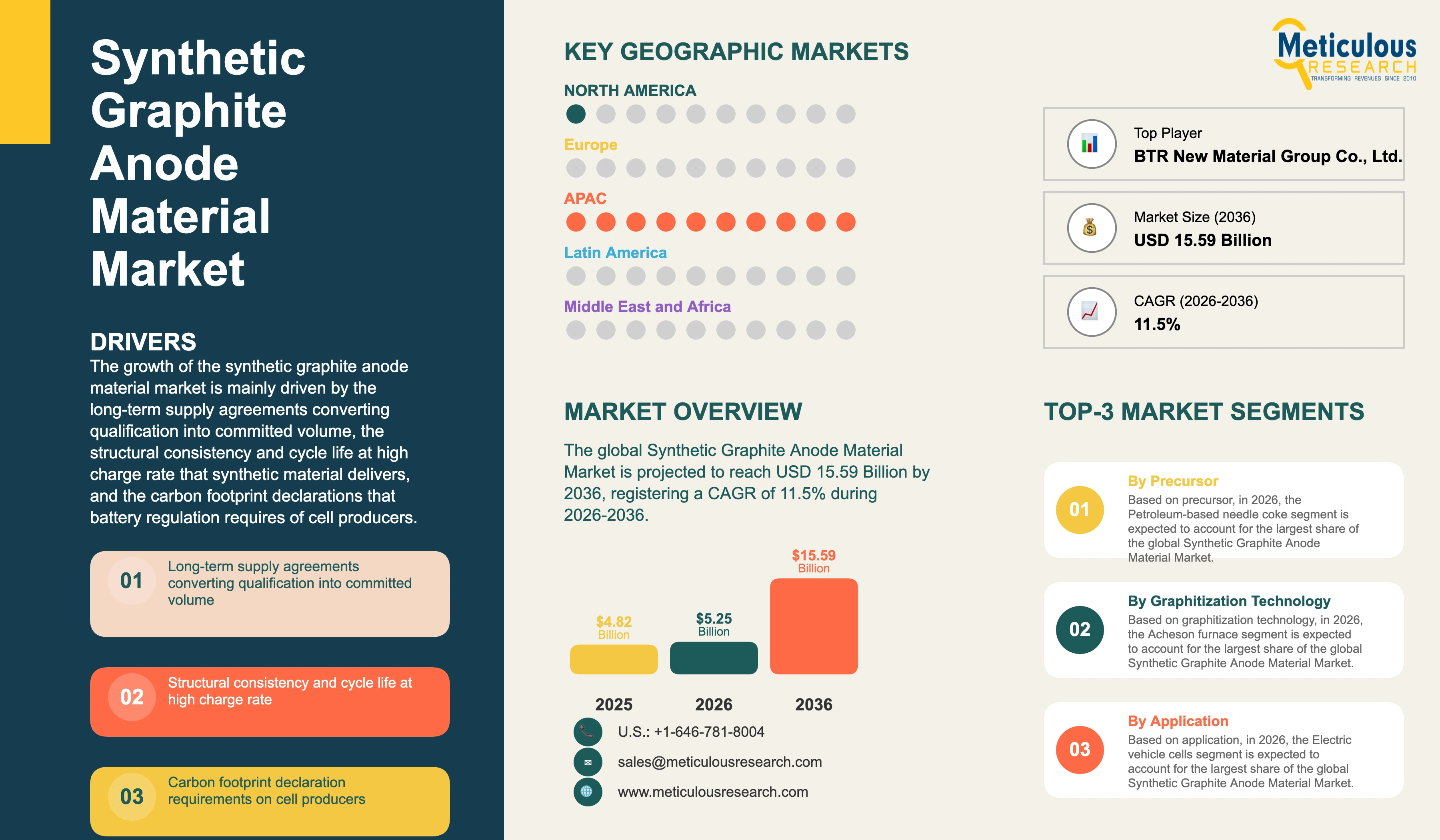
The global synthetic graphite anode material market was valued at USD 4.82 billion in 2025. This market is expected to reach USD 15.59 billion by 2036 from an estimated USD 5.25 billion in 2026, registering a CAGR of 11.5% during the forecast period (2026-2036).
- Published
- Nov 2026
- Pages
- 263
- Format
- PDF + Excel
- Report ID
- MRCHM - 1042680
- Base year
- 2025
- 2025 · BASELINE
- $4.82B
- 2036
- $15.59B
- CAGR 2026–2036
- 11.5%
2025 baseline · 2026–2036 forecast at 11.5% CAGR · hover a bar for the value
Key highlights
The global synthetic graphite anode material market is estimated at USD 5.25 billion in 2026 and is projected to reach USD 15.59 billion by 2036.
Market volume is estimated at 820.00 kilotons in 2026 and is projected to reach 2, 783.39 kilotons by 2036 at a CAGR of 13.0%, measured as finished anode active material supplied.
The average selling price is estimated at USD 6.40 per kg in 2026 and is projected to reach USD 5.60 per kg by 2036.
Petroleum-based needle coke is expected to account for the largest precursor share in 2026, while alternative and recycled precursors are projected to register the highest CAGR of 22.4%.
Acheson furnace graphitization is expected to hold the largest technology share in 2026, while inner-heating and continuous graphitization is projected to grow fastest at a CAGR of 15.6%.
Electric vehicle cells are expected to be the largest application in 2026, while stationary storage is projected to register the highest CAGR of 17.4%.
Asia-Pacific is expected to hold the largest regional share in 2026, while North America is projected to register the highest CAGR of 21.6%.
Vianode announced on 15 January 2025 a master supply agreement with General Motors valued in the multi-billion US dollar range, covering large-scale manufacturing capacity and synthetic anode graphite supply through 2033.
The agreement includes a minimum off-take commitment and followed a multi-year qualification process.
The material will be used by Ultium Cells LLC, the General Motors and LG Energy Solution joint venture, and deliveries may extend to other joint ventures.
Production under the agreement starts in 2027, from a large-scale plant in North America described as compliant with the Inflation Reduction Act.
Qualification testing was carried out on material from the Vianode pilot plant in Norway.
The full-scale plant at Heroya in Norway began production in the second half of 2024, the industrial pilot at Kristiansand has produced graphite since 2021, and the Technology Center at Kristiansand opened in 2022.
Vianode states a verified climate impact of 1.9 kg CO2 equivalents per kilogram of graphite, which it describes as a 90% lower CO2 footprint than conventional production methods.
The company targets nearly halving that figure by 2030.
Vianode states a long-term goal of supplying advanced materials for 3 million electric vehicles a year by 2030, and a phased multi-billion US dollar investment programme for large-scale plants in North America and Europe.
The announcement does not state the exact agreement value, the off-take tonnage, the location of the North American plant or any plant capacity figure.
This market stands alongside rather than within the spherical natural graphite market, since the two are alternatives at the cell design stage and are blended in proportions set design by design.
Report summary
| Particulars | Details |
|---|---|
| Forecast Period | 2026-2036 |
| Base Year | 2025 |
| Market Size in 2025 | USD 4.82 billion |
| Market Size in 2026 | USD 5.25 billion |
| Market Size by 2036 | USD 15.59 billion |
| Value CAGR (2026-2036) | 11.5% |
| Format | PDF, Excel & Cloud Portal · 263 pages |
| Volume in 2026 | 820.00 kilotons |
| Volume by 2036 | 2,783.39 kilotons |
| Volume CAGR (2026-2036) | 13.0% |
| Volume Basis | Finished synthetic graphite anode active material supplied |
| Average Selling Price in 2026 | USD 6.40 per kg |
| Average Selling Price by 2036 | USD 5.60 per kg |
| Price Direction | Average selling price declines across the forecast period as continuous graphitization displaces batch furnaces and electricity consumed per tonne falls, rather than through commoditisation of a material that remains qualified into a particular cell design |
| Measurement Basis | Finished synthetic graphite anode active material from petroleum and coal tar pitch needle coke and from alternative and recycled precursors, across graphitization technologies, and excluding needle coke and other precursors as traded products, natural and spherical natural graphite, graphite electrodes and other non-battery graphite, silicon and silicon-carbon anode materials, hard carbon for sodium-ion cells, and finished cells and packs |
| Relationship to Adjacent Markets | This market stands alongside rather than within the spherical natural graphite market, since the two are alternatives at the cell design stage and are blended in proportions set design by design; the finished coated product is measured here because synthetic material is sold to cell makers as a finished active material, whereas spherical natural graphite is sold uncoated to an anode producer |
| Largest Precursor | Petroleum-based needle coke |
| Fastest-Growing Precursor | Alternative and recycled precursors (CAGR 22.4%) |
| Largest Graphitization Technology | Acheson furnace |
| Fastest-Growing Graphitization Technology | Inner-heating and continuous graphitization (CAGR 15.6%) |
| Largest Application | Electric vehicle cells |
| Fastest-Growing Application | Stationary storage (CAGR 17.4%) |
| Largest Region | Asia-Pacific |
| Fastest-Growing Region | North America (CAGR 21.6%) |
| Segments Covered | Precursor, Graphitization Technology, Application, and Geography |
| Geographies Covered | Asia-Pacific, North America, Europe, Latin America, and Middle East & Africa |
| Companies Profiled | 11 companies, including BTR New Material Group Co., Ltd., Ningbo Shanshan Co., Ltd., Posco Future M Co., Ltd., Resonac Holdings Corporation, Vianode AS, and Novonix Limited |
Report overview
Segments covered: precursor, graphitization technology, application.
The growth of this market is mainly driven by the long-term supply agreements that are converting qualification into committed volume, including the master supply agreement through 2033 that Vianode announced with General Motors on 15 January 2025, the structural consistency and cycle life at high rate that synthetic material delivers against natural graphite, the carbon footprint declarations that battery regulation now requires of cell producers, and the localisation of anode supply outside Asia. However, factors such as the electricity consumed in graphitization, the exposure of the market to needle coke availability and price, the competition from natural graphite at a lower cost and lower embodied energy, and the concentration of graphitization capacity in a single country are expected to restrain the growth of this market to some extent.
Synthetic graphite anode material is made by graphitizing a carbon precursor at temperatures approaching 3,000 degrees Celsius and then milling, shaping and surface treating the product to the specification a cell requires. Market sizing in this report is on both a value basis in USD and a volume basis in kilotons measured as finished synthetic graphite anode active material supplied, with average selling price derived from the two. The measurement basis covers material from petroleum and coal tar pitch needle coke and from alternative and recycled precursors, across graphitization technologies, and it excludes needle coke and other precursors as traded products, natural and spherical natural graphite, graphite electrodes and other non-battery graphite, silicon and silicon-carbon anode materials, hard carbon for sodium-ion cells, and the finished cells and packs into which the material is built.
Measuring the finished coated product here while the spherical natural graphite market is measured uncoated reflects how the two actually trade rather than an inconsistency. Synthetic anode material is graphitized, milled, shaped and surface treated by the same producer and sold to a cell maker as a finished active material, while uncoated spherical natural graphite is sold by a processor to an anode producer who then coats it. The measurement point in each case is the point of sale to the next stage of the chain.
Vianode announced on 15 January 2025 a master supply agreement with General Motors valued in the multi-billion US dollar range, covering large-scale manufacturing capacity and synthetic anode graphite supply through 2033, including a minimum off-take commitment and following a multi-year qualification process. The material will be used by Ultium Cells LLC, the General Motors and LG Energy Solution joint venture, with deliveries potentially extending to other joint ventures, and production starts in 2027 from a large-scale North American plant described as compliant with the Inflation Reduction Act. Qualification testing used material from the Norwegian pilot plant.
An agreement running to 2033 with a minimum off-take is a different instrument from a letter of intent, and it is what makes a greenfield graphitization plant financeable. The multi-year qualification behind it is the reason: a cell maker that has validated electrode and cell performance on a particular material will not readily change source, so the agreement reflects a technical position already established rather than a commercial preference. The announcement does not state the exact value, the off-take tonnage, the plant location or any capacity figure, so the commitment should be read as evidence of qualification and duration rather than of volume.
Carbon footprint is where synthetic graphite has historically been weakest and where the argument is now being contested. Graphitization consumes a very large quantity of electricity per tonne, which has given natural graphite a substantial advantage in embodied emissions, and Vianode states a verified climate impact of 1.9 kg CO2 equivalents per kilogram of graphite, describing it as 90% below conventional production methods and targeting nearly halving that figure by 2030. Battery regulation now requires carbon footprint declaration from cell producers, which turns an environmental figure into a procurement specification.
The production history behind those figures is worth noting precisely because capacity claims in this industry are often prospective. The Kristiansand industrial pilot has produced graphite since 2021, the Technology Center there opened in 2022, and the Heroya full-scale plant began production in the second half of 2024, while the North American plant that will serve the General Motors agreement from 2027 has no stated location or capacity. Vianode states a long-term goal of supplying advanced materials for 3 million electric vehicles a year by 2030 under a phased multi-billion dollar programme.
Electricity is the dominant cost and the dominant constraint. Graphitization at temperatures approaching 3,000 degrees Celsius consumes power measured in thousands of kilowatt hours per tonne, which makes the economics of a plant a function of its electricity tariff more than of its labour or capital cost, and it explains why capacity has concentrated where power is cheap. It also means the carbon footprint of the product depends on the grid that supplies it, so the same process gives very different emissions figures in different locations. Continuous graphitization registers the highest technology CAGR at 15.6%.
Needle coke availability is the other structural exposure. The crystalline structure that graphitizes well comes from a narrow range of petroleum and coal tar feedstocks, needle coke capacity is itself concentrated and partly committed to graphite electrode production for steelmaking, and anode demand competes with that use. A tight electrode market therefore raises anode precursor costs for reasons unconnected to battery demand. Alternative and recycled precursors consequently register the highest precursor CAGR at 22.4%.
Against natural graphite the comparison is genuinely unsettled, and a cell maker treats it as a design variable rather than a procurement choice. Synthetic material offers more consistent structure, better cycle life at high charge rate and tighter control of impurities, natural material costs less and carries lower embodied energy, and most commercial anodes blend the two in proportions set by the energy, rate and cost requirements of the particular cell. The two markets are therefore alternatives at the design stage, which is why this market is read alongside the spherical natural graphite market rather than added to it.
Silicon is the longer-term question that neither graphite market resolves. Silicon and silicon-carbon composites store far more lithium per unit mass and are being introduced as additions to graphite anodes rather than as replacements, because silicon expands substantially on lithiation and degrades a cell if used alone. Graphite therefore remains the structural basis of the anode through the forecast period while carrying a growing silicon fraction. The effect reduces graphite content per kilowatt hour gradually rather than displacing the material.
Asia-Pacific is expected to account for the largest share in 2026, on the concentration of graphitization capacity in China and the anode and cell manufacturing base across the region. India is projected to grow at 19.6%, South Korea at 15.0% and China at 10.0%.
North America is projected to register the highest CAGR of 21.6% during the forecast period, with the United States at 22.4% and Canada at 19.0%.
Europe is projected to grow at a CAGR of 18.0%, with Norway at 24.0% and Germany at 18.6%, on low-carbon electricity that produces material with a declared footprint competitors on fossil-fired grids cannot match, on the Heroya plant that began production in the second half of 2024, and on cell capacity under construction.
The Middle East & Africa is projected to grow at a CAGR of 11.0% and Latin America at a CAGR of 12.0%, both from very small bases and principally on precursor supply from refining and coking operations rather than on graphitization capacity.
BTR New Material Group Co., Ltd., Ningbo Shanshan Co., Ltd., Shanghai Putailai New Energy Technology Co., Ltd., Shijiazhuang Shangtai Technology Co., Ltd. and Posco Future M Co., Ltd. together accounted for an estimated 62.4% of this market in 2026. The 11 companies profiled in this report together accounted for an estimated 78.6%.
Report infographic
Market dynamics
15 factors across 5 forcesLong-Term Supply Agreements Converting Qualification Into Committed Volume
Vianode announced on 15 January 2025 a master supply agreement with General Motors valued in the multi-billion US dollar range, covering capacity and supply through 2033 with a minimum off-take commitment, following a multi-year qualification process, with material for Ultium Cells LLC and production starting in 2027 from a North American plant described as compliant with the Inflation Reduction Act. An agreement of that duration with an off-take floor is what makes a greenfield graphitization plant financeable. The driver acts by converting technical qualification into bankable volume rather than by increasing consumption.
Qualification is also what protects the position once won. A cell maker that has validated electrode and cell performance on a specific material will not change source without repeating that work, so an agreement of this kind reflects a technical position that is difficult for a competitor to displace within the contract term.
The structure also shifts risk. A minimum off-take transfers part of the volume risk from the plant to the cell maker, which is the only basis on which a first-of-its-kind graphitization facility outside Asia can raise capital, and it explains why such agreements rather than capacity announcements are the meaningful signal in this market.
Structural Consistency and Cycle Life at High Charge Rate
Graphitization produces a more uniform crystalline structure and tighter impurity control than natural flake purification achieves, which gives better cycle life at high charge rate and more predictable electrode behaviour, and fast-charging vehicle designs are least tolerant of the variability natural material carries. Cell makers therefore raise the synthetic fraction in blends as rate requirements tighten. The driver acts on the blend ratio rather than on total anode demand, which is where the competition between the two materials is actually settled.
Rate capability is becoming more important rather than less as charging infrastructure improves, because a pack specified for high charge current degrades faster on a less uniform anode. The synthetic fraction therefore tends to rise with each generation of fast-charge specification rather than falling with cost pressure, and that is a trend working in favour of this market rather than against it.
Carbon Footprint Declaration Requirements on Cell Producers
Battery regulation now obliges cell producers to declare the carbon footprint of their products, which turns embodied emissions from a reputational matter into a procurement specification, and Vianode states a verified climate impact of 1.9 kg CO2 equivalents per kilogram of graphite, 90% below conventional production methods, with a target of nearly halving that by 2030. Because graphitization is electricity-intensive, the footprint of the material depends on the grid that supplies the plant. A producer on low-carbon power therefore holds an advantage that cannot be matched by process improvement alone.
Localisation of Anode Supply Outside Asia
Graphitization capacity is overwhelmingly concentrated in Asia while cell capacity is being built across North America and Europe, and vehicle incentives attach sourcing conditions that an Asian processing route cannot satisfy, which is why the General Motors agreement specifies a North American plant described as compliant with the Inflation Reduction Act. Capacity is consequently being located by policy and electricity price together. North America registers the highest regional CAGR of 21.6%, from a base small enough that the rate describes capacity being built rather than consumption shifting, since cell plants there import qualified material until local graphitization is commissioned.
Those two conditions do not always coincide, which is why localisation has proved slower here than in cell assembly. A site that satisfies sourcing rules may have expensive or high-carbon power, and a site with cheap clean power may be far from the cell plants it would serve.
Table of contents
11 chapters · 131 sections · 263 pages · click to expandSegmental analysis
| Segment | Largest share (2026) | Fastest growth (2026–2036) |
|---|---|---|
| By Precursor | Petroleum-based needle coke | Alternative and recycled precursors |
| By Graphitization Technology | Acheson furnace | Inner-heating and continuous graphitization |
| By Application | Electric vehicle cells | Stationary storage |
| Other segments | Petroleum-based needle coke | Inner-heating and continuous graphitization |
By Precursor
- Synthetic Graphite Anode Material Market Analysis by Precursor
- The petroleum-based needle coke segment is expected to account for the largest share of the global synthetic graphite anode material market.
- The large share of this segment is mainly due to the crystalline structure and low impurity content that petroleum needle coke delivers on graphitization, the scale at which it is available from refinery coking operations, and the qualification of that precursor into the installed anode production base.
- However, the alternative and recycled precursors segment is projected to register the highest CAGR of 22.4% during the forecast period.
- The rapid growth of this segment is attributed to reductions in both input cost and declared carbon footprint, which are the two measures that long-term supply agreements and carbon footprint declaration requirements now reward, together with reduced exposure to needle coke availability that an anode producer cannot otherwise manage.
- Scale matters here in a way it does not for the alternative precursors.
- Petroleum needle coke is produced in refinery-scale quantities, so an anode producer qualifying it is not constrained by feedstock availability in the way a producer of a recycled or engineered precursor may be, and that security is part of why the grade holds its share.
- Coal tar pitch-based needle coke holds the second position, produced from the distillation of coal tar and valued for a highly anisotropic structure, with availability tied to metallurgical coke production and therefore to steel output rather than to refinery operation.
- Precursor choice sets the impurity profile, the graphitization yield and the carbon footprint of the finished material simultaneously, and it is fixed by qualification rather than selected per campaign.
- A producer consequently commits to a precursor route for the life of a customer specification.
- Precursor also determines where a producer can site a plant, because petroleum needle coke follows refinery location while coal tar pitch follows metallurgical coke production, and transporting either any distance erodes a cost position that is already thin.
- Alternative and recycled precursors are projected to register the highest CAGR of 22.4% during the forecast period.
By Graphitization Technology
- Synthetic Graphite Anode Material Market Analysis by Graphitization Technology
- The Acheson furnace segment is expected to account for the largest share of the global synthetic graphite anode material market.
- The large share of this segment is mainly due to the installed base of batch furnaces built alongside Chinese anode capacity, the tolerance of the design for variation in feed, and the low capital cost per tonne against which the energy inefficiency of the route has historically been accepted.
- However, the inner-heating and continuous graphitization segment is projected to register the highest CAGR of 15.6% during the forecast period.
- The rapid growth of this segment is attributed to current being passed through the material itself in a flow process rather than through a packed bed, which cuts cycle time, energy per tonne and labour at once, improving both cost and declared carbon footprint, the two measures on which this material is now purchased.
- Other technologies, including direct electrical and plasma-assisted routes, serve a small share where particular structures or very short cycle times are required.
- Technology choice is a trade between capital cost per tonne, energy per tonne and tolerance of feed variation rather than a ranking, and it is made at plant design and difficult to revisit afterwards.
- The electricity tariff available at a site therefore influences the technology decision as much as the process merits do.
- Technology also determines how quickly capacity can be added once a contract is signed, since a continuous line can be replicated in modules while batch capacity is added in large increments that must be filled to be economic.
- A plant also carries only one graphitization technology in practice, so the technology share of this market changes through new capacity rather than through conversion of existing plant, which is why the shift toward continuous designs is gradual despite its advantages and why the installed Acheson base retains the larger share throughout the period.
By Application
- Synthetic Graphite Anode Material Market Analysis by Application
- The electric vehicle cells segment is expected to account for the largest share of the global synthetic graphite anode material market.
- The large share of this segment is mainly due to the scale of automotive cell production, the fast-charge and cycle life requirements that favour synthetic material in the blend, and the long-term supply agreements that automotive cell ventures have put in place.
- However, the stationary storage segment is projected to register the highest CAGR of 17.4% during the forecast period.
- The rapid growth of this segment is attributed to storage cell deployment growing from a smaller base than automotive demand and to the cycle life over many thousands of cycles that an installation is purchased on, which is where the structural consistency of synthetic material is worth most relative to its cost.
- Consumer electronics cells take synthetic material where volumetric energy density and cycle life in a small format matter more than cost per kilowatt hour, and the segment grows with device shipments rather than with battery capacity.
- Industrial and other applications cover power tools, two and three wheelers, backup power and specialty cells.
- Application mix determines the blend ratio a producer supplies against rather than the tonnage alone, because each duty sets a different synthetic fraction in the anode.
- The applications also differ in how they are contracted.
- Automotive cells are supplied under multi-year agreements with off-take commitments, while consumer electronics and industrial cells are bought on shorter terms, so the revenue of a producer serving automotive is more predictable and considerably harder to win.
Other segments
- Petroleum-based needle coke is expected to account for the largest share in 2026, on the crystalline structure and low impurity content it delivers and the scale at which refinery coking operations supply it.
- Acheson furnace graphitization is expected to hold the largest share in 2026, on the installed base of batch furnaces and the low capital cost per tonne against which its energy inefficiency has been accepted.
- Inner-heating and continuous graphitization is projected to register the highest CAGR of 15.6% during the forecast period.
- Electric vehicle cells are expected to account for the largest share in 2026, on the scale of automotive cell production and the fast-charge and cycle life requirements that favour synthetic material in the blend.
- Stationary storage is projected to register the highest CAGR of 17.4% during the forecast period.
Geographic analysis
Asia-Pacific
Largest shareIn 2026, Asia-Pacific is expected to account for the largest share of the global synthetic graphite anode material market. The large share of this region is mainly due to the concentration of graphitization capacity in China supported by industrial electricity tariffs, the anode and cell manufacturing base across China, Japan and South Korea, and the needle coke supply from regional refining and coking operations. China is projected to register a CAGR of 10.0%, India a CAGR of 19.6%, South Korea a CAGR of 15.0% and Japan a CAGR of 13.4% during the forecast period.
North America
Fastest growthHowever, North America is projected to register the highest CAGR of 21.6% during the forecast period. The rapid growth of this region is attributed to the cell capacity under construction, the sourcing conditions attached to vehicle incentives, and the committed supply arrangements being established, including the master supply agreement through 2033 that Vianode announced with General Motors on 15 January 2025 with production from 2027 at a plant described as compliant with the Inflation Reduction Act. The United States is projected to register a CAGR of 22.4% and Canada a CAGR of 19.0%.
Europe
Europe is projected to grow at 18.0%, with Norway at 24.0% and Germany at 18.6%, on low-carbon electricity that produces material with a declared footprint competitors on fossil-fired grids cannot match, on the Heroya plant that began production in the second half of 2024, and on cell capacity under construction.
Latin America
Latin America is projected to grow at 12.0% and the Middle East & Africa at 11.0%, both from very small bases and principally on precursor supply rather than graphitization. Those regions participate in this market as feedstock suppliers rather than as processors, so their growth rates describe refining and coking output serving graphitization elsewhere rather than anode material being made locally, and a change in their position would require graphitization capacity rather than additional feedstock, which is a far larger investment. Where this capacity locates is decided by electricity price and grid carbon intensity together, which is unusual among battery materials. Graphitization consumes thousands of kilowatt hours per tonne, so a plant needs cheap power to compete on cost and clean power to compete on declared footprint, and the two coincide in relatively few places. Policy adds a third condition by attaching sourcing requirements to vehicle incentives. A region therefore acquires this industry through its electricity system as much as through its industrial policy.
Competitive landscape
The global synthetic graphite anode material market is characterised by the presence of Chinese anode producers operating integrated graphitization capacity at scale, Japanese and Korean carbon and anode producers supplying regional cell manufacturing, and newer entrants in Europe and North America competing on declared carbon footprint and on sourcing compliance. Competition is contested on qualification into a cell design, on electricity cost and on verified emissions per kilogram rather than on precursor cost alone, because graphitization energy dominates the cost structure. BTR New Material Group Co., Ltd., Ningbo Shanshan Co., Ltd., Shanghai Putailai New Energy Technology Co., Ltd., Shijiazhuang Shangtai Technology Co., Ltd. and Posco Future M Co., Ltd. together accounted for an estimated 62.4% of this market in 2026, while the companies profiled in this report together accounted for an estimated 78.6%.
Vianode announced on 15 January 2025 a master supply agreement with General Motors valued in the multi-billion US dollar range, covering capacity and synthetic anode graphite supply through 2033 with a minimum off-take commitment following a multi-year qualification process, with material for Ultium Cells LLC, production from 2027 at a North American plant described as compliant with the Inflation Reduction Act, and a stated verified climate impact of 1.9 kg CO2 equivalents per kilogram of graphite against a goal of supplying advanced materials for 3 million electric vehicles a year by 2030. Qualification of alternative and recycled precursors, installation of continuous graphitization capacity, and establishment of plants on low-carbon grids accounted for most competitive activity through 2026.
Electricity position rather than process capability separates the competitors, because graphitization energy dominates both cost and declared footprint and cannot be engineered away. BTR New Material Group Co., Ltd., Ningbo Shanshan Co., Ltd., Shanghai Putailai New Energy Technology Co., Ltd. and Shijiazhuang Shangtai Technology Co., Ltd. compete from integrated Chinese capacity on industrial tariffs, Posco Future M Co., Ltd., Resonac Holdings Corporation, Mitsubishi Chemical Group Corporation and Tokai Carbon Co., Ltd. from carbon materials portfolios supplying regional cell manufacturing, and Vianode AS, Novonix Limited and Himadri Speciality Chemical Ltd from newer capacity positioned on grid carbon intensity and sourcing compliance. Some of the key players operating in the synthetic graphite anode material market are BTR New Material Group Co., Ltd. (China), Ningbo Shanshan Co., Ltd. (China), Shanghai Putailai New Energy Technology Co., Ltd. (China), Shijiazhuang Shangtai Technology Co., Ltd. (China), Posco Future M Co., Ltd. (South Korea), Resonac Holdings Corporation (Japan), Mitsubishi Chemical Group Corporation (Japan), Tokai Carbon Co., Ltd. (Japan), Vianode AS (Norway), Novonix Limited (Australia), and Himadri Speciality Chemical Ltd (India), among others.
- —
Vianode announced on 15 January 2025 a master supply agreement with General Motors valued in the multi-billion US dollar range, covering large-scale manufacturing capacity and synthetic anode graphite supply through 2033, including a minimum off-take commitment and following a multi-year qualification process. The material will be used by Ultium Cells LLC, the General Motors and LG Energy Solution joint venture, with deliveries potentially extending to other joint ventures, and production starts in 2027 from a large-scale North American plant described as compliant with the Inflation Reduction Act, with qualification testing carried out on material from the Vianode pilot plant in Norway. The full-scale plant at Heroya began production in the second half of 2024, the industrial pilot at Kristiansand has produced graphite since 2021 and the Technology Center there opened in 2022. Vianode states a verified climate impact of 1.9 kg CO2 equivalents per kilogram of graphite, a 90% lower CO2 footprint than conventional production methods, and targets nearly halving that figure by 2030, against a long-term goal of supplying advanced materials for 3 million electric vehicles a year by 2030 under a phased multi-billion dollar investment programme for plants in North America and Europe. The announcement does not state the exact agreement value, the off-take tonnage, the location of the North American plant or any plant capacity figure.
- BTR New Material Group Co., Ltd.
- Ningbo Shanshan Co., Ltd.
- Posco Future M Co., Ltd.
- Resonac Holdings Corporation
- Vianode AS
- Novonix Limited
Expert perspectives
Volume grows at 13.0% against 11.5% in value over the forecast period, and the average selling price falls from USD 6.40 per kg in 2026 to USD 5.60 per kg by 2036 as continuous graphitization displaces batch furnaces and electricity per tonne falls. The decline reflects process change rather than commoditisation, since the material remains qualified into a particular cell design.
The General Motors agreement is the instrument worth studying rather than the headline. Supply through 2033 with a minimum off-take, following a multi-year qualification, is what makes a greenfield graphitization plant financeable, and it reflects a technical position a competitor cannot displace within the term. The announcement gives no value, tonnage, plant location or capacity, so it should be read as evidence of qualification and duration rather than of volume.
Carbon footprint has become a specification rather than a disclosure, which changes the competitive ground. Graphitization consumes thousands of kilowatt hours per tonne, so the emissions of the product follow the grid supplying the plant, and a verified 1.9 kg CO2 equivalents per kilogram at 90% below conventional production is a position a competitor on fossil-fired power cannot reach by improving its process. Grid carbon intensity is now an input specification.
Electricity therefore decides siting twice over. A plant needs cheap power to compete on cost and clean power to compete on declared footprint, and the two coincide in relatively few places, with policy adding a third condition through sourcing requirements attached to vehicle incentives. That is why Norway grows at 24.0% and North America at 21.6% from small bases while Asia-Pacific holds the share.
Needle coke is the exposure that producers talk about least. The crystalline structure that graphitizes well comes from a narrow feedstock range, capacity is concentrated and partly committed to graphite electrodes for steelmaking, and a tight electrode market raises anode costs for reasons unconnected to batteries. Alternative and recycled precursors grow at 22.4% because they address cost, footprint and that exposure at the same time.
The risk to the forecast is the blend ratio rather than cell volumes, and silicon sits behind it. Natural and synthetic graphite are alternatives set design by design, so the synthetic share can move without any change in a producer cost position, while silicon added to graphite anodes reduces graphite content per kilowatt hour gradually. This market should be read alongside the spherical natural graphite market rather than summed with it.
Customer perspectives
Multi-year qualification of electrode and cell performance is what makes long-duration supply agreements rational, since requalifying a different anode material would repeat work that the original validation already absorbed.
Because cell producers must declare battery carbon footprint and graphitization is electricity-intensive, the grid supplying a plant determines the declared emissions of its material and has become part of the purchasing specification.
Commercial anodes blend synthetic and natural graphite in proportions set by the energy, rate and cost requirements of each cell design, so the two materials compete over the blend ratio rather than for the whole anode position.
A producer therefore sells a blend fraction rather than a product, and that fraction is reset with every new cell design rather than fixed by a supply agreement, so volume under a long contract is less certain than its duration suggests, which is what the minimum off-take in such an agreement exists to address.
“Qualification took us years, and that is precisely why we signed to 2033. Once a material is validated in our cells we are not going to repeat that work to save a few per cent, so the length of the contract reflects the cost of changing our minds.”
“We now have a carbon number in the specification next to the purity number, and we have to declare it. A supplier on coal power cannot fix that by running a better furnace, so where the plant sits has become part of what we are buying.”
“Nobody runs pure synthetic or pure natural. We set the ratio for each design against fast charge, energy and cost, and that ratio moves. Suppliers who think they are competing for the whole anode have misread how the decision is made.”
Frequently asked questions
This market was valued at USD 4.34 billion in 2024 and USD 4.82 billion in 2025, and is estimated at USD 5.25 billion in 2026. In volume terms it is estimated at 820.00 kilotons in 2026 as finished anode active material supplied.
This market is projected to reach USD 15.59 billion by 2036 in value and 2,783.39 kilotons in volume.
This market is projected to register a value CAGR of 11.5% and a volume CAGR of 13.0% during the forecast period 2026-2036. The average selling price is projected to move from USD 6.40 per kg in 2026 to USD 5.60 per kg by 2036 as continuous graphitization displaces batch furnaces.
Growth is driven by long-term supply agreements converting qualification into committed volume, including the Vianode master supply agreement with General Motors through 2033, the structural consistency and cycle life of synthetic material, carbon footprint declarations required of cell producers, and the localisation of anode supply outside Asia.
Graphitization consumes thousands of kilowatt hours per tonne, tying cost and declared emissions to the grid. Needle coke capacity is concentrated and partly committed to graphite electrodes, natural graphite competes on cost and embodied energy, and graphitization capacity is overwhelmingly located in China.
Alternative and recycled precursors reduce input cost and declared footprint together, and continuous graphitization cuts cycle time, energy and labour at once. Low-carbon grid locations and precursor integration from refinery or coking operations are further opportunities.
Petroleum-based needle coke is expected to account for the largest share in 2026, on the crystalline structure and low impurity content it delivers and the scale at which refinery coking operations supply it.
Alternative and recycled precursors are projected to register the highest CAGR of 22.4% during the forecast period.
Acheson furnace graphitization is expected to hold the largest share in 2026, on the installed base of batch furnaces and the low capital cost per tonne against which its energy inefficiency has been accepted.
Inner-heating and continuous graphitization is projected to register the highest CAGR of 15.6% during the forecast period.
Electric vehicle cells are expected to account for the largest share in 2026, on the scale of automotive cell production and the fast-charge and cycle life requirements that favour synthetic material in the blend.
Stationary storage is projected to register the highest CAGR of 17.4% during the forecast period.
Asia-Pacific is expected to account for the largest share in 2026, on the concentration of graphitization capacity in China and the anode and cell manufacturing base across the region. India is projected to grow at 19.6%, South Korea at 15.0% and China at 10.0%.
North America is projected to register the highest CAGR of 21.6% during the forecast period, with the United States at 22.4% and Canada at 19.0%.
Europe is projected to grow at a CAGR of 18.0%, with Norway at 24.0% and Germany at 18.6%, on low-carbon electricity, the Heroya plant that began production in the second half of 2024, and cell capacity under construction.
The Middle East & Africa is projected to grow at a CAGR of 11.0% and Latin America at a CAGR of 12.0%, both from very small bases and principally on precursor supply from refining and coking operations rather than on graphitization capacity.
BTR New Material Group Co., Ltd., Ningbo Shanshan Co., Ltd., Shanghai Putailai New Energy Technology Co., Ltd., Shijiazhuang Shangtai Technology Co., Ltd. and Posco Future M Co., Ltd. together accounted for an estimated 62.4% of this market in 2026. The 11 companies profiled together accounted for an estimated 78.6%.
Vianode announced on 15 January 2025 a master supply agreement with General Motors covering synthetic anode graphite supply through 2033, with a minimum off-take commitment and production starting in 2027 from a North American plant. Its Heroya plant began production in the second half of 2024, and it states a verified climate impact of 1.9 kg CO2 equivalents per kilogram of graphite.
Cite this report
Meticulous Research. (2026). Synthetic Graphite Anode Material Market - Global Opportunity Analysis and Industry Forecast (2026-2036) (Report No. MRCHM - 1042680). Meticulous Market Research Pvt. Ltd. https://www.meticulousresearch.com/product/synthetic-graphite-anode-material-market-7363