Spherical Natural Graphite Market (2026-2036)
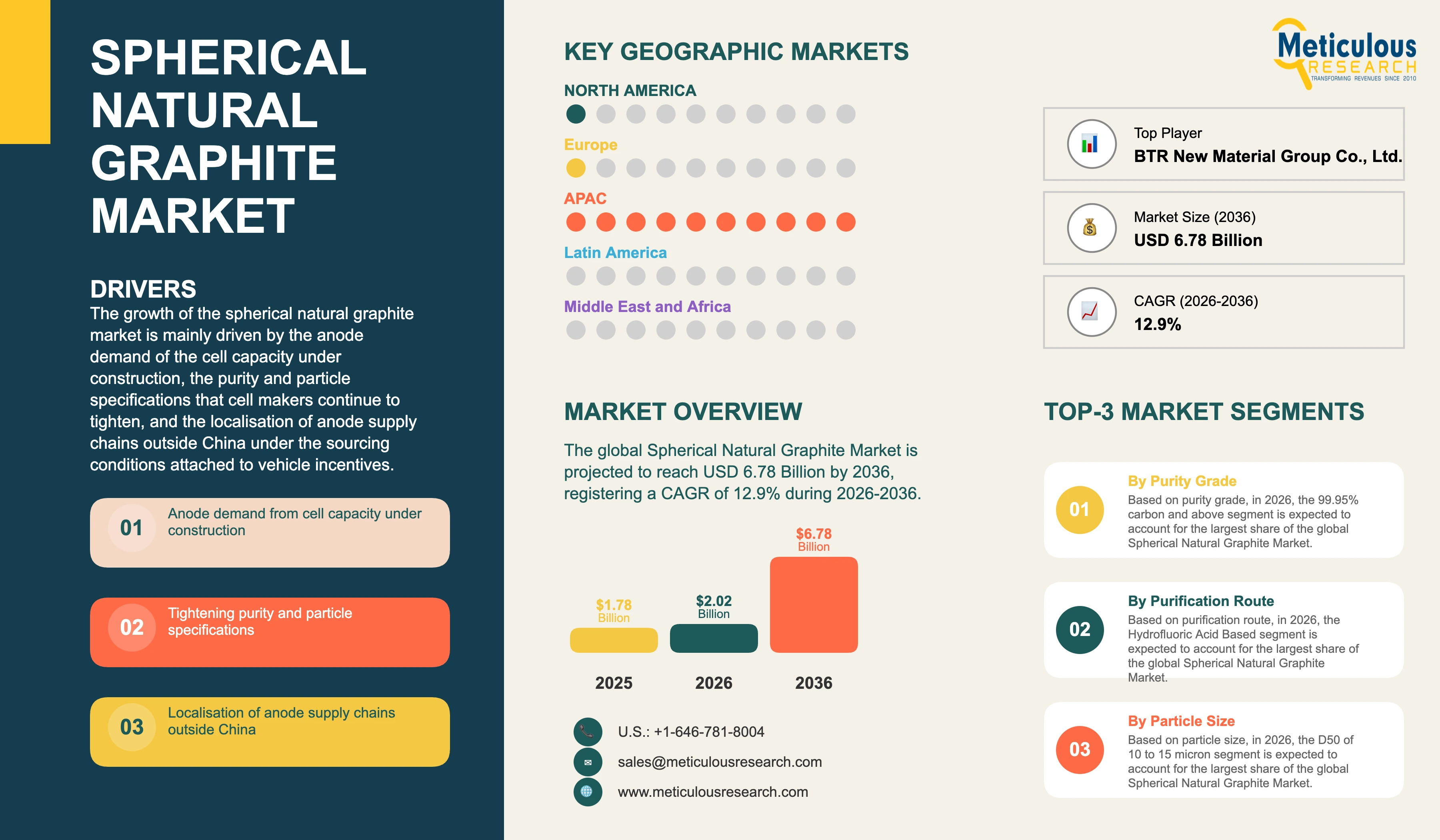
The global spherical natural graphite market was valued at USD 1.78 billion in 2025. This market is expected to reach USD 6.78 billion by 2036 from an estimated USD 2.02 billion in 2026, registering a CAGR of 12.9% during the forecast period (2026-2036).
- Published
- Nov 2026
- Pages
- 265
- Format
- PDF + Excel
- Report ID
- MRCHM - 1042679
- Base year
- 2025
- 2025 · BASELINE
- $1.78B
- 2036
- $6.78B
- CAGR 2026–2036
- 12.9%
2025 baseline · 2026–2036 forecast at 12.9% CAGR · hover a bar for the value
Key highlights
The global spherical natural graphite market is estimated at USD 2.02 billion in 2026 and is projected to reach USD 6.78 billion by 2036.
Market volume is estimated at 720.00 kilotons in 2026 and is projected to reach 2, 119.26 kilotons by 2036 at a CAGR of 11.4%, measured as uncoated spherical natural graphite supplied.
The average selling price is estimated at USD 2.80 per kg in 2026 and is projected to reach USD 3.20 per kg by 2036 on mix shift toward higher purity and tighter particle size.
Material at 99.95% carbon and above is expected to account for the largest purity grade share in 2026, while ultra-high purity material at 99.99% and above is projected to register the highest CAGR of 18.4%.
Hydrofluoric acid based purification is expected to hold the largest purification route share in 2026, while acid-free chemical purification is projected to grow fastest at a CAGR of 20.4%.
Material with a D50 of 10 to 15 micron is expected to be the largest particle size in 2026, while material below 10 micron is projected to register the highest CAGR of 16.0%.
Lithium-ion battery anode feed is expected to be the largest application in 2026, while sodium-ion and hybrid cell anode feed is projected to grow fastest at a CAGR of 28.0%.
Asia-Pacific is expected to hold the largest regional share in 2026, while North America is projected to register the highest CAGR of 23.4%.
The United States Department of Commerce published a final affirmative countervailing duty determination on active anode material from China on 17 February 2026 at 91 FR 7261, under case number C-570-195.
The scope covers anode grade graphite material with a graphite minimum purity content of 90 percent carbon by weight, whether synthetic, natural or a blend.
The scope also specifies an energy density of at least 330 mAh/g and graphitization of at least 80 percent.
The final estimated countervailable subsidy rate for Panasonic Global Procurement China Co., Ltd. and Panasonic Corporation of China was 66.86 percent ad valorem.
The rate for the BTR New Material Group entities, Shanghai Shaosheng Knitted Sweat and Huzhou Kaijin New Energy Technology Corp., Ltd. was 66.82 percent, determined on the basis of adverse facts available.
The all-others rate was 66.86 percent ad valorem, and the period of investigation was 1 January 2023 through 31 December 2023.
The United States International Trade Commission determined on 12 March 2026 that those imports have not materially retarded the establishment of an industry in the United States.
Chair Amy A. Karpel and Commissioner David S. Johanson voted in the negative and Commissioner Jason E. Kearns voted in the affirmative, in investigations 701-TA-752 and 731-TA-1730.
Because of the negative determinations, the Department of Commerce will not issue an antidumping or countervailing duty order on this product from China, and cash deposits are refunded.
The Commission report, USITC Publication 5719, was scheduled to be available by 26 April 2026.
This market sits downstream of the graphite purification chemicals market and alongside rather than within the synthetic graphite anode material market, and is not additive to either.
Report summary
| Particulars | Details |
|---|---|
| Base Year | 2025 |
| Forecast Period | 2026-2036 |
| Market Size in 2025 | USD 1.78 billion |
| Market Size in 2026 | USD 2.02 billion |
| Market Size by 2036 | USD 6.78 billion |
| Value CAGR (2026-2036) | 12.9% |
| Format | PDF, Excel & Cloud Portal · 265 pages |
| Volume in 2026 | 720.00 kilotons |
| Volume by 2036 | 2,119.26 kilotons |
| Volume CAGR (2026-2036) | 11.4% |
| Volume Basis | Uncoated spherical natural graphite supplied |
| Average Selling Price in 2026 | USD 2.80 per kg |
| Average Selling Price by 2036 | USD 3.20 per kg |
| Price Direction | Average selling price rises across the forecast period as higher purity grades and tighter particle size distributions take a larger share of the tonnage, rather than on any increase in the cost of flake feed |
| Measurement Basis | Spheroidised and purified natural flake graphite supplied uncoated, across purity grades, particle sizes and purification routes, and excluding flake concentrate and run-of-mine material, the carbon coating step and finished coated natural graphite anode active material, synthetic and artificial graphite anode material, expanded and flexible graphite products, graphite electrodes and refractories, and the purification chemicals consumed in production |
| Relationship to Adjacent Markets | This market sits downstream of the graphite purification chemicals market and upstream of coated natural graphite anode active material, and is not additive to either; it stands alongside rather than within the synthetic graphite anode material market, since the two are alternatives at the cell design stage and are blended in proportions set design by design |
| Largest Purity Grade | 99.95% carbon and above |
| Fastest-Growing Purity Grade | Ultra-high purity, 99.99% carbon and above (CAGR 18.4%) |
| Largest Purification Route | Hydrofluoric acid based |
| Fastest-Growing Purification Route | Acid-free chemical purification (CAGR 20.4%) |
| Largest Particle Size | D50 of 10 to 15 micron |
| Fastest-Growing Particle Size | D50 below 10 micron (CAGR 16.0%) |
| Largest Application | Lithium-ion battery anode feed |
| Fastest-Growing Application | Sodium-ion and hybrid cell anode feed (CAGR 28.0%) |
| Largest Region | Asia-Pacific |
| Fastest-Growing Region | North America (CAGR 23.4%) |
| Segments Covered | Purity Grade, Purification Route, Particle Size, Application, and Geography |
| Geographies Covered | Asia-Pacific, North America, Europe, Middle East & Africa, and Latin America |
| Companies Profiled | 10 companies, including BTR New Material Group Co., Ltd., Ningbo Shanshan Co., Ltd., Shanghai Putailai New Energy Technology Co., Ltd., Posco Future M Co., Ltd., Syrah Resources Limited, and Graphite One Inc. |
Report overview
Segments covered: purity grade, purification route, particle size, application.
In volume terms, this market is estimated at 720.00 kilotons in 2026 and is projected to reach 2,119.26 kilotons by 2036, registering a CAGR of 11.4% during the same period, measured as uncoated spherical natural graphite supplied. The average selling price is estimated at USD 2.80 per kg in 2026 and is projected to rise to USD 3.20 per kg by 2036 as higher purity grades and tighter particle size distributions take a larger share of the tonnage, rather than on any increase in the cost of flake feed.
The growth of this market is mainly driven by the anode demand of the cell capacity under construction, the purity and particle specifications that cell makers continue to tighten, the localisation of anode supply chains outside China, and the sodium-ion and hybrid cell chemistries that draw on carbon anodes without lithium. However, factors such as the yield loss of close to two thirds of the flake feed in spheronisation, the concentration of spheronisation and purification capacity in a single country, the refusal of trade protection to developing producers outside it as shown by the United States International Trade Commission determination of 12 March 2026, and the competition from synthetic graphite anode material are expected to restrain the growth of this market to some extent.
Battery grade material at 99.95% carbon and above accounts for the largest share of this market because it is the specification that lithium-ion anode production requires and it covers the great majority of the tonnage supplied. Ultra-high purity material at 99.99% and above grows faster because cell makers are tightening metallic impurity limits as cell energy density and fast-charge requirements rise.
Spherical natural graphite is flake graphite that has been rounded by mechanical milling and then purified to the carbon content a battery anode requires, and it is the form in which natural graphite enters anode manufacture. Market sizing in this report is on both a value basis in USD and a volume basis in kilotons measured as uncoated spherical natural graphite supplied, with average selling price derived from the two. The measurement basis covers spheroidised and purified natural flake graphite across purity grades, particle sizes and purification routes, and it excludes flake graphite concentrate and run-of-mine material, the carbon coating step and the finished coated natural graphite anode active material, synthetic and artificial graphite anode material, expanded and flexible graphite products, graphite electrodes and refractories, and the purification chemicals consumed in making the product.
Stopping the measurement at the uncoated product matters because coating is a separate process step performed by a different set of companies in many cases, and it roughly doubles the value of the material. Including it would merge this market with the finished anode active material market and count the same graphite twice across two reports. The boundary also reflects how the material actually trades, since uncoated spherical graphite is bought by anode producers as a feedstock rather than by cell makers as a component.
The United States Department of Commerce published a final affirmative countervailing duty determination on active anode material from China on 17 February 2026 at 91 FR 7261 under case number C-570-195, covering anode grade graphite material with a graphite minimum purity content of 90 percent carbon by weight, whether synthetic, natural or a blend, with an energy density of at least 330 mAh/g and graphitization of at least 80 percent. The final rate for Panasonic Global Procurement China Co., Ltd. and Panasonic Corporation of China was 66.86 percent ad valorem, the rate for the BTR New Material Group entities, Shanghai Shaosheng Knitted Sweat and Huzhou Kaijin New Energy Technology Corp., Ltd. was 66.82 percent on adverse facts available, and the all-others rate was 66.86 percent, on a period of investigation of 1 January 2023 through 31 December 2023.
Those duties were never imposed. The United States International Trade Commission determined on 12 March 2026, in investigations 701-TA-752 and 731-TA-1730, that the imports have not materially retarded the establishment of an industry in the United States, with Chair Amy A. Karpel and Commissioner David S. Johanson voting in the negative and Commissioner Jason E. Kearns in the affirmative. Because of the negative determinations the Department of Commerce will not issue an antidumping or countervailing duty order on the product from China and cash deposits are refunded. The Commission report, USITC Publication 5719, was scheduled to be available by 26 April 2026.
That sequence is the most consequential fact in this market and it is easy to misread. A subsidy rate above 66 percent was established and then set aside, not because the subsidies were disputed but because the Commission found no United States industry whose establishment had been materially retarded. The practical effect for a developer outside China is that the trade protection its project economics may have assumed is absent, and that the legal test turned on the existence of a domestic industry rather than on the pricing of imports. Project financing has to stand on cost and qualification rather than on a tariff wall.
Yield is what makes this product expensive rather than the processing itself. Rounding a flake particle removes its edges and corners, and close to two thirds of the feed mass is lost as fines that cannot be used in an anode, so three tonnes or more of flake concentrate are consumed for each tonne of spherical product. The fines retain value in refractories, lubricants and expanded graphite, but at a fraction of the price. A spheronisation operation is therefore only viable where an outlet for the fines exists, which is part of why the industry concentrated where downstream graphite demand already was.
Purity requirements are the second cost. Natural flake carries silicates, iron and other metallic impurities that must be reduced to parts per million before the material can be used in a cell, and the established route uses hydrofluoric acid because it dissolves silicates efficiently. That route carries handling hazards, effluent treatment obligations and permitting difficulty that are acceptable in some jurisdictions and not in others. Acid-free chemical purification consequently registers the highest purification route CAGR at 20.4% as producers outside China develop processes that can be permitted locally.
Geographic concentration here is extreme and it is not where the mining is. Flake graphite is mined in China, Mozambique, Madagascar, Tanzania, Brazil and elsewhere, while spheronisation and purification capacity is overwhelmingly Chinese, so concentrate is shipped to China and the processed product shipped out again. China brought spherical and expanded graphite products under export licensing from 1 December 2023, which demonstrated the position rather than created it. Asia-Pacific therefore holds the largest regional share throughout the period while North America grows fastest at 23.4%.
Particle size and distribution matter as much as purity to a cell maker, which is why this is a specification product rather than a commodity. A tighter distribution gives more predictable electrode density and coating behaviour, finer material supports faster charging through shorter diffusion paths, and coarser material gives higher initial coulombic efficiency. Each cell design therefore specifies a particular D50 and span rather than a purity alone. Material below 10 micron registers the highest particle size CAGR at 16.0% as fast-charge requirements tighten.
Synthetic graphite competes directly for the same anode position and the comparison is not settled. Natural material costs less and carries a far lower embodied energy, synthetic material offers more consistent structure and better cycle life at high rate, and cell makers blend the two in proportions set by the cell duty. The two markets are therefore alternatives at the cell rather than complements, and the share each takes is decided design by design. That is why this market is read alongside the synthetic graphite anode material market rather than added to it.
This market sits downstream of the graphite purification chemicals that are consumed in making the product and upstream of the coated anode active material into which it is converted, and it is not additive to either. The purification chemicals are an input whose cost is carried into the spherical graphite price, and the coating step adds value beyond this boundary. Reading the three as separate markets to be summed would count the same material three times.
Asia-Pacific is expected to account for the largest share in 2026, on the concentration of spheronisation and purification capacity in China and the anode and cell manufacturing base across the region. India is projected to grow at 18.0%, South Korea at 15.6% and China at 11.2%.
North America is projected to register the highest CAGR of 23.4% during the forecast period, with the United States at 24.6% and Canada at 21.0%.
Europe is projected to grow at a CAGR of 20.6%, with Germany at 20.0%, on cell capacity under construction and on anode projects developed around domestic flake deposits, constrained by the same permitting difficulty that affects the hydrofluoric acid purification route.
The Middle East & Africa is projected to grow at a CAGR of 16.0%, with Mozambique at 19.0%, Madagascar at 17.0% and Tanzania at 16.0%, principally on flake mining with limited processing. Latin America is projected to grow at a CAGR of 13.0% on Brazilian flake production.
BTR New Material Group Co., Ltd., Ningbo Shanshan Co., Ltd., Shanghai Putailai New Energy Technology Co., Ltd., Huzhou Kaijin New Energy Technology Corp., Ltd. and Posco Future M Co., Ltd. together accounted for an estimated 58.6% of this market in 2026. The 10 companies profiled in this report together accounted for an estimated 72.4%.
Material with a D50 of 10 to 15 micron is expected to account for the largest share in 2026, on that range balancing initial coulombic efficiency against rate capability for most current cell designs.
Report infographic
Market dynamics
15 factors across 5 forcesAnode Demand From Cell Capacity Under Construction
Every lithium-ion cell requires an anode, natural graphite holds a substantial share of that position, and the cell capacity being built across Asia, North America and Europe fixes the quantity of spherical graphite that will be consumed once those plants run. Anode demand therefore grows with installed cell capacity rather than with any change in the material itself. The relationship is close enough that a gigafactory schedule translates directly into a tonnage requirement, which is what makes this market forecastable where many battery materials markets are not.
The same relationship sets where the growth is fastest. Capacity additions outside China are growing from a much smaller base than the Chinese fleet, so regional growth rates diverge sharply even though the material specification is the same everywhere.
Anode material is also one of the few battery inputs whose requirement per kilowatt hour is stable across chemistries, since cathode composition changes do not alter how much graphite an anode needs. A cell capacity forecast therefore converts into a graphite tonnage more reliably than it converts into a cathode tonnage of any particular composition.
Tightening Purity and Particle Specifications
Cell makers continue to reduce permitted metallic impurity levels as energy density rises, because impurities consume lithium and nucleate defects, and they are narrowing particle size distributions to obtain predictable electrode density and coating behaviour. Higher purity and tighter distribution both command a premium and both reduce the yield a producer achieves from a given feed. The specification drift therefore raises the average selling price in this market across the forecast period rather than input costs doing so. Ultra-high purity material registers the highest purity grade CAGR at 18.4%.
Specification tightening also narrows the field of qualified suppliers at each step. A producer meeting a 99.95% limit is not automatically able to meet 99.99% without additional purification stages, so each tightening re-opens the qualification and favours producers with process headroom over those operating at the edge of their capability, which is a durable advantage rather than a one-off one.
Localisation of Anode Supply Chains Outside China
Spheronisation and purification capacity is overwhelmingly Chinese while flake graphite is mined on several continents, and vehicle incentives and critical raw material frameworks in North America and Europe now attach sourcing conditions that a wholly Chinese processing route cannot satisfy. Capacity is consequently being developed close to cell plants rather than close to mines. The driver acts on where processing is located rather than on how much graphite is consumed. North America registers the highest regional CAGR of 23.4%.
Sourcing conditions also change what a buyer is willing to pay. Material that qualifies a cell for an incentive is worth more than its landed cost comparison suggests, which is what makes capacity outside China financeable despite a higher cost base.
Sodium-Ion and Hybrid Cell Chemistries Using Carbon Anodes
Sodium-ion cells use hard carbon rather than graphite, but hybrid and blended anode designs and the carbon processing capability that sodium-ion builds both draw on the same milling, purification and classification operations, and graphite retains a role in several blended configurations. The chemistries entering production therefore widen the application for processed natural carbon rather than narrowing it. The volumes are small against lithium-ion but grow from a negligible base. Sodium-ion and hybrid cell anode feed registers the highest application CAGR at 28.0%, from a base small enough that the rate describes early adoption rather than a change in where the tonnage sits.
The segment is small in tonnage against lithium-ion anode feed throughout the period, so its growth rate describes a base effect rather than a change in where the volume sits.
Table of contents
12 chapters · 137 sections · 265 pages · click to expandSegmental analysis
| Segment | Largest share (2026) | Fastest growth (2026–2036) |
|---|---|---|
| By Purity Grade | 99.95% carbon and above | Ultra-high purity segment at 99.99% carbon and above |
| By Purification Route | Hydrofluoric acid based | Acid-free chemical purification |
| By Particle Size | D50 of 10 to 15 micron | D50 below 10 micron |
| By Application | Lithium-ion battery anode feed | Sodium-ion and hybrid cell anode feed |
| Other segments | Material at 99.95% carbon and above | Ultra-high purity material at 99.99% carbon and above |
By Purity Grade
- Spherical Natural Graphite Market Analysis by Purity Grade
- The 99.95% carbon and above segment is expected to account for the largest share of the global spherical natural graphite market.
- The large share of this segment is mainly due to it being the specification that lithium-ion anode production requires, the dominance of battery applications in total consumption of the product, and the established purification routes that reach this grade reliably at scale.
- However, the ultra-high purity segment at 99.99% carbon and above is projected to register the highest CAGR of 18.4% during the forecast period.
- The rapid growth of this segment is attributed to cell makers reducing permitted metallic impurity levels as energy density rises, because impurities consume lithium and nucleate defects, together with the fast-charge designs that are least tolerant of residual metals.
- Material below 99.95% carbon supplies expanded graphite, lubricant, refractory and other industrial applications where carbon content matters but parts per million metallic limits do not apply, and it also absorbs part of the fines generated in spheronisation.
- Purity grade is what separates the two halves of this market commercially, since battery grade is sold against a customer analytical specification under qualification while industrial grades trade against published specifications.
- A producer serving both runs two different businesses from one plant.
- Purity also sets the capital a producer must deploy.
- Reaching 99.99% requires additional purification stages, tighter water and reagent quality and more analytical capability than 99.95%, so the grade decision commits plant design rather than being a setting that can be changed between campaigns.
By Purification Route
- Spherical Natural Graphite Market Analysis by Purification Route
- The hydrofluoric acid based segment is expected to account for the largest share of the global spherical natural graphite market.
- The large share of this segment is mainly due to the efficiency with which hydrofluoric acid dissolves the silicates present in natural flake, the established operating experience of the route at commercial scale, and the permitting and effluent frameworks under which existing capacity was built.
- However, the acid-free chemical purification segment is projected to register the highest CAGR of 20.4% during the forecast period.
- The rapid growth of this segment is attributed to the handling hazards, effluent obligations and permitting difficulty that the hydrofluoric acid route carries in North America and Europe, which makes a process reaching battery purity without it the condition for building capacity in those jurisdictions at all.
- Thermal purification, which drives impurities off at very high temperature rather than dissolving them, avoids reagents and effluent entirely at the cost of substantial energy consumption, and it is used where power is inexpensive or where the highest purities are required.
- Route selection follows the impurity profile of the feed and the permitting environment of the site rather than a general ranking, which is why all three remain in commercial use.
- The route decision also fixes the reagent and energy cost structure of a plant for its life.
- Route also determines what a producer can disclose to a customer.
- Cell makers increasingly ask for the purification route and its effluent handling as part of qualification, so the process has become part of the commercial offer rather than an internal matter.
- Hydrofluoric acid based purification is expected to hold the largest share in 2026, on the efficiency with which hydrofluoric acid dissolves the silicates in natural flake and the established operating experience of the route at scale.
- Acid-free chemical purification is projected to register the highest CAGR of 20.4% during the forecast period.
By Particle Size
- Spherical Natural Graphite Market Analysis by Particle Size
- The D50 of 10 to 15 micron segment is expected to account for the largest share of the global spherical natural graphite market.
- The large share of this segment is mainly due to it being the range that balances initial coulombic efficiency against rate capability for most current cell designs, the yield that spheronisation naturally delivers in that range, and its use across the installed anode production base.
- However, the D50 below 10 micron segment is projected to register the highest CAGR of 16.0% during the forecast period.
- The rapid growth of this segment is attributed to shorter lithium diffusion paths supporting the charge rates cell makers are now specifying, together with the tighter distributions that give predictable electrode density and coating behaviour, both of which are harder to produce and command a premium.
- Material above 15 micron supplies designs where initial coulombic efficiency and electrode density matter more than charge rate, including energy cells for storage and long-range vehicles, and it is produced at better yield than fine grades.
- Particle size is specified design by design alongside purity, so a producer holds several grades rather than one product, and classification capability determines how much of a single feed can be sold into premium ranges.
By Application
- Spherical Natural Graphite Market Analysis by Application
- The lithium-ion battery anode feed segment is expected to account for the largest share of the global spherical natural graphite market.
- The large share of this segment is mainly due to every lithium-ion cell requiring an anode, the substantial share of that position held by natural graphite, and the scale of cell capacity already in operation and under construction.
- However, the sodium-ion and hybrid cell anode feed segment is projected to register the highest CAGR of 28.0% during the forecast period.
- The rapid growth of this segment is attributed to the carbon processing capability that sodium-ion builds drawing on the same milling, purification and classification operations, and to graphite retaining a role in several blended anode configurations, from a negligible base.
- Expanded graphite and industrial applications take the coarser and lower purity material, including part of the fines generated in spheronisation, and supply gaskets, seals, lubricants, refractories and friction products.
- That outlet is a condition of operating a spheronisation plant rather than an incidental business, because close to two thirds of the feed leaves the process as fines.
- Application mix therefore determines plant viability as much as battery demand does.
- The industrial outlet also sets a floor under a plant through a weak battery market, since refractory, lubricant and gasket demand moves with industrial production rather than with cell construction.
Other segments
- Material at 99.95% carbon and above is expected to account for the largest share in 2026, on it being the specification lithium-ion anode production requires and the dominance of battery applications in total consumption.
- Ultra-high purity material at 99.99% carbon and above is projected to register the highest CAGR of 18.4% during the forecast period.
- Material with a D50 below 10 micron is projected to register the highest CAGR of 16.0% during the forecast period.
- Lithium-ion battery anode feed is expected to account for the largest share in 2026, on every lithium-ion cell requiring an anode and the substantial share of that position held by natural graphite.
- Sodium-ion and hybrid cell anode feed is projected to register the highest CAGR of 28.0% during the forecast period from a negligible base.
Geographic analysis
Asia-Pacific
Largest shareIn 2026, Asia-Pacific is expected to account for the largest share of the global spherical natural graphite market. The large share of this region is mainly due to the concentration of spheronisation and purification capacity in China, the anode and cell manufacturing base across China, Japan and South Korea, the domestic flake graphite resource, and the downstream industrial graphite demand that provides an outlet for spheronisation fines. China is projected to register a CAGR of 11.2%, India a CAGR of 18.0%, South Korea a CAGR of 15.6% and Japan a CAGR of 14.0% during the forecast period.
North America
Fastest growthHowever, North America is projected to register the highest CAGR of 23.4% during the forecast period. The rapid growth of this region is attributed to the cell capacity under construction, the critical mineral sourcing requirements attached to vehicle incentives, and the development of acid-free purification processes that can be permitted locally, though the region competes without trade protection following the United States International Trade Commission determination of 12 March 2026 that imports from China have not materially retarded the establishment of a domestic industry. The United States is projected to register a CAGR of 24.6% and Canada a CAGR of 21.0%.
Europe
Europe is projected to grow at 20.6%, with Germany at 20.0%, on cell capacity under construction and on anode projects developed around domestic flake deposits, constrained by the same permitting difficulty that affects the hydrofluoric acid route.
Middle East & Africa
The Middle East & Africa is projected to grow at 16.0%, with Mozambique at 19.0%, Madagascar at 17.0% and Tanzania at 16.0%, principally on flake mining with limited processing.
Latin America
Latin America is projected to grow at 13.0% on Brazilian flake production. The regional growth rates outside Asia-Pacific therefore describe processing capacity being built rather than consumption shifting, since cell plants in those regions currently import qualified material and will continue to do so until local purification is commissioned and qualified. Mining and processing are in different places in this market and the gap is the central structural fact about it. Flake graphite is mined in China, Mozambique, Madagascar, Tanzania and Brazil, while spheronisation and purification are overwhelmingly Chinese, so concentrate is shipped to China and the processed material shipped out again. A country with a graphite deposit therefore has no position in this market until it has a purification plant, which is why project value outside China rests on processing capability rather than on reserves.
Competitive landscape
The global spherical natural graphite market is characterised by the presence of Chinese anode material producers operating integrated spheronisation and purification capacity, Korean and Japanese anode producers supplying regional cell manufacturing, and development-stage mining companies outside China building processing capacity around their own deposits. Competition in battery grade is contested on qualification against a cell maker analytical specification and on purification route permitability rather than on flake cost, because flake graphite is not scarce and processing is what limits supply. BTR New Material Group Co., Ltd., Ningbo Shanshan Co., Ltd., Shanghai Putailai New Energy Technology Co., Ltd., Huzhou Kaijin New Energy Technology Corp., Ltd. and Posco Future M Co., Ltd. together accounted for an estimated 58.6% of this market in 2026, while the companies profiled in this report together accounted for an estimated 72.4%.
The United States Department of Commerce published a final affirmative countervailing duty determination on active anode material from China on 17 February 2026 at 91 FR 7261 under case number C-570-195, with an all-others rate of 66.86 percent ad valorem and a rate of 66.82 percent on adverse facts available for the BTR New Material Group entities, Shanghai Shaosheng Knitted Sweat and Huzhou Kaijin New Energy Technology Corp., Ltd., and the United States International Trade Commission then determined on 12 March 2026 that the imports have not materially retarded the establishment of an industry in the United States, so no order will be issued and cash deposits are refunded. Development of acid-free purification processes, qualification of non-Chinese supply with cell makers, and integration from flake concentrate through to spherical product accounted for most competitive activity through 2026.
Processing capability rather than resource position separates the competitors, because flake graphite is widely available and spheronisation and purification are what limit supply. BTR New Material Group Co., Ltd., Ningbo Shanshan Co., Ltd., Shanghai Putailai New Energy Technology Co., Ltd. and Huzhou Kaijin New Energy Technology Corp., Ltd. compete from integrated Chinese capacity, Posco Future M Co., Ltd. from anode production supplying regional cell manufacturing, and Syrah Resources Limited, Talga Group Ltd, Northern Graphite Corporation, NextSource Materials Inc. and Graphite One Inc. from deposits and processing projects under development outside China. Some of the key players operating in the spherical natural graphite market are BTR New Material Group Co., Ltd. (China), Ningbo Shanshan Co., Ltd. (China), Shanghai Putailai New Energy Technology Co., Ltd. (China), Huzhou Kaijin New Energy Technology Corp., Ltd. (China), Posco Future M Co., Ltd. (South Korea), Syrah Resources Limited (Australia), Talga Group Ltd (Australia), Northern Graphite Corporation (Canada), NextSource Materials Inc. (Canada), and Graphite One Inc. (U.S.), among others.
- —
The United States Department of Commerce published a final affirmative countervailing duty determination on active anode material from China on 17 February 2026 at 91 FR 7261 under case number C-570-195, covering anode grade graphite material with a graphite minimum purity content of 90 percent carbon by weight whether synthetic, natural or a blend, with an energy density of at least 330 mAh/g and graphitization of at least 80 percent, on a period of investigation of 1 January 2023 through 31 December 2023. The final rate for Panasonic Global Procurement China Co., Ltd. and Panasonic Corporation of China was 66.86 percent ad valorem, the rate for the BTR New Material Group entities, Shanghai Shaosheng Knitted Sweat and Huzhou Kaijin New Energy Technology Corp., Ltd. was 66.82 percent determined on adverse facts available, and the all-others rate was 66.86 percent. The United States International Trade Commission then determined on 12 March 2026, in investigations 701-TA-752 and 731-TA-1730, that the imports have not materially retarded the establishment of an industry in the United States, with Chair Amy A. Karpel and Commissioner David S. Johanson voting in the negative and Commissioner Jason E. Kearns in the affirmative, so the Department of Commerce will not issue an antidumping or countervailing duty order and cash deposits are refunded. The Commission report, USITC Publication 5719, was scheduled to be available by 26 April 2026.
- BTR New Material Group Co., Ltd.
- Ningbo Shanshan Co., Ltd.
- Shanghai Putailai New Energy Technology Co., Ltd.
- Posco Future M Co., Ltd.
- Syrah Resources Limited
- Graphite One Inc
Expert perspectives
Value grows at 12.9% against 11.4% in volume over the forecast period, and the average selling price rises from USD 2.80 per kg in 2026 to USD 3.20 per kg by 2036. The increase is specification rather than input cost: higher purity grades and tighter particle distributions take a larger share of the tonnage, so a tonnage reading understates the market and should not be taken as evidence of flake price inflation.
The trade case of early 2026 is the fact that should change how this market is assessed. Commerce established an all-others countervailing rate of 66.86 percent on 17 February 2026, and the Commission then found on 12 March 2026 that the imports had not materially retarded the establishment of a United States industry, so no order issued and deposits were refunded. The subsidy finding stood and the remedy did not, because the legal test turned on whether a domestic industry existed.
For a developer outside China that removes an assumption rather than a market. Project economics built around a tariff wall have to be reworked around cost and qualification, and the 2 to 1 Commission vote indicates how finely balanced the question was rather than that it is settled for future cases. A subsequent petition brought once more domestic capacity exists would face a different factual record.
Yield rather than processing cost is what sets the economics of this product. Close to two thirds of the flake feed leaves spheronisation as fines, so three tonnes or more of concentrate are consumed per tonne of product, and the fines must find an outlet in refractories, lubricants or expanded graphite for the plant to work at all. A project without that outlet is not viable whatever its purification technology, which is a constraint many resource statements do not address.
Purification route is the real barrier to building capacity outside China. The hydrofluoric acid route is efficient and established and is difficult to permit in North America and Europe, so an acid-free process is the condition for entry rather than an improvement on it, and it grows at 20.4% accordingly. That shifts project value from the orebody to the flowsheet, which is the opposite of how graphite projects have historically been assessed.
The risk to the forecast is the blend ratio rather than cell volumes. Natural and synthetic graphite compete for the same anode position, cell makers set the proportion design by design on energy, rate and cost, and that proportion can move against natural material without any change in a producer cost position. This market should therefore be read alongside the synthetic graphite anode material market rather than added to it.
Customer perspectives
Flake graphite is widely available while spheronisation and purification capacity is concentrated, so processing rather than resource access is what limits supply of qualified material.
The established purification route carries handling and effluent obligations that are difficult to permit in North America and Europe, which makes an acid-free process the condition for building capacity in those jurisdictions.
Because the Commission found no material retardation, no antidumping or countervailing duty order issued and cash deposits were refunded, so producers outside China compete on cost and qualification without tariff support.
The decisive question in this market has consequently moved from how much graphite a project holds to whether it can process the material to specification in a jurisdiction that will permit the plant, which is a different question from the one graphite projects have historically been assessed against.
A fourth perspective recurs across buyers and developers alike: the decisive question in this market has moved from how much graphite a project holds to whether it can process it to specification in a jurisdiction that will permit the plant.
“We can buy flake almost anywhere. What we cannot buy anywhere is spheronised, purified material to our specification with a plant we are allowed to operate nearby. The bottleneck has never been the mine.”
“The hydrofluoric acid flowsheet works and we are not going to get it approved here. Everything in our project depends on whether the alternative route hits the purity number, and that is a process question, not a geology question.”
“We budgeted on a duty being in place and then it was not. The refund was welcome for our import side and the opposite for our project side, and now the whole case has to stand on landed cost and qualification.”
Frequently asked questions
This market was valued at USD 1.56 billion in 2024 and USD 1.78 billion in 2025, and is estimated at USD 2.02 billion in 2026. In volume terms it is estimated at 720.00 kilotons in 2026 as uncoated spherical natural graphite supplied.
Cite this report
Meticulous Research. (2026). Spherical Natural Graphite Market - Global Opportunity Analysis and Industry Forecast (2026-2036) (Report No. MRCHM - 1042679). Meticulous Market Research Pvt. Ltd. https://www.meticulousresearch.com/product/spherical-natural-graphite-market-7362