Paper-Based Food Packaging Market (2026-2036)
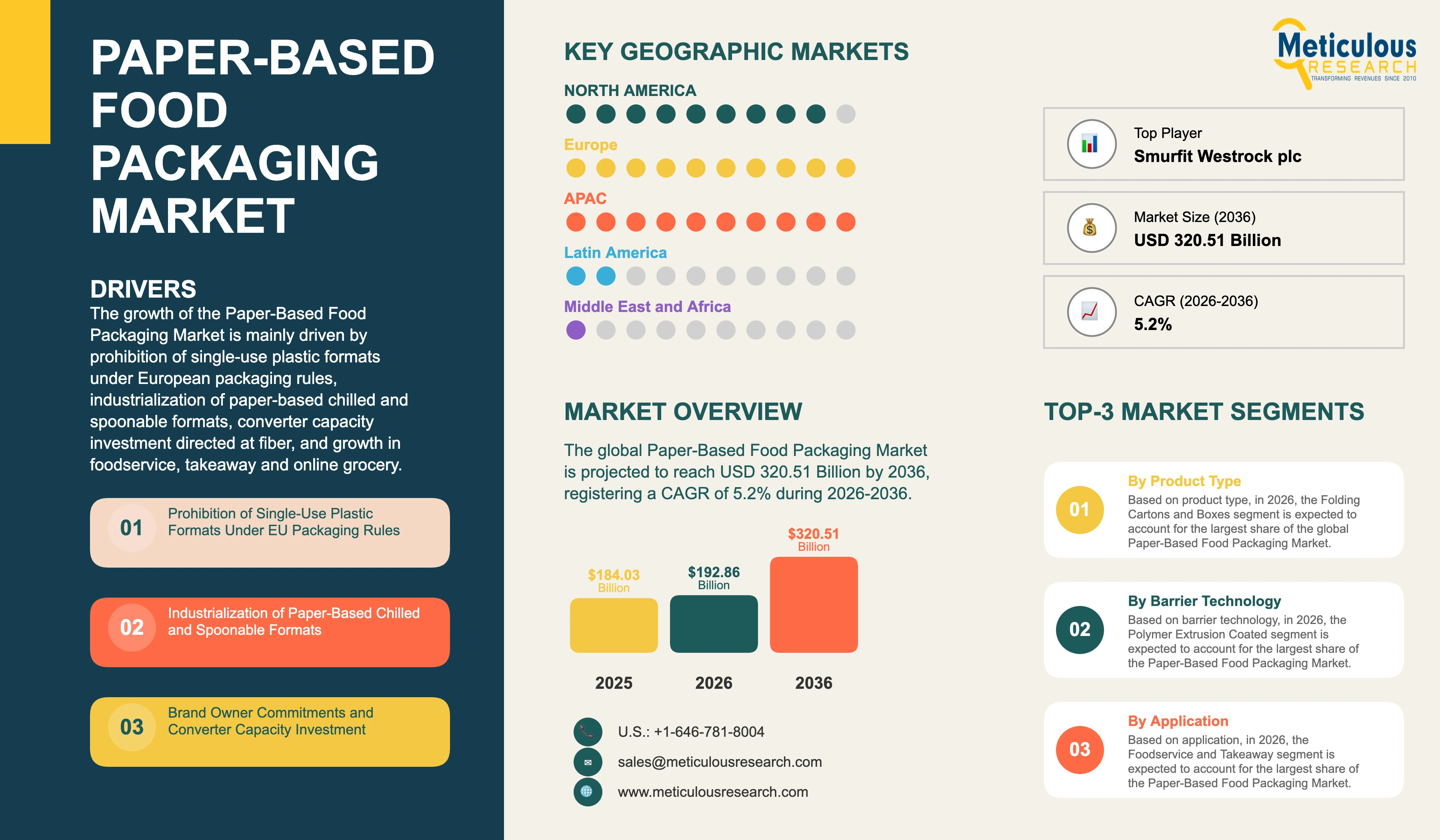
The global Paper-Based Food Packaging Market was valued at USD 184.03 billion in 2025. This market is expected to reach USD 320.51 billion by 2036 from an estimated USD 192.86 billion in 2026, registering a CAGR of 5.2% during the forecast period (2026-2036).
- Published
- Nov 2026
- Pages
- 264
- Format
- PDF + Excel
- Report ID
- MRCHM - 1042844
- Base year
- 2025
- 2025 · BASELINE
- $184.0B
- 2036
- $320.5B
- CAGR 2026–2036
- 5.2%
2025 baseline · 2026–2036 forecast at 5.2% CAGR · hover a bar for the value
Key highlights
The global Paper-Based Food Packaging Market is projected to reach USD 320.51 billion by 2036, driven by prohibition of single-use plastic formats under European packaging rules, industrialization of paper-based chilled and spoonable formats, converter capacity investment directed at fiber, and growth in foodservice, takeaway and online grocery.
Europe is expected to account for the largest market share in 2026 and is also projected to register the fastest growth during the forecast period, supported by the packaging rules taking effect across the region, the concentration of liquid packaging board and carton converting capacity, and the substitution of fiber for plastic formats scheduled for prohibition from 2030.
By product type, Folding Cartons and Boxes are expected to account for the largest market share, whereas Cups, Tubs and Spoonable Containers are projected to witness the fastest growth through 2036.
By barrier technology, Polymer Extrusion Coated are expected to account for the largest market share, whereas Water-Based Dispersion Coated are projected to witness the fastest growth through 2036.
By application, Foodservice and Takeaway are expected to account for the largest market share, whereas Fresh Fruit and Vegetables are projected to witness the fastest growth through 2036.
Regulation (EU) 2025/40 on packaging and packaging waste was adopted on 19 December 2024, entered into force on 11 February 2025 and applies from 12 August 2026, requiring all packaging to be recyclable and designed to minimize weight and volume.
Single-use plastic formats are prohibited from 2030, including films used to group goods at the point of sale, pre-packed fruit and vegetables under 1.5 kg, food and drink filled and consumed in hotels, bars and restaurants, and individual portions of condiments, sauces, coffee creamer and sugar.
Recyclability performance grades apply from 2030, the requirement to be recycled at scale applies from 2035, and stricter recyclability obligations apply from 2038.
By 2030, grouped, transport and e-commerce packaging must not exceed 50% empty space, and marketing or consumer acceptance does not justify additional weight or volume.
Tetra Pak launched Tetra Reva on 24 November 2026, described as the first globally available industrialized paper-based package for spoonable foods, covering yogurt including protein-rich varieties and those with fruit pieces, puddings and desserts, plant-based alternatives, and soft cheeses such as cottage cheese, ricotta, mascarpone and spreadable cheeses.
Tetra Pak states it is investing approximately EUR 100 million annually through 2030 in paper-based packaging development, and the Tetra Reva filling system supports chilled or high-acid ambient production.
Huhtamaki directed EUR 15.7 million of EUR 36.2 million of third quarter 2026 group capital expenditure to Fiber Packaging, a segment with EUR 97.1 million of quarterly net sales out of EUR 1,017.8 million, and reported the largest expansion investments of the first nine months going to Fiber Packaging capacity.
Fiber Packaging adjusted EBIT margin at Huhtamaki reached 14.5% in the third quarter of 2026 against 12.6% a year earlier, above the group margin of 10.9%.
Graphic Packaging produced first commercial-grade paperboard at its Waco, Texas recycled paperboard facility in October 2025, a site able to process material for up to 15 million paper cups per day, and states that about 1 billion plastic packages were replaced in 2024.
The United States Food and Drug Administration announced in February 2024 that substances containing PFAS used as grease-proofing agents are no longer sold for paper food packaging, and 35 food contact notifications were declared no longer effective in January 2025.
Report summary
| Particulars | Details |
|---|---|
| Forecast Period | 2026-2036 |
| Base Year | 2025 |
| Estimated Year | 2026 |
| CAGR (Value) | 5.2% |
| Format | PDF, Excel & Cloud Portal · 264 pages |
| CAGR (Volume) | 2.4% |
| Market Size (Value) in 2026 | USD 192.86 billion |
| Market Size (Value) in 2036 | USD 320.51 billion |
| Market Size (Volume) in 2026 | 98.90 million metric tons |
| Market Size (Volume) in 2036 | 125.20 million metric tons |
| Average Selling Price, 2026 | USD 1,950 per metric ton |
| Average Selling Price, 2036 | USD 2,560 per metric ton |
| Segments Covered | By Product Type: Folding Cartons and Boxes, Liquid Paperboard Cartons, Cups, Tubs and Spoonable Containers, Molded Fiber Trays and Clamshells, Paper Bags, Pouches and Wraps, Corrugated Food Boxes. By Barrier Technology: Polymer Extrusion Coated, Water-Based Dispersion Coated, Bio-Based and Compostable Coated, Aluminum Foil Laminated, Uncoated and Greaseproof Papers. By Application: Dairy and Spoonable Foods, Beverages, Bakery and Confectionery, Fresh Fruit and Vegetables, Meat, Poultry and Seafood, Frozen and Chilled Ready Meals, Dry Foods, Cereals and Snacks, Foodservice and Takeaway. By End User: Food and Beverage Manufacturers, Foodservice Operators and Quick Service Restaurants, Retailers and Private Label Brands, Online Grocery and Meal Kit Providers. |
| Countries Covered | Germany; France; U.K.; Italy; China; Japan; India; South Korea; U.S.; Canada; Mexico; Brazil |
| Key Companies | Smurfit Westrock plc, Graphic Packaging Holding Company, Huhtamaki Oyj, Tetra Laval International S.A., SIG Group AG, Stora Enso Oyj, and Sonoco Products Company |
Report overview
Segments covered: product type, barrier technology, application, end user.
In volume terms, the market is estimated at 98.90 million metric tons in 2026 and is expected to reach 125.20 million metric tons by 2036, registering a CAGR of 2.4% during the forecast period. The average selling price is estimated at USD 1,950 per metric ton in 2026 and USD 2,560 per metric ton in 2036.
The growth of this market is mainly driven by the prohibition of single-use plastic formats under European packaging rules from 2030, the industrialization of paper-based formats for chilled and spoonable foods, brand owner commitments backed by converter capacity investment, growth in foodservice, takeaway and online grocery, and recyclability and recycled content requirements that favor fiber. However, factors such as barrier performance against moisture, grease and oxygen, the cost premium over incumbent plastic formats, fiber and energy cost volatility, and the recyclability of coated and laminated structures are expected to restrain the growth of this market to some extent.
Among applications, Foodservice and Takeaway are expected to account for the largest market share in 2026, while Fresh Fruit and Vegetables are projected to register the highest CAGR during the forecast period. Geographically, Europe is expected to account for the largest share of this market in 2026 and is also expected to register the highest CAGR during the forecast period.
The Paper-Based Food Packaging Market comprises paper, paperboard and molded fiber packaging used to contain, protect and present food and beverages, measured at the point of sale by converters and integrated producers to brand owners, foodservice operators and retailers. The market covers folding cartons and boxes, liquid paperboard cartons in aseptic and chilled formats, cups, tubs and spoonable containers, molded fiber trays and clamshells, paper bags, pouches and wraps, and corrugated food boxes, across polymer extrusion coated, water-based dispersion coated, bio-based and compostable coated, aluminum foil laminated and uncoated and greaseproof structures, applied to dairy and spoonable foods, beverages, bakery and confectionery, fresh fruit and vegetables, meat, poultry and seafood, frozen and chilled ready meals, dry foods, cereals and snacks, and foodservice and takeaway. Non-food paper packaging, labels sold separately from the pack, plastic and metal packaging, closures and fitments sold as components, and the paperboard and pulp traded as a commodity grade rather than converted into food packaging fall outside the scope.
Regulation rather than preference is setting the pace of substitution. Regulation (EU) 2025/40 applies from 12 August 2026, requires all packaging to be recyclable and designed to minimize weight and volume, and prohibits a named list of single-use plastic formats from 2030 that includes pre-packed fruit and vegetables under 1.5 kg, films used to group goods at the point of sale, food and drink filled and consumed in hotels, bars and restaurants, and individual portions of condiments, sauces, coffee creamer and sugar. Each of those formats has a fiber-based equivalent already in production, which is why Fresh Fruit and Vegetables is projected to be the fastest-growing application in this market at 8.6%.
The formats that resisted substitution longest are now being industrialized. Tetra Pak launched Tetra Reva on 24 November 2026 as the first globally available industrialized paper-based package for spoonable foods, covering yogurt including protein-rich varieties and those carrying fruit pieces, puddings and desserts, plant-based alternatives and soft cheeses, with a full-top opening and a pull-ring in place of a foil lid and a filling system supporting chilled or high-acid ambient production. Spoonable dairy had remained in plastic cups because the pack has to survive filling, sealing and a spoon, and Cups, Tubs and Spoonable Containers is projected to grow at 7.8% in this market as that constraint is addressed.
Converter capital is following the same direction and the margin evidence supports it. Huhtamaki placed EUR 15.7 million of EUR 36.2 million of third quarter 2026 group capital expenditure into Fiber Packaging, a segment representing EUR 97.1 million of EUR 1,017.8 million in quarterly net sales, and reported that the largest expansion investments of the first nine months went to Fiber Packaging capacity. That segment delivered a 14.5% adjusted EBIT margin against a group margin of 10.9%, so the capital is moving toward the higher-return position rather than only toward the regulated one.
Barrier technology is where the value in this market is shifting. Polymer extrusion coating remains the largest barrier technology because polyethylene applied to board is proven against moisture and seals reliably, yet a polymer layer is the feature that complicates recyclability assessment under rules requiring recycling at scale from 2035. Water-Based Dispersion Coated structures are projected to grow at 9.4% in this market, the fastest of any barrier technology, because an aqueous coating keeps the pack within fiber recycling streams.
Fiber economics moved in favor of converters during the period while conversion costs did not. Recycled fiber prices were lower in the third quarter of 2026 than a year earlier while transportation and energy costs rose, and Graphic Packaging produced first commercial-grade board at its Waco, Texas recycled paperboard facility in October 2025, a site able to process material for up to 15 million paper cups per day with a closed loop returning clean scrap from its own converting operations. Average realized value in this market moves from USD 1,950 per metric ton in 2026 to USD 2,560 in 2036 while tonnage grows at 2.4% against value at 5.2%, which is the barrier and format mix rather than board inflation.
Online Grocery and Meal Kit Providers is projected to be the fastest-growing end user in this market at 8.9%, and from 2030 grouped, transport and e-commerce packaging must not exceed 50% empty space. Meeting that limit while protecting chilled and fresh food in transit favors formed fiber and corrugated structures designed to the product rather than oversized outer cases, and the packaging is specified by the operator rather than by the brand, which shortens the qualification path.
Europe is expected to account for the largest share of this market in 2026, supported by Regulation (EU) 2025/40 applying from 12 August 2026 with single-use plastic format prohibitions from 2030, the concentration of liquid packaging board capacity and carton systems in the region, and the dairy, bakery and foodservice volumes converting to fiber ahead of those dates.
Europe is projected to grow at 5.4% and holds the largest regional position in this market in 2026. Regulation (EU) 2025/40 applies from 12 August 2026 and prohibits a named list of single-use plastic formats from 2030, which places a fixed substitution deadline on brand owners selling into the region. Germany grows at 5.8% as the largest national market for cartons, board and molded fiber conversion, while France, the United Kingdom and Italy carry dairy, bakery and foodservice volumes alongside national measures already in force, and the region holds the liquid packaging board capacity and carton systems from which paper-based formats for chilled and spoonable foods are supplied.
The Middle East & Africa region is projected to grow at 5.2% from the smallest regional base, concentrated in ambient liquid dairy and juice in aseptic cartons used for shelf life and distribution reach and in foodservice packaging across the Gulf markets, with local converting capacity limited relative to consumption so board arrives as imported reels. Latin America is projected to grow at 4.9%, with Mexico taking a growing share through packaged food, beverage and foodservice production serving domestic consumption and export into North American retail, and Brazil holding the largest regional tonnage across dairy, juice and foodservice formats.
Some of the key players operating in the paper-based food packaging market are Smurfit Westrock plc, Graphic Packaging Holding Company, Huhtamaki Oyj, Tetra Laval International S.A., SIG Group AG, Stora Enso Oyj, and Sonoco Products Company, among others.
Key strategies include investing converter capital in fiber capacity ahead of regulated substitution dates, as in Huhtamaki directing the largest expansion investments of the first nine months of 2026 to Fiber Packaging and Graphic Packaging starting up recycled board capacity at Waco, Texas in October 2025; qualifying water-based dispersion coatings that keep packs within fiber recycling streams; industrializing rigid fiber formats for categories still in plastic, as in the Tetra Reva launch of 24 November 2026; integrating board production with converting to secure supply through fiber and energy cost cycles; and supplying filling systems alongside packaging material so that format conversion and line conversion are sold together.
Report infographic
Market dynamics
18 factors across 5 forcesProhibition of Single-Use Plastic Formats Under EU Packaging Rules
Regulation (EU) 2025/40 was adopted on 19 December 2024, entered into force on 11 February 2025 and applies from 12 August 2026. It prohibits a named list of single-use plastic formats from 2030, covering films used to group goods at the point of sale, pre-packed fruit and vegetables under 1.5 kg, food and drink filled and consumed in hotels, bars and restaurants, individual portions of condiments, sauces, coffee creamer and sugar, and most very lightweight plastic bags. Every one of those formats has a paper or molded fiber equivalent in commercial production, so the prohibition transfers volume rather than removing it. Fresh Fruit and Vegetables is projected to be the fastest-growing application in this market at 8.6%, and the 2030 date gives converters and brand owners a fixed deadline against which qualification and tooling decisions are being taken now.
Industrialization of Paper-Based Formats for Chilled and Spoonable Foods
Tetra Pak launched Tetra Reva on 24 November 2026, described as the first globally available industrialized paper-based package for spoonable foods, addressing yogurt including protein-rich varieties and those with fruit pieces, puddings and desserts, plant-based alternatives, and soft cheeses such as cottage cheese, ricotta, mascarpone and spreadable cheeses. The pack carries a full-top opening for eating directly from the carton, a compact-shape lid and a pull-ring in place of a foil lid, and the filling system supports chilled or high-acid ambient production. Spoonable dairy stayed in plastic because the container must withstand filling, sealing, distribution and a spoon without losing shape, which rigid board had not delivered at line speed. Cups, Tubs and Spoonable Containers is projected to grow at 7.8% in this market, and the dairy and spoonable category is large enough that a single qualified format changes regional fiber demand.
Brand Owner Commitments and Converter Capacity Investment
Tetra Pak states it is investing approximately EUR 100 million annually through 2030 in paper-based packaging development, and Huhtamaki reported that the largest expansion investments of the first nine months of 2026 were directed to increased capacity in Fiber Packaging, placing EUR 15.7 million of EUR 36.2 million of third quarter group capital expenditure into that segment. Graphic Packaging produced first commercial-grade paperboard at its Waco, Texas recycled paperboard facility in October 2025. Capacity commitments of this kind precede demand rather than follow it, because a board machine or a forming line takes years to commission and must be in place before a brand owner will qualify a format on it. The investment pattern therefore indicates where converters expect volume to sit by 2030, and it is concentrated in fiber rather than in flexible or rigid plastic lines.
Growth of Foodservice, Takeaway and Online Grocery
Foodservice and Takeaway holds the largest application share of this market in 2026 on the volume of cups, clamshells, wraps, bags and trays consumed per serving, and Online Grocery and Meal Kit Providers is projected to be the fastest-growing end user at 8.9%. Huhtamaki recorded a EUR 23 million contract in its European smooth molded fiber operation within third quarter 2026 Foodservice Packaging net sales of EUR 252.6 million. Single-serve and delivery formats consume packaging per transaction rather than per household, so the packaging intensity of a delivered meal exceeds that of the same meal cooked at home. Fiber holds an advantage in these channels because the pack is disposed of by the consumer in a kerbside stream where paper recovery infrastructure already exists.
Recyclability and Recycled Content Requirements Favoring Fiber
Under Regulation (EU) 2025/40 all packaging must be recyclable, recyclability performance grades apply from 2030, the requirement to be recycled at scale applies from 2035 and stricter obligations apply from 2038. Plastic packaging additionally carries minimum recycled post-consumer content requirements, while paper and board already move through established collection and recycling systems at high recovery rates. A fiber pack therefore starts an assessment from a position a plastic pack has to reach, and the requirement to be recycled at scale is the test a multi-layer structure is least likely to pass. That asymmetry is what converts a sustainability preference into a specification decision, and it applies to the pack a brand owner is designing in 2026 for sale in 2030.
Table of contents
12 chapters · 146 sections · 264 pages · click to expandSegmental analysis
| Segment | Largest share (2026) | Fastest growth (2026–2036) |
|---|---|---|
| By Product Type | Folding Cartons and Boxes | Cups, Tubs and Spoonable Containers |
| By Barrier Technology | Polymer Extrusion Coated | Water-Based Dispersion Coated |
| By Application | Foodservice and Takeaway | Fresh Fruit and Vegetables |
| By End User | Food and Beverage Manufacturers | Online Grocery and Meal Kit Providers |
| Other segments | Polymer Extrusion Coated | Online Grocery and Meal Kit Providers |
By Product Type
- Paper-Based Food Packaging Market Analysis by Product Type
- Folding Cartons and Boxes are expected to account for the largest share of the global Paper-Based Food Packaging Market.
- The large share of this segment is mainly due to the breadth of food categories they already serve across cereals, frozen food, confectionery, bakery and dry goods, where board is the incumbent material rather than a substitute, supported by established converting capacity and print performance.
- However, Cups, Tubs and Spoonable Containers are projected to register the highest CAGR during the forecast period.
- The rapid growth of this segment is attributed to the industrialization of rigid fiber containers for spoonable foods, including the launch of a globally available paper-based package for yogurt, desserts, plant-based alternatives and soft cheeses, in a category that had remained in plastic cups.
- Folding Cartons and Boxes are expected to account for the largest market share in 2026.
- Cups, Tubs and Spoonable Containers are projected to register the highest CAGR during the forecast period, owing to the industrialization of rigid fiber containers for spoonable foods, including the launch of a globally available paper-based package for yogurt, desserts, plant-based alternatives and soft cheeses, in a category that had remained in plastic cups.
- Water-Based Dispersion Coated are projected to register the highest CAGR during the forecast period, owing to the retention of the pack within fiber recycling streams, which is the test a structure must pass under requirements for recyclability grading from 2030 and recycling at scale from 2035, delivered through aqueous coatings that run on existing board capacity.
- Fresh Fruit and Vegetables are projected to register the highest CAGR during the forecast period, owing to the prohibition of single-use plastic packaging for pre-packed fruit and vegetables under 1.5 kg from 2030, which transfers a defined volume into molded fiber and board formats already in commercial production.
By Barrier Technology
- Paper-Based Food Packaging Market Analysis by Barrier Technology
- Polymer Extrusion Coated are expected to account for the largest market share.
- The large share of this segment is mainly due to the proven moisture resistance and sealing performance of polyethylene applied to board across cups, liquid cartons and trays, and the installed extrusion coating capacity through which most barrier board is produced.
- However, Water-Based Dispersion Coated are projected to register the highest CAGR during the forecast period.
- The rapid growth of this segment is attributed to the retention of the pack within fiber recycling streams, which is the test a structure must pass under requirements for recyclability grading from 2030 and recycling at scale from 2035, delivered through aqueous coatings that run on existing board capacity.
By Application
- Paper-Based Food Packaging Market Analysis by Application
- Foodservice and Takeaway are expected to account for the largest market share.
- The large share of this segment is mainly due to the quantity of cups, clamshells, wraps, bags and trays consumed per serving rather than per household, and the position of fiber as the default material across quick service and delivery channels where the pack is disposed of in a kerbside stream.
- However, Fresh Fruit and Vegetables are projected to register the highest CAGR during the forecast period.
- The rapid growth of this segment is attributed to the prohibition of single-use plastic packaging for pre-packed fruit and vegetables under 1.5 kg from 2030, which transfers a defined volume into molded fiber and board formats already in commercial production.
By End User
- Paper-Based Food Packaging Market Analysis by End User
- Food and Beverage Manufacturers are expected to account for the largest market share.
- The large share of this segment is mainly due to the volume of primary packaging specified at the filling line across dairy, beverage, bakery, frozen and dry food production, and the long qualification relationships that tie board and carton supply to individual plants.
- However, Online Grocery and Meal Kit Providers are projected to register the highest CAGR during the forecast period.
- The rapid growth of this segment is attributed to packaging consumed per transaction rather than per household together with the 50% empty space limit applying to e-commerce packaging from 2030, which favors formed fiber and corrugated structures designed to the product.
Other segments
- Polymer Extrusion Coated are expected to account for the largest market share in 2026.
- Foodservice and Takeaway are expected to account for the largest market share in 2026.
- Food and Beverage Manufacturers are expected to account for the largest market share in 2026.
- Online Grocery and Meal Kit Providers are projected to register the highest CAGR during the forecast period, owing to packaging consumed per transaction rather than per household together with the 50% empty space limit applying to e-commerce packaging from 2030, which favors formed fiber and corrugated structures designed to the product.
Geographic analysis
Asia-Pacific
Fastest growthAsia-Pacific is projected to be the fastest-growing region in this market at 6.3%, with India the fastest-growing country at 8.4%. Domestic packaged food and beverage brands are specifying fiber formats from launch rather than converting from plastic later, and board and converting capacity is being added in the region against both domestic demand and export packaging requirements. First specification rather than substitution accounts for the larger part of regional growth. India is projected to be the fastest-growing country at 8.4%, where domestic packaged food and beverage brands specify fiber formats from launch rather than converting from plastic later and board and converting capacity is being added against both domestic and export requirements. China holds the largest regional tonnage across foodservice, delivery and packaged food production. Japan is projected to be the slowest-growing country at 2.2%, where fiber formats are long established and demand follows population and consumption rather than substitution. Asia-Pacific is projected to register the highest CAGR at 6.3%, as domestic packaged food and beverage brands specify fiber formats from launch rather than converting later and board and converting capacity is added against domestic and export requirements, with India projected to be the fastest-growing country at 8.4%. Asia-Pacific Converting Capacity and Domestic Brands Geographic Analysis
Europe
Largest shareEurope is expected to account for the largest share of this market in 2026 and is projected to grow at 5.4%. Regulation (EU) 2025/40 applies across the region from 12 August 2026 and prohibits a named list of single-use plastic formats from 2030, which places a fixed substitution deadline on brand owners selling into the region. Germany grows at 5.8% as the largest national market for cartons, board and molded fiber conversion, while France, the United Kingdom and Italy carry dairy, bakery and foodservice volumes alongside national measures already in force. The region holds the concentration of liquid packaging board capacity and the carton systems supplied from it, including the paper-based spoonable format launched on 24 November 2026.
North America
North America is projected to grow at 4.3% and holds the third largest regional position in this market in 2026. Substitution in the United States is driven by brand owner commitments, state-level measures and recovery infrastructure rather than by a single federal prohibition, and the Food and Drug Administration announced in February 2024 that PFAS grease-proofing substances are no longer sold for paper food packaging, with 35 food contact notifications declared no longer effective in January 2025. Recycled paperboard capacity was added at Waco, Texas, where first commercial-grade board was produced in October 2025. Canadian demand follows foodservice and packaged food production alongside federal single-use measures. Mexico accounts for a growing share through packaged food, beverage and foodservice production serving both domestic consumption and export into North American retail, where supplied packaging must meet the specifications of the receiving market.
Latin America
Latin America is projected to grow at 4.9%. Brazil holds the largest regional tonnage across dairy, juice and foodservice formats and carries domestic liquid packaging board conversion. Regional growth follows packaged food consumption and foodservice expansion rather than prohibition-driven substitution.
Middle East & Africa
The Middle East & Africa region is projected to grow at 5.2% from the smallest regional base in this market. Demand is concentrated in ambient liquid dairy and juice in aseptic cartons, where the format is used for shelf life and distribution reach rather than for material substitution, and in foodservice packaging across the Gulf markets. Local converting capacity is limited relative to consumption, so board arrives as imported reels and is converted regionally, which links delivered cost to freight as much as to board price.
Competitive landscape
The global Paper-Based Food Packaging Market is fragmented, with competition among integrated paper and board producers, specialist food packaging converters and carton and filling system suppliers. Market participants compete primarily on barrier performance against the food and its shelf life, recyclability of the finished structure, converting and forming capability, filling system compatibility and installed base, and delivered cost against the plastic format being replaced.
investing converter capital in fiber capacity ahead of regulated substitution dates, qualifying water-based dispersion coatings that keep packs in fiber recycling streams, industrializing rigid fiber formats for categories still in plastic, integrating board production with converting to secure supply, and supplying filling systems alongside packaging material
The report provides a comprehensive competitive assessment of the leading companies operating in the global Paper-Based Food Packaging Market. The key players profiled in the report include Smurfit Westrock plc (Ireland), Graphic Packaging Holding Company (U.S.), Huhtamaki Oyj (Finland), Tetra Laval International S.A. (Switzerland), SIG Group AG (Switzerland), Stora Enso Oyj (Finland), and Sonoco Products Company (U.S.).
- Smurfit Westrock plc
- Graphic Packaging Holding Company
- Huhtamaki Oyj
- Tetra Laval International S.A.
- SIG Group AG
- Stora Enso Oyj
- Sonoco Products Company
Expert perspectives
A named list of single-use plastic formats becomes unlawful in the European market from 2030 and every one of them has a fiber equivalent already in commercial production, so the question for this market is not whether substitution happens but which structure wins it. Pre-packed fruit and vegetables under 1.5 kg, point-of-sale grouping films, hotel and restaurant service packs and portioned condiments move on a fixed date, and Fresh Fruit and Vegetables grows at 8.6% on that basis. Brand owners qualifying packs in 2026 are specifying for a 2030 shelf.
The technical contest is between barrier performance and recyclability, and the regulation has written the tiebreak. Polymer extrusion coating holds the largest barrier share because polyethylene on board seals and resists moisture, while recyclability grading from 2030 and recycling at scale from 2035 penalize exactly that layer. Water-Based Dispersion Coated structures grow at 9.4%, the fastest of any barrier technology, because an aqueous coating runs on installed board capacity and keeps the pack in a fiber stream, and the categories that cannot accept it are those needing an oxygen barrier for ambient shelf life.
Converter capital allocation is the clearest read on where this market is going. Huhtamaki put EUR 15.7 million of EUR 36.2 million of third quarter 2026 capital expenditure into a Fiber Packaging segment carrying EUR 97.1 million of EUR 1,017.8 million in quarterly sales and returning a 14.5% adjusted EBIT margin against 10.9% for the group, Tetra Pak states it is spending approximately EUR 100 million a year through 2030 on paper-based packaging, and Graphic Packaging started up recycled board capacity at Waco in October 2025. Tonnage in this market grows at 2.4% while value grows at 5.2%, so the return sits in specification and barrier content rather than in volume.
Customer perspectives
Insights gathered during primary interviews with food and beverage brand owners, packaging converters, foodservice operators, and board and coating suppliers operating in this market highlight where specification priorities are shifting. The following perspectives reflect recurring themes raised across these discussions.
This reflects filling line capital rather than material availability governing the pace of substitution in spoonable foods, with regulated deadlines rather than packaging performance setting the planning horizon.
This indicates that aqueous coatings address grease and moisture requirements while oxygen-sensitive ambient products remain dependent on laminated structures, so shelf life determines which categories can move to single-stream fiber.
This points to foodservice substitution being largely complete in dry and ambient formats, with the remaining conversions concentrated in hot and wet applications where the cost premium against plastic has not closed.
“The spoonable category stayed in plastic because the container has to hold its shape through filling, sealing, a cold chain and then somebody digging a spoon into it. A rigid fiber pack that does all of that changes our options, but it also changes our filling line, and that capital is the real decision. Regulation has given us a date, so we are planning the line, not the pack.”
“We can coat board to resist grease and water with a water-based dispersion and keep the whole pack in the paper stream, which is what our customers now ask for first. Where it gets difficult is oxygen, because an ambient juice or a liquid dairy product still needs a foil layer and that is the structure the recyclability rules are hardest on. The coating choice is being made by the shelf life, not by us.”
“Our packaging is handled by a customer for ten minutes and then goes into a bin, so what matters is that it performs for that ten minutes and that it is recoverable afterwards. Fiber does both, and we have moved most formats already. The cost gap on the remaining items, mainly anything holding a hot liquid or a wet sauce, is where we are still negotiating.”
Frequently asked questions
The global Paper-Based Food Packaging Market is estimated at USD 192.86 billion in 2026.
Cite this report
Meticulous Research. (2026). Paper-Based Food Packaging Market - Global Opportunity Analysis and Industry Forecast (2026-2036) (Report No. MRCHM - 1042844). Meticulous Market Research Pvt. Ltd. https://www.meticulousresearch.com/product/paper-based-food-packaging-market-7527