South East Asia Galvanized Steel Market (2023-2031)
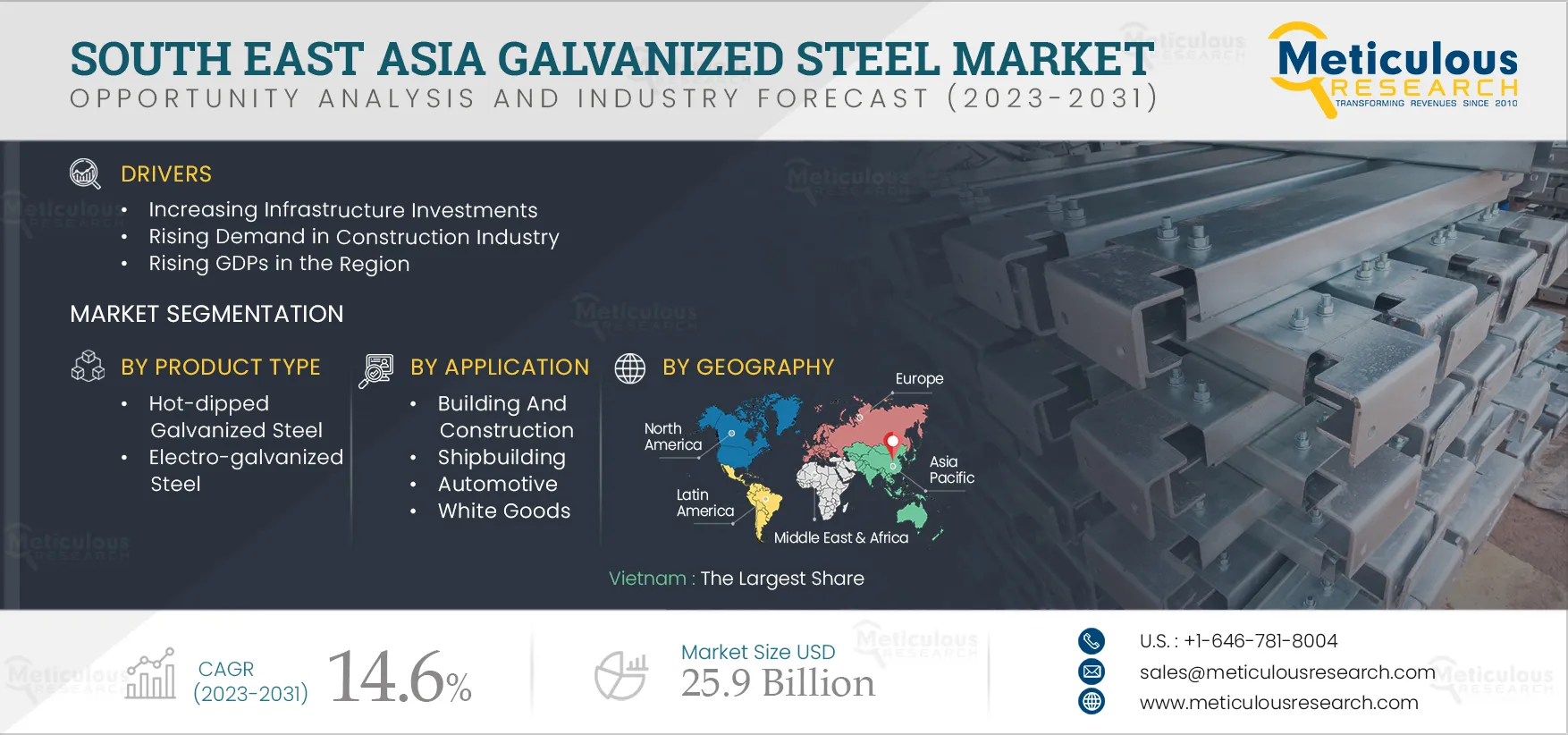
The South East Asia Galvanized Steel Market is expected to reach $25.9 billion by 2031, at a CAGR of 14.6% during the forecast period of 2023-2031. By volume, this market is expected to reach 27.6 million tons by 2031, at a CAGR of 13.8% during the forecast period 2023-2031.The growth of the South East Asia galvanized steel market is driven by increasing infrastructure investments, rising demand in the construction industry, and rising GDPs in the region.
- Published
- Jun 2024
- Pages
- 150
- Format
- PDF + Excel
- Report ID
- MR-318
- Base year
- 2023
- 2031 · FORECAST
- $25.90B
- 2031
- $25.90B
- CAGR 2024–2031
- 14.6%
2023 baseline · 2024–2031 forecast at 14.6% CAGR · hover a bar for the value
Key highlights
The South East Asia Galvanized Steel Market is expected to reach $25.9 billion by 2031, at a CAGR of 14.6% during the forecast period of 2023-2031.
By volume, this market is expected to reach 27.6 million tons by 2031, at a CAGR of 13.8% during the forecast period 2023-2031.The growth of the South East Asia galvanized steel market is driven by increasing infrastructure investments, rising demand in the construction industry, and rising GDPs in the region.
The hot-dipped galvanized steel segment is expected to account for the larger share of above 76.9% of the South East Asia galvanized steel market.
The building and construction segment is expected to account for the largest share of above 70.4% of the South East Asia galvanized steel market.
In 2024, Vietnam is expected to account for the largest share of above 37.7% of the South East Asia galvanized steel market.
Report summary
| Particulars | Details |
|---|---|
| Number of Pages | 150 |
| Format | |
| Forecast Period | 2024–2031 |
| Base Year | 2023 |
| CAGR (Value) | 14.6% |
| CAGR (Volume) | 13.8% |
| Market Size (Value) | USD 25.9 billion by 2031 |
| Market Size (Volume) | 27.6 Million Tons by 2031 |
| Segments Covered | By Product Type · Hot-dipped Galvanized Steel · Hot-dipped Zinc Coated Galvanized Steel · Hot-dipped Aluminum Coated Galvanized Steel · Hot-dipped Sn-Zinc Coated Galvanized Steel · Hot-dipped Zinc-Magnesium-Aluminum Alloy Coated Galvanized Steel · Hot-dipped Zinc-Aluminum-Silicon Alloy Coated Galvanized Steel · Hot dipped Zinc-Aluminum-Magnesium-Silicon Alloy Coated Galvanized Steel · Electro-galvanized Steel · Electrolytic Zinc-Coated Galvanized Steel · Electrolytic Zinc-Nickel Alloy-Coated Galvanized Stee · Electrolytic Nickel-Coated Galvanized Steel · Electrolytic Zinc-Sn-Nickel Alloy-Coated Galvanized Steel · Electrolytic Phosphate-Treated Galvanized Steel · By Application · Building and Construction · Trusses · Roofs · Frames · Exterior Wall · Interior Wall · Pipes and Ducts · Purlins · Decking · Other Building and Construction Applications · Shipbuilding · Automotive · White Goods · Refrigerators · Washing Machines · Air-conditioning · Microwave Ovens · Other White Goods Appliances · Other Appliances · Electrical Transmission Towers · Telecom Towers · Steel Furniture · Office Equipment · Miscellaneous Applications |
| Countries Covered | Europe (Germany, U.K., France, Italy, Spain, Netherlands, Switzerland, Sweden, Denmark, and Rest of Europe), Asia-Pacific (China, Japan, India, South Korea, Australia & New Zealand, Indonesia, Thailand, Vietnam, Malaysia, Singapore, and Rest of Asia- Pacific), North America (U.S., Canada), Latin America (Brazil, Mexico, and Rest of Latin America), and the Middle East & Africa (UAE, Israel, and Rest of Middle East & Africa) |
| Key Companies | Essar Steel India Limited (India), Nippon Steel Corporation (Japan), POSCO (South Korea), JFE Holdings, Inc. (Japan), JTL Infra Limited (India), NS BlueScope Steel Limited (Australia), Hoa Sen Group (Vietnam), Hoa Phat Group (Vietnam), Dongkuk Steel Group (South Korea), Chinh Dai Industrial Co. Ltd (Vietnam), FiW Steel Sdn. Bhd. (Malaysia), Galvaco Industries Sdn. Bhd. (Malaysia), Nam Kim Steel Joint Stock Company (Vietnam), Tata Steel Limited (India), and Hyundai Steel Co., Ltd. (South Korea) |
Report overview
Segments covered: product type. Regions: Europe, Asia-Pacific, North America, Latin America, Middle East & Africa.
However, the volatility in raw material prices, regulatory compliance and standards, and decline in the purchase of Chinese steel among south East ASIAN countries due to changing international trade dynamics may restrain market growth.
Furthermore, technological advancements in the galvanized steel manufacturing process and the establishment of the ASEAN economic community are expected to create market growth opportunities. However, high manufacturing costs pose a significant challenge to the market’s growth.
Market dynamics
4 factors across 3 forcesIncreasing Infrastructure Investments
The swift urbanization and burgeoning population in various regions underscore the urgency of erecting new infrastructure to meet the escalating need for housing, transportation, utilities, and public amenities. Crucial infrastructure endeavors like roads, bridges, railways, airports, and utilities hinge on a substantial supply of construction materials, prominently galvanized steel. This perpetuates a constant demand for galvanized steel across urban development projects, owing to its unmatched corrosion resistance, durability, and robustness, rendering it indispensable for structural frameworks, reinforcements, and support mechanisms.
South East Asia stands as a focal point of rapid infrastructural expansion, largely propelled by the relocation of manufacturing enterprises to the region. Such development initiatives not only invigorate economic vitality but also foster employment opportunities within South East Asian nations. Anticipated upsurges in expenditure on transport infrastructure, notably high-speed and urban rail networks, are poised to catalyze seamless movement of goods, materials, and populace throughout the ASEAN region. Singapore's ambitious plan to double its Mass Rapid Transit (MTR) system by 2030 exemplifies the commitment to enhancing commuter convenience.
Vietnam emerged as a leader in infrastructure investments within the region, with an estimated allocation of 5.7% of its GDP. This heightened focus on infrastructure development is projected to propel the demand for galvanized steel across South East Asia as nations intensify efforts to bolster their foundational frameworks for sustained growth and prosperity.
Rising Demand in the Construction Industry
Galvanized steel holds a prominent position in the construction sector owing to its robustness, longevity, and resistance to corrosion. Its widespread use stems from the assurance of safety and durability it offers, guarding against fire hazards, corrosion, pests, and structural deterioration. This ensures the steadfastness and dependability of constructed towers and infrastructure.
Galvanized steel finds application in diverse structural undertakings such as buildings, bridges, stadiums, warehouses, and other vital projects where structural resilience is paramount. Particularly, galvanized steel sheets and panels are prevalent choices for roofing and cladding in both residential and commercial construction endeavors. They boast exceptional resilience against harsh weather conditions, corrosion, and environmental wear, rendering them well-suited for outdoor applications. These attributes fuel the market's growth trajectory over the forecast period.
Key players in this sector continually initiate endeavors to augment market development. For instance, in March 2024, The Building and Construction Authority (Singapore) unveiled new initiatives aimed at bolstering transformation within Singapore's built environment sector. These initiatives are geared towards enhancing productivity, digitalization, and sustainability, thereby fostering progress and innovation in the industry.
Table of contents
10 chapters · 117 sections · 150 pages · click to expandSegmental analysis
| Segment | Largest share (2024) | Fastest growth (2024–2031) |
|---|---|---|
| By Product Type | Hot-dipped Galvanized Steel | Hot-dipped galvanized steel |
| By Application | Building and Construction | White goods |
By Product Type
- The hot-dipped galvanized steel segment is expected to account for the larger share of above 76.9% of the South East Asia galvanized steel market.
- This segment's large market share can be attributed to the various factors as hot-dipped galvanized steel provides numerous environmental and economic benefits to achieve sustainable designs.
- Also, it can prevent costly and damaging corrosion protection inspections and maintenance.
- Hot-dip galvanized steel can withstand the effects of corrosion for decades is maintenance-free, and ensures these structures will stand strong long into the future.
- Hot-dipped galvanizing facilitates tight bonding of zinc coating with the steel, and it has a low peeling tendency due to its low-friction surface.
- Due to such factors, hot-dipped galvanized coatings are considered highly ductile since they can maintain their full corrosion protection even after being heavily formed.
- Moreover, hot-dipped galvanized steel can be welded using a variety of welding methods, including resistance, laser, and arc welding.
- Moreover, the hot-dipped galvanized steel segment is projected to register the highest CAGR during the forecast period.
By Application
- The building and construction segment is expected to account for the largest share of above 70.4% of the South East Asia galvanized steel market.
- This segment's large market share can be attributed to the various factors of galvanized steel having numerous measurable benefits when it is used as a crucial ingredient in buildings and construction purposes.
- Steel frames for buildings, whether residential or commercial, are often galvanized to shield against rust and corrosion, making them particularly advantageous in humid or coastal areas.
- This protection extends to the building’s structural components, safeguarding them from moisture, environmental elements, and other corrosive factors.
- Galvanized steel is an affordable, low-maintenance option, ideal for metal buildings due to its durability.
- Galvanized steel beams and columns offer robust structural support, ensuring the stability and safety of buildings over the long term.
- Additionally, galvanized steel can be more cost-effective compared to other steel coatings.
- Its low maintenance requirements and reduced labor costs after construction make it an economical choice.
- Unlike other coatings, galvanized steel surfaces do not need harsh chemical treatments to prevent corrosion.
- Simple periodic wiping a few times a year is sufficient to keep the surface corrosion-free.
- The necessity for durable and low-maintenance building materials fuels the demand for galvanized steel in construction.
- As infrastructure development accelerates, particularly in emerging markets, the use of galvanized steel is anticipated to increase significantly.
- Additionally, advancements in galvanizing technologies and a growing emphasis on sustainable construction practices are further enhancing its adoption.
- However, the white goods segment is projected to register the highest CAGR during the forecast period.
- This segment's high growth is attributed to the large portion of steel used for its manufacture.
- An electro-galvanized steel sheet with a coating weight of 20 g/m2 is normally used for white goods.
- This is to restrain red rust on steel by taking advantage of the preferential corrosion of zinc under general conditions.
Geographic analysis
Asia-Pacific
Largest shareIn 2024, Vietnam is expected to account for the largest share of above 37.7% of the South East Asia galvanized steel market. Several key factors drive Vietnam’s significant market share in galvanized steel. Rapid industrialization and extensive infrastructure development are major contributors to the rising demand for galvanized steel. As various industries expand, there is an increased need for durable and corrosion-resistant materials, particularly in construction, automotive, electronics, and other sectors. The construction industry, in particular, is a major consumer of galvanized steel, utilizing it for roofing, fencing, structural components, and other applications. Vietnam's booming construction sector, propelled by urbanization, real estate development, and large-scale infrastructure projects, significantly boosts the demand for galvanized steel. This trend is expected to continue as the country progresses in its industrial and urban growth. However, Indonesia is projected to register the highest CAGR of 16.7% during the forecast period. The growth of this regional market can be attributed to various factors, as the automotive sector in Indonesia is one of the largest in South East Asia. Galvanized steel is extensively used in vehicle manufacturing for body panels, chassis, and other components due to its strength and corrosion resistance. The growth in the automotive industry significantly boosts the demand for galvanized steel. Additionally, Indonesia's role as a manufacturing hub for various industries creates numerous export opportunities, further driving the demand for galvanized steel. Export-oriented industries depend on high-quality materials like galvanized steel to meet international standards and remain competitive in South East Asian markets. These factors collectively contribute to the market's growth during the forecast period. In 2024, Vietnam to Dominate the South East Asia Galvanized Steel Market
Competitive landscape
- March 2023
The Government of India signed agreements with 27 companies, kick-starting the USD 63,220 million (INR 6,322 crore) production-linked incentive (PLI) scheme for specialty steel. This scheme is expected to attract investments of up to USD 300,000 million (INR 30,000 crore) over the next five years.
- June 2022
Nippon Steel Corporation (Japan) announced a joint venture between and ArcelorMittal S.A. (Luxembourg). It announced a spending of roughly USD 1.1 billion (YEN 140 billion) to build advanced steel processing lines in India, with the potential for expanding capacity further to tap the country's growing demand for steel. The new lines will be installed at AM/NS India's Hazira plant, an integrated steelworks in the western state of Gujarat. They include a cold-rolling mill and a hot-dip galvanizing line, with a combined annual processing capacity of 2 million tons.
- January 2022
POSCO (South Korea), the world's fifth-largest steelmaker by output, announced that it had started the construction of a plant in China that will produce galvanized steel sheets for cars. The plant, which will be located in Tangshan in northern China's Hebei Province, will have a production capacity of 900,000 tons.
- ABB Ltd. · Switzerland
- Schneider Electric SE · France
- Siemens AG · Germany
- Rockwell Automation Inc. (U.S.)
- Allied Motion Technologies, Inc. (U.S.)
- AMETEK Inc. (U.S.)
- Johnson Electric Holdings Limited · Hong Kong
- Nidec Motor Corporation · Japan
- Franklin Electric Co., Inc. (U.S.)
- Regal Rexnord Corporation (U.S.)
- Arc Systems Inc. (U.S.)
- Denso Corporation · Japan
- Emerson Electric Co. (U.S.)
- Nidec Corporation · Japan
- Oriental Motor USA Corp · Germany
Frequently asked questions
The South East Asia galvanized steel market is expected to reach $25.9 billion by 2031, at a CAGR of 14.6% during the forecast period 2023-2031.
Cite this report
Meticulous Research. (2024). South East Asia Galvanized Steel Market - Opportunity Analysis and Industry Forecast (2023-2031) (Report No. MR-318). Meticulous Market Research Pvt. Ltd. https://www.meticulousresearch.com/product/south-east-asia-galvanized-steel-market-5019