Anti Graffiti Coatings Market (2026-2036)
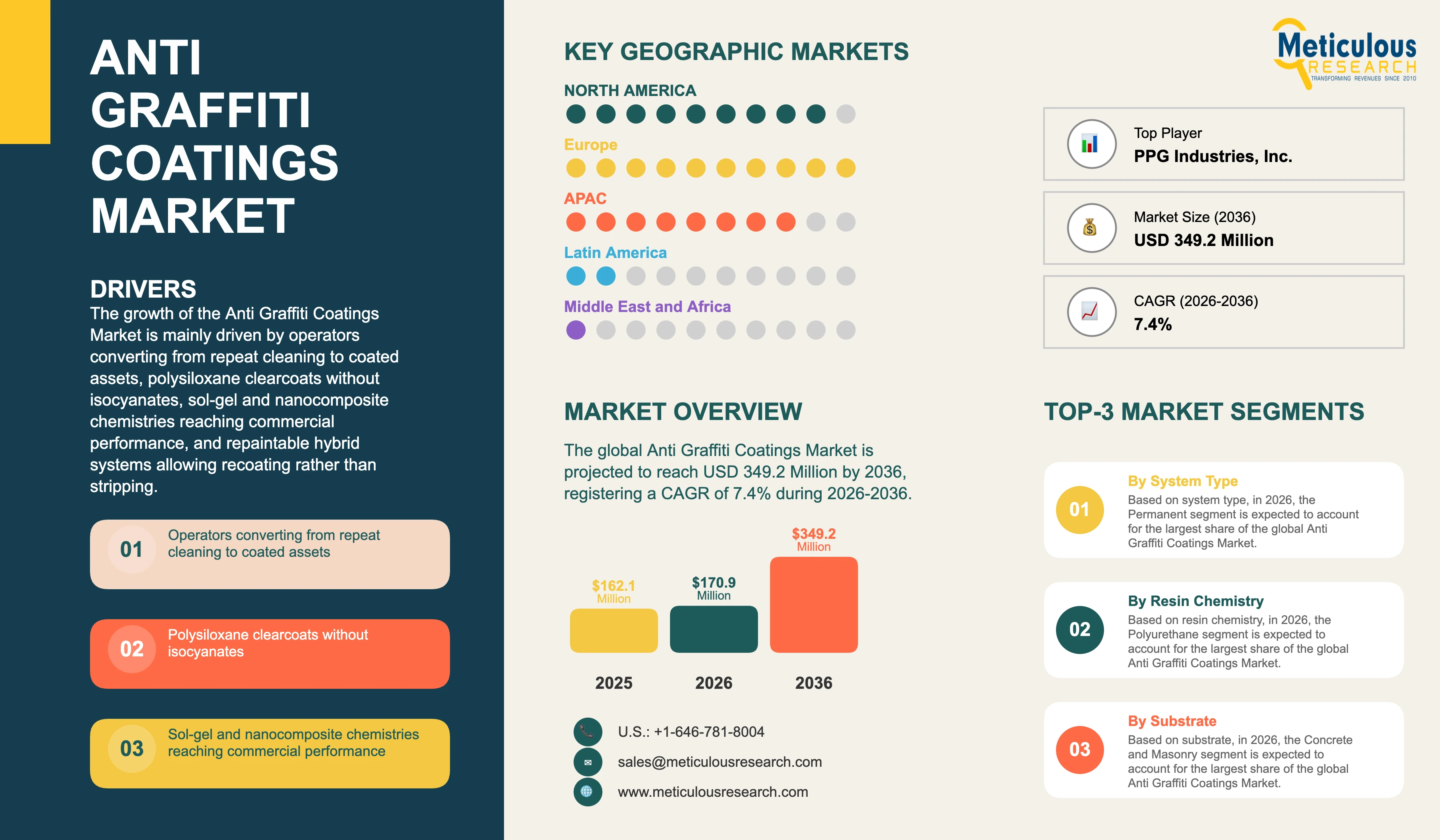
The anti graffiti coatings market is valued at USD 170.9 million in 2026 and is projected to reach USD 349.2 million by 2036, at a CAGR of 7.4% during the forecast period. The market was valued at USD 162.1 million in 2025 and at USD 154.2 million in 2024.
- Published
- Nov 2026
- Pages
- 259
- Format
- PDF + Excel
- Report ID
- MRCHM - 1042792
- Base year
- 2025
- 2024 · HISTORICAL
- $154.2M
- 2036
- $349.2M
- CAGR 2026–2036
- 7.4%
2024–2025 baseline · 2026–2036 forecast at 7.4% CAGR · hover a bar for the value
Key highlights
This market measures coatings formulated and sold to resist or release graffiti, taken at the manufacturer gate on a tonne basis, covering sacrificial, semi-permanent, permanent and repaintable systems.
Graffiti removal solvents, gels and cleaning chemicals are excluded, as are removal labour and equipment services, protective films and wraps, graffiti-resistant laminates, and general-purpose topcoats carrying no anti-graffiti claim.
Network Rail states that it spends more than GBP 3.5 million every year removing graffiti, money that it states could be better spent improving the railway.
A letter from the Secretary of State for Transport to the chief executive of Network Rail refers to its current annual GBP 3.5 million programme of antigraffiti measures.
That letter also records a GBP 1 million programme of work that Network Rail safely undertook in the Spring to target graffiti, and asks the operator to use all the tools and innovations available to address and prevent graffiti.
Network Rail states that trespassing to create graffiti is dangerous and can lead to train delays, especially where people go onto the tracks, and that fines of up to GBP 1,000 apply for trespassing on the railway.
A universal restriction proposal on per- and polyfluoroalkyl substances was prepared by the Netherlands, Germany, Norway, Denmark and Sweden for submission to the European Chemicals Agency in January 2023.
That proposal would cover a wide range of per- and polyfluoroalkyl substance uses, which reaches the fluoropolymer binders used in permanent anti-graffiti clearcoats.
The European Union chemicals strategy for sustainability commits to phasing out all per- and polyfluoroalkyl substances, allowing their use only where proven irreplaceable and essential to society.
Fluoropolymer chemistry records the slowest growth of any resin class in this market over the forecast period at 2.4% a year as a result of that position.
PPG supplies PSX 700 A Clear Coat, described as a two-component engineered polysiloxane clearcoat and as isocyanate-free.
That product is stated to resist graffiti and to be resistant to graffiti removal solvents, which is a claim of cleaning durability rather than of non-stick release.
It is stated to be compatible with primed steel, clean metals and concrete, which covers the three principal substrate classes in this market.
The same product is described as high solids and low volatile organic compound content at a maximum of 220 grams a litre, with a glossy finish and high durability in challenging environments.
Polysiloxane chemistry grows at 10.8% a year over the forecast period, the second fastest resin class, on that combination of solvent resistance, isocyanate-free formulation and low volatile organic compound content.
Sol-gel and nanocomposite chemistries record the highest resin class CAGR in this market at 13.0%, from the smallest 2026 base of 8.5%.
Sacrificial systems, which are removed together with the graffiti and reapplied, hold 20.0% of this market in 2026 and grow slowest among system types at 5.2%.
Rolling stock and vehicles record the highest end-use CAGR in this market at 9.6%, and transport infrastructure holds the largest end-use share at 27.0% in 2026.
Report summary
| Particulars | Details |
|---|---|
| Base Year | 2025 |
| Actual Years | 2024-2025 |
| Forecast Period | 2026-2036 |
| Market Size in 2024 | USD 154.2 million |
| Market Size in 2025 | USD 162.1 million |
| Market Size in 2026 | USD 170.9 million |
| Market Size in 2036 | USD 349.2 million |
| Value CAGR (2026-2036) | 7.4% |
| Format | PDF, Excel & Cloud Portal · 259 pages |
| Volume in 2025 | 25.40 kilotons |
| Volume in 2026 | 26.50 kilotons |
| Volume in 2036 | 43.00 kilotons |
| Volume CAGR (2026-2036) | 5.0% |
| Average Selling Price, 2026 | USD 6,450 per tonne |
| Average Selling Price, 2036 | USD 8,120 per tonne |
| Units | Value in USD million; volume in kilotons of coating; price in USD per tonne |
| Measurement Basis | Coatings formulated and sold to resist or release graffiti, measured at the manufacturer gate on a tonne basis, covering sacrificial, semi-permanent, permanent and repaintable systems |
| Historical Value Growth | Value grew at 5.3% a year between 2024 and 2026 against volume growth of 4.2% a year; the forecast of 7.4% sits above that rate because reformulation away from fluorinated chemistry and conversion of rolling stock and new infrastructure both fall inside the forecast period |
| Budget Basis Note | Network Rail states that it spends more than GBP 3.5 million every year removing graffiti, and a letter from the Secretary of State for Transport describes the same figure as an annual programme of antigraffiti measures alongside a GBP 1 million programme undertaken in the Spring; across a national network those are cleaning budgets, so a permanent coating is a capital item competing against them rather than funded from them |
| Fluorine Position Note | Fluoropolymer binders give the lowest surface energy and the best release performance in this market and grow slowest of any resin class at 2.4% a year; a universal restriction proposal on per- and polyfluoroalkyl substances was prepared by the Netherlands, Germany, Norway, Denmark and Sweden for submission to the European Chemicals Agency in January 2023, and the European Union chemicals strategy for sustainability allows continued use only where proven irreplaceable and essential to society |
| Performance Claim Note | Permanent products are sold on surviving repeated application of aggressive removal solvents rather than on preventing adhesion; the leading polysiloxane clearcoat is stated to resist graffiti and to be resistant to graffiti removal solvents, and there is no common standard for removal cycles, solvent resistance or acceptable gloss loss against which such claims can be compared |
| Overlap Note | Products sold with both easy-clean and anti-graffiti claims are counted in this title and in the Easy Clean Sanitary Coatings Market and Self Cleaning Coatings Market titles, so those titles are non-additive with this one on the overlapping products |
| Exclusions | Graffiti removal solvents, gels, poultices and cleaning chemicals; removal labour, pressure washing and media blasting services; protective films, wraps and graffiti-resistant laminates; general-purpose topcoats and decorative paints carrying no anti-graffiti claim; easy-clean and photocatalytic self-cleaning coatings sold for hygiene or soiling rather than graffiti; anti-climb and anti-vandal hardware; enforcement, lighting and surveillance measures |
| Segments: System Type | Permanent; Semi-Permanent; Sacrificial; Hybrid and Repaintable |
| Segments: Resin Chemistry | Polyurethane; Acrylic and Wax; Polysiloxane; Fluoropolymer; Sol-Gel and Nanocomposite |
| Segments: Substrate | Concrete and Masonry; Metal; Painted Surfaces; Glass and Transparent; Plastic and Composite; Other Substrates |
| Segments: End Use | Transport Infrastructure; Buildings and Facades; Rolling Stock and Vehicles; Street Furniture and Signage; Education and Public Buildings; Other End Uses |
| Largest Segment by System Type, 2026 | Permanent, at 44.0% |
| Fastest-Growing Segment by System Type | Hybrid and Repaintable, at 12.4% |
| Largest Segment by Resin Chemistry, 2026 | Polyurethane, at 32.0% |
| Fastest-Growing Segment by Resin Chemistry | Sol-Gel and Nanocomposite, at 13.0% |
| Slowest-Growing Segment by Resin Chemistry | Fluoropolymer, at 2.4% |
| Largest Segment by Substrate, 2026 | Concrete and Masonry, at 34.0% |
| Fastest-Growing Segment by Substrate | Glass and Transparent, at 9.4% |
| Largest Segment by End Use, 2026 | Transport Infrastructure, at 27.0% |
| Fastest-Growing Segment by End Use | Rolling Stock and Vehicles, at 9.6% |
| Largest Region, 2026 | Europe, at 34.0% |
| Fastest-Growing Region | Asia-Pacific, at 8.6% |
| Fastest-Growing Country | China, at 9.4% |
| Slowest-Growing Country | Canada, at 6.2% |
| Regions Covered | Europe; North America; Asia-Pacific; Latin America; Middle East & Africa |
| Countries Covered | Germany; U.K.; France; Italy; U.S.; Canada; China; Japan; Australia; U.A.E.; Mexico; Brazil |
| Key Players | PPG Industries, Inc.; Akzo Nobel N.V.; The Sherwin-Williams Company; RPM International Inc.; Hempel A/S; Jotun A/S; Sika AG; Axalta Coating Systems Ltd.; Nippon Paint Holdings Co., Ltd.; Tnemec Company, Inc. |
| Top Five Share, 2026 | 44.8% |
| Profiled Companies Share, 2026 | 56.3% |
| Currency | USD |
Report overview
Market value is measured in in USD million; volume in kilotons of coating; price in USD per tonne. Segments covered: system type, resin chemistry, substrate, end use.
The growth of this market is mainly driven by rolling stock and transport infrastructure operators converting from repeat cleaning to coated assets, polysiloxane clearcoats offering solvent resistance without isocyanates, sol-gel and nanocomposite chemistries reaching commercial performance, and repaintable hybrid systems that allow a surface to be recoated rather than stripped. However, factors such as operator budgets committed to removal rather than prevention, the highest-performing fluoropolymer chemistry sitting inside a proposed universal restriction, sacrificial systems matching an operating budget that a coating cannot, and specification fragmented across thousands of public authorities are expected to restrain the growth of this market to some extent.
Anti graffiti coatings work in one of two opposite ways, and the distinction governs who buys them and on what budget. A sacrificial coating is a soft wax or polysaccharide film applied over the surface, which is stripped off together with the paint when graffiti appears and then reapplied, so the substrate is never touched. A permanent coating is a hard, low-surface-energy or solvent-resistant film that stays in place while the graffiti is removed from it, usually many times over its life.
That difference is a budget difference before it is a technical one. A sacrificial system is a consumable bought out of a cleaning budget and reapplied after every incident, which matches how most public asset owners account for graffiti. A permanent system is a capital item specified at construction or refurbishment, and it has to be justified against a revenue line that is already being spent on removal. Sacrificial systems therefore remain 20.0% of this market and are the slowest-growing at 5.2% rather than disappearing.
The scale of the removal spend sets the commercial context. Network Rail states that it spends more than GBP 3.5 million every year removing graffiti, and a letter from the Secretary of State for Transport to its chief executive refers to the same figure as a current annual programme of antigraffiti measures alongside a GBP 1 million programme of work undertaken in the Spring. For a network of that size those are cleaning budgets, and a coating has to compete with them rather than be funded from them.
Removal itself carries an indirect cost that coatings suppliers sell against. Network Rail states that trespassing to create graffiti is dangerous and can lead to train delays, especially where people go onto the tracks, with fines of up to GBP 1,000 for trespass. The cost that matters to an operator is therefore the access, possession and delay required to clean an asset rather than the labour and solvent, which is the argument a permanent coating makes.
Resin chemistry divides the market along performance and regulatory lines rather than price. Polyurethane carries the largest share at 32.0% in 2026 as the established two-component anti-graffiti clearcoat, offering good solvent and abrasion resistance at a manageable cost, with isocyanate handling as the operational constraint. Acrylics and waxes carry the sacrificial and semi-permanent volume at 24.0% and grow slowly at 5.6%.
Fluoropolymer binders give the lowest surface energy available and therefore the best release performance of any chemistry, and they have the weakest regulatory position. A universal restriction proposal on per- and polyfluoroalkyl substances was prepared by the Netherlands, Germany, Norway, Denmark and Sweden for submission to the European Chemicals Agency in January 2023, covering a wide range of such uses, and the European Union chemicals strategy for sustainability commits to phasing out all of them, allowing use only where proven irreplaceable and essential to society.
An anti-graffiti clearcoat on a bridge parapet or a station wall is unlikely to meet a test of being irreplaceable and essential to society, since alternative chemistries already perform the function at acceptable cost. Fluoropolymer chemistry therefore grows at 2.4% a year over the forecast period, the slowest of any resin class in this market, and holds 14.0% of the market in 2026 against a performance position that would otherwise command more.
Polysiloxane is taking that ground, and the leading product illustrates how the claim has shifted. PPG supplies PSX 700 A Clear Coat, a two-component engineered polysiloxane clearcoat described as isocyanate-free, stated to resist graffiti and to be resistant to graffiti removal solvents, compatible with primed steel, clean metals and concrete, and offered as high solids and low volatile organic compound content at a maximum of 220 grams a litre.
The significant word there is resistant rather than releasing. A polysiloxane clearcoat is not sold as a non-stick surface that graffiti will not adhere to; it is sold as a film that survives repeated application of aggressive removal solvents without losing gloss or integrity. That is a different proposition from a fluoropolymer release coating and it suits an asset that will be cleaned many times rather than one that is expected never to be marked.
Sol-gel and nanocomposite systems are the fastest-growing chemistry at 13.0% a year from the smallest base. A silica or hybrid inorganic network applied thinly gives hardness, chemical resistance and very low surface energy without a fluorinated group, which is the combination the regulatory position favours. The constraints are application tolerance, since a thin inorganic film is unforgiving of surface preparation, and a cost per square metre above an organic clearcoat.
Substrate decides which system is viable more than end use does. Concrete and masonry carry the largest substrate share at 34.0% and the slowest growth at 6.4%, because a porous mineral surface absorbs both the graffiti and the coating, so penetrating sealers and sacrificial systems dominate and a hard clearcoat changes the appearance of the surface it protects. Metal grows faster at 8.2% on a non-porous substrate that a clearcoat suits.
Glass and transparent surfaces grow fastest at 9.4% from an 11.0% base, serving shelters, screens, station glazing and vehicle windows where scratching and etching rather than spray paint are the damage mode, and where a sacrificial film or coating protects a component that is expensive to replace. The economics there are the clearest in this market, since the alternative to a coating is glass replacement rather than cleaning.
End use follows asset ownership. Transport infrastructure holds the largest share at 27.0% in 2026, covering stations, bridges, tunnels, noise barriers and lineside structures owned by operators with identifiable maintenance budgets and a safety reason to reduce access requirements. Buildings and facades hold 23.5% and grow slowest at 6.2%, because private building owners specify at refurbishment intervals measured in decades.
Rolling stock and vehicles are the fastest-growing end use at 9.6%. A train, tram or bus is a high value asset taken out of service to be cleaned, the cleaning is done to a schedule rather than on discovery, and the body is a painted metal or composite surface that a clearcoat suits. The operator therefore counts availability as well as cleaning cost, which is the strongest business case for a permanent system anywhere in this market.
The structural weakness of this market is on the procurement side rather than the technical one. Specification sits with thousands of municipalities, transport authorities, school estates and building owners, each with its own standards and no common performance requirement, so a supplier sells into a fragmented base one project at a time. That is why this market grows at 7.4% on a small absolute base despite a cost problem that every asset owner recognises.
Europe holds the largest regional share because its rail and urban transport networks are dense, its graffiti exposure is high and its regulatory framework pushes hardest on chemistry, while Asia-Pacific grows fastest at 8.6% on new metro, station and infrastructure construction where an anti-graffiti specification can be written in at build rather than retrofitted. North America grows at 6.7% on a transit and highway asset base with established cleaning contracts.
Report infographic
Market dynamics
20 factors across 5 forcesOperators Converting From Repeat Cleaning to Coated Assets
Network Rail states that it spends more than GBP 3.5 million every year removing graffiti, money that it states could be better spent improving the railway, and a letter from the Secretary of State for Transport refers to the same figure as a current annual programme of antigraffiti measures alongside a GBP 1 million programme undertaken in the Spring.
The cost that drives a coating decision is not the solvent and labour but the access. Cleaning a lineside structure or a station surface requires possession, isolation or working at height, and Network Rail states that trespass to create graffiti can lead to train delays, especially where people go onto the tracks.
A permanent coating converts repeated access into a single application, which is the argument that has made transport infrastructure the largest end use in this market at 27.0% in 2026 and permanent systems the largest system type at 44.0%.
Polysiloxane Clearcoats Without Isocyanates
PPG supplies PSX 700 A Clear Coat, a two-component engineered polysiloxane clearcoat described as isocyanate-free, stated to resist graffiti and to be resistant to graffiti removal solvents, and compatible with primed steel, clean metals and concrete.
Removing isocyanate from a two-component anti-graffiti clearcoat removes the respiratory sensitisation handling requirement that governs spray application, which matters where the work is done on site rather than in a booth.
The product is also offered as high solids and low volatile organic compound content at a maximum of 220 grams a litre. Polysiloxane grows at 10.8% a year over the forecast period, the second fastest resin class in this market.
Sol-Gel and Nanocomposite Chemistries Reaching Commercial Performance
A silica or hybrid inorganic network applied as a thin film gives hardness, chemical resistance and very low surface energy without a fluorinated group, which is the performance combination the regulatory position now favours.
That matters because the European Union chemicals strategy for sustainability commits to phasing out all per- and polyfluoroalkyl substances, allowing their use only where proven irreplaceable and essential to society, which is a test an anti-graffiti clearcoat is unlikely to meet.
Sol-gel and nanocomposite chemistries record the highest resin class CAGR in this market at 13.0% over the forecast period from the smallest 2026 base of 8.5%.
Repaintable Hybrid Systems Allowing Recoating Rather Than Stripping
A repaintable system is formulated so that the marked surface can be overcoated with the same product rather than stripped back and rebuilt, which removes the solvent and waste handling that removal requires.
For a facade or a painted structure the alternative is a full repaint of a panel or elevation to avoid patch visibility, so a system that can be spot-recoated without a colour or gloss mismatch changes the unit cost of each incident.
Hybrid and repaintable systems record the highest system type CAGR in this market at 12.4% over the forecast period from a 7.0% share in 2026, the fastest growth of any segment in the system type breakdown.
Table of contents
12 chapters · 137 sections · 259 pages · click to expandSegmental analysis
| Segment | Largest share (2026) | Fastest growth (2026–2036) |
|---|---|---|
| By System Type | Permanent systems | Hybrid and repaintable systems |
| By Resin Chemistry | Polyurethane | Sol-gel and nanocomposite chemistries |
| By Substrate | Concrete and masonry | Glass and transparent surfaces |
| By End Use | Transport infrastructure | Rolling stock and vehicles |
By System Type
- Anti Graffiti Coatings Market Analysis by System Type
- Permanent systems are expected to hold the largest share of this market in 2026.
- A hard, solvent-resistant or low-surface-energy film stays in place while graffiti is removed from it, usually many times over the life of the asset, which is what an owner wants where access to clean is the expensive part of the operation.
- The segment grows at 8.0%, above the market rate, as transport operators and rolling stock fleets convert from repeat cleaning.
- Capital approval rather than performance is the limiting factor.
- Hybrid and repaintable systems are expected to record the highest CAGR during the forecast period at 12.4% from a 7.0% share in 2026.
- These are formulated so that a marked surface can be overcoated with the same product rather than stripped back, which removes the solvent and waste handling that removal requires and avoids the patch visibility that forces a full panel repaint on a facade.
- Semi-permanent systems hold 29.0% and grow at 6.8%, surviving a limited number of cleaning cycles before reapplication is needed, typically acrylic or polyurethane films that sit between the sacrificial and permanent positions on both cost and durability.
- They serve owners who want more than a single-use film without the capital case a permanent system requires.
- Sacrificial systems hold 20.0% and grow slowest at 5.2%.
- A soft wax or polysaccharide film is stripped off together with the graffiti and reapplied, so the substrate is never touched and the spend recurs with every incident.
- That recurrence is the commercial point: the cost falls in the same cleaning budget it replaces, which is why the least durable segment is displaced slowly rather than quickly.
By Resin Chemistry
- Anti Graffiti Coatings Market Analysis by Resin Chemistry
- Polyurethane is expected to hold the largest share of this market in 2026 at 32.0%, as the established two-component anti-graffiti clearcoat offering solvent and abrasion resistance at a manageable cost across metal, painted and composite substrates.
- The operational constraint is isocyanate handling, which governs spray application and matters most on assets coated in service rather than in a booth.
- The chemistry grows at 7.2%, close to the market rate.
- Sol-gel and nanocomposite chemistries are expected to record the highest CAGR during the forecast period at 13.0% from an 8.5% share.
- A silica or hybrid inorganic network applied as a thin film delivers hardness, chemical resistance and very low surface energy without a fluorinated group, which is the combination the regulatory position favours.
- Application tolerance is the constraint, since a thin inorganic film is unforgiving of surface preparation.
- Polysiloxane grows at 10.8%, the second fastest.
- The leading product in this class is a two-component engineered polysiloxane clearcoat described as isocyanate-free, stated to resist graffiti and to be resistant to graffiti removal solvents, compatible with primed steel, clean metals and concrete, and offered as high solids and low volatile organic compound content at a maximum of 220 grams a litre.
- Fluoropolymer chemistry grows slowest at 2.4% despite giving the lowest surface energy and the best release performance available, because a universal restriction proposal on per- and polyfluoroalkyl substances was prepared for submission to the European Chemicals Agency in January 2023 and the chemicals strategy for sustainability allows continued use only where proven irreplaceable and essential to society.
- Acrylic and wax chemistries grow at 5.6%, carrying the sacrificial and semi-permanent volume.
By Substrate
- Anti Graffiti Coatings Market Analysis by Substrate
- Concrete and masonry are expected to hold the largest share of this market in 2026 at 34.0% and the slowest growth at 6.4%.
- A porous mineral surface absorbs spray paint into the pore structure, so removal means drawing pigment back out rather than lifting it off, and a hard clearcoat applied over such a substrate changes its appearance and can trap moisture.
- Penetrating sealers and sacrificial films are therefore the viable products, which caps the value per square metre.
- Glass and transparent surfaces are expected to record the highest CAGR during the forecast period at 9.4% from an 11.0% share.
- On shelters, screens, station glazing and vehicle windows the damage mode is scratching and etching rather than spray paint, and the alternative to protection is replacing the glass, so the coating competes against a component replacement cost rather than a cleaning cost.
- Optical clarity after repeated cleaning favours sacrificial films here.
- Metal holds 26.5% and grows at 8.2%, the second fastest substrate.
- A non-porous surface suits a hard clearcoat, graffiti sits on the film rather than in the substrate, and the leading polysiloxane product is stated to be compatible with primed steel and clean metals.
- Street furniture, signage, barriers and rolling stock bodies sit in this class.
- Painted surfaces hold 17.0% and grow at 7.0%, where an anti-graffiti clearcoat is applied over an existing decorative or protective coating and compatibility with the underlying system governs specification.
- Plastic and composite substrates grow at 8.0% on vehicle panels, shelters and cladding, and other substrates at 6.0%.
By End Use
- Anti Graffiti Coatings Market Analysis by End Use
- Transport infrastructure is expected to hold the largest share of this market in 2026 at 27.0%, covering stations, bridges, tunnels, noise barriers and lineside structures owned by operators with identifiable maintenance budgets and a safety reason to reduce access.
- Network Rail states that it spends more than GBP 3.5 million every year removing graffiti and that trespass to create graffiti can lead to train delays.
- The segment grows at 7.4%.
- Rolling stock and vehicles are expected to record the highest CAGR during the forecast period at 9.6% from an 18.0% share.
- A train, tram or bus taken out of service to be cleaned costs the operator availability as well as labour, cleaning is scheduled rather than reactive, the body is a painted metal or composite surface that suits a clearcoat, and application happens in a depot where conditions can be controlled.
- Buildings and facades hold 23.5% and grow slowest at 6.2%.
- Private building owners specify at refurbishment intervals measured in decades, the surfaces at risk are the lower storeys rather than the whole elevation, and the repaintable systems that avoid patch visibility are the segment where growth is concentrated rather than across the whole facade area.
- Street furniture and signage hold 14.5% and grow at 7.0%, with municipal owners specifying sacrificial and semi-permanent products on dispersed assets that are cheap to clean individually and expensive to visit.
- Education and public buildings grow at 7.4% on school and civic estates with planned maintenance cycles, and other end uses at 6.4%.
Geographic analysis
Europe
Largest shareEurope is expected to account for the largest share of this market in 2026, while Asia-Pacific is expected to register the highest CAGR during the forecast period. Europe leads because its rail and urban transport networks are dense, graffiti exposure on those networks is high, and its regulatory framework pushes hardest on chemistry. The region grows at 7.4%, at the market rate, with the per- and polyfluoroalkyl substance restriction proposal prepared by the Netherlands, Germany, Norway, Denmark and Sweden driving reformulation toward polysiloxane and sol-gel systems ahead of any decision. Germany and the United Kingdom hold the largest national positions within Europe on rail and urban transport asset bases, with Network Rail stating annual graffiti removal spending of more than GBP 3.5 million and a Secretary of State letter referring to a GBP 1 million programme undertaken in the Spring. France and Italy follow on metro, regional rail and civic estates.
Asia-Pacific
Fastest growthAsia-Pacific grows fastest at 8.6%, on new construction rather than on retrofit. An anti-graffiti requirement written into a new metro station, noise barrier or bridge specification is applied once under controlled conditions on a substrate prepared for it, which removes the application tolerance constraint that limits thin inorganic films in service work. China grows fastest of the countries covered at 9.4%. Japan holds the specialty chemistry position within the region and Australia a transit and civic asset base with established anti-graffiti specification practice. The regional share of 25.5% in 2026 is below the European and North American positions because much of the asset base is newer and the cleaning cost history is shorter.
North America
North America grows at 6.7%, the slowest of the three major regions. Transit authorities and highway agencies operate established cleaning contracts that a coating has to displace, specification is dispersed across states, counties and municipalities, and no federal chemistry restriction equivalent to the European proposal applies. The United States holds the great majority of the regional total and Canada grows slowest of the countries covered at 6.2%. Mexico and Brazil carry metro and urban transport assets with high graffiti exposure and constrained maintenance budgets, which favours sacrificial systems, while Gulf markets specify permanent systems into new transport and civic construction where the budget is capital rather than operational.
Latin America
Latin America grows at 6.4% and the Middle East and Africa at 6.8%.
Competitive landscape
This market is served almost entirely as a product line within protective and industrial coatings businesses rather than by specialists. An anti-graffiti clearcoat is formulated from the same polyurethane, polysiloxane and acrylic platforms a supplier already runs for infrastructure, marine and rail coatings, and it is sold through the same specification and applicator channels. The specialist participants are small formulators serving municipal and facade markets with sacrificial and semi-permanent products.
Concentration is high relative to the size of the market. The top five participants are estimated to hold 44.8% of this market in 2026 and the profiled companies 56.3%, because specification into transport infrastructure and rolling stock runs through approved supplier lists that favour the large protective coatings groups, and because those groups hold the technical service capability that site application demands.
Product positioning has moved toward solvent resistance rather than release. PPG supplies PSX 700 A Clear Coat, a two-component engineered polysiloxane clearcoat described as isocyanate-free, stated to resist graffiti and to be resistant to graffiti removal solvents, compatible with primed steel, clean metals and concrete, offered as high solids and low volatile organic compound content at a maximum of 220 grams a litre with a glossy finish and high durability in challenging environments.
The competitive variable that will matter most over the forecast period is fluorine. A universal restriction proposal on per- and polyfluoroalkyl substances was prepared by the Netherlands, Germany, Norway, Denmark and Sweden for submission to the European Chemicals Agency in January 2023, and the European Union chemicals strategy for sustainability commits to phasing them out except where proven irreplaceable and essential to society, so a supplier holding a qualified fluorine-free product has a position that strengthens without further investment.
Specialist formulators hold a durable position at the sacrificial and semi-permanent end, where the product is sold on cost per square metre and reapplication cycle to municipal and facade customers rather than through an infrastructure approved supplier list, and where the technical service requirement is lower than a two-component permanent system demands.
Some of the key players operating in the anti graffiti coatings market are PPG Industries, Inc., Akzo Nobel N.V., The Sherwin-Williams Company, RPM International Inc., Hempel A/S, Jotun A/S, Sika AG, Axalta Coating Systems Ltd., Nippon Paint Holdings Co., Ltd., and Tnemec Company, Inc., among others.
- PPG Industries, Inc.
- Akzo Nobel N.V.
- Sherwin-Williams Company
- RPM International Inc.
- Hempel A/S
- Jotun A/S
- Sika AG
- Axalta Coating Systems Ltd.
- Nippon Paint Holdings Co., Ltd.
- Tnemec Company, Inc
Expert perspectives
The list driver for this title is public infrastructure maintenance, and the maintenance cost is real while the budget it sits in works against the product. Network Rail states that it spends more than GBP 3.5 million every year removing graffiti, and a letter from the Secretary of State for Transport describes the same figure as an annual programme of antigraffiti measures alongside a GBP 1 million programme undertaken in the Spring. Across a national network those are cleaning lines.
A permanent coating is a capital item that must be justified against that revenue spending at a refurbishment interval, while a sacrificial film is a consumable drawn from the same budget as the cleaning it replaces. That is why sacrificial systems still hold 20.0% of this market and are displaced at only 5.2% a year, and why the market grows at 7.4% on a small absolute base rather than converting a recognised cost problem quickly.
Where the economics do work, they work on access rather than on cleaning. Network Rail states that trespass to create graffiti can lead to train delays, especially where people go onto the tracks, and cleaning a lineside structure requires possession, isolation or working at height. Rolling stock is the clearest case, growing at 9.6%, because a vehicle out of service costs availability and is coated in a depot under controlled conditions.
The chemistry position is the sharpest feature of this market. Fluoropolymer binders give the lowest surface energy and the best release performance available, and they grow slowest of any resin class at 2.4% a year. A universal restriction proposal on per- and polyfluoroalkyl substances was prepared by five member state authorities for submission to the European Chemicals Agency in January 2023, and the chemicals strategy allows continued use only where proven irreplaceable and essential to society.
An anti-graffiti clearcoat is unlikely to meet that test while polysiloxane and sol-gel alternatives perform the function at acceptable cost, so the best-performing chemistry has the weakest commercial future. Polysiloxane grows at 10.8% and sol-gel and nanocomposite systems at 13.0%, and the leading polysiloxane product markets resistance to graffiti removal solvents rather than non-stick release, which is a different and more honest claim.
The binding constraint on the forecast is procurement rather than technology or regulation. Specification sits with thousands of municipalities, transport authorities, school estates and building owners with no common performance standard for removal cycles, solvent resistance or acceptable gloss loss, so a buyer comparing two products stated to resist graffiti has no shared basis for doing it and a supplier sells one project at a time.
Frequently asked questions
The market is valued at USD 170.9 million in 2026 and is projected to reach USD 349.2 million by 2036, at a CAGR of 7.4%. It was valued at USD 162.1 million in 2025 and USD 154.2 million in 2024.
Cite this report
Meticulous Research. (2026). Anti Graffiti Coatings Market - Global Opportunity Analysis and Industry Forecast (2026-2036) (Report No. MRCHM - 1042792). Meticulous Market Research Pvt. Ltd. https://www.meticulousresearch.com/product/anti-graffiti-coatings-market-7475