Aluminium Dross Recovery Market (2026-2036)
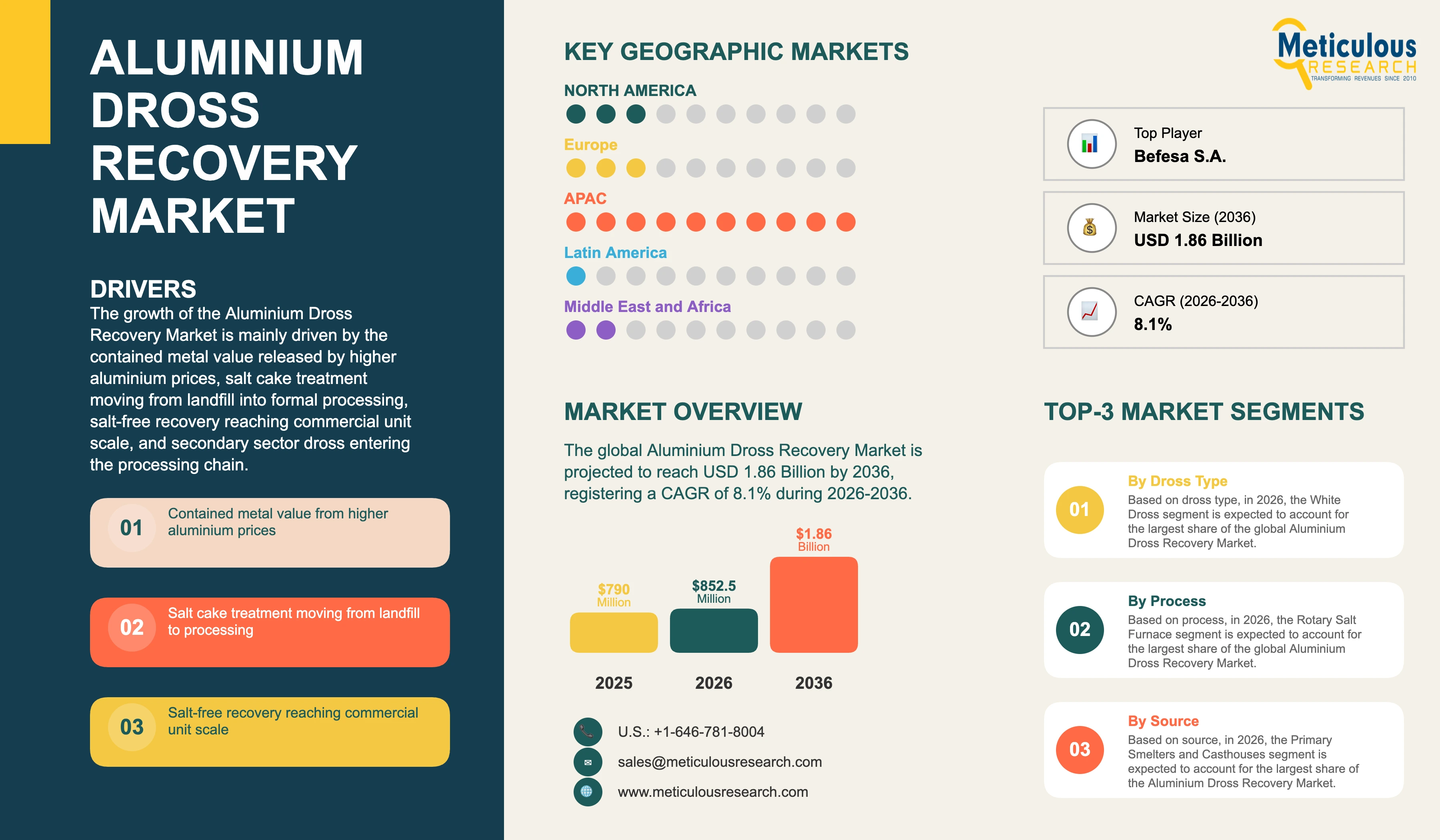
The aluminium dross recovery market is valued at USD 852.5 million in 2026 and is projected to reach USD 1.86 billion by 2036, at a CAGR of 8.1% during the forecast period. The market was valued at USD 790.0 million in 2025 and at USD 726.0 million in 2024.
- Published
- Nov 2026
- Pages
- 278
- Format
- PDF + Excel
- Report ID
- MRCHM - 1042789
- Base year
- 2025
- 2024 · HISTORICAL
- $726.0M
- 2036
- $1.86B
- CAGR 2026–2036
- 8.1%
2024–2025 baseline · 2026–2036 forecast at 8.1% CAGR · hover a bar for the value
Key highlights
This market measures the processing and recovery revenue earned on aluminium dross and its residues, covering tolling and on-site service fees together with dross processing equipment, on a tonne of dross processed basis.
The value of the recovered aluminium metal is excluded, because that metal is counted within the aluminium market and including it would measure the metal price rather than the recovery industry.
World aluminium smelter production reached 74.0 million tonnes in 2025 against 72.8 million in 2024, with China at 45.0 million tonnes.
Smelters typically lose between 2% and 10% of annual melt to dross, and that dross can contain as much as 80% metallic aluminium, so recovery is pursued for yield before compliance.
About 4.78 million tonnes of dross were generated in 2024, with up to 8 million tonnes indicated once smaller facilities are counted, and generation is expected to grow 3% to 4% a year.
Between 30% and 40% of dross still goes to landfill, concentrated in the secondary sector, where metallic content is lowest and the hazardous salt cake sits.
The United States ingot spot price rose from 129.5 cents per pound in 2024 to 180 cents in 2025, a rise of 39%, and the value of primary production rose 35% to about USD 2.6 billion even as output fell.
At 80% metallic content and 98% recovery, a tonne of white dross carries about USD 3,111 of aluminium at that price, a multiple of any landfill levy.
Befesa recycled 205 kilotonnes of salt slags and spent pot lining in the first half of 2026, 4% below a year earlier, at 87% utilisation, while Aluminium Salt Slags adjusted earnings rose 9% to EUR 20 million.
Aluminium alloy prices rose 17% to average EUR 2, 841 per tonne in that period, so earnings grew on price while treated volume fell.
PyroGenesis completed a seven-system Drosrite deployment for Radian Oil and Gas Services Company in Saudi Arabia on 15 October 2026, with combined capacity of up to 45,000 tonnes of dross a year.
It recovers up to 98% of the aluminium in dross, as much as 20% above some commonly used processes, and uses no salt, so no hazardous salt cake is created.
The final four units include the first two 10, 000 tonne per year systems that company has deployed anywhere, so the salt-free route has only now reached smelter unit scale.
Against 4.78 million tonnes of dross generated in 2024, that flagship 45,000 tonne capacity is about 0.9% of world generation, which is the measure of how early this market remains.
Enviri supplies AluSalt salt slag processing through ALTEK, acquired in 2018, with active equipment in more than 600 locations worldwide, and is working with Real Alloy on a zero waste salt slag facility at Wabash, Indiana with the United States Department of Energy.
That facility produces non-metallic byproducts for reuse in cement and steel, which is how salt cake stops being a disposal liability.
Among processes, the rotary salt furnace is expected to hold the largest share in 2026, while salt-free rotary and plasma processing is expected to grow fastest.
Among sources, primary smelters and casthouses are expected to hold the largest share in 2026, while extruders and rolling mills are expected to grow fastest.
Report summary
| Particulars | Details |
|---|---|
| Base Year | 2025 |
| Actual Years | 2024-2025 |
| Forecast Period | 2026-2036 |
| Market Size in 2024 | USD 726.0 million |
| Market Size in 2025 | USD 790.0 million |
| Market Size in 2026 | USD 852.5 million |
| Market Size in 2036 | USD 1.86 billion |
| Value CAGR (2026-2036) | 8.1% |
| Format | PDF, Excel & Cloud Portal · 278 pages |
| Volume in 2025 | 3.16 million tonnes |
| Volume in 2026 | 3.33 million tonnes |
| Volume in 2036 | 5.63 million tonnes |
| Volume CAGR (2026-2036) | 5.4% |
| Average Processing Revenue, 2026 | USD 256 per tonne |
| Average Processing Revenue, 2036 | USD 330 per tonne |
| Units | Value in USD million; volume in million tonnes of dross processed; price in USD per tonne of dross processed |
| Measurement Basis | Processing and recovery revenue earned on aluminium dross and its residues, covering tolling and on-site service fees together with dross processing equipment, on a tonne of dross processed basis |
| Recovered Metal Note | The value of the recovered aluminium metal is excluded, because that metal is counted within the aluminium market; including it would double count the largest single value in the chain and would measure the metal price rather than the recovery industry |
| Processed Share of Generation | 65% of world dross generation in 2026, rising to 78% by 2036; between 30% and 40% of dross currently goes to landfill |
| Exclusions | The value of recovered aluminium metal and alloy; spent pot lining treatment except where recycled alongside salt slag; bauxite residue and red mud; steel slag and zinc dust recycling; primary and secondary aluminium smelting; landfill and disposal services |
| Segments: Dross Type | White Dross; Black Dross; Salt Cake and Salt Slag |
| Segments: Process | Rotary Salt Furnace; Salt-Free Rotary and Plasma; Mechanical and Press Recovery; Leaching and Hydrometallurgical Residue Treatment |
| Segments: Source | Primary Smelters and Casthouses; Secondary Smelters and Refiners; Foundries and Die Casters; Extruders and Rolling Mills |
| Largest Segment by Dross Type, 2026 | White Dross |
| Fastest-Growing Segment by Dross Type | Salt Cake and Salt Slag, at 10.3% |
| Largest Segment by Process, 2026 | Rotary Salt Furnace |
| Fastest-Growing Segment by Process | Salt-Free Rotary and Plasma, at 12.0% |
| Largest Segment by Source, 2026 | Primary Smelters and Casthouses |
| Fastest-Growing Segment by Source | Extruders and Rolling Mills, at 10.2% |
| Largest Region, 2026 | Asia-Pacific |
| Fastest-Growing Region | Middle East & Africa, at 9.6% |
| Fastest-Growing Country | Saudi Arabia, at 10.6% |
| Slowest-Growing Country | Japan, at 5.6% |
| Regions Covered | Asia-Pacific; Europe; North America; Latin America; Middle East & Africa |
| Countries Covered | China; India; Japan; South Korea; Germany; Spain; France; U.S.; Canada; Mexico; Brazil; Saudi Arabia; UAE; Bahrain |
| Key Players | Befesa S.A.; Enviri Corporation; PyroGenesis Canada Inc.; Speira GmbH; Taha International Corporation |
| Top Five Share, 2026 | 21.4% |
| Profiled Companies Share, 2026 | 21.4% |
| Currency | USD |
Report overview
Market value is measured in in USD million; volume in million tonnes of dross processed; price in USD per tonne of dross processed. Segments covered: dross type, process, source.
In volume terms, the market is estimated at 3.33 million tonnes of dross processed in 2026, rising to 5.63 million tonnes by 2036, at a CAGR of 5.4%. The average processing revenue is estimated at USD 256 per tonne in 2026 and USD 330 per tonne in 2036, the increase reflecting a shift in the mix from metal-rich white dross toward black dross and salt cake, which carry higher treatment cost and a hazardous classification in most jurisdictions.
The growth of this market is mainly driven by the contained metal value released by higher aluminium prices, salt cake treatment moving from landfill into formal processing, salt-free recovery reaching commercial unit scale, and secondary sector dross entering the processing chain. However, factors such as processing capacity already running near full utilisation, falling treated volumes at established recyclers, dross recovery economics that depend on a metal price outside the control of the processor, and an installed salt-free base that remains very small are expected to restrain the growth of this market to some extent.
Among dross types, white dross is expected to hold the largest share of this market in 2026, while salt cake and salt slag is expected to record the highest CAGR during the forecast period. Geographically, Asia-Pacific is expected to account for the largest share of this market in 2026, while the Middle East & Africa is expected to register the highest CAGR during the forecast period.
Dross forms on the surface of molten aluminium wherever the metal meets air, as a mixture of aluminium oxide skin and entrained metal droplets that is skimmed from furnaces, holding baths and casting launders. Smelters typically lose between 2% and 10% of annual melt to it, and the skimmed material can contain as much as 80% metallic aluminium, so the first question at every plant is how much of that metal can be returned rather than whether the residue can be disposed of.
White dross is skimmed from primary metal and high purity remelt, carries the highest metallic content and the lowest salt, and is the material whose recovery has always paid for itself. Black dross comes from secondary smelting where salt flux has been used, carries lower metallic content and higher oxide and chloride, and is harder to treat. Salt cake, also called salt slag, is the residue left after a salt-based furnace has taken the metal out, and it is classified as hazardous in most jurisdictions because it releases ammonia and flammable gases on contact with water.
That gradient sets the economics of the whole market. At 80% metallic content and 98% recovery, a tonne of white dross carries about USD 3,111 of aluminium at the 2025 United States ingot price of 180 cents per pound, which is a multiple of any landfill charge. The metal in white dross is therefore recovered because it pays, and has been for decades.
What remains unrecovered is the low metal fraction. Between 30% and 40% of dross still goes to landfill, concentrated in the secondary aluminium sector, which is precisely where metallic content is lowest and where the residue carries a hazardous classification. The growth in this market is therefore in the material whose recovery economics are worst, and policy rather than metal price is what moves it.
Three process families compete. The rotary salt furnace melts dross under a sodium and potassium chloride flux that coalesces the metal droplets, which recovers metal efficiently but converts the residue into salt cake that must then be treated or landfilled. Mechanical and press recovery squeezes hot dross to drain free metal without flux, recovering less but creating no new waste stream.
Salt-free rotary and plasma processing heats dross directly without flux, so metal is recovered and no salt cake is created. PyroGenesis recovers up to 98% of the aluminium in dross by that route, as much as 20% above some commonly used processes, and the absence of salt allows the unit to sit inside the smelter rather than requiring off-site tolling.
Leaching and hydrometallurgical treatment is the fourth family and addresses the residue rather than the dross, dissolving and recovering the salts and separating non-metallic oxide for reuse. Enviri supplies that capability as AluSalt through ALTEK, with active equipment in more than 600 locations worldwide.
Scale in this market is set by world melt volume. Aluminium smelter production reached 74.0 million tonnes in 2025 against 72.8 million in 2024, with China at 45.0 million tonnes, India at 4.2 million, Canada at 3.3 million and Russia at 3.9 million, while total aluminium usage across primary and recycled metal rose from 82.0 million tonnes in 2016 to 100.8 million in 2024.
About 4.78 million tonnes of dross were generated in 2024, with up to 8 million tonnes a year indicated once smaller facilities are counted, and generation is expected to grow at 3% to 4% a year, so the feedstock for this market expands with melt rather than with any technology cycle.
Secondary metal is the faster growing part of that melt. The United States recovered about 3.6 million tonnes from purchased scrap in 2025, roughly 56% from new manufacturing scrap and 44% from old discarded products, with old scrap recovery equal to about 28% of apparent consumption, while primary production fell from 889,000 tonnes in 2021 to an estimated 660,000 in 2025 from six smelters run by three companies.
Because secondary smelting uses salt flux and produces black dross and salt cake, a melt mix shifting from primary to secondary raises the share of dross that is difficult rather than easy to treat, which is the structural reason the hardest segments grow fastest.
Metal price governs marginal recovery. The United States ingot spot price rose from 129.5 cents per pound in 2024 to 180 cents in 2025, and the value of primary production rose 35% to about USD 2.6 billion even though output fell, so every tonne of marginal dross became materially more worth processing within a single year.
The published results of the largest salt slag recycler show the same effect from the processing side. Befesa recycled 205 kilotonnes of salt slags and spent pot lining in the first half of 2026, 4% below a year earlier, with utilisation held at 87%, yet Aluminium Salt Slags adjusted earnings rose 9% to EUR 20 million on higher prices and lower operating costs, with aluminium alloy prices up 17% to average EUR 2,841 per tonne.
Earnings rising on falling volume at high utilisation is the signature of a capacity-constrained price-led market rather than a demand-led one, and it means near-term growth depends on new capacity being built rather than on existing plants filling up.
Capacity is being built, but from a very small base at the salt-free end. PyroGenesis completed a seven-system Drosrite deployment in Saudi Arabia on 15 October 2026 with combined capacity of up to 45,000 tonnes of dross a year, the final four units including the first two 10,000 tonne per year systems that company has deployed anywhere.
Against 4.78 million tonnes of world generation, a flagship installation at the largest integrated aluminium complex represents about 0.9%, which places this market at the stage where unit scale and reference sites rather than price competition decide share.
Asia-Pacific is expected to account for the largest share in 2026, with China alone producing 45.0 million tonnes of primary aluminium out of 74.0 million worldwide in 2025. The Middle East & Africa is projected to grow fastest at 9.6%, and Saudi Arabia is the fastest growing country at 10.6%.
Europe holds 17% of this market and grows slowest at 7.0%, because salt slag treatment is already formalised and the leading recycler ran at 87% utilisation on 4% lower volumes. The Middle East & Africa grows fastest at 9.6% on 4.3 million tonnes of Emirati and Bahraini primary production and new Saudi capacity, and Latin America follows at 8.8% on Brazilian primary output and Mexican remelt.
The recovered metal is counted within the aluminium market, and it is worth far more than the service that recovers it. A market sized on contained metal would be several times larger and would track the aluminium price rather than the recovery industry, so this title measures processing and equipment revenue only.
Growth is concentrated in black dross and salt cake, which carry low metallic content, a hazardous classification and the highest treatment fees, so the mix shift raises processing revenue from USD 256 per tonne to USD 330 per tonne while processed tonnage grows at 5.4%.
About 4.78 million tonnes of dross were generated in 2024, with up to 8 million tonnes a year indicated once smaller facilities are counted, and generation is expected to grow 3% to 4% a year. Between 30% and 40% still goes to landfill, so the processed share is estimated at 65% in 2026 rising to 78% by 2036.
A salt furnace recovers metal under a chloride flux and converts the residue into hazardous salt cake that must then be treated. Salt-free rotary and plasma processing recovers up to 98% of the aluminium without flux, as much as 20% above some commonly used processes, so no salt cake is created and the unit can be installed inside the smelter rather than requiring off-site tolling.
Befesa S.A., Enviri Corporation, PyroGenesis Canada Inc., Speira GmbH and Taha International Corporation. Those five companies are profiled and hold 21.4% of this market in 2026, which makes it the most fragmented title in this sub-domain.
Report infographic
Market dynamics
20 factors across 5 forcesContained metal value released by higher aluminium prices
Dross can contain as much as 80% metallic aluminium, and modern processes recover up to 98% of it, so the value a processor can release from a tonne of feedstock moves directly with the metal price. The United States ingot spot price rose from 129.5 cents per pound in 2024 to 180 cents in 2025, a rise of 39%, and the value of primary production rose 35% to about USD 2.6 billion even as output fell.
At that price a tonne of white dross carries about USD 3,111 of recoverable aluminium. Aluminium alloy prices rose 17% year on year to average EUR 2,841 per tonne in the first half of 2026 at the largest salt slag recycler, whose Aluminium Salt Slags earnings rose 9% to EUR 20 million on price and cost rather than on volume.
A higher metal price brings dross that was previously marginal into economic range, which widens the addressable feedstock without any change in generation, and it is the single largest determinant of how much of the 4.78 million tonnes generated each year is processed rather than buried.
Salt cake treatment moving from landfill into formal processing
Salt cake is classified as hazardous in most jurisdictions because it releases ammonia and flammable gases on contact with water, and between 30% and 40% of dross still goes to landfill, concentrated in the secondary aluminium sector where that residue is produced.
Enviri supplies AluSalt salt slag processing through ALTEK and is working with Real Alloy on a zero waste aluminium salt slag recycling facility at Wabash, Indiana, in partnership with the United States Department of Energy Office of Clean Energy Demonstrations, recovering metallics and salts and producing non-metallic byproducts for reuse in the aluminium process and in cement and steel.
Treatment revenue per tonne is highest on this material because the hazard classification and the chemistry both add cost, so moving it from disposal into processing raises market value faster than it raises processed tonnage.
Salt-free recovery reaching commercial unit scale
Salt-free rotary and plasma processing recovers metal without flux, so it creates no salt cake and can be installed inside the smelter rather than requiring off-site tolling. PyroGenesis recovers up to 98% of the aluminium in dross by that route, as much as 20% above some commonly used processes.
The seven-system deployment completed in Saudi Arabia on 15 October 2026 reached combined capacity of up to 45,000 tonnes a year, and the final four units included the first two 10,000 tonne per year systems that company has deployed anywhere.
Unit scale is what converts a technology into a procurement option, because a large smelter cannot be served by a fleet of small machines, and the arrival of 10,000 tonne units removes the main practical objection to on-site salt-free processing.
Secondary sector dross entering the processing chain
The United States recovered about 3.6 million tonnes of aluminium from purchased scrap in 2025, 56% from new manufacturing scrap and 44% from old discarded products, with old scrap recovery equal to about 28% of apparent consumption, while primary production fell to an estimated 660,000 tonnes from six smelters run by three companies.
Secondary smelting uses salt flux and therefore produces black dross and salt cake rather than white dross, so a melt mix shifting toward recycled metal shifts the feedstock of this market toward the types that require paid treatment rather than yielding free metal.
That is why the secondary smelter and refiner source segment grows at 9.3% against 6.3% for primary smelters and casthouses, and why processing revenue per tonne rises across the forecast.
Table of contents
11 chapters · 122 sections · 278 pages · click to expandSegmental analysis
| Segment | Largest share (2026) | Fastest growth (2026–2036) |
|---|---|---|
| By Dross Type | White dross | Salt cake and salt slag |
| By Process | Rotary salt furnace | Salt-free rotary and plasma processing |
| By Source | Primary smelters and casthouses | Extruders and rolling mills |
| Other segments | Primary smelters and casthouses | Extruders and rolling mills |
By Dross Type
- Aluminium Dross Recovery Market Analysis by Dross Type
- White dross is expected to account for the largest share of this market in 2026.
- Skimmed from primary metal and high purity remelt, it carries the highest metallic content, up to 80% aluminium, and the lowest salt, so it is the material whose recovery has always paid for itself and it is processed close to completely wherever it is generated.
- Processing revenue per tonne is lowest on this type, because the metal recovered covers much of the cost and the processor competes for the feedstock rather than charging to remove it, and the segment grows at 6.5% broadly in line with primary melt.
- Black dross follows, generated in secondary smelting where salt flux has been used, carrying lower metallic content and higher oxide and chloride, and it grows faster at 8.7% because the secondary melt that produces it is growing faster than primary melt.
- Salt cake and salt slag is projected to register the highest CAGR of 10.3% during the forecast period.
- It is the residue left after a salt furnace has taken the metal out, is classified as hazardous in most jurisdictions because it releases ammonia and flammable gases on contact with water, and carries the highest treatment revenue per tonne of any type in this market.
- It is also the type most exposed to the 30% to 40% of dross still going to landfill, so its growth comes from material entering the processing chain for the first time rather than from rising generation, and it is the segment where regulation rather than metal price sets the pace.
- White dross is expected to hold the largest share in 2026, carrying up to 80% metallic aluminium and recovered close to completely wherever generated.
- Salt cake and salt slag is projected to grow fastest at 10.3%, followed by black dross at 8.7%.
By Process
- Aluminium Dross Recovery Market Analysis by Process
- The rotary salt furnace is expected to hold the largest share of this market in 2026.
- Melting dross under a sodium and potassium chloride flux coalesces the entrained metal droplets efficiently and the equipment is long established at tolling plants, so it holds the installed base and most of the current throughput.
- Its weakness is structural rather than technical.
- The flux converts the residue into salt cake that must then be treated or landfilled, so the process solves a yield problem and creates a waste problem, and the segment grows slowest at 5.5%.
- Mechanical and press recovery squeezes hot dross in a press to drain free metal without flux, recovering less metal but creating no new waste stream and requiring the least capital of any route.
- It grows at 6.6% and is most often installed as a first stage at the furnace, draining the easy metal before the residue goes to a rotary or salt-free unit, so it competes for position in the chain rather than for the whole duty.
- Salt-free rotary and plasma processing is projected to register the highest CAGR of 12.0% during the forecast period.
- Recovering up to 98% of the aluminium without flux, as much as 20% above some commonly used processes, it creates no salt cake and can therefore be installed inside the smelter.
- The first two 10, 000 tonne per year units were deployed in the seven-system Saudi Arabian project completed on 15 October 2026, which brought combined capacity to about 45,000 tonnes a year and gave the route its first reference at smelter scale.
- Leaching and hydrometallurgical residue treatment grows at 10.8%, addressing salt cake rather than dross by dissolving and recovering the salts and separating non-metallic oxide for reuse, and it is supplied as AluSalt through ALTEK with active equipment in more than 600 locations worldwide.
- The rotary salt furnace is expected to hold the largest share in 2026 on its installed base, while salt-free rotary and plasma processing is projected to grow fastest at 12.0%, followed by leaching and hydrometallurgical residue treatment at 10.8%.
By Source
- Aluminium Dross Recovery Market Analysis by Source
- Primary smelters and casthouses are expected to account for the largest share of this market in 2026.
- World smelter production of 74.0 million tonnes in 2025, against 72.8 million in 2024, generates the largest single pool of dross; it is predominantly white and metal-rich, and it arises at concentrated sites where on-site processing is practical and where the producer has a direct interest in keeping the recovered metal rather than selling it to a toller.
- The segment grows slowest at 6.3%, because primary capacity is growing slowly outside China and because its dross is already recovered close to completely.
- Secondary smelters and refiners follow and grow faster at 9.3%, since salt flux use makes their dross black rather than white and their output is rising, with about 3.6 million tonnes recovered from purchased scrap in the United States alone in 2025.
- Foundries and die casters grow at 8.7% on dispersed, smaller volumes that suit tolling rather than on-site processing, since no single site generates enough dross to justify a plant and the hazardous classification of any salt residue limits what can be held awaiting collection.
- Extruders and rolling mills are projected to register the highest CAGR of 10.2% during the forecast period, as remelt capacity is added alongside rolling and extrusion lines to take recycled feedstock directly.
- That builds a new dross source at sites that previously generated none, which is why the smallest source segment grows fastest while contributing least to current tonnage.
Other segments
- Primary smelters and casthouses are expected to hold the largest share in 2026, on world smelter production of 74.0 million tonnes in 2025.
- Extruders and rolling mills are projected to grow fastest at 10.2%, followed by secondary smelters and refiners at 9.3%.
Geographic analysis
Asia-Pacific
Largest shareAsia-Pacific is expected to account for the largest share of this market in 2026. China produced 45.0 million tonnes of primary aluminium in 2025 out of a world total of 74.0 million, India 4.2 million and Malaysia 1.1 million, so the region generates the majority of world dross and holds the largest installed processing base alongside it. The region grows at 8.4%, above the world rate, because secondary melt capacity is being added faster there than primary and because formal treatment of salt cake is being established where it previously was not.
Middle East & Africa
Fastest growthThe Middle East & Africa is projected to register the highest CAGR of 9.6% during the forecast period. The United Arab Emirates and Bahrain together produced 4.3 million tonnes of primary aluminium in 2025, and the flagship salt-free deployment completed in October 2026 went to a Saudi Arabian complex described as the world largest vertically integrated aluminium operation. Saudi Arabia is the fastest growing country in this market at 10.6%, with the equipment supplier stating that increased dross processing is likely as that complex expands, so the growth rests on capacity already in train rather than on prospective demand.
Latin America
Latin America follows at 8.8%, with Brazil at 1.2 million tonnes of primary production in 2025 and Mexico holding remelt and die casting capacity serving North American assembly, and growth coming from formal treatment replacing disposal.
Europe
Europe holds 17% of this market and grows at 7.0%, the slowest of the five regions, because salt slag treatment is already formalised and the leading recycler ran at 87% utilisation with volumes 4% lower in the first half of 2026, operating plants in Germany, Spain, Sweden, France and Turkey alongside positions in South Korea, China and the United States.
North America
North America grows at 7.4% on primary production that fell to an estimated 660, 000 tonnes in 2025 from six smelters run by three companies, offset by about 3.6 million tonnes recovered from purchased scrap and by zero waste salt slag capacity being built at Wabash, Indiana with Department of Energy participation.
Competitive landscape
This market is fragmented, with the five companies profiled holding 21.4% of it in 2026. Recovery is carried out by three different kinds of participant, the specialist residue recycler operating its own plants, the equipment supplier selling furnaces and systems, and the smelter processing its own dross on site, and the boundaries between them are moving as salt-free units make on-site processing practical.
Befesa S.A. holds the largest position in salt slag recycling, with plants in Germany, Spain, Sweden, France, Turkey, South Korea, China and the United States. It recycled 205 kilotonnes of salt slags and spent pot lining in the first half of 2026 at 87% utilisation, with Aluminium Salt Slags adjusted earnings of EUR 20 million, and is expanding aluminium alloy capacity at Bernburg in Germany for completion in the second half of 2026.
Enviri Corporation supplies AluSalt salt slag processing through ALTEK, which it acquired in 2018 to extend metal recovery byproduct reuse into the aluminium industry, holds active equipment in more than 600 locations worldwide, and is working with Real Alloy on a zero waste salt slag facility at Wabash, Indiana with the Department of Energy Office of Clean Energy Demonstrations.
PyroGenesis Canada Inc. holds the salt-free plasma position with Drosrite, recovering up to 98% of the aluminium in dross without flux, and completed a seven-system deployment of up to 45,000 tonnes a year in Saudi Arabia on 15 October 2026 including the first two 10,000 tonne per year units it has deployed anywhere. Speira GmbH holds the European recycling and remelt position acquired from Real Alloy Europe, and Taha International Corporation operates dross processing services in the Gulf smelter cluster.
Competitive activity over the last two years has run along two lines. Capacity has been added at the residue end, with a zero waste salt slag facility under construction in Indiana and aluminium alloy capacity expanding at Bernburg in Germany for completion in the second half of 2026, while the salt-free route reached smelter unit scale for the first time with two 10,000 tonne per year systems in Saudi Arabia. European ownership also consolidated, with the Real Alloy European recycling and remelt business passing to Speira.
Some of the key players operating in the aluminium dross recovery market are Befesa S.A., Enviri Corporation, PyroGenesis Canada Inc., Speira GmbH, and Taha International Corporation, among others.
- —
PyroGenesis completed a seven-system Drosrite deployment of up to 45,000 tonnes a year in Saudi Arabia on 15 October 2026, including its first two 10,000 tonne per year units; Befesa reported first half 2026 results on 29 July 2026 showing salt slag volumes down 4% at 87% utilisation with segment earnings up 9%; and Enviri announced on 26 November 2024 that ALTEK would supply AluSalt to the Real Alloy zero waste facility at Wabash, Indiana with Department of Energy participation.
- Befesa S.A.
- Enviri Corporation
- PyroGenesis Canada Inc.
- Speira GmbH
- Taha International Corporation
Expert perspectives
The stated demand driver for this market is metal yield and landfill limits, and the evidence separates those two cleanly. Metal yield already governs the material that holds the value, because white dross carries as much as 80% metallic aluminium recovered at up to 98%, worth about USD 3,111 a tonne at the 2025 United States ingot price, which is a multiple of any landfill levy.
Landfill policy governs what is left. Between 30% and 40% of dross still goes to landfill, concentrated in the secondary sector where metallic content is lowest and the residue is hazardous, so this market grows into its least profitable material while its most profitable material is already fully recovered.
That is why the value CAGR of 8.1% sits above the volume CAGR of 5.4% and why processing revenue rises from USD 256 per tonne to USD 330 per tonne. Growth comes from treating harder material at a higher fee, not from treating more of the easy material.
Near-term growth is price led rather than volume led. The largest salt slag recycler treated 4% less material in the first half of 2026 at 87% utilisation, yet segment earnings rose 9% on higher prices and lower costs, with alloy prices up 17%, so capacity rather than demand is the binding constraint.
The metal price is the variable to watch, and it is outside the control of every participant. A 39% move in the United States ingot price within one year widened the economically recoverable feedstock without any change in generation, and a reversal would narrow it just as quickly while the plants remain committed.
The structural change to watch is salt elimination rather than salt treatment. A route that recovers 98% without flux and creates no salt cake removes the problem the rest of the industry is built to solve, and its installed base of about 45,000 tonnes a year against 4.78 million tonnes of world generation means the question is adoption rather than capability.
Customer perspectives
Primary smelters treat dross as a yield question before a waste question, and ask what percentage of contained aluminium a process returns and how quickly, because metal held in cooling dross oxidises and is lost permanently.
They increasingly ask whether processing can happen inside the fence, since on-site treatment removes freight and transit metal loss and keeps the recovered metal in their own books.
Secondary smelters and refiners ask a different question, because their dross is black and their residue is salt cake. Their concern is the delivered cost of compliance per tonne, set against a landfill route that is becoming more expensive and more restricted.
Those buyers want a fee they can budget across a year, which puts them at odds with processors whose margin depends partly on recovered metal value.
Foundries and die casters generate dispersed volumes too small to justify a plant, so they buy tolling and ask about collection frequency, container handling and the paperwork that a hazardous classification brings.
Extruders and rolling mills adding remelt capacity ask processors to specify dross handling at the design stage rather than retrofitting it, which gives the supplier a position difficult to displace later.
Buyers across every source now ask what happens to the residue after the metal is out, because a process that leaves them holding salt cake has moved the liability rather than removed it.
A facility that recovers metallics and salts and sells non-metallic byproducts into cement and steel answers that question in a way that a salt furnace cannot, which is why zero waste configurations are being specified.
Buyers ask whether the supplier will sell the equipment, operate it on site, or process off site under tolling, since the answer determines who carries the metal price exposure.
Permitting timelines are raised early, since a hazardous residue brings storage, transport and site approval requirements that can take longer than the equipment lead time.
Large integrated complexes ask about unit scale above all, because a smelter cannot be served by a fleet of small machines and the arrival of 10,000 tonne per year systems is what made on-site salt-free processing a practical option for them.
Frequently asked questions
The market is valued at USD 852.5 million in 2026, having stood at USD 790.0 million in 2025 and USD 726.0 million in 2024, and is projected to reach USD 1.86 billion by 2036.
Cite this report
Meticulous Research. (2026). Aluminium Dross Recovery Market - Global Opportunity Analysis and Industry Forecast (2026-2036) (Report No. MRCHM - 1042789). Meticulous Market Research Pvt. Ltd. https://www.meticulousresearch.com/product/aluminium-dross-recovery-market-7472