Post Harvest Coatings for Produce Market (2026-2036)
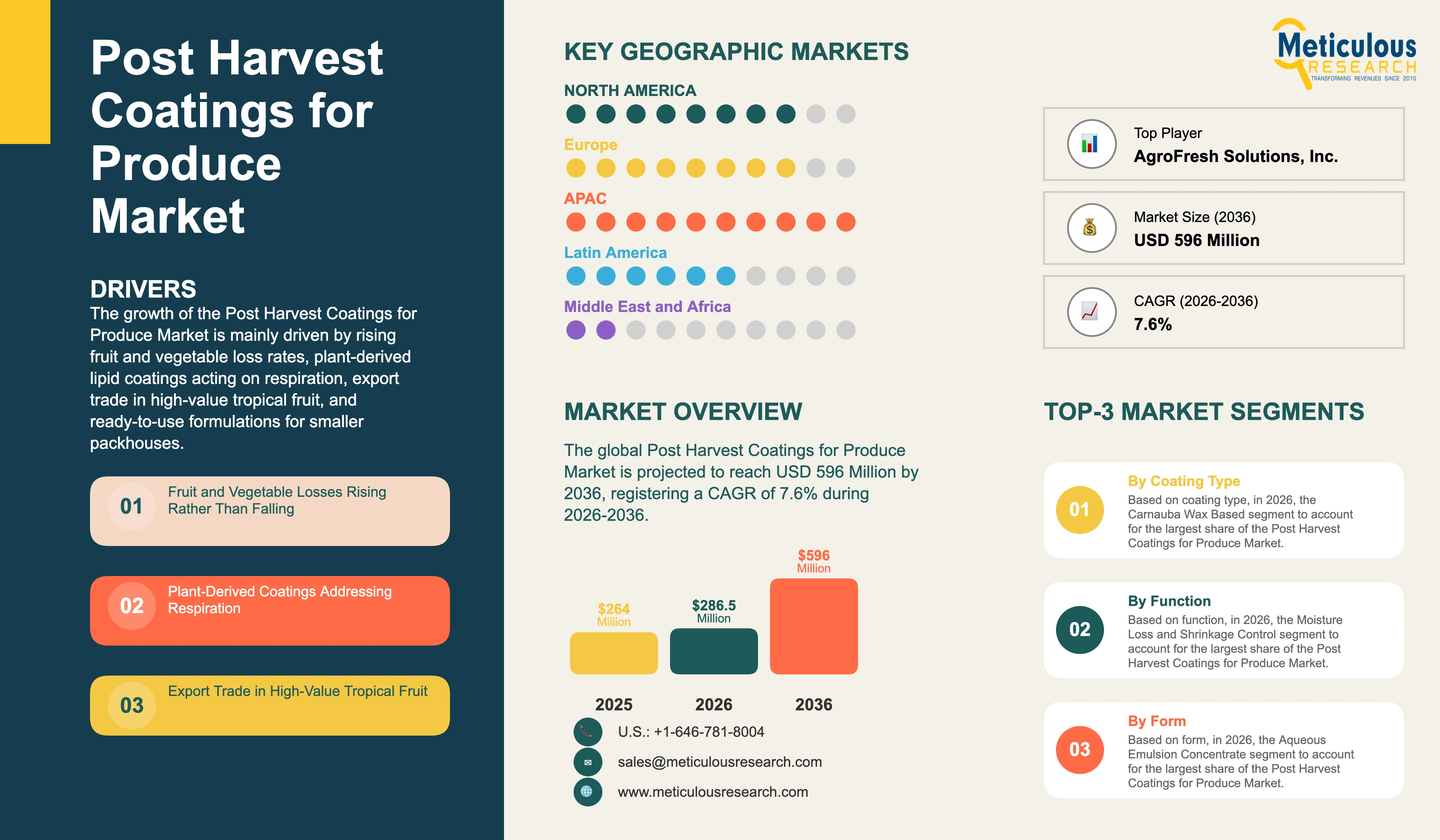
The global Post Harvest Coatings for Produce Market was valued at USD 264.0 million in 2025. This market is expected to reach USD 596.0 million by 2036 from an estimated USD 286.5 million in 2026, registering a CAGR of 7.6% during the forecast period (2026-2036).
- Published
- Nov 2026
- Pages
- 245
- Format
- PDF + Excel
- Report ID
- MRCHM - 1042788
- Base year
- 2025
- 2025 · BASELINE
- $264.0M
- 2036
- $596.0M
- CAGR 2026–2036
- 7.6%
2025 baseline · 2026–2036 forecast at 7.6% CAGR · hover a bar for the value
Key highlights
The global Post Harvest Coatings for Produce Market is projected to reach USD 596.0 million by 2036, driven by rising fruit and vegetable loss rates, plant-derived lipid coatings, respiration and ripening control, and ready-to-use formulations for smaller packhouses.
Asia-Pacific is expected to account for the largest market share in 2026 and is also projected to register the fastest growth during the forecast period, supported by the scale of fruit and vegetable production in the region combined with packhouse investment and loss rates well above those in northern America and Europe.
By coating type, Carnauba Wax Based coatings are expected to account for the largest market share, whereas Plant-Derived Lipid and Monoglyceride coatings are projected to witness the fastest growth through 2036.
By function, Moisture Loss and Shrinkage Control are expected to account for the largest market share, whereas Respiration and Ripening Control are projected to witness the fastest growth through 2036.
By form, Aqueous Emulsion Concentrate are expected to account for the largest market share, whereas Ready-to-Use and Dip Formulation are projected to witness the fastest growth through 2036.
Fruit and vegetable losses between harvest and retail reached 25.4% in 2023 against 23.2% in 2015, the highest of any commodity group and the only major group where the loss rate rose over that period.
Global food loss across all commodities was 13.3% in 2023 against 13.0% in 2015, with the monitoring authority recording no apparent progress in reducing food losses since 2015.
Regional loss rates diverge sharply, at 23.0% in sub-Saharan Africa, 19.9% in least developed countries, 13.9% in eastern and south-eastern Asia and 10.0% in northern America and Europe.
Beeswax, carnauba wax, shellac and microcrystalline wax are authorized for the surface treatment of certain fruits under an amendment to the European food additives framework adopted on 4 December 2012 and in force from 25 December 2012, so a new coating chemistry requires an additive authorization rather than a product registration.
United States federal rules are narrower still, with the coating provision written for fresh citrus fruit alone and requiring that the coating and each component be applied in the minimum quantity required to accomplish the intended effect.
That provision permits substances generally recognized as safe or previously sanctioned, or a prescriptive list covering fatty acids, tall oil oleic acid, rosins and rosin esters, polyethylene glycol, sodium lauryl sulfate and montan wax acid diesters, with specification limits including a refractive index maximum of 1.5012 at 100 degrees Celsius for partially hydrogenated rosin and acid numbers of 134 to 145 or 176 to 186 for the rosin esters.
Alternative permitted systems include a vinyl chloride-vinylidene chloride copolymer as an aqueous dispersion of at least 75% water, and a calcium salt of partially dimerized rosin.
A listed post-harvest solutions company was taken private through investment funds affiliated with a food chain investor, approved by stockholders on 30 March 2023 and closed on 3 April 2023, placing plant-based coatings inside a post-harvest portfolio rather than a coatings one.
Report summary
| Particulars | Details |
|---|---|
| Forecast Period | 2026-2036 |
| Base Year | 2025 |
| Estimated Year | 2026 |
| CAGR (Value) | 7.6% |
| Format | PDF, Excel & Cloud Portal · 245 pages |
| CAGR (Volume) | 5.6% |
| Market Size (Value) in 2026 | USD 286.5 million |
| Market Size (Value) in 2036 | USD 596.0 million |
| Market Size (Volume) in 2026 | 72.00 kilotons of coating as supplied |
| Market Size (Volume) in 2036 | 124.00 kilotons |
| Average Selling Price, 2026 | USD 3,980 per ton |
| Average Selling Price, 2036 | USD 4,810 per ton |
| Segments Covered | By Coating Type: Carnauba Wax Based, Shellac Based, Polyethylene and Synthetic Wax Based, Resin and Rosin Ester Based, Plant-Derived Lipid and Monoglyceride, Hydrocolloid and Other Edible Coatings. By Function: Moisture Loss and Shrinkage Control, Gloss and Appearance, Fungicide and Treatment Carrier, Respiration and Ripening Control. By Form: Aqueous Emulsion Concentrate, Solvent and Resin Solution, Ready-to-Use and Dip Formulation. By Crop: Citrus, Apples and Pears, Avocado, Mango and Tropical Fruit, Cucumber, Pepper and Other Vegetables, Melons and Berries, Other Produce. |
| Countries Covered | China; India; Australia; Spain; Italy; Netherlands; Turkey; U.S.; Mexico; Chile; Brazil; South Africa |
| Key Companies | AgroFresh Solutions, Inc., UPL Limited, RPM International Inc., Apeel Sciences, Inc., Productos Citrosol, S.A., Xeda International S.A., and Liquidseal Holding B.V. |
Report overview
Segments covered: coating type, function, form, crop.
In volume terms, the market is estimated at 72.00 kilotons of coating as supplied in 2026 and is expected to reach 124.00 kilotons by 2036, registering a CAGR of 5.6% during the forecast period. The average selling price is estimated at USD 3,980 per ton in 2026 and USD 4,810 per ton in 2036.
The growth of this market is mainly driven by fruit and vegetable losses of 25.4% between harvest and retail in 2023 against 23.2% in 2015, plant-derived lipid and monoglyceride coatings growing at 14.6%, respiration and ripening control functions growing at 13.0%, and ready-to-use and dip formulations growing at 9.2%. However, factors such as coatings being regulated as food additives requiring per-additive and per-crop authorization, a United States federal coating rule written for citrus alone, loss being dominated by handling, storage and cold chain rather than by surface treatment, and labeling that exposes waxed produce at the point of sale are expected to restrain the growth of this market to some extent.
Among forms, Aqueous Emulsion Concentrate are expected to account for the largest market share in 2026, while Ready-to-Use and Dip Formulation are projected to register the highest CAGR during the forecast period. Geographically, Asia-Pacific is expected to account for the largest share of this market in 2026 and is also expected to register the highest CAGR during the forecast period.
The Post Harvest Coatings for Produce Market comprises coatings applied to harvested fruit and vegetables to control moisture loss, appearance and respiration, taken at the manufacturer gate on a ton basis as supplied. The market includes Carnauba Wax Based, Shellac Based, Polyethylene and Synthetic Wax Based, Resin and Rosin Ester Based, Plant-Derived Lipid and Monoglyceride, and Hydrocolloid and Other Edible Coatings, serving moisture loss and shrinkage control, gloss and appearance, fungicide and treatment carrier, and respiration and ripening control functions, supplied as aqueous emulsion concentrate, solvent and resin solution, or ready-to-use and dip formulation, across citrus, apples and pears, avocado, mango and tropical fruit, cucumber, pepper and other vegetables, melons and berries. Fungicides and sanitizers sold as active products, modified atmosphere packaging and films, ethylene absorbers, packhouse equipment and the produce itself fall outside the scope.
A harvested fruit continues to respire and to lose water, and both processes end in the loss that post-harvest coatings are sold to reduce. A coating slows water loss by replacing the natural wax removed in washing and slows respiration by restricting gas exchange across the skin. The measurement basis in this market is coating as supplied at the manufacturer gate, so a ton of concentrate counts once whether it is diluted five times or twenty on the packhouse line, and the applied volume reaching fruit is several times the figure measured here.
The scale of the problem is documented and is not improving. Fruit and vegetable losses between harvest and retail reached 25.4% in 2023 against 23.2% in 2015, the highest of any commodity group, while global food loss across all commodities moved from 13.0% to 13.3% over the same period and the monitoring authority records no apparent progress since 2015. The regional spread shows where the losses sit, at 23.0% in sub-Saharan Africa and 19.9% in least developed countries against 10.0% in northern America and Europe.
Regulatory structure, not technical performance, sets the pace at which new chemistry enters this market. Beeswax, carnauba wax, shellac and microcrystalline wax are authorized for the surface treatment of certain fruits under an amendment to the European food additives framework adopted on 4 December 2012 and in force from 25 December 2012, which means a new coating requires an additive authorization rather than a product registration before it can be applied to fruit sold in the European Union.
United States federal rules are narrower still. The coating provision is written for fresh citrus fruit alone and requires that the coating and each component be applied in the minimum quantity required to accomplish the intended effect, permitting substances generally recognized as safe or previously sanctioned or a prescriptive list covering fatty acids, tall oil oleic acid, rosins and rosin esters, polyethylene glycol, sodium lauryl sulfate and montan wax acid diesters. Specification limits are written into that list, including a refractive index maximum of 1.5012 at 100 degrees Celsius for partially hydrogenated rosin and acid numbers of 134 to 145 or 176 to 186 for the rosin esters.
A substantial part of the market is defined by what the coating carries rather than by what it does. Coatings act as carriers holding fungicide treatments on the fruit surface, which places 21.0% of this market in the Fungicide and Treatment Carrier function and ties coating selection to the treatment program rather than to barrier performance. Carnauba Wax Based coatings hold the largest coating type share at 26.0% in 2026 and grow at 6.6%, while polyethylene and synthetic wax systems grow slowest at 5.0%.
The growth is in the chemistries and functions that address respiration rather than appearance. Plant-Derived Lipid and Monoglyceride coatings have entered the market on a respiration and moisture mechanism rather than a gloss one and grow at 14.6%, the fastest of the coating types, while Respiration and Ripening Control grows at 13.0% by function. Value grows ahead of volume throughout at 7.6% against 5.6%, because the mix moves toward plant-derived and ready-to-use systems priced above conventional wax emulsion concentrate.
A listed post-harvest solutions company was taken private through investment funds affiliated with a food chain investor, approved by stockholders on 30 March 2023 and closed on 3 April 2023, and sells plant-based coatings alongside freshness management systems. Positioning the coating inside a post-harvest portfolio rather than a coatings one changes the buyer from the packhouse line manager to the commercial team managing shelf life and rejection, which supports a value rather than a volume price.
The documented loss figures are measured at commodity-group level, at 25.4% for fruit and vegetables in 2023, while a coating is sold against a specific crop, chain and storage period. Suppliers able to document loss reduction through a named commercial chain rather than in trial conditions convert a general argument into a procurement case. The work is commercially demanding but it is the basis on which retailers rather than packers would specify coating.
Asia-Pacific is expected to account for the largest share of this market in 2026 at 29.0%, supported by the largest regional fruit and vegetable production and by loss rates of 13.9% in eastern and south-eastern Asia against 10.0% in northern America and Europe.
Europe accounts for 24.0% of this market in 2026 and is projected to grow at 6.4%. Coating use is governed by the food additives framework under which beeswax, carnauba wax, shellac and microcrystalline wax are authorized for the surface treatment of certain fruits, so new chemistry enters only through additive authorization. Spain and Italy carry the regional citrus volume, with the Netherlands important as a trading and repacking center and Turkey supplying citrus and tropical fruit. Italy is projected to be the slowest-growing country at 4.8%.
The Middle East & Africa region holds 7.0% of this market in 2026 with projected growth of 8.6%, with losses in sub-Saharan Africa at 23.0%, the highest regional figure recorded, and South African citrus and tropical fruit export forming the established demand while further growth depends on packhouse and cold chain investment. Latin America holds 18.0% with projected growth of 8.0%, as the principal origin for avocado, mango and tropical fruit shipped to North America, Europe and Asia, with Mexico, Chile and Brazil accounting for most regional volume.
Some of the key players operating in the post harvest coatings for produce market are AgroFresh Solutions, Inc., UPL Limited, RPM International Inc., Apeel Sciences, Inc., Productos Citrosol, S.A., Xeda International S.A., and Liquidseal Holding B.V., among others.
Key strategies include carrying food additive dossiers so new chemistries can be authorized per crop and jurisdiction, positioning coatings inside post-harvest programs alongside freshness management and treatment chemistry, extending plant-derived lipid portfolios onto fast-respiring tropical crops, introducing ready-to-use formulations for packhouses without coating lines, and documenting loss reduction through named commercial supply chains to reach retail specifiers.
Report infographic
Market dynamics
17 factors across 4 forcesFruit and Vegetable Losses Rising Rather Than Falling
Fruit and vegetable losses between harvest and retail reached 25.4% in 2023 against 23.2% in 2015, the highest of any commodity group and the only major group where the rate rose over that period. Across all commodities global food loss moved from 13.0% to 13.3% over the same period, with the monitoring authority recording no apparent progress in reducing food losses since 2015. The quantified deterioration gives growers, packers and retailers a measured basis for investing in treatment at the point where the produce leaves the field. Because weight loss is a direct revenue loss on produce sold by weight and shrivel is a direct cause of rejection at intake, the coating is assessed against a figure the packhouse already tracks. Moisture Loss and Shrinkage Control accordingly holds the largest function share of this market in 2026.
Plant-Derived Coatings Addressing Respiration Rather Than Gloss
Coatings formulated from plant-derived lipids and monoglycerides are sold on a mechanism rather than on appearance, restricting gas exchange across the skin to slow respiration and extend the period before ripening advances. This changes the sales argument from presentation at retail to days of shelf life gained, which is measurable along the chain rather than visible on the fruit. Plant-Derived Lipid and Monoglyceride coatings are projected to grow at 14.6%, the fastest of the coating types in this market, and Respiration and Ripening Control is the fastest-growing function at 13.0%. The two figures describe the same shift, since the new chemistries and the new function category have arrived together.
Export Trade in High-Value Tropical Fruit
Avocado, mango and other tropical fruit are shipped over long distances to markets that pay a premium, and the value at risk per container is high enough that a coating is justified on rejection avoidance alone. These crops also respire faster than citrus or apples, which makes respiration control rather than moisture barrier the binding requirement and favors the newer chemistries. Avocado, Mango and Tropical Fruit is projected to be the fastest-growing crop segment in this market at 10.8%, against 6.4% for citrus on the largest share at 34.0% in 2026. Export trade growth and the arrival of coatings that address respiration are reinforcing one another in this segment.
Ready-to-Use Formulations for Smaller Packhouses
An aqueous emulsion concentrate requires dilution, mixing and application control on site, which assumes a packhouse with a coating line, trained staff and technical support. Ready-to-use and dip formulations remove all three requirements, which brings coating within reach of operations that handle fruit without a dedicated coating line. Ready-to-Use and Dip Formulation is projected to be the fastest-growing form in this market at 9.2%. The form reaches the packhouses in the regions carrying the highest losses, at 23.0% in sub-Saharan Africa and 19.9% in least developed countries, where the constraint on treatment has been application capability rather than product availability.
Coatings Replacing Fungicide Load
Coatings hold fungicide treatments on the fruit surface and determine how much active is required to achieve a given level of control, which places 21.0% of this market in the Fungicide and Treatment Carrier function. As residue limits tighten in export markets, a carrier that delivers control at lower active loading becomes a route to compliance rather than a formulation detail. Fungicide and Treatment Carrier applications are projected to grow at 7.2%, and the coating choice is made alongside the treatment program rather than independently of it. That ties the coating supplier into the post-harvest chemistry relationship and raises the switching cost for the packhouse.
Table of contents
12 chapters · 136 sections · 245 pages · click to expandSegmental analysis
| Segment | Largest share (2026) | Fastest growth (2026–2036) |
|---|---|---|
| By Coating Type | Carnauba Wax Based coatings | Plant-Derived Lipid and Monoglyceride coatings |
| By Function | Moisture Loss and Shrinkage Control | Respiration and Ripening Control |
| By Form | Aqueous Emulsion Concentrate | Ready-to-Use and Dip Formulation |
| By Crop | Citrus | Avocado, Mango and Tropical Fruit |
| Other segments | Moisture Loss and Shrinkage Control | Respiration and Ripening Control |
By Coating Type
- Carnauba Wax Based coatings are expected to account for the largest share of the global Post Harvest Coatings for Produce Market.
- The large share of this segment is mainly due to its authorization as a food additive for the surface treatment of certain fruits, its delivery of both moisture barrier and gloss in one material, and the broadest crop and jurisdiction coverage of any single chemistry in the market.
- However, Plant-Derived Lipid and Monoglyceride coatings are projected to register the highest CAGR during the forecast period.
- The rapid growth of this segment is attributed to the arrival of a respiration and moisture mechanism rather than a gloss one, which addresses the loss that occurs along the chain rather than the presentation at retail, and which suits the tropical crops growing fastest in this market.
- Carnauba Wax Based coatings are expected to account for the largest market share in 2026.
- Plant-Derived Lipid and Monoglyceride coatings are projected to register the highest CAGR during the forecast period, owing to the arrival of a respiration and moisture mechanism rather than a gloss one, which addresses the loss that occurs along the chain rather than the presentation at retail, and which suits the tropical crops growing fastest in this market.
- Avocado, Mango and Tropical Fruit are projected to register the highest CAGR during the forecast period, owing to growth in export trade in high-value fruit, the faster respiration rate of these crops relative to citrus and apples, and the value at risk per container that justifies treatment on rejection avoidance alone.
By Function
- Moisture Loss and Shrinkage Control are expected to account for the largest market share.
- The large share of this segment is mainly due to the fact that weight loss is a direct revenue loss on produce sold by weight and shrivel is a direct cause of rejection at intake, so the benefit is measured against figures the packhouse already tracks.
- However, Respiration and Ripening Control are projected to register the highest CAGR during the forecast period.
- The rapid growth of this segment is attributed to the extension of shelf life available from restricting gas exchange across the skin, which matters most on fast-respiring tropical fruit shipped over long distances, and the arrival of chemistries formulated for that mechanism.
By Form
- Aqueous Emulsion Concentrate are expected to account for the largest market share.
- The large share of this segment is mainly due to the lower delivered cost of a concentrate diluted on site for a packhouse that already runs a coating line with application control and technical support in place.
- However, Ready-to-Use and Dip Formulation are projected to register the highest CAGR during the forecast period.
- The rapid growth of this segment is attributed to the removal of dilution, mixing and application control from the packhouse, which brings coating within reach of operations in the regions carrying the highest loss rates, where application capability rather than product availability has been the constraint.
By Crop
- Citrus are expected to account for the largest market share.
- The large share of this segment is mainly due to near-universal coating use on the crop, long storage and shipping periods, and the existence of the only federal coating provision written for a specific crop, which requires the coating and each component to be applied in the minimum quantity needed.
- However, Avocado, Mango and Tropical Fruit are projected to register the highest CAGR during the forecast period.
- The rapid growth of this segment is attributed to growth in export trade in high-value fruit, the faster respiration rate of these crops relative to citrus and apples, and the value at risk per container that justifies treatment on rejection avoidance alone.
Other segments
- Moisture Loss and Shrinkage Control are expected to account for the largest market share in 2026.
- Respiration and Ripening Control are projected to register the highest CAGR during the forecast period, owing to the extension of shelf life available from restricting gas exchange across the skin, which matters most on fast-respiring tropical fruit shipped over long distances, and the arrival of chemistries formulated for that mechanism.
- Aqueous Emulsion Concentrate are expected to account for the largest market share in 2026.
- Ready-to-Use and Dip Formulation are projected to register the highest CAGR during the forecast period, owing to the removal of dilution, mixing and application control from the packhouse, which brings coating within reach of operations in the regions carrying the highest loss rates, where application capability rather than product availability has been the constraint.
- Citrus are expected to account for the largest market share in 2026.
Geographic analysis
Asia-Pacific
Fastest growthAsia-Pacific holds 29.0% of this market in 2026 and is projected to be the fastest-growing region at 9.4%, with India projected to be the fastest-growing country at 11.6%. Loss rates in eastern and south-eastern Asia stand at 13.9% against 10.0% in northern America and Europe, and packhouse investment is converting that gap into addressable demand. Ready-to-use formulations growing at 9.2% are the form through which the region adopts coating ahead of full line capability. Asia-Pacific holds the largest share of this market in 2026 at 29.0% and is projected to be the fastest-growing region at 9.4%. The region produces the largest volume of fruit and vegetables, and loss rates in eastern and south-eastern Asia stand at 13.9% against 10.0% in northern America and Europe, which is the gap packhouse investment is converting into addressable demand. India is projected to be the fastest-growing country in this market at 11.6%, with coating adoption following the construction of packhouse capacity for domestic retail and export. China holds the largest regional volume across citrus, apple and vegetable crops. Australian demand is concentrated in citrus and tropical fruit for export, where treatment standards follow destination market requirements. Asia-Pacific is also projected to register the highest CAGR at 9.4%, driven by packhouse investment converting the regional loss gap into treated volume, with India projected to be the fastest-growing country at 11.6%. Asia-Pacific Packhouse Investment Geographic Analysis
Europe
Europe accounts for 24.0% of this market in 2026 with projected growth of 6.4%. Coating use is governed by the food additives framework under which beeswax, carnauba wax, shellac and microcrystalline wax are authorized for the surface treatment of certain fruits, following an amendment adopted on 4 December 2012 and in force from 25 December 2012, so new chemistry enters only through additive authorization. Spain and Italy carry the regional citrus volume, with the Netherlands important as a trading and repacking center and Turkey supplying citrus and tropical fruit into the region. Italy is projected to be the slowest-growing country in this market at 4.8%, where coating use on citrus is already established and retail resistance to waxed produce is pronounced.
North America
North America represents 22.0% of this market in 2026 with projected growth of 6.0%. The United States holds most regional volume, and coating practice is shaped by the federal provision written for fresh citrus fruit alone, which requires the coating and each component to be applied in the minimum quantity required to accomplish the intended effect and permits either substances generally recognized as safe or previously sanctioned, or a prescriptive list with stated specification limits. Loss rates at 10.0% across northern America and Europe are the lowest recorded, which means regional growth comes from chemistry and function mix rather than from extending treatment to untreated produce. Mexico, Chile and Brazil account for most regional volume across citrus, table grape, avocado and tropical fruit. Coating specification in the region follows destination market requirements rather than domestic rules, which concentrates demand on chemistries authorized in the importing jurisdictions.
Latin America
Latin America holds 18.0% of this market in 2026 and is projected to grow at 8.0%, the second-fastest regional rate. The region is the principal origin for avocado, mango and other tropical fruit shipped to North America, Europe and Asia, and that export trade carries the highest value at risk per container in the market.
Middle East & Africa
The Middle East & Africa region accounts for 7.0% of this market in 2026 and is projected to grow at 8.6%, the fastest regional rate after Asia-Pacific. Losses stand at 23.0% in sub-Saharan Africa, the highest regional figure recorded, and South African citrus and tropical fruit export forms the established part of regional demand. Growth elsewhere in the region depends on packhouse and cold chain investment, since treating the surface of fruit that will sit unrefrigerated recovers little of the loss, and ready-to-use formulations are the form through which treatment reaches operations without coating lines.
Competitive landscape
The global Post Harvest Coatings for Produce Market is moderately consolidated, with competition among post-harvest solutions companies, specialty chemicals groups with crop science divisions and regional packhouse chemistry suppliers. Market participants compete primarily on additive authorization coverage by crop and jurisdiction, documented shelf life and loss reduction, carrier performance with the associated treatment program, application support at the packhouse, and availability in ready-to-use form.
carrying food additive dossiers for new chemistries, positioning coatings inside post-harvest programs alongside freshness management, extending plant-derived lipid portfolios onto tropical crops, and introducing ready-to-use formulations for packhouses without coating lines
The report provides a comprehensive competitive assessment of the leading companies operating in the global Post Harvest Coatings for Produce Market. The key players profiled in the report include AgroFresh Solutions, Inc. (U.S.), UPL Limited (India), RPM International Inc. (U.S.), Apeel Sciences, Inc. (U.S.), Productos Citrosol, S.A. (Spain), Xeda International S.A. (France), and Liquidseal Holding B.V. (Netherlands).
- AgroFresh Solutions, Inc.
- UPL Limited
- RPM International Inc.
- Apeel Sciences, Inc.
- Productos Citrosol, S.A.
- Xeda International S.A.
- Liquidseal Holding B.V
Expert perspectives
The authorization structure, not the chemistry, decides who competes in this market. Beeswax, carnauba wax, shellac and microcrystalline wax are the authorized surface treatments for certain fruits in Europe under the 2012 amendment, and the United States coating provision is written for fresh citrus fruit alone with a prescriptive list carrying stated specification limits. A new coating needs a food additive dossier held per additive and per crop, which is a capability a crop science or post-harvest company has and a coatings formulator generally does not. That is why the entrants succeeding here arrive from the post-harvest side.
The honest limit on this market is the rest of the chain. Losses stand at 25.4% for fruit and vegetables in 2023 and at 23.0% in sub-Saharan Africa, but those figures are driven by handling damage, delay, storage and absent refrigeration rather than by what happens at the fruit surface. A coating applied to produce that will sit unrefrigerated recovers little, which means the addressable share of the documented loss is far smaller than the headline suggests and the growth follows cold chain investment rather than leading it.
Defensible positions sit on mechanism and on crop, not on appearance. Gloss and Appearance holds 26.0% of the market and grows at 5.8% because retail labeling has turned the function into a liability, while Respiration and Ripening Control grows at 13.0% and plant-derived lipid systems at 14.6%. The crops that reward that mechanism are the tropical fruits growing at 10.8%, shipped far enough that days of shelf life convert directly into accepted containers. A supplier able to document loss reduction through a named commercial chain can take that argument to the retailer rather than to the packer.
Customer perspectives
Insights gathered during primary interviews with packhouse operators, fruit exporters, post-harvest technical managers, and retail produce buyers operating in this market highlight where specification priorities are shifting. The following perspectives reflect recurring themes raised across these discussions.
This reflects application control rather than product selection as the determinant of outcome, with the regulatory minimum quantity requirement and shelf life objectives pulling in opposite directions.
This indicates a shift in the purchasing conversation from presentation to measured shelf life, which is where the plant-derived chemistries have found their position.
This points to retail labeling as a constraint on conventional wax use and to chain-level loss documentation as the condition under which retailers would specify coating themselves.
“The rule for us says minimum quantity to accomplish the intended effect, and that is the line we work to. Too little and there is no measurable benefit. Too much and we get internal disorders and a complaint from the buyer. The product is the easy part. Holding the application rate across a season, with fruit coming in at different maturities, is the work.”
“On a container of avocados going to Europe the number that matters is how many arrive accepted. We do not care about shine. We care whether the fruit is still three days short of ripe when it is unloaded. The newer plant-based coatings are the first ones where that is what the supplier wants to talk about.”
“We have lines where the pack has to say the fruit is surface treated, and that conversation with the shopper is one we would rather not have. An edible, plant-derived coating we can explain. A wax we cannot. If somebody can show me the loss figures through our own depots, that becomes a specification rather than a preference.”
Frequently asked questions
The global Post Harvest Coatings for Produce Market is estimated at USD 286.5 million in 2026.
Cite this report
Meticulous Research. (2026). Post Harvest Coatings for Produce Market - Global Opportunity Analysis and Industry Forecast (2026-2036) (Report No. MRCHM - 1042788). Meticulous Market Research Pvt. Ltd. https://www.meticulousresearch.com/product/post-harvest-coatings-for-produce-market-7471