Soil Conditioners Market (2024-2031)
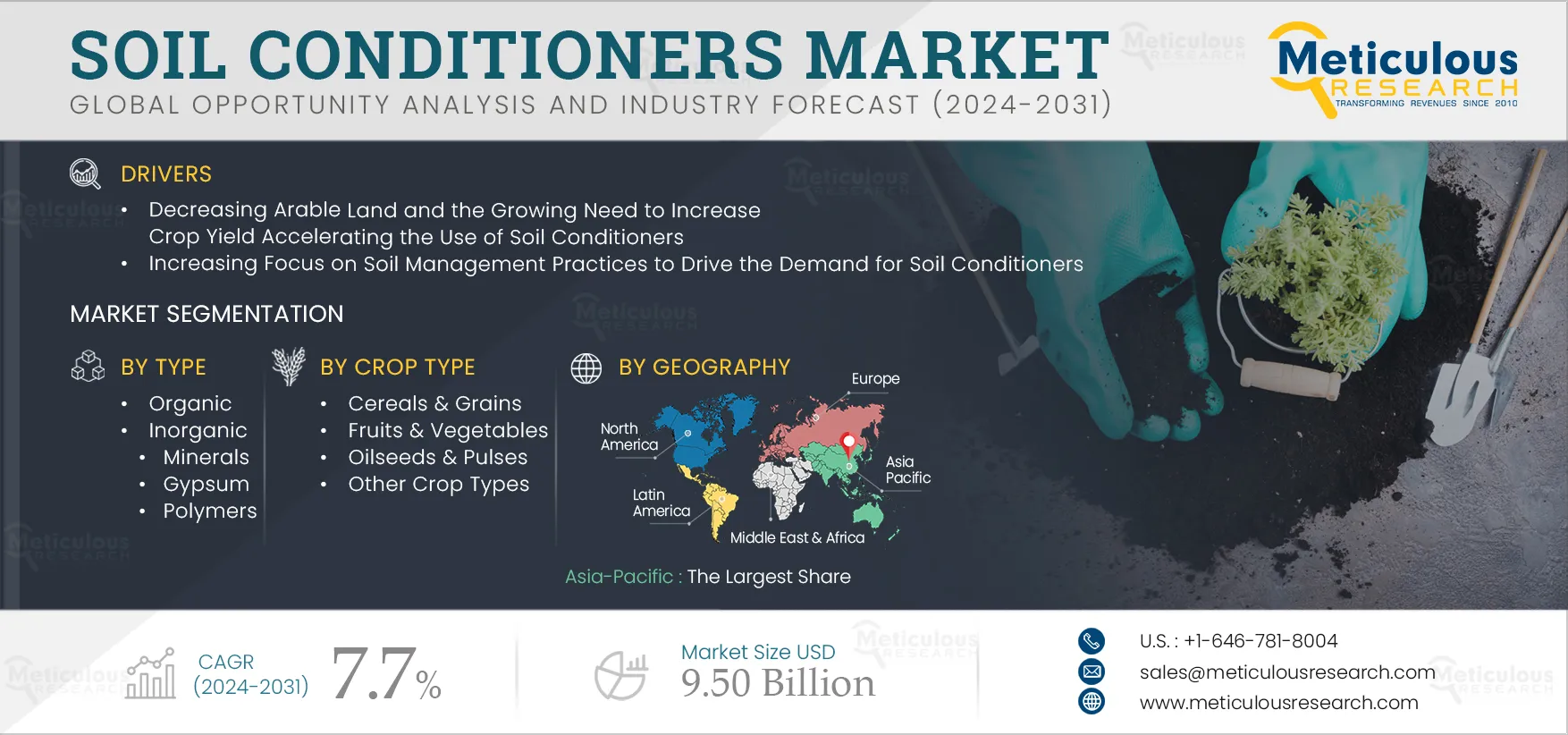
The Soil Conditioners Market is expected to reach $9.50 billion by 2031, at a CAGR of 7.7% from 2024 to 2031.
- Published
- Jul 2024
- Pages
- 285
- Format
- PDF + Excel
- Report ID
- MR-49
- Base year
- 2023
- 2031 · FORECAST
- $9.50B
- 2031
- $9.50B
- CAGR 2024–2031
- 7.7%
2023 baseline · 2024–2031 forecast at 7.7% CAGR · hover a bar for the value
Key highlights
By Type: In 2024, the Organic Segment to Dominate the Soil Conditioners Market
By Solubility: In 2024, the Water-Soluble Segment to Dominate the Soil Conditioners Market
By Soil Type: In 2024, the Loam Soil Segment to Dominate the Soil Conditioners Market
By Crop Type: The Cereals & Grains Segment to Dominate the Soil Conditioners Market
Report summary
| Particulars | Details |
|---|---|
| Number of Pages | 285 |
| Format | |
| Forecast Period | 2024–2031 |
| Base Year | 2023 |
| CAGR (Value) | 7.7% |
| Market Size (Value) | $9.50 Billion by 2031 |
| Segments Covered | By Type · Organic · Polysaccharides · Other Organic Soil Conditioners · Inorganic · Minerals · Gypsum · Polymers · By Solubility · Water-Soluble · Water-Insoluble · Hydrogels · Other Water-insoluble Soil Conditioners · By Soil Type · Loam Soil · Sand Soil · Clay Soil · Slit Soil · Peat Soil · By Crop Type · Cereals & Grains · Fruits & Vegetables · Oilseeds & Pulses · Other Crop Types |
| Countries Covered | North America (U.S., Canada), Europe (France, Germany, U.K., Spain, Italy, and Rest of Europe), Asia-Pacific (China, India, Japan, Australia, and Rest of Asia-Pacific), Latin America (Brazil, Mexico, Argentina, Chile, and Rest of Latin America), and the Middle East & Africa |
| Key Companies | BASF SE (Germany), Loveland Products, Inc. (U.S.), Eastman Chemical Company (U.S.), Evonik Industries AG (Germany), Aquatrols (A Part of Lamberti S.P.A.) (U.S.), Sanoway GmbH (Austria), Jaipur Bio Fertilizers (India), Syngenta AG (A Part of China National Chemical Corporation/ChemChina) (Switzerland), UPL Limited (India), FMC Corporation (U.S.), and Omnia Specialities Pty (Australia). |
Report overview
Segments covered: type, solubility, soil type, crop type. Regions: North America, Europe, Asia-Pacific, Latin America.
The growth of this market is driven by the decrease in arable land, increasing focus on soil management practices, growth in organic farming, and the rising demand for organic food. However, low awareness regarding soil conditioners restrains the growth of this market.
Additionally, the increasing utilization of soil conditioners in emerging economies is expected to create growth opportunities for players operating in the soil conditioners market. However, lengthy product approval and registration processes are some of the challenges impacting the market’s growth.
Report infographic
Market dynamics
3 factors across 2 forcesDecreasing Arable Land and the Growing Need to Increase Crop Yield Accelerating the Use of Soil Conditioners
Arable land is one of the most important resources for agricultural production. Numerous cultivation techniques have emerged over the years, resulting in the overutilization of land resources. This increasing use of land and the constantly rising demand for improved agricultural output have resulted in land exploitation, with degradation in the quality and a decrease in the quantity of land available for agriculture.
According to the Global Land Assessment of Degradation report by the United Nations Food and Agricultural Organization (FAO), nearly two billion hectares worldwide have been degraded since the 1950s. Land degradation is one of the world’s most pressing environmental problems, which will continue to worsen without rapid remedial action. Globally, about 25% of the total land area has been degraded. When land is degraded, soil carbon and nitrous oxide are released into the atmosphere, making land degradation a significant contributor to climate change. Scientists have warned that 24 billion tons of fertile soil are lost annually due to unsustainable agriculture practices (Source: Global Environment Facility). If this trend continues, 95% of the land areas could become degraded by 2050.
Africa and Latin America have the highest proportion of degraded agricultural land. Countries whose economies largely depend on agriculture have registered negative trends in land availability. The latest data published by the Indian Agriculture Ministry shows that as many as 20 states in India reported a decrease of up to 790,000 hectares of cultivable land in the last 4–5 years. This decrease is mainly attributed to the rising diversion of cultivable land for non-agricultural purposes, including construction, industries, and other development activities.
According to the World Bank, by 2050, the world will have more than 9.8 billion people to feed, an increase of around 40% from current levels. This increase in the demand for food is expected to exert immense pressure on the already decreasing arable land. Therefore, it is imperative to improve agricultural soil quality using soil conditioners.
Soil conditioners are added to soil to improve its properties and control erosion. Soil conditioners improve soil structure and aeration and increase the soil’s water and nutrient-holding capacity. They also help loosen compacted, hardpan, and clay soils and release locked-up nutrients. Soil conditioners can also raise or lower pH levels. Thus, the growing global food demand and the declining availability of arable land are expected to boost the utilization of soil conditioners, driving the growth of this market.
Increasing Focus on Soil Management Practices to Drive the Demand for Soil Conditioners
Soil is composed of organic and inorganic materials that promote plant growth. Soil provides structural support to plants and is the medium through which water and nutrients are delivered. Soil quality is the capacity of the soil to function as a vital living ecosystem and sustain plants, animals, and humans. Soil structure impacts plant growth as it determines the delivery of water, air, and nutrients to plants. Hence, agricultural yield depends on the quality of the soil.
According to the Food and Agriculture Organization (FAO), by 2050, the land under irrigation is expected to expand by 32.0 million hectares, while harvested irrigated land is expected to expand by 17.0% compared to 2018. These increases are expected to be witnessed in developing countries, leading to insufficient nutrient supply to crops. Also, soil erosion can decrease crop yield by up to 50%. Globally, 3.2 billion people, including rural communities and smallholder farmers, are affected by land degradation (Source: International Institute for Sustainable Development, 2019).
Healthy soil promotes plant growth, nutrient cycling, and biological control of plant pests and regulates water and air supply. These functions are affected by the interrelated physical, chemical, and biological properties of soil; however, such issues can be overcome through soil management practices. Soil management is important for the maintenance and enhancement of soil quality. Soil management helps protect soil and improves its performance.
The Food and Agriculture Organization of the United Nations (FAO) Council established the Global Soil Partnership (GSP) in December 2012; a vigorous campaign was conducted to promote sustainable soil management. After the revision of major policies and scientific advancements over the past three decades, the World Soil Charter, under the aegis of the GSP, established the 2030 agenda for sustainable development, which includes objectives such as restoring degraded soil, striving to achieve a land degradation-neutral world, and implementing resilient agricultural practices that progressively improve soil quality and minimize soil contamination.
Moreover, the FAO sanctioned Voluntary Guidelines for Sustainable Soil Management (VGSSM) in December 2016 aimed at minimizing soil erosion, enhancing the soil’s organic matter content, fostering soil-nutrient balance and cycles, and preventing, minimizing, and mitigating soil salinization & alkalization, soil contamination, and soil acidification. The guidelines are also aimed at preserving and enhancing soil biodiversity, minimizing soil sealing, preventing and mitigating soil compaction, and improving soil water management. These guidelines highlight the rising awareness about soil management practices.
Furthermore, in May 2021, the Australian government introduced its National Soil Strategy, Australia’s first national policy on soil. It outlines how Australia will value, manage, and improve its soil over the next 20 years. The strategy prioritizes soil health and empowers soil innovation. In April 2022, the Netherlands Water Partnership (NWP) and the Dutch Embassy (Spain) organized a ‘water & soil management for resilient agriculture’ scoping mission in Murcia, Spain. The mission was an important step in planning a multi-day knowledge program on water-soil-agrifood in Murcia later in the year. Moreover, the United Nations’ Sustainable Development Goal 15 of the 2030 Agenda aims to ‘protect, restore and promote the sustainable use of terrestrial ecosystems, sustainably manage forests, combat desertification, halt and reverse land degradation and halt biodiversity loss.
Thus, the increasing focus on soil management practices is boosting the adoption of soil conditioners, driving market growth.
Table of contents
12 chapters · 107 sections · 285 pages · click to expandSegmental analysis
| Segment | Largest share (2024) | Fastest growth (2024–2031) |
|---|---|---|
| By Type | Organic | Organic |
| By Solubility | Water-Soluble | — |
| By Soil Type | Loam Soil | Clay soil |
| By Crop Type | Cereals & Grains | Oilseeds & pulses |
By Type
- The Organic Segment to Dominate the Soil Conditioners Market
- The organic segment is expected to account for the larger share of 75.2% of the soil conditioners market.
- The large market share of this segment can be attributed to the rising concerns regarding environmental and public health stemming from the use of chemical products, the increasing demand for chemical residue-free agricultural products, and supportive government initiatives aimed at promoting organic agricultural practices.
- Moreover, the organic segment is projected to register the highest CAGR during the forecast period.
- This segment’s growth is driven by the increasing adoption of organic farming methods.
By Solubility
- The Water-Soluble Segment to Dominate the Soil Conditioners Market
- The water-soluble segment is expected to account for the larger share of 65.7% of the soil conditioners market.
- The large market share of this segment can be attributed to the benefits offered by water-soluble soil conditioners, including their effectiveness in retaining water, stabilizing soil, and mitigating the risk of nutrient buildup in farmlands.
By Soil Type
- The Loam Soil Segment to Dominate the Soil Conditioners Market
- The loam soil segment is expected to account for the largest share of 48.0% of the soil conditioners market.
- The large market share of this segment can be attributed to the widespread adoption of soil conditioners for loam soil due to its low water retention and nutrient-holding capacity and the frequent use of this soil type for rotational crops.
- However, the clay soil segment is projected to register the highest CAGR during the forecast period due to the growing need to overcome the problems of poor aeration and drainage in clay soil.
By Crop Type
- The Cereals & Grains Segment to Dominate the Soil Conditioners Market
- The cereals & grains segment is expected to account for the largest share of 49.2% of the soil conditioners market.
- The large market share of this segment is mainly attributed to the increased demand for cereals & grains, which serve as staple foods in numerous countries, and the growing utilization of these crops in applications such as animal feed, biofuel production, and starch & ethanol manufacturing.
- However, the oilseeds & pulses segment is projected to register the highest CAGR during the forecast period due to the increasing global production of oilseeds & pulses, the rising consumer demand for organic produce free from chemical residues, and the growing adoption of natural soil conditioners specifically tailored for oilseeds & pulses.
Geographic analysis
Asia-Pacific
Largest shareIn 2024, Asia-Pacific is expected to account for the largest share of 42.8% of the soil conditioners market. Asia-Pacific's significant market share can be attributed to its vast arable land, expanding population, adoption of modern farming practices, increasing consumer concerns about soil quality, the rising popularity of organic farming, and increased awareness among consumers regarding chemical hazards. Moreover, the market in Asia-Pacific is projected to witness the highest CAGR during the forecast period. The growth of this regional market is driven by factors such as the increasing crop yield losses caused by inappropriate soil management practices, the rising adoption of organic farming, and increasing consumer awareness regarding chemical hazards. Asia-Pacific is Expected to Dominate the Soil Conditioners Market In 2024
Competitive landscape
- January 2023
Lamberti S.p.A. (Italy) acquired Aquatrols (U.S.) to expand its presence in the turf industry and growing media market and further develop its agriculture water optimization products within the agriculture division.
- BASF SE · Germany
- Loveland Products, Inc. (U.S.)
- Eastman Chemical Company (U.S.)
- Evonik Industries AG · Germany
- Aquatrols (A Part of Lamberti S.P.A.) (U.S.)
- Sanoway GmbH · Austria
- Jaipur Bio Fertilizers · India
- UPL Limited · India
- FMC Corporation (U.S.)
- Omnia Specialities Pty · Australia
Frequently asked questions
This study focuses on market assessment and opportunity analysis by analyzing the sales of soil conditioners across various regions and countries. This study also offers a competitive analysis of the soil conditioners market based on an extensive assessment of the leading players' product portfolios, geographic presence, and key growth strategies.
This study offers valuable insights into market sizes and forecasts for various segments of the soil conditioners market, including type, solubility, soil type, crop type, and country/region.
Cite this report
Meticulous Research. (2024). Soil Conditioners Market - Global Opportunity Analysis And Industry Forecast (2024-2031) (Report No. MR-49). Meticulous Market Research Pvt. Ltd. https://www.meticulousresearch.com/product/soil-conditioners-market-3888