Resources
About Us

Electric Weed Control Market Size, Share, Trends & Forecast Analysis by Technology Type (Direct-Contact Electrode Systems, High-Frequency Electrode Systems, Hybrid Electrolyte-Assisted Systems), Platform Type (Tractor-Mounted & Trailed, Self-Propelled, Handheld & Backpack, Robotic & Autonomous), Crop Type, Application, End User, and Geography — Global Forecast to 2036
Report ID: MRAGR - 1042171 Pages: 276 Sep-2026 Formats*: PDF Category: Agriculture Delivery: 24 to 72 Hours Download Free Sample Report
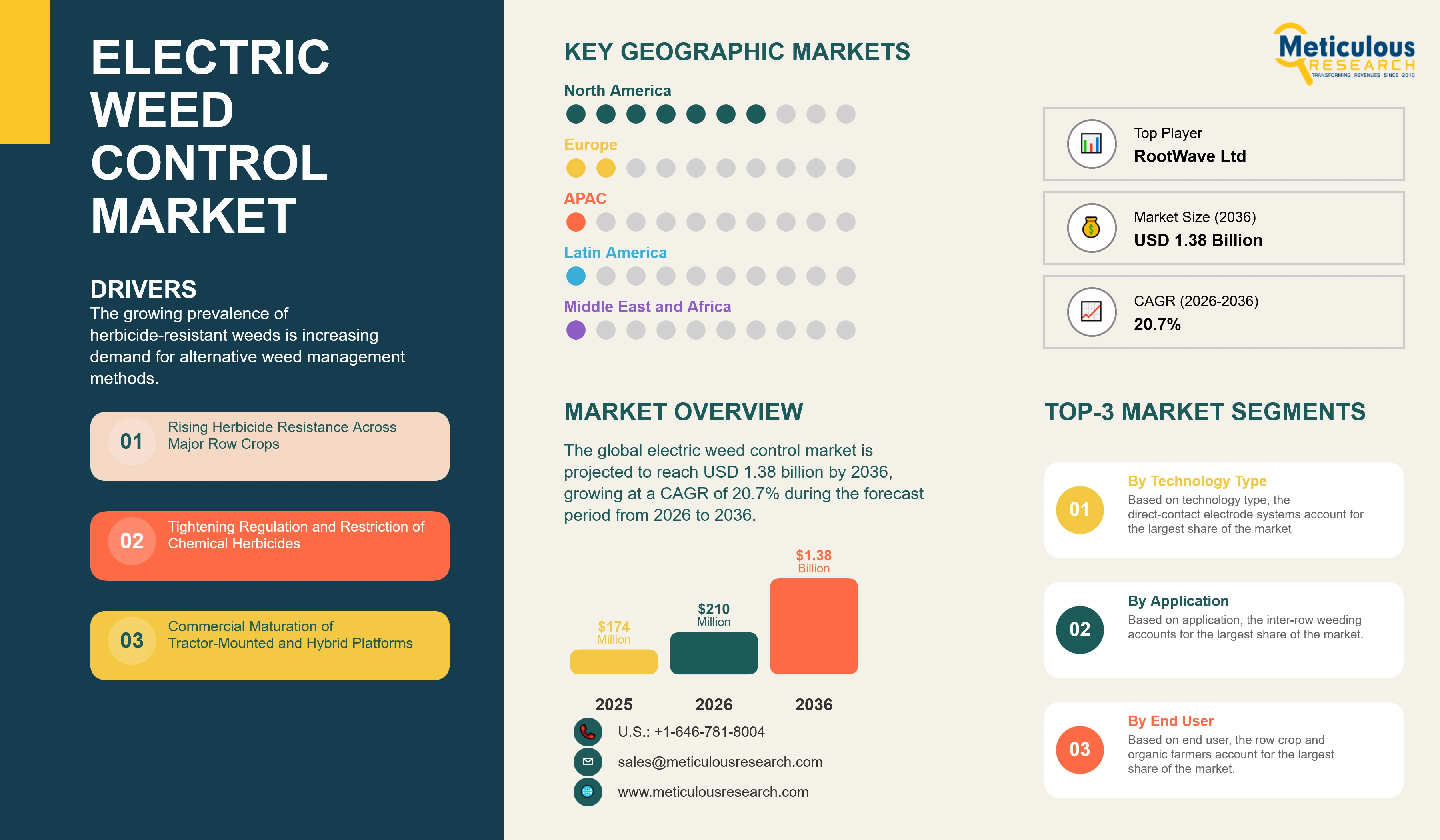
The global electric weed control market is projected to reach USD 1.38 billion by 2036 from an estimated USD 210 million in 2026, at a CAGR of 20.7% during the forecast period from 2026 to 2036. Direct-contact electrode systems account for the largest share of market value through most of the forecast period, reflecting their established use in row-crop desiccation and broadcast weeding, while hybrid electrolyte-assisted systems represent the fastest-growing technology category as manufacturers combine conductive spray chemistry with electrical discharge to cut energy use and widen the range of treatable weed species.
Click here to: Get Free Sample Pages
Electric weed control refers to equipment that uses electrical current, rather than chemical herbicides, to control and destroy weeds and other unwanted vegetation. A generator, typically powered by a tractor's power take-off or a self-contained power unit, produces electrical energy that is delivered to plants through metal electrodes, applicator bars, or specialized booms. When the electrode contacts a weed, electrical current passes through the plant and damages its tissues and vascular systems, disrupting water and nutrient transport and ultimately causing plant death. The category includes direct-contact electrical systems, which apply electrical current directly to plant tissue; spark-discharge systems, which transfer electrical energy to weeds through electrode contact and electrical discharge; and electrolyte-assisted systems, which pre-treat plants with a conductive liquid to reduce electrical resistance and improve energy transfer. The market encompasses tractor-mounted and trailed systems, self-propelled units, handheld and walk-behind equipment for spot treatment, and emerging robotic and autonomous platforms.
The technology has expanded beyond its historical use in railway and right-of-way vegetation management into commercial agriculture and horticulture. Old School Manufacturing's Weed Zapper Annihilator and Terminator systems are used for row-crop and organic farming, with the company reporting sales in the U.S., Canada, Argentina, and several European countries. Its current portfolio includes tractor-mounted Annihilator models and self-propelled Terminator systems. LASCO continues to commercialize its Lightning Weeder electric discharge system for tall-weed control in row crops, while Zasso Group AG's XPower technology is commercialized through CNH Industrial's AGXTEND platform for agricultural and non-crop applications. RootWave has developed high-frequency electrical weed-control technology for applications ranging from spot treatment to tractor-mounted orchard, vineyard, and horticultural systems, building on electrical weed-control research associated with the University of Sheffield. CROP.ZONE, which emerged from the RWTH Aachen innovation ecosystem, has developed a hybrid system combining its VOLT.FUEL conductive liquid with electrical treatment. In partnership with Nufarm, this technology is commercialized as NUCROP for weed control and crop desiccation, particularly in potatoes.
Demand for electric weed control is being supported by the increasing need to reduce reliance on chemical herbicides, manage herbicide-resistant weeds, and develop non-chemical weed-management alternatives. Herbicide resistance reduces the effectiveness of repeated chemical control programs and encourages growers to incorporate technologies based on non-chemical modes of action. In Europe, the Farm to Fork Strategy established a 2030 objective to reduce the use and risk of chemical pesticides by 50%, supporting the broader development of integrated and non-chemical crop-protection approaches. At the same time, glyphosate remains approved in the EU until December 15, 2033, subject to specified conditions and restrictions, meaning that electric weed control is more accurately positioned as an alternative or complementary technology rather than a direct consequence of a glyphosate ban.
Government support is also helping address the relatively high upfront cost of electric weeding equipment. In the U.K., the Farming Equipment and Technology Fund has specifically included tractor-powered electric desiccators for weed and plant control. Under the 2024 program, such equipment was eligible for a 60% grant, capped at £50,000, while the 2025 program again listed tractor-powered electric desiccators among eligible productivity equipment. These developments indicate growing institutional support for electric weed-control technologies and are expected to contribute to market expansion through 2036.
Rising Herbicide Resistance Across Major Row Crops
Herbicide resistance is becoming a significant constraint on chemical weed management, with the International Herbicide-Resistant Weed Database recording 548 unique resistance cases across 275 weed species, 102 crops, and 76 countries, including resistance to 21 of the 31 known herbicide sites of action and 168 herbicides as of September 2026. The U.S. Environmental Protection Agency (EPA) has identified herbicide resistance as a major economic concern for crop production and noted that no new herbicide mechanism of action had been developed in the preceding 30 years.
The challenge is particularly pronounced in major row crops. USDA research has documented glyphosate-resistant Palmer amaranth populations and reported resistance levels of 14 to 17 times that of susceptible biotypes in Mississippi, while USDA data also document multiple resistance in waterhemp to glyphosate, ALS inhibitors, and other herbicide groups. Cornell University reports that poorly managed Palmer amaranth can reduce soybean yields by up to 79% and corn yields by up to 91%. Because electrical weed control physically damages plant tissues rather than targeting a biochemical herbicide site of action, it offers growers a non-chemical control tool that can be incorporated into integrated weed-management programs, consistent with EPA's recommendation to combine multiple control methods to manage resistance.
Tightening Regulation and Restriction of Chemical Herbicides
Government policies are increasingly emphasizing reduced reliance on chemical pesticides and tighter conditions on their use. In the EU, glyphosate remains approved until December 2033, but its use is subject to conditions and restrictions, including a prohibition on using it for desiccation to control harvest timing or optimize threshing. The European Commission also reported a 56% reduction in the use and risk of chemical pesticides during 2018–2024 compared with the 2015–2017 baseline, reinforcing the shift toward integrated pest management and nonchemical alternatives. In the U.S., more than 30 states and hundreds of cities and counties have adopted pesticide laws or ordinances, including restrictions around schools, parks, water supplies, and other sensitive areas. This regulatory environment is creating opportunities for electric weed control systems from Zasso Group AG, RootWave Ltd., and crop.zone GmbH, which provide nonchemical weed and vegetation control options for applications such as desiccation and inter-row weeding.
Convergence of Direct-Contact and Hybrid Electrolyte-Assisted Technologies
The market is evolving around three technical approaches: direct-contact electrical systems, high-frequency direct-contact systems, and hybrid systems that combine electricity with a conductive liquid. Old School Manufacturing and LASCO represent established direct-contact approaches, while RootWave's 18 kHz technology is designed to deliver controlled electrical treatment at higher frequencies; RootWave reports that its systems can achieve up to 99% weed control and, in company testing, required 50–98 MJ/ha of electrical energy. CROP.ZONE's VOLT.FUEL platform takes a different approach by pre-treating plants with a conductive liquid before electrical application. Nufarm and CROP.ZONE state that NUCROP uses lower energy consumption than conventional electric weeding technologies, and Nufarm reported that commercial sales of the technology had commenced in Europe.
This technical differentiation is gaining importance as growers seek alternatives to chemical weed control. The International Herbicide-Resistant Weed Database currently records 548 unique herbicide-resistance cases across 76 countries and 102 crops, covering resistance to 168 herbicides and 21 herbicide sites of action. At the same time, the European Commission reported a 56% reduction in the use and risk of chemical pesticides from the 2015–2017 baseline by 2024, reinforcing the policy environment for non-chemical and integrated weed-management technologies. These conditions are encouraging suppliers to differentiate between high-power direct-contact equipment, lower-energy hybrid systems, and specialized high-frequency platforms, while commercial models range from Old School Manufacturing's direct farmer sales to Zasso's integration with CNH Industrial's established distribution infrastructure.
Growing Integration with Established Agricultural Equipment Channels
Electric weed control is increasingly moving through established agricultural machinery and crop-protection channels rather than being marketed solely as specialist agtech. CNH Industrial acquired a minority stake in Zasso in 2020 and subsequently expanded commercial distribution of Zasso's XPower portfolio through its dealer network; CNH stated that XPower was being offered through its network from 2022. AGXTEND also provides access to CNH's Case IH, New Holland Agriculture, and STEYR customer base, giving electric weed-control technology a route into established machinery channels.
Integration is also extending into large-scale crop-treatment concepts. CROP.ZONE's Dual.Volt.24M, co-developed with John Deere Walldorf, received the DLG Agrifuture Concept Winner 2023 recognition. The system features a 24-meter working width and combines electrical treatment with adaptive broadcast and band application for desiccation, cover-crop management, weed control, and camera-guided inter-row treatment. Such integration can improve access to established dealer networks, demonstrations, technical support, financing, and after-sales services, helping electric weed control move from specialist demonstrations toward scalable commercial agricultural applications.
By Technology Type: Direct-Contact Electrode Systems Dominate the Market in 2026, While Hybrid Electrolyte-Assisted Systems Grow Fastest
Based on technology type, the electric weed control market is segmented into direct-contact electrode systems, high-frequency electrode systems, and hybrid electrolyte-assisted systems. In 2026, direct-contact electrode systems account for the largest share of the market, driven by their established use in North American row-crop desiccation through equipment from Old School Manufacturing and Lasco, Inc.
However, hybrid electrolyte-assisted systems are projected to grow fastest, as crop.zone GmbH's volt.fuel platform and its Nucrop collaboration with Nufarm Limited demonstrate meaningful reductions in energy use per hectare while extending effective treatment to a broader range of crops and growth stages.
By Platform Type: Tractor-Mounted & Trailed Units Lead in 2026, Robotic & Autonomous Platforms Grow Fastest
Based on platform type, the market is segmented into tractor-mounted and trailed units, self-propelled units, handheld and backpack devices, and robotic and autonomous platforms. In 2026, tractor-mounted and trailed units hold the largest share, revealing their dominance across row-crop, vineyard, and orchard applications from manufacturers including Zasso Group AG, RootWave Ltd, and Old School Manufacturing. Robotic and autonomous platforms are projected to grow fastest as early-stage development work extends electric weeding into unattended field operation.
By Crop Type: Row Crops Hold the Largest Share in 2026, Orchards & Vineyards Grow Fastest
Based on crop type, the market is segmented into row crops, vegetables, orchards and vineyards, potatoes and sugar beet, and non-crop and amenity areas. In 2026, row crops account for the largest share, driven by soybean, corn, and cotton acreage treated with Old School Manufacturing's Annihilator and Terminator series across the United States. Orchards and vineyards are projected to grow fastest, led by RootWave Ltd's Top Fruit system and Zasso Group AG's XPS platform addressing narrow-row perennial crop layouts in Europe.
By Application: Inter-Row Weeding Leads in 2026, Crop & Haulm Desiccation Grows Fastest
Based on application, the market is segmented into inter-row weeding, pre-plant broadcast burndown, crop and haulm desiccation, and amenity and right-of-way vegetation control. In 2026, inter-row weeding accounts for the largest share, reflecting the core use case for tractor-mounted electric weeders across row crops and perennial plantings. Crop and haulm desiccation is projected to grow fastest, supported by crop.zone GmbH and Nufarm Limited's Nucrop system addressing potato haulm destruction as chemical desiccant options such as diquat face tightening restriction.
By End User: Row Crop & Organic Farmers Dominate the Market in 2026
Based on end user, the market is segmented into row crop and organic farmers, specialty and horticultural growers, municipal and railway or utility right-of-way operators, and custom or contract service providers. In 2026, row crop and organic farmers account for the largest share, reflecting the scale of North American and European field-crop acreage already using electric weeding equipment. Municipal and railway or utility right-of-way operators are projected to register meaningful growth, driven by glyphosate restrictions in public spaces and adoption of handheld systems such as RootWave Ltd's RootWave Pro.
Based on geography, the global electric weed control market is segmented into North America, Europe, Asia-Pacific, Latin America, and the Middle East & Africa. Europe holds a leading share in 2026, reflecting the concentration of technology development and commercialization among Zasso Group AG, RootWave Ltd, and crop.zone GmbH, and reinforced by the EU's Farm to Fork pesticide-reduction target and the restrictive conditions attached to glyphosate's 2023 reauthorization. France, Spain, Germany, and Italy, which together accounted for the largest shares of EU pesticide sales volumes in 2024, represent the core addressable base for electric weeding adoption within the region.
North America represents one of the largest markets by unit volume, led by United States row-crop and organic farm adoption of Old School Manufacturing's Weed Zapper and Lasco, Inc.'s Lightning Weeder. State-level restrictions on certain chemical herbicides, combined with the spread of herbicide-resistant weed species such as Palmer amaranth and waterhemp across the Midwest, continue to support grower interest in electrical alternatives for both conventional and organic operations.
Asia-Pacific is expected to register the fastest CAGR during the forecast period, as national pesticide-reduction and sustainable-agriculture initiatives extend the regulatory pressure already seen in Europe, though adoption remains at an earlier stage given the region's limited base of commercially established electric weeding manufacturers. Latin America is an emerging market supported by early equipment sales from Old School Manufacturing into Argentina and Zasso Group AG's integration into CNH Industrial's regional product portfolio. The Middle East & Africa region remains at an early stage, with adoption concentrated in isolated pilot programs rather than commercial-scale deployment.
Major companies in the global electric weed control market have pursued technology refinement, distribution partnerships with established agricultural machinery manufacturers, and geographic expansion to strengthen their market positions. Specialist electro-physical weeding companies compete alongside legacy manufacturers and agrochemical companies applying electric weeding as a complement to their existing crop protection portfolios.
Some of the prominent players operating in the global electric weed control market include Zasso Group AG (Switzerland), RootWave Ltd (United Kingdom), crop.zone GmbH (Germany), CNH Industrial N.V. (United Kingdom/United States), Old School Manufacturing, LLC (United States), Lasco, Inc. (United States), Garford Farm Machinery Ltd. (United Kingdom), and Nufarm Limited (Australia).
Electric Weed Control Market: Latest Developments from Key Industry Players
|
Forecast Period |
2026–2036 |
|
Base Year |
2025 |
|
Estimated Year |
2026 |
|
CAGR (Value) |
20.7% |
|
Market Size (Value) in 2026 |
USD 210 Million |
|
Market Size (Value) in 2036 |
USD 1.38 Billion |
|
Segments Covered |
By Technology Type: Direct-Contact Electrode Systems; High-Frequency Electrode Systems; Hybrid Electrolyte-Assisted Systems. By Platform Type: Tractor-Mounted & Trailed; Self-Propelled; Handheld & Backpack; Robotic & Autonomous. By Crop Type: Row Crops; Vegetables; Orchards & Vineyards; Potatoes & Sugar Beet; Non-Crop & Amenity Areas. By Application: Inter-Row Weeding; Pre-Plant Broadcast Burndown; Crop & Haulm Desiccation; Amenity & Right-of-Way Vegetation Control. By End User: Row Crop & Organic Farmers; Specialty & Horticultural Growers; Municipal & Railway/Utility Right-of-Way Operators; Custom & Contract Service Providers |
|
Countries Covered |
North America: U.S., Canada. Europe: Germany, U.K., France, Spain, Italy, Netherlands, Nordics, and Rest of Europe. Asia-Pacific: China, India, Japan, South Korea, Australia & New Zealand, and Rest of Asia-Pacific. Latin America: Brazil, Argentina, Mexico, and Rest of Latin America. Middle East & Africa: Saudi Arabia, UAE, South Africa, and Rest of Middle East & Africa. |
|
Key Companies |
Zasso Group AG (Switzerland); RootWave Ltd (United Kingdom); crop.zone GmbH (Germany); CNH Industrial N.V. (United Kingdom/United States); Old School Manufacturing, LLC (United States); Lasco, Inc. (United States); Garford Farm Machinery Ltd. (United Kingdom); Nufarm Limited (Australia) |
The global electric weed control market size is estimated at USD 210 million in 2026.
The market is projected to grow from USD 210 million in 2026 to USD 1.38 billion by 2036, at a CAGR of 20.7%.
The electric weed control market is projected to reach USD 1.38 billion by 2036, at a compound annual growth rate of 20.7% from 2026 to 2036.
Key companies include Zasso Group AG (Switzerland), RootWave Ltd (United Kingdom), crop.zone GmbH (Germany), CNH Industrial N.V. (United Kingdom/United States), Old School Manufacturing, LLC (United States), Lasco, Inc. (United States), and Nufarm Limited (Australia), among others.
The convergence of direct-contact and hybrid electrolyte-assisted electrical weeding technologies, growing integration of electric weeding equipment with established agricultural machinery distribution channels, and continued strategic collaboration between electro-physical specialists such as crop.zone and agrochemical companies such as Nufarm are prominent trends in the market.
By technology type, direct-contact electrode systems hold the largest share in 2026 while hybrid electrolyte-assisted systems grow fastest; by platform type, tractor-mounted and trailed units lead while robotic and autonomous platforms grow fastest; by crop type, row crops lead while orchards and vineyards grow fastest; by application, inter-row weeding leads while crop and haulm desiccation grows fastest; by end user, row crop and organic farmers lead; and by geography, Europe and North America together command the largest share in 2026.
Europe and North America hold the largest combined share in 2026, supported by regulatory pressure on chemical herbicides in the European Union and herbicide-resistant weed pressure across United States row-crop acreage. Asia-Pacific is expected to register the fastest growth rate as national pesticide-reduction initiatives extend beyond Europe.
Key drivers include rising herbicide resistance across major row crops, tightening regulation and restriction of chemical herbicides, and the commercial maturation of tractor-mounted and hybrid electric weeding platforms distributed through established agricultural machinery channels.
























Published Date: Aug-2026
Published Date: Sep-2026
Published Date: Sep-2026
Please enter your corporate email id here to view sample report.
Subscribe to get the latest industry updates


