Self Cleaning Coatings Market (2026-2036)
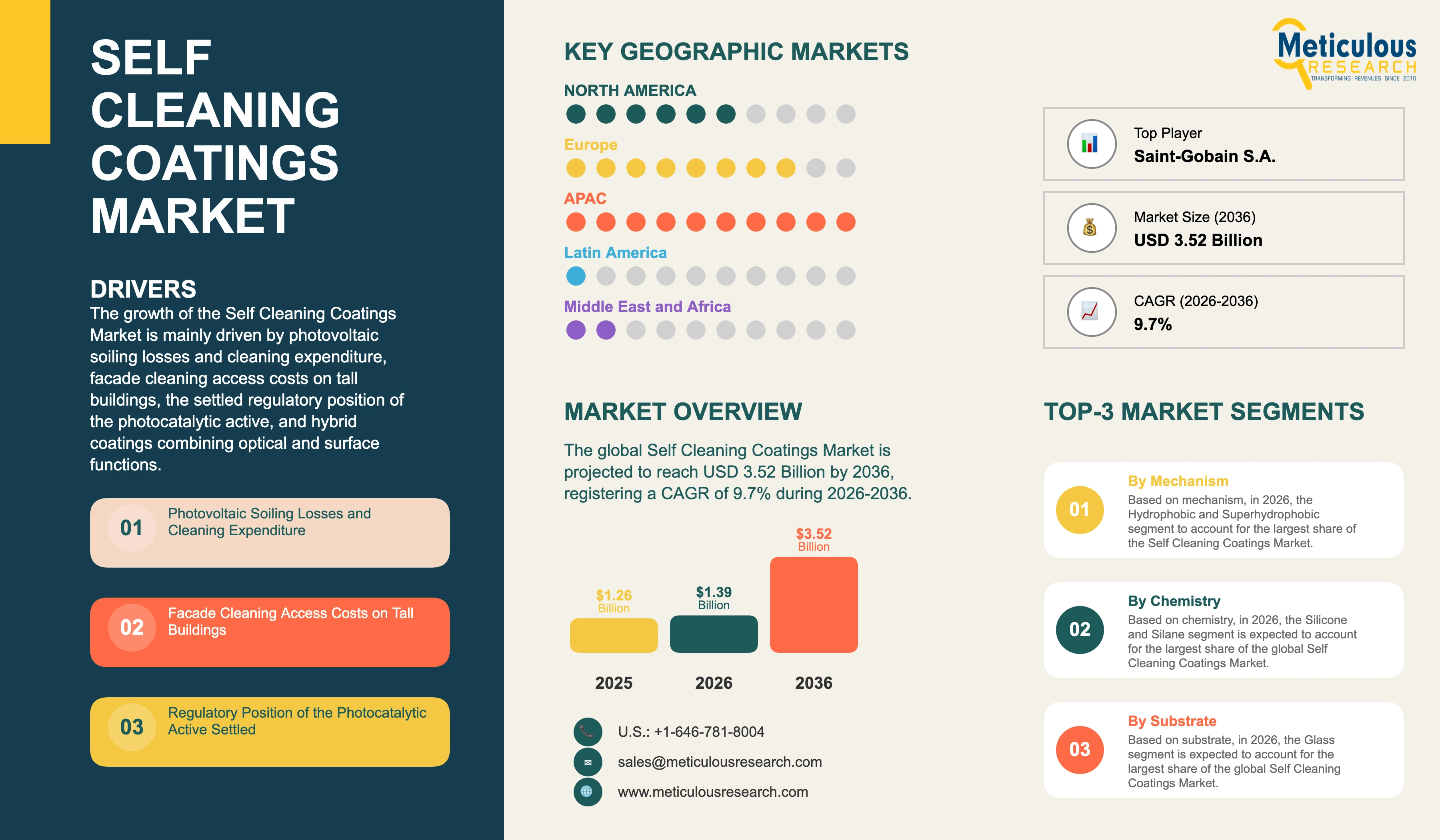
The global Self Cleaning Coatings Market was valued at USD 1.26 billion in 2025. This market is expected to reach USD 3.52 billion by 2036 from an estimated USD 1.39 billion in 2026, registering a CAGR of 9.7% during the forecast period (2026-2036).
- Published
- Nov 2026
- Pages
- 263
- Format
- PDF + Excel
- Report ID
- MRCHM - 1042826
- Base year
- 2025
- 2025 · BASELINE
- $1.26B
- 2036
- $3.52B
- CAGR 2026–2036
- 9.7%
2025 baseline · 2026–2036 forecast at 9.7% CAGR · hover a bar for the value
Key highlights
The global Self Cleaning Coatings Market is projected to reach USD 3.52 billion by 2036, driven by photovoltaic soiling losses and cleaning expenditure, facade cleaning access costs on tall buildings, the settled regulatory position of the photocatalytic active, and hybrid coatings combining optical and surface functions.
Asia-Pacific is expected to account for the largest market share in 2026 and is also projected to register the fastest growth during the forecast period, supported by the scale of commercial construction and photovoltaic installation in the region together with the concentration of flat glass coating capacity.
By mechanism, Hydrophobic and Superhydrophobic systems are expected to account for the largest market share, whereas Hybrid and Dual-Function systems are projected to witness the fastest growth through 2036.
By chemistry, Silicone and Silane chemistry are expected to account for the largest market share, whereas Silica Sol-Gel chemistry are projected to witness the fastest growth through 2036.
By substrate, Glass are expected to account for the largest market share, whereas Textile and Other Substrates are projected to witness the fastest growth through 2036.
Soiling is estimated to cause a loss of 3% to 5% of annual photovoltaic energy production globally, with an economic cost on the order of EUR 3 billion to EUR 5 billion through higher operating, cleaning and capital expenditure.
A five-year outdoor coupon study at Mesa, Sacramento, Mumbai, Kuwait City and Dubai found average soiling of 12.0% on one anti-soiling coating against 12.4% on uncoated glass and 12.6% on another coating, with standard deviations of 10 to 11 points, and concluded that the measurable optical benefit came from the anti-reflective rather than the anti-soiling function.
Optical performance after five years stood at 87.9% for the best coated coupon against 86.7% for uncoated glass, from initial values of 92.9% and 91.2% respectively.
Porous silica anti-reflective coatings typically survive 50 to 200 cleanings, and at the Mumbai site the coatings were largely absent at four and five years with the glass substrate exposed by year four.
Photocatalytic self-cleaning glass requires ultraviolet daylight to break organic dirt into smaller particles and rain or a waterjet to carry it away, and the glazing has to sit on a gradient so that water flows across the surface.
One pyrolytic self-cleaning glass coating is applied on line, is hydrophilic, and is stated to last the lifetime of the glass, which separates coated glass from applied aftermarket systems on service life.
Superhydrophobic facade coatings take up to 30 days of weathering before their properties develop, and highly textured surfaces show reduced hydrophobicity, while a lotus-effect facade coating is specified at a wet-cup vapor permeability of 39 perms, or 2,231 nanograms per pascal second square meter unprimed at one coat, with wind-driven rain weight gains of 0.03 to 0.08 pounds depending on primer and coat count.
Titanium dioxide was classified as a suspected human carcinogen by inhalation for powder forms containing 1% or more of particles of 10 micrometers or less, a classification annulled by the General Court on 23 November 2022, with appeals brought by France and the Commission dismissed by the Court of Justice on 1 August 2025.
Report summary
| Particulars | Details |
|---|---|
| Forecast Period | 2026-2036 |
| Base Year | 2025 |
| Estimated Year | 2026 |
| CAGR (Value) | 9.7% |
| Format | PDF, Excel & Cloud Portal · 263 pages |
| CAGR (Volume) | 7.0% |
| Market Size (Value) in 2026 | USD 1.39 billion |
| Market Size (Value) in 2036 | USD 3.52 billion |
| Market Size (Volume) in 2026 | 295 million square meters of surface coated |
| Market Size (Volume) in 2036 | 580 million square meters |
| Average Selling Price, 2026 | USD 4.71 per square meter |
| Average Selling Price, 2036 | USD 6.07 per square meter |
| Segments Covered | By Mechanism: Hydrophobic and Superhydrophobic, Hydrophilic and Photocatalytic, Hybrid and Dual-Function. By Chemistry: Silicone and Silane, Titanium Dioxide Based, Silica Sol-Gel, Fluoropolymer, Other Polymers. By Substrate: Glass, Concrete, Render and Masonry, Metal and Cladding, Ceramic and Sanitaryware, Textile and Other Substrates. By End Use: Building Facades and Glazing, Solar Modules, Automotive and Transport, Sanitaryware and Interiors, Other End Uses. |
| Countries Covered | China; Japan; India; South Korea; Australia; Germany; U.K.; France; U.S.; U.A.E.; Brazil; Mexico |
| Key Companies | Saint-Gobain S.A., Nippon Sheet Glass Co., Ltd., AGC Inc., Sto SE & Co. KGaA, TOTO LTD., and Nippon Paint Holdings Co., Ltd. |
Report overview
Segments covered: mechanism, chemistry, substrate, end use.
The growth of this market is mainly driven by soiling losses of 3% to 5% of annual photovoltaic energy production worth an estimated EUR 3 billion to EUR 5 billion, facade cleaning access costs on tall buildings, hybrid and dual-function systems growing at 11.6%, and solar module applications growing at 12.4%. However, factors such as photocatalytic self-cleaning requiring both ultraviolet daylight and rainfall to work, a five-year multi-site study finding no overt anti-soiling effect relative to uncoated glass, porous anti-reflective coatings surviving typically 50 to 200 cleanings, and superhydrophobic facade coatings requiring up to 30 days of weathering before their properties develop are expected to restrain the growth of this market to some extent.
The Self Cleaning Coatings Market comprises coatings applied to exterior surfaces to reduce manual cleaning, covering photocatalytic hydrophilic systems, hydrophobic and superhydrophobic systems and hybrid dual-function systems, taken at the manufacturer gate on an area coated basis. The market includes Silicone and Silane, Titanium Dioxide Based, Silica Sol-Gel, Fluoropolymer and other polymer chemistries, applied to glass, concrete, render and masonry, metal and cladding, ceramic and sanitaryware, and textile substrates, across building facades and glazing, solar modules, automotive and transport, and sanitaryware and interiors. Self-cleaning glass sold as finished glazing, cleaning robots and water-fed pole systems, interior easy-clean sanitary glazes, antimicrobial coatings sold for hygiene claims and the substrate itself fall outside the scope.
Two different physical mechanisms are sold under one name. A photocatalytic coating uses ultraviolet light to break down organic soiling and a hydrophilic surface to let rain sheet it away, so it requires ultraviolet daylight, rainfall and a glazing gradient on which water can flow across the surface. A hydrophobic or superhydrophobic coating instead prevents water and soil from wetting the surface at all, works on any substrate, needs no ultraviolet activation and can be applied in the field. Hydrophobic and Superhydrophobic systems accordingly hold the largest mechanism share in this market at 46.0% in 2026.
The commercial case rests on maintenance cost rather than on appearance. Soiling is estimated to cause a loss of 3% to 5% of annual photovoltaic energy production globally, with an economic cost on the order of EUR 3 billion to EUR 5 billion through higher operating, cleaning and capital expenditure. On buildings, access cost rather than cleaning labor sets exterior maintenance expenditure, since cleaning a tall facade requires rope access, cradles or mast climbers whose cost is largely independent of the area cleaned.
Field evidence on the anti-soiling function is mixed and the market should be read with that in view. A five-year outdoor coupon study at Mesa, Sacramento, Mumbai, Kuwait City and Dubai found average soiling of 12.0% on one anti-soiling coating against 12.4% on uncoated glass and 12.6% on another coating, with standard deviations of 10 to 11 points, and concluded there was no overt anti-soiling effect relative to the glass substrate. The measurable optical benefit came from the anti-reflective rather than the anti-soiling function, with transmission after five years at 87.9% on the best coated coupon against 86.7% on uncoated glass.
Durability is the second constraint. Porous silica anti-reflective coatings typically survive 50 to 200 cleanings, and at the Mumbai site in that study the coatings were largely absent at four and five years with the glass substrate exposed by year four. A coating with a service life measured in cleaning cycles sits against a module or facade life measured in decades, which places recoating inside the asset maintenance plan rather than removing cleaning from it.
Factory application is the exception that avoids the durability question. One pyrolytic self-cleaning glass coating is applied on line, is hydrophilic and is stated to last the lifetime of the glass, which separates coated glass from applied aftermarket systems on service life. Field-applied systems are thin by comparison, with a hydrophilic exterior topcoat applied in two wet-on-wet coats at about 5 micrometers dry film thickness per coat from a formulation at about 6% volume solids.
The regulatory position of the photocatalytic active is now settled. Titanium dioxide was classified as a suspected human carcinogen by inhalation for powder forms containing 1% or more of particles of 10 micrometers or less, a classification annulled by the General Court on 23 November 2022, with appeals brought by France and the Commission dismissed by the Court of Justice on 1 August 2025. Photocatalytic coating technology has been commercialized since 2000, with a transparent finishing coat reaching the Japanese market in 2007 and an easier-applied version in May 2014. Value grows ahead of volume throughout at 9.7% against 7.0%, because the mix moves toward hybrid, sol-gel and solar-qualified systems.
A building owner sees a self-cleaning coating working as fewer cleaning mobilizations, which is a cost that did not occur rather than a benefit delivered. Suppliers able to document avoided cleaning cycles or measured transmission retention on an owner asset convert that absence into a procurement case. Solar operators already measure generation, which is why that segment is where documented benefit is most achievable and why it grows fastest at 12.4%.
Photocatalytic self-cleaning requires ultraviolet daylight, rainfall and a gradient on which water can flow, which excludes shaded elevations, low-rainfall climates, horizontal surfaces and interior courtyards. Hydrophobic and superhydrophobic chemistry has none of those dependencies and can be applied in the field, which makes it the only mechanism available across a large part of the installed surface area. Silicone and silane chemistry already holds the largest chemistry share on that basis.
Asia-Pacific is expected to account for the largest share of this market in 2026 at 36.0%, supported by the fastest addition of commercial facade area and photovoltaic capacity and by regional flat glass coating capacity.
Europe accounts for 29.0% of this market in 2026 and is projected to grow at 8.8%. Regional demand is weighted toward building facades, where maintenance access cost on tall buildings is the governing economic argument, and toward mineral render and masonry where vapor permeability specifications apply. The titanium dioxide classification was annulled by the General Court on 23 November 2022 with appeals dismissed by the Court of Justice on 1 August 2025, which removes a specification contingency from photocatalytic systems in the jurisdiction where the classification arose. Germany, the United Kingdom and France hold most regional volume.
The Middle East & Africa region holds 8.0% of this market in 2026 with projected growth of 10.4%, driven by Gulf state commercial construction and large-scale solar installation and carrying the highest soiling rates in the market, with insufficient rainfall for photocatalytic self-cleaning to function without a waterjet so that hydrophobic and dual-function systems carry demand. Latin America holds 5.0% with projected growth of 9.4%, with Brazil and Mexico accounting for most volume across commercial facades, glazing and a developing utility-scale solar base.
Some of the key players operating in the self cleaning coatings market are Saint-Gobain S.A., Nippon Sheet Glass Co., Ltd., AGC Inc., Sto SE & Co. KGaA, TOTO LTD., and Nippon Paint Holdings Co., Ltd., among others.
Key strategies include moving coatings onto the float glass line where service life matches the glass rather than the cleaning cycle, developing dual-function anti-reflective and anti-soiling systems whose benefit is measurable on installation, qualifying systems with utility-scale solar operators that audit generation data, extending hydrophobic chemistry onto textile, cladding and mineral substrates, and documenting avoided cleaning cycles at asset level.
What comes next: Self-Healing and Anti-Fouling Coatings for Industrial Assets, a Meticulous Next™ foresight brief.
Report infographic
Market dynamics
17 factors across 4 forcesPhotovoltaic Soiling Losses and Cleaning Expenditure
Soiling is estimated to cause a loss of 3% to 5% of annual photovoltaic energy production globally, with an economic cost on the order of EUR 3 billion to EUR 5 billion through higher operating, cleaning and capital expenditure. On a utility-scale plant that loss is measured directly in generation data, and cleaning is a recurring operating cost scheduled against it, which gives the coating a quantified target rather than a general claim. Solar Modules are projected to be the fastest-growing end use in this market at 12.4%. The segment also brings the most demanding qualification, since the operator measures the result and the coating must deliver optical gain without adding to soiling or degrading within the cleaning cycle.
Facade Cleaning Access Costs on Tall Buildings
Cleaning an exterior facade above a few stories requires rope access, cradles or mast climbers, and the cost of mobilizing that access is largely independent of the area cleaned. Extending the interval between cleans therefore reduces expenditure in steps rather than proportionally, which is a different economic case from the one made for interior or low-level surfaces. Building Facades and Glazing accordingly hold the largest end use share of this market in 2026. The decision is made by the building owner or facilities manager against a maintenance budget, which makes the coating a capital item justified by avoided operating cost.
Regulatory Position of the Photocatalytic Active Settled
Titanium dioxide was classified as a suspected human carcinogen by inhalation for powder forms containing 1% or more of particles of 10 micrometers or less, a classification annulled by the General Court on 23 November 2022. The Court of Justice dismissed the appeals brought by France and the Commission on 1 August 2025 and upheld that annulment. That removes the principal regulatory uncertainty from the active ingredient used in photocatalytic self-cleaning coatings, which had deterred specification in construction projects with long procurement cycles. Hydrophilic and Photocatalytic systems can now be written into specifications without a classification contingency attached.
Hybrid Coatings Combining Optical and Surface Functions
The five-year coupon study found the measurable optical benefit came from the anti-reflective rather than the anti-soiling function, with transmission after five years at 87.9% on the best coated coupon against 86.7% on uncoated glass. A coating that delivers both an anti-reflective gain and a surface effect therefore has a benefit that holds even where the anti-soiling claim does not. Hybrid and Dual-Function systems are projected to be the fastest-growing mechanism in this market at 11.6%, and Silica Sol-Gel the fastest-growing chemistry at 12.0%. Both reflect the same shift toward systems whose value can be measured in transmission rather than in cleaning frequency.
Textile, Cladding and Non-Glazing Substrates
Hydrophobic treatment works on any substrate, requires no ultraviolet activation and can be applied in the field, which opens surfaces where photocatalytic systems cannot function. Architectural textiles, tensile roofs, metal cladding and mineral render all soil visibly and are expensive to access for cleaning. Textile and Other Substrates are projected to be the fastest-growing substrate segment in this market at 13.6%, against 38.0% of 2026 volume on glass. A lotus-effect facade coating specified at a wet-cup vapor permeability of 39 perms, or 2,231 nanograms per pascal second square meter unprimed at one coat, illustrates the requirement that a mineral substrate keep breathing while repelling water.
Table of contents
12 chapters · 133 sections · 263 pages · click to expandSegmental analysis
| Segment | Largest share (2026) | Fastest growth (2026–2036) |
|---|---|---|
| By Mechanism | Hydrophobic and Superhydrophobic systems | Hybrid and Dual-Function systems |
| By Chemistry | Silicone and Silane chemistry | Silica Sol-Gel chemistry |
| By Substrate | Glass | Textile and Other Substrates |
| By End use | Building Facades and Glazing | Solar Modules |
| Other segments | Silicone and Silane chemistry | Hybrid and Dual-Function systems |
By Mechanism
- Self Cleaning Coatings Market Analysis by Mechanism
- Hydrophobic and Superhydrophobic systems are expected to account for the largest share of the global Self Cleaning Coatings Market.
- The large share of this segment is mainly due to their ability to work on any substrate without ultraviolet activation and to be applied in the field, which covers the shaded elevations, arid climates and non-glazing surfaces that photocatalysis cannot serve.
- However, Hybrid and Dual-Function systems are projected to register the highest CAGR during the forecast period.
- The rapid growth of this segment is attributed to the combination of an anti-reflective gain with a surface effect, which gives a measurable benefit in transmission even where the anti-soiling claim is not demonstrable in field conditions.
- Hydrophobic and Superhydrophobic systems are expected to account for the largest market share in 2026.
- Silica Sol-Gel chemistry are projected to register the highest CAGR during the forecast period, owing to its use in anti-reflective and dual-function systems where the optical gain is the measurable benefit, and its suitability for the solar qualification work that sets the technical benchmark in this market.
- Solar Modules are projected to register the highest CAGR during the forecast period, owing to soiling losses of 3% to 5% of annual photovoltaic energy production worth an estimated EUR 3 billion to EUR 5 billion, measured directly in generation data and set against a scheduled cleaning cost.
By Chemistry
- Self Cleaning Coatings Market Analysis by Chemistry
- Silicone and Silane chemistry are expected to account for the largest market share.
- The large share of this segment is mainly due to water beading combined with vapor permeability and compatibility with mineral facades, where a lotus-effect coating must repel wind-driven rain while allowing the wall to breathe at specifications such as 39 perms wet-cup.
- However, Silica Sol-Gel chemistry are projected to register the highest CAGR during the forecast period.
- The rapid growth of this segment is attributed to its use in anti-reflective and dual-function systems where the optical gain is the measurable benefit, and its suitability for the solar qualification work that sets the technical benchmark in this market.
By Substrate
- Self Cleaning Coatings Market Analysis by Substrate
- Glass are expected to account for the largest market share.
- The large share of this segment is mainly due to the combination of factory-applied pyrolytic coatings stated to last the lifetime of the glass with field-applied systems on existing glazing, which together cover both new build and retrofit.
- However, Textile and Other Substrates are projected to register the highest CAGR during the forecast period.
- The rapid growth of this segment is attributed to the applicability of hydrophobic chemistry to architectural textiles, tensile structures and other surfaces that soil visibly, cannot be factory coated and are expensive to access for cleaning.
By End use
- Self Cleaning Coatings Market Analysis by End Use
- Building Facades and Glazing are expected to account for the largest market share.
- The large share of this segment is mainly due to access cost rather than cleaning labor setting exterior maintenance expenditure on tall buildings, where rope access, cradles or mast climbers cost much the same whatever area is cleaned.
- However, Solar Modules are projected to register the highest CAGR during the forecast period.
- The rapid growth of this segment is attributed to soiling losses of 3% to 5% of annual photovoltaic energy production worth an estimated EUR 3 billion to EUR 5 billion, measured directly in generation data and set against a scheduled cleaning cost.
Other segments
- Hybrid and Dual-Function systems are projected to register the highest CAGR during the forecast period, owing to the combination of an anti-reflective gain with a surface effect, which gives a measurable benefit in transmission even where the anti-soiling claim is not demonstrable in field conditions.
- Silicone and Silane chemistry are expected to account for the largest market share in 2026.
- Glass are expected to account for the largest market share in 2026.
- Textile and Other Substrates are projected to register the highest CAGR during the forecast period, owing to the applicability of hydrophobic chemistry to architectural textiles, tensile structures and other surfaces that soil visibly, cannot be factory coated and are expensive to access for cleaning.
- Building Facades and Glazing are expected to account for the largest market share in 2026.
Geographic analysis
Asia-Pacific
Fastest growthAsia-Pacific holds 36.0% of this market in 2026 and is projected to be the fastest-growing region at 11.0%, with India projected to be the fastest-growing country at 14.2%. The region is adding both commercial facade area and photovoltaic capacity faster than elsewhere, and high soiling rates across much of it make the cleaning cost base larger. Factory coating capacity sits in the region alongside flat glass production, which supports the on-line route. Asia-Pacific holds the largest share of this market in 2026 at 36.0% and is projected to be the fastest-growing region at 11.0%. The region is adding commercial facade area and photovoltaic capacity faster than elsewhere, and high ambient soiling across much of it makes the cleaning cost base larger than in temperate markets. India is projected to be the fastest-growing country in this market at 14.2%, on construction activity and utility-scale solar installation. China holds the largest regional volume and the flat glass coating capacity that supports factory-applied pyrolytic systems. Japan is projected to be the slowest-growing country at 6.4%, where photocatalytic technology has been commercialized since 2000 and the market is mature. Asia-Pacific is also projected to register the highest CAGR at 11.0%, with India projected to be the fastest-growing country at 14.2% on construction activity and utility-scale solar installation. Asia-Pacific Construction and Solar Build-Out Geographic Analysis
Europe
Europe accounts for 29.0% of this market in 2026 with projected growth of 8.8%. Regional demand is weighted toward building facades, where maintenance access cost on tall buildings is the governing economic argument, and toward mineral render and masonry where vapor permeability specifications such as 39 perms wet-cup apply. The regulatory position of titanium dioxide, annulled by the General Court on 23 November 2022 with appeals dismissed by the Court of Justice on 1 August 2025, is settled in the jurisdiction where the classification arose, which removes a specification contingency from photocatalytic systems. Germany, the United Kingdom and France hold most regional volume.
North America
North America represents 22.0% of this market in 2026 with projected growth of 8.6%. The United States holds most regional volume across commercial glazing, utility-scale solar and architectural cladding. Regional soiling and cleaning economics vary widely, from the arid southwest where photocatalytic systems lack the rainfall to function to temperate coastal markets where they do, which concentrates demand on hydrophobic and hybrid systems that carry no climatic dependency. Utility-scale solar operators in the region measure generation closely, which raises the evidential bar for any anti-soiling claim.
Middle East & Africa
The Middle East & Africa region holds 8.0% of this market in 2026 and is projected to grow at 10.4%, the fastest regional rate after Asia-Pacific. Gulf state commercial construction and large-scale solar installation drive demand, and the region carries the highest soiling rates in the market. It is also where field performance is most severely tested, since the five-year coupon study sites at Kuwait City and Dubai sit in this region and rainfall is insufficient for photocatalytic self-cleaning to function without a waterjet. Hydrophobic and dual-function systems therefore carry regional demand.
Latin America
Latin America accounts for 5.0% of this market in 2026 and is projected to grow at 9.4%. Brazil and Mexico hold most regional volume across commercial facades, glazing and a developing utility-scale solar base. Humid tropical conditions favor biological rather than particulate soiling, which suits the photocatalytic mechanism where rainfall and orientation allow, while coastal and arid areas are served by hydrophobic systems. Specification is concentrated in the larger commercial markets rather than spread across the region.
Competitive landscape
The global Self Cleaning Coatings Market is consolidated, with competition among flat glass manufacturers with on-line coating capability, construction coatings groups and specialty surface treatment companies. Market participants compete primarily on demonstrable optical and transmission performance, coating durability measured in cleaning cycles, vapor permeability on mineral substrates, factory versus field application route, and qualification with solar operators that audit generation data.
moving coatings onto the float glass line where service life matches the glass, developing dual-function anti-reflective and anti-soiling systems whose benefit is measurable, qualifying systems with utility-scale solar operators, and extending hydrophobic chemistry onto textile, cladding and mineral substrates
The report provides a comprehensive competitive assessment of the leading companies operating in the global Self Cleaning Coatings Market. The key players profiled in the report include Saint-Gobain S.A. (France), Nippon Sheet Glass Co., Ltd. (Japan), AGC Inc. (Japan), Sto SE & Co. KGaA (Germany), TOTO LTD. (Japan), and Nippon Paint Holdings Co., Ltd. (Japan).
- Saint-Gobain S.A.
- Nippon Sheet Glass Co., Ltd.
- AGC Inc.
- Sto SE & Co. KGaA
- TOTO LTD.
- Nippon Paint Holdings Co., Ltd
Expert perspectives
The evidence base obliges suppliers to change what they sell on. A five-year coupon study across Mesa, Sacramento, Mumbai, Kuwait City and Dubai found average soiling of 12.0% on a coated surface against 12.4% on uncoated glass, with standard deviations of 10 to 11 points, and concluded there was no overt anti-soiling effect. The measurable benefit was optical, at 87.9% transmission after five years against 86.7%. Any buyer that measures will find the same thing, so the durable position is the anti-reflective gain with soiling resistance as a secondary property, which is precisely where Hybrid and Dual-Function systems at 11.6% and Silica Sol-Gel at 12.0% are growing.
Service life, not performance, separates the two routes to market. A pyrolytic coating applied on the float line and stated to last the lifetime of the glass is a glazing specification sold once into a thirty year asset. A porous field-applied coating surviving 50 to 200 cleanings, and largely absent at four years at the Mumbai site, is a maintenance consumable. These are different businesses with different customers and different pricing, and treating them as one market understates how firmly the glass position is held by the float glass producers.
Defensible positions sit where photocatalysis cannot go and where the customer measures the result. The photocatalytic mechanism needs ultraviolet daylight, rainfall and a gradient, which rules out shaded elevations, arid markets including the Gulf states growing at 10.4%, horizontal glazing and textiles. Hydrophobic chemistry has no such dependency, which is why Silicone and Silane holds the largest chemistry share and Textile and Other Substrates grows at 13.6%. At the other end, solar operators at 12.4% growth will audit any claim, and a system that survives that audit carries the credential back into architectural work.
Customer perspectives
Insights gathered during primary interviews with facade consultants, building owners and facilities managers, solar plant operators, and glass and coatings manufacturers operating in this market highlight where specification priorities are shifting. The following perspectives reflect recurring themes raised across these discussions.
This reflects a benefit experienced as an absence of cost, which leaves the purchasing case resting on documentation the supplier has generally not provided at asset level.
This indicates that in the segment with the best measurement the market has already repriced the anti-soiling claim, with optical gain and cleaning durability becoming the purchased attributes.
This points to mineral substrate work being governed by the permeability and rain-resistance balance, with property development time after application as a commercial expectation that has to be managed.
“What I am buying is one fewer mobilization of rope access a year, and that is a number I can put in a budget. The difficulty is that when the coating works I see nothing, so I have no evidence either way until the cleaning contractor tells me the glass came up easily. Nobody has ever shown me the avoided cycles on my own buildings.”
“We have generation data on every string, so a soiling claim is testable and we test it. What we have found is that the transmission gain shows up on day one and the soiling difference is inside the noise. So we buy anti-reflective performance and treat the self-cleaning part as a bonus. Durability through the wash cycle is the other number we watch.”
“On render the balance is narrow. The coating has to shed wind-driven rain and still let the wall breathe, and the primer and the number of coats change both numbers. The other thing we have to explain up front is that a superhydrophobic finish can take up to thirty days of weathering before it behaves as specified, and clients do not expect to wait.”
Frequently asked questions
The global Self Cleaning Coatings Market is estimated at USD 1.39 billion in 2026.
The market is projected to reach USD 3.52 billion by 2036.
The market is expected to grow at a CAGR of 9.7% during 2026-2036.
Growth is driven by photovoltaic soiling losses of 3% to 5% of annual energy production worth an estimated EUR 3 billion to EUR 5 billion, and by facade cleaning access costs on tall buildings. Hybrid and dual-function systems growing at 11.6%, solar module applications growing at 12.4%, and the settling of the titanium dioxide classification question on 1 August 2025 also contribute.
A photocatalytic coating uses ultraviolet daylight to break down organic soiling and a hydrophilic surface to let rain sheet it away, so it requires ultraviolet light, rainfall and a glazing gradient. A hydrophobic or superhydrophobic coating prevents water and soil from wetting the surface, works on any substrate, needs no ultraviolet activation and can be applied in the field.
A five-year outdoor coupon study at Mesa, Sacramento, Mumbai, Kuwait City and Dubai found average soiling of 12.0% on one anti-soiling coating against 12.4% on uncoated glass and 12.6% on another coating, and concluded there was no overt anti-soiling effect relative to the glass substrate. The measurable benefit came from the anti-reflective rather than the anti-soiling function.
Porous silica anti-reflective coatings typically survive 50 to 200 cleanings, and at the Mumbai site they were largely absent at four and five years. One pyrolytic self-cleaning glass coating is applied on line and is stated to last the lifetime of the glass.
Challenges include field evidence finding no overt anti-soiling effect relative to uncoated glass, the dependence of photocatalytic systems on ultraviolet daylight, rainfall and a glazing gradient, and coating service life of 50 to 200 cleanings against facade and module lives measured in decades. Application control on existing surfaces and the narrow balance between water repellency and vapor permeability on mineral substrates are also challenges.
Emerging technologies include hybrid dual-function systems growing at 11.6%, silica sol-gel chemistry growing at 12.0%, and pyrolytic coatings applied on the float glass line. Hydrophobic treatments for architectural textiles, tensile structures and mineral render are also emerging, with textile and other substrates growing at 13.6%.
Titanium dioxide was classified as a suspected human carcinogen by inhalation for certain powder forms; the General Court annulled that classification on 23 November 2022 and the Court of Justice dismissed the appeals on 1 August 2025, settling the position. Coatings on mineral facades additionally carry vapor permeability requirements, such as 39 perms wet-cup for a lotus-effect facade coating.
Hydrophobic and Superhydrophobic systems are expected to account for the largest market share in 2026.
Hybrid and Dual-Function systems are projected to register the highest CAGR during the forecast period, owing to the combination of an anti-reflective gain with a surface effect, which gives a measurable benefit in transmission even where the anti-soiling claim is not demonstrable.
Silicone and Silane chemistry are expected to account for the largest market share in 2026.
Silica Sol-Gel chemistry are projected to register the highest CAGR during the forecast period, owing to its use in anti-reflective and dual-function systems and its suitability for solar qualification work.
Glass are expected to account for the largest market share in 2026.
Textile and Other Substrates are projected to register the highest CAGR during the forecast period, owing to the applicability of hydrophobic chemistry to architectural textiles, tensile structures and other surfaces that soil visibly, cannot be factory coated and are expensive to access for cleaning.
Building Facades and Glazing are expected to account for the largest market share in 2026.
Solar Modules are projected to register the highest CAGR during the forecast period, owing to soiling losses of 3% to 5% of annual photovoltaic energy production worth an estimated EUR 3 billion to EUR 5 billion.
Asia-Pacific is expected to account for the largest share of this market in 2026 at 36.0%, supported by the fastest addition of commercial facade area and photovoltaic capacity and by regional flat glass coating capacity.
Asia-Pacific is also projected to register the highest CAGR at 11.0%, with India projected to be the fastest-growing country at 14.2% on construction activity and utility-scale solar installation.
Europe accounts for 29.0% of this market in 2026 and is projected to grow at 8.8%. Demand is weighted toward building facades and mineral render and masonry, and Germany, the United Kingdom and France hold most regional volume.
The Middle East & Africa region holds 8.0% of this market in 2026 with projected growth of 10.4%, driven by Gulf state commercial construction and large-scale solar installation. Latin America holds 5.0% with projected growth of 9.4%, with Brazil and Mexico accounting for most volume.
Some of the key players operating in the self cleaning coatings market are Saint-Gobain S.A., Nippon Sheet Glass Co., Ltd., AGC Inc., Sto SE & Co. KGaA, TOTO LTD., and Nippon Paint Holdings Co., Ltd., among others.
Key strategies include moving coatings onto the float glass line, developing dual-function anti-reflective and anti-soiling systems, and qualifying systems with utility-scale solar operators. Companies are also extending hydrophobic chemistry onto textile, cladding and mineral substrates and documenting avoided cleaning cycles at asset level.
Cite this report
Meticulous Research. (2026). Self Cleaning Coatings Market - Global Opportunity Analysis and Industry Forecast (2026-2036) (Report No. MRCHM - 1042826). Meticulous Market Research Pvt. Ltd. https://www.meticulousresearch.com/product/self-cleaning-coatings-market-7509