Resources
About Us

Rice Transplanter Market by Product Type (Ride-On Rice Transplanter, Walking Rice Transplanter), Propulsion Type (Self-Propelled, Manually Operated), Capacity (Less than 4 Rows, 4-8 Rows), Navigation System, Application — Global Forecast to 2035
Report ID: MRAGR - 1041633 Pages: 225 Dec-2025 Formats*: PDF Category: Agriculture Delivery: 24 to 72 Hours Download Free Sample Report
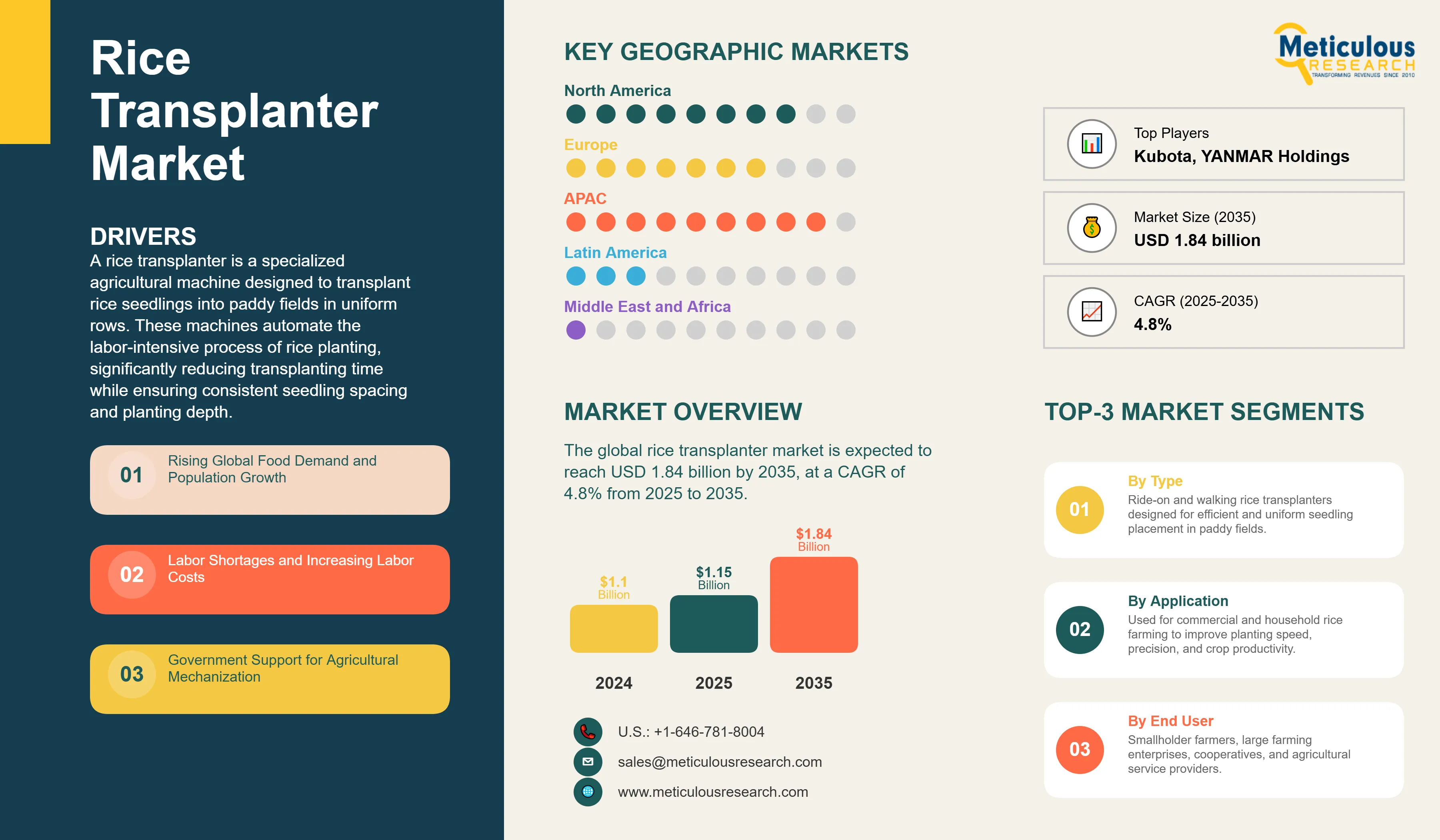
The global rice transplanter market is expected to reach USD 1.84 billion by 2035 from USD 1.15 billion in 2025, at a CAGR of 4.8% from 2025 to 2035.
A rice transplanter is a specialized agricultural machine designed to transplant rice seedlings into paddy fields in uniform rows. These machines automate the labor-intensive process of rice planting, significantly reducing transplanting time while ensuring consistent seedling spacing and planting depth. Rice transplanters improve seedling survival rates, enhance crop management efficiency, and support higher productivity compared to traditional manual transplantation methods. Available in ride-on and walking configurations with manual to fully autonomous operation, these machines have become essential for modern rice cultivation, particularly in regions where rice production is intensive and labor shortages are increasingly common.
Key Market Highlights:
Click here to: Get Free Sample Pages of this Report
What is the Rice Transplanter Market?
Rice transplanters are specialized agricultural machines that automate the process of planting rice seedlings in paddy fields. These machines represent a critical advancement in rice cultivation technology, addressing fundamental challenges facing global agriculture including labor shortages, rising labor costs, and the need for increased productivity to meet growing food demand. The machines transplant seedlings in uniform rows with consistent spacing and planting depth, promoting healthy crop growth and optimizing yields.
The rice transplanter market is expected to witness steady growth as farmers seek modern solutions to boost efficiency and reduce operational costs globally. Several factors are driving the growth of this market, including the growing adoption of mechanization in agriculture, supportive government schemes and subsidies, technological advancements in precision agriculture, and the increasing integration of AI, GPS, and IoT technologies. The market serves diverse needs ranging from small household operations to large commercial farming enterprises across major rice-producing regions.
|
Parameter |
Details |
|
Market Size Value in 2025 |
USD 1.15 Billion |
|
Revenue Forecast in 2035 |
USD 1.84 Billion |
|
Growth Rate |
CAGR of 4.8% from 2025 to 2035 |
|
Base Year for Estimation |
2024 |
|
Historical Data |
2023–2024 |
|
Forecast Period |
2025–2035 |
|
Quantitative Units |
Revenue in USD Billion and CAGR from 2025 to 2035 |
|
Report Coverage |
Revenue forecast, company ranking, competitive landscape, growth factors, and trends |
|
Segments Covered |
Product Type, Propulsion Type, Capacity, Navigation System, Application, Region |
|
Regional Scope |
North America, Europe, Asia-Pacific, Latin America, Middle East & Africa |
|
Countries Covered |
U.S., Canada, Germany, France, Italy, China, Japan, South Korea, India, Indonesia, Thailand, Vietnam, Brazil, Argentina, Saudi Arabia, South Africa |
|
Key Companies Profiled |
Kubota Corporation, YANMAR Holdings Co. Ltd., ISEKI & CO. LTD., Mahindra & Mahindra Ltd., Mitsubishi Mahindra Agricultural Machinery Co. Ltd., CLAAS KGaA mbH, CNH Industrial N.V., TYM Corporation, Dongfeng Agricultural Machinery Co. Ltd., Escorts Kubota Ltd. |
What are the Key Trends Shaping the Rice Transplanter Market?
The rice transplanter market is being driven by technological innovation, changing agricultural demographics, and evolving farming practices. Some of the major trends that are shaping the competitive outlook include the following:
Integration of GPS and Autonomous Technology: Modern rice transplanters use GPS navigation, automated planting mechanisms, and real-time data analytics. The Kubota Agri-Robo Rice Transplanter is revolutionary because it became the first machine ever to be able to work the fields without including the need for an operator on board. It features 'expert full-field planting,' performing uniform seedling placement from corner to corner. Yanmar's YR8D auto-rice transplanter makes use of RTK positioning with Linear Mode for straight-line autonomous driving and Auto Mode, which enables fully automated field coverage, including turns.
IoT Integration-Smart Agriculture: Integration of IoT sensors and data analytics is changing rice transplanting operations. Smart transplanters collect valuable data on soil conditions, weather patterns, and crop health; farmers can make informed decisions for irrigation, fertilization, and pest control. With the availability of real-time monitoring capabilities, it is easy to conduct remote oversight operations during transplantation, which further increases efficiencies and reduces operator fatigue.
Eco-friendly and Sustainable Solution: The manufacturers are developing eco-friendly rice transplanters with efficient fuel systems and electric or hybrid power source compatibility. The precise planting methods reduce the requirement for chemical inputs such as fertilizers and pesticides, which helps in healthier soil and reduced environmental impact. Kubota and Yanmar are investing in fuel-efficient models with reduced greenhouse gas emissions without compromising operational performance.
Government Support and Mechanization Programs: Various governments in different parts of the world have initiated agricultural mechanization through subsidies and other types of financial support programs. China's Ministry of Agriculture and Rural Affairs has issued subsidies worth 10 billion yuan, or around $1.46 billion, for buying agricultural machinery during 2023. The Indian government has initiated the Sub-Mission on Agricultural Mechanization under which they will offer rice transplanters at subsidized rates to facilitate their greater adoption by farmers, particularly small and medium-sized ones.
What are the market dynamics of the rice transplanter market?
Driver: Increasing Global Food Demand and Population Growth
The increasing global population triggers an unprecedented demand for food, particularly rice, being a staple food for billions of people across the globe. Global rice production has reportedly reached a record 543 million tonnes for 2024/25, against the projected consumption of 522 million metric tons for 2023/24 as projected by FAO. As more people are fed, farmers seek ways to plant rice faster and more accurately. Rice transplanters help farmers save time, reduce labor costs, and ensure consistent growth in crops, which is becoming an essential tool in meeting the growing demands in food supply.
Driver: Labor Shortages and Rising Labor Costs
Agricultural laborers have become scarce in major rice-producing areas. According to the International Labor Organization, the global percentage of people working in agriculture decreased to 26% in 2022. The Indian Council of Food and Agriculture estimates that the agricultural workforce will shrink by 25.7% in India by 2050. With increasing labor costs, migration of rural workers to urban areas is forcing farmers to turn toward mechanization. Rice transplanters save considerable labor; mechanical transplanting reduces the workload by up to 80%, as compared to transplanting manually.
Opportunity: Emerging Markets and Small Farm Mechanization
The extension of mechanization to small and medium-sized farms offers great potential for growth. Low-cost mechanical transplanters are being developed by manufacturers to help mechanize smallholding operations. Affordable walking rice transplanters are making mechanization benefits accessible to smaller farmers. Government subsidies and access to credit are making technology more accessible to the emerging markets of Africa, Southeast Asia, and Latin America, which also mark the new frontiers of rice cultivation.
Opportunity: Precision Agriculture and Yield Optimization
The increasing emphasis on precision agriculture provides scope for advanced rice transplanters with GPS guidance, automatic adjustment of planting depth, and variable rate application technologies. These will ensure uniform plant-to-plant spacing, optimum planting depth, and minimum seed wastage, thus increasing crop yield. Integration of AI-powered systems for real-time decision-making and automated adjustments based on field conditions represents the next frontier in rice transplanter technology.
What are the major segments of the rice transplanter market?
By Product Type:
In 2025, the ride-on rice transplanter segment holds the largest share of the overall market. This reflects an increasing preference among farmers for mechanized solutions that offer efficiency and ease of operation in large paddy fields. Ride-on models are mainly appreciated for the fact that they are able to cover wider areas in a shorter time, reducing labor dependency and operational costs. Most of these machines have 6 to 8 rows and give better performance during operations compared to conventional methods of transplanting.
The walking rice transplanter segment is expected to grow at the highest CAGR during the forecast period, 2025 - 2035. These small machines find their application in small to medium-sized rice farms where ride-on models are not practical or too expensive to use. Increasing demand for mechanization among smallholder farmers and government incentives for encouraging modern farming equipment is contributing to the adoption of walking transplanters, especially in developing economies.
By Capacity:
The 4-8 rows segment dominated the market in 2025 due to its ideal balance between efficiency and affordability. Government support programs and subsidies make such equipment more accessible to farmers, which, in turn, reinforce this leading position in the market.
By Application:
The commercial segment accounts for the largest share, indicating increasing adoption by large-scale farming globally. Commercial rice transplanters are designed for efficient planting over large areas; they can cover more area in a shorter period with great accuracy. The household segment caters to the small-scale farmer's needs for compact, handy transplanting machinery and is gaining popularity in rural areas of China, India, and Southeast Asia.
Which region leads the rice transplanter market?
The Asia-Pacific region accounts for the largest share of the global rice transplanter market, in 2025. The largest share of this market is supported by the wide rice cultivation in this region, making nearly 90% of the world's total rice production, developing mechanization traits, and supportive governmental policies through subsidies and financial aid. Major regional growth comes from China, India, Japan, Indonesia, Vietnam, and Thailand.
Who are the Major Players in the Rice Transplanter Market?
The rice transplanter market is fragmented with many small and medium-sized companies competing alongside a few dominant players. Major manufacturers focus on innovation to maintain competitive positions, with strategic partnerships and collaborations becoming increasingly common as companies seek to expand product portfolios and market reach.
The rice transplanter market is expected to grow from USD 1.15 billion in 2025 to USD 1.84 billion by 2035.
The rice transplanter market is expected to grow at a CAGR of 4.8% from 2025 to 2035.
The major players in the rice transplanter market include Kubota Corporation, YANMAR Holdings Co. Ltd., ISEKI & CO. LTD., Mahindra & Mahindra Ltd., Mitsubishi Mahindra Agricultural Machinery Co. Ltd., CLAAS KGaA mbH, CNH Industrial N.V., TYM Corporation, Dongfeng Agricultural Machinery Co. Ltd., Escorts Kubota Ltd., Jiangsu World Agriculture Machinery Co. Ltd., Changfa Agricultural Equipment Co. Ltd., VST Tillers Tractors Ltd., and FJ Dynamics Technology Co. Ltd., among others.
The main factors driving the rice transplanter market include rising global food demand and population growth, labor shortages and rising labor costs in agricultural sectors, government support and subsidies for agricultural mechanization, increasing adoption of precision agriculture technologies, technological development in autonomous and GPS-guided transplanters, and growing awareness about the benefits of mechanized planting among farmers.
Asia-Pacific region will lead the global rice transplanter market during the forecast period 2025 to 2035. China, Japan, India, Indonesia, and Southeast Asian countries are the major contributors to the regional market growth.
The rice transplanter market is segmented by product type (ride-on rice transplanter, walking rice transplanter), propulsion type (self-propelled, manually operated), capacity (less than 4 rows, 4-8 rows, more than 8 rows), navigation system (manual, semi-autonomous, autonomous), application (commercial, household), and geography (North America, Europe, Asia-Pacific, Latin America, Middle East & Africa).
























Published Date: May-2026
Please enter your corporate email id here to view sample report.
Subscribe to get the latest industry updates


