Reverse Logistics Market (2026-2036)
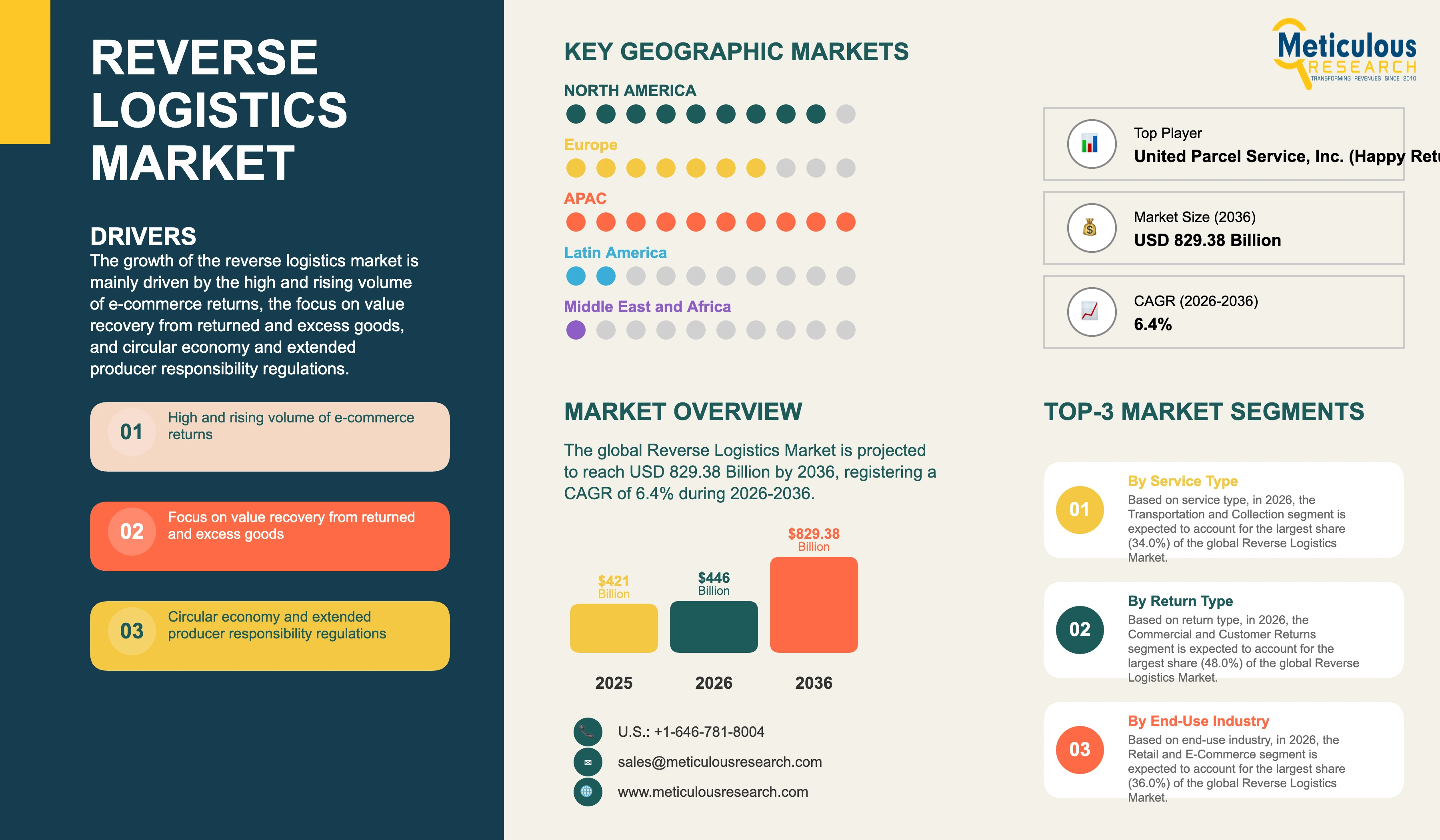
The global reverse logistics market was valued at USD 421.00 billion in 2025. This market is expected to reach USD 829.38 billion by 2036 from an estimated USD 446.00 billion in 2026, registering a CAGR of 6.4% during the forecast period (2026-2036).
- Published
- Nov 2026
- Pages
- 275
- Format
- PDF + Excel
- Report ID
- MRAUTO - 1042471
- Base year
- 2025
- 2024 · HISTORICAL
- $890.0B
- 2036
- $829.4B
- CAGR 2026–2036
- 6.4%
2024–2025 baseline · 2026–2036 forecast at 6.4% CAGR · hover a bar for the value
Key highlights
U.S. retailers estimated that 15.8% of their annual sales, or about USD 849.9 billion of merchandise, would be returned in 2025, compared with USD 890 billion in 2024, according to the National Retail Federation and Happy Returns, while the return rate for online sales was estimated at 19.3%.
The same NRF and Happy Returns study estimated that about 9% of all returns in 2025 were fraudulent, and 85% of retailers surveyed said they use AI to detect or prevent return fraud, showing how fraud prevention has become part of returns management.
UPS expanded the drop-off network of its Happy Returns business to about 10, 000 U.S. locations in 2026, while FedEx Easy Returns operates at about 3,000 locations, as parcel carriers compete to consolidate returns and lower processing costs for retailers.
According to the NRF and Happy Returns study, 82% of shoppers said free returns influence where they shop, and about two-thirds of merchants said updating their returns process was a priority, which shows the commercial pressure on retailers to invest in faster, cheaper, and more convenient returns.
Retailers surveyed by the NRF and Happy Returns said they planned to manage peak-season returns by relying more on third-party logistics partners, hiring seasonal staff for returns, and extending return windows, all of which add to demand for outsourced reverse logistics services.
DHL Supply Chain acquired the returns and reverse logistics business of Inmar Intelligence in 2025, strengthening its position as one of the largest reverse logistics providers in North America, and Global-e acquired the AI-based returns platform ReturnGO in 2025.
The EU's Ecodesign for Sustainable Products Regulation bans large companies from destroying unsold apparel and footwear from July 2026, and the EU Right to Repair Directive, adopted in 2024, requires manufacturers to offer repair for certain products, which increases demand for repair, resale, and recycling services.
U.S. e-commerce sales reached about USD 340.2 billion in the second quarter of 2026, or 17.1% of total retail sales, according to the U.S. Census Bureau, and continued online sales growth supports higher return volumes.
By service type, transportation and collection account for the largest share of 34.0% in 2026, while returns management software registers the highest CAGR.
By return type, commercial and customer returns account for the largest share in 2026, while end-of-life returns register the highest CAGR.
By end-use industry, retail and e-commerce account for the largest share of 36.0% in 2026, while consumer electronics and IT register the highest CAGR.
By geography, Asia-Pacific accounts for the largest share of 35.0% in 2026, while Latin America registers the highest CAGR of 7.6%.
Report summary
| Particulars | Details |
|---|---|
| Base Year | 2025 |
| Estimated Year | 2026 |
| Forecast Period | 2026-2036 |
| Market Size in 2025 | USD 421.00 billion |
| Market Size in 2026 | USD 446.00 billion |
| Market Size by 2036 | USD 829.38 billion |
| CAGR (2026-2036) | 6.4% |
| Format | PDF, Excel & Cloud Portal · 275 pages |
| Largest Segment by Service Type (2026) | Transportation and Collection (34.0%) |
| Largest Segment by End-Use Industry (2026) | Retail and E-Commerce (36.0%) |
| Largest Region (2026) | Asia-Pacific (35.0%) |
| Fastest-Growing Region | Latin America (CAGR 7.6%) |
| Segments Covered | Service Type, Return Type, End-Use Industry, and Geography |
| Geographic Scope | Asia-Pacific, North America, Europe, Latin America, and Middle East and Africa |
| Key Companies Profiled | UPS (Happy Returns), FedEx, DHL Group, GXO Logistics, DSV, Kuehne+Nagel, Ryder, GEODIS, Reverse Logistics Group, Optoro, Liquidity Services, ReverseLogix, Loop Returns, and Sims Lifecycle Services |
Report overview
Segments covered: service type, return type, end-use industry.
The growth of this market is mainly driven by the high and rising volume of product returns from e-commerce, the growing focus of retailers and brands on recovering value from returned and excess goods through refurbishment and resale, extended producer responsibility and right-to-repair regulations that require companies to take back, repair, and recycle products, rising demand for refurbished electronics and remanufactured parts, and investments by parcel carriers and logistics companies in consolidated, box-free returns networks. However, factors such as the high cost and complexity of processing returns, limited visibility into return flows, return fraud, and the low value of many returned items, which makes processing uneconomic, are expected to restrain the growth of this market to some extent.
Reverse logistics covers the movement and management of goods after they reach the customer, flowing back from consumers or business users to retailers, manufacturers, service centers, resellers, or recyclers. It includes the collection and transportation of returned products, receiving, inspection, and sorting at returns centers, repair, refurbishment, and remanufacturing, restocking and resale through primary and secondary channels, recovery of parts and materials, and recycling and responsible disposal of products that cannot be reused.
This market covers the global revenue generated from reverse logistics services and solutions, measured in value. It includes transportation and collection, warehousing and returns processing, repair, refurbishment, and remanufacturing services, remarketing and resale services, recycling and disposal services, and returns management software, whether provided by third-party logistics companies, parcel carriers, specialist reverse logistics providers, or software vendors, as well as the cost of reverse logistics operations performed in-house by retailers and manufacturers. It is segmented by service type, return type, end-use industry, and geography. The value of the returned goods themselves and the revenue from resale of goods by retailers and brands are not included.
Reverse logistics differs from forward logistics in several ways that make it more complex and costly. Return volumes are difficult to forecast, items arrive one at a time from many locations in different conditions, each item must be inspected and graded before a decision is made about what to do with it, and the value of many items falls quickly while they wait to be processed. Retailers and brands often have many possible outcomes for each item, such as returning it to stock, selling it as open-box, refurbishing it, sending it to a liquidator, returning it to the vendor, donating it, or recycling it, and the best choice depends on the item's condition, value, and demand.
E-commerce has transformed the scale of reverse logistics, as online shoppers return items at much higher rates than in-store shoppers, because they cannot see, touch, or try on products before buying, and practices such as buying several sizes and returning those that do not fit, known as bracketing, have become common. According to the National Retail Federation and Happy Returns, U.S. retailers expected about 19.3% of online sales to be returned in 2025. Free and easy returns have become an important factor in where consumers choose to shop, which means retailers must offer convenient returns while controlling costs.
Reverse logistics is also important in business-to-business industries, where manufacturers manage warranty returns, repairs, and spare parts, automotive companies collect cores for remanufacturing, technology companies recover used IT equipment from businesses and data centers for refurbishment and recycling, and healthcare companies manage the return of expired and recalled pharmaceuticals and medical devices. These flows often require specialized handling, tracking, and compliance with environmental and safety regulations.
The cost of a return is made up of several parts: the shipping cost to bring the item back, the labor and space needed to receive, inspect, and process it, the cost of repairs, cleaning, and repackaging, and the loss of value when an item cannot be sold again at full price. For many retailers, these costs together can amount to a large share of the item's original selling price, which is why companies are investing in ways to reduce both the number of returns and the cost of each return.
Sustainability and circular economy goals are increasingly shaping the market, as governments are introducing extended producer responsibility rules that require producers to take back and recycle products, bans on destroying unsold goods, and right-to-repair laws, while companies are setting targets to reduce waste and increase the reuse of products and materials. These developments are shifting reverse logistics from a cost center focused on handling returns to a value recovery function that supports resale, refurbishment, and recycling.
Over the forecast period, the reverse logistics market is expected to grow steadily, supported by e-commerce growth, circular economy regulations, demand for refurbished and remanufactured products, investments in returns networks and automation, and the adoption of software and AI to improve decisions and reduce costs.
Regulation and customer demand are pushing us to repair and resell more devices instead of recycling them. We need partners who can test, refurbish, and track every unit, and who can wipe data securely.
Demand for refurbishment, data-secure processing, and take-back explains why consumer electronics and IT form the fastest-growing end-use industry in this market.
Our return volumes rise sharply after big sales events like Singles Day, and we used to struggle to process them quickly. Software that tells us what to restock, resell, or recycle has reduced write-offs and freed warehouse space.
Data-driven disposition decisions support the rapid growth of returns management software, the fastest-growing service type in this market.
We are building a network across several countries to collect, test, and repurpose or recycle batteries from our vehicles, because regulations require it and the materials are valuable.
Battery take-back and recycling are an important part of the strong growth of end-of-life returns, the fastest-growing return type in this market.
Report infographic
Market dynamics
17 factors across 5 forcesHigh and rising volume of e-commerce returns
The growth of e-commerce has greatly increased the volume of returns that retailers and brands must handle. Online return rates are much higher than store return rates, particularly in categories such as apparel, footwear, and consumer electronics, where fit, appearance, and performance are difficult to judge online. According to the National Retail Federation and Happy Returns, U.S. retailers estimated that about USD 849.9 billion of merchandise would be returned in 2025, with online sales returned at a rate of about 19.3%.
Consumer expectations also drive return volumes, as many shoppers expect free returns, long return windows, and instant refunds, and they consider return policies when deciding where to shop. Social commerce, marketplaces, and cross-border e-commerce are adding further return flows, often over longer distances. As e-commerce continues to grow in all regions, the volume of returns that require collection, processing, and disposition is expected to rise, which supports demand for transportation, processing, and software services. Retail and e-commerce account for the largest share of the market by end-use industry.
Focus on value recovery from returned and excess goods
Retailers and brands are increasingly focused on recovering as much value as possible from returned, excess, and damaged goods, instead of writing them off or sending them to landfill. Faster processing, better grading, and the use of multiple resale channels, such as open-box sales, outlet stores, online marketplaces, liquidation, and the brand's own resale programs, can significantly increase recovery rates. Because returned items can lose value quickly, especially seasonal and technology products, speed is a key factor in value recovery.
Specialist providers offer services such as inspection, grading, cleaning, repair, repackaging, and listing on resale channels, and software platforms help retailers decide the best disposition for each item based on its condition and market value. Remarketing and resale services are among the fastest-growing service types in this market, supported by growing consumer acceptance of refurbished, open-box, and secondhand products.
Value recovery has become more important as retailers face pressure on margins, higher inventory costs, and investor attention on profitability. Every percentage point of additional value recovered from returns can have a meaningful effect on profits for large retailers, which encourages them to invest in better processing, grading, and resale capabilities, either in-house or through specialist partners.
Circular economy and extended producer responsibility regulations
Governments are introducing regulations that require companies to take responsibility for their products at the end of their life and reduce waste. Extended producer responsibility rules for electronics, batteries, packaging, textiles, and vehicles require producers to fund and organize the collection and recycling of their products, and the EU's Ecodesign for Sustainable Products Regulation bans large companies from destroying unsold apparel and footwear from July 2026. The EU Right to Repair Directive requires manufacturers to offer repair services for certain products.
Similar rules are being introduced in other regions, such as electronic waste and battery regulations in India, China, and U.S. states, and right-to-repair laws in several U.S. states. These regulations create steady demand for collection, repair, refurbishment, and recycling services and require companies to track products and materials through reverse supply chains. End-of-life returns form the fastest-growing return type in this market.
Extended producer responsibility schemes for packaging are also expanding, including the EU's Packaging and Packaging Waste Regulation and new schemes in several U.S. states, which require producers to fund the collection and recycling of packaging and may encourage reusable packaging systems that depend on reverse logistics for collection, cleaning, and redistribution.
Investment in consolidated returns networks and automation
Parcel carriers, logistics companies, and retailers are investing in returns networks that make returns more convenient for consumers and less costly for retailers. Box-free and label-free returns, in which consumers drop off items at a retail location without packaging, allow returns from many shoppers and merchants to be consolidated and shipped in bulk to processing centers. UPS expanded its Happy Returns network to about 10,000 U.S. drop-off locations in 2026, and FedEx, DHL, and other carriers are expanding their own returns services.
Returns processing centers are also adopting automation, such as automated sorting, conveyor systems, robotic handling, and computer vision for grading, which improves speed and reduces labor costs. These investments make reverse logistics more efficient and support the outsourcing of returns to specialist providers.
Table of contents
11 chapters · 126 sections · 275 pages · click to expandGeographic analysis
Asia-Pacific
Largest shareIn 2026, Asia-Pacific is expected to account for the largest share of 35.0% of the global reverse logistics market. The large share of this region is mainly due to the size of e-commerce markets in China, Japan, South Korea, India, and Southeast Asia, the region's role as the main manufacturing base for electronics, apparel, and consumer goods, and the growing volume of electronic waste and end-of-life products that require collection and recycling. China has the world's largest e-commerce market, with high return volumes during major shopping festivals, and its platforms and logistics providers operate large returns networks. Japan and South Korea have mature reverse logistics systems for electronics and home appliances supported by recycling laws, while India and Southeast Asia are seeing rapid growth in e-commerce returns, particularly in fashion. Electronics manufacturers in the region also manage large volumes of warranty returns and repairs. Asia-Pacific is expected to remain the largest region throughout the forecast period.
Latin America
Fastest growthLatin America is projected to register the highest CAGR of 7.6% during the forecast period. Growth is driven by the rapid expansion of e-commerce in Brazil, Mexico, Colombia, and Chile, the development of returns networks by marketplaces such as Mercado Libre, and new solid waste and electronic waste regulations.
North America
North America holds a significant share, led by the U.S., which has very high e-commerce return volumes and a large network of returns providers. In North America, U.S. retailers face some of the highest return rates in the world, driven by generous return policies and a large e-commerce market, and the region has a dense network of returns providers, liquidators, and recommerce platforms. Box-free returns networks from UPS, FedEx, and Amazon are expanding, and specialist providers, such as Optoro, Liquidity Services, and ReverseLogix, serve retailers and brands. Canada has a smaller but growing returns market with similar characteristics.
Europe
Europe is supported by strict circular economy regulations, while the Middle East and Africa is growing with e-commerce in the Gulf countries. In Europe, return rates for online fashion are particularly high in countries such as Germany, where free returns are widely expected, and the EU's circular economy regulations, including the ban on destroying unsold apparel and footwear, the Right to Repair Directive, and extended producer responsibility for electronics, batteries, and packaging, are increasing demand for repair, resale, and recycling services. Providers such as DHL, DSV, GEODIS, and Reverse Logistics Group operate large reverse logistics networks across the region.
Competitive landscape
The reverse logistics market is highly fragmented, with parcel carriers, global third-party logistics providers, specialist reverse logistics and recommerce companies, liquidators, refurbishers, recyclers, and returns software vendors. Leading companies include UPS, FedEx, DHL Group, GXO Logistics, DSV, Kuehne+Nagel, Ryder System, GEODIS, Reverse Logistics Group, Optoro, Liquidity Services, ReverseLogix, Loop Returns, and Sims Lifecycle Services.
Providers compete on network coverage, processing speed, value recovery rates, cost per return, technology and data, integration with retailer and carrier systems, and the ability to offer end-to-end services from collection to resale or recycling. Large carriers benefit from their parcel networks, pickup and delivery density, and retail locations, while specialist providers compete on expertise in processing, refurbishment, and resale.
Parcel carriers, such as UPS, FedEx, and DHL, lead in returns transportation and consolidated drop-off networks. Global third-party logistics providers, such as GXO, DSV, Kuehne+Nagel, Ryder, and GEODIS, operate returns centers for retailers and manufacturers. Specialist companies, such as Reverse Logistics Group, Optoro, and Liquidity Services, focus on returns processing, value recovery, and resale, while software vendors, such as ReverseLogix and Loop Returns, provide returns portals, exchange tools, and workflow software for retailers and brands, and Sims Lifecycle Services focuses on IT asset disposition and electronics recycling.
The top five players are estimated to account for 16.0% of the reverse logistics market in 2025, reflecting the fragmented nature of the market and the large share of returns handled in-house by retailers and manufacturers.
Players use several strategies to grow in this market, including expanding drop-off networks, acquiring returns software and specialist providers, investing in automated returns centers, launching recommerce and refurbishment services, and partnering with retailers and marketplaces. Recent examples include UPS's expansion of Happy Returns, DHL's acquisition of Inmar's returns business, and Global-e's acquisition of ReturnGO.
Competition is expected to center on technology, value recovery, consolidated networks, and sustainability services. Providers that combine dense logistics networks with software, data, and resale capabilities are expected to gain share, and consolidation is expected to continue, as carriers and logistics companies acquire specialist processors, recommerce platforms, and software vendors to offer complete end-to-end services under one contract.
Some of the key players operating in the reverse logistics market are United Parcel Service, Inc. (Happy Returns), FedEx Corporation, Deutsche Post AG (DHL Group), GXO Logistics, Inc., DSV A/S, Kuehne+Nagel International AG, Ryder System, Inc., GEODIS, Reverse Logistics Group, Optoro, Inc., Liquidity Services, Inc., ReverseLogix, Loop Returns, and Sims Lifecycle Services.
- —
UPS expanded Happy Returns to about 10,000 U.S. locations in 2026, DHL Supply Chain acquired Inmar's returns business, Global-e acquired ReturnGO, and the EU's ban on destroying unsold apparel and footwear took effect in July 2026.
- UPS · Happy Returns
- FedEx
- DHL Group
- GXO Logistics
- DSV
- Kuehne+Nagel
- Ryder
- GEODIS
- Reverse Logistics Group
- Optoro
- Liquidity Services
- ReverseLogix
- Loop Returns
- Sims Lifecycle Services
Expert perspectives
Reverse logistics has moved from a back-office cost center to a strategic function for retailers, brands, and manufacturers, as returns grow with e-commerce, regulations require take-back and recycling, and companies seek to recover more value from returned and used products. The market combines high-volume consumer returns with specialized business-to-business flows in electronics, automotive, and healthcare.
Over the forecast period, the market is expected to grow at about 6.4% per year, supported by e-commerce growth, circular economy regulations, refurbishment and resale, and investment in networks and software. Growth in software, resale, and end-of-life services is expected to be faster than growth in transportation and processing.
Transportation and collection remain the largest service type, while returns management software grows fastest. Commercial and customer returns remain the largest return type, while end-of-life returns grow fastest. Retail and e-commerce remain the largest end-use industry, while consumer electronics and IT grow fastest.
Asia-Pacific remains the largest region, while Latin America is the fastest-growing region at a CAGR of 7.6%. The main swing factors are e-commerce growth, return policies, regulation, and the economics of resale and recycling.
For retailers and brands, the key priorities are reducing avoidable returns, making returns convenient and low-cost, recovering more value, and meeting regulatory requirements. For providers, success depends on network density, automation, data, and the ability to offer end-to-end value recovery services.
The most important change for the market is the shift from handling returns at the lowest possible cost to managing them as a source of value and data. Retailers that use returns data to improve products and reduce return rates, process returns quickly to recover more value, and use multiple resale channels can significantly improve profitability, and providers that support these capabilities are expected to grow faster than the overall market.
Regulation is the second major force shaping the market, as circular economy rules in the EU and extended producer responsibility in other regions will require companies to take back, repair, and recycle more products, which will increase volumes in end-of-life and refurbishment services. Risks include slower e-commerce growth, stricter return policies that reduce volumes, and the low economic value of many returned items, while opportunities include AI, automation, and the growth of resale and refurbished products in both developed and emerging markets.
Overall, reverse logistics is expected to become a core part of supply chains and circular business models over the forecast period, with growing integration between returns, resale, repair, and recycling, and with technology playing a larger role in every step of the process.
Customer perspectives
Vice President of Supply Chain - apparel retailer, U.S.
Returns are now one of our biggest supply chain costs after outbound shipping, and moving to consolidated, box-free returns cut our shipping cost per return and got items back on sale faster.
Retailers' strong and growing focus on the cost of returns explains why transportation and collection account for 34.0% of the market and why retail and e-commerce account for 36.0%.
Frequently asked questions
The market was valued at USD 421.00 billion in 2025 and USD 398.00 billion in 2024, and is estimated at USD 446.00 billion in 2026, measured as revenue and spending on reverse logistics services and solutions.
Cite this report
Meticulous Research. (2026). Reverse Logistics Market - Global Opportunity Analysis and Industry Forecast (2026-2036) (Report No. MRAUTO - 1042471). Meticulous Market Research Pvt. Ltd. https://www.meticulousresearch.com/product/reverse-logistics-market-7154