Dexterous Robotic Hands Market (2026-2036)
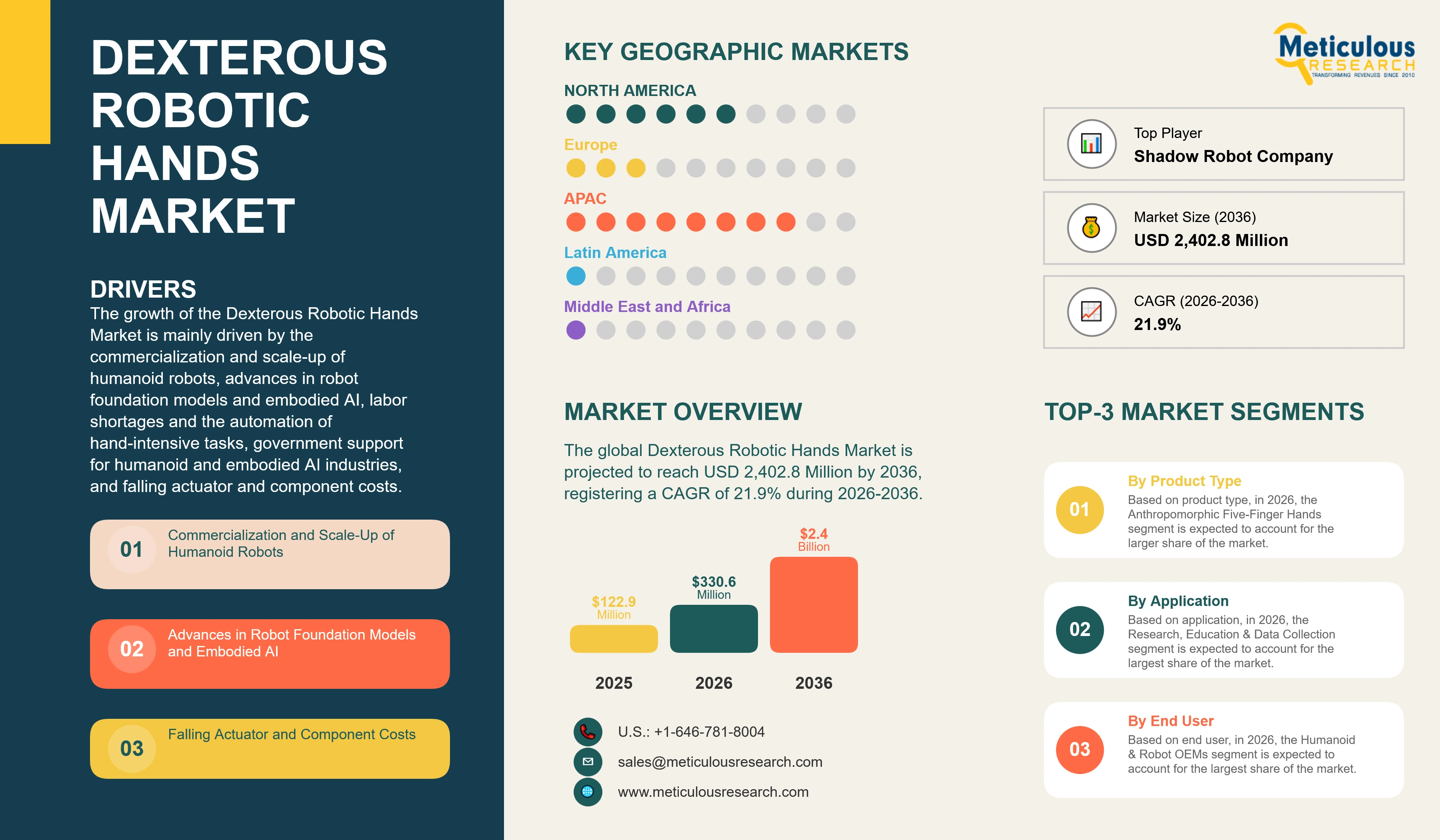
The global Dexterous Robotic Hands Market was valued at USD 122.9 million in 2025. This market is expected to reach USD 2,402.8 million by 2036 from an estimated USD 330.6 million in 2026, registering a CAGR of 21.9% during the forecast period (2026-2036). In terms of volume, the market is estimated at 74,000 units in 2026 and is projected to reach 1,180,000 units by 2036, at a CAGR of 31.9%.
- Published
- Oct 2026
- Pages
- 316
- Format
- PDF + Excel
- Report ID
- MRAUTO - 1042185
- Base year
- 2025
- 2025 · BASELINE
- $122.9M
- 2036
- $2.40B
- CAGR 2026–2036
- 21.9%
2025 baseline · 2026–2036 forecast at 21.9% CAGR · hover a bar for the value
Key highlights
The global Dexterous Robotic Hands Market is projected to reach USD 2, 402.8 million by 2036 from an estimated USD 330.6 million in 2026, at a CAGR of 21.9%. Volume grows faster, at a CAGR of 31.9%, because the average selling price is projected to fall from about USD 5,208 per hand in 2025 to about USD 2,036 in 2036.
MIIT cited 2025 global humanoid shipments of 13, 000 to 16,000 units, as reported by Gasgoo (July 2026), and GGII put China sales of dexterous hands at 19,200 units in 2025, up 237%, according to 36Kr (July 2026). Inspire Robots alone shipped more than 10,000 hands in 2025.
By product type, the anthropomorphic five-finger hands segment is expected to account for the larger share of 77.4% of the market in 2026 and is also projected to register the higher CAGR of 23.3%, as humanoid makers and AI developers prefer human-like hands.
By degrees of freedom, the above 15 DoF segment is expected to account for the largest share of 43.4% in 2026 and to register the highest CAGR of 24.9%, while hands with up to 6 DoF account for 52.9% of the hands sold in 2026.
By actuation type, the linkage & linear actuator-driven segment is expected to account for the largest share of 38.7% in 2026, while the direct/gear-driven segment is projected to register the highest CAGR of 25.3%, and tendon-driven hands become the largest actuation type by value from 2031.
By tactile sensing, the fingertip tactile sensing segment is expected to account for the largest share of 41.8% in 2026, while the full-hand tactile skin segment is projected to register the highest CAGR of 28.8% and to become the largest segment by value from 2029.
By robot platform, the research & teleoperation platforms segment is expected to account for the largest share of 49.0% in 2026, while the humanoid robots segment is projected to register the highest CAGR of 28.6% and to become the largest robot platform from 2028. By end user, humanoid & robot OEMs are expected to account for the largest share of 38.0% in 2026 and to register the highest CAGR of 27.9%.
Asia-Pacific is expected to account for the largest share of 59.4% of the market in 2026, led by China, while Latin America is projected to register the highest CAGR of 33.9%, from a small base. China is the largest country market and the U.S. the second largest, while India is the fastest-growing individual country.
Report summary
| Particulars | Details |
|---|---|
| Forecast Period | 2026-2036 |
| Base Year | 2025 |
| Estimated Year | 2026 |
| CAGR (Value) | 21.9% |
| Format | PDF, Excel & Cloud Portal · 316 pages |
| CAGR (Volume) | 31.9% |
| Market Size (Value) in 2026 | USD 330.6 Million |
| Market Size (Value) in 2036 | USD 2,402.8 Million |
| Market Size (Volume) in 2026 | 74,000 Units |
| Market Size (Volume) in 2036 | 1,180,000 Units |
| Segments Covered | By Product Type: Anthropomorphic Five-Finger Hands, Non-Anthropomorphic Multi-Finger Hands. By Degrees of Freedom: Up to 6 DoF, 7–15 DoF, Above 15 DoF. By Actuation Type: Linkage & Linear Actuator-Driven, Tendon-Driven, Direct/Gear-Driven, Hybrid & Others. By Tactile Sensing: Without Tactile Sensing, Fingertip Tactile Sensing, Full-Hand Tactile Skin. By Robot Platform: Humanoid Robots (General-Purpose Humanoids, Upper-Body & Wheeled Humanoids), Mobile Manipulators, Industrial & Collaborative Robot Arms, Research & Teleoperation Platforms. By Application: Research, Education & Data Collection, Manufacturing & Assembly, Logistics & Warehousing, Healthcare & Laboratories, Household & Personal Service, Other Applications. By End User: Humanoid & Robot OEMs, Research Institutions & Universities, Embodied AI & Data Collection Companies, Industrial & Commercial Operators. |
| Countries Covered | North America: U.S., Canada. Europe: Germany, U.K., France, Italy, Switzerland, Rest of Europe. Asia-Pacific: China, Japan, South Korea, India, Rest of Asia-Pacific. Latin America. Middle East & Africa. |
| Key Companies | Shadow Robot, Inspire Robots, LinkerBot, Sharpa, Wuji Technology, Xynova, BrainCo, Wonik Robotics, Tesollo, PSYONIC, Seed Robotics, qb robotics, mimic robotics, Unitree, ROBOTERA, AGILINK, SCHUNK, Agile Robots, PaXini Technology, and Zhaowei. |
Report overview
Segments covered: product type, degrees of freedom, actuation type, tactile sensing, robot platform, application, end user.
The growth of this market is mainly driven by the commercialization and scale-up of humanoid robots, advances in robot foundation models and embodied AI, labor shortages and the automation of hand-intensive tasks, government support for humanoid and embodied AI industries, and falling actuator and component costs. However, the high unit cost of dexterous hands, their limited durability and reliability in unstructured environments, the difficulty of miniaturizing actuators, and trade-offs between dexterity, strength, and weight restrain the growth of this market.
Furthermore, teleoperation and robot training data collection, modular hands for handling variable parts on collaborative robot arms, service, healthcare, and laboratory automation, and the crossover between prosthetic and robotic hand technologies are expected to offer growth opportunities for the stakeholders in this market. However, the maturity of tactile sensing and control software, the lack of standard interfaces and performance benchmarks, supply chain concentration in micro-motors and reducers, and safety requirements for hands working alongside people remain major challenges impacting the growth of this market. Additionally, the integration of tactile skins and in-hand vision, the shift toward high-DoF and tendon-driven designs, vertical integration by hand and humanoid makers, rapid cost reduction through mass production, and partnerships between hand makers and humanoid and AI platform developers are prominent trends in this market.
The Dexterous Robotic Hands Market covers sales of multi-fingered robotic hands that are sold as products to third parties, including the hand mechanism, actuators, sensors, and hand controller. Hands sold by robot makers as separate products or paid options, such as the Dex3 and Dex5 hands of Unitree, are included. Hands built in-house by robot makers for their own robots and not sold separately, such as those of Tesla, Figure, and Sanctuary AI, are excluded as captive production, as are simple parallel-jaw and suction grippers, underactuated industrial grippers, and prosthetic and bionic hands for people. Market value is presented in USD million and volume in units, where one unit is one hand, and values are attributed to the country where hands are bought and delivered.
Dexterous hands range from low-cost hands with 6 active DoF and 11 or 12 coupled joints to fully actuated research hands with 20 or more DoF. The Inspire RH56 series, the most widely used hand on Chinese humanoids, drives 12 joints with 6 motors through linkages, while the tendon-driven Shadow Dexterous Hand has 20 DoF and 24 movements and the SharpaWave combines 22 active DoF with more than 1,000 tactile sensing points per fingertip. Prices range from RMB 3,999 after subsidy for the LinkerBot O6 Lite to about EUR 110,000 for the Shadow Hand Plus.
Demand rose sharply after 2024, when Chinese humanoid makers moved from prototypes to series shipments and AI developers began to collect large volumes of manipulation data. The China Academy of Information and Communications Technology (CAICT) counted more than 70 embodied AI training grounds in operation in China by the end of June 2026, as reported by TechNode (August 2026), while universities, AI laboratories, and integrators of collaborative robot arms remain important buyers of high-DoF hands.
Competition is led by Chinese makers in volume and by Western, Korean, and Singaporean makers in high-DoF and research hands. Prices are falling as component localization in China rises and production scales up, while tactile sensing has moved from an option to a common feature, fitted to more than 50% of hands at the end of 2025, up from just over 10% a year earlier, according to 36Kr (August 2026).
Report infographic
Market dynamics
18 factors across 4 forcesCommercialization and Scale-Up of Humanoid Robots
Unitree shipped more than 5,500 humanoids in 2025, according to its STAR Market prospectus as reported by China Daily (August 2026), and AgiBot rolled out its 10,000th mass-produced humanoid in March 2026. MIIT said in July 2026 that humanoid production in China is on track to exceed 100,000 units in 2026, as reported by Gasgoo. Every humanoid fitted with multi-fingered hands needs two of them, and only about 27% of the humanoids that Unitree sold in January–September 2025 carried such hands, which leaves room for hand demand to grow faster than robot output.
Advances in Robot Foundation Models and Embodied AI
Robot foundation models such as Physical Intelligence π0, NVIDIA Isaac GR00T, and Google DeepMind Gemini Robotics learn manipulation from large sets of human demonstrations, so the robots that run them need hands able to reproduce human grasps. In June 2026, NVIDIA announced an Isaac GR00T reference humanoid for academic research built with two 22-DoF SharpaWave tactile hands, which ties a merchant hand to a model platform used by leading laboratories. Investors had put at least RMB 100 billion into the embodied AI and humanoid sector in China in 2026 by mid-July, according to Bloomberg (July 2026).
Labor Shortages and Automation of Hand-Intensive Tasks
More than 600,000 industrial robots were installed worldwide in 2025, according to the IFR World Robotics 2026 report, and most of them use grippers, suction cups, or fixtures designed for repeated picks of the same part. Kitting of mixed parts, cable routing, connector insertion, and handling of soft items still rely on human hands. U.S. manufacturing may need up to 3.8 million new employees between 2024 and 2033, according to the Manufacturing Institute and Deloitte, while shrinking workforces in China and Japan reduce the supply of workers for repetitive manual jobs.
Government Support for Humanoid and Embodied AI Industries
MIIT set humanoid robots and their core components, including dexterous hands, as a priority in its guiding opinions of November 2023, and the 15th Five-Year Plan (2026–2030) lists embodied intelligence among future industries. Beijing, Shenzhen, and Shanghai have added funds and implementation plans. In August 2026, South Korea announced KRW 2.3 trillion through 2030 for humanoid development, with robotic hands named as a weak component, and the state-backed National Growth Fund committed KRW 150 billion to Wonik Robotics for a robot hand plant.
Falling Actuator and Component Costs
The drive system and sensing together account for about 80% of the bill of materials of a dexterous hand, according to 36Kr (June 2026). Domestic coreless motors in China cost 30% to 40% of imported Maxon and Faulhaber motors, and domestic Hall-effect tactile sensors cost about RMB 199 each, against more than RMB 1,000 for imported sensors. Raising average component localization from about 40% in 2025 to 80% by 2030 could cut the hand bill of materials by 50% to 60%, which widens the range of robots and tasks for which a multi-fingered hand is worth its cost.
Table of contents
15 chapters · 171 sections · 316 pages · click to expandSegmental analysis
| Segment | Largest share (2026) | Fastest growth (2026–2036) |
|---|---|---|
| By Product Type | — | — |
| By Degrees of Freedom | Above 15 DoF | Above 15 DoF |
| By Actuation Type | Linkage & Linear Actuator-Driven | Direct/Gear-Driven |
| By Tactile Sensing | Fingertip Tactile Sensing | Full-Hand Tactile Skin |
| By Robot Platform | Research & Teleoperation Platforms | Humanoid Robots |
| By Application | Research, Education & Data Collection | Logistics & Warehousing |
| By End User | Humanoid & Robot OEMs | Humanoid & Robot OEMs |
By Product Type
- The Anthropomorphic Five-Finger Hands segment is expected to account for the larger share of 77.4% of the market and is also projected to register the higher CAGR of 23.3% during the forecast period.
- The large share of this segment is mainly due to humanoid makers and AI developers, which prefer human-like hands that can use the same tools and objects as people.
- In terms of volume, anthropomorphic five-finger hands account for 80.2% of the hands sold in 2026, since most Chinese humanoids are fitted with five-finger linkage hands.
- Non-anthropomorphic multi-finger hands, such as the three-finger and four-finger designs of Wonik Robotics, Tesollo, Shadow Robot, and Unitree, keep a role on robot arms and in research, and their average selling price of about USD 5,086 in 2026 is higher than that of five-finger hands.
By Degrees of Freedom
- The Above 15 DoF segment is expected to account for the largest share of 43.4% of the market and is also projected to register the highest CAGR of 24.9% during the forecast period.
- The growth of this segment is driven by Chinese makers bringing hands with 20 or more DoF to market at much lower prices than earlier research hands, and by AI developers that need fully dexterous hands for data collection.
- In terms of volume, hands with up to 6 DoF account for 52.9% of the hands sold in 2026, against 14.1% for hands with above 15 DoF, because low-cost linkage hands are fitted to most Chinese humanoids.
- A hand with above 15 DoF sells for about USD 13, 721 on average in 2026, against about USD 1,610 for a hand with up to 6 DoF, because each added DoF needs its own motor and encoder.
By Actuation Type
- The Linkage & Linear Actuator-Driven segment is expected to account for the largest share of 38.7% of the market, supported by the volume of low-cost hands such as the Inspire RH56 series and the entry models of LinkerBot, which account for 61.0% of the units sold in 2026.
- However, the Direct/Gear-Driven segment is projected to register the highest CAGR of 25.3% during the forecast period, as makers such as Wuji Technology, ROBOTERA, AGILINK, and Tesollo place motors and gears in the fingers.
- Tendon-driven hands, used in the Shadow Dexterous Hand and in several high-DoF Chinese hands, become the largest actuation type by value from 2031, while hybrid, hydraulic, and pneumatic hands serve niche uses that need high grip force or compliance.
By Tactile Sensing
- The Fingertip Tactile Sensing segment is expected to account for the largest share of 41.8% of the market.
- However, the Full-Hand Tactile Skin segment is projected to register the highest CAGR of 28.8% during the forecast period and becomes the largest segment by value from 2029, as robot foundation models need contact data from the palm and finger segments as well as the fingertips.
- Makers such as Sharpa and PaXini Technology are building dense tactile arrays into their hands.
- Hands without tactile sensing are the largest group by volume in 2026, with 47.6% of the units sold, because low-cost humanoid hands still rely on motor current and position feedback, but fingertip sensing takes the lead in units from 2028.
By Robot Platform
- The Research & Teleoperation Platforms segment is expected to account for the largest share of 49.0% of the market.
- However, the Humanoid Robots segment is projected to register the highest CAGR of 28.6% during the forecast period and becomes the largest robot platform by value from 2028.
- Humanoid robots already account for the largest share of units, at 46.0% of the hands sold in 2026, but their hands sell at lower average prices than research hands.
- Within humanoid robots, general-purpose humanoids account for 64.1% of the segment value in 2026 and grow at a CAGR of 29.7%, while upper-body and wheeled humanoids, a format led by Chinese makers for data collection and service tasks, grow at a CAGR of 26.4%.
By Application
- The Research, Education & Data Collection segment is expected to account for the largest share of 54.8% of the market, as universities, AI laboratories, and data collection centers buy most high-DoF hands.
- However, the Logistics & Warehousing segment is projected to register the highest CAGR of 32.9% during the forecast period, as humanoids, mobile manipulators, and robot arms with hands are tested for picking, sorting, and packing.
- Manufacturing & Assembly becomes the largest application from 2033, when robots with dexterous hands move from pilots to regular use in automotive, electronics, and other factories.
By End User
- The Humanoid & Robot OEMs segment is expected to account for the largest share of 38.0% of the market and is also projected to register the highest CAGR of 27.9% during the forecast period, as humanoid makers in China, the U.S., South Korea, and Europe move to series production and buy merchant hands for at least part of their fleets.
- Research institutions & universities were the largest buyers in 2024 and 2025, and they continue to buy the most expensive research hands.
- Embodied AI & data collection companies account for 25.0% of the market in 2026, while industrial & commercial operators form the smallest group but grow at a CAGR of 27.6% as manufacturers and logistics operators begin to fit hands to existing robot arms.
Geographic analysis
Asia-Pacific
Largest shareIn 2026, Asia-Pacific is expected to account for the largest share of 59.4% of the global Dexterous Robotic Hands Market, and for 80.5% of the hands sold. China accounts for 80.1% of the regional market in 2026, because it hosts most humanoid makers, data collection centers, and low-cost hand makers, such as Inspire Robots, LinkerBot, AGILINK, and ROBOTERA. South Korea and Japan add demand from robot makers, research institutes, and national humanoid programs, such as the K-Humanoid Alliance and the Kyoto Humanoid Association, while India is the fastest-growing individual country, at a CAGR of 32.9%, from a small base. Asia-Pacific
North America
North America is expected to account for a share of 28.0% of the market in 2026, led by the U.S., which is the second-largest country market. Demand comes from AI laboratories, universities, robot learning startups, and humanoid developers, which buy a larger share of high-DoF hands than buyers in China. Hands bought through U.S. resellers carry import costs and reseller margins, which raises the value share of the region compared with its share of units, and the region is expected to grow at a CAGR of 23.2%. North America
Europe
Europe is expected to account for a share of 11.8% of the market in 2026 and to grow at a CAGR of 23.5% during the forecast period. Germany is the largest market in the region, supported by industrial automation, research institutes, and hand makers such as SCHUNK and Agile Robots, while Italy is the fastest-growing country in the region. The U.K. adds demand from robot learning research and from Shadow Robot Company, and Switzerland combines research demand from institutions such as ETH Zurich with local makers such as mimic robotics. Europe
Latin America
Fastest growthLatin America is projected to register the highest CAGR of 33.9% during the forecast period, from a small base of 0.3% of the market in 2026. Demand comes mainly from universities, military research institutes, and schools that buy imported humanoids, mostly from Unitree, through importers and dealers in Brazil and Mexico, and hands reach the region mainly as options on these robots. Latin America
Middle East & Africa
The Middle East & Africa is expected to account for 0.5% of the market in 2026 and to grow at a CAGR of 33.1% during the forecast period. Demand is concentrated in the UAE, Saudi Arabia, and Israel, where governments and large companies are funding embodied AI and humanoid programs, with smaller research demand in South Africa. Most hands arrive fitted to Chinese humanoids or through distributors, such as Ednex Automation in the UAE. Middle East & Africa
Competitive landscape
The global Dexterous Robotic Hands Market is fragmented, with a few Chinese makers leading in volume and a group of European, Korean, Singaporean, and U.S. makers leading in high-DoF and research hands. In 2025, Inspire Robots held an estimated 18.7% share, followed by Shadow Robot (9.0%), Wonik Robotics (7.7%), LinkerBot (6.1%), ROBOTERA (5.7%), and Unitree (4.6%), while other players accounted for 48.2%.
Between January 2024 and October 2026, the 20 companies profiled in the report announced 107 verified developments related to dexterous robotic hands, led by product launches (47) and investments (35), followed by partnerships (13), agreements and contracts (7), and expansions (5). Major examples include the adoption of SharpaWave hands for the NVIDIA Isaac GR00T reference humanoid in June 2026, the 22-DoF RH5MK1 of Inspire Robots shown at IROS 2026, and funding rounds of more than RMB 4.5 billion for Sharpa and nearly RMB 1.5 billion for LinkerBot in 2026.
The report provides a comprehensive competitive assessment of the leading companies operating in the global Dexterous Robotic Hands Market. The key players profiled in the report include Shadow Robot Company (U.K.), Beijing Inspire-Robots Technology Co., Ltd. (China), LinkerBot (China), Sharpa (Singapore), Wuji Technology (China), Xynova (China), BrainCo (China), Wonik Robotics Co., Ltd. (South Korea), Tesollo Inc. (South Korea), PSYONIC, Inc. (U.S.), Seed Robotics (Portugal), qb robotics (Italy), mimic robotics (Switzerland), Unitree Robotics Co., Ltd. (China), ROBOTERA (China), AGILINK (China), SCHUNK SE & Co. KG (Germany), Agile Robots SE (Germany), PaXini Technology (China), and Shenzhen Zhaowei Machinery & Electronics Co., Ltd. (China).
- Shadow Robot
- Inspire Robots
- LinkerBot
- Sharpa
- Wuji Technology
- Xynova
- BrainCo
- Wonik Robotics
- Tesollo
- PSYONIC
- Seed Robotics
- Unitree
- ROBOTERA
- AGILINK
- SCHUNK
- Agile Robots
- PaXini Technology
- Zhaowei
Expert perspectives
Dexterous robotic hands moved from a niche research product to a volume component in 2025, as Chinese humanoid makers began series shipments and AI developers started to collect large volumes of manipulation data. The market is still small, but it grows quickly in value and even faster in units, because prices fall as Chinese makers scale up and localize components.
Several shifts are expected to shape the market through 2036. Humanoid robots overtake research and teleoperation platforms as the largest robot platform from 2028, and manufacturing & assembly overtakes research, education & data collection as the largest application from 2033. The product mix moves toward hands with more than 15 DoF, full-hand tactile skins, and tendon or direct drives, with tendon-driven hands becoming the largest actuation type from 2031 and full-hand tactile skins the largest sensing segment from 2029. The price gap between China and other regions is expected to narrow as distributors scale and local makers compete.
For suppliers, the most attractive positions are likely to be in high-DoF hands with dense tactile sensing at falling prices, durable hands for industrial and logistics duty cycles, and hands with standard interfaces for collaborative robot arms. The main risks are the pace of humanoid deployment beyond pilots, the share of humanoid makers that build hands in-house, and trade measures between China and the U.S., such as tariffs and the FCC Covered List.
Customer perspectives
Insights gathered during primary interviews with engineers and managers at humanoid and robot makers, robot integrators, embodied AI developers, data collection operators, manufacturers, logistics operators, and research laboratories, and with executives at hand makers, component and sensor suppliers, and distributors, highlight where priorities are shifting. The following perspectives reflect recurring themes raised across these discussions.
“This reflects why hands with up to 6 DoF lead in units while hands with above 15 DoF lead in value.”
“This indicates how robot foundation models raise requirements for DoF and sensing, and why full-hand tactile skin is the fastest-growing sensing segment.”
“This highlights durability as the main condition for adoption in logistics and warehousing, the fastest-growing application.”
Frequently asked questions
The global Dexterous Robotic Hands Market is estimated at USD 330.6 million in 2026, corresponding to 74,000 hands.
Cite this report
Meticulous Research. (2026). Dexterous Robotic Hands Market - Global Opportunity Analysis and Industry Forecast (2026-2036) (Report No. MRAUTO - 1042185). Meticulous Market Research Pvt. Ltd. https://www.meticulousresearch.com/product/dexterous-robotic-hands-market-6868