Automotive Remanufacturing Market (2026-2036)
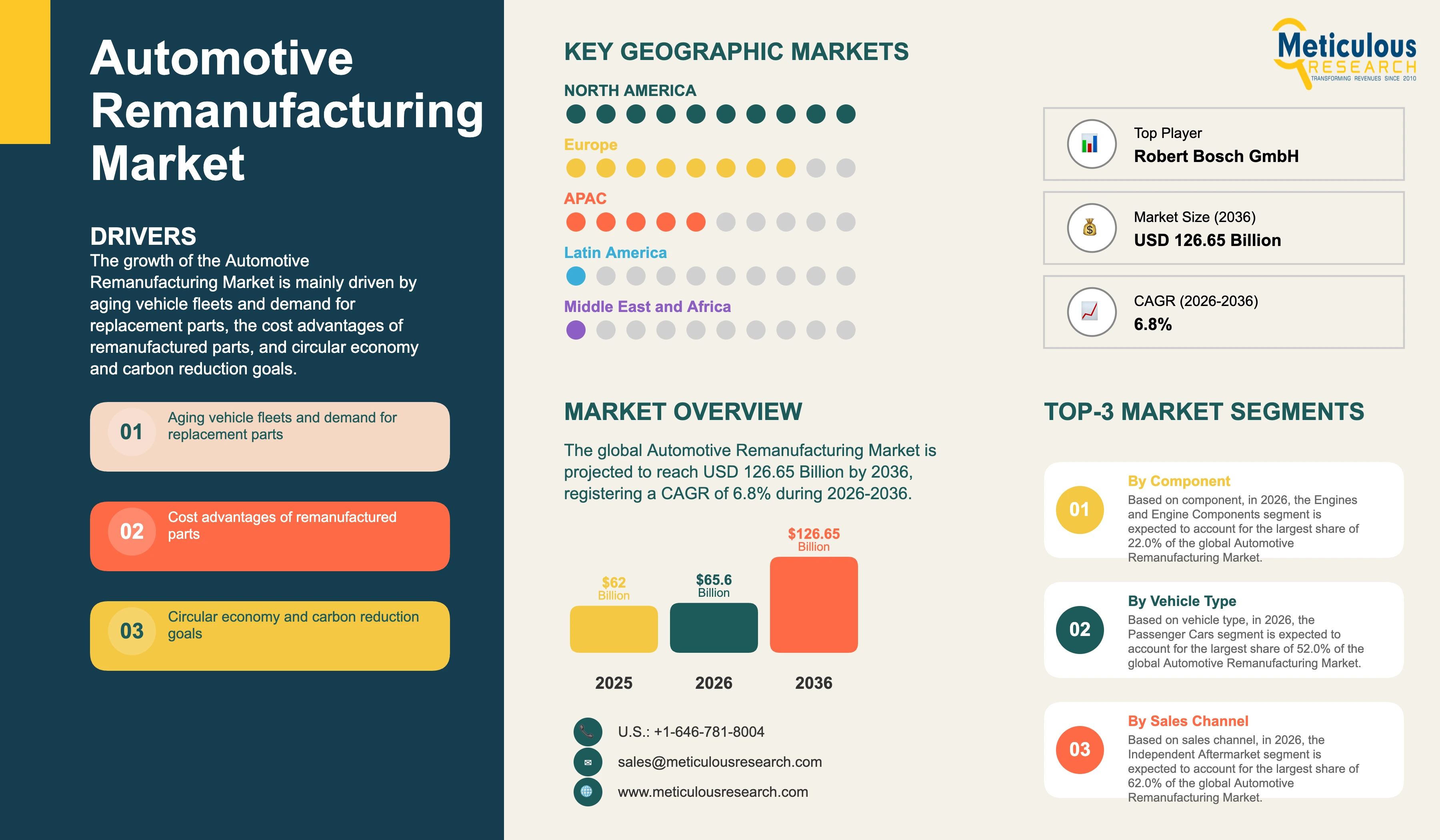
The global automotive remanufacturing market was valued at USD 62.00 billion in 2025. This market is expected to reach USD 126.65 billion by 2036 from an estimated USD 65.60 billion in 2026, registering a CAGR of 6.8% during the forecast period (2026-2036).
- Published
- Nov 2026
- Pages
- 315
- Format
- PDF + Excel
- Report ID
- MRAUTO - 1042499
- Base year
- 2025
- 2025 · BASELINE
- $62.00B
- 2036
- $126.7B
- CAGR 2026–2036
- 6.8%
2025 baseline · 2026–2036 forecast at 6.8% CAGR · hover a bar for the value
Key highlights
Motorcar Parts of America, one of the largest remanufacturers of automotive parts in North America, reported net sales of about USD 789.8 million for its fiscal year ended March 31, 2026, up 4.3%, and said it expected annualized net sales of more than USD 900 million by the end of fiscal 2027, supported by demand for non-discretionary replacement parts as consumers keep vehicles longer.
The average age of light vehicles in operation in the U.S. reached about 12.8 years in 2025, according to S&P Global Mobility, a record high that supports demand for replacement parts, including remanufactured engines, transmissions, starters, alternators, brake calipers, and steering components.
BBB Industries, a leading North American remanufacturer of alternators, starters, brake calipers, and steering components, has expanded through acquisitions in North America and Europe, including the European aftermarket suppliers Metalcaucho, FARE Automotive, and Redline Auto Parts, showing continued consolidation in the remanufacturing industry.
Motorcar Parts of America reported that its fiscal 2026 results included about USD 35 million of core revenue linked to the realignment of inventory at customer distribution centers, showing how core management and core values affect the financial results of remanufacturers.
Commercial vehicle OEMs, such as Daimler Truck through Detroit Reman, Volvo Group, and Cummins through its ReCon program, operate long-established remanufacturing programs for engines, transmissions, axles, and aftertreatment systems that are widely used by truck and bus fleets to reduce repair costs and downtime.
The EU is replacing its End-of-Life Vehicles Directive with a new regulation that sets requirements for the reuse, remanufacturing, and recycling of vehicle parts and materials, which is expected to increase the supply of cores and the use of remanufactured parts in Europe.
Automakers are expanding remanufacturing as part of their circular economy strategies, with Stellantis operating its SUSTAINera circular economy business, which includes remanufactured parts, and Renault Group running remanufacturing operations at its Flins site in France under its Refactory program.
By component, engines and engine components account for the largest share of 22.0% in 2026, while EV batteries and electric drive components register the highest CAGR.
By vehicle type, passenger cars account for the largest share of 52.0% in 2026, while light commercial vehicles register the highest CAGR.
By propulsion type, internal combustion engine vehicles account for the largest share in 2026, while hybrid and electric vehicles register the higher CAGR.
By sales channel, the independent aftermarket accounts for the largest share in 2026, while OEM and OES remanufacturing programs register the higher CAGR.
By geography, North America accounts for the largest share of 40.0% in 2026, while Asia-Pacific registers the highest CAGR of 8.7%.
Report summary
| Particulars | Details |
|---|---|
| Base Year | 2025 |
| Estimated Year | 2026 |
| Forecast Period | 2026-2036 |
| Market Size in 2025 | USD 62.00 billion |
| Market Size in 2026 | USD 65.60 billion |
| Market Size by 2036 | USD 126.65 billion |
| CAGR (2026-2036) | 6.8% |
| Format | PDF, Excel & Cloud Portal · 315 pages |
| Largest Segment by Component (2026) | Engines and Engine Components (22.0%) |
| Largest Segment by Vehicle Type (2026) | Passenger Cars (52.0%) |
| Largest Region (2026) | North America (40.0%) |
| Fastest-Growing Region | Asia-Pacific (CAGR 8.7%) |
| Segments Covered | Component, Vehicle Type, Propulsion Type, Sales Channel, and Geography |
| Geographic Scope | North America, Europe, Asia-Pacific, Latin America, and Middle East and Africa |
| Key Companies Profiled | Bosch, ZF, Valeo, Denso, Schaeffler, PHINIA, Cummins, Caterpillar, Daimler Truck (Detroit Reman), Volvo Group, BBB Industries, Cardone Industries, Motorcar Parts of America, and Jasper Engines and Transmissions |
Report overview
Segments covered: component, vehicle type, propulsion type, sales channel.
The growth of this market is mainly driven by the rising average age of vehicles on the road, which increases demand for replacement parts, the lower cost of remanufactured parts compared with new parts, the growing focus of automakers, suppliers, and governments on the circular economy and carbon emission reduction, the expansion of OEM-backed remanufacturing programs, the increasing complexity and cost of electronic and electrified components, and the emergence of remanufacturing for electric vehicle batteries and electric drive units. However, factors such as difficulties in collecting enough used cores, consumer perceptions that remanufactured parts are lower in quality, the rising complexity of modern vehicle components, the shift away from internal combustion engines over the long term, and competition from low-cost new aftermarket parts are expected to restrain the growth of this market to some extent.
Automotive remanufacturing is the industrial process of restoring used vehicle components, known as cores, to like-new condition and performance. The process involves collecting used parts, completely disassembling them, cleaning and inspecting every component, replacing worn or damaged parts with new or reconditioned ones, reassembling the unit, and testing it to meet original equipment specifications. Remanufactured parts are usually sold with warranties similar to those of new parts, which distinguishes them from used, repaired, or reconditioned parts that do not go through the full process.
This market covers the global revenue generated from the sale of remanufactured automotive components for passenger cars, light commercial vehicles, and heavy commercial vehicles, measured in value. It includes engines and engine components, transmissions and drivetrain components, starters and alternators, brake components, steering components, fuel injection systems, electronics and control units, turbochargers, EV batteries and electric drive components, and other components, sold through the independent aftermarket and OEM and OES remanufacturing programs. It is segmented by component, vehicle type, propulsion type, sales channel, and geography. Remanufactured components for off-highway, construction, agricultural, marine, and aerospace equipment, as well as used and salvaged parts that are not remanufactured, are not included.
Remanufacturing offers clear advantages to customers and the environment, as remanufactured parts typically cost significantly less than equivalent new parts, which makes them attractive to vehicle owners, fleets, and repair shops, particularly for older vehicles where the cost of a new part may be high relative to the value of the vehicle. Remanufacturing also reuses most of the material and much of the energy embedded in the original part, which reduces raw material use, energy consumption, waste, and carbon emissions compared with manufacturing a new part, and it creates skilled jobs in disassembly, machining, testing, and assembly.
The core return system is central to remanufacturing economics, because when a customer buys a remanufactured part, they usually pay a core charge, which is refunded when they return their old part. This system ensures a steady supply of cores for remanufacturers, who must collect, sort, and store large numbers of used parts across many product types and vehicle models. Managing core supply, core value, and the timing of core returns is one of the most important capabilities in the industry, as shown by the core-related revenue reported by companies such as Motorcar Parts of America.
The industry includes several types of companies, as independent aftermarket remanufacturers, such as BBB Industries, Cardone Industries, Motorcar Parts of America, and Jasper Engines and Transmissions, supply parts to retailers, distributors, and repair shops. Automotive suppliers, such as Bosch, ZF, Valeo, Denso, Schaeffler, and PHINIA, operate remanufacturing programs for their own products, and vehicle and engine manufacturers, such as Cummins, Caterpillar, Daimler Truck through Detroit Reman, Volvo Group, Stellantis, and Renault Group, run OEM remanufacturing programs that sell parts through their dealer networks.
Remanufacturing is also important for keeping older and less common vehicles on the road, because new replacement parts for these vehicles may no longer be produced or may be very expensive. Remanufacturers can restore discontinued parts from cores, which supports owners of classic, specialty, and older commercial vehicles and helps automakers meet their obligations to supply parts for older models.
The market is changing as vehicles become more complex and electrified, because modern vehicles contain more electronic control units, sensors, and mechatronic components, which are expensive to replace and increasingly suitable for remanufacturing. The growth of hybrid and electric vehicles is creating new remanufacturing opportunities for batteries, electric motors, inverters, and power electronics, while demand for remanufactured engine and fuel system components is expected to decline gradually over the long term in markets with high electric vehicle adoption.
Over the forecast period, the automotive remanufacturing market is expected to grow steadily across all major regions, supported by the aging vehicle fleet, cost advantages, circular economy policies, OEM programs, and new opportunities in electronics and electric vehicle components.
Report infographic
Market dynamics
17 factors across 5 forcesAging vehicle fleets and demand for replacement parts
Vehicles are staying on the road longer than ever, as improved vehicle quality, high new vehicle prices, and higher interest rates encourage owners to keep and repair their vehicles rather than replace them. According to S&P Global Mobility, the average age of light vehicles in operation in the U.S. reached a record of about 12.8 years in 2025, and vehicle fleets in Europe and Japan are similarly aging. Older vehicles need more repairs and replacement parts, particularly for major components such as engines, transmissions, starters, alternators, brakes, and steering systems.
Remanufactured parts are well suited to older vehicles, because they offer quality and warranties similar to new parts at a lower price, which helps owners keep repair costs in line with the value of the vehicle. Many repairs on older vehicles are non-discretionary, as vehicles cannot be driven without a working starter, alternator, or brake system, which supports stable demand for remanufactured parts even during economic downturns and periods of weak new vehicle sales. Motorcar Parts of America has highlighted demand for non-discretionary replacement parts as consumers keep vehicles longer as a key driver of its growth.
Vehicle complexity also means that repairs are more expensive, which encourages the use of remanufactured parts. As more vehicles reach ages at which major components, such as transmissions, steering racks, and turbochargers, begin to fail, the number of repair opportunities for remanufactured parts increases, particularly in the independent aftermarket where price is a key factor.
Cost advantages of remanufactured parts
Remanufactured parts are typically priced significantly below equivalent new original equipment parts, which makes them attractive to price-sensitive consumers, independent repair shops, and commercial fleets. For expensive components, such as engines, transmissions, turbochargers, and electronic control units, the savings can be substantial and can determine whether a vehicle is repaired or scrapped. Fleet operators, which focus on total cost of ownership and vehicle uptime, are major users of remanufactured parts for trucks, buses, and vans.
Rising prices for new parts, due to higher raw material, labor, and logistics costs and tariffs on imported parts, have increased the price advantage of remanufactured parts in some markets. Remanufacturers that source cores and operate facilities in North America and Europe can also offer more stable supply than importers of new parts. Engines and engine components account for the largest share of the market by component.
Insurers and extended warranty providers are also increasingly approving remanufactured parts for repairs, because they reduce claim costs while maintaining quality, and some insurers encourage or require the use of remanufactured or recycled parts where appropriate.
Circular economy and carbon reduction goals
Automakers, suppliers, fleet operators, and governments are increasingly focused on reducing carbon emissions and raw material use across the vehicle life cycle, and remanufacturing is one of the most effective ways to achieve this, because it reuses most of the material and energy in the original part. Several automakers, such as Stellantis, Renault Group, and Volkswagen Group, have set up circular economy businesses that include remanufacturing, reuse of parts, and recycling, and suppliers, such as Bosch, ZF, and Valeo, promote their remanufactured product lines as sustainable alternatives.
Regulations are also supporting remanufacturing, as the EU's planned End-of-Life Vehicles Regulation aims to increase the reuse and remanufacturing of vehicle parts and the recycling of materials, and some governments, such as China, have introduced policies to support the development of the remanufacturing industry. Corporate fleets with sustainability targets are also choosing remanufactured parts to reduce the carbon footprint of their maintenance operations.
Expansion of OEM and supplier remanufacturing programs
Vehicle manufacturers and major suppliers are expanding their remanufacturing programs to capture more aftermarket revenue, provide affordable parts for older vehicles in their dealer networks, and meet sustainability goals. OEM remanufacturing programs offer parts that are built to the latest original specifications, often including updates and improvements, and they are sold through dealer networks with OEM warranties, which gives customers confidence in quality.
Commercial vehicle manufacturers, such as Daimler Truck through Detroit Reman, Volvo Group, PACCAR, and Cummins through its ReCon program, have well-established remanufacturing programs for engines, transmissions, axles, and aftertreatment systems, which are widely used by truck fleets. OEM and OES remanufacturing programs form the faster-growing sales channel in this market.
Table of contents
12 chapters · 123 sections · 315 pages · click to expandSegmental analysis
| Segment | Largest share (2026) | Fastest growth (2026–2036) |
|---|---|---|
| By Component | Engines and engine components | EV batteries and electric drive components |
| By Vehicle Type | Passenger cars | Light commercial vehicles |
| By Propulsion Type | Internal combustion engine vehicles | — |
| By Sales Channel | — | Rapid growth of this |
By Component
- Automotive Remanufacturing Market Analysis by Component
- The engines and engine components segment is expected to account for the largest share of 22.0% of the market.
- The large share of this segment is mainly due to the high value of remanufactured engines, long blocks, cylinder heads, and related components, the large number of engine failures in aging vehicles, and the strong use of remanufactured engines by commercial vehicle fleets.
- Remanufactured engines offer vehicle owners and fleets a cost-effective alternative to replacing a vehicle or buying a new engine, with warranties that are often similar to new engines.
- Commercial vehicle manufacturers, such as Cummins, Daimler Truck, Volvo Group, and Caterpillar, have long-established engine remanufacturing programs for trucks and buses, while independent remanufacturers, such as Jasper Engines and Transmissions, supply passenger car and light truck engines to repair shops and dealers.
- Engine remanufacturing requires significant engineering capability, precision machining, and testing, which creates barriers to entry.
- Engines and engine components are expected to remain one of the largest component segments over the forecast period, although their share is expected to decline gradually as electric vehicle adoption grows.
- However, the EV batteries and electric drive components segment is projected to register the highest CAGR during the forecast period.
- The rapid growth of this segment is driven by the growing number of out-of-warranty electric vehicles, the high cost of new battery packs and drive units, and the investments that automakers and specialist companies are making in battery diagnostics and repair capabilities.
- Transmissions and drivetrain components hold a significant share, followed by starters and alternators, brake components, steering components, fuel injection systems, electronics and control units, turbochargers, and other components.
- Transmissions and drivetrain components, including automatic and manual transmissions, transfer cases, differentials, and axles, are among the most valuable remanufactured parts, as transmission repairs are costly and complex modern automatic transmissions are difficult to repair in a workshop.
- Starters and alternators are high-volume products sold mainly through auto parts retailers and are among the most widely remanufactured parts in North America, while brake components, such as calipers, brake boosters, master cylinders, and electronic brake modules, and steering components, such as steering racks, pumps, and electronic power steering units, are important categories for independent remanufacturers.
- Electronics and control units are growing rapidly, as more vehicles reach ages at which electronic modules, displays, and sensors fail, while turbochargers and fuel injection systems remain important for diesel and modern direct-injection gasoline engines in older and commercial vehicles.
By Vehicle Type
- Automotive Remanufacturing Market Analysis by Vehicle Type
- The passenger cars segment is expected to account for the largest share of 52.0% of the market.
- The large share of this segment is mainly due to the very large global fleet of passenger cars, the rising average age of these vehicles, and the wide availability of remanufactured parts for passenger cars through retailers, distributors, and repair shops.
- Passenger car owners use remanufactured parts mainly for out-of-warranty repairs, where cost is a key factor, and independent aftermarket remanufacturers, such as BBB Industries, Cardone Industries, and Motorcar Parts of America, supply a wide range of parts for passenger cars and light trucks to major auto parts retailers and distributors.
- Passenger cars are expected to remain the largest vehicle type over the forecast period.
- However, the light commercial vehicles segment is projected to register the highest CAGR during the forecast period.
- The rapid growth of this segment is driven by the expansion of delivery and service fleets.
- Heavy commercial vehicles hold a significant share, supported by well-established OEM remanufacturing programs.
- Heavy commercial vehicles, including trucks and buses, account for a large share of the market relative to their number, because their components are expensive and fleets use remanufactured parts extensively to manage costs and reduce downtime.
- OEM remanufacturing programs are particularly strong in this segment, and remanufactured engines, transmissions, axles, turbochargers, and aftertreatment systems are standard options in fleet maintenance.
By Propulsion Type
- Automotive Remanufacturing Market Analysis by Propulsion Type
- The internal combustion engine vehicles segment is expected to account for the largest share of the market, due to the very large fleet of combustion engine vehicles in operation worldwide.
- However, the hybrid and electric vehicles segment is projected to register the higher CAGR during the forecast period, driven by the growing fleet of out-of-warranty hybrid and electric vehicles and the high cost of their batteries and electric drive components.
- Hybrid vehicles already create demand for remanufactured hybrid battery packs, which are widely available in the aftermarket for popular hybrid models, and this experience is helping remanufacturers develop capabilities for full electric vehicle batteries.
- As electric vehicle fleets in China, Europe, and North America age, remanufacturing of high-voltage batteries, electric motors, and power electronics is expected to grow rapidly, while combustion engine vehicles will continue to account for most of the market by value throughout the forecast period because of the large size of the existing fleet.
By Sales Channel
- Automotive Remanufacturing Market Analysis by Sales Channel
- The independent aftermarket segment is expected to account for the largest share of the market.
- The large share of this segment is mainly due to the large number of independent repair shops, retailers, and distributors that sell remanufactured parts for out-of-warranty vehicles, and the wide product ranges offered by independent remanufacturers.
- Independent remanufacturers offer broad coverage across many vehicle makes and models, which makes them the main source of remanufactured parts for independent repair shops and do-it-yourself customers, and their close relationships with large retailers and distributors give them strong access to both customers and cores, which is a key advantage in this business.
- However, the OEM and OES remanufacturing programs segment is projected to register the higher CAGR during the forecast period.
- The rapid growth of this segment is driven by automakers' circular economy strategies and their focus on aftermarket revenue.
- The independent aftermarket includes major auto parts retailers, such as AutoZone, O'Reilly Auto Parts, and Advance Auto Parts in the U.S., and distributors such as LKQ in Europe and North America, which sell remanufactured parts to repair shops and do-it-yourself consumers under retailer and remanufacturer brands.
- OEM and OES programs sell remanufactured parts through dealer networks and authorized service centers, often for newer vehicles and commercial vehicles, and they benefit from access to original engineering data and dealer-based core collection.
Geographic analysis
North America
Largest shareIn 2026, North America is expected to account for the largest share of 40.0% of the global automotive remanufacturing market. The large share of this region is mainly due to the large and aging vehicle fleet in the U.S., the well-established core return system, the strong presence of independent remanufacturers and auto parts retailers, and the wide use of remanufactured parts by commercial truck fleets. The U.S. has the world's most developed automotive remanufacturing industry, with major remanufacturers, such as BBB Industries, Cardone Industries, Motorcar Parts of America, and Jasper Engines and Transmissions, supplying large auto parts retailers, such as AutoZone, O'Reilly Auto Parts, and Advance Auto Parts, as well as distributors and repair shops. Many remanufacturers operate large facilities in Mexico to serve the U.S. market, and commercial vehicle remanufacturing programs from Cummins, Daimler Truck, and other OEMs are widely used by U.S. fleets. North America is expected to remain the largest region throughout the forecast period.
Asia-Pacific
Fastest growthAsia-Pacific is projected to register the highest CAGR of 8.7% during the forecast period. Growth is driven by China's policies supporting remanufacturing, large and aging vehicle fleets in China, India, and Southeast Asia, and the growing number of electric vehicles in China that will need battery and drive unit repairs. In Asia-Pacific, Japan has a mature market for remanufactured parts, particularly for commercial vehicles, while China is developing its large remanufacturing industry under government policies that support remanufacturing pilots and standards. India and Southeast Asia have large informal repair and rebuilding sectors, which are gradually being joined by organized remanufacturing as vehicle fleets grow and age.
Europe
Europe holds a significant share, supported by strong OEM and supplier remanufacturing programs and circular economy regulations, while Latin America and the Middle East and Africa are growing from smaller bases, led by Brazil, Mexico, Saudi Arabia, the UAE, Turkey, and South Africa, where large commercial vehicle fleets and price-sensitive customers support demand for remanufactured parts. In Europe, Germany, France, Italy, and the U.K. are the largest markets, with strong remanufacturing programs from suppliers, such as Bosch, ZF, Valeo, and Schaeffler, and from automakers, such as Stellantis, Renault Group, and Volkswagen Group. The EU's new End-of-Life Vehicles Regulation and broader circular economy policies are expected to support further growth, and Eastern European countries, such as Poland, have become important locations for remanufacturing operations.
Competitive landscape
The automotive remanufacturing market is fragmented, with automotive suppliers, vehicle and engine manufacturers, independent aftermarket remanufacturers, and many small regional remanufacturers. Leading companies include Robert Bosch, ZF Friedrichshafen, Valeo, Denso, Schaeffler, PHINIA, Cummins, Caterpillar, Daimler Truck, Volvo Group, BBB Industries, Cardone Industries, Motorcar Parts of America, and Jasper Engines and Transmissions.
Companies compete mainly on product quality and long-term reliability, product range and vehicle coverage, core management, price, availability and delivery speed, warranty terms, and relationships with retailers, distributors, fleets, and OEMs. Suppliers and OEMs benefit from access to original specifications and engineering data, while independent remanufacturers compete on broad coverage and strong retail relationships.
Automotive suppliers, such as Bosch, ZF, Valeo, Denso, Schaeffler, and PHINIA, remanufacture components such as starters, alternators, steering systems, transmissions, fuel injection systems, and electronic modules for both OEM and aftermarket customers. Commercial vehicle and engine manufacturers, such as Cummins, Caterpillar, Daimler Truck, and Volvo Group, lead in engine and drivetrain remanufacturing for trucks and buses. Independent remanufacturers, such as BBB Industries, Cardone Industries, Motorcar Parts of America, and Jasper Engines and Transmissions, lead in the North American aftermarket, supplying large auto parts retailers, distributors, dealers, and repair shops.
The top five players are estimated to account for 24.0% of the automotive remanufacturing market in 2025, reflecting the fragmented nature of the market across many product categories and regions.
Players use several strategies to grow in this market, including acquiring remanufacturers and aftermarket suppliers, expanding product ranges into electronics and electric vehicle components, investing in automated remanufacturing and testing, nearshoring operations, and partnering with OEMs and fleets. BBB Industries' acquisitions in Europe and automakers' circular economy businesses, such as Stellantis's SUSTAINera, are recent examples of these strategies.
Competition is expected to center on electronics and electric vehicle capabilities, core supply, cost, speed of delivery, and sustainability credentials. Companies that build capabilities in new technologies while maintaining strong core supply and distribution are expected to gain share, and further consolidation is expected over the forecast period as larger remanufacturers and private equity-backed groups acquire smaller regional players to gain product lines, cores, and customers.
Some of the key players operating in the automotive remanufacturing market are Robert Bosch GmbH, ZF Friedrichshafen AG, Valeo SA, Denso Corporation, Schaeffler AG, PHINIA Inc., Cummins Inc., Caterpillar Inc., Daimler Truck AG (Detroit Reman), AB Volvo, BBB Industries, LLC, Cardone Industries, Inc., Motorcar Parts of America, Inc., and Jasper Engines and Transmissions.
- —
Motorcar Parts of America reported fiscal 2026 net sales of about USD 789.8 million, BBB Industries expanded in Europe through acquisitions, automakers expanded circular economy businesses, and the EU advanced its new End-of-Life Vehicles Regulation.
- Bosch
- ZF
- Valeo
- Denso
- Schaeffler
- PHINIA
- Cummins
- Caterpillar
- Daimler Truck · Detroit Reman
- Volvo Group
- BBB Industries
- Cardone Industries
- Motorcar Parts of America
- Jasper Engines and Transmissions
Expert perspectives
Automotive remanufacturing is a mature but steadily growing market, supported by aging vehicle fleets, cost advantages, and the circular economy. Its value proposition, offering like-new parts at lower cost with lower environmental impact, is becoming more relevant as vehicles stay on the road longer and companies and governments focus on reducing carbon emissions and resource use.
Over the forecast period, the market is expected to grow at about 6.8% per year across all major regions, supported by demand for replacement parts, OEM programs, electronics, and electric vehicle components. Growth will vary significantly by product and region, with combustion engine components growing slowly and electric vehicle and electronic components growing rapidly.
Engines and engine components remain the largest component segment, while EV batteries and electric drive components grow fastest. Passenger cars are the largest vehicle type, while light commercial vehicles grow fastest. The independent aftermarket is the largest sales channel, while OEM and OES programs grow faster.
North America remains the largest region, while Asia-Pacific is the fastest-growing region at a CAGR of 8.7%. The main swing factors are the pace of electric vehicle adoption, core availability, competition from new low-cost parts, and regulation.
For remanufacturers, the key priorities are securing core supply, building electronics and electric vehicle capabilities, improving productivity through automation, and strengthening relationships with OEMs and retailers. Remanufacturers that depend heavily on combustion engine products need to plan for the long-term transition by diversifying their product ranges and building new technical skills, while those with strong positions in electronics, brakes, and steering are less exposed to the shift.
The biggest long-term question for the market is how quickly the shift to electric vehicles will reduce demand for combustion engine components and how quickly electric vehicle component remanufacturing will grow to replace it. Our base case assumes that the large existing fleet of combustion engine vehicles, particularly commercial vehicles and vehicles in emerging markets, will support demand for combustion engine components throughout the forecast period, while electric vehicle components grow from a small base to become a significant segment of the market by 2036.
Remanufacturers that move early to build capabilities in battery diagnostics and repair, electric motors, power electronics, and vehicle electronics, and that develop partnerships with automakers to access cores and technical data, are expected to be best positioned for the transition.
Overall, remanufacturing is expected to play a growing role in the automotive aftermarket, in fleet maintenance, and in the circular economy strategies of automakers and suppliers over the forecast period.
Customer perspectives
Fleet Maintenance Director - Trucking company, U.S.
A remanufactured engine with an OEM warranty gets a truck back on the road quickly at a much lower cost than a new engine. For our fleet, it is a standard part of maintenance.
Strong fleet demand supports the large share of engines and engine components, which account for 22.0% of the market.
Demand from owners of older vehicles explains why passenger cars account for 52.0% of the market.
This fast-growing need for affordable battery and drive unit repairs is why EV batteries and electric drive components are the fastest-growing component segment in this market.
Category Manager - Auto parts retailer, U.S.
Remanufactured parts are a core part of our hard parts range, and customers want reliable parts at good prices, and the core return program keeps our supply chain running.
Strong and steady retail demand and well-run core return programs support the independent aftermarket, which is the largest sales channel in this market.
“Customers with older cars want reliable repairs they can afford, and they are often surprised that a remanufactured part comes with a warranty like a new one. Remanufactured starters, alternators, and steering units help us keep these cars running at a fair price.”
“As our early electric vehicles come out of warranty, owners need affordable battery repairs instead of expensive new packs. Remanufactured modules and packs, tested and certified by us, will be essential to keeping these vehicles on the road.”
Frequently asked questions
The market was valued at USD 62.00 billion in 2025 and USD 58.80 billion in 2024, and is estimated at USD 65.60 billion in 2026, measured as revenue from the sale of remanufactured automotive components.
Cite this report
Meticulous Research. (2026). Automotive Remanufacturing Market - Global Opportunity Analysis and Industry Forecast (2026-2036) (Report No. MRAUTO - 1042499). Meticulous Market Research Pvt. Ltd. https://www.meticulousresearch.com/product/automotive-remanufacturing-market-7182