Cochlear Implants Market (2026-2036)
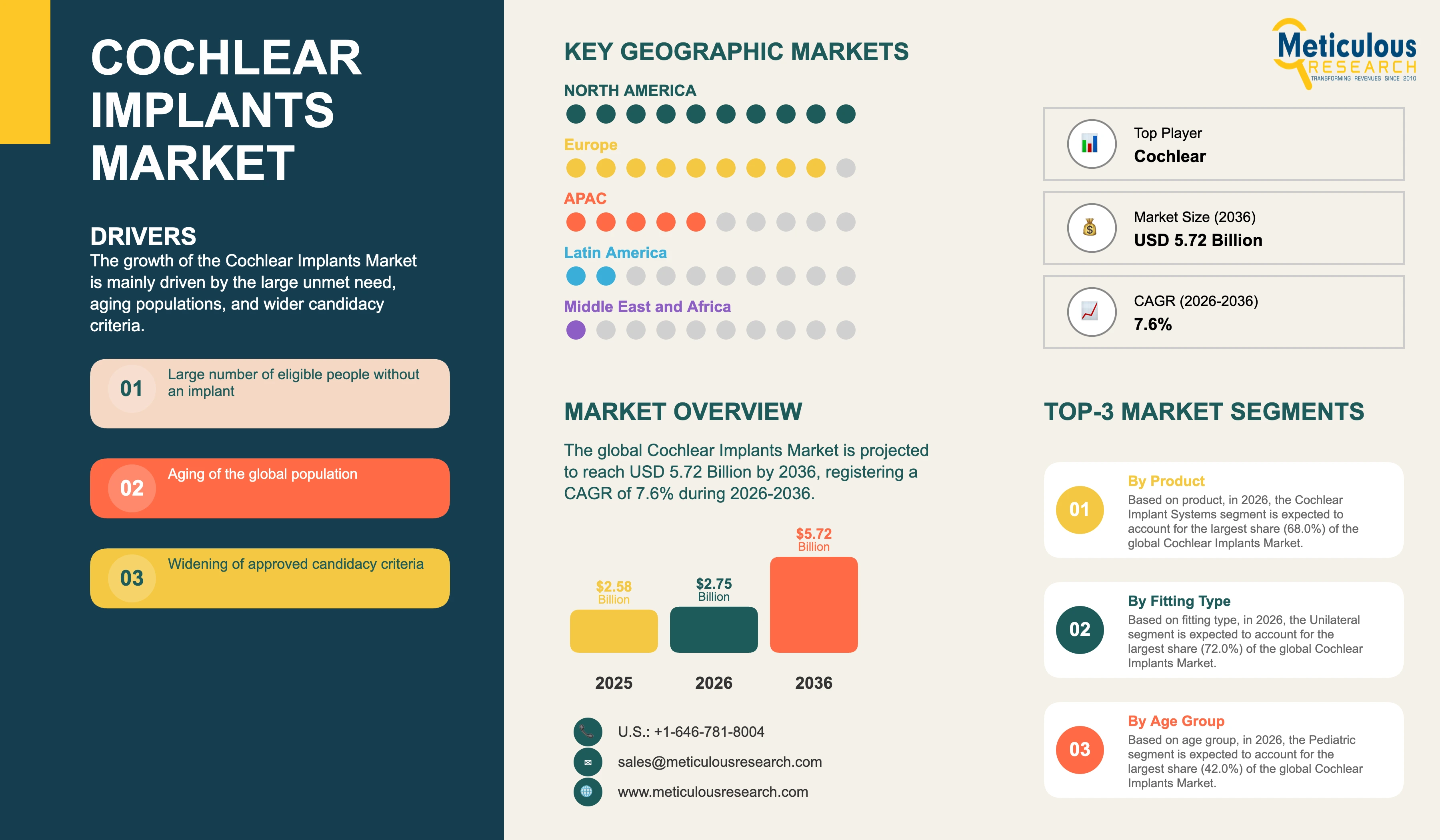
The global cochlear implants market was valued at USD 2.58 billion in 2025. This market is expected to reach USD 5.72 billion by 2036 from an estimated USD 2.75 billion in 2026, registering a CAGR of 7.6% during the forecast period (2026-2036).
- Published
- Nov 2026
- Pages
- 238
- Format
- PDF + Excel
- Report ID
- MRHC - 1042606
- Base year
- 2025
- 2025 · BASELINE
- $2.58B
- 2036
- $5.72B
- CAGR 2026–2036
- 7.6%
2025 baseline · 2026–2036 forecast at 7.6% CAGR · hover a bar for the value
Key highlights
Cochlear Limited reported sales revenue of AUD 2.34 billion for the year ended June 2026, up 2% in constant currency, with cochlear implant units rising 5% to 56,692, while cochlear implant revenue was flat in constant currency at AUD 1.44 billion due to a higher mix of lower-priced emerging market units, according to Cochlear's FY26 results.
Cochlear's Nucleus Nexa System, launched in June 2025 as the world's first smart cochlear implant system with upgradeable firmware, accounted for more than 95% of Cochlear's implant sales across developed markets by June 2026, and Cochlear increased R&D investment by 15% to support projects including a drug-eluting electrode and a totally implantable cochlear implant, according to Cochlear.
MED-EL launched TICI UNICO in September 2026, the world's first commercially available cochlear implant with all components implanted beneath the skin, with CE mark approval and introduction in European markets; the device is not FDA approved, according to MED-EL and MD+DI.
The U.S. FDA approved an expanded indication for MED-EL cochlear implants for children seven months and older with bilateral sensorineural hearing loss in November 2025, making it the first and only FDA-approved cochlear implant for infants this young, according to MED-EL and the FDA.
China's first national centralized procurement of cochlear implants cut prices from more than 200,000 yuan to around 50,000 yuan, with a procurement volume of 11,000 sets awarded to MED-EL, Advanced Bionics, Cochlear, Listent, and Nurotron, and the new prices took effect in March 2025, according to China's National Healthcare Security Administration, Yicai, and China Daily.
Sonova's Cochlear Implants segment sales declined 11.1% in local currencies to CHF 252.1 million in its 2025/26 financial year, due to volume-based procurement in China and a major competitor's product launch, while cochlear implant system sales outside China rose 0.7%, according to Sonova and Hearing Tracker. These developments show strong technology progress alongside pricing pressure in some emerging markets. Hearing aid makers are also expanding links with implant makers through bimodal products. Manufacturers are also investing more in research and development.
By product, Cochlear implant systems account for the largest share of 68.0% in 2026, while sound processor upgrades register the highest CAGR.
By fitting type, unilateral accounts for the larger share in 2026, while bilateral registers the higher CAGR.
By age group, pediatric accounts for the largest share in 2026, while seniors (65 years and above) registers the highest CAGR.
By end user, hospitals account for the largest share of 70.0% in 2026, while ambulatory surgical centers register the highest CAGR.
By geography, North America accounts for the largest share of 37.0% in 2026, while Asia-Pacific registers the highest CAGR of 10.3%.
Report summary
| Particulars | Details |
|---|---|
| Base Year | 2025 |
| Estimated Year | 2026 |
| Forecast Period | 2026-2036 |
| Market Size in 2025 | USD 2.58 billion |
| Market Size in 2026 | USD 2.75 billion |
| Market Size by 2036 | USD 5.72 billion |
| CAGR (2026-2036) | 7.6% |
| Format | PDF, Excel & Cloud Portal · 238 pages |
| Largest Segment by Product (2026) | Cochlear Implant Systems (68.0%) |
| Largest Segment by End User (2026) | Hospitals (70.0%) |
| Largest Region (2026) | North America (37.0%) |
| Fastest-Growing Region | Asia-Pacific (CAGR 10.3%) |
| Companies Profiled | 6 companies and other companies |
| Segments Covered | Product, Fitting Type, Age Group, End User, Geography |
| Countries Covered | U.S., Canada, Germany, U.K., France, Italy, Spain, Netherlands, Switzerland, Belgium, Sweden, Denmark, Norway, Finland, Austria, Poland, Ireland, Rest of Europe, China, Japan, India, South Korea, Australia, Singapore, Indonesia, Thailand, Malaysia, Vietnam, Philippines, Taiwan, New Zealand, Rest of Asia-Pacific, Brazil, Mexico, Argentina, Colombia, Chile, Peru, Rest of Latin America, Saudi Arabia, U.A.E., Israel, South Africa, Turkey, Egypt, Rest of Middle East & Africa |
Report overview
Segments covered: product, fitting type, age group, end user.
The growth of this market is mainly driven by the large number of people with severe to profound hearing loss who could benefit from a cochlear implant but have not received one, the aging of the global population, which increases the number of adults and seniors with hearing loss, the widening of approved candidacy criteria to include younger infants and adults with more residual hearing, new implant and sound processor technology, such as upgradeable implants and fully implanted systems, and growing efforts by manufacturers and clinics to improve referral of adults to implant centers. In addition, the large number of existing implant users creates steady demand for sound processor upgrades. However, the high cost of implants and surgery, limited reimbursement in many countries, low awareness among adults and referring doctors, and price cuts from government procurement programs, such as volume-based procurement in China, are expected to restrain the growth of this market to some extent.
A cochlear implant is a medical device that restores a sense of sound to people with severe to profound sensorineural hearing loss who receive little or no benefit from hearing aids. Unlike a hearing aid, which makes sounds louder, a cochlear implant bypasses the damaged hair cells of the inner ear and directly stimulates the hearing nerve with electrical signals. The system has two main parts: an implant, which is placed under the skin behind the ear during surgery and includes an electrode array inserted into the cochlea, and an external sound processor, which is worn on the ear or head and converts sound into signals sent to the implant. After surgery, users need programming and hearing rehabilitation to learn to understand speech with the implant.
This report covers the global cochlear implants market, including cochlear implant systems, which consist of the implant and the first sound processor sold at the time of surgery, sound processor upgrades purchased by existing users to replace older processors, and accessories and services, such as batteries, chargers, cables, wireless accessories, and repairs. The market is analyzed by product, fitting type, age group, end user, and geography. Market size is measured on a revenue basis at manufacturer selling prices. Surgery, hospital, and rehabilitation fees, bone conduction and middle ear implants, and auditory brainstem implants are not included.
The need for cochlear implants is very large compared with current use. The WHO estimates that more than 1.5 billion people live with some degree of hearing loss, that 430 million people have disabling hearing loss, and that by 2050 more than 700 million people will have disabling hearing loss. The WHO also estimates that unaddressed hearing loss costs the world almost USD 1 trillion each year. A 2026 study published in Audiology Research found that, despite awareness activities in recent years, the percentage of profoundly deaf people with cochlear implants remains low, even in high-income countries. Most implant recipients in many countries are children, while adults, especially older adults, remain greatly underserved.
The cochlear implants market is highly concentrated, with three global manufacturers supplying most implants. Cochlear Limited is the largest manufacturer, followed by MED-EL and Advanced Bionics, which is owned by Sonova. Chinese manufacturers, such as Nurotron and Listent, have grown in their home market, especially after China's national procurement program. Cochlear reported that its cochlear implant units rose 5% in its 2026 financial year, while revenue was flat because of a higher share of lower-priced units in emerging markets, particularly China.
Implant and sound processor technology continues to advance, with several major launches since 2025. Cochlear launched the Nucleus Nexa System in June 2025, the world's first smart cochlear implant system with upgradeable firmware, which allows the implant to receive new features over time, and it quickly became the main implant Cochlear sells in developed markets. MED-EL launched TICI UNICO in September 2026, the first commercially available totally invisible cochlear implant, with all parts placed beneath the skin, for European markets. Sound processors now offer direct streaming from phones and other devices, rechargeable batteries, and smaller designs, and manufacturers are developing drug-eluting electrodes and fully implanted systems.
Approved candidacy criteria for cochlear implants have widened over time in many countries. In the U.S., the FDA approved MED-EL cochlear implants for children as young as seven months in November 2025, and earlier approved expanded criteria for adults with moderate-to-profound hearing loss and for single-sided deafness. Wider criteria increase the number of people eligible for an implant, but awareness and referral remain major barriers. Cochlear has said that most people who receive an implant find their own way to an implant clinic, and it is working with hearing care professionals and ENT doctors to improve referral pathways.
In 2026, cochlear implant systems account for the largest share of the market by product, while sound processor upgrades are the fastest-growing product. Unilateral fittings account for the larger share by fitting type, while bilateral fittings grow faster. Pediatric patients account for the largest share by age group, while seniors aged 65 years and above are the fastest-growing age group. Hospitals are the largest end user, while ambulatory surgical centers are the fastest-growing end user. North America accounts for the largest share of the market, while Asia-Pacific is the fastest-growing region.
Over the forecast period, the cochlear implants market is expected to grow steadily as more adults and seniors are referred for implants, as candidacy criteria continue to widen, as new technologies reach the market, and as access improves in emerging markets. Growth in value will be affected by lower prices in China and other emerging markets, while unit growth is expected to be stronger than revenue growth in these regions.
Hospitals are expected to account for the largest share of 70.0% of the market in 2026, while ambulatory surgical centers are projected to register the highest CAGR as more adult implant surgeries move to outpatient settings.
North America is expected to account for the largest share of 37.0% of the market in 2026, mainly due to high implant prices, broad reimbursement, wide FDA-approved candidacy criteria, and strong referral programs.
Asia-Pacific is projected to register the highest CAGR of 10.3% during the forecast period, driven by the large population with hearing loss, China's national procurement program, domestic manufacturers, and aging populations.
The report profiles 6 companies: Cochlear Limited, MED-EL, Sonova (Advanced Bionics), Nurotron, Listent, and Envoy Medical. The market is highly concentrated, with three global manufacturers accounting for most sales.
Many adults with severe hearing loss and many of the doctors who treat them are not aware of implants or of current candidacy criteria. As a result, most eligible adults are never referred to an implant center, even in countries where implants are funded.
Report infographic
Market dynamics
18 factors across 5 forcesLarge number of eligible people without an implant
The number of people who could benefit from a cochlear implant is many times larger than the number who have received one. The WHO estimates that 430 million people worldwide have disabling hearing loss, and many of those with severe to profound loss in both ears are potential implant candidates. A 2026 study in Audiology Research found that the share of profoundly deaf people with implants remains low, even in high-income countries. Cochlear has also stated that adult penetration remains low.
This large gap between need and use is the main long-term driver of the market. Even small improvements in the share of eligible adults who receive an implant would add significant numbers of procedures. Manufacturers, hospitals, and patient groups are working to close the gap through awareness campaigns, screening programs, and better referral pathways, which is expected to support steady growth in implant volumes over the forecast period.
Aging of the global population
Hearing loss becomes much more common with age, which makes aging a key factor for this market. The WHO reports that over 25% of people older than 60 years are affected by disabling hearing loss. As populations age in North America, Europe, Japan, China, and other countries, the number of older adults with severe to profound hearing loss is rising. Research has also linked untreated hearing loss with a higher risk of dementia and faster cognitive decline, which is increasing interest in hearing treatment among older adults and their doctors.
Older adults are increasingly seen as good candidates for cochlear implants, as studies have shown that they can achieve good speech understanding and quality-of-life benefits. Seniors aged 65 years and above are the fastest-growing age group in this market. Manufacturers are focusing on referral programs for older adults, such as Cochlear's work with hearing care professionals in the U.K. and the U.S.
Widening of approved candidacy criteria
Regulators and clinical guidelines have widened the criteria for who can receive a cochlear implant. In the U.S., the FDA approved MED-EL cochlear implants for children as young as seven months in November 2025, based on a study of 123 children that showed clinical success rates of 81% to 88%. The FDA has also approved expanded indications for adults with moderate-to-profound hearing loss and for single-sided deafness and asymmetric hearing loss. In many countries, clinical guidelines now recommend implants for adults with more residual hearing than in the past.
Wider criteria increase the number of people eligible for implants and allow earlier treatment, which improves outcomes, especially for children who need sound during the key years for speech and language development. As more clinics apply the updated criteria and as more countries update their guidelines, implant volumes are expected to rise.
New implant and sound processor technology
Manufacturers continue to introduce new technology that improves hearing outcomes, comfort, and convenience. Cochlear's Nucleus Nexa System includes upgradeable firmware that allows the implant to receive new features over time, and it accounted for more than 95% of Cochlear's implant sales in developed markets by June 2026. MED-EL launched TICI UNICO, a totally invisible implant with no external parts, in Europe in September 2026, and introduced OTOGUIDE in May 2026 to provide real-time insight during electrode insertion. Sound processors now offer direct streaming from smartphones, rechargeable batteries, and smaller designs.
New technology encourages more people to choose an implant and encourages existing users to upgrade their sound processors. It also supports price increases, as Cochlear achieved an average price increase of about 3% with the Nexa System, according to its FY26 results call. Manufacturers are investing heavily in research and development, with Cochlear increasing R&D spending by 15% in its 2026 financial year to support a drug-eluting electrode and a totally implantable cochlear implant.
Efforts to improve referral of adults to implant centers
Many adults who could benefit from an implant are never referred to an implant center, because audiologists, general practitioners, and ENT doctors may not be familiar with current candidacy criteria. Manufacturers and clinics are working to improve referral pathways. Cochlear reported that direct engagement with referring audiologists in the U.K. has doubled high-quality referrals to cochlear implant clinics over four years, and that its direct-to-consumer channel in the U.S. grew 10% in its 2026 financial year. Private surgeries in Australia grew 15% in the same period, according to Cochlear. Better referral is expected to increase adult implant volumes significantly over the forecast period, particularly in developed markets with good reimbursement.
Table of contents
12 chapters · 173 sections · 238 pages · click to expandSegmental analysis
| Segment | Largest share (2026) | Fastest growth (2026–2036) |
|---|---|---|
| By Product | Cochlear implant systems | Sound processor upgrades |
| By Fitting Type | — | Rapid growth of this |
| By Age Group | Pediatric | Seniors (65 years and above) |
| By End User | Hospitals | Ambulatory surgical centers |
| Other segments | Pediatric | Seniors (65 years and above) |
By Product
- Cochlear Implants Market Analysis by Product
- The cochlear implant systems segment is expected to account for the largest share of 68.0% of the global cochlear implants market.
- The large share of this segment is mainly due to the high value of a complete implant system, which includes the implant and the first sound processor, the growing number of implant procedures worldwide, the launch of new implant systems, such as Cochlear's Nucleus Nexa System and MED-EL's TICI UNICO, and the widening of candidacy criteria for infants and adults.
- Cochlear's cochlear implant revenue, which is its largest revenue line, shows the size of this segment.
- However, the sound processor upgrades segment is projected to register the highest CAGR during the forecast period.
- The rapid growth of this segment is driven by the large and growing number of existing implant users worldwide, the need to replace sound processors every few years, the launch of new processors with direct streaming, rechargeable batteries, and smaller designs, and the growing number of users in markets with reimbursement for upgrades.
- The accessories and services segment includes batteries, chargers, cables, remote controls, wireless accessories, and repair services, which provide recurring revenue for manufacturers.
- Services, which include replacement sound processors and accessories, are a large and stable part of revenue for the leading manufacturers, including Cochlear.
By Fitting Type
- Cochlear Implants Market Analysis by Fitting Type
- The unilateral segment is expected to account for the larger share of the global cochlear implants market.
- The large share of this segment is mainly due to the fact that most adults receive an implant in one ear, reimbursement rules in many countries that fund only one implant for adults, the higher cost of bilateral implantation, and the use of a hearing aid in the other ear by many users, which is supported by bimodal solutions, such as MED-EL and Starkey's DualSync.
- Single-sided deafness indications also involve implantation in one ear.
- However, the bilateral segment is projected to register the higher CAGR during the forecast period.
- The rapid growth of this segment is driven by evidence that implants in both ears improve speech understanding in noise and the ability to locate sounds, the routine use of bilateral implants for children in many developed countries, the growing number of adults who receive a second implant, and improving reimbursement for bilateral implants in some countries.
- Clinical evidence and reimbursement are the main factors that decide whether patients receive one or two implants.
- In many developed countries, children with severe to profound loss in both ears receive two implants, either in one surgery or in two separate surgeries, while adults more often receive one implant and continue to use a hearing aid in the other ear.
- Wider coverage for second implants in adults would increase demand significantly.
- Single-sided deafness indications are also adding to unilateral demand in the U.S. and Europe.
- Coverage rules for second implants in adults differ widely between countries and insurers.
- The unilateral segment is expected to account for the larger share of the cochlear implants market, while the bilateral segment is projected to register the higher CAGR during the forecast period.
By Age Group
- Cochlear Implants Market Analysis by Age Group
- The pediatric segment is expected to account for the largest share of the global cochlear implants market.
- The large share of this segment is mainly due to newborn hearing screening programs in many countries, which identify children with hearing loss early, the strong clinical evidence that early implantation supports speech and language development, high implantation rates among eligible children in developed countries, and the widening of approved criteria to include younger infants, such as the FDA's approval of MED-EL implants for children from seven months.
- Many children also receive implants in both ears.
- However, the seniors (65 years and above) segment is projected to register the highest CAGR during the forecast period.
- The rapid growth of this segment is driven by the aging of the global population, the high rate of hearing loss among older adults, growing evidence of the benefits of implants for older adults, including possible links to cognitive health, and the efforts of manufacturers and clinics to improve referral of older adults to implant centers.
- The adults (18-64 years) segment includes working-age adults with acquired or progressive hearing loss, many of whom are underserved due to low awareness and referral.
- The age mix of new implant recipients also differs widely between developed and emerging markets.
- In developed markets, most eligible children are already implanted, so growth comes mainly from adults and seniors, while in China, India, and other emerging markets, children still account for most new implants and pediatric volumes are growing quickly as access improves.
By End User
- Cochlear Implants Market Analysis by End User
- The hospitals segment is expected to account for the largest share of 70.0% of the global cochlear implants market.
- The large share of this segment is mainly due to the fact that most cochlear implant surgeries are performed in hospitals, especially for children and older adults who may need hospital-based care, the location of most implant programs and specialist teams in large hospitals and academic medical centers, and the role of public hospitals in performing funded implants in many countries, including China, where government procurement supplies public hospitals.
- However, the ambulatory surgical centers segment is projected to register the highest CAGR during the forecast period.
- The rapid growth of this segment is driven by the move of suitable surgeries to outpatient settings to lower costs, the growing number of adult implant surgeries that can be done as day procedures, and the growth of private surgery in countries such as Australia, as reported by Cochlear.
- The ENT and audiology clinics segment includes specialist ear, nose, and throat practices and hearing clinics that assess candidates, refer patients, perform surgeries in some cases, and provide programming, follow-up, and upgrade services.
Other segments
- The pediatric segment is expected to account for the largest share of the cochlear implants market, while the seniors (65 years and above) segment is projected to register the highest CAGR during the forecast period.
Geographic analysis
North America
Largest shareIn 2026, North America is expected to account for the largest share of 37.0% of the global cochlear implants market. The large share of this region is mainly due to the high prices of implants in the U.S., broad reimbursement through Medicare and private insurance, wide candidacy criteria approved by the FDA, including approval for infants from seven months, the large number of implant centers, and strong efforts by manufacturers to improve adult referral, such as Cochlear's direct-to-consumer channel, which grew 10% in its 2026 financial year. The U.S. also has a large aging population with significant unmet need for hearing treatment. The FDA approvals of expanded indications, including for single-sided deafness and asymmetric hearing loss, have also widened the group of people who can benefit in the U.S. Canada has public coverage for implants in most provinces, although waiting lists remain a concern.
Asia-Pacific
Fastest growthAsia-Pacific is projected to register the highest CAGR of 10.3% during the forecast period. The rapid growth of this region is mainly driven by the large population with hearing loss in China, India, and Southeast Asia, the national procurement program in China, which has lowered implant prices by about 75% and is expected to increase access, the growth of domestic manufacturers, such as Nurotron and Listent, rising healthcare spending and insurance coverage in many countries, and aging populations in Japan, South Korea, and China. More than 100,000 people have received cochlear implants in China since the first operation in 1995, according to Xinhua, which leaves large room for growth. Unit growth in the region is expected to be faster than revenue growth because of lower prices, especially in China. China's first national procurement program cut cochlear implant prices by about 75%, from more than 200,000 yuan to around 50,000 yuan, starting in March 2025. This has increased access and implant volumes in China but reduced revenue for manufacturers, as reported by Cochlear and Sonova.
Europe
Europe accounts for a significant share of the market, supported by public reimbursement for implants in most countries, strong implant programs in Germany, the U.K., France, Italy, Spain, and the Nordic countries, the presence of MED-EL in Austria and Advanced Bionics' parent Sonova in Switzerland, and early access to new technologies, such as MED-EL's TICI UNICO, which was launched in European markets with CE mark approval in September 2026. European countries also have newborn screening programs that support high pediatric implant rates. Germany is one of the largest markets in the region, with well-established implant programs for both children and adults and broad public reimbursement.
Latin America
Latin America and the Middle East & Africa account for smaller shares of the market but offer growth opportunities. Cochlear reported growth in Latin America and Eastern Europe in its 2026 financial year, according to its results presentation, while conflict in the Middle East disrupted sound processor orders in that region. Brazil, Mexico, Saudi Arabia, and the U.A.E. have government programs that fund implants, and expanding healthcare systems in these regions are expected to increase access over the forecast period. Lower-priced products and local training for surgeons and audiologists will be important for growth in these regions, where many patients still pay for implants themselves.
Competitive landscape
The global cochlear implants market is highly consolidated, with the top three players estimated to account for more than 85% of the market in 2025. The market includes a small number of global manufacturers and a few regional manufacturers, mainly in China.
Cochlear Limited, based in Australia, is the market leader, with cochlear implant revenue of AUD 1.44 billion and 56,692 implant units in its 2026 financial year, supported by its Nucleus Nexa System. MED-EL, a privately owned company based in Austria, is the second-largest manufacturer and has received several FDA approvals for expanded indications, including for infants from seven months, and launched the TICI UNICO totally invisible implant in Europe. Advanced Bionics, owned by Sonova, is the third major global manufacturer, with Cochlear Implants segment sales of CHF 252.1 million in Sonova's 2025/26 financial year. In China, Nurotron and Listent have grown with the national procurement program, and in the U.S., Envoy Medical is developing a fully implanted cochlear implant, called Acclaim, which is in clinical trials.
Companies in this market compete on hearing outcomes, long-term implant reliability, upgradeability, sound processor features, design and comfort, MRI compatibility, candidacy indications, clinical support, price, and access to reimbursement. Key strategies include launching new implants and sound processors, building clinical evidence for new indications and age groups, seeking expanded regulatory approvals, investing in referral programs and direct-to-consumer marketing, partnering with hearing aid makers, and developing lower-priced products for emerging markets.
Recent competitive activity in the cochlear implants market has focused on new product launches and regulatory approvals. Cochlear's Nexa System became its main implant in developed markets, MED-EL launched TICI UNICO and OTOGUIDE in 2026 and received FDA approval for infants from seven months, and Sonova reported lower cochlear implant sales due to China's procurement program and a competitor's product launch.
We expect competition to remain intense among the three global manufacturers, with technology launches, such as upgradeable and fully implanted systems, as key competitive factors. Chinese manufacturers are expected to gain share in China and expand into other emerging markets. Because the market has few manufacturers and high barriers to entry, including clinical evidence, regulatory approvals, and long-term reliability data, new entrants are expected to be limited.
Some of the key players operating in the cochlear implants market are Cochlear Limited, MED-EL Medical Electronics, Sonova Holding AG (Advanced Bionics), Zhejiang Nurotron Biotechnology Co., Ltd., Shanghai Listent Medical Tech Co., Ltd., and Envoy Medical, Inc., among others.
- —
MED-EL launched the TICI UNICO totally invisible cochlear implant in Europe in September 2026, Cochlear's Nexa System accounted for more than 95% of its implant sales in developed markets by June 2026, and the FDA approved MED-EL implants for children from seven months.
- Cochlear Limited
- MED-EL Medical Electronics
- Sonova Holding AG · Advanced Bionics
- Zhejiang Nurotron Biotechnology Co., Ltd.
- Shanghai Listent Medical Tech Co., Ltd.
- Envoy Medical, Inc.
Expert perspectives
The cochlear implants market is supported by a very large unmet need, as only a small share of people with severe to profound hearing loss have received an implant, especially among adults. New technology, wider candidacy criteria, and better referral programs are expected to increase implant volumes, while government procurement in China and lower prices in emerging markets are reducing revenue per unit.
Over the forecast period, the market is expected to grow at a steady CAGR of 7.6%, from USD 2.75 billion in 2026 to USD 5.72 billion in 2036. Growth will be driven mainly by the rising number of adult and senior implant recipients in developed markets, wider candidacy criteria, new implants and sound processors, steady demand for processor upgrades, and expanding access in emerging markets.
Among the market segments, cochlear implant systems are the largest product, while sound processor upgrades grow fastest. Unilateral fittings account for the larger share, while bilateral fittings grow faster. Pediatric patients are the largest age group, while seniors grow fastest, and hospitals are the largest end user, while ambulatory surgical centers grow fastest. North America is the largest region, and Asia-Pacific is the fastest-growing region at a CAGR of 10.3%.
In our view, the single most important factor for the cochlear implants market over the forecast period will be the ability of manufacturers, clinics, and health systems to improve adult referral. The technology works well and candidacy criteria have widened, but most eligible adults are still not referred. Programs that train audiologists and doctors, reach adults directly, and simplify the path to assessment have shown strong results and are expected to drive growth in developed markets. Cochlear's experience in the U.K., where direct engagement doubled high-quality referrals, shows what can be achieved.
We also see pricing in emerging markets as a key factor for manufacturers' revenue and profits over the forecast period. China's national procurement program has shown that large price cuts can increase volumes but reduce revenue, and manufacturers will need suitable products and cost structures to grow profitably in these markets. Fully implanted and upgradeable implants are expected to support premium pricing in developed markets. Companies that can serve both premium and value segments will be best placed to balance growth and profits.
Overall, we believe the cochlear implants market will grow steadily over the forecast period, with sound processor upgrades, bilateral fittings, seniors, ambulatory surgical centers, and Asia-Pacific providing the fastest growth. Companies with strong technology, broad indications, effective referral programs, and products for different price levels will be best positioned to capture this growth.
Customer perspectives
Director of Cochlear Implant Program - Academic Hospital, U.S.
Most of our adult patients came to us on their own after years of struggling with hearing aids. When referral works well, our adult numbers grow quickly.
“Our implant users replace their processors every few years, and the new models with streaming and rechargeable batteries are very popular.”
“Since prices came down under the national program, many more families can afford an implant for their child. Our waiting list has grown a lot.”
Frequently asked questions
The global cochlear implants market was valued at USD 2.58 billion in 2025, up from USD 2.42 billion in 2024, and is estimated at USD 2.75 billion in 2026. The market includes cochlear implant systems, sound processor upgrades, and accessories and services.
Cite this report
Meticulous Research. (2026). Cochlear Implants Market - Global Opportunity Analysis and Industry Forecast (2026-2036) (Report No. MRHC - 1042606). Meticulous Market Research Pvt. Ltd. https://www.meticulousresearch.com/product/cochlear-implants-market-7289