Recyclable Thermoset Resins Market (2026-2036)
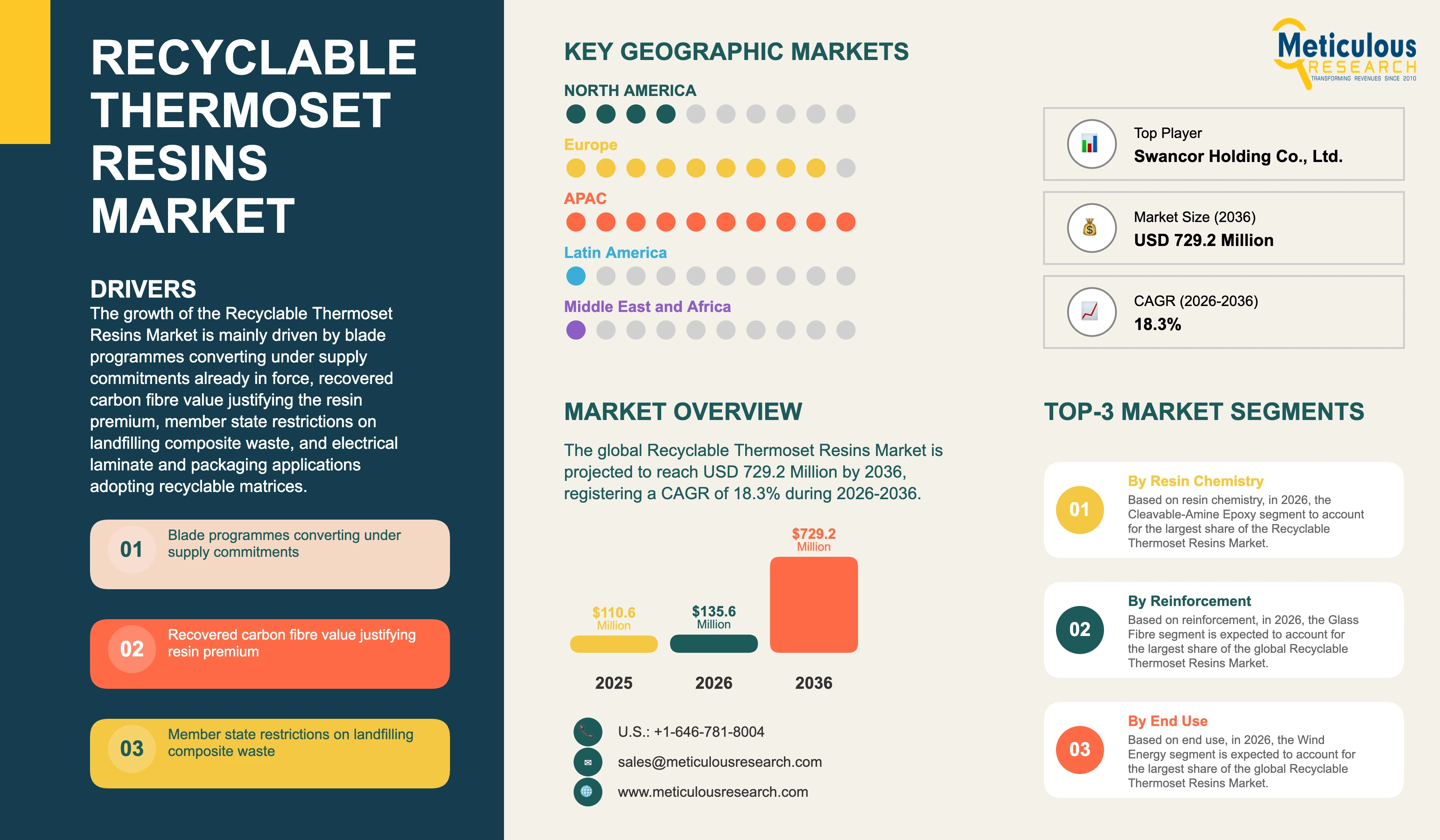
The recyclable thermoset resins market is valued at USD 135.6 million in 2026 and is projected to reach USD 729.2 million by 2036, at a CAGR of 18.3% during the forecast period. The market was valued at USD 110.6 million in 2025 and at USD 91.5 million in 2024.
- Published
- Nov 2026
- Pages
- 256
- Format
- PDF + Excel
- Report ID
- MRCHM - 1042751
- Base year
- 2025
- 2024 · HISTORICAL
- $91.5M
- 2036
- $729.2M
- CAGR 2026–2036
- 18.3%
2024–2025 baseline · 2026–2036 forecast at 18.3% CAGR · hover a bar for the value
Key highlights
This market measures thermoset resins and curing agents formulated so that the cured network can be chemically cleaved or reprocessed, taken as resin plus hardener sold at the supplier gate on a tonne of resin system basis.
Conventional epoxy, polyester, vinyl ester and polyurethane thermosets with no cleavable or reprocessable design are excluded, as are liquid thermoplastic acrylic resins used as a thermoset substitute, recovered fibre output, and separately sold depolymerisation agents.
Regulation (EU) 2026/1738 on circularity requirements for vehicle design and on management of end-of-life vehicles was adopted on 8 July 2026, repealing Directives 2000/53/EC and 2005/64/EC.
Article 6 requires new vehicle types type-approved from 1 September 2032 to contain a minimum of 15% of plastic recycled by weight from post-consumer plastic waste, rising to 25% from 1 September 2036.
At least 20% of each of those shares must come from plastics recycled from end-of-life vehicles or from parts removed during the use phase.
Article 6 does not count elastomers from tyres or thermosets other than polyurethane cushioning foams toward the minimum recycled plastic content, which places structural composites outside the principal automotive circularity requirement.
The Commission must adopt the calculation and verification methodology by 31 August 2028, and a delegated act setting a minimum share of recycled steel is due by 30 September 2028 and applies no later than 14 August 2033.
Recital 82 of the regulation states that it is necessary to lay down a specific recycling target of 30% of plastics from end-of-life vehicles, with a transitional period of three years during which the earlier targets of 85% reuse and recycling and 95% reuse and recovery continue to apply.
Article 7 requires vehicle types type-approved from 1 September 2032 to be designed so as not to hinder the removal by authorised treatment facilities of the parts listed in Part C of Annex VIII for replacement, reuse, recycling, remanufacturing or refurbishing.
Article 9 requires each manufacturer to draw up a circularity strategy at manufacturer level from 1 September 2029, submitted to type-approval authorities and the Commission within 30 days of drafting and updated every five years.
The regulation applies to M1 and N1 vehicles, to special purpose vehicles of those categories from 1 September 2029, and to M2, M3, N2, N3, O and L-category vehicles from 1 September 2031.
Siemens Gamesa launched the first recyclable wind turbine blade for commercial use offshore on 7 September 2021, stating that the chemical structure of the new resin type makes it possible to efficiently separate the resin from the other blade components.
The first six RecyclableBlades were 81 metres long and were installed at the Kaskasi offshore wind power plant in Germany with RWE.
The onshore version followed on 22 September 2022, with recovery using a mild acidic solution to separate the materials at the end of turbine life for reuse in construction, consumer goods or automotive applications.
Swancor signed a letter of intent with Siemens Gamesa formalising their recyclable blade collaboration, under which all resin supplied from Swancor to Siemens from 2026 will be recyclable.
Swancor launched EzCiclo recyclable epoxy resin and the CleaVER degradation technology on 14 November 2021, the process requiring no crushing of fibre-reinforced plastic before decomposition, no change to blade production equipment, and producing no waste solvent or gas.
EzCiclo has been used in commercial wind turbine blades of 100 metres and above, in carbon fibre bicycles and in shoe materials, with dry-type transformers, copper clad laminates and epoxy moulding compound packaging materials in testing.
The Recyclamine curing agent platform of Aditya Birla Chemicals uses amine hardeners containing specifically engineered cleavage points at cross-linking sites, which under pre-defined conditions convert cured epoxy thermosets into thermoplastics and release reinforcing fibre in near virgin form.
Report summary
| Particulars | Details |
|---|---|
| Base Year | 2025 |
| Actual Years | 2024-2025 |
| Forecast Period | 2026-2036 |
| Market Size in 2024 | USD 91.5 million |
| Market Size in 2025 | USD 110.6 million |
| Market Size in 2026 | USD 135.6 million |
| Market Size in 2036 | USD 729.2 million |
| Value CAGR (2026-2036) | 18.3% |
| Format | PDF, Excel & Cloud Portal · 256 pages |
| Volume in 2025 | 19.20 kilotons |
| Volume in 2026 | 24.00 kilotons |
| Volume in 2036 | 118.00 kilotons |
| Volume CAGR (2026-2036) | 17.3% |
| Average Selling Price, 2026 | USD 5,650 per tonne |
| Average Selling Price, 2036 | USD 6,180 per tonne |
| Units | Value in USD million; volume in kilotons of resin system; price in USD per tonne |
| Measurement Basis | Thermoset resins and curing agents formulated so that the cured network can be chemically cleaved or reprocessed, measured as resin plus hardener sold at the supplier gate on a tonne of resin system basis |
| Historical Price Movement | Volume grew at 24.4% a year between 2024 and 2026 against value growth of 21.8%, because the average selling price fell from USD 5,900 to USD 5,650 per tonne as supply widened and the first blade programmes moved from demonstration to series production; the forecast assumes price rises at 0.9% a year on mix rather than recovering the lost premium |
| Automotive Exclusion Note | Article 6 of Regulation (EU) 2026/1738 does not count elastomers from tyres or thermosets other than polyurethane cushioning foams toward the minimum recycled plastic content for new vehicles, so a recyclable structural composite earns no credit under that requirement; the obligations that do reach composites are the Article 7 design-for-removal duty from 1 September 2032 and the Article 9 circularity strategy from 1 September 2029 |
| Wind Landfill Note | The Europe-wide ban on blade landfilling called for by turbine manufacturers and the industry association is a sector commitment rather than enacted law; national rules prohibiting the landfilling of untreated waste above an organic carbon threshold achieve a similar result in some member states but bind the waste holder rather than the designer |
| Overlap Note | Recyclable epoxy infusion systems counted here are also counted in the Epoxy Infusion Resins Market title, and bio-based epoxy grades cured with a cleavable hardener in the Bio Based Epoxy Resins Market title, so those titles are non-additive with this one on the overlapping grades |
| Exclusions | Conventional epoxy, polyester, vinyl ester and polyurethane thermosets with no cleavable or reprocessable design; liquid thermoplastic acrylic resins used as a thermoset substitute, which are thermoplastics; recovered glass and carbon fibre output, which is measured separately; depolymerisation and cleavage agents sold separately from the resin system; mechanical grinding, pyrolysis and solvolysis services; polyurethane foam chemical recycling; composite part fabrication |
| Segments: Resin Chemistry | Cleavable-Amine Epoxy; Vitrimer and Covalent Adaptable Network; Recyclable Unsaturated Polyester and Vinyl Ester; Other Chemistries |
| Segments: Reinforcement | Glass Fibre; Carbon Fibre; Natural and Hybrid Fibre; Unreinforced |
| Segments: Process | Infusion and VARTM; Prepreg; Pultrusion; Filament Winding; Other Processes |
| Segments: End Use | Wind Energy; Automotive and Transportation; Aerospace and Defence; Sports and Leisure; Electrical and Electronics; Other Applications |
| Largest Segment by Resin Chemistry, 2026 | Cleavable-Amine Epoxy, at 68.0% |
| Fastest-Growing Segment by Resin Chemistry | Vitrimer and Covalent Adaptable Network, at 23.5% |
| Largest Segment by Reinforcement, 2026 | Glass Fibre, at 62.0% |
| Fastest-Growing Segment by Reinforcement | Carbon Fibre, at 21.0% |
| Largest Segment by Process, 2026 | Infusion and VARTM, at 55.0% |
| Fastest-Growing Segment by Process | Prepreg, at 20.2% |
| Largest Segment by End Use, 2026 | Wind Energy, at 51.0% |
| Fastest-Growing Segment by End Use | Electrical and Electronics, at 21.0% |
| Largest Region, 2026 | Asia-Pacific, at 42.0% |
| Fastest-Growing Region | Europe, at 19.9% |
| Fastest-Growing Country | Germany, at 21.6% |
| Slowest-Growing Country | Canada, at 14.6% |
| Regions Covered | Asia-Pacific; Europe; North America; Latin America; Middle East & Africa |
| Countries Covered | China; Taiwan; India; Japan; Germany; Denmark; Spain; U.K.; U.S.; Canada; Mexico; Brazil |
| Key Players | Swancor Holding Co., Ltd.; Grasim Industries Limited; Westlake Corporation; Huntsman Corporation; Olin Corporation; Mitsubishi Chemical Group Corporation; Toray Industries, Inc.; Evonik Industries AG; Adesso Advanced Materials Inc.; Mallinda, Inc. |
| Top Five Share, 2026 | 62.4% |
| Profiled Companies Share, 2026 | 74.1% |
| Currency | USD |
Report overview
Market value is measured in in USD million; volume in kilotons of resin system; price in USD per tonne. Segments covered: resin chemistry, reinforcement, process, end use.
In volume terms, the market is estimated at 24.00 kilotons of resin system in 2026, rising to 118.00 kilotons by 2036, at a CAGR of 17.3%. The average selling price is estimated at USD 5,650 per tonne in 2026 and USD 6,180 per tonne in 2036, with the early premium having eroded between 2024 and 2026 as supply widened and the forecast increase reflecting a shift in mix toward prepreg and vitrimer grades.
The growth of this market is mainly driven by wind turbine blade programmes converting to recyclable resin under supply commitments already in force, the value of recovered carbon fibre making cleavable chemistry pay back fastest in high-performance composites, member state landfill restrictions on composite waste, and electrical laminate and packaging applications where recyclability is becoming a design requirement. However, factors such as the exclusion of thermosets other than polyurethane cushioning foams from the European recycled plastic content requirement for vehicles, a blade landfill restriction that rests on a voluntary industry commitment rather than law, certification and qualification cycles for structural composites, and a price premium over conventional epoxy systems are expected to restrain the growth of this market to some extent.
Among resin chemistries, cleavable-amine epoxy systems are expected to hold the largest share of this market in 2026, while vitrimer and covalent adaptable network chemistries are expected to record the highest CAGR during the forecast period. Geographically, Asia-Pacific is expected to account for the largest share of this market in 2026, while Europe is expected to register the highest CAGR during the forecast period.
A thermoset is defined by the property this market is built to remove. Curing creates covalent cross-links that give epoxy and polyester composites their stiffness, creep resistance and solvent tolerance, and the same cross-links mean the cured part cannot be melted, dissolved or reformed. A wind turbine blade, an aircraft panel and a pressure vessel are therefore structurally excellent and terminal: at end of life the only conventional routes are landfill, cement co-processing or mechanical grinding into filler, and each destroys the reinforcement that carries most of the value.
Recyclable thermoset chemistry changes the network rather than the process. A cleavable-amine epoxy uses a hardener carrying engineered cleavage points at the cross-linking sites, so that under defined conditions the cured thermoset converts into a thermoplastic that can be dissolved away, releasing the fibre. A vitrimer instead builds dynamic covalent bonds that exchange above a threshold temperature, so the network can be reshaped and reprocessed without depolymerising. The first route recovers the fibre; the second reuses the part.
The commercial case rests on what is recovered rather than on waste avoidance. Glass fibre is inexpensive, so a cleavable glass-reinforced laminate is worth recycling mainly to avoid a disposal cost and to satisfy a customer commitment. Carbon fibre is an order of magnitude more valuable, so releasing it in near virgin form is worth paying a resin premium for. That asymmetry is why carbon fibre is the fastest-growing reinforcement in this market while glass fibre carries the larger share through wind energy volume.
Wind energy is the application that created the market. A single modern blade is tens of tonnes of glass or carbon laminate in one piece, blades are replaced on a known schedule, and the owner is a utility with public commitments. Siemens Gamesa launched the first recyclable blade for commercial offshore use on 7 September 2021, with the first six blades at 81 metres installed at the Kaskasi project in Germany with RWE, and the onshore version followed on 22 September 2022.
The recovery route the OEM describes is a mild acidic solution that separates the materials at end of turbine life, with the recovered material reused in construction, consumer goods or automotive applications and the process described as protecting the properties of the materials in the blade. The company states that the blade allows separation and reuse of up to 95% of its raw materials, and holds a stated goal of fully recyclable wind turbines by 2040.
Supply has consolidated behind that programme. Swancor launched EzCiclo recyclable epoxy and the CleaVER degradation technology on 14 November 2021, and signed a letter of intent with Siemens Gamesa under which all resin supplied from Swancor to Siemens from 2026 will be recyclable. Swancor had delivered resin for more than 600 Integralblades to the OEM, and twenty recyclable blade resin pieces had been manufactured in Denmark, with final product quality testing and certification in progress at the time of the agreement.
The other established platform works from the hardener rather than the resin. The Recyclamine curing agents of Aditya Birla Chemicals carry specifically engineered cleavage points at cross-linking sites, converting the cured thermoset into a thermoplastic under pre-defined conditions and releasing reinforcing fibre in near virgin form with nominally reduced mechanical strength. The business sells the hardeners as building blocks and as formulated Briozen systems covering infusion, wet lay-up, pultrusion, prepreg, resin transfer moulding, compression moulding and filament winding.
A hardener platform is commercially different from a resin platform. It allows a formulator to convert an existing epoxy system to cleavable chemistry without changing the base resin or the process, which lowers the qualification burden on the composite manufacturer. It also means the value in this market sits in the curing agent rather than in the resin, so the market measures the resin system as supplied rather than resin alone.
The regulatory position is where the stated demand driver breaks down. Regulation (EU) 2026/1738, adopted on 8 July 2026, is the principal new circularity instrument touching composites in automotive, and Article 6 requires new vehicle types type-approved from 1 September 2032 to contain a minimum of 15% of plastic recycled from post-consumer waste, rising to 25% from 1 September 2036. Article 6 does not count thermosets other than polyurethane cushioning foams toward that minimum.
A recyclable structural composite therefore earns no credit under the requirement most often cited as the reason automotive will adopt it. What the regulation does create for composites is indirect: the Article 7 obligation from 1 September 2032 that vehicles not hinder the removal of listed parts by authorised treatment facilities, and the Article 9 obligation from 1 September 2029 that each manufacturer draw up and publish a circularity strategy. Both reward design decisions without specifying a material.
Wind is governed by commitment rather than statute. The Europe-wide ban on blade landfilling that OEMs and WindEurope have called for is an industry position rather than enacted law, although several member states already prohibit landfilling untreated waste above an organic carbon threshold, which has the same practical effect for composite waste in those jurisdictions. The binding constraint on a blade owner is therefore national waste law and a corporate target, not a composite-specific rule.
Pricing has behaved like an early-stage specialty rather than a scarce one. Volume grew at 24.4% a year between 2024 and 2026 against value growth of 21.8%, because the average selling price fell from USD 5,900 to USD 5,650 per tonne over the same two years as supply widened and the first blade programmes moved from demonstration to series production. The forecast assumes price rises at 0.9% a year on mix rather than recovering the lost premium.
Process choice follows the application. Infusion and vacuum-assisted resin transfer moulding carry the largest share because that is how blades and large marine and transport structures are built, and because a cleavable system has to match the long pot life and low viscosity an infusion demands. Prepreg is the fastest-growing process, since prepreg is where carbon fibre is concentrated and where the recovered fibre value most clearly justifies the resin premium.
Electrical and electronics is the fastest-growing end use from a small base. Copper clad laminates and epoxy moulding compounds are thermoset-bound, are produced in very large volume, and sit inside waste electrical equipment streams where recovery of the metal is already economic and the organic matrix is the obstacle. Swancor lists dry-type transformers, copper clad laminates and epoxy moulding compound packaging among applications in testing, which is where that growth comes from.
Asia-Pacific holds the largest regional share because that is where the resin and the blades are made. Taiwan holds the EzCiclo and CleaVER platform, India and Thailand hold the Recyclamine and Briozen production and development base, and China holds the largest blade manufacturing capacity in the world. Europe grows fastest on the strength of its regulatory programme and its offshore wind pipeline, with Germany, Denmark and Spain carrying the blade and turbine assembly positions.
The structural question for the next decade is whether recyclable thermoset chemistry stays a specification written by a handful of wind OEMs or becomes a material class. The 2026 resin supply commitment is the first case of a composite manufacturer converting an entire resin stream rather than a demonstration line, which is what a material class requires. Against that, certification of the blades was still in progress when the commitment was signed, and no jurisdiction yet requires a recyclable matrix in any application.
Report infographic
Market dynamics
20 factors across 5 forcesBlade Programmes Converting Under Supply Commitments Already in Force
Swancor signed a letter of intent with Siemens Gamesa formalising their recyclable blade collaboration, under which all resin supplied from Swancor to Siemens from 2026 will be recyclable. That is a conversion of an entire resin stream rather than a demonstration line, and it is the single largest committed volume in this market.
The supply relationship behind it is established. Swancor had delivered resin for more than 600 Integralblades to the OEM, and twenty recyclable blade resin pieces had been manufactured in Denmark. EzCiclo has been used in commercial blades of 100 metres and above.
Siemens Gamesa launched the first recyclable blade for commercial offshore use on 7 September 2021 and the onshore version on 22 September 2022, and holds a stated goal of fully recyclable wind turbines by 2040. Wind energy holds the largest end-use share of this market in 2026 on that basis.
Recovered Carbon Fibre Value Justifying the Resin Premium
Carbon fibre is an order of magnitude more valuable than glass fibre, so releasing it in near virgin form repays a resin premium that a glass laminate cannot. The Recyclamine platform states that recovered fibres are in near virgin form with nominally reduced mechanical strength, which is the commercial claim the premium rests on.
Conventional end-of-life routes destroy the asset. Cement co-processing burns the matrix and the fibre together, and mechanical grinding reduces a structural laminate to filler, so neither returns a reinforcement that can be used in a structural application.
Carbon fibre records the highest reinforcement CAGR in this market at 21.0% over the forecast period, and prepreg the highest process CAGR at 20.2%, because prepreg is where carbon fibre is concentrated and where the recovered value is most clearly attributable.
Member State Restrictions on Landfilling Composite Waste
Several member states prohibit the landfilling of untreated waste above an organic carbon threshold, which for a glass or carbon laminate removes the cheapest disposal route and leaves incineration, cement co-processing or a recovery process as the alternatives.
That constraint applies to the waste holder rather than to the designer, so it reaches a blade owner or a vehicle dismantler rather than a resin supplier. Its effect on this market runs through the disposal cost a composite owner faces at end of life and the value of avoiding it.
Article 7 of Regulation (EU) 2026/1738 reinforces the direction for vehicles from 1 September 2032, requiring that vehicle design not hinder the removal by authorised treatment facilities of the parts listed in Part C of Annex VIII for replacement, reuse, recycling, remanufacturing or refurbishing.
Electrical Laminate and Packaging Applications Adopting Recyclable Matrices
Copper clad laminates and epoxy moulding compounds are thermoset-bound, are produced in very large volume, and sit inside waste electrical and electronic equipment streams where recovery of the metal is already economic and the organic matrix is the obstacle.
Swancor lists dry-type transformers, copper clad laminates and epoxy moulding compound packaging materials among the applications in testing for EzCiclo, alongside the commercial uses in wind blades, carbon fibre bicycles and shoe materials.
Electrical and electronics records the highest end-use CAGR in this market at 21.0% over the forecast period from a small 2026 base, because the volumes in the application are large and the qualification path is shorter than for a structural composite.
Table of contents
12 chapters · 135 sections · 256 pages · click to expandSegmental analysis
| Segment | Largest share (2026) | Fastest growth (2026–2036) |
|---|---|---|
| By Resin Chemistry | Cleavable-amine epoxy systems | Vitrimer and covalent adaptable network chemistries |
| By Reinforcement | Glass fibre | Carbon fibre |
| By Process | Infusion and vacuum-assisted resin transfer moulding | Prepreg |
| By End Use | Wind energy | Electrical and electronics |
By Resin Chemistry
- Recyclable Thermoset Resins Analysis by Resin Chemistry
- Cleavable-amine epoxy systems are expected to hold the largest share of this market in 2026.
- The chemistry uses amine hardeners carrying specifically engineered cleavage points at the cross-linking sites, which under pre-defined conditions convert the cured thermoset into a thermoplastic that can be dissolved away and release the reinforcement.
- It carries the largest share because it is the route in commercial wind blade production, because it works with existing base epoxy resins and processes, and because the hardener can be sold as a building block into an existing formulation.
- The chemistry grows at 17.8%.
- Vitrimer and covalent adaptable network chemistries are expected to record the highest CAGR during the forecast period at 23.5%.
- A vitrimer builds dynamic covalent bonds that exchange above a threshold temperature, so the network can be reshaped, welded and reprocessed without being depolymerised, which changes the proposition from fibre recovery to part reuse and removes the cost of a chemical recovery step.
- The constraint is thermal, since a network able to exchange bonds has a service ceiling a permanently cross-linked system does not.
- Recyclable unsaturated polyester and vinyl ester systems grow at 16.4%.
- These matrices dominate marine, pipe, tank and construction composites, where the resin cost is a larger share of part cost and the reinforcement is almost always glass, so the recovered value is low and the conversion case rests on disposal cost rather than on material recovery.
- Other chemistries including recyclable polyurethane and benzoxazine systems grow at 18.0% from the smallest base.
- Benzoxazine serves high-temperature aerospace and electronics applications where a cleavable route has to survive a service temperature that a cleavable amine epoxy cannot, and recyclable polyurethane composite systems sit adjacent to the foam chemical recycling route that is covered separately.
By Reinforcement
- Recyclable Thermoset Resins Analysis by Reinforcement
- Glass fibre is expected to hold the largest share of this market in 2026, on wind turbine blade volume.
- A single modern blade is tens of tonnes of laminate and glass carries the bulk of it, so the application that created this market is also the one that fixes glass as the dominant reinforcement.
- The recovered value is low, which means the conversion case for a glass laminate rests on avoided disposal cost and on a customer commitment rather than on the material released.
- The segment grows at 17.3%.
- Carbon fibre is expected to record the highest CAGR during the forecast period at 21.0%.
- Carbon is an order of magnitude more valuable than glass, so releasing it in near virgin form repays a resin premium that a glass laminate cannot, and the conventional alternatives destroy the asset since cement co-processing burns the fibre and mechanical grinding reduces a structural laminate to filler.
- Commercial use already extends beyond industrial composites into carbon fibre bicycles.
- Natural and hybrid fibre reinforcement grows at 18.5% from a small base, in interior panels, consumer products and secondary structures where the whole part can be routed to composting or energy recovery once the matrix is cleaved.
- The combination of a cleavable matrix and a non-structural natural reinforcement is attractive where disposal rather than recovery is the objective.
- Unreinforced applications grow slowest at 16.0%, covering electrical potting and encapsulation, adhesives and coatings where a cleavable network allows a component to be separated rather than a fibre to be recovered.
- The volumes are small per unit but the qualification path is short, which is where electrical and electronics growth enters this market.
By Process
- Recyclable Thermoset Resins Analysis by Process
- Infusion and vacuum-assisted resin transfer moulding are expected to hold the largest share of this market in 2026, because that is how wind blades and large marine and transport structures are built and because the wind application dominates volume.
- A cleavable system has to match the low viscosity, long pot life and controlled exotherm that an infusion across tens of tonnes of laminate in one shot demands, which is the technical reason conversion sits with a small number of qualified suppliers.
- The process grows at 17.9%.
- Prepreg is expected to record the highest CAGR during the forecast period at 20.2%.
- Prepreg is where carbon fibre is concentrated and where the recovered fibre value most clearly justifies the resin premium, and the format also allows a cleavable hardener to be introduced under factory control rather than at an infusion line.
- Aerospace, sports and high-performance automotive parts are produced this way.
- Pultrusion grows at 18.6%, serving profiles for construction, infrastructure and blade spar caps in continuous production where the resin system is fixed and the conversion decision is made once for a product line rather than per part.
- Filament winding grows at 17.0%, in pressure vessels, pipes and shafts where the structure is a single wound laminate and separation of fibre from matrix is the only recovery route available.
- Other processes including wet lay-up, resin transfer moulding and compression moulding grow slowest at 16.4%.
- These cover repair work, low-volume marine and industrial production and automotive structural parts, and the Recyclamine platform is offered across all of them, which means availability rather than chemistry is what limits conversion in this group.
By End Use
- Recyclable Thermoset Resins Analysis by End Use
- Wind energy is expected to hold the largest share of this market in 2026.
- Blades are the largest single composite structures made, are replaced on a known schedule, and are owned by utilities with public commitments, and the first recyclable blade for commercial offshore use was launched on 7 September 2021 with the onshore version following on 22 September 2022.
- The commitment that all resin supplied by one producer to one OEM from 2026 will be recyclable is the largest committed volume in this market.
- The segment grows at 17.75%.
- Electrical and electronics is expected to record the highest CAGR during the forecast period at 21.0%.
- Copper clad laminates and epoxy moulding compounds are thermoset-bound, produced in very large volume, and sit inside waste electrical equipment streams where metal recovery is economic and the organic matrix prevents clean separation.
- Dry-type transformers, copper clad laminates and epoxy moulding compound packaging are named among the applications in testing, and the qualification path is shorter than for a structural composite.
- Automotive and transportation grows at 20.4%, the second fastest.
- Article 7 of Regulation (EU) 2026/1738 requires from 1 September 2032 that vehicle design not hinder removal of listed parts by authorised treatment facilities, and Article 9 requires a published circularity strategy from 1 September 2029, both of which reward a separable composite part.
- Article 6 nonetheless excludes thermosets other than polyurethane cushioning foams from the recycled plastic content minimum, so the growth rests on design obligations and disclosure rather than on a material credit.
- Aerospace and defence grows at 19.0%, where carbon fibre content is highest and recovered value greatest, but where certification of a matrix change is slowest and service temperature requirements narrow the chemistry available.
- Sports and leisure grows at 16.2%, already carrying commercial carbon fibre bicycle and footwear applications, and other uses including construction and marine grow at 17.0% on glass laminates where disposal cost rather than recovery drives the decision.
Geographic analysis
Asia-Pacific
Largest shareAsia-Pacific is expected to account for the largest share of this market in 2026, while Europe is expected to register the highest CAGR during the forecast period. Asia-Pacific leads because the resin and the blades are made there. Taiwan holds the EzCiclo and CleaVER platform launched on 14 November 2021, India and Thailand hold the Recyclamine and Briozen production and development base, and China holds the largest wind blade manufacturing capacity in the world. The region grows at 18.0%, below the global rate, because its base is already the largest and because domestic policy does not condition market access on a recyclable matrix.
Europe
Fastest growthEurope grows fastest at 19.9%, on the strength of its regulatory programme and its offshore wind pipeline. Regulation (EU) 2026/1738 was adopted on 8 July 2026 and introduces a published circularity strategy obligation from 1 September 2029 and a design-for-removal obligation from 1 September 2032, and several member states prohibit landfilling untreated waste above an organic carbon threshold, which removes the cheapest disposal route for composite waste. Germany grows fastest of the countries covered at 21.6%. Denmark and Spain carry the blade and turbine assembly positions within Europe, with twenty recyclable blade resin pieces manufactured in Denmark and the first six 81-metre RecyclableBlades installed at the Kaskasi offshore project in Germany. The United Kingdom holds offshore wind capacity and composite research depth, and conversion there follows the OEM specification rather than a domestic rule.
North America
North America grows at 16.8%. The driver is procurement and aerospace rather than regulation, with no federal requirement touching composite recyclability and state-level extended producer responsibility programmes not reaching structural composites. The United States holds the great majority of the regional total through aerospace, sports equipment and onshore wind, and Canada grows slowest of the countries covered at 14.6%.
Latin America
Latin America grows at 15.0%. Brazil holds the larger position on wind installation and blade assembly, with Mexico second on automotive and aerospace component manufacturing. Conversion in both follows the specifications of multinational OEMs applied to local production rather than any domestic circularity requirement.
Middle East & Africa
The Middle East and Africa grows slowest at 14.2%. Composite manufacturing is concentrated in pipe, tank and construction applications where glass reinforcement and low recovered value weaken the case, disposal costs are low, and no jurisdiction in the region conditions market access on recyclability, so adoption follows export requirements and the standards of international project developers.
Competitive landscape
This market has two supplier types selling different things. Curing agent producers sell cleavable amine hardeners that convert an existing epoxy system, and compete on the cleavage chemistry and the recovery conditions it requires. Resin producers sell a complete recyclable system matched to a process, and compete on qualification status with the composite manufacturer. The first group holds the technology position because cleavage functionality sits at the cross-linking sites, and the second holds the customer relationship because a blade or an airframe is qualified on a resin system rather than on a component.
Concentration is the highest of any title in this sub-domain. The top five participants are estimated to hold 62.4% of this market in 2026 and the profiled companies 74.1%, because the chemistry is patented, the qualification burden excludes new entrants from structural applications, and the largest committed volume runs through a single supply relationship.
Swancor Holding Co., Ltd. holds the most committed volume. It launched EzCiclo recyclable epoxy and the CleaVER degradation technology on 14 November 2021, signed a letter of intent with Siemens Gamesa formalising their recyclable blade collaboration under which all resin supplied to the OEM from 2026 will be recyclable, had delivered resin for more than 600 Integralblades, and has EzCiclo in commercial use in blades of 100 metres and above, carbon fibre bicycles and shoe materials, with dry-type transformers, copper clad laminates and epoxy moulding compound packaging in testing.
Aditya Birla Chemicals holds the hardener platform position with Recyclamine, a patented amine curing agent range containing specifically engineered cleavage points at cross-linking sites, sold as Recyclamine building blocks and as formulated Briozen recyclable systems across infusion, wet lay-up, pultrusion, prepreg, resin transfer moulding, compression moulding and filament winding. The business describes itself as the leading epoxy resins producer in India and operates production and development sites across India, Thailand, Germany and the United States.
Some of the key players operating in the recyclable thermoset resins market are Swancor Holding Co., Ltd., Grasim Industries Limited, Westlake Corporation, Huntsman Corporation, Olin Corporation, Mitsubishi Chemical Group Corporation, Toray Industries, Inc., Evonik Industries AG, Adesso Advanced Materials Inc., and Mallinda, Inc., among others.
- Swancor Holding Co., Ltd.
- Grasim Industries Limited
- Westlake Corporation
- Huntsman Corporation
- Olin Corporation
- Mitsubishi Chemical Group Corporation
- Toray Industries, Inc.
- Evonik Industries AG
- Adesso Advanced Materials Inc.
- Mallinda, Inc
Expert perspectives
The list driver for this title is composite circularity requirements, and the primary evidence contradicts it more directly than in any other title in this sub-domain. Regulation (EU) 2026/1738, adopted on 8 July 2026, is the principal new circularity instrument touching composites in automotive. Article 6 requires new vehicle types type-approved from 1 September 2032 to contain a minimum of 15% of plastic recycled from post-consumer waste, rising to 25% from 1 September 2036, and does not count thermosets other than polyurethane cushioning foams toward that minimum.
A recyclable structural composite therefore earns no credit under the requirement most often cited as the reason automotive will adopt it. What the regulation does create is indirect and reputational: a design obligation from 1 September 2032 that vehicles not hinder removal of the parts listed in Part C of Annex VIII, and a published circularity strategy from 1 September 2029 that the Commission makes public and reports on from 31 August 2033. Neither specifies a material.
Wind, which is the application that actually created this market, is governed by commitment rather than statute. The Europe-wide blade landfill ban that OEMs and the industry association have called for is a sector position, and the national rules that prohibit landfilling untreated waste above an organic carbon threshold bind the waste holder rather than the designer. No jurisdiction conditions market access on a recyclable matrix in any application.
What is real is the procurement. The commitment that all resin supplied from Swancor to Siemens from 2026 will be recyclable converts an entire resin stream rather than a demonstration line, and it follows resin deliveries for more than 600 Integralblades, twenty recyclable blade resin pieces manufactured in Denmark, and commercial blades of 100 metres and above. The qualification is that final product quality testing and certification were in progress when the commitment was signed.
Pricing behaviour is the clearest evidence that this is an early market rather than a scarce one. Volume grew at 24.4% a year between 2024 and 2026 against value growth of 21.8%, because the average selling price fell from USD 5,900 to USD 5,650 per tonne as supply widened and the first programmes moved to series production. The forecast assumes price rises at 0.9% a year on mix rather than recovering the lost premium.
The forecast of 18.3% therefore rests on application breadth and on the committed blade volume rather than on a compliance deadline. Carbon fibre and prepreg grow fastest among reinforcements and processes because recovered carbon value justifies the premium on its own, and electrical and electronics grows fastest among end uses because the volumes are large and no structural certification stands in the way. A compliance-driven step would require a rule that does not yet exist in any jurisdiction.
Frequently asked questions
The market is valued at USD 135.6 million in 2026 and is projected to reach USD 729.2 million by 2036, at a CAGR of 18.3%. It was valued at USD 110.6 million in 2025 and USD 91.5 million in 2024.
Cite this report
Meticulous Research. (2026). Recyclable Thermoset Resins Market - Global Opportunity Analysis and Industry Forecast (2026-2036) (Report No. MRCHM - 1042751). Meticulous Market Research Pvt. Ltd. https://www.meticulousresearch.com/product/recyclable-thermoset-resins-market-7434