Rare Earth Permanent Magnet Recycling Market (2026-2036)
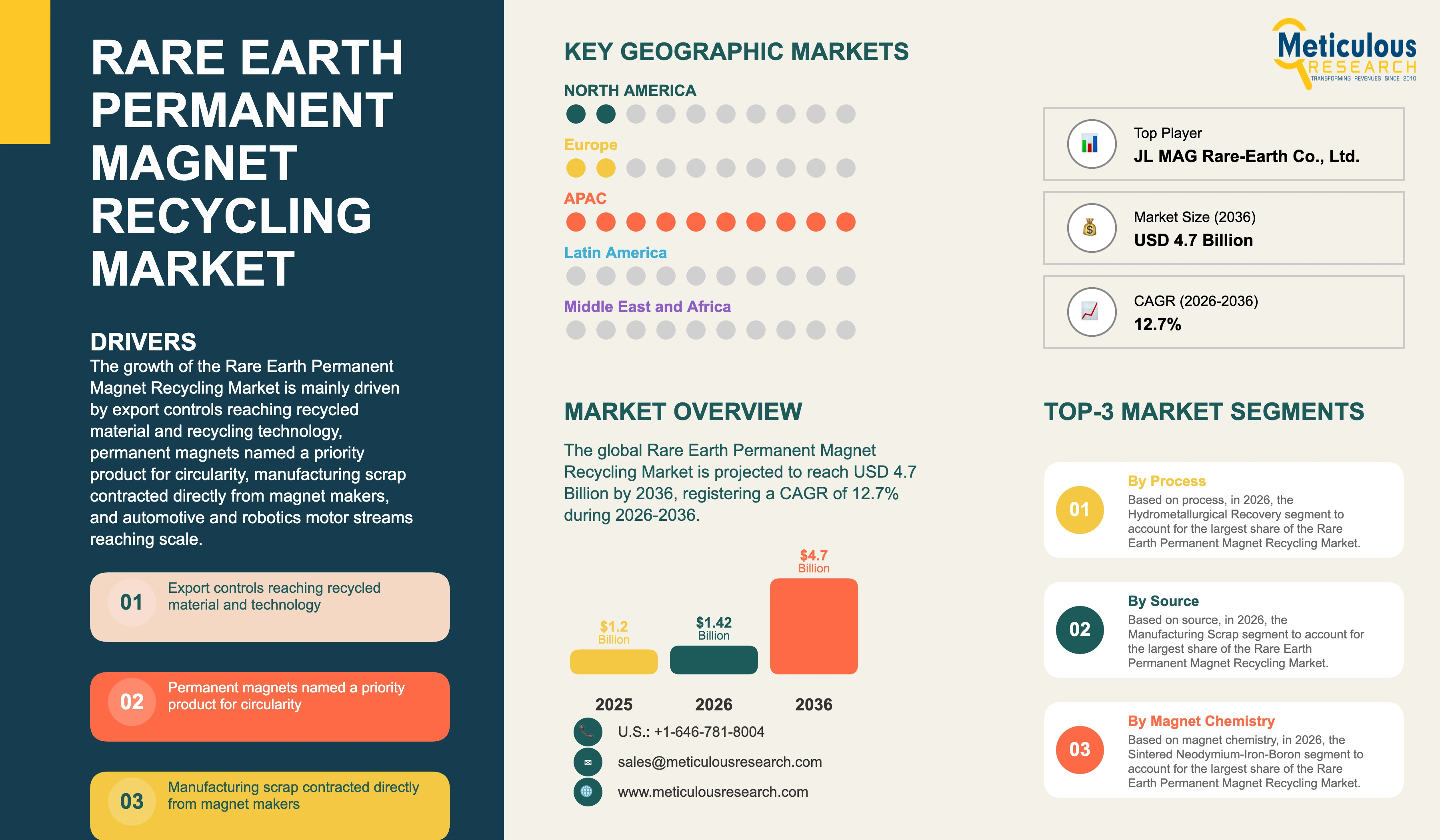
The rare earth permanent magnet recycling market is valued at USD 1.42 billion in 2026 and is projected to reach USD 4.70 billion by 2036, at a CAGR of 12.7% during the forecast period. The market was valued at USD 1.20 billion in 2025 and at USD 1.02 billion in 2024.
- Published
- Nov 2026
- Pages
- 261
- Format
- PDF + Excel
- Report ID
- MRCHM - 1042753
- Base year
- 2025
- 2024 · HISTORICAL
- $1.02B
- 2036
- $4.70B
- CAGR 2026–2036
- 12.7%
2024–2025 baseline · 2026–2036 forecast at 12.7% CAGR · hover a bar for the value
Key highlights
This market measures revenue from recovering rare earth content out of end-of-life and manufacturing-scrap permanent magnets, taken at the recycler gate on a tonne of recycled magnet-equivalent basis.
Primary mined and separated rare earths are excluded, as is magnet manufacture from virgin feedstock, separation reagents, collection services sold separately, and battery, catalyst and phosphor recycling streams.
Regulation (EU) 2024/1252, the Critical Raw Materials Act, was adopted on 11 April 2024 and sets a benchmark of recycling capacity covering at least 25% of annual Union consumption of strategic raw materials.
The same regulation sets benchmarks of extraction capacity covering at least 10% of Union consumption and processing capacity covering at least 40% of annual Union consumption.
It further provides that by 2030 the Union should not depend on a single third country for more than 65% of the supply of any strategic raw material, unprocessed or at any stage of processing.
Recital 57 identifies permanent magnets as a priority product for circularity and records that they contain critical raw materials including neodymium, praseodymium, dysprosium and terbium.
Article 28 requires a conspicuous, clearly legible and indelible label showing whether a product contains permanent magnets and whether they are neodymium-iron-boron, samarium-cobalt, aluminium-nickel-cobalt or ferrite.
The products covered by that article are magnetic resonance imaging devices, wind energy generators, industrial robots and motor vehicles.
Article 28 also requires a data carrier on or in the product, linked to a unique product identifier giving the weight, location and composition of each magnet together with instructions for safe removal.
That information must stay accurate and available for a period at least equal to the typical product lifetime plus 10 years, and the obligations apply to imaging devices, motor vehicles and light vehicles of category L from 24 May 2029.
Article 29 requires producers to publish the share of eight listed materials recovered from post-consumer waste, for products whose total magnet weight exceeds 0.2 kilograms.
The power to set minimum recovered-content shares under Article 29(3) must be exercised after the calculation delegated act takes effect and, in the words of the regulation, in any event by 31 December 2031.
The Ministry of Commerce of China issued Notice 2025 No. 61 on 9 October 2025, requiring designated foreign export operators to obtain a dual-use item export permit before exporting the listed rare earth items.
That notice reaches items made outside China containing Chinese-origin listed rare earths amounting to 0.1% or more of the value of the item, and separately reaches listed items produced abroad using Chinese-origin rare earths together with secondary resource recycling technology.
In December 2025 the European Commission presented the RESourceEU action plan with a proposal to amend the regulation, extending the recyclability rules for permanent magnets to hard disk drives, transducers, loudspeakers, civil drones and motorised toys.
The Committee on Industry, Research and Energy adopted its report on that proposal on 8 October 2026 by 64 votes to one with 17 abstentions, under procedure 2025/0385(COD), the Council having adopted its negotiating mandate in March 2026.
HyProMag GmbH at Pforzheim was announced as a strategic project under the Critical Raw Materials Act in October 2026, with a minimum initial capacity of approximately 100 tonnes a year scaling to about 350 tonnes a year on multiple shifts.
Cyclic Materials Inc. opened a commercial-scale automated rare earth magnet recovery facility in the United States on 9 September 2026, pairing mechanical separation with hydrometallurgical refining to a mixed rare earth oxide.
Report summary
| Particulars | Details |
|---|---|
| Base Year | 2025 |
| Actual Years | 2024-2025 |
| Forecast Period | 2026-2036 |
| Market Size in 2024 | USD 1.02 billion |
| Market Size in 2025 | USD 1.20 billion |
| Market Size in 2026 | USD 1.42 billion |
| Market Size in 2036 | USD 4.70 billion |
| Value CAGR (2026-2036) | 12.7% |
| Format | PDF, Excel & Cloud Portal · 261 pages |
| Volume in 2025 | 47.00 kilotons |
| Volume in 2026 | 52.00 kilotons |
| Volume in 2036 | 139.00 kilotons |
| Volume CAGR (2026-2036) | 10.3% |
| Average Realised Value, 2026 | USD 27,300 per tonne |
| Average Realised Value, 2036 | USD 33,800 per tonne |
| Units | Value in USD million; volume in kilotons of recycled magnet-equivalent output; realised value in USD per tonne |
| Measurement Basis | Revenue from recovering rare earth content out of end-of-life and manufacturing-scrap permanent magnets, taken as the value of recycled output sold or transferred at the recycler gate and expressed on a tonne of recycled magnet-equivalent basis |
| Historical Value Growth | Value grew at 17.7% a year between 2024 and 2026 against volume growth of 10.6% a year, as rare earth prices moved sharply following the October 2025 export control measures; the forecast of 12.7% assumes volume rather than price does the work, with realised value rising at 2.2% a year on mix |
| Obligation Timing | Article 29(1) of Regulation (EU) 2024/1252 creates a duty to publish a recovered share from 24 May 2027 or two years after the calculation delegated act, whichever is later; the minimum share under Article 29(3) is an conferred power exercisable in any event by 31 December 2031, with a further five years under Article 29(6) for imaging devices, motor vehicles and category L vehicles |
| Control Perimeter Note | Notice 2025 No. 61 of the Ministry of Commerce of China reaches foreign-made items containing Chinese-origin listed rare earths at 0.1% or more of item value, and separately reaches items produced abroad using Chinese-origin rare earths together with secondary resource recycling technology |
| Overlap Note | Solvent extraction reagents and other separation chemicals purchased by magnet recyclers are counted in the Rare Earth Separation Chemicals Market title and are excluded here, so the two titles are non-additive on that spend |
| Exclusions | Primary mined and separated rare earths; magnet manufacture from virgin feedstock; collection and logistics services sold separately; separation reagents and consumables; ferrite magnet handling where no rare earth is recovered; battery, catalyst and phosphor recycling streams; magnet assembly and machining services |
| Segments: Process | Hydrometallurgical Recovery; Pyrometallurgical and Molten Salt; Hydrogen Processing; Direct Reuse and Remanufacture |
| Segments: Source | Manufacturing Scrap; End-of-Life Magnets; Unused and Obsolete Stock |
| Segments: Magnet Chemistry | Sintered Neodymium-Iron-Boron; Bonded Neodymium-Iron-Boron; Samarium-Cobalt; Other Chemistries |
| Segments: Application | Automotive; Consumer Electronics and Data Storage; Industrial Motors and Robotics; Wind Energy; Medical Imaging; Other Applications |
| Largest Segment by Process, 2026 | Hydrometallurgical Recovery, at 71.0% |
| Fastest-Growing Segment by Process | Hydrogen Processing, at 24.0% |
| Largest Segment by Source, 2026 | Manufacturing Scrap, at 58.0% |
| Fastest-Growing Segment by Source | End-of-Life Magnets, at 15.3% |
| Largest Segment by Magnet Chemistry, 2026 | Sintered Neodymium-Iron-Boron, at 83.0% |
| Fastest-Growing Segment by Magnet Chemistry | Samarium-Cobalt, at 14.5% |
| Largest Segment by Application, 2026 | Automotive, at 29.0% |
| Fastest-Growing Segment by Application | Industrial Motors and Robotics, at 16.5% |
| Largest Region, 2026 | Asia-Pacific, at 68.0% |
| Fastest-Growing Region | Europe, at 15.6% |
| Fastest-Growing Country | Germany, at 17.2% |
| Slowest-Growing Country | Japan, at 9.9% |
| Regions Covered | Asia-Pacific; Europe; North America; Latin America; Middle East & Africa |
| Countries Covered | China; Japan; India; South Korea; Germany; France; U.K.; U.S.; Canada; Mexico; Brazil; Saudi Arabia |
| Key Players | JL MAG Rare-Earth Co., Ltd.; Proterial, Ltd.; TDK Corporation; VACUUMSCHMELZE GmbH & Co. KG; Solvay SA; Neo Performance Materials Inc.; Cyclic Materials Inc.; Noveon Magnetics, Inc.; Mkango Magnetic Materials Limited; Carester SAS; Ionic Rare Earths Limited |
| Top Five Share, 2026 | 31.4% |
| Profiled Companies Share, 2026 | 38.9% |
| Currency | USD |
Report overview
Market value is measured in in USD million; volume in kilotons of recycled magnet-equivalent output; realised value in USD per tonne. Segments covered: process, source, magnet chemistry, application.
The growth of this market is mainly driven by export controls that reach recycled material and recycling technology alike, permanent magnets named a priority product for circularity under European law with dated labelling obligations attached, manufacturing scrap contracted directly from magnet makers, and automotive and robotics motor streams reaching scale as the first large end-of-life pool. However, factors such as a minimum recycled content obligation that need not exist before the end of 2031, recycled output priced against a reference the recycler does not set, collection economics for magnets weighing a fraction of a kilogram per unit, and Western capacity measured in hundreds of tonnes against magnet demand measured in hundreds of thousands are expected to restrain the growth of this market to some extent.
Rare earth permanent magnets carry the highest energy product of any commercial magnet class, which is why an electric traction motor, a drive actuator and a direct-drive wind turbine generator can be built at the sizes they are. A sintered neodymium-iron-boron magnet is roughly 30% rare earth by weight, dominated by neodymium and praseodymium with a few percent of dysprosium and terbium added to hold coercivity at temperature. That composition is what makes recovery worth attempting, since a tonne of end-of-life magnet carries a separated value an order of magnitude above the recoverable value in most waste streams.
Recovery follows one of two routes. The long loop dissolves the magnet, separates the rare earths from iron, boron and coatings, and returns individual oxides that re-enter the ordinary supply chain alongside mined material. The short loop keeps the alloy intact, using hydrogen to break the sintered body into a powder that can be reprocessed into a magnet without chemical separation. The long loop is chemically flexible and tolerant of mixed feed but carries a separation plant with its reagent and effluent load; the short loop is cheaper per tonne and needs feed of known composition.
Feedstock divides on the same line. Manufacturing scrap from magnet production, consisting of machining swarf, grinding sludge and rejected blanks, is clean, compositionally known and available in tonnage at a single address. End-of-life magnets are the larger long-term pool but arrive bonded, coated, magnetised and buried inside an assembly that was not designed to be opened. A hard disk drive holds a magnet of a few tens of grams, a traction motor one to three kilograms, a direct-drive generator several tonnes.
The cost of getting the magnet out of the assembly, rather than the cost of treating it once out, is what determines whether a stream is worth collecting. That single fact explains why the largest application pool by unit count grows slowest in this market and why the first large end-of-life streams to reach a recycler are those where a dismantler is already opening the product for another reason.
The commercial geography is heavily concentrated. China produces the large majority of global sintered magnet output and therefore generates the large majority of the manufacturing scrap, and Chinese separation plants have absorbed that scrap as a routine feed for two decades. Recycling elsewhere was a demonstration activity until recently, with capacity measured in tens and hundreds of tonnes a year against a magnet market measured in hundreds of thousands.
That position changed in character rather than in scale over 2025 and 2026, as export controls made the provenance of magnet material a licensing question and public money moved behind first-of-a-kind plants in Europe and North America. The capacity now being commissioned is an answer to a policy expectation rather than to a contracted premium.
The architecture meant to create demand sits in the Critical Raw Materials Act. The recycling benchmark of at least 25% of annual Union consumption of strategic raw materials is a capacity target for the Union, not an obligation on any producer. The obligations that do fall on producers are informational: a label identifying magnet type, a data carrier giving magnet weight, location, composition and removal instructions, and a published share of recovered content.
A minimum recovered share is a conferred power rather than a requirement, exercisable after the calculation rules take effect and in any event by the end of 2031, with a further five years under Article 29(6) for imaging devices, motor vehicles and category L vehicles. The information duty therefore arrives four to five years ahead of any purchasing duty, and the purchasing duty arrives latest for the products with the most accessible magnets.
The export control measures of October 2025 work from the other direction. A licence requirement attaching to items that contain Chinese-origin listed rare earths at 0.1% or more of item value makes the provenance of every magnet in a finished product a compliance matter, which argues for a recycled supply originating inside the buyer jurisdiction. The same notice reaches items produced abroad using Chinese-origin rare earths together with secondary resource recycling technology, so a recycler whose feed or process traces to China sits inside the perimeter rather than outside it.
Pricing is set elsewhere. Recovered mixed oxide is sold against a separated oxide benchmark quoted in China; recycled sintered magnets are sold against a magnet price reflecting Chinese production cost. A recycler captures the spread between feedstock cost and that benchmark and carries processing cost in between, so the economics move with a price it neither sets nor hedges. Value growth of 17.7% a year between 2024 and 2026 sits well above the 12.7% a year forecast to 2036 for that reason.
The buyer side is narrower than the breadth of applications suggests. Magnet makers buy recovered alloy and oxide; original equipment manufacturers buy magnets. Where an automaker or an electronics producer contracts for recycled content it does so through its magnet supplier, which is why the partnerships announced in this field pair a recycler with a magnet maker rather than with a car company.
Automotive traction motors dominate the forward volume case. Vehicles sold in the first volume years of electrification are reaching the end of a first life, and the dismantler handling them already recovers the battery for value, so the motor enters an existing commercial flow. Industrial motors and robotics follow the same logic at smaller unit size and higher turnover, and are the fastest-growing application for that reason.
Consumer electronics and data storage is the largest pool by unit count and the hardest to serve. A drive is usually destroyed for data security rather than disassembled, and the shredded output mixes magnet material with steel and aluminium at a concentration that is expensive to upgrade. Automated separation rather than manual dismantling is what changes that position, and it is the basis of the commercial-scale facility opened in the United States in September 2026.
Wind energy is the opposite case: very large magnets in very few units, with a first significant decommissioning wave still ahead. Medical imaging occupies a distinct position, since a magnetic resonance imaging device is named in Article 28, holds substantial magnet mass and is replaced through a controlled channel that makes the end-of-life unit traceable, yet carries the latest recovered-content obligation of any application.
Samarium-cobalt sits apart from the neodymium story. It holds coercivity at temperatures neodymium-iron-boron cannot reach and is specified in aerospace, defence and high-temperature industrial equipment. Samarium has little primary demand outside magnets, so a separation plant has limited incentive to produce it and recovery from scrap is the practical route to supply, which makes it the fastest-growing chemistry in this market despite a small share.
What is already settled is the feedstock position. Manufacturing scrap is contracted, clean and growing with magnet production outside China, and the partnership announced in October 2025 between Cyclic Materials Inc. and VACUUMSCHMELZE GmbH & Co. KG to recycle magnet manufacturing waste in the United States is the template. The committee proposal to count materials rejected in production toward the recovered share would align the obligation with the feedstock that actually exists, and is the single change that would most alter the shape of this market.
Report infographic
Market dynamics
20 factors across 5 forcesExport Controls Reaching Recycled Material and Recycling Technology
Notice 2025 No. 61 of the Ministry of Commerce of China, issued on 9 October 2025, requires designated foreign export operators to hold a dual-use item export permit before exporting listed rare earth items, and extends to items manufactured outside China containing Chinese-origin listed rare earths amounting to 0.1% or more of the value of the item.
A threshold of a tenth of one percent of item value captures almost any product containing a rare earth magnet, since the magnet is a small fraction of product mass and a material fraction of product value. Provenance becomes a licensing question for the finished article rather than a procurement preference.
Material recovered inside a buyer jurisdiction offers provenance documented without reference to a Chinese export licence, which is the proposition behind every Western project announced in this period. The same notice reaches items produced abroad using Chinese-origin rare earths together with secondary resource recycling technology, so the proposition holds only where both feed and process sit outside that origin.
Permanent Magnets Named a Priority Product for Circularity
Recital 57 of Regulation (EU) 2024/1252 identifies permanent magnets as a priority product for circularity and records that they contain neodymium, praseodymium, dysprosium and terbium among other critical raw materials. That designation is the basis for the only provisions in the regulation attaching to an identified manufacturer rather than to the Union as a whole.
Article 28 requires a conspicuous, clearly legible and indelible label showing magnet presence and type across magnetic resonance imaging devices, wind energy generators, industrial robots and motor vehicles, together with a data carrier giving the weight, location and composition of each magnet and instructions for safe removal, held accurate for the typical product lifetime plus 10 years.
Those requirements apply to imaging devices, motor vehicles and light vehicles of category L from 24 May 2029. For a recycler the value is that finding and extracting a magnet becomes a lookup rather than a search, which is the largest variable cost in treating an end-of-life assembly.
Manufacturing Scrap Contracted Directly From Magnet Makers
Magnet production generates machining swarf, grinding sludge and rejected blanks in a proportion no sintering operation has eliminated. That material is compositionally known, uncoated, unassembled and available in tonnage at a single address, which makes it the lowest-cost feedstock in this market by a wide margin.
As sintered capacity is built outside China the associated scrap becomes available outside China at meaningful scale for the first time. The partnership expanded on 22 October 2025 between Cyclic Materials Inc. and VACUUMSCHMELZE GmbH & Co. KG to recycle magnet manufacturing waste in the United States is the structure this takes.
For the magnet maker the arrangement converts a disposal cost into a recovery credit and shortens the distance between its own production and its own feed. For the recycler it supplies contracted volume that underwrites utilisation while end-of-life channels are still being built, which is why scrap-anchored projects reached commercial scale first.
Automotive and Robotics Motor Streams Reaching Scale
An electric traction motor holds one to three kilograms of magnet in a single assembly at a known location, one to two orders of magnitude more magnet per visit than a consumer device. Vehicles from the first volume years of electrification are reaching the end of a first life, and the dismantler handling them already recovers the battery for value.
Industrial motors and robotics follow the same logic at smaller unit size and higher replacement frequency, and record the highest application CAGR in this market at 16.5%. Robotics and drone motors and actuators are named among the feedstocks the commercial-scale United States facility opened in September 2026 is designed to take.
The proposal presented with the RESourceEU action plan in December 2025 would extend the recyclability rules to civil drones among other products, bringing documentation to a stream that is currently opaque. Vehicle and industrial motor pools are the first to arrive with an existing route to a recycler.
Table of contents
12 chapters · 134 sections · 261 pages · click to expandSegmental analysis
| Segment | Largest share (2026) | Fastest growth (2026–2036) |
|---|---|---|
| By Process | Hydrometallurgical recovery | Hydrogen processing |
| By Source | Manufacturing scrap | End-of-life magnets |
| By Magnet Chemistry | Sintered neodymium-iron-boron | Samarium-cobalt |
| By Application | Automotive | Industrial motors and robotics |
By Process
- Rare Earth Permanent Magnet Recycling Market Analysis by Process
- Hydrometallurgical recovery is expected to hold the largest share of this market in 2026.
- It dissolves the magnet, separates the rare earths from iron, boron and coating metals, and returns individual oxides that re-enter the ordinary supply chain alongside mined material.
- The route tolerates mixed, coated and partially oxidised feed and produces an output any separated-oxide buyer can use without qualification against a magnet specification.
- Chinese separation plants have treated magnet scrap as a routine feed on that basis for two decades, which is why the dominant share sits in Asia-Pacific.
- Hydrogen processing is expected to record the highest CAGR of any process at 24.0%.
- The route uses hydrogen to break a sintered body into a powder that can be reprocessed into a magnet without chemical separation, removing the separation plant and its reagent and effluent load from the cost base.
- It was developed and patented at the University of Birmingham and is the basis of the plants at Pforzheim and at Tyseley Energy Park.
- Growth is bounded by composition rather than capital, since a short loop returns the alloy it was given.
- Pyrometallurgical and molten salt routes recover rare earth metal or alloy directly by electrochemical or slag extraction without an aqueous separation train.
- They avoid reagent consumption and effluent treatment but carry high energy intensity and tight feed requirements, and are used where the product is wanted as metal rather than oxide.
- The route grows slowest of the four at 10.4%.
- Direct reuse and remanufacture covers magnets removed intact and either refitted or reshaped without being broken down.
- It applies where the magnet is large, accessible and of known provenance, which in practice means wind turbine generators, some industrial drives and imaging equipment.
- The route carries the lowest processing cost of the four and the narrowest applicability, and grows at 15.0%.
By Source
- Rare Earth Permanent Magnet Recycling Market Analysis by Source
- Manufacturing scrap is expected to hold the largest share of this market in 2026.
- It consists of machining swarf, grinding sludge and rejected blanks from magnet production, compositionally known, uncoated, unassembled and available in tonnage at a single address, which makes it the lowest-cost feedstock here and the reason most installed capacity sits next to magnet production.
- As sintered capacity is built outside China the associated scrap becomes available outside China at scale for the first time, which is the structure of the manufacturing waste partnership announced on 22 October 2025.
- The source grows at 11.6%.
- End-of-life magnets are expected to record the highest CAGR during the forecast period at 15.3%.
- The pool is far larger but arrives bonded, coated, magnetised and inside an assembly that was not designed to be opened, so extraction cost rather than treatment cost governs whether a stream is worth collecting.
- Vehicle traction motors and industrial drives are the first large end-of-life pools to arrive with an existing route to a recycler, and the Article 28 duties are aimed at reducing extraction cost for this source.
- Unused and obsolete stock covers magnets and assemblies that never entered service, including discontinued inventory, cancelled programme material and distributor surplus.
- The source is attractive because the material is clean and documented, and limited because the pool does not replenish with activity.
- It grows slowest of the three at 9.4%.
By Magnet Chemistry
- Rare Earth Permanent Magnet Recycling Market Analysis by Magnet Chemistry
- Sintered neodymium-iron-boron is expected to hold the largest share of this market in 2026, accounting for the overwhelming majority of rare earth magnet production and therefore of both scrap and end-of-life volume.
- The chemistry is roughly 30% rare earth by weight, dominated by neodymium and praseodymium with a few percent of dysprosium and terbium added to hold coercivity at temperature, and it is the only chemistry for which both short-loop and long-loop routes are commercially established.
- It grows at 12.7%.
- Samarium-cobalt is expected to record the highest CAGR during the forecast period at 14.5%.
- It holds coercivity at temperatures sintered neodymium-iron-boron cannot reach and is specified in aerospace, defence and high-temperature industrial equipment.
- Samarium has little primary demand outside magnets, so recovery from magnet scrap is the practical route to supply rather than a secondary alternative to mining.
- The qualification on samarium-cobalt is regulatory rather than technical.
- Products designed primarily for defence or space applications are exempt from the Article 28 identification duties under Article 28(9), and those products hold much of the installed samarium-cobalt base, so the identification support available to the neodymium streams does not extend to this one.
- Bonded neodymium-iron-boron combines magnet powder with a polymer binder, allowing complex shapes and lower cost at lower energy product.
- The binder complicates recovery, since it must be removed thermally or chemically before the powder can be treated, and rare earth content per tonne is lower than in a sintered body.
- It grows at 12.2%, while other chemistries including aluminium-nickel-cobalt grow slowest at 8.5%.
By Application
- Rare Earth Permanent Magnet Recycling Market Analysis by Application
- Automotive is expected to hold the largest share of this market in 2026.
- An electric traction motor holds one to three kilograms of magnet in a single assembly at a known location, and the dismantler handling the vehicle already recovers the battery for value, so the motor enters an established flow.
- Motor vehicles are named in Article 28 and carry the labelling and data-carrier duties from 24 May 2029, though Article 29(6) defers the recovered-content requirement by five years.
- The segment grows at 14.0%.
- Industrial motors and robotics are expected to record the highest CAGR during the forecast period at 16.5%, on smaller unit magnet mass but higher replacement frequency and a dismantling route that already exists for the motor itself.
- Industrial robots are named in Article 28, the December 2025 amendment proposal would extend the rules to civil drones, and robotics and drone motors are among the feedstocks the automated recovery facility opened in September 2026 is designed to take.
- Consumer electronics and data storage is the largest pool by unit count and grows slowest of the six at 9.6%.
- A hard disk drive magnet weighs a few tens of grams, the drive is destroyed for data security rather than disassembled, and the shredded output mixes magnet material with steel and aluminium at a concentration that is expensive to upgrade.
- The December 2025 proposal would extend the recyclability rules to hard disk drives, transducers and loudspeakers.
- Wind energy covers very large magnets in very few units, with the first significant decommissioning wave still ahead, and grows at 11.8%.
- Medical imaging grows at 10.2%, with a magnetic resonance imaging device named in Article 28 and replaced through a controlled channel that makes the unit traceable, yet deferred five years under Article 29(6).
- Other applications including aerospace and defence grow at 12.5%, where samarium-cobalt content is concentrated and the Article 28 defence exemption applies.
Geographic analysis
Asia-Pacific
Largest shareAsia-Pacific is expected to account for the largest share of this market in 2026, while Europe is expected to register the highest CAGR during the forecast period. Asia-Pacific leads because China produces the large majority of global sintered magnet output and therefore generates the large majority of the manufacturing scrap, and because Chinese separation plants have treated that scrap as a routine feed for two decades. The region grows at 11.8%, below the global rate, since its base is already large and its growth tracks magnet production rather than policy. Japan grows slowest of the countries covered at 9.9%, on a mature magnet industry with established internal scrap handling.
Europe
Fastest growthEurope grows fastest at 15.6%, on the clearest policy architecture of any region. Permanent magnets are a named priority product for circularity under Regulation (EU) 2024/1252, the Article 28 labelling and data-carrier duties apply to vehicles and imaging devices from 24 May 2029, and the recycling capacity benchmark of at least 25% of annual Union consumption gives member states an explicit target. Germany grows fastest of the countries covered at 17.2%, carrying the Pforzheim plant awarded strategic project status in October 2026. France holds the European long-loop position, with the Caremag project at Lacq targeting the recycling of 2,000 tonnes of magnets alongside the separation of 5,000 tonnes of heavy rare earth concentrates from mining under France Relance and France 2030, and a memorandum of understanding signed on 8 March 2024 between Carester SAS and Solvay SA. The United Kingdom holds the short-loop demonstration position at Tyseley Energy Park in Birmingham, where the process originated.
North America
North America grows at 15.1%, close to the European rate but on procurement and provenance rather than a circularity regulation. A commercial-scale automated magnet recovery facility opened on 9 September 2026, a magnet manufacturing waste stream is contracted from a European magnet producer operating in the United States, and the announced short-loop project carries a design capacity of 750 tonnes a year of recycled sintered magnets plus 291 tonnes of co-products. Canada carries separation and refining development supported by a CAD 9.1 million investment from Natural Resources Canada announced on 2 March 2026. Mexico is the larger of the two markets covered on its vehicle and appliance manufacturing base, with Brazil behind.
Latin America
Latin America grows at 10.4%. The region holds no sintered magnet production of scale and therefore no scrap stream, and activity is confined to collection and export of magnet-bearing assemblies from vehicle and appliance dismantling.
Middle East & Africa
The Middle East and Africa grows slowest at 9.8%. Activity in magnet-bearing equipment is limited, the end-of-life pool is small, and regional interest in rare earths sits upstream in mining and separation rather than in recovery from manufactured goods. Saudi Arabia accounts for most of the regional total through industrial equipment replacement and announced downstream materials programmes.
Competitive landscape
This market has three distinct competitor groups rather than a single ranking. The first is the established magnet producers, which recycle their own manufacturing scrap as a routine part of production and account for the largest recovered tonnage without selling a recycling service. The second is the dedicated recyclers, which hold the process intellectual property and the public funding but operate capacity measured in hundreds of tonnes. The third is the separation and specialty chemical companies, which treat magnet scrap as one feed among several into an existing separation train.
Concentration is moderate rather than high. The top five participants are estimated to hold 31.4% of this market in 2026 and the profiled companies 38.9%, with the balance spread across Chinese separation plants treating scrap on a merchant basis and across smaller collection and pre-treatment operations. The fragmentation reflects the fact that the largest recovered volumes sit inside magnet production as an internal flow rather than in a traded market.
Competition among the dedicated recyclers turns on feedstock access rather than on process cost. A contracted scrap stream from a magnet maker underwrites plant utilisation, which is why the partnerships announced in this field pair a recycler with a magnet producer, and why ownership structures combine recycling and magnet making inside one group rather than contracting across a merchant market. Mkango Magnetic Materials Limited holds 79.4% of Maginito Limited with CoTec Holdings Ltd holding 20.6%, and Maginito holds a 90% direct and indirect interest in HyProMag GmbH assuming conversion of a convertible loan.
Public instruments rather than contracted premiums have carried the capacity built in Europe and North America. HyProMag GmbH was announced as a strategic project under the Critical Raw Materials Act in October 2026. Cyclic Materials Inc. raised USD 75 million in a Series C financing announced on 23 January 2026 and USD 75 million in a strategic growth financing announced on 27 August 2026, alongside the Natural Resources Canada investment of CAD 9.1 million announced on 2 March 2026, and announced a non-binding memorandum of understanding with Neo Performance Materials Inc. on 2 March 2026 for a trans-Atlantic circular supply chain. Noveon Magnetics, Inc. operates a sintered magnet plant at San Marcos in Texas with a stated capacity of 2,000 tons a year able to run new or recycled feed, and has contracted 1,000 tons of magnets over five years to Nidec Motor Corporation.
Some of the key players operating in the rare earth permanent magnet recycling market are JL MAG Rare-Earth Co., Ltd., Proterial, Ltd., TDK Corporation, VACUUMSCHMELZE GmbH & Co. KG, Solvay SA, Neo Performance Materials Inc., Cyclic Materials Inc., Noveon Magnetics, Inc., Mkango Magnetic Materials Limited, Carester SAS, and Ionic Rare Earths Limited, among others.
- JL MAG Rare-Earth Co., Ltd.
- Proterial, Ltd.
- TDK Corporation
- VACUUMSCHMELZE GmbH & Co. KG
- Solvay SA
- Neo Performance Materials Inc.
- Cyclic Materials Inc.
- Noveon Magnetics, Inc.
- Mkango Magnetic Materials Limited
- Carester SAS
- Ionic Rare Earths Limited
Expert perspectives
The list driver for this title is magnet supply security, and the primary evidence supports the motive while undercutting the mechanism. Notice 2025 No. 61 of the Ministry of Commerce of China, issued on 9 October 2025, makes provenance a licensing question for any product in which Chinese-origin listed rare earths reach 0.1% of item value, which captures almost every product containing a rare earth magnet.
The same notice reaches items produced outside China using Chinese-origin rare earths together with technologies for secondary resource recycling, naming recycling alongside the production technologies it is meant to replace. Since most of the installed magnet base was made in China from Chinese-separated material, a recycler treating that base does not sit cleanly outside the exposure it is funded to escape.
On the European side the obligation chain is incomplete in a way that matters to a forecast. Article 29(1) creates a duty to publish a recovered share, not to buy one. The minimum share under Article 29(3) is a conferred power exercisable in any event by 31 December 2031, with five further years under Article 29(6) for imaging devices, motor vehicles and category L vehicles. The regulation is simultaneously being reopened under procedure 2025/0385(COD).
The one amendment that would materially change near-term demand is the committee proposal to count materials rejected in production and required to be recycled, rather than post-consumer waste alone. Manufacturing scrap is the feedstock that exists in contracted tonnage today and counts toward nothing under the adopted wording, so aligning the obligation with it would turn an internal cost-recovery arrangement into a compliance asset.
Scale is the other constraint on what the forecast can carry. The leading announced short-loop capacities outside China are approximately 100 tonnes a year at Pforzheim scaling to about 350 on multiple shifts, a minimum of 100 tonnes a year at Tyseley, and 750 tonnes a year of recycled sintered magnets plus 291 tonnes of co-products in the United States, with Caremag targeting 2,000 tonnes recycled. The European and North American CAGRs of 15.6% and 15.1% therefore sit on small bases rather than on share capture.
The forecast assumes volume rather than price does the work. Value grew at 17.7% a year between 2024 and 2026 against volume growth of 10.6%, because rare earth prices moved sharply following the export control measures. Carrying that rate forward would embed a price assumption the recycler does not control, since recovered material is sold against benchmarks quoted in China. The 12.7% value CAGR sits below the recent run rate deliberately, with realised value rising at 2.2% a year on mix.
Frequently asked questions
The market is valued at USD 1.42 billion in 2026 and is projected to reach USD 4.70 billion by 2036, at a CAGR of 12.7%. It was valued at USD 1.20 billion in 2025 and USD 1.02 billion in 2024.
It measures revenue from recovering rare earth content out of end-of-life and manufacturing-scrap permanent magnets, taken at the recycler gate on a tonne of recycled magnet-equivalent basis. Primary mined and separated rare earths, magnet manufacture from virgin feedstock, separation reagents, collection services, and battery, catalyst and phosphor streams are excluded.
Partly. Notice 2025 No. 61 of the Ministry of Commerce of China requires a dual-use export permit and reaches foreign-made items containing Chinese-origin listed rare earths at 0.1% or more of item value. It also reaches items produced abroad using Chinese-origin rare earths together with secondary resource recycling technology, so a recycler treating the installed base does not sit cleanly outside the exposure.
Recital 57 of Regulation (EU) 2024/1252 names them a priority product for circularity, and Article 28 requires a label and a data carrier, applying to imaging devices, motor vehicles and category L vehicles from 24 May 2029. Article 29(1) requires publication of a recovered share where magnet weight exceeds 0.2 kilograms, and the minimum share under Article 29(3) is a conferred power exercisable in any event by 31 December 2031.
Extraction capacity of at least 10% of Union consumption, processing capacity of at least 40% and recycling capacity covering at least 25% of annual Union consumption of strategic raw materials. By 2030 the Union should not depend on a single third country for more than 65% of the supply of any strategic raw material; these are Union capacity targets rather than obligations on producers.
Hydrometallurgical recovery holds the largest share in 2026, because it tolerates mixed, coated and partially oxidised feed and yields an output any separated-oxide buyer can use. Hydrogen processing records the highest CAGR at 24.0%, breaking a sintered body into a reprocessable powder without chemical separation.
Manufacturing scrap is compositionally known, uncoated, unassembled and available in tonnage at a single address, which makes it the lowest-cost feedstock. End-of-life magnets are the far larger pool but arrive bonded, coated, magnetised and inside an assembly not designed to be opened, and they grow at 15.3% against 11.6% for manufacturing scrap.
The leading announced short-loop figures are approximately 100 tonnes a year at Pforzheim scaling to about 350 on multiple shifts, a minimum of 100 tonnes a year at Tyseley Energy Park, and a United States design capacity of 750 tonnes a year plus 291 tonnes of co-products. Caremag at Lacq targets 2,000 tonnes recycled, while global sintered magnet demand runs to hundreds of thousands of tonnes a year.
In December 2025 the European Commission presented the RESourceEU action plan with a proposal extending the recyclability rules to hard disk drives, transducers, loudspeakers, civil drones and motorised toys. The Committee on Industry, Research and Energy adopted its report on 8 October 2026 under procedure 2025/0385(COD); it would have the delegated acts count materials rejected in production, aligning the obligation with the feedstock that exists today.
Automotive holds the largest share in 2026, because a traction motor carries one to three kilograms of magnet in a single assembly and the dismantler already recovers the battery for value. Industrial motors and robotics record the highest CAGR at 16.5%, while consumer electronics and data storage grows slowest at 9.6%.
It holds coercivity at temperatures neodymium-iron-boron cannot reach, and samarium has little primary demand outside magnets, so recovery from scrap is the practical route to supply. The chemistry grows at 14.5% against 12.7%, from a much smaller base, with Article 28(9) exempting defence and space products from the identification duties.
Asia-Pacific holds the largest share in 2026, because China produces the large majority of global sintered magnet output and therefore of the manufacturing scrap. Europe records the highest CAGR at 15.6%, with Germany the fastest-growing country covered at 17.2%, and North America grows at 15.1%.
Key players include JL MAG Rare-Earth Co., Ltd., Proterial, Ltd., TDK Corporation, VACUUMSCHMELZE GmbH & Co. KG, Solvay SA, Neo Performance Materials Inc., Cyclic Materials Inc., Noveon Magnetics, Inc., Mkango Magnetic Materials Limited, Carester SAS and Ionic Rare Earths Limited. The top five hold an estimated 31.4% in 2026 and the profiled companies 38.9%.
HyProMag GmbH at Pforzheim was announced as a strategic project under the Critical Raw Materials Act in October 2026 and is being commissioned at approximately 100 tonnes a year. Cyclic Materials Inc. opened a commercial-scale automated magnet recovery facility in the United States on 9 September 2026, and Carester SAS and Solvay SA signed a memorandum of understanding on 8 March 2024.
Recovered mixed oxide is sold against a separated oxide benchmark quoted in China and recycled sintered magnets against a magnet price reflecting Chinese production cost, so a recycler earns the spread between feedstock cost and a benchmark it neither sets nor hedges. A reversal in that price compresses margin without any change in operating performance.
The minimum recovered-content share need not exist before 31 December 2031 and is deferred five further years for imaging devices and vehicles. Recovered alloy may not meet the required heavy rare earth grade, the data carrier duty falls on product makers, and a traction motor magnet is qualified as part of the motor, so substitution requires requalification measured in years.
Cite this report
Meticulous Research. (2026). Rare Earth Permanent Magnet Recycling Market - Global Opportunity Analysis and Industry Forecast (2026-2036) (Report No. MRCHM - 1042753). Meticulous Market Research Pvt. Ltd. https://www.meticulousresearch.com/product/rare-earth-permanent-magnet-recycling-market-7436