Anti Icing Coatings Market (2026-2036)
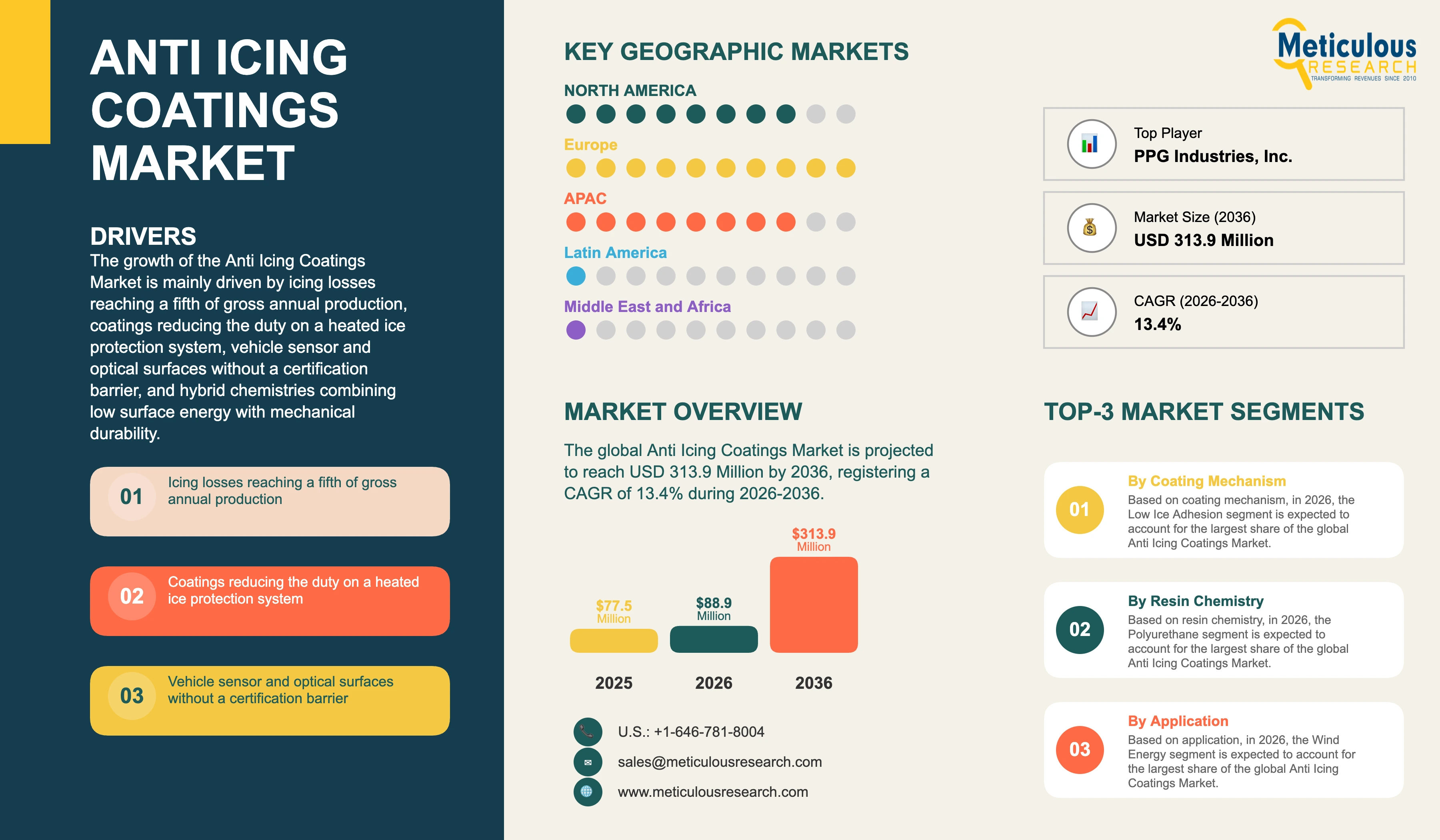
The anti icing coatings market is valued at USD 88.9 million in 2026 and is projected to reach USD 313.9 million by 2036, at a CAGR of 13.4% during the forecast period. The market was valued at USD 77.5 million in 2025 and at USD 67.6 million in 2024.
- Published
- Nov 2026
- Pages
- 261
- Format
- PDF + Excel
- Report ID
- MRCHM - 1042793
- Base year
- 2025
- 2024 · HISTORICAL
- $67.6M
- 2036
- $313.9M
- CAGR 2026–2036
- 13.4%
2024–2025 baseline · 2026–2036 forecast at 13.4% CAGR · hover a bar for the value
Key highlights
This market measures coatings formulated and sold to reduce ice adhesion or delay ice formation on a surface, taken at the manufacturer gate on a tonne basis.
De-icing and anti-icing fluids are excluded, as are electrothermal and hot-air ice protection systems, pneumatic boots, ice detection sensors, leading-edge erosion coatings sold without an anti-icing claim, and general hydrophobic coatings sold for soiling rather than icing.
IEA Wind Recommended Practice 13, second edition, was submitted by Task 19 and approved by the Executive Committee of the IEA Wind Technology Collaboration Programme on 1 February 2017.
That document sets an ice classification in which Class 5 sites experience meteorological icing for more than 10% of the year, instrumental icing for more than 20% of the year and icing losses above 20% of gross annual production.
Class 4 sites carry 5% to 10% meteorological icing, 10% to 30% instrumental icing and icing losses of 10% to 25%, while Class 1 sites carry up to 0.5% meteorological icing and losses of 0% to 0.5%.
The same document states that the energy consumption of blade heating is typically 2% or less of annual energy production, and that in moderate or severe icing conditions the payback time of a proven ice protection system can be less than a year.
It identifies the most promising approaches as those that heat the blade surface actively, using electro-thermal foils or warm air circulated inside the blades, and records that such systems exist although the industry is not yet mature.
It further states that no standardised method exists for tracking ice protection efficiency and reliability, and recommends a performance specification, follow-up testing and warranted performance levels.
Icing losses vary widely with turbine control strategy, with some sites recorded as having seen a factor of 5 impact on the production loss.
Type certification of large aeroplanes for flight in icing conditions falls under CS 25.1419 and 14 CFR 25.1419, with turbine engine inlet ice protection under CS E-780 and 14 CFR 33.68.
Appendix C to CS-25 and 14 CFR Part 25 defines continuous maximum and intermittent maximum icing envelopes by liquid water content, droplet size, air temperature and horizontal extent, which together characterise 99.9% of the atmospheric icing environment.
Appendix O covers supercooled large drop conditions, meaning freezing drizzle and freezing rain occurring in or below stratiform clouds, and was added to CS-25 at Amendment 16 in 2015.
Appendix P covers the ice crystal and mixed-phase envelope and was also added at CS-25 Amendment 16, with total water content scaled to a standard cloud length of 32.2 kilometres.
Under Appendix O Part II the most critical ice accretion for each flight phase is used to show compliance with the performance and handling qualities requirements of Subpart B.
A study published in Coatings on 11 July 2024 by authors at Zhejiang University of Science and Technology, Zhejiang University and Guodian Ningbo Wind Power reports a silicone and silica elastomeric coating with ice adhesion of about 15 kilopascals.
That work records naturally aged coatings rising from 15 to 70 kilopascals within one month before stabilising, remaining below 100 kilopascals and about 75% lower than an uncoated blade.
In a 150-day outdoor fan test at 0 to 300 revolutions a minute, the silica-free coating tore at the blade tip by day 126 while the silica-containing coating remained intact at day 150, and the authors state that the present work still cannot support the large-scale application of elastic deicing coatings.
LM Wind Power states that leading edge surface erosion increases dramatically with increased rotor speed, that there is no global design standard for erosion on the leading edge, and that rain erosion testing uses three whirling arms rotating at 234 to 640 kilometres an hour under an artificially generated rain field.
Report summary
| Particulars | Details |
|---|---|
| Base Year | 2025 |
| Actual Years | 2024-2025 |
| Forecast Period | 2026-2036 |
| Market Size in 2024 | USD 67.6 million |
| Market Size in 2025 | USD 77.5 million |
| Market Size in 2026 | USD 88.9 million |
| Market Size in 2036 | USD 313.9 million |
| Value CAGR (2026-2036) | 13.4% |
| Format | PDF, Excel & Cloud Portal · 261 pages |
| Volume in 2025 | 6.95 kilotons |
| Volume in 2026 | 7.80 kilotons |
| Volume in 2036 | 21.50 kilotons |
| Volume CAGR (2026-2036) | 10.7% |
| Average Selling Price, 2026 | USD 11,400 per tonne |
| Average Selling Price, 2036 | USD 14,600 per tonne |
| Units | Value in USD million; volume in kilotons of coating; price in USD per tonne |
| Measurement Basis | Coatings formulated and sold to reduce ice adhesion or delay ice formation on a surface, measured at the manufacturer gate on a tonne basis |
| Historical Value Growth | Value grew at 14.7% a year between 2024 and 2026 against volume growth of 12.2% a year; the forecast of 13.4% is marginally lower in percentage terms on a larger base, with average selling price rising 2.5% a year on mix toward hybrid and active systems |
| Icing Loss Basis | IEA Wind Recommended Practice 13, second edition, approved 1 February 2017, classifies sites from Class 1 to Class 5: Class 5 carries meteorological icing above 10% of the year, instrumental icing above 20% and icing losses above 20% of gross annual production; Class 4 carries losses of 10% to 25% and Class 1 losses of 0% to 0.5% |
| Competing Solution Note | The same Recommended Practice identifies active blade surface heating with electro-thermal foils or warm air as the most promising approach, records blade heating energy consumption at typically 2% or less of annual energy production, and states that in moderate or severe icing the payback time of a proven ice protection system can be less than a year |
| Durability Evidence Note | A study published in Coatings on 11 July 2024 reports a silicone and hydrophobic silica coating at about 15 kilopascals of ice adhesion rising to 70 kilopascals within one month of natural ageing, contact angle falling from 129 to 115 degrees after 90 hours of xenon exposure, tensile modulus falling from 1.62 to 0.88 megapascals, and a silica-free film tearing at the blade tip by day 126 of a 150-day fan test; the authors state that the present work still cannot support the large-scale application of elastic deicing coatings |
| Aviation Certification Note | Type certification of large aeroplanes for flight in icing falls under CS 25.1419 and 14 CFR 25.1419, with engine inlets under CS E-780 and 14 CFR 33.68, requiring demonstrated safe operation across the Appendix C continuous and intermittent maximum envelopes, the Appendix O supercooled large drop conditions added at CS-25 Amendment 16 in 2015 and the Appendix P ice crystal and mixed-phase envelope; an anti icing coating is specified as a supplement to a certified system rather than as one |
| Measurement Gap Note | IEA Wind Recommended Practice 13 states that no standardised method exists for tracking ice protection efficiency and reliability and recommends a performance specification with follow-up testing and warranted performance levels; LM Wind Power states that there is no global design standard for erosion on the leading edge, with rain erosion testing on whirling arms at 234 to 640 kilometres an hour |
| Overlap Note | Products sold with both self-cleaning or easy-clean and anti icing claims are counted in this title and in the Self Cleaning Coatings Market and Easy Clean Sanitary Coatings Market titles, so those titles are non-additive with this one on the overlapping products |
| Exclusions | De-icing and anti-icing fluids, including aircraft Type I to Type IV fluids and runway and road de-icers; electrothermal and hot-air ice protection systems, heating mats, foils and elements; pneumatic de-icing boots; mechanical and ultrasonic de-icing devices; ice detection sensors and control systems; leading edge erosion protection coatings and tapes sold without an anti icing claim; general hydrophobic and self-cleaning coatings sold for soiling rather than icing |
| Segments: Coating Mechanism | Low Ice Adhesion; Superhydrophobic and Water-Repellent; Elastomeric Deicing; Slippery Liquid-Infused and Lubricant-Releasing; Active and Hybrid |
| Segments: Resin Chemistry | Polyurethane; Silicone and Polysiloxane; Fluoropolymer; Epoxy; Hybrid and Nanocomposite |
| Segments: Application | Wind Energy; Aviation and Aerospace; Power Transmission and Distribution; HVAC and Refrigeration; Marine and Offshore; Automotive and Rail; Other Applications |
| Segments: Substrate | Composite; Metal; Glass and Polymer Optics; Concrete and Other |
| Largest Segment by Coating Mechanism, 2026 | Low Ice Adhesion, at 34.0% |
| Fastest-Growing Segment by Coating Mechanism | Active and Hybrid, at 18.4% |
| Largest Segment by Resin Chemistry, 2026 | Polyurethane, at 31.0% |
| Fastest-Growing Segment by Resin Chemistry | Hybrid and Nanocomposite, at 18.0% |
| Slowest-Growing Segment by Resin Chemistry | Fluoropolymer, at 5.8% |
| Largest Segment by Application, 2026 | Wind Energy, at 32.0% |
| Fastest-Growing Segment by Application | Automotive and Rail, at 17.0% |
| Slowest-Growing Segment by Application | Aviation and Aerospace, at 10.4% |
| Largest Segment by Substrate, 2026 | Composite, at 42.0% |
| Fastest-Growing Segment by Substrate | Glass and Polymer Optics, at 15.6% |
| Largest Region, 2026 | Europe, at 36.0% |
| Fastest-Growing Region | Asia-Pacific, at 15.2% |
| Fastest-Growing Country | China, at 16.4% |
| Slowest-Growing Country | Brazil, at 10.2% |
| Regions Covered | Europe; Asia-Pacific; North America; Latin America; Middle East & Africa |
| Countries Covered | Germany; Sweden; Finland; France; U.K.; China; Japan; India; U.S.; Canada; Brazil; Mexico |
| Key Players | PPG Industries, Inc.; Akzo Nobel N.V.; 3M Company; Hempel A/S; BASF SE; Henkel AG & Co. KGaA; Mankiewicz Gebr. & Co.; Nitto Denko Corporation; Teknos Group Oy; NEI Corporation |
| Top Five Share, 2026 | 38.2% |
| Profiled Companies Share, 2026 | 49.5% |
| Currency | USD |
Report overview
Market value is measured in in USD million; volume in kilotons of coating; price in USD per tonne. Segments covered: coating mechanism, resin chemistry, application, substrate.
In volume terms, the market is estimated at 7.80 kilotons of coating in 2026, rising to 21.50 kilotons by 2036, at a CAGR of 10.7%. The average selling price is estimated at USD 11,400 per tonne in 2026 and USD 14,600 per tonne in 2036, the increase reflecting a shift in mix toward hybrid and active systems and away from single-layer superhydrophobic products.
The growth of this market is mainly driven by icing losses that reach a fifth of gross annual production at the most exposed wind sites, coatings used as a supplement that reduces the duty on a heated ice protection system, sensor and camera surfaces on vehicles where no certification barrier applies, and hybrid chemistries that combine a low-adhesion surface with an active element. However, factors such as aircraft ice protection being certified as a system rather than as a surface, blade heating offering a payback of less than a year in moderate or severe icing, ice adhesion rising almost fivefold within a month of natural ageing, and the absence of a standardised method for tracking ice protection performance are expected to restrain the growth of this market to some extent.
Among coating mechanisms, low ice adhesion systems are expected to hold the largest share of this market in 2026, while active and hybrid systems are expected to record the highest CAGR during the forecast period. Geographically, Europe is expected to account for the largest share of this market in 2026, while Asia-Pacific is expected to register the highest CAGR during the forecast period.
An anti icing coating works on the interface rather than on the energy balance. Ice forms on a cold surface whatever is painted on it; what a coating changes is how strongly the ice bonds and how long nucleation is delayed, so that wind, vibration or centrifugal force sheds the accretion before it builds. That is a useful property and a fundamentally different proposition from a heated system, which prevents the ice forming at all and can be relied on to clear a defined icing condition.
The distinction decides where a coating can be sold. In an application where shedding is acceptable and the consequence of residual ice is a performance penalty, a coating can carry the function alone. In an application where residual ice is a safety matter and a regulator requires demonstrated protection across a defined envelope, a coating supplements a system rather than replacing it. Aviation sits firmly in the second category and wind energy sits between the two.
Wind energy is the largest application at 32.0% of this market in 2026 and the losses justify the attention. IEA Wind Recommended Practice 13, second edition, approved on 1 February 2017, classifies sites from Class 1 to Class 5, with Class 5 carrying meteorological icing for more than 10% of the year and icing losses above 20% of gross annual production, and Class 4 carrying losses of 10% to 25%. Those are production losses on assets with fixed capital costs.
The same document, however, points the solution at heating rather than at surfaces. It identifies the most promising approaches as those that heat the blade surface actively using electro-thermal foils or warm air circulated inside the blades, records blade heating energy consumption at typically 2% or less of annual energy production, and states that in moderate or severe icing conditions the payback time of a proven ice protection system can be less than a year.
A coating therefore competes against a system that pays back inside twelve months and costs 2% of output to run. Where it wins is alongside that system rather than instead of it, by lowering the adhesion the heater has to break and so reducing the heating duty, the energy draw and the number of start cycles. That is why active and hybrid mechanisms are the fastest-growing in this market at 18.4% a year while standalone superhydrophobic products grow slowest at 10.2%.
The durability problem is quantified and it is severe. A study published in Coatings on 11 July 2024 reports a silicone and hydrophobic silica elastomeric coating achieving ice adhesion of about 15 kilopascals, then records naturally aged samples rising from 15 to 70 kilopascals within one month before stabilising. That is a loss of roughly four fifths of the initial advantage inside a single month, although the aged figure remains below 100 kilopascals and about 75% lower than an uncoated blade.
The same work measured the mechanisms behind that decay. Contact angle fell from 129 to 115 degrees after 90 hours under a xenon lamp, tensile modulus fell from 1.62 to 1.27 megapascals after 50 hours and to 0.88 megapascals by the end of the exposure, and naturally aged coatings lost contact angle from 119 to 107 degrees where insolated and to 110 degrees where wind-eroded. Ultraviolet light and wind each degrade the surface independently.
Mechanical survival is the harder constraint. In a 150-day outdoor fan test at 0 to 300 revolutions a minute the silica-free coating tore at the blade tip by day 126, with the silica-containing formulation intact at day 150 and coating life extended by at least 20%. The authors conclude that the present work still cannot support the large-scale application of elastic deicing coatings, which is the most direct statement of maturity available.
The surface where ice accretes is also the surface that erodes fastest, which compounds the problem. LM Wind Power states that leading edge surface erosion increases dramatically with increased rotor speed, that it ran a reliability study of more than 1300 blade leading edges from numerous sites, and that its leading edge protection is a polyurethane coating protection system on blades designed for over a twenty-year lifetime.
The test conditions show what an anti icing layer at that location has to withstand. Rain erosion testing uses three whirling arms rotating at high speed under an artificially generated rain field at 234 to 640 kilometres an hour, and LM Wind Power states that there is no global design standard for erosion on the leading edge. A soft, low-modulus icephobic layer and a hard erosion-resistant layer are competing requirements on the same square metre.
Aviation is the second largest application at 21.5% and the slowest-growing at 10.4%, because the certification basis is written around systems. Type certification of large aeroplanes for flight in icing falls under CS 25.1419 and 14 CFR 25.1419, with engine inlets under CS E-780 and 14 CFR 33.68, and the applicant must show that the aeroplane can operate safely across defined icing envelopes rather than that a surface performs better than bare metal.
Those envelopes are demanding. Appendix C defines continuous maximum and intermittent maximum conditions by liquid water content, droplet size, air temperature and horizontal extent, together characterising 99.9% of the atmospheric icing environment. Appendix O, added at CS-25 Amendment 16 in 2015, covers supercooled large drops, meaning freezing drizzle and freezing rain in or below stratiform clouds, and Appendix P covers ice crystal and mixed-phase conditions.
Under Appendix O Part II the most critical ice accretion for each flight phase is used to show compliance with the performance and handling qualities requirements of Subpart B. No surface treatment can be shown to clear a freezing rain accretion on that basis, so an aviation coating is specified to reduce runback, assist shedding downstream of a protected leading edge or keep an unprotected secondary surface clear, which is a supplementary role at a supplementary value.
The applications growing fastest are the ones the stated driver does not name. Automotive and rail is the fastest application at 17.0% and glass and polymer optics the fastest substrate at 15.6%, because camera lenses, lidar windows and radar covers on vehicles must stay clear for driver assistance functions to operate, the surfaces are small, the coating is applied in a factory, and no airworthiness certification or leading-edge erosion exposure applies.
Heating, ventilation and refrigeration follows at 15.4%, where frost on an evaporator coil cuts heat transfer and forces a defrost cycle that costs energy and capacity. A coating that delays frost nucleation or lowers adhesion extends the interval between defrosts on a component that is indoors, not exposed to ultraviolet light and not subject to rain impact, which removes two of the three decay mechanisms that limit blade coatings.
Chemistry divides along the same regulatory line seen elsewhere in surface treatment. Fluoropolymer binders give the lowest surface energy and the slowest growth in this market at 5.8% a year, because a universal restriction proposal on per- and polyfluoroalkyl substances is under consideration in the European Union and the chemicals strategy for sustainability allows continued use only where proven irreplaceable and essential to society. Silicone and polysiloxane grows at 16.4% and hybrid and nanocomposite systems at 18.0%.
What limits the market more than any single technical constraint is the absence of a measurement basis. IEA Wind Recommended Practice 13 states that no standardised method exists for tracking ice protection efficiency and reliability and recommends a performance specification with follow-up testing and warranted performance levels, and LM Wind Power states that there is no global design standard for erosion on the leading edge. A buyer comparing two icephobic claims therefore has no common basis for doing it.
Report infographic
Market dynamics
20 factors across 5 forcesIcing Losses Reaching a Fifth of Gross Annual Production
IEA Wind Recommended Practice 13, second edition, approved on 1 February 2017, classifies sites from Class 1 to Class 5, with Class 5 carrying meteorological icing for more than 10% of the year, instrumental icing for more than 20% and icing losses above 20% of gross annual production.
Class 4 sites carry 5% to 10% meteorological icing and losses of 10% to 25%, and Class 3 sites 3% to 5% meteorological icing and losses of 3% to 12%, against Class 1 losses of 0% to 0.5%.
Those are production losses on assets with fixed capital costs, and the same document records that some sites have seen a factor of 5 impact on the production loss depending on turbine control strategy. Wind energy holds the largest application share in this market at 32.0% in 2026 and grows at 14.7%.
Coatings Reducing the Duty on a Heated Ice Protection System
IEA Wind Recommended Practice 13 identifies the most promising approaches as those that heat the blade surface actively using electro-thermal foils or warm air circulated inside the blades, with blade heating energy consumption typically 2% or less of annual energy production.
Lowering the adhesion the heater has to break reduces the heating duty, the energy draw and the number of start cycles, which is a measurable saving on a system that is already installed rather than a replacement for it.
Active and hybrid mechanisms combining a low-adhesion surface with an active element record the highest mechanism CAGR in this market at 18.4% over the forecast period, against 10.2% for standalone superhydrophobic products.
Vehicle Sensor and Optical Surfaces Without a Certification Barrier
Camera lenses, lidar windows and radar covers on vehicles must stay clear for driver assistance functions to operate, and a frozen or frosted aperture disables the function rather than degrading it.
The surfaces are small, the coating is applied under factory conditions, the component is replaced on a vehicle service interval rather than a twenty-year asset life, and no airworthiness certification or leading-edge rain erosion exposure applies.
Automotive and rail is the fastest-growing application in this market at 17.0% over the forecast period and glass and polymer optics the fastest-growing substrate at 15.6%, neither of which the stated demand driver names.
Hybrid Chemistries Combining Low Surface Energy With Mechanical Durability
A soft, low-modulus surface sheds ice well and erodes quickly, while a hard, erosion-resistant surface survives and holds ice, which is the central formulation conflict in this market.
Work published in Coatings on 11 July 2024 shows the trade-off directly, with ice adhesion rising from 22 to 28 kilopascals as hydrophobic silica loading rose from 0.25% to 2% by weight, while the same silica extended coating life by at least 20% and kept the film intact to day 150 of a 150-day fan test that tore the silica-free coating at the blade tip by day 126.
Hybrid and nanocomposite chemistries record the highest resin CAGR in this market at 18.0% over the forecast period, and silicone and polysiloxane systems 16.4%, on that balance of surface property and mechanical survival.
Table of contents
12 chapters · 137 sections · 261 pages · click to expandSegmental analysis
| Segment | Largest share (2026) | Fastest growth (2026–2036) |
|---|---|---|
| By Coating Mechanism | Low ice adhesion systems | Active and hybrid systems |
| By Resin Chemistry | Polyurethane | Hybrid and nanocomposite chemistries |
| By Application | Wind energy | Automotive and rail |
| By Substrate | Composite | Glass and polymer optics |
By Coating Mechanism
- Anti Icing Coatings Market Analysis by Coating Mechanism
- Low ice adhesion systems are expected to hold the largest share of this market in 2026.
- These are topcoats formulated for a low interfacial bond strength so that wind, vibration or centrifugal force sheds the accretion, and the measure of performance is ice adhesion in kilopascals rather than a contact angle.
- The silicone and hydrophobic silica system reported in Coatings on 11 July 2024 reached about 15 kilopascals, roughly 75% below an uncoated blade even after ageing.
- The mechanism grows at 12.6%.
- Active and hybrid systems are expected to record the highest CAGR during the forecast period at 18.4% from a 12.5% share.
- Pairing a low-adhesion surface with an electro-thermal or hot-air element addresses both of the failures the evidence identifies, since the coating reduces the energy the heater must deliver and the heater removes the requirement for the coating to work unaided once it has aged.
- Elastomeric deicing coatings grow at 15.8%, using a soft, low-modulus film that deforms under ice load so the bond fails at the interface, which is the mechanism behind the silicone systems tested on operating blades.
- Mechanical survival is the constraint, with the silica-free formulation in the 2024 study tearing at the blade tip by day 126 of a 150-day fan test at 0 to 300 revolutions a minute.
- Slippery liquid-infused and lubricant-releasing surfaces grow at 14.0% from the smallest base, holding a liquid within a porous or gel matrix so that ice contacts a mobile layer.
- Depletion of the infused phase bounds the service life.
- Superhydrophobic and water-repellent coatings grow slowest at 10.2%, since repelling liquid water does not reliably prevent ice nucleation and the surface texture that creates repellency is the first thing erosion removes.
By Resin Chemistry
- Anti Icing Coatings Market Analysis by Resin Chemistry
- Polyurethane is expected to hold the largest share of this market in 2026 at 31.0%, carried by the wind and aerospace coating systems it already serves.
- LM Wind Power protects blade leading edges with a polyurethane coating protection system on blades designed for over a twenty-year lifetime, so an anti icing function formulated into a polyurethane platform inherits an established erosion and adhesion position.
- The chemistry grows at 13.7%.
- Hybrid and nanocomposite chemistries are expected to record the highest CAGR during the forecast period at 18.0% from a 15.0% share, combining an organic binder with inorganic or particulate phases to hold low surface energy while resisting erosion.
- The 2024 study quantifies that trade-off, with ice adhesion rising from 22 to 28 kilopascals as hydrophobic silica loading rose from 0.25% to 2% by weight while coating life extended by at least 20%.
- Silicone and polysiloxane chemistry grows at 16.4% from a 27.0% share, giving intrinsically low surface energy and a low modulus without a fluorinated group, which is the combination the regulatory position favours.
- It is the chemistry behind the elastomeric systems reaching about 15 kilopascals of ice adhesion, with ultraviolet degradation of contact angle and modulus as the measured weakness.
- Fluoropolymer chemistry grows slowest at 5.8% despite the lowest surface energy available, because a universal restriction proposal on per- and polyfluoroalkyl substances is under consideration in the European Union and the chemicals strategy for sustainability allows continued use only where proven irreplaceable and essential to society.
- Epoxy grows at 11.0%, used where hardness and adhesion matter more than release.
By Application
- Anti Icing Coatings Market Analysis by Application
- Wind energy is expected to hold the largest share of this market in 2026 at 32.0%.
- IEA Wind Recommended Practice 13 puts icing losses above 20% of gross annual production at Class 5 sites and at 10% to 25% at Class 4 sites, which are large losses on assets with fixed capital costs, and records that some sites have seen a factor of 5 impact on production loss depending on turbine control strategy.
- The application grows at 14.7%.
- Automotive and rail are expected to record the highest CAGR during the forecast period at 17.0% from a 7.0% share.
- Camera lenses, lidar windows and radar covers must stay clear for driver assistance functions to operate, the surfaces are small and coated under factory conditions, the component is replaced on a service interval rather than a twenty-year asset life, and no airworthiness certification or rain erosion exposure applies.
- Aviation and aerospace hold 21.5% and grow slowest at 10.4%.
- Type certification under CS 25.1419 and 14 CFR 25.1419 requires demonstration of safe operation across the Appendix C continuous and intermittent maximum envelopes, the Appendix O supercooled large drop conditions and the Appendix P ice crystal envelope, so a coating is specified to reduce runback, assist shedding downstream of a protected leading edge or keep a secondary surface clear.
- Heating, ventilation and refrigeration grow at 15.4% on evaporator and heat exchanger surfaces where frost cuts heat transfer and forces an energy-consuming defrost cycle, with the component indoors and free of ultraviolet and rain exposure.
- Power transmission and distribution grow at 13.0% on conductor and insulator icing, marine and offshore at 12.2% on superstructure icing, and other applications at 11.0%.
By Substrate
- Anti Icing Coatings Market Analysis by Substrate
- Composite is expected to hold the largest share of this market in 2026 at 42.0%, reflecting wind turbine blades and aircraft control surfaces as the two largest coated areas.
- The substrate brings the hardest requirements with it, since a blade carries a gelcoat or paint system and a separate leading edge protection layer that an anti icing coating must adhere to, survive the thermal cycling of and be repairable over at height.
- The substrate grows at 14.0%.
- Glass and polymer optics are expected to record the highest CAGR during the forecast period at 15.6% from a 17.0% share.
- Optical and electromagnetic clarity is binary rather than graded, so a frosted camera lens, lidar window or radar cover disables a function instead of degrading it, and the small coated area supports the highest value per tonne in this market.
- Metal holds 33.0% and grows at 12.2%, covering aircraft leading edges and inlets, transmission conductors and hardware, heat exchanger fins and marine superstructure.
- The substrate is thermally conductive, which works against a passive coating because heat is drawn away from the surface, and it is the substrate where active heating is most readily integrated.
- Concrete and other substrates grow slowest at 10.4%, covering bridge decks, walkways, steps and civil structures where the alternative is a chemical de-icer applied each event.
- Porosity limits the coatings available and the alternative is cheap, which caps both the value and the growth in the segment.
Geographic analysis
Europe
Largest shareEurope is expected to account for the largest share of this market in 2026, while Asia-Pacific is expected to register the highest CAGR during the forecast period. Europe leads because its cold-climate wind fleet, its aerospace manufacturing base and its regulatory pressure on chemistry all sit together. IEA Wind Recommended Practice 13 came out of a Task 19 collaboration centred on Nordic conditions, and the universal restriction proposal on per- and polyfluoroalkyl substances under consideration in the European Union is driving reformulation toward silicone and hybrid systems. The region grows at 13.3%. Sweden and Finland carry the densest Class 3 to Class 5 wind sites in the region and the longest operating experience of ice protection, so specification practice originates there. Germany holds the largest installed wind fleet and the automotive sensor demand, and France carries the aerospace position where coatings are qualified as supplements to certified ice protection systems.
Asia-Pacific
Fastest growthAsia-Pacific grows fastest at 15.2%. China grows fastest of the countries covered at 16.4%, on wind capacity additions in cold northern provinces, domestic blade and coating manufacture, and vehicle sensor production at scale. The 2024 elastomeric coating study was conducted by authors at Zhejiang University of Science and Technology, Zhejiang University and Guodian Ningbo Wind Power, which indicates where the development work is being done. Japan and South Korea contribute specialty chemistry and optical and sensor coating demand rather than wind volume, and India grows from a small base with limited cold-climate wind exposure and rising vehicle electronics content. The regional mix is therefore weighted toward the applications growing fastest rather than toward the largest one. Growth is slower than in Asia-Pacific because the fleet is mature and no chemistry restriction equivalent to the European proposal applies.
North America
North America grows at 12.6%. Canada and the northern United States carry Class 3 and higher wind sites and the transmission icing exposure that goes with long overhead lines, and the United States holds the largest aerospace coating qualification base.
Latin America
Latin America grows at 10.6% and the Middle East and Africa at 9.8%, the slowest of the regions. Cold-climate wind exposure is limited to high-altitude and southern sites, aerospace manufacturing is concentrated in Brazil, and demand elsewhere follows refrigeration and vehicle sensor content rather than icing risk.
Competitive landscape
Three participant types compete and they enter the market from different directions. Protective and aerospace coatings groups add an anti icing function to platforms they already supply into wind and aviation, and hold the qualification and application service. Specialty materials companies supply silicone, fluoropolymer and nanomaterial technology into those platforms or sell finished products into industrial niches. Research-stage developers hold intellectual property on low-adhesion surfaces and reach the market by licence or by supplying a single application.
Concentration is moderate and the market is early. The top five participants are estimated to hold 38.2% of this market in 2026 and the profiled companies 49.5%, with the balance across a long tail of research-stage developers, regional formulators and the equipment suppliers who package a coating inside a heated ice protection system.
The commercial centre of gravity has moved toward the heated system. IEA Wind Recommended Practice 13 identifies active blade surface heating with electro-thermal foils or warm air as the most promising approach and puts the payback of a proven ice protection system at under a year in moderate or severe icing conditions, so a coating supplier increasingly sells into an ice protection specification set by a turbine manufacturer or a system integrator rather than directly to an operator.
Blade coating positions rest on erosion credentials rather than on icephobic claims. LM Wind Power states that leading edge surface erosion increases dramatically with increased rotor speed, that it ran a reliability study of more than 1300 blade leading edges, that its leading edge protection is a polyurethane coating protection system which surpassed all current test standards, and that there is no global design standard for erosion on the leading edge, with testing on whirling arms at 234 to 640 kilometres an hour.
Some of the key players operating in the anti icing coatings market are PPG Industries, Inc., Akzo Nobel N.V., 3M Company, Hempel A/S, BASF SE, Henkel AG & Co. KGaA, Mankiewicz Gebr. & Co., Nitto Denko Corporation, Teknos Group Oy, and NEI Corporation, among others.
- PPG Industries, Inc.
- Akzo Nobel N.V.
- 3M Company
- Hempel A/S
- BASF SE
- Henkel AG & Co. KGaA
- Mankiewicz Gebr. & Co.
- Nitto Denko Corporation
- Teknos Group Oy
- NEI Corporation
Expert perspectives
The list driver for this title is aviation and wind blade operation, and both named applications carry a structural obstacle that the other applications do not. Aviation ice protection is certified as a system: type certification under CS 25.1419 and 14 CFR 25.1419 requires demonstration of safe operation across the Appendix C continuous and intermittent maximum envelopes, the Appendix O supercooled large drop conditions added at CS-25 Amendment 16 in 2015 and the Appendix P ice crystal envelope.
No surface treatment can be shown to clear a freezing rain accretion on that basis, so an aviation coating reduces runback, assists shedding downstream of a protected leading edge or keeps a secondary surface clear. That is a supplementary role at a supplementary value, and it is why aviation and aerospace grows slowest of any application in this market at 10.4% despite holding 21.5% of it.
Wind energy has the losses to justify spending and a competing solution with a proven payback. IEA Wind Recommended Practice 13, approved on 1 February 2017, puts icing losses above 20% of gross annual production at Class 5 sites, identifies active blade surface heating with electro-thermal foils or warm air as the most promising approach, records heating energy consumption at typically 2% or less of annual energy production, and states that payback of a proven system can be less than a year in moderate or severe icing.
The coating evidence is quantified and it is not yet sufficient. Work published in Coatings on 11 July 2024 reports a silicone and hydrophobic silica system at about 15 kilopascals of ice adhesion rising to 70 kilopascals within one month of natural ageing, contact angle falling from 129 to 115 degrees after 90 hours of xenon exposure, and a silica-free film tearing at the blade tip by day 126 of a 150-day fan test. The authors state that the present work still cannot support the large-scale application of elastic deicing coatings.
The location compounds the problem, because the surface where ice accretes is the surface that erodes fastest. LM Wind Power states that leading edge surface erosion increases dramatically with increased rotor speed, protects that area with a polyurethane coating protection system on blades designed for over a twenty-year lifetime, and notes that there is no global design standard for erosion on the leading edge, with rain erosion testing at 234 to 640 kilometres an hour.
The forecast of 13.4% therefore rests on the applications the driver does not name and on the role the coating can actually hold. Active and hybrid mechanisms grow fastest at 18.4% because they sell reduced heating duty rather than ice prevention, automotive and rail grows at 17.0% and glass and polymer optics at 15.6% because neither carries a certification or erosion barrier, and fluoropolymer chemistry grows at 5.8% because the lowest surface energy available has the weakest regulatory position.
Customer perspectives
The buyer is usually specifying an ice protection outcome rather than a coating, so the coating is assessed as a component of a system.
Wind operators at Class 4 and Class 5 sites compare a coating against blade heating that consumes up to 2% of annual energy production and pays back in under a year.
They also require evidence over a blade life measured in decades, against durability data measured in months, which is the gap that stalls most specifications.
Turbine manufacturers evaluate an anti icing layer for compatibility with the gelcoat and leading edge protection stack it sits on and for field repairability at height.
Airframers and operators buy to a certification basis that requires demonstrated safe operation across defined icing envelopes, so a coating is purchased as a supplement to a certified system.
Aerospace buyers value runback control and shedding downstream of a protected surface, which are specific functions rather than general ice prevention.
Vehicle manufacturers buying sensor and optics coatings treat a frosted aperture as a lost safety function, which makes the purchase a specification requirement rather than a cost comparison.
Refrigeration equipment makers judge a coating on the defrost interval and the energy it saves at the unit, which is directly measurable and the simplest case in this market.
Transmission utilities weigh a conductor or insulator coating against mechanical and thermal de-icing methods already in use on long overhead lines.
European buyers increasingly exclude fluorinated chemistry on composition ahead of any restriction taking effect, which favours silicone and hybrid products regardless of measured performance.
Across the buyer set there is no standardised method for tracking ice protection efficiency and reliability, so references from comparable sites and assets carry more weight than published adhesion figures.
Frequently asked questions
The market is valued at USD 88.9 million in 2026 and is projected to reach USD 313.9 million by 2036, at a CAGR of 13.4%. It was valued at USD 77.5 million in 2025 and USD 67.6 million in 2024.
Cite this report
Meticulous Research. (2026). Anti Icing Coatings Market - Global Opportunity Analysis and Industry Forecast (2026-2036) (Report No. MRCHM - 1042793). Meticulous Market Research Pvt. Ltd. https://www.meticulousresearch.com/product/anti-icing-coatings-market-7476