Polymer Electrolytes Market (2026-2036)
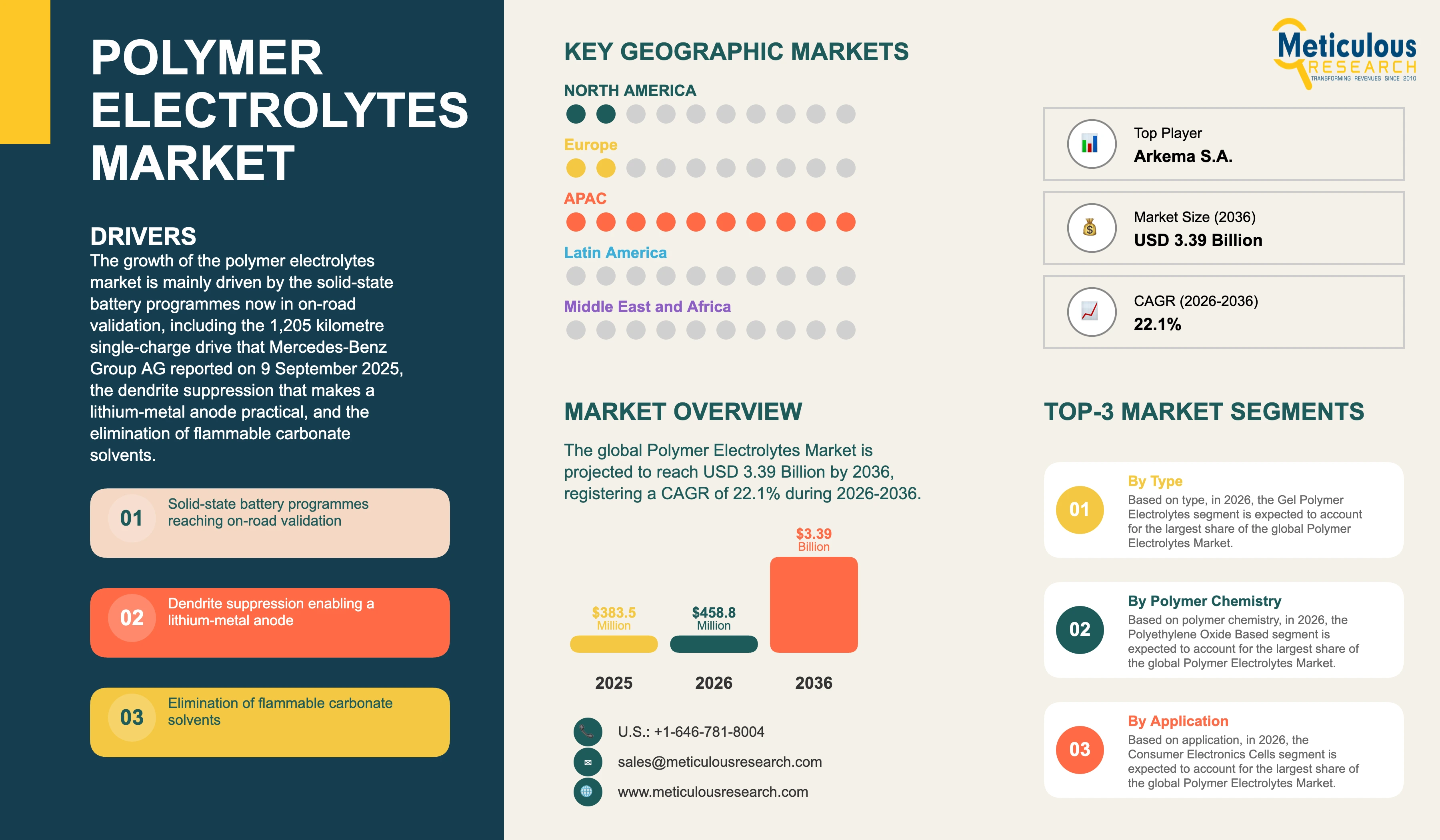
The global polymer electrolytes market was valued at USD 383.5 million in 2025. This market is expected to reach USD 3.39 billion by 2036 from an estimated USD 458.8 million in 2026, registering a CAGR of 22.1% during the forecast period (2026-2036).
- Published
- Nov 2026
- Pages
- 256
- Format
- PDF + Excel
- Report ID
- MRCHM - 1042677
- Base year
- 2025
- 2025 · BASELINE
- $383.5M
- 2036
- $3.39B
- CAGR 2026–2036
- 22.1%
2025 baseline · 2026–2036 forecast at 22.1% CAGR · hover a bar for the value
Key highlights
The global polymer electrolytes market is estimated at USD 458.8 million in 2026 and is projected to reach USD 3.39 billion by 2036.
Market volume is estimated at 7, 400.00 tonnes in 2026 and is projected to reach 77,022.68 tonnes by 2036 at a CAGR of 26.4%, measured as polymer electrolyte system supplied.
The average selling price is estimated at USD 62.00 per kg in 2026 and is projected to reach USD 44.00 per kg by 2036.
Gel polymer electrolytes are expected to account for the largest type share in 2026, while composite polymer-ceramic electrolytes are projected to register the highest CAGR of 34.0%.
Polyethylene oxide based chemistries are expected to hold the largest chemistry share in 2026, while other chemistries including polycarbonate and polysiloxane are projected to grow fastest at a CAGR of 30.8%.
Consumer electronics cells are expected to be the largest application in 2026, while electric vehicle cells are projected to register the highest CAGR of 32.4%.
Asia-Pacific is expected to hold the largest regional share in 2026, while Europe is projected to register the highest CAGR of 30.0%.
Mercedes-Benz Group AG reported on 9 September 2025 that a lightly modified EQS test vehicle fitted with a lithium-metal solid-state battery had covered 1,205 kilometres on a single charge.
The drive took place at the end of August 2025 from Stuttgart to Malmo via the A7 and E20 through Germany and Denmark, without ferries and with no charging stops.
The vehicle arrived with 137 kilometres of range remaining.
The company states that the trip exceeded the distance covered by the Vision EQXX from Stuttgart to Silverstone by three kilometres.
The battery system was developed with Mercedes-AMG High Performance Powertrains, and the lithium-metal cells are supplied by Factorial Energy of the United States.
The company names the electrolyte technology as FEST, Factorial Electrolyte System Technology, and does not state whether the electrolyte is polymer based.
Usable energy content rose 25% while the weight and size of the battery remained comparable to the standard EQS battery.
The work forms part of a validation programme covering digital simulation, bench testing at Stuttgart-Unterturkheim and Sindelfingen, and public road testing, with series production targeted by the end of the decade.
Blue Solutions announced on 17 May 2024 an investment of more than EUR 2.2 billion in France, with an initial pilot line in the Quimper Bretagne Occidentale area of Brittany.
The gigafactory could reach 25 GWh per year in the long term, equivalent to approximately 250,000 vehicles annually, with nearly 1,500 jobs by 2032 and Gen4 production possibly in Alsace by 2030.
This market excludes the lithium salt where it is supplied separately, which falls within the lithium salt electrolytes market, so the two are not additive.
Report summary
| Particulars | Details |
|---|---|
| Base Year | 2025 |
| Forecast Period | 2026-2036 |
| Market Size in 2025 | USD 383.5 million |
| Market Size in 2026 | USD 458.8 million |
| Market Size by 2036 | USD 3.39 billion |
| Value CAGR (2026-2036) | 22.1% |
| Format | PDF, Excel & Cloud Portal · 256 pages |
| Volume in 2026 | 7,400.00 tonnes |
| Volume by 2036 | 77,022.68 tonnes |
| Volume CAGR (2026-2036) | 26.4% |
| Volume Basis | Polymer electrolyte system supplied, meaning the polymer matrix with the lithium salt and any additives incorporated |
| Average Selling Price in 2026 | USD 62.00 per kg |
| Average Selling Price by 2036 | USD 44.00 per kg |
| Commercialisation Status | Gel polymer electrolytes are in volume production in consumer electronics pouch cells, while solid polymer and composite polymer-ceramic systems are in development and pilot manufacture, with automotive series production targeted toward the end of the decade |
| Measurement Basis | Gel polymer, solid polymer and composite polymer-ceramic electrolytes, measured as the system supplied, and excluding liquid carbonate electrolytes, purely inorganic sulfide and oxide solid electrolytes, separators and coated separators, ionic liquids supplied as such, proton exchange and anion exchange membranes for fuel cells and electrolysers, and the lithium salt where it is supplied separately into a formulation |
| Relationship to Adjacent Markets | The lithium salt is included only where it is supplied already incorporated in a finished polymer electrolyte system; where the salt is sold separately to a cell maker or formulator it falls within the lithium salt electrolytes market, so the two markets are not additive and divide at the point of sale |
| Largest Type | Gel polymer electrolytes |
| Fastest-Growing Type | Composite polymer-ceramic (CAGR 34.0%) |
| Largest Polymer Chemistry | Polyethylene oxide based |
| Fastest-Growing Polymer Chemistry | Other chemistries including polycarbonate and polysiloxane (CAGR 30.8%) |
| Largest Application | Consumer electronics cells |
| Fastest-Growing Application | Electric vehicle cells (CAGR 32.4%) |
| Largest Region | Asia-Pacific |
| Fastest-Growing Region | Europe (CAGR 30.0%) |
| Segments Covered | Type, Polymer Chemistry, Application, and Geography |
| Geographies Covered | Asia-Pacific, Europe, North America, Latin America, and Middle East & Africa |
| Companies Profiled | 10 companies, including Arkema S.A., Syensqo SA, Daikin Industries, Ltd., Kureha Corporation, Zeon Corporation, and Factorial Inc. |
Report overview
Segments covered: type, polymer chemistry, application.
In volume terms, this market is estimated at 7,400.00 tonnes in 2026 and is projected to reach 77,022.68 tonnes by 2036, registering a CAGR of 26.4% during the same period, measured as polymer electrolyte system supplied, meaning the polymer matrix with the lithium salt and any additives incorporated. The average selling price is estimated at USD 62.00 per kg in 2026 and is projected to decline to USD 44.00 per kg by 2036 as production moves from specialty batch quantities to continuous manufacture at cell-plant scale.
The growth of this market is mainly driven by the solid-state battery programmes now in on-road validation, including the lithium-metal test vehicle that Mercedes-Benz Group AG reported on 9 September 2025 as having covered 1,205 kilometres on a single charge, the suppression of dendrite growth that a solid or gelled matrix provides against a free liquid, the elimination of the flammable carbonate solvents that govern cell safety engineering, and the form factor freedom that a conformable electrolyte allows in wearable and medical devices. However, factors such as the ionic conductivity of polymer systems at ambient temperature, the interfacial resistance between a solid polymer and the electrode surfaces, the absence of manufacturing equipment and process knowledge at cell-plant scale, and the non-disclosure of electrolyte composition in the programmes that would otherwise signal demand are expected to restrain the growth of this market to some extent.
Gel polymer electrolytes account for the largest share of this market because they are already in volume production in the pouch cells used across consumer electronics, where a gelled matrix delivers conductivity close to a liquid while permitting a thin flexible package. Composite polymer-ceramic electrolytes grow fastest because adding an inorganic phase raises conductivity and mechanical strength together, which is the combination that an automotive cell requires.
A polymer electrolyte conducts lithium ions through a polymer matrix rather than through a free liquid, either as a gel in which a solvent and salt are immobilised in the polymer or as a solid in which the polymer itself carries the ions. Market sizing in this report is on both a value basis in USD and a volume basis in tonnes measured as polymer electrolyte system supplied, meaning the polymer matrix with the lithium salt and any additives incorporated, with average selling price derived from the two. The measurement basis covers gel polymer, solid polymer and composite polymer-ceramic electrolytes, and it excludes liquid carbonate electrolytes, purely inorganic sulfide and oxide solid electrolytes, separators and coated separators, ionic liquids supplied as such, proton exchange and anion exchange membranes for fuel cells and electrolysers, and the lithium salt where it is supplied separately into a formulation.
Excluding the separately supplied salt matters because a polymer electrolyte is a salt dissolved in a polymer, and the salt is often bought by the cell maker or the electrolyte formulator as its own product. Counting it here as well as in the lithium salt electrolytes market would value the same material twice. Where a supplier delivers a finished polymer electrolyte with the salt already incorporated, the whole system falls in this market, and the two markets therefore divide along the point of sale rather than along chemistry.
Mercedes-Benz Group AG reported on 9 September 2025 that a lightly modified EQS test vehicle fitted with a lithium-metal solid-state battery covered 1,205 kilometres on a single charge at the end of August 2025, running from Stuttgart to Malmo via the A7 and E20 through Germany and Denmark without ferries or charging stops and arriving with 137 kilometres of range remaining. The battery system was developed with Mercedes-AMG High Performance Powertrains and the lithium-metal cells are supplied by Factorial Energy. Usable energy content rose 25% at comparable weight and size, within a validation programme covering simulation, bench testing at Stuttgart-Unterturkheim and Sindelfingen and road testing, with series production targeted by the end of the decade.
The company names the electrolyte technology as FEST, Factorial Electrolyte System Technology, and does not state whether that electrolyte is polymer based. That non-disclosure is itself the central commercial feature of this market. Solid-state demonstrations are reported in terms of range, energy content and production dates, while the electrolyte family behind them is treated as proprietary, which means a materials supplier cannot read a demonstration as demand for polymer rather than for sulfide or oxide. Programme news therefore establishes that solid-state cells are advancing without establishing which electrolyte market will supply them.
Blue Solutions announced on 17 May 2024 an investment of more than EUR 2.2 billion in France, covering an initial pilot line in the Quimper Bretagne Occidentale area of Brittany and a gigafactory that could reach 25 GWh per year in the long term, equivalent to approximately 250,000 vehicles annually, with nearly 1,500 jobs by 2032 and Gen4 production possibly in Alsace by 2030. The company states that Gen4 batteries would offer 40% more autonomy than the maximum capacities currently estimated for lithium-ion, and that it is the only company making this type of battery at industrial scale. The French State and the Brittany and Grand Est Regions back the projects, which are tied to the France 2030 objective of close to 2 million electric vehicles a year and supported by the green industries investment tax credit.
That announcement describes the batteries as solid-state lithium-metal rather than as lithium-metal polymer, and gives no electrolyte composition, which is the same disclosure boundary. What it does establish is scale and public commitment: a figure above EUR 2.2 billion with state and regional backing and a long-term capacity of 25 GWh is a European manufacturing base for solid-state cells on a dated path, with Gen4 production possibly from 2030 and the employment target set at 2032. Both dates fall inside the forecast period.
Conductivity at ambient temperature is the technical problem that has governed this market for decades. Polyethylene oxide conducts lithium ions well above its melting range and poorly below it, which is why the earliest commercial lithium metal polymer batteries were operated heated, and heating a vehicle battery costs energy, adds hardware and complicates thermal management. Gel systems avoid the problem by retaining a solvent, at the cost of retaining its flammability. Composite systems address it by adding an inorganic phase, and consequently register the highest type CAGR at 34.0%.
Dendrite suppression is what makes a lithium-metal anode practical, and it is the reason this market exists rather than a refinement of it. Plating lithium metal in a liquid electrolyte grows filaments that eventually bridge the cell and short it, while a mechanically stiff electrolyte resists that growth physically as well as electrochemically. A lithium-metal anode is also what delivers the energy density that justifies the change, so the electrolyte and the anode advance together. Electric vehicle cells consequently register the highest application CAGR at 32.4%.
Gel polymer systems are the commercial reality of this market today rather than its future. The pouch cells used across phones, tablets, laptops, wearables and power tools immobilise a carbonate solvent in a polymer matrix, which permits a thin flexible package without a rigid can while delivering conductivity close to a free liquid. That business is established, high volume and price-competitive, and it is the reason consumer electronics cells hold the largest application share while growing at a far lower rate than the automotive segment.
Manufacturing rather than chemistry is what will decide the timing of solid-state adoption. A gel electrolyte is introduced into a conventional cell line, while a solid polymer film has to be cast, handled, laminated to electrodes and kept free of pinholes across square kilometres of material, and the equipment and process knowledge for that at cell-plant scale do not yet exist in volume. This is why pilot lines such as the one announced for Brittany matter more than laboratory conductivity results. The average selling price falls across the period as that transition occurs.
Asia-Pacific is expected to account for the largest share in 2026, on the concentration of pouch cell manufacturing in China, Japan and South Korea and the specialty polymer production supplying it. South Korea is projected to grow at 23.6%, Japan at 22.4% and China at 18.8%.
Europe is projected to register the highest CAGR of 30.0% during the forecast period, with France at 33.2%, Germany at 31.0% and the United Kingdom at 26.0%.
Europe is the fastest-growing region at a CAGR of 30.0%, on the solid-state manufacturing capacity being built with public support including the investment of more than EUR 2.2 billion that Blue Solutions announced on 17 May 2024, the on-road validation programmes of the German vehicle manufacturers, and the specialty fluoropolymer production already located in the region.
The Middle East & Africa is projected to grow at a CAGR of 17.0% and Latin America at a CAGR of 19.0%, both from very small bases and principally on consumer device assembly and stationary storage rather than on cell or materials manufacture.
Arkema S.A., Syensqo SA, Daikin Industries, Ltd., Kureha Corporation and Zeon Corporation together accounted for an estimated 46.8% of this market in 2026. The 10 companies profiled in this report together accounted for an estimated 68.2% of merchant supply, with a further share of the technology held captive within cell developers.
Report infographic
Market dynamics
15 factors across 5 forcesSolid-State Battery Programmes Reaching On-Road Validation
Mercedes-Benz Group AG reported on 9 September 2025 that a lightly modified EQS test vehicle with a lithium-metal solid-state battery covered 1,205 kilometres on a single charge from Stuttgart to Malmo, arriving with 137 kilometres remaining, with usable energy content up 25% at comparable weight and size and series production targeted by the end of the decade. On-road validation is a different signal from a laboratory result because it commits engineering organisations and supplier qualification programmes to dates. The driver acts on the credibility of the timeline rather than on volumes already being bought.
The programmes also pull materials development forward by fixing a date. Once a manufacturer states a production target, electrolyte suppliers, equipment makers and electrode producers work to that schedule rather than to their own, which compresses development that would otherwise run at research pace.
Dendrite Suppression Enabling a Lithium-Metal Anode
Plating lithium metal in a liquid electrolyte grows filaments that eventually bridge the cell and short it, while a mechanically stiff polymer or composite electrolyte resists that growth physically as well as electrochemically, and the lithium-metal anode is what delivers the energy density that justifies changing the electrolyte at all. The two therefore advance together rather than independently. A cell maker adopting lithium metal has no liquid option, which makes the electrolyte choice a condition of the anode. Electric vehicle cells register the highest application CAGR at 32.4%.
The relationship also sets the order in which this market grows. Polymer and composite electrolyte demand follows lithium-metal anode adoption rather than cell production generally, so the forecast depends on how quickly lithium-metal cells enter series production rather than on electric vehicle volumes alone, and a programme that reaches production with a graphite or silicon anode creates no demand for this material at all.
Elimination of Flammable Carbonate Solvents
Conventional lithium-ion cells carry an organic carbonate solvent whose flashpoint governs the thermal runaway behaviour that pack design, cooling and enclosure engineering exist to contain, and a solid polymer electrolyte removes that solvent entirely while a gel immobilises it. Removing the fuel changes what a pack has to be built to survive rather than merely improving its margin, which allows mass and cost to be taken out of structures rather than added to them. Safety requirements for vehicle batteries continue to tighten in every major market. The saving therefore appears at pack level rather than at cell level.
Regulatory and insurance pressure acts on the same point. Pack-level fire and propagation requirements continue to be tightened, and a chemistry that removes the fuel rather than containing it addresses those requirements at source, which is an argument that carries weight with approval authorities as well as with engineers.
Form Factor Freedom in Wearable and Medical Devices
A gel or solid polymer electrolyte holds its shape without a rigid containment, which allows a cell to be thin, curved or conformal in a way a liquid-filled can cannot, and devices worn on the body or implanted have shapes set by anatomy rather than by battery geometry. The same property removes the leak path that liquid electrolytes present in a device in contact with skin or tissue. Price sensitivity in these applications is low relative to the design benefit. Medical and wearable devices therefore take polymer electrolytes well ahead of cost parity.
These applications also serve as a qualification route into the larger ones. A supplier producing to medical standards at modest volume accumulates the manufacturing and documentation record that automotive qualification later requires, which makes the segment strategically larger than its tonnage and explains why specialty suppliers pursue it ahead of the automotive opportunity.
Table of contents
11 chapters · 132 sections · 256 pages · click to expandSegmental analysis
| Segment | Largest share (2026) | Fastest growth (2026–2036) |
|---|---|---|
| By Type | Gel polymer electrolytes | — |
| Other segments | — | Composite polymer-ceramic electrolytes |
| By Polymer Chemistry | — | — |
By Type
- Gel polymer electrolytes are expected to account for the largest share in 2026, on volume production already established in consumer electronics pouch cells and compatibility with conventional cell lines.
- Polyethylene oxide based chemistries are expected to hold the largest share in 2026, on the longest commercial history of any polymer electrolyte chemistry and the ability of the ether backbone to dissociate and coordinate lithium salts.
- Consumer electronics cells are expected to account for the largest share in 2026, on pouch cells using gel polymer electrolytes being in volume production across phones, tablets, laptops, wearables and power tools.
Other segments
- Composite polymer-ceramic electrolytes are projected to register the highest CAGR of 34.0% during the forecast period.
- Electric vehicle cells are projected to register the highest CAGR of 32.4% during the forecast period.
By Polymer Chemistry
- Other chemistries, covering polycarbonate, polysiloxane, polyester and emerging backbones, are projected to register the highest CAGR of 30.8% during the forecast period.
Geographic analysis
Asia-Pacific
Largest shareIn 2026, Asia-Pacific is expected to account for the largest share of the global polymer electrolytes market. The large share of this region is mainly due to the concentration of pouch cell manufacturing for consumer electronics in China, Japan and South Korea, the specialty polymer production supplying those cells, and the solid-state development programmes of the regional cell makers and vehicle manufacturers. South Korea is projected to register a CAGR of 23.6%, Japan a CAGR of 22.4% and China a CAGR of 18.8% during the forecast period.
Europe
Fastest growthHowever, Europe is projected to register the highest CAGR of 30.0% during the forecast period. The rapid growth of this region is attributed to the solid-state manufacturing capacity being built with public support, including the investment of more than EUR 2.2 billion that Blue Solutions announced on 17 May 2024 with a pilot line in Brittany and a long-term capacity of 25 GWh per year, the on-road validation programmes of the German vehicle manufacturers, and the specialty fluoropolymer and polymer production already located in the region. France is projected to register a CAGR of 33.2%, Germany a CAGR of 31.0% and the United Kingdom a CAGR of 26.0%.
North America
North America is projected to grow at 28.0%, with the United States at 28.4%, on the solid-state cell developers based there, including the supplier of the lithium-metal cells used in the Mercedes-Benz test vehicle, and on the cell capacity under construction.
Latin America
Latin America is projected to grow at 19.0% and the Middle East & Africa at 17.0%, both from very small bases and principally on consumer device assembly and stationary storage rather than on cell or materials manufacture. Regional share in this market reflects where cells are assembled rather than where the polymers are made, and the two are separable. Specialty fluoropolymer and polyether production is concentrated in Europe, Japan and the United States, while cell assembly consuming gel electrolytes is concentrated in Asia-Pacific, so material moves between regions as a formulated system. Solid-state capacity now being built in Europe is the first case of the two coinciding at scale, which is part of why the regional growth rate there is the highest. That separation also explains why value and volume sit in different places. The formulated system is sold where the cells are assembled, while the margin on the specialty polymer is earned where it is made, so a regional revenue figure describes the point of sale rather than where the value was created.
Competitive landscape
The global polymer electrolytes market is characterised by the presence of specialty polymer producers supplying fluoropolymer and polyether matrices, Japanese and Korean chemical companies supplying formulated electrolyte systems to the cell makers alongside which they operate, and cell developers holding proprietary electrolyte technology that does not reach the merchant market at all. Competition is contested on qualification into a specific cell design and on processing support rather than on resin price, because a cell maker is solving a formulation and handling problem rather than buying a polymer. Arkema S.A., Syensqo SA, Daikin Industries, Ltd., Kureha Corporation and Zeon Corporation together accounted for an estimated 46.8% of this market in 2026, while the companies profiled in this report together accounted for an estimated 68.2%. These shares describe merchant supply, and a further share of the technology is held captive within cell developers.
Mercedes-Benz Group AG reported on 9 September 2025 that a lithium-metal solid-state test vehicle covered 1,205 kilometres on a single charge with cells supplied by Factorial Energy, naming the electrolyte technology as FEST without stating whether it is polymer based, and Blue Solutions announced on 17 May 2024 an investment of more than EUR 2.2 billion in France with a pilot line in Brittany, a long-term capacity of 25 GWh per year and Gen4 production possibly in Alsace by 2030. Qualification of composite polymer-ceramic formulations, construction of pilot casting and lamination capacity, and supply of formulated systems rather than base polymers accounted for most competitive activity through 2026.
Position in this market is held through qualification into a cell design rather than through materials capability alone, because displacing a qualified electrolyte means revalidating cycle life and safety on a production line. Arkema S.A., Syensqo SA, Daikin Industries, Ltd. and Kureha Corporation compete from fluoropolymer production and the casting processes already used for separators and electrodes, Zeon Corporation, Mitsui Chemicals, Inc., Ube Corporation and LG Chem Ltd. from battery materials portfolios supplied into regional cell manufacturing, and Bolloré SE and Factorial Inc. from integrated cell development. Some of the key players operating in the polymer electrolytes market are Arkema S.A. (France), Syensqo SA (Belgium), Daikin Industries, Ltd. (Japan), Kureha Corporation (Japan), Zeon Corporation (Japan), Mitsui Chemicals, Inc. (Japan), Ube Corporation (Japan), LG Chem Ltd. (South Korea), Bolloré SE (France), and Factorial Inc. (U.S.), among others.
- —
Mercedes-Benz Group AG reported on 9 September 2025 that a lightly modified EQS test vehicle fitted with a lithium-metal solid-state battery had covered 1,205 kilometres on a single charge at the end of August 2025, running from Stuttgart to Malmo via the A7 and E20 through Germany and Denmark without ferries or charging stops and arriving with 137 kilometres of range remaining, exceeding the Stuttgart to Silverstone distance of the Vision EQXX by three kilometres. The battery system was developed with Mercedes-AMG High Performance Powertrains and the lithium-metal cells are supplied by Factorial Energy, with the electrolyte technology named as FEST and no statement as to whether it is polymer based. Usable energy content rose 25% at comparable weight and size, within a validation programme covering digital simulation, bench testing at Stuttgart-Unterturkheim and Sindelfingen and public road testing, and series production is targeted by the end of the decade. Blue Solutions announced on 17 May 2024 an investment of more than EUR 2.2 billion in France, with an initial pilot line in the Quimper Bretagne Occidentale area of Brittany, a gigafactory that could reach 25 GWh per year in the long term equivalent to approximately 250,000 vehicles annually, nearly 1,500 jobs by 2032 and Gen4 production possibly in Alsace by 2030, backed by the French State and the Brittany and Grand Est Regions.
- Arkema S.A.
- Syensqo SA
- Daikin Industries, Ltd.
- Kureha Corporation
- Zeon Corporation
- Factorial Inc
Expert perspectives
Volume grows at 26.4% against 22.1% in value over the forecast period, and the average selling price falls from USD 62.00 per kg in 2026 to USD 44.00 per kg by 2036 as production moves from specialty batch quantities to continuous manufacture at cell-plant scale. The decline is scale rather than commoditisation, since the product remains qualified into a particular cell design.
The most important fact about this market is what the announcements do not say. Mercedes-Benz Group AG names the electrolyte in its 1,205 kilometre test vehicle as FEST and does not state whether it is polymer based, and Blue Solutions describes solid-state lithium-metal batteries without naming an electrolyte family. A supplier therefore cannot read solid-state progress as polymer demand, and capacity decisions have to be taken without knowing which electrolyte market a given programme will supply.
Where the revenue is and where the attention is are two different places. Gel polymer electrolytes in consumer pouch cells carry the largest application share and grow slowly, while solid and composite systems attract the programmes and the capital and grow at 34.0% and above from small bases. Reading the announcements alone would misplace both the current business and its cost structure.
What decides the timing is the factory rather than the chemistry. A gel electrolyte goes into a conventional line, while a solid film must be cast, handled and laminated free of pinholes across very large areas, and that equipment and process knowledge do not exist in volume. The pilot line announced for Brittany and the capacity targets of 25 GWh in the long term and Gen4 production possibly from 2030 are therefore better indicators than conductivity figures.
Composite formulations are the direction the market is actually taking, for a straightforward reason. A polymer alone conducts poorly at ambient temperature and a ceramic alone is brittle and hard to make in thin sheets, while a composite raises conductivity and modulus together and keeps roll-to-roll processability. The proprietary content moves into dispersion and formulation, which favours suppliers with both polymer and inorganic capability.
The risk to the forecast is that solid-state adoption resolves toward sulfide or oxide electrolytes rather than polymer, in which case the automotive growth rate in this market would not materialise even though solid-state cells reached production. The gel business in consumer electronics is not exposed to that outcome, which is why the two parts of this market should be assessed separately rather than as one growth story.
Customer perspectives
Electrolyte composition is treated as proprietary in solid-state programmes while range and production dates are published, so materials suppliers cannot determine from programme announcements which electrolyte family a given demonstration represents.
Materials investment in this market is consequently made against a judgement about which electrolyte family will prevail rather than against disclosed demand.
Scale-up risk in this market sits in film casting, handling and lamination at cell-plant throughput rather than in materials performance, which is why pilot line capability rather than laboratory conductivity governs adoption timing.
That also means a supplier is judged on demonstrated line capability rather than on data sheets, which favours companies with existing film casting operations over those with better chemistry.
Gel polymer electrolytes in consumer pouch cells are an established high-volume business competing on cost, which is a different commercial position from the development-stage solid and composite systems that attract most programme attention.
The two parts of this market therefore face different buyers with different purchasing criteria, and a cost position won in consumer cells does not transfer into an automotive qualification.
“We do not disclose the electrolyte family and neither do our suppliers, because it is the differentiator. What we publish is range and production timing. I understand that makes life difficult for materials companies, but it is not going to change.”
“Conductivity numbers are not our problem. Casting a film that thin with no pinholes, at line speed, kilometre after kilometre, is our problem. Show me that running on a pilot line and I will take the chemistry on trust.”
“Our gel cells have been in production for years and they compete on cost per watt hour like everything else. The solid-state conversation is interesting but it is not the business we are buying for this year or next.”
Frequently asked questions
This market was valued at USD 319.6 million in 2024 and USD 383.5 million in 2025, and is estimated at USD 458.8 million in 2026. In volume terms it is estimated at 7,400.00 tonnes in 2026 as polymer electrolyte system supplied.
Cite this report
Meticulous Research. (2026). Polymer Electrolytes Market - Global Opportunity Analysis and Industry Forecast (2026-2036) (Report No. MRCHM - 1042677). Meticulous Market Research Pvt. Ltd. https://www.meticulousresearch.com/product/polymer-electrolytes-market-7360