Pet Wearables Market (2026-2036)
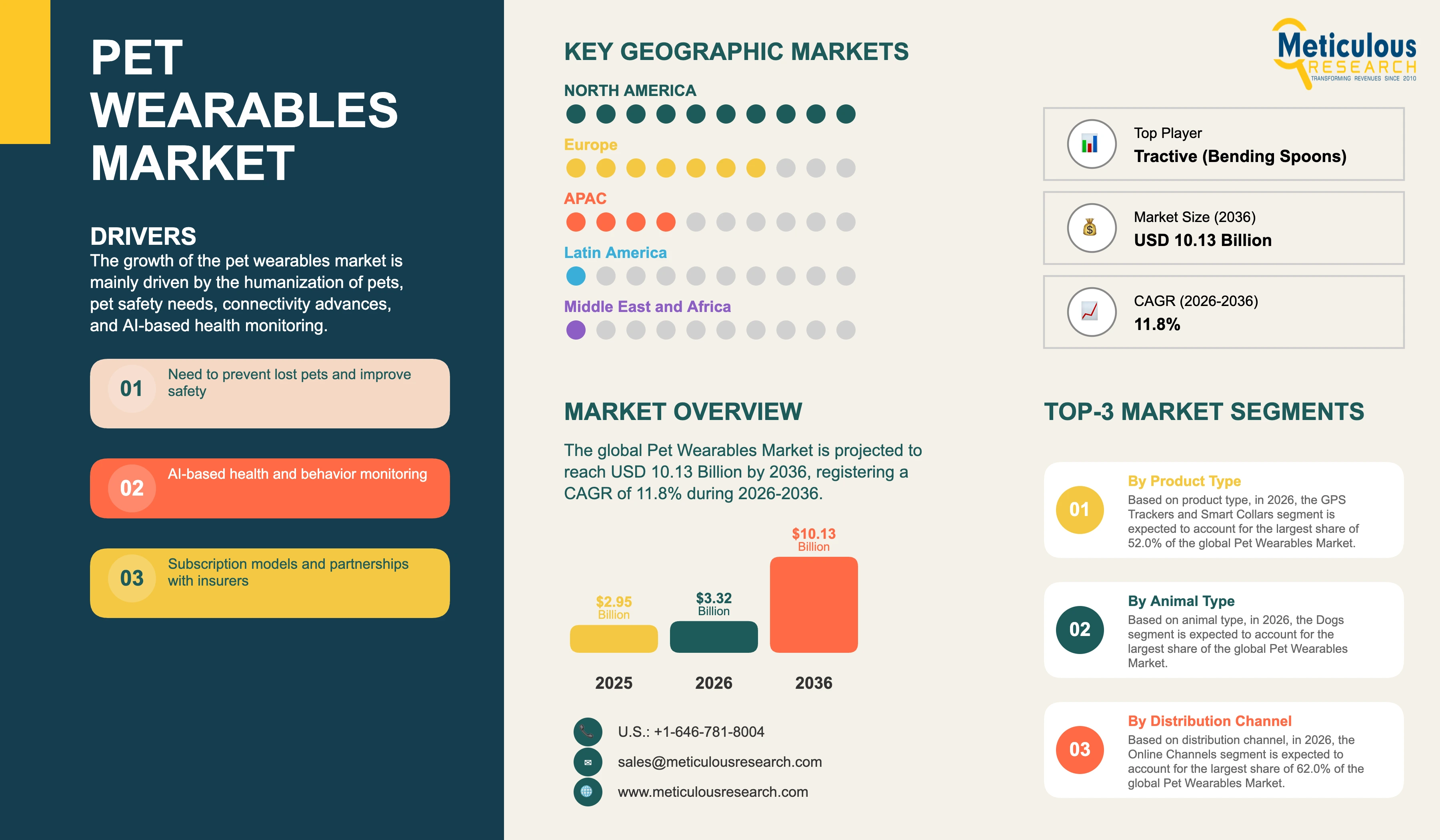
The global pet wearables market was valued at USD 2.95 billion in 2025. This market is expected to reach USD 10.13 billion by 2036 from an estimated USD 3.32 billion in 2026, registering a CAGR of 11.8% during the forecast period (2026-2036).
- Published
- Nov 2026
- Pages
- 230
- Format
- PDF + Excel
- Report ID
- MRHC - 1042623
- Base year
- 2025
- 2025 · BASELINE
- $2.95B
- 2036
- $10.13B
- CAGR 2026–2036
- 11.8%
2025 baseline · 2026–2036 forecast at 11.8% CAGR · hover a bar for the value
Key highlights
On May 18, 2026, Bending Spoons closed its acquisition of Tractive, an Austria-based leader in GPS tracking and health monitoring for pets, after the companies entered into a definitive agreement in March 2026, with Bending Spoons stating that it intends to invest significantly in Tractive's health and safety capabilities and next-generation devices, according to Tractive.
In April 2026, Tractive launched the CAT 6 Mini, its first collar-integrated GPS and health tracker designed specifically for cats, alongside the DOG 6 XL tracker and enhanced app capabilities, according to the company.
On July 8, 2026, Fi launched Fi Ultra, which the company described as the world's first dog tracker powered by T-Satellite with Starlink, allowing dogs to remain trackable outside the reach of cellular towers; Fi has raised about USD 45 million, expanded its connectivity network to 38 countries, and expects to pass USD 100 million in annual recurring revenue in 2026, according to Fi, Fortune, and The Next Web.
Fortune reported that Tractive crossed USD 100 million in annual recurring revenue in 2024 and acquired pet wearable company Whistle in August 2025, after which the Whistle product was discontinued, according to Fortune and The Next Web.
In April 2026, Halo Collar introduced Precision+, a next-generation positioning system for its Halo Collar 5 GPS fence collar, and the company has said that its system protects more than 200,000 dogs across the U.S. each day, according to Halo Collar.
In February 2026, pet insurer Wagmo partnered with Fi to offer its plan members access to Fi's GPS tracking devices, and in June 2026, Tractive partnered with Swiss digital pet insurer Calingo, reflecting the growing links between pet wearables and pet insurance. Fi also launched its products in Canada and Mexico and expanded into the U.K. and the EU in 2026, while Tractive's devices serve pet owners in many countries in Europe, North America, and other regions. Satellai also announced an AI-powered smart dog collar at CES 2026, adding to the range of new products entering the market.
By product type, GPS trackers and smart collars account for the largest share of 52.0% in 2026, while activity and health monitors register the highest CAGR.
By offering, hardware accounts for the larger share in 2026, while subscription services register the higher CAGR.
By animal type, dogs account for the largest share in 2026, while cats register the highest CAGR.
By distribution channel, online channels account for the largest share of 62.0% in 2026, while veterinary clinics register the highest CAGR.
By geography, North America accounts for the largest share of 44.0% in 2026, while Asia-Pacific registers the highest CAGR of 14.7%.
Report summary
| Particulars | Details |
|---|---|
| Base Year | 2025 |
| Estimated Year | 2026 |
| Forecast Period | 2026-2036 |
| Market Size in 2025 | USD 2.95 billion |
| Market Size in 2026 | USD 3.32 billion |
| Market Size by 2036 | USD 10.13 billion |
| CAGR (2026-2036) | 11.8% |
| Format | PDF, Excel & Cloud Portal · 230 pages |
| Largest Segment by Product Type (2026) | GPS Trackers and Smart Collars (52.0%) |
| Largest Segment by Distribution Channel (2026) | Online Channels (62.0%) |
| Largest Region (2026) | North America (44.0%) |
| Fastest-Growing Region | Asia-Pacific (CAGR 14.7%) |
| Companies Profiled | 14 companies and other companies |
| Segments Covered | Product Type, Offering, Animal Type, Distribution Channel, Geography |
| Countries Covered | U.S., Canada, Germany, U.K., France, Italy, Spain, Netherlands, Switzerland, Belgium, Sweden, Denmark, Norway, Finland, Austria, Poland, Ireland, Rest of Europe, China, Japan, India, South Korea, Australia, Indonesia, Thailand, Singapore, Malaysia, Vietnam, Philippines, Taiwan, New Zealand, Rest of Asia-Pacific, Brazil, Mexico, Argentina, Colombia, Chile, Peru, Rest of Latin America, Saudi Arabia, U.A.E., Israel, South Africa, Turkey, Egypt, Rest of Middle East & Africa |
Report overview
Segments covered: product type, offering, animal type, distribution channel.
The growth of this market is mainly driven by the humanization of pets and rising spending on pet care, the need to prevent lost pets and keep them safe, advances in GPS, cellular, and satellite connectivity, the growing use of AI-based health and behavior monitoring, the shift to subscription-based business models that combine devices with apps and services, and growing partnerships between pet wearable companies, pet insurers, and veterinary service providers. However, factors such as the cost of devices and recurring subscriptions, short battery life and connectivity limits, the risk of service discontinuation when companies exit the market, and concerns about data privacy are expected to restrain the growth of this market to some extent. Nevertheless, the large number of pets without connected devices offers a strong base for growth.
Pet wearables are electronic devices worn by pets, usually on a collar or harness, that track their location, activity, health, and behavior. The most common products are GPS trackers and smart collars that use satellite positioning and cellular connectivity to show a pet's location in real time on a smartphone app. Other products include virtual fence collars that keep dogs within boundaries set in an app, activity and health monitors that measure steps, sleep, scratching, and vital signs, and Bluetooth and RFID smart tags that help locate pets nearby or identify them.
This report covers the global pet wearables market, including GPS trackers and smart collars, virtual fence collars, activity and health monitors, Bluetooth and RFID smart tags, and other products, such as smart harnesses and connected feeding tags. The market is analyzed by product type, offering, animal type, distribution channel, and geography. Revenue includes both hardware sales and subscription services, such as cellular connectivity, app features, and health insights. General-purpose item trackers that are not designed for pets, pet cameras, and microchips implanted by veterinarians are not included.
The pet wearables market has grown rapidly as pet owners seek peace of mind about their pets' safety and health. Lost pets are a common and stressful problem, and GPS trackers allow owners to find escaped pets quickly. Leading companies have built large subscriber bases and recurring revenue, and Tractive crossed USD 100 million in annual recurring revenue in 2024, according to Fortune, and Fi expects to pass the same level in 2026. Halo Collar has said that its system protects more than 200,000 dogs across the U.S. each day.
The pet wearables market has also seen significant consolidation and investment over the past two years. Tractive acquired Whistle in August 2025 and later discontinued the Whistle product, and in 2026 Bending Spoons acquired Tractive, closing the deal in May 2026. Fi has expanded into Canada, Mexico, the U.K., and the EU, and launched a satellite-enabled tracker in July 2026. These developments show that the market is moving from a fragmented group of start-ups toward larger and better-funded players.
Most pet wearables use a subscription business model, in which owners buy a device and pay a monthly or annual fee for connectivity and app features. Typical prices in 2026 range from about USD 50 for a Tractive DOG 6 tracker plus a monthly plan to about USD 149 for a Fi Series 3+ collar plus an annual subscription and USD 599 or more for a Halo Collar 5 virtual fence collar plus a monthly plan, according to company and retail listings. Subscription revenue gives companies recurring income and funds continued product development.
Pet wearables are increasingly becoming health devices rather than only location trackers. Companies such as Tractive, Fi, and PetPace offer activity, sleep, behavior, and vital sign monitoring, and AI-based features can detect behaviors such as barking, licking, scratching, and eating. Partnerships with pet insurers, such as Wagmo and Calingo, and veterinary telehealth services, such as Halo Collar's addition of Pawp telehealth, are linking wearables with broader pet health services.
In 2026, GPS trackers and smart collars account for the largest share of the market by product type, while activity and health monitors are the fastest-growing product type. Hardware accounts for the larger share by offering, while subscription services are the faster-growing offering. Dogs are the largest animal type, while cats are the fastest-growing animal type. Online channels are the largest distribution channel, while veterinary clinics are the fastest-growing channel. North America accounts for the largest share of the market, while Asia-Pacific is the fastest-growing region.
Over the forecast period, the pet wearables market is expected to grow strongly, supported by rising pet care spending, new connectivity options such as satellite and low-power cellular networks, AI-based health monitoring, products for cats, international expansion, and partnerships with insurers and veterinary services. However, companies will need to address battery life, subscription costs, and service reliability to reach a broader group of pet owners. Retail distribution through Amazon, Chewy, and Best Buy has also helped bring pet wearables to a broad group of consumers, while direct sales through company websites and apps allow companies to offer bundled subscription plans and promotions.
North America is expected to account for the largest share of 44.0% of the market in 2026, mainly due to the large number of pet-owning households, high pet care spending, the presence of leading companies, and strong e-commerce and retail distribution.
Asia-Pacific is projected to register the highest CAGR of 14.7% during the forecast period, driven by rising pet ownership and spending, high smartphone use, strong e-commerce, and interest in health monitoring.
The report profiles 14 companies, including Tractive (Bending Spoons), Fi, Halo Collar, Garmin, Radio Systems Corporation (PetSafe), SpotOn, PetPace, Invoxia, Sure Petcare, Weenect, PitPat, FitBark, Petcube, and Satellai.
Most pet GPS trackers use cellular networks to send a pet's location to the owner's smartphone, which requires a data connection paid for through a subscription. Subscriptions also fund app features, health insights, and customer support, and they provide recurring revenue for companies.
Pet insurers are partnering with wearable companies to engage customers and promote preventive health. In 2026, Wagmo partnered with Fi to offer its members access to Fi's GPS trackers, and Tractive partnered with Swiss digital insurer Calingo. Wearable data may also support new insurance pricing models in the future.
Report infographic
Market dynamics
18 factors across 5 forcesHumanization of pets and rising pet care spending
Pet owners increasingly treat their pets as members of the family and spend more on high-quality food, veterinary care, insurance, and technology to keep them safe and healthy. Younger pet owners, including millennials and Gen Z, are comfortable using connected devices and apps in their own lives and are willing to use similar technology for their pets. This humanization of pets is a major driver of demand for pet wearables, particularly GPS trackers and health monitors.
Rising spending on pet care also supports the adoption of premium products and subscriptions. Pet owners who already pay for pet insurance, premium food, and veterinary services are more likely to see a monthly subscription for a GPS tracker or health monitor as a reasonable expense. Pet wearable companies are targeting these owners with attractive designs, easy-to-use apps, and family sharing features that allow multiple household members to follow a pet's location and activity.
Need to prevent lost pets and improve safety
Lost and escaped pets are a common problem, and finding a lost pet quickly can be critical to its safety. GPS trackers allow owners to see their pet's location in real time, set safe zones, and receive escape alerts when a pet leaves a designated area. Virtual fence collars, such as Halo Collar, allow owners to create wireless boundaries without physical fences, which is attractive for rural and suburban homes.
Safety features are often the main reason pet owners buy a wearable device, so companies continue to improve location accuracy and reliability. For example, Halo Collar introduced its Precision+ positioning system in April 2026, and Fi launched Fi Ultra with satellite connectivity in July 2026 to keep dogs trackable outside cellular coverage. Owners of dogs that are prone to escape, hunting dogs, and outdoor cats are particularly strong customers for these products.
Advances in connectivity, battery, and sensor technologies
Advances in GPS and GNSS positioning, low-power cellular networks such as LTE-M, satellite connectivity, and sensors have made pet wearables smaller, more accurate, and longer lasting. Fi's Series 3+ collar can last up to three months on a charge under favorable conditions, and the Fi Mini uses the Verizon LTE-M network, according to Fi. In July 2026, Fi launched Fi Ultra, which uses T-Satellite with Starlink to stay connected outside cellular coverage.
These technological advances improve the user experience and make wearables suitable for more pets, including smaller dogs and cats. Smaller devices with longer battery life also reduce the inconvenience of frequent charging, which has been a common complaint of pet wearable users. Tractive's CAT 6 Mini, launched in April 2026, is an example of a device designed specifically for the size and physiology of cats.
AI-based health and behavior monitoring
Pet wearables increasingly include sensors and AI algorithms that monitor activity, sleep, behavior, and vital signs. Fi's Series 3+ uses AI to detect behaviors such as barking, licking, scratching, and eating, and Tractive's newest devices include health monitoring features designed for dogs and cats. Changes in activity, sleep, or behavior can be early signs of health problems, and wearables can alert owners to contact a veterinarian.
Health monitoring adds value to wearables beyond location tracking and supports subscription revenue. Owners of older pets and pets with chronic conditions are particularly interested in health insights. Activity and health monitors are the fastest-growing product type in the market, supported by AI features and growing interest from veterinarians in data that can support diagnosis and treatment.
Subscription models and partnerships with insurers
Subscription business models provide recurring revenue for pet wearable companies and allow them to continually add new app features and services. Partnerships with pet insurers, veterinary telehealth providers, and retailers are also expanding the reach and value of wearables. In February 2026, Wagmo partnered with Fi to offer its plan members access to Fi's GPS trackers, in June 2026 Tractive partnered with Calingo, and Halo Collar added veterinary telehealth services from Pawp to its subscription plans. These partnerships make wearables part of a broader pet health ecosystem, which increases customer engagement and retention. Bundled offers that combine a device with insurance or veterinary services can also lower the effective cost of devices for owners. Insurers also see wearables as a way to engage policyholders between claims.
Table of contents
12 chapters · 180 sections · 230 pages · click to expandSegmental analysis
| Segment | Largest share (2026) | Fastest growth (2026–2036) |
|---|---|---|
| By Product Type | GPS trackers and smart collars | Activity and health monitors |
| By Offering | — | Rapid growth of this |
| By Animal Type | Dogs | Cats |
| By Distribution Channel | Online channels | Veterinary clinics |
| Other segments | Online channels | Veterinary clinics |
By Product Type
- Pet Wearables Market Analysis by Product Type
- The GPS trackers and smart collars segment is expected to account for the largest share of 52.0% of the global pet wearables market.
- The large share of this segment is mainly due to the strong demand from pet owners for real-time location tracking to prevent and recover lost pets, the large subscriber bases of leading companies such as Tractive and Fi, the availability of products at a wide range of prices, the addition of activity and health features to GPS devices, and the strong distribution of these products through online channels and retailers.
- GPS trackers and smart collars are used mainly for dogs, but products for cats are growing.
- Leading products in this segment include Tractive's DOG 6 and CAT 6 Mini, Fi's Series 3+, Fi Mini, and Fi Ultra, and products from Garmin, Invoxia, Weenect, and PitPat.
- Companies are improving battery life, location accuracy, and connectivity, and are adding satellite connectivity, as shown by Fi's July 2026 launch of Fi Ultra.
- The growth of this segment is expected to remain strong over the forecast period.
- However, the activity and health monitors segment is projected to register the highest CAGR during the forecast period.
- The rapid growth of this segment is driven by growing interest among pet owners in monitoring their pets' health and wellbeing, the use of AI to detect behaviors and health changes, growing interest from veterinarians in remote monitoring data, the needs of owners of older pets and pets with chronic conditions, and partnerships with insurers and telehealth services.
- Companies such as PetPace focus on clinical-grade vital sign monitoring, while FitBark and Sure Petcare offer activity monitors.
- Many GPS trackers also include health monitoring features, which blurs the line between product types.
- The virtual fence collars segment accounts for a significant share of the market and includes products such as Halo Collar and SpotOn, which combine GPS tracking with wireless boundaries and training features.
- These products command high prices and are popular in rural and suburban areas of North America.
- The Bluetooth and RFID smart tags segment includes low-cost tags that help locate pets nearby or identify them, while the other products segment includes smart harnesses, connected feeding tags, and other devices.
- Companies are expected to launch more devices for cats and small dogs, which will help expand the market beyond its traditional base of medium and large dogs.
- Price competition is also expected to increase in basic GPS trackers, while premium products with health and satellite features command higher prices.
- Waterproof and durable designs remain important buying factors.
By Offering
- Pet Wearables Market Analysis by Offering
- The hardware segment is expected to account for the larger share of the global pet wearables market.
- The large share of this segment is mainly due to the upfront cost of devices, including GPS trackers, smart collars, virtual fence collars, and health monitors, the high prices of premium products such as virtual fence collars, the regular replacement of devices due to wear, damage, and new product generations, and the large number of new customers buying devices each year.
- Hardware sales also include accessories such as collars, charging docks, and replacement bands.
- However, the subscription services segment is projected to register the higher CAGR during the forecast period.
- The rapid growth of this segment is driven by the growing installed base of connected devices, the addition of premium features such as health insights, AI-based behavior detection, satellite connectivity, and veterinary telehealth to subscription plans, and the strategy of leading companies to build recurring revenue.
- Both Tractive and Fi have reported strong growth in recurring subscription revenue, according to Fortune.
- Subscription revenue is expected to account for a growing share of the market as companies add more services and as device prices fall.
- Bundled offers with pet insurers and veterinary services are also expected to increase the value of subscriptions and improve customer retention, which is critical for the long-term profitability of pet wearable companies.
- Annual plans with discounts also help reduce churn.
By Animal Type
- Pet Wearables Market Analysis by Animal Type
- The dogs segment is expected to account for the largest share of the global pet wearables market.
- The large share of this segment is mainly due to the large number of pet dogs in North America, Europe, and other regions, the higher risk of escape and loss among dogs that spend time outdoors, the strong demand for GPS tracking, virtual fences, and activity monitoring among dog owners, and the focus of most pet wearable companies on products for dogs.
- Virtual fence collars and many smart collars are designed specifically for dogs, including small and large breeds.
- However, the cats segment is projected to register the highest CAGR during the forecast period.
- The rapid growth of this segment is driven by the large population of pet cats and their low adoption of wearables, the launch of products designed specifically for cats, such as Tractive's CAT 6 Mini in April 2026, growing interest among cat owners in tracking outdoor cats and monitoring health, and improvements in device size, weight, and battery life.
- The other companion animals segment includes wearables for horses, rabbits, and other animals, which accounts for a small share of the market.
- Owners of small dog breeds are also an important growth group, as device sizes fall.
- Cat owners also value lightweight designs and safety release collars.
- The dogs segment is expected to account for the largest share of the pet wearables market, while the cats segment is projected to register the highest CAGR during the forecast period.
By Distribution Channel
- Pet Wearables Market Analysis by Distribution Channel
- The online channels segment is expected to account for the largest share of 62.0% of the global pet wearables market.
- The large share of this segment is mainly due to the strong direct-to-consumer sales of leading companies through their own websites and apps, the importance of e-commerce platforms such as Amazon and Chewy in pet product sales, the ability of online channels to offer subscription plans and bundled offers, and the strong digital marketing of pet wearable companies.
- Online channels also allow companies to reach customers in many countries without building physical retail networks, which supports international expansion.
- However, the veterinary clinics segment is projected to register the highest CAGR during the forecast period.
- The rapid growth of this segment is driven by growing interest among veterinarians in using wearable data for remote monitoring and early detection of health problems, partnerships between wearable companies and veterinary groups and insurers, and the trust pet owners place in their veterinarians' recommendations.
- The pet specialty stores segment accounts for a significant share and includes large pet retail chains that sell wearables alongside other pet products, while the consumer electronics and mass retail segment includes electronics retailers, such as Best Buy, and mass merchandisers that offer pet wearables to a broad customer base.
- Companies are also expected to expand their presence in physical retail to increase brand awareness among first-time buyers.
Other segments
- The online channels segment is expected to account for the largest share of 62.0% of the pet wearables market, while the veterinary clinics segment is projected to register the highest CAGR during the forecast period.
Geographic analysis
North America
Largest shareIn 2026, North America is expected to account for the largest share of 44.0% of the global pet wearables market. The large share of this region is mainly due to the large number of pet-owning households in the U.S. and Canada, high spending on pet care, the strong presence of companies such as Fi, Halo Collar, Garmin, SpotOn, and PetSafe, the popularity of virtual fence collars in rural and suburban areas, high smartphone adoption, and strong e-commerce and retail distribution through Amazon, Chewy, and Best Buy. The U.S. is also the first market for many new products, such as Fi Ultra, launched in July 2026. Partnerships with pet insurers, such as the February 2026 partnership between Wagmo and Fi, also support adoption in the region.
Asia-Pacific
Fastest growthAsia-Pacific is projected to register the highest CAGR of 14.7% during the forecast period. The rapid growth of this region is mainly driven by rising pet ownership and pet care spending in China, Japan, South Korea, Australia, and other countries, the humanization of pets among younger urban consumers, high smartphone use, strong e-commerce platforms, and growing interest in health and activity monitoring for pets living in apartments. Local electronics manufacturers in China and other countries offer competitively priced devices, which supports broad adoption. Japan and South Korea have aging pet populations, which supports demand for health monitoring devices.
Europe
Europe accounts for a significant share of the market and is an important center of pet wearable innovation, supported by the strong presence of Tractive, which is headquartered in Austria, and other European companies, such as Invoxia and Weenect in France and PitPat in the U.K. High pet ownership in Germany, the U.K., France, Italy, and the Nordic countries supports demand for GPS trackers and health monitors. Fi's expansion into the U.K. and the EU in 2026 and Tractive's partnership with Calingo in Switzerland are expected to increase competition and adoption in the region.
Latin America
Latin America and the Middle East & Africa account for smaller shares of the market but offer growth potential. In Latin America, Brazil, Mexico, Argentina, and Chile have large pet populations and growing pet care spending, and Fi launched in Mexico in 2026.
Middle East & Africa
In the Middle East & Africa, rising pet ownership in the U.A.E., Saudi Arabia, Israel, and South Africa is creating demand for pet wearables, although adoption is still at an early stage. Improvements in cellular networks and e-commerce distribution are expected to support growth in these regions over the forecast period. Lower-priced devices and flexible subscription plans will be important for reaching price-sensitive consumers in these markets, along with partnerships with local retailers and veterinary clinics. Regional differences in pet ownership, pet care spending, cellular network coverage, smartphone use, and retail distribution shape the demand for pet wearables around the world, and companies are adapting their products, apps, and pricing to the needs of each region and its pet owners.
Competitive landscape
The global pet wearables market is moderately consolidated, with the top five players estimated to account for about half of the market in 2025. The market is led by Tractive, now owned by Bending Spoons, Fi, and Halo Collar, followed by Garmin, PetSafe, SpotOn, and a large number of smaller companies and regional players.
Tractive is the largest player in GPS tracking, with a strong presence in Europe and North America, and crossed USD 100 million in annual recurring revenue in 2024, according to Fortune. Fi offers the Series 3+, Fi Mini, and Fi Ultra smart collars and trackers and expects to pass USD 100 million in annual recurring revenue in 2026. Halo Collar leads in GPS virtual fence collars, Garmin offers tracking and training systems for sporting and hunting dogs, and Radio Systems Corporation's PetSafe and SpotOn offer containment and tracking products. PetPace, Invoxia, Sure Petcare, Weenect, PitPat, FitBark, Petcube, and Satellai offer GPS trackers, activity monitors, and health monitoring devices.
Companies in this market compete on location accuracy, battery life, device size and design, connectivity coverage, health and behavior features, app quality, subscription pricing, customer service, and partnerships. Key strategies include launching new devices for cats and small dogs, adding AI-based health features, expanding connectivity through satellite and international cellular partnerships, entering new countries, partnering with insurers and veterinary services, and building recurring subscription revenue.
Recent competitive activity in the pet wearables market has included major acquisitions and product launches. Bending Spoons acquired Tractive in 2026, closing the deal in May, after Tractive acquired Whistle in 2025. Tractive launched the CAT 6 Mini and DOG 6 XL in April 2026, Fi launched Fi Ultra with satellite connectivity in July 2026 and expanded into the U.K. and the EU, Halo Collar introduced Precision+ in April 2026 and added veterinary telehealth services, and Satellai announced an AI-powered smart dog collar at CES 2026.
We expect competition to intensify as leading companies invest in health features, satellite connectivity, and international expansion, while consolidation continues among smaller companies. Partnerships with insurers and veterinary services are expected to become an important competitive differentiator.
Some of the key players operating in the pet wearables market are Tractive GmbH (Bending Spoons), Fi (Barking Labs, Inc.), Halo Collar (Protect Animals With Satellites, LLC), Garmin Ltd., Radio Systems Corporation (PetSafe), SpotOn Fence, PetPace LLC, Invoxia SAS, Sure Petcare (MSD Animal Health), Weenect, PitPat Ltd., FitBark Inc., Petcube Inc., and Satellai, among others. Customer service quality also influences brand loyalty.
- —
Bending Spoons closed its acquisition of Tractive in May 2026, Tractive launched the CAT 6 Mini for cats in April 2026, Fi launched the satellite-enabled Fi Ultra in July 2026, and Halo Collar introduced Precision+ in April 2026.
- Tractive GmbH · Bending Spoons
- Fi (Barking Labs, Inc.)
- Garmin Ltd.
- Radio Systems Corporation (PetSafe)
- SpotOn Fence
- PetPace LLC
- Invoxia SAS
- Sure P
Expert perspectives
The pet wearables market is entering a new stage of maturity, scale, and technological development. After years of growth led by start-ups, leading companies have built large subscriber bases and recurring revenue, and consolidation has accelerated with Tractive's acquisition of Whistle in 2025 and Bending Spoons' acquisition of Tractive in 2026. At the same time, new technologies, such as satellite connectivity and AI-based health monitoring, are expanding what pet wearables can do.
Over the forecast period, the market is expected to grow at a CAGR of 11.8%, from USD 3.32 billion in 2026 to USD 10.13 billion in 2036. Growth will be supported by the humanization of pets, demand for pet safety, advances in connectivity and sensors, AI-based health monitoring, products for cats, subscription services, partnerships with insurers and veterinary services, and expansion in Europe and Asia-Pacific.
Among the market segments, GPS trackers and smart collars are the largest product type, while activity and health monitors grow fastest. Hardware accounts for the larger share by offering, while subscription services grow faster, and dogs are the largest animal type, while cats grow fastest. Online channels are the largest distribution channel, while veterinary clinics grow fastest. North America is the largest region, and Asia-Pacific is the fastest-growing region at a CAGR of 14.7%.
In our view, the most important factor for the market over the forecast period will be the shift from location tracking to health monitoring. Wearables that provide reliable and clinically useful health insights can become part of routine pet care, supported by veterinarians and insurers, which would significantly expand the market and increase subscription revenue. Clinical validation and integration with veterinary systems will be key to achieving this.
We also expect connectivity improvements, particularly satellite fallback and low-power cellular networks, to improve reliability and battery life, which addresses two of the most common customer concerns. However, companies will need to manage subscription costs carefully to avoid churn, and to provide long-term support commitments to reassure customers after the discontinuation of Whistle. Cat-specific products are also expected to become an important source of growth.
Overall, we believe the pet wearables market will grow strongly over the forecast period, with health monitors, subscription services, cats, veterinary channels, and Asia-Pacific providing the fastest growth. Companies that combine reliable devices with valuable services and strong partnerships will be best positioned to capture this growth. We also expect partnerships with insurers and veterinary groups to become a major channel for growth, as these partners can help reduce the effective cost of devices and increase trust in health features among pet owners.
Customer perspectives
Dog Owner - U.S.
Our dog escaped from the backyard twice before we finally bought a GPS collar for him. Now we get an alert as soon as he leaves the yard, and the app shows us exactly where he is.
Veterinarian - U.K.
Activity and sleep data from wearables can help us spot problems earlier, especially in older pets, but we need data we can trust.
“Earlier trackers were too big for our cat. The new smaller devices are comfortable, and I like seeing how active she is each day.”
Frequently asked questions
The global pet wearables market was valued at USD 2.95 billion in 2025, up from USD 2.62 billion in 2024, and is estimated at USD 3.32 billion in 2026. The market includes hardware and subscription service revenues for GPS trackers, smart collars, virtual fence collars, health monitors, and smart tags.
The global pet wearables market is expected to reach USD 10.13 billion by 2036, supported by the humanization of pets, pet safety, connectivity advances, AI-based health monitoring, cat products, subscription services, and expansion in Europe and Asia-Pacific.
The market is expected to register a CAGR of 11.8% from 2026 to 2036.
Market growth is mainly driven by the humanization of pets and rising pet care spending, the need to prevent lost pets and improve safety, advances in connectivity, battery, and sensor technologies, AI-based health and behavior monitoring, and subscription models and partnerships with insurers.
The cost of devices and subscriptions and battery life, connectivity limits, and service discontinuation risk restrain growth, while data privacy and security concerns and competition and consolidation are key challenges.
Key growth opportunities include products designed for cats, integration with veterinary care and pet insurance, satellite connectivity and outdoor applications, and expansion in Europe and Asia-Pacific.
GPS trackers and smart collars are expected to account for the largest share of 52.0% of the market in 2026, while activity and health monitors are projected to register the highest CAGR.
Hardware is expected to account for the larger share of the market in 2026, while subscription services are projected to register the higher CAGR as the installed base of connected devices grows and companies add premium services.
In 2026, the online channels segment is expected to account for the largest share of 62.0% of the pet wearables market, while the veterinary clinics segment is projected to register the highest CAGR during the forecast period.
In 2026, the dogs segment is expected to account for the largest share of the pet wearables market, while the cats segment is projected to register the highest CAGR during the forecast period.
North America is expected to account for the largest share of 44.0% of the market in 2026, mainly due to the large number of pet-owning households, high pet care spending, the presence of leading companies, and strong e-commerce and retail distribution.
Asia-Pacific is projected to register the highest CAGR of 14.7% during the forecast period, driven by rising pet ownership and spending, high smartphone use, strong e-commerce, and interest in health monitoring.
The report profiles 14 companies, including Tractive (Bending Spoons), Fi, Halo Collar, Garmin, Radio Systems Corporation (PetSafe), SpotOn, PetPace, Invoxia, Sure Petcare, Weenect, PitPat, FitBark, Petcube, and Satellai.
Bending Spoons closed its acquisition of Tractive in May 2026, Tractive launched the CAT 6 Mini for cats in April 2026, Fi launched the satellite-enabled Fi Ultra in July 2026, and Halo Collar introduced Precision+ in April 2026.
Most pet GPS trackers use cellular networks to send a pet's location to the owner's smartphone, which requires a data connection paid for through a subscription. Subscriptions also fund app features, health insights, and customer support, and they provide recurring revenue for companies.
Pet insurers are partnering with wearable companies to engage customers and promote preventive health. In 2026, Wagmo partnered with Fi to offer its members access to Fi's GPS trackers, and Tractive partnered with Swiss digital insurer Calingo. Wearable data may also support new insurance pricing models in the future.
Cite this report
Meticulous Research. (2026). Pet Wearables Market - Global Opportunity Analysis and Industry Forecast (2026-2036) (Report No. MRHC - 1042623). Meticulous Market Research Pvt. Ltd. https://www.meticulousresearch.com/product/pet-wearables-market-7306