Pet Insurance Market (2026-2036)
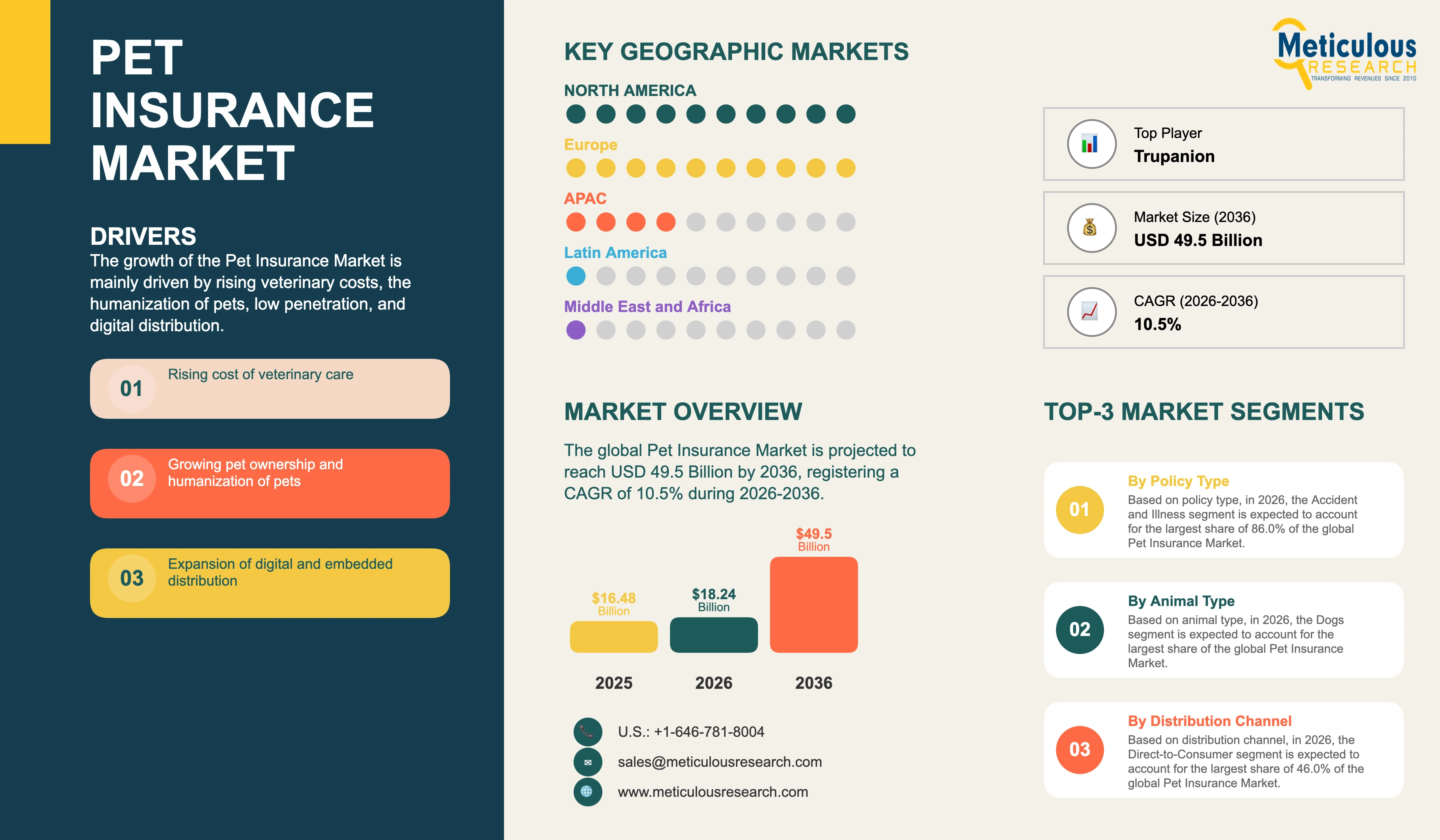
The global pet insurance market was valued at USD 16.48 billion in 2025. This market is expected to reach USD 49.50 billion by 2036 from an estimated USD 18.24 billion in 2026, registering a CAGR of 10.5% during the forecast period (2026-2036).
- Published
- Nov 2026
- Pages
- 247
- Format
- PDF + Excel
- Report ID
- MRHC - 1042624
- Base year
- 2025
- 2025 · BASELINE
- $16.48B
- 2036
- $49.50B
- CAGR 2026–2036
- 10.5%
2025 baseline · 2026–2036 forecast at 10.5% CAGR · hover a bar for the value
Key highlights
The North American Pet Health Insurance Association's 2026 State of the Industry Report, released in June 2026, reported that gross written premium in North America reached USD 6.2 billion in 2025, up 19.4% from 2024, and that 7.6 million pets were insured across the U.S. and Canada at the end of 2025, according to NAPHIA.
NAPHIA reported that the number of insured pets in the U.S. rose 9.0% to 6.98 million in 2025 and has grown about 76% over the past five years, while penetration reached only 5.99% for dogs and 2.29% for cats, which means that more than 95% of U.S. dogs and cats remain uninsured.
Trupanion reported 2025 total revenue of USD 1.439 billion, up 12%, with subscription revenue up 16% to USD 989.3 million, subscription pets up 5% to 1,096,173, and monthly average revenue per pet up 11% to USD 80.79, and guided to 2026 revenue of USD 1.55 billion to USD 1.582 billion, according to the company.
The Association of British Insurers reported that pet insurance payouts in the U.K. reached a record £1.23 billion in 2024, up 4%, with a record 1.8 million claims and 4.6 million policies, while the average claim rose 3% to £685 as veterinary and pet service prices rose 9.1%, according to the ABI and the Office for National Statistics.
Anicom Insurance, Japan's largest pet insurer, reported 1,392,772 policies in force at the end of March 2026, an increase of 8.1% from the previous year, and has held the leading share of Japan's pet insurance market for 17 consecutive years, according to the company.
In February 2026, pet insurer Wagmo partnered with Fi to offer plan members access to Fi's GPS tracking devices, and in June 2026, Tractive partnered with Swiss digital pet insurer Calingo, reflecting the growing links between pet insurance and connected pet health devices. Anicom also operates a direct settlement system used by about 7,000 animal hospitals in Japan, which allows policyholders to pay only their share of the bill at the clinic.
By policy type, accident and illness accounts for the largest share of 86.0% in 2026, while wellness and routine care registers the highest CAGR.
By animal type, dogs account for the largest share in 2026, while cats register the highest CAGR.
By provider type, specialist Pet insurers account for the largest share in 2026, while insurtech providers register the highest CAGR.
By distribution channel, direct-to-consumer accounts for the largest share of 46.0% in 2026, while employer benefit programs register the highest CAGR.
By geography, Europe accounts for the largest share of 40.0% in 2026, while Asia-Pacific registers the highest CAGR of 13.8%.
Report summary
| Particulars | Details |
|---|---|
| Base Year | 2025 |
| Estimated Year | 2026 |
| Forecast Period | 2026-2036 |
| Market Size in 2025 | USD 16.48 billion |
| Market Size in 2026 | USD 18.24 billion |
| Market Size by 2036 | USD 49.50 billion |
| CAGR (2026-2036) | 10.5% |
| Format | PDF, Excel & Cloud Portal · 247 pages |
| Largest Segment by Policy Type (2026) | Accident and Illness (86.0%) |
| Largest Segment by Distribution Channel (2026) | Direct-to-Consumer (46.0%) |
| Largest Region (2026) | Europe (40.0%) |
| Fastest-Growing Region | Asia-Pacific (CAGR 13.8%) |
| Companies Profiled | 14 companies and other companies |
| Segments Covered | Policy Type, Animal Type, Provider Type, Distribution Channel, Geography |
| Countries Covered | U.K., Germany, France, Sweden, Italy, Spain, Netherlands, Switzerland, Belgium, Denmark, Norway, Finland, Austria, Poland, Ireland, Rest of Europe, U.S., Canada, Japan, China, Australia, South Korea, India, Indonesia, Thailand, Singapore, Malaysia, Vietnam, Philippines, Taiwan, New Zealand, Rest of Asia-Pacific, Brazil, Mexico, Argentina, Colombia, Chile, Peru, Rest of Latin America, U.A.E., Saudi Arabia, Israel, South Africa, Turkey, Egypt, Rest of Middle East & Africa |
Report overview
Segments covered: policy type, animal type, provider type, distribution channel.
The growth of this market is mainly driven by the rising cost of veterinary care, the growing number of pet-owning households and the humanization of pets, the low penetration of pet insurance in most countries, which leaves large room for growth, the growing adoption of pet insurance among millennials and Gen Z pet owners, the expansion of digital and embedded distribution channels, and the growing use of pet insurance as an employee benefit. However, factors such as rising premiums that reduce affordability, the exclusion of pre-existing conditions, complex policy terms that create confusion among consumers, and high loss ratios driven by veterinary inflation are expected to restrain the growth of this market to some extent. Nevertheless, the large uninsured pet population in most countries is expected to support strong growth.
Pet insurance is a type of insurance that helps pet owners pay for veterinary care when their pets become ill or injured. Most policies reimburse a share of eligible veterinary bills after a deductible, up to an annual or lifetime limit, while some insurers pay veterinary clinics directly. Policies are mainly sold for dogs and cats, although some insurers also cover rabbits, birds, horses, and exotic pets. Pet insurance gives owners more financial certainty and allows veterinarians to recommend the best treatment options without cost becoming the main barrier.
This report covers the global pet insurance market, including accident and illness policies, accident-only policies, and wellness and routine care plans or add-ons. The market is analyzed by policy type, animal type, provider type, distribution channel, and geography. The market is measured on the basis of gross written premiums. Pet health savings plans and veterinary practice membership plans that are not insurance products are not included.
Pet insurance is well established in Sweden and the U.K., where a large share of dogs and cats are insured, and it is growing rapidly in North America, Japan, and other markets. In North America, NAPHIA reported that gross written premium reached USD 6.2 billion in 2025, up 19.4% from 2024, while the number of insured pets reached 7.6 million. However, penetration remains low, with only 5.99% of U.S. dogs and 2.29% of U.S. cats insured, which leaves large room for growth. In the U.K., ABI members paid a record £1.23 billion in claims in 2024 on 4.6 million policies.
The main factor shaping the pet insurance market is the rising cost of veterinary care. Advances in veterinary medicine, such as advanced imaging, specialty surgery, cancer treatment, and emergency and critical care, have improved outcomes for pets but have also increased the cost of treatment. The U.K. Office for National Statistics recorded 9.1% inflation in veterinary and other pet services in 2024. Rising costs encourage more owners to buy insurance, but they also increase claims costs, which leads insurers to raise premiums. NAPHIA noted that premium growth has consistently outpaced the growth in insured pets because average premiums have risen each year.
The pet insurance market is also benefiting from important changes in who owns pets and how they care for them. Millennials and Gen Z pet owners, who often view pets as members of the family, are more likely to buy pet insurance and to spend more on veterinary care. Trupanion has noted that Gen Z is the fastest-growing generation of pet parents. The growth of digital distribution, embedded insurance at the point of pet adoption or purchase, and pet insurance offered as an employee benefit is making insurance easier to buy.
The market includes specialist pet insurers, such as Trupanion, Agria, Petplan, and Anicom, multi-line insurers that offer pet insurance alongside other products, such as Nationwide, MetLife, Chubb, and Allianz, and insurtech providers that sell mainly through digital channels, such as Lemonade, Pumpkin, and Wagmo. Many insurers work with managing general agents, affinity partners, and pet retailers to reach customers.
In 2026, accident and illness policies account for the largest share of the market by policy type, while wellness and routine care plans are the fastest-growing policy type. Dogs are the largest animal type, while cats are the fastest-growing animal type. Specialist pet insurers are the largest provider type, while insurtech providers are the fastest-growing provider type. Direct-to-consumer sales are the largest distribution channel, while employer benefit programs are the fastest-growing channel. Europe accounts for the largest share of the market, while Asia-Pacific is the fastest-growing region.
Over the forecast period, the pet insurance market is expected to grow strongly, supported by rising veterinary costs, increasing penetration in North America, Asia-Pacific, and other underpenetrated markets, new digital and embedded distribution models, and growing demand for wellness coverage. However, affordability will remain a key issue as premiums continue to rise. Claims experience is also becoming more important, as owners increasingly compare insurers based on the speed and ease of reimbursement. Insurers are investing in digital claims tools, direct payment to veterinary clinics, and customer service to differentiate their products and improve retention in a competitive market.
Europe is expected to account for the largest share of 40.0% of the market in 2026, mainly due to high penetration in Sweden, the U.K., and other countries, strong insurer brands, and large pet populations.
Asia-Pacific is projected to register the highest CAGR of 13.8% during the forecast period, driven by rising pet ownership, growing incomes, the humanization of pets, and low insurance penetration in China, India, and Southeast Asia.
The report profiles 14 companies, including Trupanion, Nationwide, Independence Pet Holdings, Lemonade, MetLife, Chubb (Healthy Paws), Crum & Forster (ASPCA Pet Health Insurance), Allianz (Petplan), Agria (Länsförsäkringar), Anicom, ipet Insurance, Fetch, Pumpkin, and Wagmo.
According to NAPHIA, 7.6 million pets were insured in North America at the end of 2025, including 6.98 million in the U.S. and about 643,000 in Canada. Penetration remains low, with only 5.99% of U.S. dogs and 2.29% of U.S. cats insured.
Pet insurance premiums are rising mainly because the cost of veterinary care is increasing due to advanced diagnostics and treatments, higher staff costs, and practice consolidation. The U.K. Office for National Statistics recorded 9.1% inflation in veterinary and other pet services in 2024, and NAPHIA noted that average premiums have risen consistently each year.
Report infographic
Market dynamics
18 factors across 5 forcesRising cost of veterinary care
The cost of veterinary care has risen significantly in recent years due to advances in diagnostics and treatment, higher staff costs, and the consolidation of veterinary practices. The U.K. Office for National Statistics recorded 9.1% inflation in veterinary and other pet services in 2024, and the ABI reported that the average pet insurance claim rose 3% to £685, with some treatments, such as elbow dysplasia surgery, costing more than £50,000. In North America, NAPHIA reported that gastrointestinal conditions were the most common insurance claims for both dogs and cats in 2025.
As the cost of unexpected veterinary bills rises, more pet owners recognize the value of insurance in protecting them from large expenses. Rising treatment costs also increase average premiums, which supports growth in gross written premiums. Trupanion reported that its monthly average revenue per pet rose 11% in 2025, reflecting necessary pricing adjustments to keep up with veterinary inflation. Veterinarians increasingly recommend insurance to clients so that pets can receive the best available care.
Growing Pet ownership and humanization of pets
Pet ownership has grown in many countries, and owners increasingly view their pets as members of the family. This humanization of pets leads owners to spend more on high-quality food, veterinary care, and other services, and to seek the best possible treatment when their pets become ill. Pet owners are also more willing to pay for insurance to make sure they can afford advanced care, such as cancer treatment or surgery.
Younger generations of pet owners are particularly important for the long-term growth of the pet insurance market. According to Trupanion, millennials account for about 30% to 33% of pet parents, and Gen Z is currently the fastest-growing segment of pet parents. These owners are generally comfortable buying insurance online and are more likely to see insurance as a responsible part of pet ownership. As they acquire more pets and as their incomes rise, demand for pet insurance is expected to grow.
Low penetration and large untapped market
Pet insurance penetration remains low in most countries, which leaves significant room for growth. NAPHIA reported that only 5.99% of U.S. dogs and 2.29% of U.S. cats were insured in 2025, and that insured pets in Canada grew only 3.9%, the slowest rate in five years, despite a large pet population. In many countries in Asia-Pacific, Latin America, and the Middle East, penetration is even lower, while markets such as Sweden and the U.K. show that much higher penetration is possible.
As awareness grows and insurers develop simpler and more affordable products, penetration is expected to increase steadily, particularly in North America and Asia-Pacific, which supports strong market growth over the forecast period. Even small increases in penetration create large gains in premium volume because of the large pet populations in these markets.
Expansion of digital and embedded distribution
Insurers are using digital channels, mobile apps, and embedded distribution to make pet insurance easier to buy and manage. Customers can obtain quotes, buy policies, and submit claims online in minutes, and many insurers use automation and data analytics to speed up claims processing. Pet insurance is increasingly offered at the point where owners adopt or buy a pet, through shelters, breeders, pet retailers, and veterinary clinics, often with a free introductory period.
Partnerships between insurers and pet technology companies are also creating new channels to reach pet owners. In February 2026, Wagmo partnered with Fi to offer its members access to Fi's GPS tracking devices, and in June 2026, Tractive partnered with Swiss digital insurer Calingo. These partnerships help insurers reach new customers and engage existing policyholders. Comparison websites and pet care apps are also making it easier for owners to compare policies and prices.
Growing use of Pet insurance as an employee benefit
A growing number of employers offer pet insurance as a voluntary employee benefit, often with group discounts and payroll deduction. Employers use pet benefits to attract and retain employees, particularly younger workers who place a high value on their pets. Insurers such as Nationwide, MetLife, and Trupanion offer pet insurance through employer benefit programs. Employer benefit programs are the fastest-growing distribution channel in the market, supported by benefit brokers and human resources platforms that make enrollment simple. Pet benefits are also increasingly bundled with other lifestyle benefits on employee benefit platforms.
Table of contents
12 chapters · 176 sections · 247 pages · click to expandSegmental analysis
| Segment | Largest share (2026) | Fastest growth (2026–2036) |
|---|---|---|
| By Policy Type | Direct-to-consumer | Employer benefit programs |
By Policy Type
- The direct-to-consumer segment is expected to account for the largest share of 46.0% of the pet insurance market, while the employer benefit programs segment is projected to register the highest CAGR during the forecast period.
- The specialist Pet insurers segment is expected to account for the largest share of the pet insurance market, while the insurtech providers segment is projected to register the highest CAGR during the forecast period.
Geographic analysis
Europe
Largest shareIn 2026, Europe is expected to account for the largest share of 40.0% of the global pet insurance market. The large share of this region is mainly due to the high penetration of pet insurance in Sweden, the U.K., Norway, Denmark, and other countries, the long history and strong brands of insurers such as Agria and Petplan, the large pet populations in the U.K., Germany, and France, and the rising cost of veterinary care. The U.K. is one of the largest pet insurance markets in the world, where ABI members paid a record £1.23 billion in claims in 2024 on a record 4.6 million policies. In Germany, France, and other continental European markets, penetration is lower but growing, supported by digital insurers and partnerships with pet retailers and banks.
Asia-Pacific
Fastest growthAsia-Pacific is projected to register the highest CAGR of 13.8% during the forecast period. The rapid growth of this region is mainly driven by rising pet ownership, growing incomes, the humanization of pets, and low insurance penetration in large markets such as China, India, and Southeast Asia. Japan has a significant and growing pet insurance market led by Anicom Insurance, which reported 1,392,772 policies in force at the end of March 2026, an increase of 8.1%, and ipet Insurance. Australia and South Korea also have growing pet insurance markets, supported by rising veterinary costs and the growth of digital distribution, while China's large pet population represents a major long-term opportunity for both domestic and international insurers.
North America
North America accounts for a significant share of the market and is one of the fastest-growing major markets. NAPHIA reported that gross written premium in North America reached USD 6.2 billion in 2025, up 19.4%, and that the number of insured pets reached 7.6 million, including 6.98 million in the U.S. and about 643,000 in Canada. Low penetration, rising veterinary costs, strong digital distribution, and the growth of employer benefit programs support strong growth in the region, while companies such as Trupanion, Nationwide, Independence Pet Holdings, Lemonade, MetLife, and Chubb compete for customers.
Latin America
Latin America and the Middle East & Africa account for smaller shares of the market but offer long-term growth potential. In Latin America, Brazil, Mexico, Argentina, Chile, and Colombia have large and growing pet populations and rising spending on veterinary care, and insurers and insurtech companies are launching digital pet insurance products.
Middle East & Africa
In the Middle East & Africa, pet insurance is still at an early stage, but growing pet ownership in the U.A.E., Saudi Arabia, Israel, and South Africa is creating demand. Insurers are partnering with veterinary clinics, pet retailers, and digital platforms to build awareness in these regions. Penetration in both regions is expected to rise gradually over the forecast period. Regional differences in pet ownership, veterinary costs, incomes, regulation, and awareness of pet insurance shape the demand for coverage around the world and the speed at which penetration increases in each market.
Competitive landscape
The global pet insurance market is moderately fragmented, with leading players in each region and many smaller insurers, managing general agents, and insurtech companies. The top ten players are estimated to account for about half of the market in 2025, with competition largely organized by country.
In North America, Trupanion reported 2025 revenue of USD 1.439 billion and more than 1 million subscription pets, while Nationwide, Independence Pet Holdings, which operates brands such as Embrace, Figo, and Pets Best, Lemonade, MetLife, Chubb's Healthy Paws, Crum & Forster's ASPCA Pet Health Insurance, Fetch, Pumpkin, and Wagmo are other important players. In Europe, Agria, part of Länsförsäkringar, is a leading insurer in the Nordic countries and also operates in the U.K., while Allianz's Petplan is a leading brand in the U.K. In Japan, Anicom Insurance has held the leading share for 17 consecutive years, followed by ipet Insurance and other insurers.
Companies in this market compete on price, coverage, claims experience, speed of reimbursement, brand, digital experience, veterinary relationships, and distribution partnerships. Key strategies include expanding digital and embedded distribution, developing wellness and preventive care products, building direct payment networks with veterinary clinics, expanding employer benefit programs, entering new countries, and using data and AI to improve pricing and claims processing.
Recent competitive activity has focused on pricing, retention, and new distribution partnerships. Trupanion reported improved retention in 2025 while continuing to raise prices to keep up with veterinary inflation, and it guided to 2026 revenue of USD 1.55 billion to USD 1.582 billion. Wagmo partnered with Fi in February 2026 and Calingo partnered with Tractive in June 2026, linking insurance with connected pet devices, and Anicom continued to grow its policies in force in Japan.
We expect competition to increase as more insurers, insurtech companies, and non-insurance brands enter the market, particularly in North America and Asia-Pacific. Companies with strong brands, efficient claims processing, accurate pricing, and broad distribution networks are expected to gain share, while consolidation among smaller insurers and agents is likely to continue.
Some of the key players operating in the pet insurance market are Trupanion, Inc., Nationwide Mutual Insurance Company, Independence Pet Holdings, Inc., Lemonade, Inc., MetLife, Inc., Chubb Limited (Healthy Paws), Crum & Forster (ASPCA Pet Health Insurance), Allianz SE (Petplan), Agria Djurförsäkring (Länsförsäkringar), Anicom Holdings, Inc., ipet Insurance Co., Ltd., Fetch, Inc., Pumpkin Insurance Services Inc., and Wagmo, Inc., among others. Pet retailers and veterinary groups are also becoming important partners for insurers.
- —
NAPHIA reported in June 2026 that North American gross written premium grew 19.4% to USD 6.2 billion in 2025, Trupanion guided to 2026 revenue of up to USD 1.582 billion, and insurers such as Wagmo and Calingo partnered with pet wearable companies Fi and Tractive in 2026.
- Embrace
- Figo
- Pets Best
- Lemonade
- MetLife
- Chubb's Healthy Paws
- Crum & Forster's ASPCA Pet Health Insurance
Expert perspectives
The pet insurance market is one of the fastest-growing segments of the insurance industry and of the broader pet care industry. Rising veterinary costs, the humanization of pets, and low penetration in most countries create a strong foundation for growth. NAPHIA's 2026 report showed that North American gross written premium grew 19.4% in 2025, and markets in Japan and Europe also continued to grow.
Over the forecast period, the market is expected to grow at a CAGR of 10.5%, from USD 18.24 billion in 2026 to USD 49.50 billion in 2036. Growth will be supported by rising veterinary costs, increasing penetration in North America and Asia-Pacific, digital and embedded distribution, employer benefit programs, wellness coverage, and the growth of insurance for cats.
Among the market segments, accident and illness policies are the largest policy type, while wellness and routine care plans grow fastest. Dogs are the largest animal type, while cats grow fastest, and specialist pet insurers are the largest provider type, while insurtech providers grow fastest. Direct-to-consumer sales are the largest distribution channel, while employer benefit programs grow fastest. Europe is the largest region, and Asia-Pacific is the fastest-growing region at a CAGR of 13.8%.
In our view, the most important factor for the market over the forecast period will be the balance between premium growth and affordability. Rising veterinary costs will continue to drive premium increases, which supports revenue growth but can reduce retention and limit new customer acquisition. Insurers that manage pricing carefully, communicate clearly with customers, and offer flexible products for different budgets will be best positioned to grow their customer base.
We also expect distribution to change significantly, with more insurance sold through embedded offers, employer benefits, veterinary clinics, and pet technology partnerships. Data from claims and connected devices will help insurers price more accurately and develop preventive health programs. In Asia-Pacific, particularly China, we expect rapid growth from a low base as pet ownership and veterinary spending increase. Regulatory changes that improve transparency should also strengthen consumer trust over time.
Overall, we believe the pet insurance market will grow strongly over the forecast period, with wellness coverage, cats, insurtech providers, employer benefit programs, and Asia-Pacific providing the fastest growth. Companies that combine strong customer experience with disciplined pricing and broad distribution will be best positioned to capture this growth. We also expect insurers to invest heavily in technology to reduce claims costs and improve customer experience, which will be critical for maintaining profitability as veterinary inflation continues. Insurers that build trust through fast claims and transparent pricing will benefit most.
Customer perspectives
Customers in the pet insurance market are mainly dog and cat owners, although employers that offer pet insurance as a benefit and veterinary clinics that recommend insurance also influence purchasing decisions. Pet owners focus on the price of premiums, the scope of coverage, deductibles and reimbursement rates, exclusions, the speed and ease of claims, and the reputation of the insurer. Younger owners value digital buying and claims experiences and wellness coverage, while owners of older pets focus on coverage for chronic conditions and the cost of renewals. Veterinarians value insurers that pay claims quickly, offer direct payment, and allow them to recommend the best treatment without cost becoming the main barrier. Many owners compare prices on comparison websites and switch insurers when premiums rise significantly. Employers increasingly evaluate pet insurance providers based on the ease of enrollment and employee satisfaction.
Dog Owner - U.S.
I bought the policy online in a few minutes when we adopted our puppy. After one emergency surgery, I would never go without insurance again.
This comment explains why direct-to-consumer sales account for 46.0% of the market, why accident and illness policies account for 86.0% of the market, and why dogs are the largest animal type.
Veterinarian - U.K.
Insured clients are much more likely to go ahead with the treatment we recommend, but many owners are worried about how much premiums have increased.
This comment explains why Europe accounts for 40.0% of the market and why affordability is a key restraint for the market.
Human Resources Director - U.S.
Pet insurance has become one of our most popular voluntary benefits, especially among younger employees who see their pets as family.
This comment explains why employer benefit programs are the fastest-growing distribution channel and why direct-to-consumer sales, which account for 46.0% of the market, face growing competition from new channels.
Frequently asked questions
The global pet insurance market was valued at USD 16.48 billion in 2025, up from USD 14.65 billion in 2024, and is estimated at USD 18.24 billion in 2026. The market is measured on the basis of gross written premiums for accident and illness, accident-only, and wellness policies.
The global pet insurance market is expected to reach USD 49.50 billion by 2036, supported by rising veterinary costs, increasing penetration, digital and embedded distribution, employer benefits, wellness coverage, and growth in Asia-Pacific.
The market is expected to register a CAGR of 10.5% from 2026 to 2036.
Market growth is mainly driven by the rising cost of veterinary care, growing pet ownership and the humanization of pets, low penetration and a large untapped market, the expansion of digital and embedded distribution, and the growing use of pet insurance as an employee benefit.
Rising premiums and affordability concerns and pre-existing condition exclusions and complex policy terms restrain growth, while high loss ratios driven by veterinary inflation and regulatory scrutiny are key challenges.
Key growth opportunities include wellness and preventive care coverage, expansion in Asia-Pacific and other underpenetrated markets, data, AI, and connected pet health, and insurance coverage for cats and older pets.
Accident and illness policies are expected to account for the largest share of 86.0% of the market in 2026, while wellness and routine care plans are projected to register the highest CAGR.
Dogs are expected to account for the largest share of the market in 2026, while cats are projected to register the highest CAGR due to their low penetration and growing insurance adoption.
In 2026, the direct-to-consumer segment is expected to account for the largest share of 46.0% of the pet insurance market, while the employer benefit programs segment is projected to register the highest CAGR during the forecast period.
In 2026, the specialist Pet insurers segment is expected to account for the largest share of the pet insurance market, while the insurtech providers segment is projected to register the highest CAGR during the forecast period.
Europe is expected to account for the largest share of 40.0% of the market in 2026, mainly due to high penetration in Sweden, the U.K., and other countries, strong insurer brands, and large pet populations.
Asia-Pacific is projected to register the highest CAGR of 13.8% during the forecast period, driven by rising pet ownership, growing incomes, the humanization of pets, and low insurance penetration in China, India, and Southeast Asia.
The report profiles 14 companies, including Trupanion, Nationwide, Independence Pet Holdings, Lemonade, MetLife, Chubb (Healthy Paws), Crum & Forster (ASPCA Pet Health Insurance), Allianz (Petplan), Agria (Länsförsäkringar), Anicom, ipet Insurance, Fetch, Pumpkin, and Wagmo.
NAPHIA reported in June 2026 that North American gross written premium grew 19.4% to USD 6.2 billion in 2025, Trupanion guided to 2026 revenue of up to USD 1.582 billion, and insurers such as Wagmo and Calingo partnered with pet wearable companies Fi and Tractive in 2026.
According to NAPHIA, 7.6 million pets were insured in North America at the end of 2025, including 6.98 million in the U.S. and about 643,000 in Canada. Penetration remains low, with only 5.99% of U.S. dogs and 2.29% of U.S. cats insured.
Pet insurance premiums are rising mainly because the cost of veterinary care is increasing due to advanced diagnostics and treatments, higher staff costs, and practice consolidation. The U.K. Office for National Statistics recorded 9.1% inflation in veterinary and other pet services in 2024, and NAPHIA noted that average premiums have risen consistently each year.
Cite this report
Meticulous Research. (2026). Pet Insurance Market - Global Opportunity Analysis and Industry Forecast (2026-2036) (Report No. MRHC - 1042624). Meticulous Market Research Pvt. Ltd. https://www.meticulousresearch.com/product/pet-insurance-market-7307