Optical Genome Mapping Market (2026-2036)
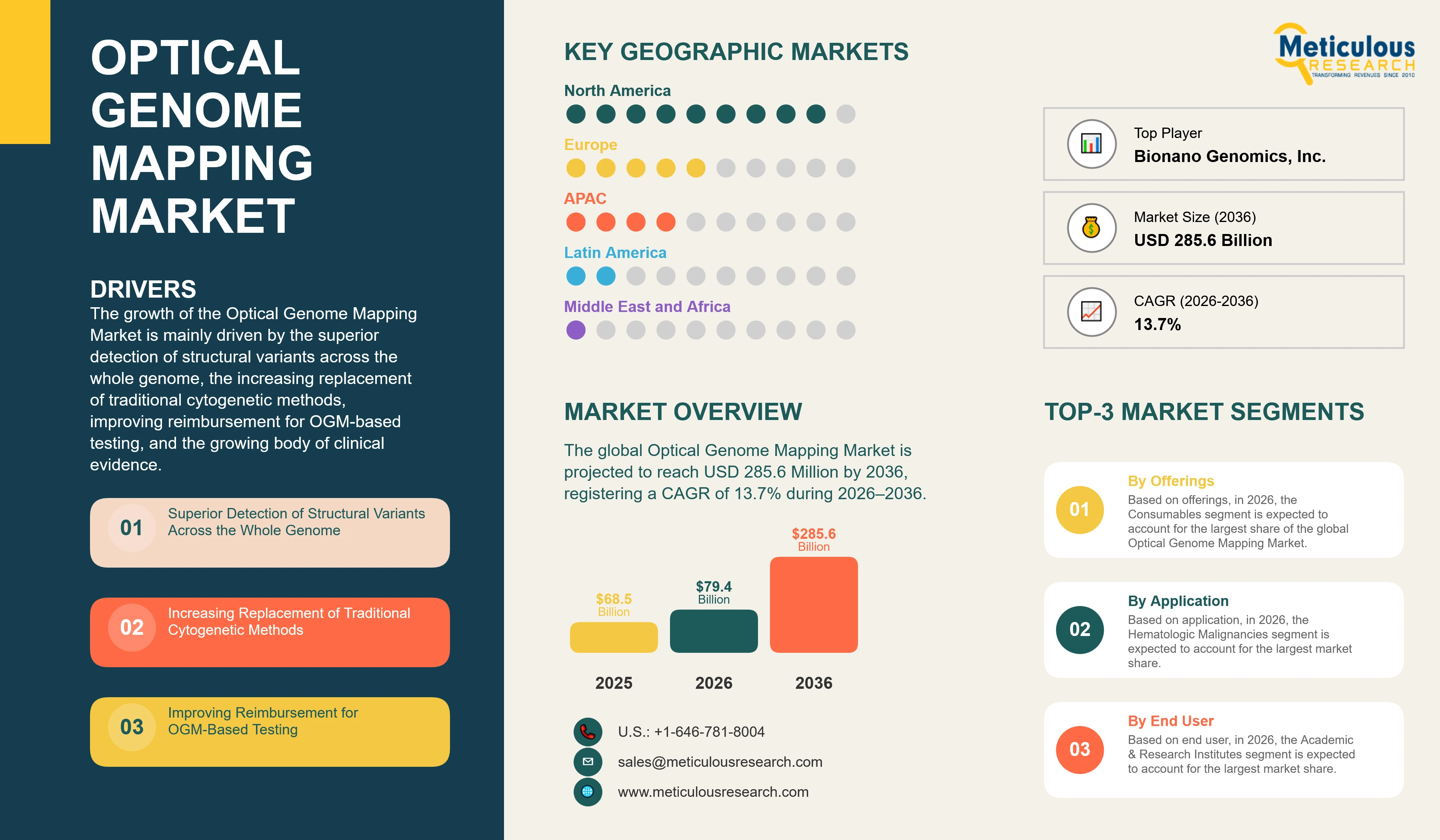
The global Optical Genome Mapping Market was valued at USD 68.5 million in 2025. This market is expected to reach USD 285.6 million by 2036 from an estimated USD 79.4 million in 2026, registering a CAGR of 13.7% during the forecast period (2026-2036).
- Published
- Oct 2026
- Pages
- 299
- Format
- PDF + Excel
- Report ID
- MR-2336
- Base year
- 2025
- 2024 · HISTORICAL
- $8.0M
- 2036
- $285.6M
- CAGR 2026–2036
- 13.7%
2024–2025 baseline · 2026–2036 forecast at 13.7% CAGR · hover a bar for the value
Key highlights
The global Optical Genome Mapping Market is projected to reach USD 285.6 million by 2036, driven by clinical adoption in hematologic malignancies, expert recommendations, improving reimbursement, and expanding applications in constitutional, prenatal, and cell and gene therapy testing.
North America is expected to account for the largest market share in 2026, while Asia-Pacific is projected to register the fastest growth during the forecast period. Under the final 2026 Clinical Laboratory Fee Schedule, the U.S. Centers for Medicare & Medicaid Services (CMS) increased the payment rate for Category I CPT code 81195, which covers the use of OGM for genome-wide cytogenomic analysis of hematologic malignancies, by 47% to USD 1,853.22 from USD 1,263.53, effective January 1, 2026.
By offering, Consumables are expected to account for the largest market share in 2026, whereas Services are projected to witness the fastest growth through 2036. In Q2 2026, Bionano reported revenue of USD 8.2 million, up 21% year over year, with consumables revenue up 31% to USD 4.3 million and 9,219 flowcells sold, up 27%, driven by increased clinical adoption and higher utilization at existing and new clinical sites, and raised the low end of its 2026 revenue guidance to USD 31 million to USD 33 million.
Clinical evidence is strengthening the case for OGM. In May 2025, the International Consortium for Optical Genome Mapping (ICOGM) published expert recommendations in the American Journal of Hematology, developed by 19 experts, recommending OGM as a first-line test for acute myeloid leukemia (AML), myelodysplastic syndromes (MDS), myeloproliferative neoplasms (MPN), B-cell and T-cell acute lymphoblastic leukemia, and pediatric leukemias, in place of karyotyping and fluorescence in situ hybridization (FISH), when high-resolution genome-wide structural variant detection is needed.
Alternative genome mapping technologies are entering the market. In May 2026, Nabsys announced new installations of its OhmX electronic genome mapping platform under the RAMP UP program of Hitachi High-Tech America, supporting targeted structural variant analysis in AML and MDS research at Columbia University.
Report summary
| Particulars | Details |
|---|---|
| Forecast Period | 2026-2036 |
| Base Year | 2025 |
| Estimated Year | 2026 |
| CAGR (Value) | 13.7% |
| Format | PDF, Excel & Cloud Portal · 299 pages |
| Market Size (Value) in 2026 | USD 79.4 Million |
| Market Size (Value) in 2036 | USD 285.6 Million |
| Segments Covered | By Offering: Instruments, Consumables (Flowcells & Chips, DNA Isolation & Labeling Kits), Software, Services (Clinical Testing Services, Research Services). By Application: Hematologic Malignancies, Solid Tumors, Constitutional Genetic Disorders, Reproductive Health & Prenatal Testing, Cell & Gene Therapy and Cell Line Characterization, Genome Assembly & Other Research Applications. By End User: Clinical & Cytogenetic Laboratories, Academic & Research Institutes, Pharmaceutical & Biotechnology Companies, Other End Users. |
| Countries Covered | North America: U.S., Canada. Europe: Germany, France, U.K., Italy, Spain, Netherlands, Rest of Europe. Asia-Pacific: China, Japan, South Korea, Australia, India, Rest of Asia-Pacific. Latin America: Brazil, Mexico, Rest of Latin America. Middle East & Africa: Saudi Arabia, UAE, Israel, Rest of Middle East & Africa. |
| Key Companies | Bionano Genomics, Inc., Nabsys 2.0, LLC, Hitachi High-Tech Corporation, and Beijing Genome Precision Technology Co., Ltd. |
Report overview
Segments covered: offering, application, end user.
The growth of this market is mainly driven by the ability of optical genome mapping to detect all classes of structural variants across the whole genome in a single assay, the increasing adoption of OGM as an alternative to karyotyping, FISH, and chromosomal microarray in hematologic malignancies and constitutional genetic disorders, the publication of expert recommendations supporting its clinical use, and improving reimbursement for OGM-based testing. In addition, the growing use of OGM in reproductive health and prenatal research, cell and gene therapy and cell line quality control, and genome assembly, together with the introduction of higher-throughput systems and AI-enabled analysis software, is further supporting the growth of this market.
The Optical Genome Mapping Market, also referred to as the OGM market, genome mapping market, or high-resolution structural variant mapping market, comprises the instruments, consumables, software, and services used to image and analyze ultra-long, labeled DNA molecules in order to detect structural variants across the entire genome. The market includes OGM systems that linearize and image DNA molecules hundreds of kilobases long in nanochannel arrays; consumables such as nanochannel array flowcells and DNA isolation and labeling kits; analysis and interpretation software; and research and clinical testing services, including laboratory-developed tests for hematologic malignancies and constitutional genetic disorders. It also includes electronic genome mapping, which detects labeled ultra-long DNA molecules electronically in nanochannels. These technologies enable the detection of balanced and unbalanced structural variants, including translocations, inversions, insertions, deletions, duplications, and copy number variants, at much higher resolution than traditional cytogenetic methods. The market ecosystem extends from reagent and component suppliers to platform manufacturers, software providers, clinical and research laboratories, pharmaceutical and cell and gene therapy companies, and payers.
The market is experiencing strong growth as clinical laboratories seek to replace or consolidate traditional cytogenetic methods, which require multiple separate tests and offer limited resolution. Karyotyping detects only large chromosomal changes and depends on cell culture and expert interpretation, FISH examines only a small number of predefined loci, and chromosomal microarray cannot detect balanced rearrangements. Optical genome mapping can detect all of these variant classes in a single genome-wide assay, reducing the number of tests, turnaround time, and the risk of missed findings. In a T-cell acute lymphoblastic leukemia study highlighted by Bionano in Q2 2026, OGM detected abnormalities in 97.8% of cases, compared with 55% for karyotyping, illustrating the diagnostic yield advantage that is driving clinical adoption.
The leading platform provider reflects the shift toward clinical use. Bionano Genomics, the leading provider of optical genome mapping (OGM) systems, reported 2025 revenue of USD 28.5 million, with consumables and software revenue up 7%, 30,171 nanochannel array flowcells sold, and an installed base of 387 OGM systems at the end of 2025, including 32 new installations. In Q2 2026, Bionano reported revenue of USD 8.2 million, up 21% year over year, with consumables revenue up 31% to USD 4.3 million and 9,219 flowcells sold, up 27%, driven by increased clinical adoption and higher utilization at existing and new clinical sites, and raised the low end of its 2026 revenue guidance to USD 31 million to USD 33 million. The growth in consumables and flowcell volumes, despite a decline in instrument revenue to USD 6.4 million in 2025 from USD 8.0 million in 2024, indicates that market growth is increasingly driven by utilization of the installed base in clinical settings rather than by new capital purchases.
Clinical guidelines and reimbursement are providing important support for adoption. In May 2025, the International Consortium for Optical Genome Mapping (ICOGM) published expert recommendations in the American Journal of Hematology, developed by 19 experts, recommending OGM as a first-line test for acute myeloid leukemia (AML), myelodysplastic syndromes (MDS), myeloproliferative neoplasms (MPN), B-cell and T-cell acute lymphoblastic leukemia, and pediatric leukemias, in place of karyotyping and fluorescence in situ hybridization (FISH), when high-resolution genome-wide structural variant detection is needed. The recommendations also position OGM as an alternative to traditional methods in chronic lymphocytic leukemia, plasma cell neoplasms and multiple myeloma, aplastic anemia, bone marrow failure syndromes, and germline predisposition syndromes when conventional methods fail or are inconclusive. Under the final 2026 Clinical Laboratory Fee Schedule, the U.S. Centers for Medicare & Medicaid Services (CMS) increased the payment rate for Category I CPT code 81195, which covers the use of OGM for genome-wide cytogenomic analysis of hematologic malignancies, by 47% to USD 1,853.22 from USD 1,263.53, effective January 1, 2026. A second Category I code, CPT 81354, covers the use of OGM in constitutional genetic disease, providing a reimbursement pathway for postnatal genetic testing.
Applications are expanding beyond hematologic malignancies. Research is increasingly evaluating OGM in reproductive health and prenatal testing, with Bionano reporting that thirteen 2026 reproductive health and prenatal studies covering 730 subjects had been published by Q2 2026, as well as in solid tumors, multiple myeloma, rare disease, and cell and gene therapy, where OGM is used to assess genome integrity and off-target structural changes in engineered cell lines and edited cells. Bionano reported 136 peer-reviewed publications in Q4 2025 alone, reflecting the growing body of evidence across these applications.
The competitive landscape is also evolving. Nabsys, which develops electronic genome mapping technology, works with Hitachi High-Tech America through the RAMP UP program to place its OhmX platform in leading research laboratories, and in May 2026 announced multiple OhmX installations at Columbia University for structural variant analysis in AML and MDS. Nabsys and Hitachi also presented electronic genome mapping data at the Japanese Society of Human Genetics annual meeting in December 2025, including high-resolution detection of TP53 deletions. In China, Beijing Genome Precision Technology, an OEM partner of Bionano, received NMPA Class I registrations for DNA labeling and bone marrow aspirate DNA isolation kits for in vitro diagnostic use in hematologic malignancies, supporting clinical use of OGM in the country.
At the same time, the market faces competition from sequencing-based approaches. Long-read sequencing and mapped-read technologies can also detect structural variants, and laboratories are evaluating the relative cost, resolution, and workflow advantages of OGM against these alternatives. As a result, the ability to demonstrate clinical utility, cost-effectiveness, and workflow simplicity, supported by higher-throughput systems and AI-enabled software, is expected to be critical for market growth over the forecast period.
Report infographic
Market dynamics
15 factors across 5 forcesSuperior Detection of Structural Variants Across the Whole Genome
The ability of optical genome mapping to detect all classes of structural variants across the whole genome in a single assay is a major factor driving the Optical Genome Mapping Market, as structural variants are a leading cause of genetic disease and a key driver of cancer, but many are missed or only partially characterized by traditional cytogenetic methods and short-read sequencing. OGM images ultra-long DNA molecules hundreds of kilobases in length, allowing it to detect balanced translocations, inversions, insertions, deletions, and copy number changes, and to resolve complex rearrangements that span large genomic regions. In a T-cell acute lymphoblastic leukemia study highlighted by Bionano in Q2 2026, OGM detected abnormalities in 97.8% of cases, compared with 55% for karyotyping.
This higher diagnostic yield allows laboratories to identify clinically relevant variants that influence diagnosis, prognosis, and treatment selection. As clinicians and laboratories increasingly recognize the importance of comprehensive structural variant detection, demand for OGM systems, consumables, and testing services is expected to grow steadily over the forecast period.
Increasing Replacement of Traditional Cytogenetic Methods
The increasing replacement of karyotyping, FISH, and chromosomal microarray with optical genome mapping is significantly accelerating market growth, as clinical laboratories seek to consolidate multiple tests into a single, higher-resolution workflow. Traditional cytogenetic testing of a leukemia sample often requires a karyotype, a panel of FISH probes, and sometimes microarray, each with separate costs, turnaround times, and expertise requirements. In May 2025, the International Consortium for Optical Genome Mapping (ICOGM) published expert recommendations in the American Journal of Hematology, developed by 19 experts, recommending OGM as a first-line test for acute myeloid leukemia (AML), myelodysplastic syndromes (MDS), myeloproliferative neoplasms (MPN), B-cell and T-cell acute lymphoblastic leukemia, and pediatric leukemias, in place of karyotyping and fluorescence in situ hybridization (FISH), when high-resolution genome-wide structural variant detection is needed.
The consolidation of multiple cytogenetic tests into one assay can reduce turnaround time and laboratory workload and lower the risk of missed findings. Bionano reported that consumables revenue grew 31% and flowcell volumes 27% in Q2 2026, driven by increased clinical adoption and utilization at existing and new clinical sites, indicating that laboratories are moving from evaluation to routine use of OGM.
Improving Reimbursement for OGM-Based Testing
Improving reimbursement is a key factor supporting the clinical adoption of optical genome mapping, as laboratories require adequate payment to offer new tests. Under the final 2026 Clinical Laboratory Fee Schedule, the U.S. Centers for Medicare & Medicaid Services (CMS) increased the payment rate for Category I CPT code 81195, which covers the use of OGM for genome-wide cytogenomic analysis of hematologic malignancies, by 47% to USD 1,853.22 from USD 1,263.53, effective January 1, 2026. A second Category I code, CPT 81354, covers OGM in constitutional genetic disease, providing an established coding pathway for postnatal genetic testing. Higher payment rates are making OGM-based laboratory-developed tests, such as OGM-Dx HemeOne, more economically viable for clinical laboratories to offer as alternatives to traditional cytogenetic testing, and are expected to encourage more laboratories to adopt OGM over the forecast period.
Growing Body of Clinical Evidence and Publications
The rapid growth of clinical evidence is strengthening confidence in optical genome mapping among clinicians, laboratory directors, and payers. Bionano reported 136 peer-reviewed publications in Q4 2025, and studies in 2026 have included a Johns Hopkins and MD Anderson study in multiple myeloma and thirteen reproductive health and prenatal studies covering 730 subjects. As evidence accumulates across hematologic malignancies, constitutional disorders, prenatal testing, and solid tumors, OGM is expected to be included in more clinical guidelines and testing algorithms, supporting broader adoption.
Table of contents
11 chapters · 133 sections · 299 pages · click to expandSegmental analysis
| Segment | Largest share (2026) | Fastest growth (2026–2036) |
|---|---|---|
| By Offering | Consumables | Services |
| By Application | Hematologic Malignancies | Reproductive Health & Prenatal Testing |
| By End User | Academic & Research Institutes | Clinical & Cytogenetic Laboratories |
By Offering
- Optical Genome Mapping Market Analysis by Offering
- Consumables are further segmented into Flowcells & Chips and DNA Isolation & Labeling Kits, while services are further segmented into Clinical Testing Services and Research Services.
- The Consumables segment is expected to account for the largest share of the global Optical Genome Mapping Market.
- The large share of this segment is mainly due to the recurring purchase of flowcells and DNA isolation and labeling kits for every sample analyzed across an installed base of 387 Bionano OGM systems, as reflected in the 30,171 flowcells sold in 2025 and the 31% growth in consumables revenue in Q2 2026.
- However, the Services segment is projected to register the highest CAGR during the forecast period.
- The rapid growth of this segment is attributed to the increasing adoption of OGM-based laboratory-developed tests by clinical laboratories, supported by the 47% increase in the payment rate for CPT code 81195 in 2026 and the availability of CPT code 81354 for constitutional testing.
- The Software segment is expected to record strong growth, supported by AI-enabled analysis and interpretation tools such as VIA software that simplify OGM data analysis, while the Instruments segment is expected to recover as higher-throughput systems are introduced and new clinical sites are established.
By Application
- Optical Genome Mapping Market Analysis by Application
- The Hematologic Malignancies segment is expected to account for the largest market share, due to the established use of OGM in leukemia and myelodysplastic syndrome testing, the ICOGM recommendations for first-line use in AML, MDS, MPN, B-ALL, T-ALL, and pediatric leukemias, and the availability of Category I CPT code 81195 with a 2026 payment rate of USD 1,853.22.
- However, the Reproductive Health & Prenatal Testing segment is projected to register the highest CAGR during the forecast period, owing to the rapid growth of clinical evidence, with thirteen 2026 studies covering 730 subjects published by Q2 2026, and the ability of OGM to detect balanced rearrangements associated with infertility and pregnancy loss.
- The Constitutional Genetic Disorders segment is expected to account for a significant share, supported by CPT code 81354 and the use of OGM in rare disease and developmental delay, while the Cell & Gene Therapy segment is expected to record strong growth as developers adopt genome integrity testing for engineered cells.
By End User
- Optical Genome Mapping Market Analysis by End User
- The Academic & Research Institutes segment is expected to account for the largest market share, as research institutions and genome centers account for a large share of the installed base and use OGM for structural variant research, genome assembly, and translational studies.
- However, the Clinical & Cytogenetic Laboratories segment is projected to register the highest CAGR during the forecast period, driven by the replacement of traditional cytogenetic methods, improving reimbursement, and expert recommendations, as reflected in the clinical adoption cited by Bionano as the main driver of its 31% consumables growth in Q2 2026.
Geographic analysis
North America
Largest shareIn 2026, North America is expected to account for the largest share of the global Optical Genome Mapping Market. The large share of this region is mainly attributed to the concentration of clinical cytogenetic laboratories, academic medical centers, and research institutions in the U.S., the presence of leading providers such as Bionano Genomics and Nabsys, and the availability of Category I CPT codes for OGM. Under the final 2026 Clinical Laboratory Fee Schedule, the U.S. Centers for Medicare & Medicaid Services (CMS) increased the payment rate for Category I CPT code 81195, which covers the use of OGM for genome-wide cytogenomic analysis of hematologic malignancies, by 47% to USD 1,853.22 from USD 1,263.53, effective January 1, 2026. Leading U.S. institutions, including Johns Hopkins, MD Anderson, and Columbia University, are generating clinical and translational evidence for OGM and electronic genome mapping, supporting adoption across the region. In the U.S., the combination of Category I coding, laboratory-developed test pathways under CLIA, and a large network of reference and academic cytogenetics laboratories allows new OGM-based tests to reach clinical use faster than in most other countries, and the shift of Bionano revenue toward consumables reflects this growing clinical utilization. Canada is also expected to contribute to regional growth, supported by provincial genetics programs and academic hematology centers evaluating OGM as an alternative to karyotyping and FISH.
Europe
Europe is expected to account for a significant share of the market, supported by strong clinical cytogenetics and hematology communities, active participation in international OGM research, and the growing evaluation of OGM in national healthcare systems. European laboratories have contributed significantly to OGM clinical studies in hematologic malignancies and constitutional disorders, and the adoption of OGM in routine cytogenetic workflows is expected to grow as evidence accumulates and testing algorithms are updated. Germany, France, the U.K., Italy, Spain, and the Netherlands are expected to account for the largest shares within the region, as these countries have large hematology and clinical genetics networks and well-established cytogenetic laboratories. However, the implementation of the EU In Vitro Diagnostic Regulation (IVDR), which places stricter requirements on in-house tests and research-use-only products used in clinical settings, is expected to shape the pace of clinical adoption, favoring providers that can support laboratories with validated workflows and regulatory documentation.
Asia-Pacific
Fastest growthAsia-Pacific is projected to register the highest CAGR during the forecast period. In China, Beijing Genome Precision Technology, an OEM partner of Bionano, received NMPA Class I registrations for DNA labeling and bone marrow aspirate DNA isolation kits for in vitro diagnostic use in hematologic malignancies, providing a pathway for clinical OGM testing in one of the largest healthcare markets. In Japan, Nabsys and Hitachi High-Tech presented electronic genome mapping data at the Japanese Society of Human Genetics annual meeting in December 2025, reflecting growing interest in genome mapping. Large patient populations, expanding genomic medicine programs, and investment in cancer and rare disease diagnostics across China, Japan, South Korea, Australia, and India are expected to drive strong growth in the region. China is expected to account for the largest share within Asia-Pacific, supported by registered OGM reagents, a large hematologic malignancy patient population, and strong domestic investment in genomic medicine, while Japan is expected to see growing adoption in research and clinical genetics, supported by the presence of Hitachi High-Tech. South Korea and Australia are expected to contribute through advanced clinical genomics programs and academic research centers.
Latin America
Latin America and the Middle East & Africa are expected to account for smaller shares of the market, with demand supported by academic research, the development of clinical genetics services, and national genomics initiatives in selected countries.
Competitive landscape
The global Optical Genome Mapping Market is highly consolidated, with one established optical genome mapping platform provider accounting for most of the market, alongside an electronic genome mapping developer and its industrial partner, regional OEM and distribution partners, and clinical and research laboratories offering OGM-based testing services. Market participants compete primarily on structural variant detection performance, throughput and cost per sample, sample preparation requirements, ease of data analysis, clinical evidence, and reimbursement support.
Leading companies are investing in higher-throughput systems, AI-enabled analysis software, clinical evidence generation, reimbursement, and partnerships with research and clinical institutions. Recent examples include the successful request by Bionano Laboratories for a higher CMS payment rate for CPT code 81195, the ICOGM recommendations published in May 2025, the OhmX installations announced by Nabsys under the Hitachi High-Tech America RAMP UP program in May 2026, and the NMPA registrations of OGM reagents by Beijing Genome Precision Technology in China.
The report provides a comprehensive competitive assessment of the leading companies operating in the global Optical Genome Mapping Market. The key players profiled in the report include Bionano Genomics, Inc. (U.S.), Nabsys 2.0, LLC (U.S.), Hitachi High-Tech Corporation (Japan), and Beijing Genome Precision Technology Co., Ltd. (China).
- Bionano Genomics, Inc.
- Nabsys 2.0, LLC
- Hitachi High-Tech Corporation
- Beijing Genome Precision Technology Co., Ltd
Expert perspectives
The Optical Genome Mapping Market is entering a period in which clinical utilization, rather than instrument placements, is becoming the main variable determining market growth. With expert recommendations positioning OGM as a first-line test in several hematologic malignancies, a 47% increase in the Medicare payment rate for CPT code 81195 in 2026, and Bionano consumables revenue growing 31% in Q2 2026 while instrument revenue declined, OGM is moving from evaluation to routine cytogenomic use. The binding constraint is shifting from technical validation to the ability of laboratories to integrate OGM into testing algorithms, secure reimbursement across payers, and process higher sample volumes efficiently.
Three structural changes are expected to shape competitive positions through 2036. First, the replacement of karyotyping, FISH, and microarray in hematologic malignancies and constitutional disorders is expected to become the main growth driver, favoring providers that can deliver complete, clinically validated workflows. Second, electronic genome mapping and sequencing-based structural variant methods are increasing competition, making cost per sample, throughput, and workflow simplicity critical. Third, new applications in prenatal and reproductive health, solid tumors, and cell and gene therapy are broadening the addressable market beyond hematology.
For companies planning entry or expansion, the most defensible positions over the forecast period are likely to be found in clinical OGM testing services, constitutional and prenatal applications, genome integrity testing for cell and gene therapy, and AI-enabled analysis software. For established providers, the principal risks are competition from long-read and mapped-read sequencing, the research-use-only status of most systems, and the limited financial resources of specialized providers.
Overall, the market is expected to grow strongly from a small base, with consumables and hematologic malignancy testing providing the core of demand and clinical services, prenatal and constitutional applications, and Asia-Pacific providing the fastest growth.
Customer perspectives
Insights gathered during primary interviews with cytogenetic laboratory directors, hematopathologists, and research scientists operating in this market highlight where procurement priorities are shifting. The following perspectives reflect recurring themes raised across these discussions.
“This reflects the role of test consolidation and reimbursement in clinical adoption.”
“This indicates that guidelines are supporting the use of OGM in hematologic malignancies.”
“This points to the growing role of OGM in cell and gene therapy quality control.”
Frequently asked questions
The global Optical Genome Mapping Market is estimated at USD 79.4 million in 2026.
Cite this report
Meticulous Research. (2026). Optical Genome Mapping Market - Global Opportunity Analysis And Industry Forecast (2026-2036) (Report No. MR-2336). Meticulous Market Research Pvt. Ltd. https://www.meticulousresearch.com/product/optical-genome-mapping-market-7019