Open RAN Market (2026-2036)
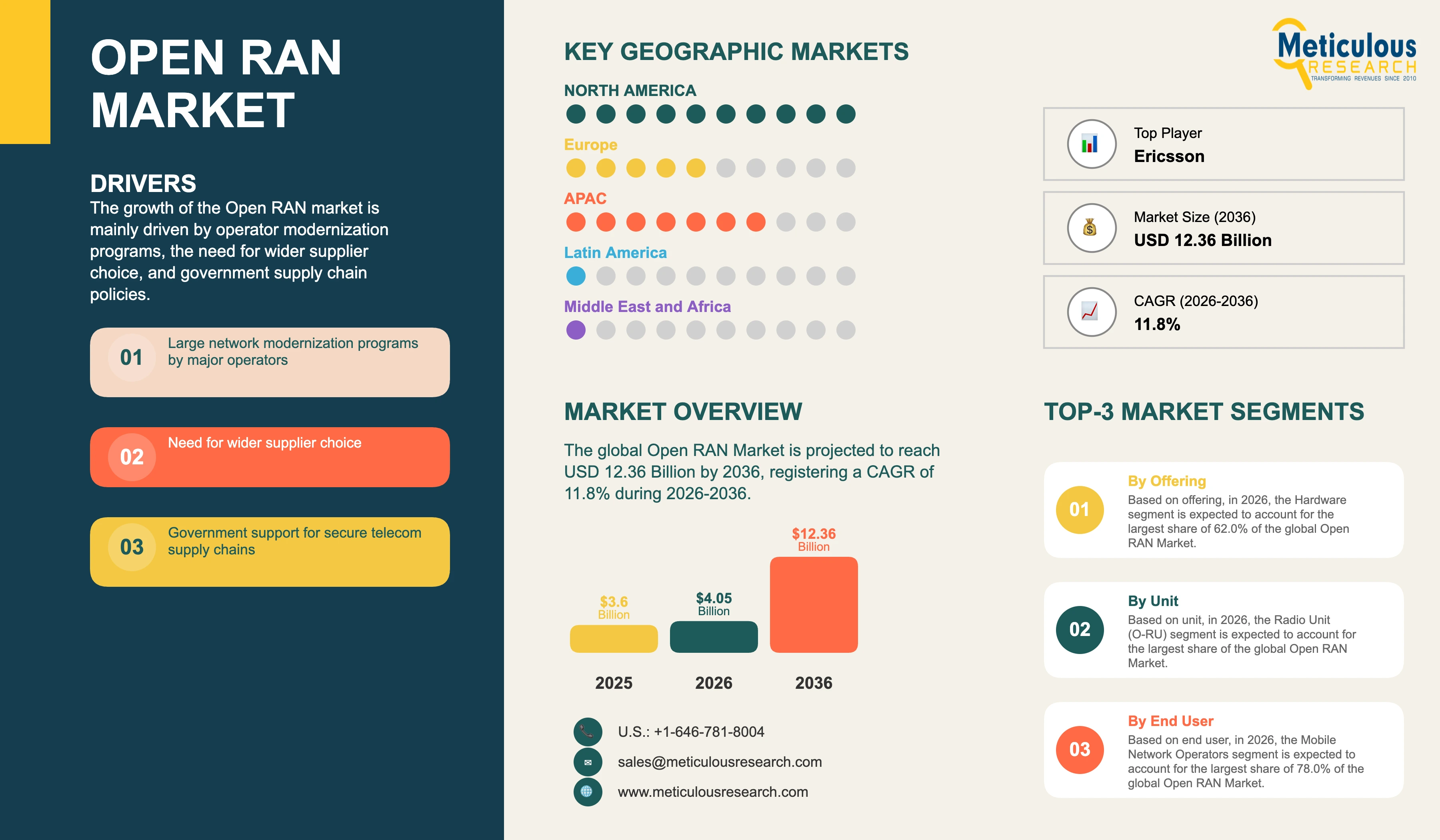
The global Open RAN market was valued at USD 3.60 billion in 2025. This market is expected to reach USD 12.36 billion by 2036 from an estimated USD 4.05 billion in 2026, registering a CAGR of 11.8% during the forecast period (2026-2036).
- Published
- Nov 2026
- Pages
- 240
- Format
- PDF + Excel
- Report ID
- MRICT - 1042613
- Base year
- 2025
- 2025 · BASELINE
- $3.60B
- 2036
- $12.36B
- CAGR 2026–2036
- 11.8%
2025 baseline · 2026–2036 forecast at 11.8% CAGR · hover a bar for the value
Key highlights
In March 2026, AT&T reported that it had completed more than 50% of its nationwide radio replacement program and that more than 50% of its network traffic was carried on open-capable hardware, and it confirmed an Open RAN call on its commercial network using Ericsson baseband units and radios from 1Finity, according to AT&T and Converge Digest. AT&T had earlier set a goal of moving 70% of its wireless traffic onto open-capable platforms by late 2026 under its roughly USD 14 billion agreement with Ericsson.
Vodafone selected Samsung in October 2025 as a primary partner for deploying Open RAN in Germany and other European countries, with plans to add thousands of Open RAN sites over a five-year program, starting with Hannover and with Wismar set to become the first city fully equipped with Open RAN in early 2026, according to Samsung and Fierce Network. Vodafone has stated a goal of using Open RAN in 30% of its network by 2030.
Deutsche Telekom has deployed Open RAN at more than 3, 000 sites in Germany with Nokia and 1Finity, replacing a previous supplier, and said it would issue a request for quotation covering 30,000 radio sites at the start of 2026 with Open RAN as part of the mix, according to TelecomTV.
In February 2026, Dell'Oro Group lowered its expectation for multi-vendor RAN to less than 5% of the total RAN market by 2030, from a previous range of 5% to 10%, while noting that longer-term Open RAN growth assumptions had improved on the back of 5G and future 6G deployments, according to RCR Wireless.
The O-RAN ALLIANCE completed its Specification Release 5 in July 2026, and in February 2026 ATIS and the O-RAN ALLIANCE completed the transposition of an initial set of O-RAN specifications into ATIS standards to support adoption in North America, according to the O-RAN ALLIANCE.
1Finity, the former Fujitsu mobile networks business, said it has shipped more than 600,000 radios, most of which in recent years are O-RAN compliant, and Rakuten Mobile completed the rollout of 1Finity 5G radio units in its virtualized Open RAN network, according to Light Reading.
By offering, hardware accounts for the largest share of 62.0% in 2026, while software registers the highest CAGR.
By unit, radio unit (o-RU) accounts for the largest share in 2026, while RAN intelligent controller and SMO registers the highest CAGR.
By network type, public mobile networks account for the larger share in 2026, while private and enterprise networks register the higher CAGR.
By end user, mobile network operators account for the largest share of 78.0% in 2026, while enterprises register the highest CAGR.
By geography, North America accounts for the largest share of 42.0% in 2026, while Europe registers the highest CAGR of 14.8%.
Report summary
| Particulars | Details |
|---|---|
| Base Year | 2025 |
| Estimated Year | 2026 |
| Forecast Period | 2026-2036 |
| Market Size in 2025 | USD 3.60 billion |
| Market Size in 2026 | USD 4.05 billion |
| Market Size by 2036 | USD 12.36 billion |
| CAGR (2026-2036) | 11.8% |
| Format | PDF, Excel & Cloud Portal · 240 pages |
| Largest Segment by Offering (2026) | Hardware (62.0%) |
| Largest Segment by End User (2026) | Mobile Network Operators (78.0%) |
| Largest Region (2026) | North America (42.0%) |
| Fastest-Growing Region | Europe (CAGR 14.8%) |
| Companies Profiled | 16 companies and other companies |
| Segments Covered | Offering, Unit, Network Type, End User, Geography |
| Countries Covered | U.S., Canada, Germany, U.K., France, Italy, Spain, Netherlands, Switzerland, Belgium, Sweden, Denmark, Norway, Finland, Austria, Poland, Ireland, Rest of Europe, Japan, China, India, South Korea, Australia, Singapore, Indonesia, Thailand, Malaysia, Vietnam, Philippines, Taiwan, New Zealand, Rest of Asia-Pacific, Brazil, Mexico, Argentina, Colombia, Chile, Peru, Rest of Latin America, Saudi Arabia, U.A.E., Israel, South Africa, Turkey, Egypt, Rest of Middle East & Africa |
Report overview
Segments covered: offering, unit, network type, end user.
The growth of this market is mainly driven by large network modernization programs at major operators, such as AT&T, Deutsche Telekom, and Vodafone, that are moving their radio networks to open interfaces, the need for operators to widen their supplier choice and reduce dependence on a small number of vendors, government policies that support secure and diverse telecom supply chains, the replacement of high-risk vendor equipment in Europe, and the growing maturity of O-RAN specifications. In addition, the move toward cloud-based radio networks, software that automates network operations, and the expected use of open interfaces in 6G networks are creating new opportunities for vendors. However, the higher cost and effort of integrating equipment from several vendors, the slow progress of true multi-vendor deployments, and the flat overall spending on radio networks are expected to restrain the growth of this market to some extent.
Open RAN, or open radio access network, is an approach to building mobile radio networks in which the main parts of the base station, namely the radio unit, the distributed unit, and the centralized unit, are connected through open and standard interfaces. In a traditional radio network, these parts come from one vendor and use proprietary links, which makes it difficult for operators to mix equipment from different suppliers. Open RAN allows operators to buy radios, baseband equipment, and software from different vendors and to run parts of the network as software on standard servers. The O-RAN ALLIANCE, an industry body of operators and vendors, develops the main technical specifications, which build on 3GPP standards.
This report covers the global Open RAN market, including hardware, such as O-RAN compliant radio units and baseband equipment, software, such as virtualized and cloud-based distributed and centralized unit software, RAN intelligent controllers, service management and orchestration platforms, and third-party applications that run on these platforms, and services, such as system integration, testing, deployment, and managed services. The market is analyzed by offering, unit, network type, end user, and geography. Market size is measured on a revenue basis and includes spending on open-capable and O-RAN compliant equipment, software, and related services by operators, enterprises, governments, and neutral host providers. Spending on traditional closed RAN equipment is not included.
The Open RAN market has gone through an uneven period since the first commercial networks were launched. Early growth came from greenfield networks, such as Rakuten Mobile in Japan and Dish (now EchoStar) in the U.S., and from government programs that promoted supplier diversity. Spending then slowed as several large projects ended and the overall RAN market declined. In 2025 and 2026, growth returned as large incumbent operators began to deploy open-capable equipment at scale. Most of these deployments use equipment from established vendors such as Ericsson, Nokia, and Samsung, often with a single vendor providing most of the equipment at first and open interfaces allowing other suppliers to be added later.
Industry activity in 2026 has focused mainly on scaling these large operator programs across more sites and markets. AT&T reported in March 2026 that more than half of its traffic was carried on open-capable hardware and that it had deployed a third-party rApp in its live network. Deutsche Telekom has more than 3,000 Open RAN sites in Germany and planned a request for quotation covering 30,000 sites, while Vodafone began a five-year program with Samsung in Germany and other European markets. In Japan, NTT Docomo and NEC are offering Open RAN systems to other operators through the OREX SAI joint venture, and in March 2026 OREX SAI partnered with KCCTech and Palo Alto Networks to introduce a commercial Open RAN solution in Singapore.
The direction of the market is also changing as operators and vendors gain practical experience with open networks. According to Dell'Oro Group, Open RAN is increasingly becoming a story about common interface standards rather than about bringing many new suppliers into operator networks. Open fronthaul, the interface between the radio and the baseband, is gaining wide acceptance, and leading vendors have stated that their product lines now support O-RAN principles. At the same time, true multi-vendor deployments remain limited, and Dell'Oro expects them to stay below 5% of the total RAN market by 2030. This means that the Open RAN market will be shaped mostly by the share of new radio equipment that is built to open standards, rather than by the number of new vendors.
Government policy has played a large role in this market, particularly in the U.S., Europe, and Japan. In the U.S., the Public Wireless Supply Chain Innovation Fund was created with USD 1.5 billion under the CHIPS and Science Act to support open and interoperable networks, although USD 850 million of unallocated funds was later rescinded and the program has shifted its focus toward AI-enabled radio networks that still must meet 3GPP and O-RAN specifications. In Europe, rules on high-risk suppliers are requiring operators to replace equipment in many networks, which creates a natural point at which to introduce open-capable equipment.
In 2026, hardware accounts for the largest share of the market by offering, while software is the fastest-growing offering. The radio unit (O-RU) is the largest unit segment, while the RAN intelligent controller and SMO segment grows fastest. Public mobile networks account for most of the market, while private and enterprise networks grow faster. Mobile network operators are the largest end user, while enterprises are the fastest-growing end user. North America accounts for the largest share of the market, while Europe is the fastest-growing region.
Over the forecast period, the market is expected to grow steadily as more of the world's radio equipment is built to open standards, as operators automate their networks using RAN intelligent controllers and third-party applications, and as 6G networks are designed with open interfaces from the start. Growth will depend on how quickly large operators extend their programs to new markets and on whether the cost and effort of multi-vendor integration continue to fall.
Mobile network operators are expected to account for the largest share of 78.0% of the market in 2026, while enterprises are projected to register the highest CAGR, driven by the adoption of private 5G networks.
North America is expected to account for the largest share of 42.0% of the market in 2026, mainly due to AT&T's large Open RAN program, earlier greenfield deployments, government support, and the presence of leading technology suppliers.
Europe is projected to register the highest CAGR of 14.8% during the forecast period, driven by Deutsche Telekom's and Vodafone's large Open RAN programs and the replacement of high-risk vendor equipment under European security rules.
The report profiles 16 companies, including Ericsson, Nokia, Samsung, NEC, 1Finity, Mavenir, Rakuten Symphony, Dell Technologies, Hewlett Packard Enterprise, Intel, Qualcomm, Red Hat, Wind River, Radisys, Parallel Wireless, and VIAVI Solutions.
Dell'Oro Group expects multi-vendor RAN to account for less than 5% of the total RAN market by 2030. Most Open RAN deployments use open-capable equipment from one main vendor at first, with open interfaces allowing other suppliers to be added later.
The O-RAN ALLIANCE is working with 3GPP to coordinate efforts toward a unified approach for 6G, and many operators and vendors expect open interfaces, cloud-based software, and network automation to be part of 6G networks from the start, which would expand the Open RAN market later in the forecast period.
In 2026, the public mobile networks segment is expected to account for the larger share of the Open RAN market, while the private and enterprise networks segment is projected to register the higher CAGR during the forecast period.
What comes next: Open RAN and the Future of Telecom Network Architecture, a Meticulous Next™ foresight brief.
Report infographic
Market dynamics
18 factors across 5 forcesLarge network modernization programs by major operators
Large network modernization programs by major operators are now the main source of Open RAN spending. AT&T is spending roughly USD 14 billion over five years with Ericsson to move 70% of its traffic onto open-capable platforms, and by March 2026 it had completed more than half of its radio replacement program. Deutsche Telekom has deployed Open RAN at more than 3,000 sites in Germany with Nokia and 1Finity and planned a tender for 30,000 sites across its European footprint. Vodafone is working with Samsung to add thousands of Open RAN sites across Europe over five years, starting in Germany, its largest market.
These programs are much larger than the early greenfield and trial projects that defined the market in its first phase. They also show that Open RAN is being adopted by operators with large existing networks, which was not the case a few years ago. When large operators commit to open-capable equipment, vendors develop products to meet their needs, and the cost of those products falls over time, which makes Open RAN more attractive to other operators. These programs are expected to remain the largest source of market revenue during the first half of the forecast period.
Need for wider supplier choice and lower dependence on few vendors
The global RAN market is highly concentrated, with a small number of vendors supplying most of the world's radio equipment. Operators are concerned that this concentration limits their negotiating power, slows innovation, and creates risk if a supplier faces financial difficulties or is restricted by governments. Open RAN gives operators the option to add new suppliers for specific parts of the network, such as small cells, indoor radios, or software applications, without replacing the whole network.
Even when operators deploy Open RAN with a single main vendor at first, open interfaces allow them to bring in other suppliers later, which improves their position in future negotiations. AT&T, for example, has used radios from 1Finity alongside Ericsson baseband equipment, and Deutsche Telekom uses Nokia baseband with 1Finity radios. This flexibility is an important reason why large operators are choosing open-capable equipment for their network upgrades, even when the first deployments use mostly one vendor.
Government support for secure and diverse telecom supply chains
Governments in the U.S., Europe, Japan, and other countries view secure and diverse telecom supply chains as a matter of national security. The U.S. created the Public Wireless Supply Chain Innovation Fund to support open and interoperable networks and has awarded grants for open radio unit development, testing, and commercialization. In 2026, NTIA announced a USD 53 million funding opportunity for AI-enabled radio network solutions that must meet 3GPP and O-RAN specifications. ATIS also adopted an initial set of O-RAN specifications as North American standards in February 2026.
In Europe, rules on high-risk suppliers are leading operators to replace equipment in many networks, and these replacement projects are natural points at which to introduce open-capable equipment. Deutsche Telekom's Open RAN rollout in Germany, for example, has replaced equipment from a previous supplier. Government support lowers the risk of adopting Open RAN and encourages operators and vendors to invest in open technology.
Growing maturity of o-RAN specifications and products
The O-RAN ALLIANCE has published a large number of technical specifications since it was formed in 2018, and it completed its Specification Release 5 in July 2026. The alliance has said that its focus for 2026 and beyond is on consolidating specification work to update existing 5G networks. At the O-RAN ALLIANCE Summit during MWC Barcelona 2026, leading RAN vendors confirmed that their product lines now support O-RAN principles, reflecting clear demand from operators.
As specifications mature, equipment from different vendors becomes easier to test and integrate, and operators gain more confidence in the performance and reliability of open networks. Testing and certification programs, such as those supported by the O-RAN ALLIANCE and industry labs, also help reduce integration risk. The growing maturity of specifications and products is expected to support wider adoption of Open RAN throughout the forecast period.
Move toward cloud-based and automated radio networks
Operators are moving parts of their radio networks to software that runs on standard servers and cloud platforms, which is known as virtualized or cloud RAN. This approach allows operators to update network functions through software, share computing resources, and use common cloud tools for operations. AT&T reported in early 2026 that it was live with cloud RAN in two U.S. cities and was scaling the deployment, and Rakuten Mobile operates one of the world's largest fully virtualized Open RAN networks. Open RAN architecture is closely linked to this shift because it separates hardware from software and defines open interfaces for management.
Operators are also using RAN intelligent controllers and third-party applications, known as rApps and xApps, to automate network optimization, energy savings, and fault management. These tools can reduce operating costs, which is an important benefit for operators facing flat revenue. The move toward cloud-based and automated radio networks is driving demand for Open RAN software and is a key reason why software is the fastest-growing offering segment.
Table of contents
12 chapters · 169 sections · 240 pages · click to expandSegmental analysis
| Segment | Largest share (2026) | Fastest growth (2026–2036) |
|---|---|---|
| By Offering | Hardware | Software |
| By Unit | Radio unit (O-RU) | RAN intelligent controller and SMO |
| By Network Type | — | Rapid growth of this |
| By End User | Mobile network operators | Enterprises |
By Offering
- The hardware segment is expected to account for the largest share of 62.0% of the global Open RAN market.
- The large share of this segment is mainly due to the high cost of radio units and baseband equipment compared with software, the large number of open-capable radios being installed in operator modernization programs, such as those of AT&T, Deutsche Telekom, and Vodafone, the need for new equipment in replacement projects in Europe, and the fact that radio units must be installed at every cell site.
- Ericsson, Nokia, Samsung, NEC, and 1Finity are among the leading suppliers of Open RAN hardware.
- However, the software segment is projected to register the highest CAGR during the forecast period.
- The rapid growth of this segment is driven by the move toward virtualized and cloud-based radio networks, in which baseband functions run as software on standard servers, the growing use of RAN intelligent controllers and service management and orchestration platforms, and the deployment of third-party applications that automate network optimization and energy savings.
- Software also generates recurring license and subscription revenue, which vendors are encouraging.
- The services segment includes system integration, testing, deployment, and managed services, which are important because multi-vendor networks require more integration work than traditional networks.
- Pricing in the Open RAN market is also changing as large operators place bigger orders.
- Operators that buy open-capable equipment from a main vendor often pay prices close to those of traditional equipment, as vendors compete hard for large contracts.
- AT&T has said that Ericsson offered very competitive terms to win its program.
- Software, on the other hand, is increasingly sold through licenses and subscriptions, which spreads costs over time and gives vendors a more stable source of revenue.
By Unit
- The radio unit (O-RU) segment is expected to account for the largest share of the global Open RAN market.
- The large share of this segment is mainly due to the large number of radio units required in every network, the high cost of advanced radios, such as Massive MIMO units, the wide adoption of open fronthaul, which allows radios from one vendor to connect to baseband equipment from another, and the entry of specialist radio suppliers, such as 1Finity, which has shipped more than 600,000 radios.
- Radio units are also the part of the network where operators most often introduce a second supplier.
- However, the RAN intelligent controller and SMO segment is projected to register the highest CAGR during the forecast period.
- The rapid growth of this segment is driven by operators' need to automate network operations, reduce energy use, and manage networks with equipment from several vendors, as well as by the growing number of third-party rApps and xApps that run on these platforms.
- The distributed unit (O-DU) and centralized unit (O-CU) segments include the baseband functions that process radio signals and manage connections, and these are increasingly delivered as software on standard servers in virtualized and cloud RAN deployments.
- The radio unit (o-RU) segment is expected to account for the largest share of the Open RAN market, while the RAN intelligent controller and SMO segment is projected to register the highest CAGR during the forecast period.
By Network Type
- The public mobile networks segment is expected to account for the larger share of the global Open RAN market.
- The large share of this segment is mainly due to the large modernization programs of national mobile operators, such as AT&T, Deutsche Telekom, Vodafone, Rakuten Mobile, and NTT Docomo, the scale of public networks, which require tens of thousands of cell sites, and the replacement of high-risk vendor equipment in Europe.
- Public networks are expected to remain the main source of market revenue throughout the forecast period.
- However, the private and enterprise networks segment is projected to register the higher CAGR during the forecast period.
- The rapid growth of this segment is driven by the growing adoption of private 5G networks in manufacturing, logistics, ports, mining, energy, and campuses, the preference of enterprises for flexible and lower-cost equipment, and the growth of neutral host networks in venues and large buildings.
- Smaller Open RAN vendors and system integrators are particularly active in this segment, as enterprises are often more open to new suppliers than large operators.
By End User
- The mobile network operators segment is expected to account for the largest share of 78.0% of the global Open RAN market.
- The large share of this segment is mainly due to the large-scale Open RAN programs at operators such as AT&T, Deutsche Telekom, Vodafone, Rakuten Mobile, and NTT Docomo, the need for operators to modernize their networks and replace older equipment, operators' interest in wider supplier choice and lower operating costs, and the leading role of operators in the O-RAN ALLIANCE.
- Operators also account for most spending on Open RAN software and integration services.
- However, the enterprises segment is projected to register the highest CAGR during the forecast period.
- The rapid growth of this segment is driven by the adoption of private 5G networks in industries such as manufacturing, logistics, mining, and energy, the need for reliable wireless connections for automation and safety systems, and the availability of lower-cost Open RAN equipment designed for smaller networks.
- The government and defense segment includes agencies that use Open RAN for secure, private, and tactical networks and that fund research and testing, while the neutral host providers segment includes companies that build shared networks for venues, stadiums, transport hubs, and buildings.
- Government programs in the U.S. and Europe are also expected to support demand from the government and defense segment during the forecast period.
Geographic analysis
North America
Largest shareIn 2026, North America is expected to account for the largest share of 42.0% of the global Open RAN market. The large share of this region is mainly due to AT&T's large Open RAN program with Ericsson, under which more than half of the operator's traffic was carried on open-capable hardware by March 2026, the earlier greenfield Open RAN network built by Dish (now EchoStar), strong government support through the Public Wireless Supply Chain Innovation Fund, the adoption of O-RAN specifications as ATIS standards, and the presence of leading technology suppliers, such as Dell Technologies, Hewlett Packard Enterprise, Intel, Qualcomm, and Red Hat. Canadian operators, such as Telus, have also committed to Open RAN deployments, which adds to demand in the region.
Europe
Fastest growthEurope is projected to register the highest CAGR of 14.8% during the forecast period. The rapid growth of this region is mainly driven by Deutsche Telekom's Open RAN rollout of more than 3,000 sites in Germany and its tender for 30,000 sites across its European footprint, Vodafone's five-year program with Samsung to add thousands of Open RAN sites in Germany and other European countries, and the replacement of high-risk vendor equipment required by European security rules. Operators such as Telefónica and Orange are also testing and deploying Open RAN, and the region's focus on secure supply chains supports demand. Operators in Spain, Italy, France, and Eastern Europe are also expected to add open-capable equipment as they upgrade their 5G networks. However, market-by-market decisions vary, as shown by VodafoneThree's choice not to use Open RAN for its UK upgrade.
Asia-Pacific
Asia-Pacific accounts for a significant share of the market, supported by Japan, which Omdia describes as the region's leading open vRAN market. Rakuten Mobile operates the world's largest fully virtualized Open RAN network, and NTT Docomo has deployed Open RAN and offers its systems to other operators through OREX SAI, its joint venture with NEC. KDDI and other Japanese operators are also adopting O-RAN based equipment. In India, Reliance Jio has developed its own 5G radio technology through Radisys, and operators in South Korea, Singapore, Australia, and the Philippines are testing and deploying Open RAN. OREX SAI introduced a commercial Open RAN solution in Singapore with KCCTech and Palo Alto Networks in March 2026.
Latin America
Latin America and the Middle East & Africa account for smaller shares of the market but offer growth opportunities as operators expand 4G and 5G coverage, especially in rural areas, and look for lower-cost equipment and wider supplier choice. Operators in Brazil, Saudi Arabia, the U.A.E., and several African countries have tested Open RAN, and operator-led offerings, such as Rakuten Symphony and OREX SAI, are targeting these markets. Rural coverage projects, shared networks, and private networks for mining, oil and gas, and ports are expected to support demand in these regions during the forecast period, along with the growing use of shared networks to lower costs.
Competitive landscape
The global Open RAN market is moderately consolidated, with the top five players estimated to account for about 65% of the market in 2025. The market includes traditional RAN vendors that now offer open-capable equipment, specialist Open RAN vendors, radio suppliers, chip companies, cloud and server providers, and software and testing companies.
Ericsson, Nokia, and Samsung are the leading suppliers in this market, supported by large operator contracts. Ericsson is the main partner for AT&T's Open RAN program, Nokia leads Deutsche Telekom's Open RAN rollout in Germany, and Samsung is Vodafone's primary Open RAN partner in Europe and a leading supplier of virtualized RAN. NEC and 1Finity are major suppliers of O-RAN compliant radios, while Mavenir, Rakuten Symphony, and Parallel Wireless offer software-based Open RAN systems. Dell Technologies, Hewlett Packard Enterprise, Intel, Qualcomm, Red Hat, and Wind River provide servers, chips, and cloud software, and VIAVI Solutions provides testing solutions.
Companies in this market compete on product performance and energy efficiency, compliance with O-RAN specifications, the ability to integrate with equipment from other vendors, the strength of their software and automation tools, price, and long-term support. Key strategies include winning large operator contracts, forming partnerships with radio, chip, and cloud suppliers, investing in testing and integration labs, and offering complete packages that reduce integration effort for operators.
Recent competitive activity in the Open RAN market has centered mainly on large operator programs and supplier partnerships. Samsung was selected by Vodafone in October 2025 for thousands of Open RAN sites in Europe, 1Finity's radios were deployed by AT&T and Rakuten Mobile, and OREX SAI partnered with KCCTech and Palo Alto Networks to introduce an Open RAN solution in Singapore in March 2026. Mavenir completed a recapitalization in 2025 and refocused its business.
We expect the leading RAN vendors to keep a strong position, as operators prefer proven suppliers for large networks, while specialist suppliers will find their best opportunities in radios, software applications, private networks, and smaller operators. Partnerships between equipment vendors and software and cloud companies are expected to become more important as networks move to the cloud.
Some of the key players operating in the Open RAN market are Telefonaktiebolaget LM Ericsson, Nokia Corporation, Samsung Electronics Co., Ltd., NEC Corporation, 1Finity Inc. (Fujitsu Limited), Mavenir Systems, Inc., Rakuten Symphony, Inc., Dell Technologies Inc., Hewlett Packard Enterprise Company, Intel Corporation, Qualcomm Incorporated, Red Hat, Inc. (IBM), Wind River Systems, Inc., Radisys Corporation (Reliance Industries Limited), Parallel Wireless, Inc., and VIAVI Solutions Inc., among others.
- —
AT&T reported in March 2026 that more than half of its traffic was carried on open-capable hardware, Vodafone selected Samsung for thousands of Open RAN sites in Europe, Deutsche Telekom planned a tender for 30,000 sites, and the O-RAN ALLIANCE completed its Specification Release 5 in July 2026.
- Telefonaktiebolaget LM Ericsson
- Nokia Corporation
- Samsung Electronics Co., Ltd.
- NEC Corporation
- 1Finity Inc. · Fujitsu Limited
- Mavenir Systems, Inc.
- Rakuten Symphony, Inc.
- Dell Technologies Inc.
- Hewlett Packard Enterprise Company
- Intel Corporation
- Qualcomm Incorporated
- Red Hat, Inc. (IBM)
- Wind River Systems, Inc.
- Radisys Corporation (Reliance Industries Limited)
- Parallel Wireless, Inc.
- VIAVI Solutions Inc.
Expert perspectives
The Open RAN market has moved from early greenfield networks and government-backed trials to large-scale deployments at major incumbent operators. AT&T, Deutsche Telekom, and Vodafone are now deploying open-capable equipment across thousands of sites, and the O-RAN ALLIANCE's specifications have matured to the point where leading vendors build them into their standard product lines.
Over the forecast period, the market is expected to grow at a CAGR of 11.8%, from USD 4.05 billion in 2026 to USD 12.36 billion in 2036. Growth will come mainly from the rising share of radio equipment built to open standards, the move to cloud-based radio networks, the use of automation software, and the adoption of open interfaces in 6G networks later in the forecast period, when operators are expected to start large new equipment cycles.
Among the market segments, hardware is the largest offering, while software grows fastest. The radio unit is the largest unit segment, while the RAN intelligent controller and SMO segment grows fastest. Public mobile networks account for most of the market, while private and enterprise networks grow faster, and mobile network operators are the largest end user, while enterprises grow fastest. North America is the largest region, and Europe is the fastest-growing region at a CAGR of 14.8%.
In our view, the most important change in this market over the past two years is that Open RAN is becoming a standard feature of radio equipment rather than a separate category of network. Operators are buying open-capable equipment from established vendors and keeping the option to add other suppliers later. This approach reduces risk for operators, but it also means that the benefit of wider supplier choice will take longer to appear. True multi-vendor networks are expected to remain a small part of the market for several years.
The financial health of alternative suppliers is a key risk for the market. If smaller vendors cannot win enough business, operators will have fewer real choices, and the market will look much like the traditional RAN market. Operator-led offerings, system integrators, and government programs will play an important role in supporting a wider supplier base during the forecast period. The adoption of open interfaces in 6G standards, which we expect, would also give alternative suppliers a stronger position in future network tenders.
Overall, we believe the Open RAN market will grow steadily over the forecast period, with software, RAN intelligent controllers, private and enterprise networks, enterprises, and Europe providing the fastest growth. Companies that combine reliable hardware, strong automation software, and proven integration support will be best positioned to capture this growth.
Customer perspectives
Head of Network Strategy - Tier 1 Mobile Operator, U.S.
We are putting open-capable radios into every site we upgrade. It costs us little extra today and gives us real options when we buy again.
“Replacing old equipment gives us the chance to move to open interfaces. Our main concern is making sure the integration work does not eat up the savings.”
“For our private network, we wanted a flexible system that we could expand step by step without being tied to one supplier.”
Frequently asked questions
The global Open RAN market was valued at USD 3.60 billion in 2025, up from USD 3.15 billion in 2024, and is estimated at USD 4.05 billion in 2026. Most of this spending comes from open-capable hardware deployed in large operator modernization programs.
The global Open RAN market is expected to reach USD 12.36 billion by 2036, driven by the rising share of radio equipment built to open standards, cloud-based radio networks, automation software, and the use of open interfaces in 6G networks.
The market is expected to register a CAGR of 11.8% from 2026 to 2036, which is well above the growth of the overall RAN market, as open-capable equipment takes a larger share of operator spending.
Market growth is mainly driven by large network modernization programs by major operators, the need for wider supplier choice, government support for secure and diverse telecom supply chains, the growing maturity of O-RAN specifications and products, and the move toward cloud-based and automated radio networks.
The higher integration cost and complexity of multi-vendor networks and flat overall spending on radio networks restrain growth, while the limited number of viable suppliers, vendor financial pressure, and concerns about performance, energy efficiency, and security are key challenges.
Key growth opportunities include open interfaces in 6G networks, RAN automation software and third-party applications, private networks and neutral host deployments, and network expansion in emerging markets.
Hardware is expected to account for the largest share of 62.0% of the market in 2026, mainly due to the large number of open-capable radios and baseband units deployed in operator programs, while software is projected to register the highest CAGR.
In 2026, the radio unit (o-RU) segment is expected to account for the largest share of the Open RAN market, while the RAN intelligent controller and SMO segment is projected to register the highest CAGR during the forecast period.
In 2026, the public mobile networks segment is expected to account for the larger share of the Open RAN market, while the private and enterprise networks segment is projected to register the higher CAGR during the forecast period.
Mobile network operators are expected to account for the largest share of 78.0% of the market in 2026, while enterprises are projected to register the highest CAGR, driven by the adoption of private 5G networks.
North America is expected to account for the largest share of 42.0% of the market in 2026, mainly due to AT&T's large Open RAN program, earlier greenfield deployments, government support, and the presence of leading technology suppliers.
Europe is projected to register the highest CAGR of 14.8% during the forecast period, driven by Deutsche Telekom's and Vodafone's large Open RAN programs and the replacement of high-risk vendor equipment under European security rules.
The report profiles 16 companies, including Ericsson, Nokia, Samsung, NEC, 1Finity, Mavenir, Rakuten Symphony, Dell Technologies, Hewlett Packard Enterprise, Intel, Qualcomm, Red Hat, Wind River, Radisys, Parallel Wireless, and VIAVI Solutions.
AT&T reported in March 2026 that more than half of its traffic was carried on open-capable hardware, Vodafone selected Samsung for thousands of Open RAN sites in Europe, Deutsche Telekom planned a tender for 30,000 sites, and the O-RAN ALLIANCE completed its Specification Release 5 in July 2026.
Dell'Oro Group expects multi-vendor RAN to account for less than 5% of the total RAN market by 2030. Most Open RAN deployments use open-capable equipment from one main vendor at first, with open interfaces allowing other suppliers to be added later.
The O-RAN ALLIANCE is working with 3GPP to coordinate efforts toward a unified approach for 6G, and many operators and vendors expect open interfaces, cloud-based software, and network automation to be part of 6G networks from the start, which would expand the Open RAN market later in the forecast period.
Cite this report
Meticulous Research. (2026). Open RAN Market - Global Opportunity Analysis and Industry Forecast (2026-2036) (Report No. MRICT - 1042613). Meticulous Market Research Pvt. Ltd. https://www.meticulousresearch.com/product/open-ran-market-7296