NPU-Equipped Microcontrollers Market (2026-2036)
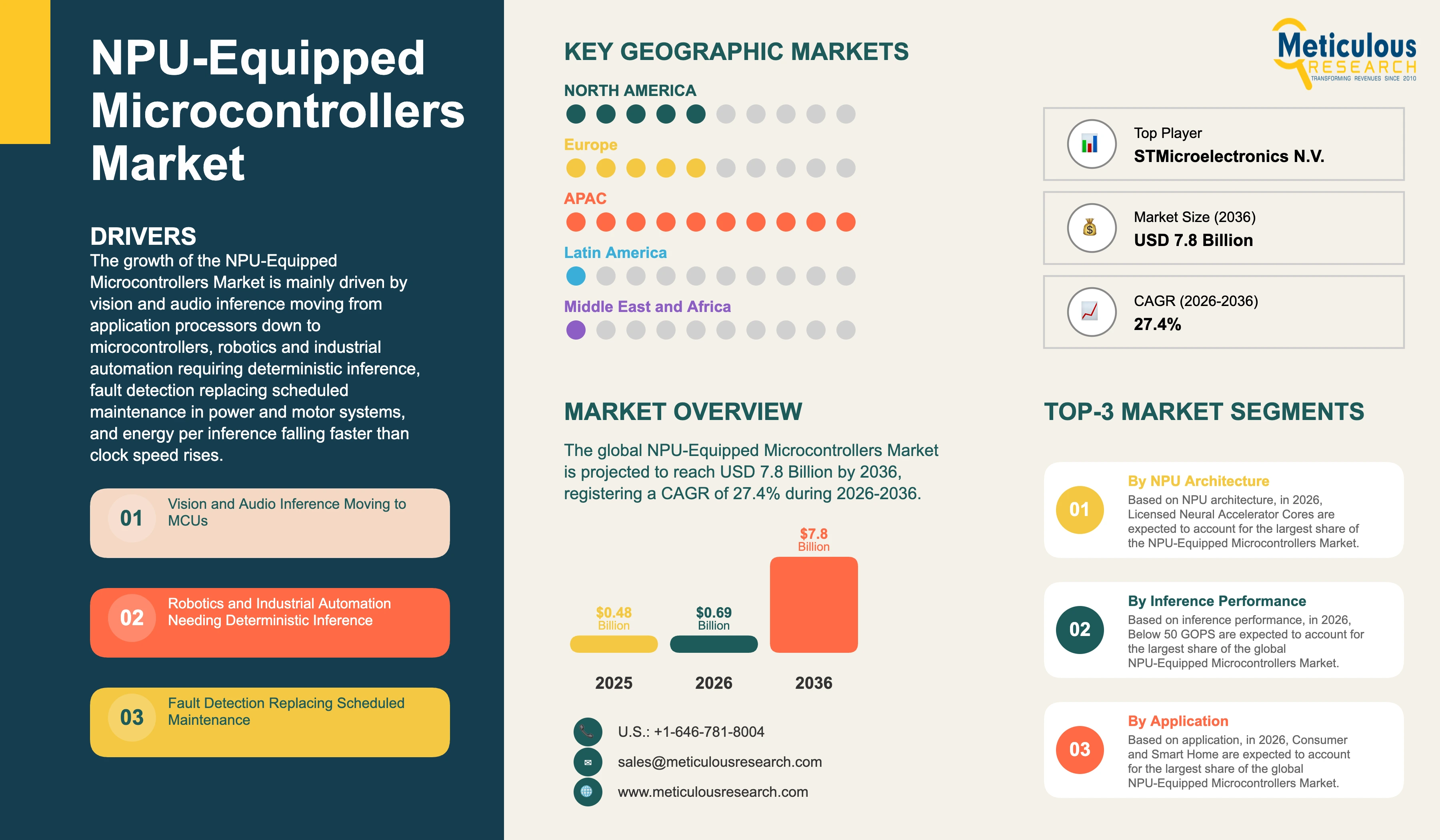
The global NPU-Equipped Microcontrollers Market was valued at USD 0.48 billion in 2025. This market is expected to reach USD 7.80 billion by 2036 from an estimated USD 0.69 billion in 2026, registering a CAGR of 27.4% during the forecast period (2026-2036).
- Published
- Nov 2026
- Pages
- 266
- Format
- PDF + Excel
- Report ID
- MRSE - 1042866
- Base year
- 2025
- 2025 · BASELINE
- $480.0M
- 2036
- $7.80B
- CAGR 2026–2036
- 27.4%
2025 baseline · 2026–2036 forecast at 27.4% CAGR · hover a bar for the value
Key highlights
The global NPU-Equipped Microcontrollers Market is projected to reach USD 7.80 billion by 2036, driven by vision and audio inference moving from application processors down to microcontrollers, robotics and industrial automation requiring deterministic inference, fault detection replacing scheduled maintenance in power and motor systems, and energy per inference falling faster than clock speed rises.
Asia-Pacific is expected to account for the largest market share in 2026 and is also projected to register the fastest growth during the forecast period, supported by the concentration of electronics manufacture and of consumer, industrial and robotics original equipment manufacturer design activity in the region, which places the design-in decision and the production volume inside the same market.
By npu architecture, Licensed Neural Accelerator Cores are expected to account for the largest market share, whereas Proprietary Vendor Neural Accelerators are projected to witness the fastest growth through 2036.
By inference performance, Below 50 GOPS are expected to account for the largest market share, whereas 250 to 600 GOPS are projected to witness the fastest growth through 2036.
By memory configuration, On-Chip Non-Volatile Memory Devices are expected to account for the largest market share, whereas On-Chip SRAM With External Flash are projected to witness the fastest growth through 2036.
The STM32N6 series announced by STMicroelectronics on 10 December 2024 pairs an Arm Cortex-M55 running at 800 MHz with the Neural-ART Accelerator, rated at 600 GOPS using close to 300 configurable multiply-accumulate units and two 64-bit AXI memory buses, at a stated efficiency of 3 TOPS per watt.
That device carries 4.2 MB of contiguous on-chip SRAM, the largest embedded RAM on an STM32, alongside 128 KB of data and 64 KB of instruction tightly coupled RAM with error correction and 8 KB of backup SRAM, and has no on-chip user flash, fetching assets over Octo and Hexa SPI interfaces.
The Renesas RA8P1 group announced on 1 July 2025 combines a 1 GHz Arm Cortex-M85 delivering more than 7,300 CoreMarks, an optional 250 MHz Cortex-M33, and an Arm Ethos-U55 neural processing unit running at 500 MHz at up to 256 multiply-accumulate operations per cycle and 256 GOPS.
That device carries 2 MB of error-corrected SRAM with either 1 MB or 512 KB of magnetoresistive non-volatile memory, 32 KB instruction and data caches per core, an optional 4 MB or 8 MB system-in-package external flash, and is built on a 22 nm ultra-low-leakage process in 224-ball and 289-ball packages.
Neither of those two devices carries a published manufacturer price at any quantity tier, and distributor quantity break tables for the STM32N657X0H3Q end at 119 units, at which point the unit price stands at USD 18.63 against USD 26.99 at single quantity, recorded on 25 November 2026.
Stock on that part stood at zero on the same date with 119 units expected on 11 March 2027 and a manufacturer standard lead time of 30 weeks, while an active RA8P1 part number carried an 18-week manufacturer standard lead time.
The NXP i.MX RT700 announced on 24 September 2024 carries up to five cores including a 325 MHz Cortex-M33 with a HiFi 4 digital signal processor and a separate sense compute subsystem, with the eIQ Neutron neural processing unit delivering image classification up to 172 times faster than the Cortex-M33 alone and energy per inference reduced by up to 119 times, on up to 7.5 MB of ultra-low-power SRAM.
Infineon PSOC Edge devices pair a Cortex-M55 with Helium and a low-power Cortex-M33, with the E81 carrying the NNLite accelerator alone and the E83 and E84 adding an Arm Ethos-U55, the E84 also carrying a 2.5D graphics processor and a display controller supporting up to 1024 by 768.
Texas Instruments announced the TMS320F28P55x on 11 November 2024 as a real-time microcontroller with an integrated neural processing unit, claiming fault detection accuracy above 99% at five to ten times lower latency than a software implementation, directed at arc fault detection in solar and energy storage systems and at motor bearing fault detection.
Nordic Semiconductor announced the nRF54LM20B in January 2026 with the Axon neural accelerator alongside a 128 MHz Cortex-M33 and a RISC-V coprocessor, 2 MB of non-volatile memory and 512 KB of RAM, claiming up to seven times the performance and up to eight times the energy efficiency of competing solutions on sound classification, keyword spotting and image-based detection, with broad development availability expected in the second quarter of 2026.
Report summary
| Particulars | Details |
|---|---|
| Forecast Period | 2026-2036 |
| Base Year | 2025 |
| Estimated Year | 2026 |
| CAGR (Value) | 27.4% |
| Format | PDF, Excel & Cloud Portal · 266 pages |
| CAGR (Volume) | 34.5% |
| Market Size (Value) in 2026 | USD 0.69 billion |
| Market Size (Value) in 2036 | USD 7.80 billion |
| Market Size (Volume) in 2026 | 27.8 million units |
| Market Size (Volume) in 2036 | 540.0 million units |
| Average Selling Price, 2026 | USD 24.80 per unit |
| Average Selling Price, 2036 | USD 14.40 per unit |
| Segments Covered | By NPU Architecture: Licensed Neural Accelerator Cores, Proprietary Vendor Neural Accelerators, Hybrid Accelerator and Digital Signal Processor Configurations. By Inference Performance: Below 50 GOPS, 50 to 250 GOPS, 250 to 600 GOPS, Above 600 GOPS. By Memory Configuration: On-Chip Non-Volatile Memory Devices, On-Chip SRAM With External Flash, System-in-Package Stacked Flash, External Memory Bus Configurations. By Application: Consumer and Smart Home, Industrial Automation and Robotics, Building Automation and Security, Automotive, Medical and Wearable, Energy and Power Conversion. By Price Band: Above USD 20, USD 10 to USD 20, Below USD 10. |
| Countries Covered | China, Japan, South Korea, Taiwan, India, the U.S., Canada, Germany, France, the U.K., Italy, Mexico and Brazil |
| Key Companies | STMicroelectronics N.V., Renesas Electronics Corporation, NXP Semiconductors N.V., Infineon Technologies AG, Texas Instruments Incorporated, Nordic Semiconductor ASA, and Alif Semiconductor, Inc. |
Report overview
Segments covered: npu architecture, inference performance, memory configuration, application, price band.
In volume terms, the market is estimated at 27.8 million units in 2026 and is expected to reach 540.0 million units by 2036, registering a CAGR of 34.5% during the forecast period. The average selling price is estimated at USD 24.80 per unit in 2026 and USD 14.40 per unit in 2036.
The growth of this market is mainly driven by vision and audio inference moving from application processors down to microcontrollers, robotics and industrial automation requiring deterministic inference inside a control loop, fault detection replacing scheduled maintenance in power and motor systems, energy per inference falling faster than clock speed rises, and vendor toolchains lowering the model deployment barrier. However, factors such as lead times and constrained supply on flagship devices, external memory requirements that raise board cost on devices without on-chip non-volatile memory, unit prices above established microcontroller price points, and the difficulty of comparing published inference performance across vendors are expected to restrain the growth of this market to some extent.
Among applications, Consumer and Smart Home are expected to account for the largest market share in 2026, while Industrial Automation and Robotics are projected to register the highest CAGR during the forecast period. Geographically, Asia-Pacific is expected to account for the largest share of this market in 2026 and is also expected to register the highest CAGR during the forecast period.
The NPU-Equipped Microcontrollers Market comprises microcontrollers that integrate a hardware neural network accelerator on the same die as the control processor, measured at the point of sale by semiconductor manufacturers with volume expressed as units. The market covers devices carrying licensed accelerator cores, proprietary vendor accelerators and hybrid accelerator and digital signal processor configurations, across consumer, industrial, automotive, medical and power conversion applications. Application processors and system-on-chip devices running a general-purpose operating system, standalone accelerator chips, and microcontrollers that run inference on processor vector extensions without a separate accelerator block fall outside the scope.
A Cortex-M class core executing a convolutional network consumes most of its cycles and most of its energy budget on multiply-accumulate operations, and while it is doing that it cannot service a motor control loop or a safety interrupt on time. Offloading those operations to a dedicated block returns the processor to deterministic work, which is why the performance claims that matter in this market are expressed as inferences per second and energy per inference rather than as clock frequency.
The STMicroelectronics STM32N6 series, announced on 10 December 2024, pairs an Arm Cortex-M55 at 800 MHz with the Neural-ART Accelerator rated at 600 GOPS across close to 300 configurable multiply-accumulate units and two 64-bit AXI memory buses, at a stated 3 TOPS per watt, with 4.2 MB of contiguous on-chip SRAM, an image signal processor, MIPI CSI-2, an H.264 encoder and a NeoChrom graphics processor, and no on-chip user flash. The Renesas RA8P1 group, announced on 1 July 2025, combines a 1 GHz Cortex-M85 delivering more than 7,300 CoreMarks with an Arm Ethos-U55 at 500 MHz reaching 256 multiply-accumulate operations per cycle and 256 GOPS, 2 MB of error-corrected SRAM and 1 MB or 512 KB of magnetoresistive non-volatile memory on a 22 nm ultra-low-leakage process.
A device with no on-chip user flash holds its model weights in external serial flash and executes from on-chip SRAM, which gives a very large working memory at the cost of an external memory device, the board area for it and a longer boot sequence. A device with on-chip magnetoresistive memory holds code and weights on die with no external component, at a smaller capacity. On-Chip SRAM With External Flash is projected to register a CAGR of 33.4% over the forecast period because the models being deployed are growing faster than on-chip non-volatile memory capacity is.
Neither the STM32N6 nor the RA8P1 carries a published manufacturer price at any quantity tier, distributor quantity break tables for the STM32N657X0H3Q end at 119 units where the unit price stands at USD 18.63 against USD 26.99 at single quantity, and stock on that part stood at zero on 25 November 2026 with 119 units expected on 11 March 2027 against a manufacturer standard lead time of 30 weeks. An active RA8P1 part number carried an 18-week manufacturer standard lead time on the same date.
Texas Instruments announced the TMS320F28P55x on 11 November 2024 as a real-time microcontroller with an integrated neural processing unit, claiming fault detection accuracy above 99% at five to ten times lower latency than a software implementation for arc fault detection in solar and energy storage systems and for motor bearing fault detection. That is inference inside a control loop with a hard deadline, not inference alongside a user interface, and Industrial Automation and Robotics is projected to grow at 33.8%, the fastest of any application.
Unit volume is projected to grow at 34.5% against 27.4% for value, which lowers the average selling price from USD 24.80 in 2026 to USD 14.40 in 2036. The flagship devices available today sit between roughly USD 19 and USD 27 at distribution quantities, and the volume ahead lies in devices below USD 10. Below USD 10 is projected to register 46.2% over the forecast period, the fastest of any price band, and that migration rather than any increase in flagship shipments is what carries the unit forecast.
Asia-Pacific is expected to account for the largest share of this market in 2026, supported by the concentration of electronics manufacture and of consumer, industrial and robotics original equipment manufacturer design activity across the region, which places the design-in decision and the production volume inside the same market.
Europe is projected to grow at 29.6%, the highest regional rate, and holds the third largest regional position in this market in 2026. Germany grows at 30.2% on factory automation, drive and robotics content, and the region carries both the supply side and the demand side of this market, with four of the seven leading suppliers headquartered there and the two highest performance devices in the market originating with a European and a Japanese manufacturer. Machinery safety and cyber resilience requirements applying in the region place secure boot, hardware isolation and tamper resistance among the selection criteria rather than among the optional features, which favors devices carrying a cryptographic engine and an immutable first stage bootloader.
The Middle East & Africa region is projected to grow at 25.6%, where demand follows building automation, security and solar and energy storage installation rather than domestic electronics manufacture, so devices arrive inside imported equipment and the local content is in system integration. Latin America is projected to grow at 26.0% from the smallest regional base, with Mexico accounting for most demand through contract electronics and automotive component manufacture serving North American programs, and Brazilian consumption following appliance production, industrial retrofit and distributed solar installation.
Some of the key players operating in the npu-equipped microcontrollers market are STMicroelectronics N.V., Renesas Electronics Corporation, NXP Semiconductors N.V., Infineon Technologies AG, Texas Instruments Incorporated, Nordic Semiconductor ASA, and Alif Semiconductor, Inc., among others.
Key strategies include designing proprietary accelerators matched to the memory architecture and power envelope of a specific device family rather than integrating a licensed core, with Proprietary Vendor Neural Accelerators growing at 31.6%; shipping the toolchain with the silicon so design-in conversion does not wait on software; migrating accelerator content into lower cost process nodes to reach the band below USD 10, growing at 46.2%; placing accelerators inside real-time control architectures to reach industrial buyers the general-purpose lines do not serve; and acquiring model generation capability, as one supplier did with a tinyML model generation company in June 2025.
Report infographic
Market dynamics
17 factors across 4 forcesVision and Audio Inference Moving From Application Processors to Microcontrollers
A camera-based detection function that previously required an application processor running a general-purpose operating system can now be executed on a microcontroller, which removes the operating system, the external memory it needs and the boot time it carries. The STM32N6 series announced on 10 December 2024 supports that directly with an image signal processor shared with the STM32MP2 line, MIPI CSI-2, an H.264 hardware encoder, a JPEG codec and a NeoChrom graphics processor alongside the 600 GOPS Neural-ART Accelerator. The NXP i.MX RT700 announced on 24 September 2024 claims image classification up to 172 times faster than its Cortex-M33 alone and energy per inference reduced by up to 119 times. 250 to 600 GOPS is projected to register 38.2% over the forecast period, which is the performance band at which camera workloads become practical on a microcontroller.
Robotics and Industrial Automation Requiring Deterministic Inference
A robot joint controller or a machine safety function has a deadline measured in tens of microseconds, and an inference that occupies the control processor for an unbounded number of cycles cannot be scheduled against it. Separating the accelerator from the processor makes the inference time predictable and leaves the control loop intact, which is the property an industrial designer is buying rather than peak throughput. Multi-core partitioning supports the same requirement, with the Renesas RA8P1 pairing a 1 GHz Cortex-M85 with an optional 250 MHz Cortex-M33 and the Infineon PSOC Edge devices pairing a Cortex-M55 carrying Helium with a low-power Cortex-M33. Industrial Automation and Robotics is projected to grow at 33.8% over the forecast period, the fastest of any application in this market.
Fault Detection Replacing Scheduled Maintenance in Power and Motor Systems
Texas Instruments announced the TMS320F28P55x on 11 November 2024 as a real-time microcontroller with an integrated neural processing unit, claiming fault detection accuracy above 99% at five to ten times lower latency than a software implementation, directed at arc fault detection in solar and energy storage installations and at motor bearing fault detection for predictive maintenance. A model that learns the signature of a specific installation and adapts to it replaces a threshold set at design time, and the economic case rests on avoided downtime rather than on component cost. Energy and Power Conversion accordingly constitutes a distinct application in this market with its own real-time control requirement, and the devices serving it come from the real-time control product lines rather than from the general-purpose microcontroller lines.
Energy per Inference Falling Faster Than Clock Speed Rises
The STM32N6 carries a stated efficiency of 3 TOPS per watt, the NXP i.MX RT700 claims energy per inference reduced by up to 119 times against its own processor core and a 30% to 70% reduction in power consumption against the previous generation, and Nordic Semiconductor claims up to eight times higher energy efficiency for its Axon accelerator than competing solutions on sound classification, keyword spotting and image-based detection. A battery-powered or energy-harvesting device is limited by joules per inference rather than by inferences per second, so an efficiency improvement converts directly into either longer service life or a smaller cell. That is what makes always-on sensing viable in products that cannot accept a larger battery, and it is the basis on which Below 50 GOPS retains the largest unit share of this market.
Vendor Toolchains Lowering the Model Deployment Barrier
An embedded engineer who cannot train and quantize a network will not use an accelerator however capable it is, so the vendors have moved the competition to the toolchain. STMicroelectronics published STM32CubeN6 alongside the silicon and provides image signal processor tuning software, Texas Instruments supplies an artificial intelligence toolchain with application-specific models, and Nordic Semiconductor has made its Edge AI Lab and custom Neuton models available for nRF54 series devices and cellular modules, with those models typically under 5 KB. Nordic acquired Neuton.AI in June 2025 to that end. Toolchain quality determines design-in conversion more directly than any published performance figure, and it is where the incumbent microcontroller vendors hold an advantage over accelerator specialists.
Table of contents
14 chapters · 159 sections · 266 pages · click to expandSegmental analysis
| Segment | Largest share (2026) | Fastest growth (2026–2036) |
|---|---|---|
| By Npu Architecture | Licensed Neural Accelerator Cores | Proprietary Vendor Neural Accelerators |
| By Inference Performance | Below 50 GOPS | 250 |
| By Memory Configuration | On-Chip Non-Volatile Memory Devices | On-Chip SRAM With External Flash |
| By Application | Consumer and Smart Home | Industrial Automation and Robotics |
| By Price Band | Above USD 20 | Below USD 10 |
| By NPU Architecture | Licensed Neural Accelerator Cores | Proprietary Vendor Neural Accelerators |
| Other segments | On-Chip Non-Volatile Memory Devices | Below USD 10 |
By Npu Architecture
- Licensed Neural Accelerator Cores are expected to account for the largest share of the global NPU-Equipped Microcontrollers Market.
- The large share of this segment is mainly due to a licensed core carries an established compilation path and operator coverage that a customer can evaluate before committing silicon, which shortens qualification and allows a vendor to bring a device to market without designing an accelerator.
- However, Proprietary Vendor Neural Accelerators are projected to register the highest CAGR during the forecast period.
- The rapid growth of this segment is attributed to vendor-designed blocks allowing the accelerator to be matched to the memory architecture and the power envelope of the specific device family, which is how the highest published figures in this market have been reached, and allowing differentiation that a shared licensed core does not.
By Inference Performance
- Below 50 GOPS are expected to account for the largest market share.
- The large share of this segment is mainly due to the majority of deployed functions are keyword spotting, anomaly detection, presence sensing and simple classification, which run inside this band at a power and price level that battery powered and cost-constrained products can accept.
- However, 250 to 600 GOPS are projected to register the highest CAGR during the forecast period.
- The rapid growth of this segment is attributed to camera-based detection and classification becoming practical on a microcontroller at this band, which is where the image signal processor, camera interface and video encoding content on these devices becomes usable rather than nominal.
- Below 50 GOPS are expected to account for the largest market share in 2026.
By Memory Configuration
- On-Chip Non-Volatile Memory Devices are expected to account for the largest market share.
- The large share of this segment is mainly due to holding code and model weights on die requires no external memory component, no additional board area and no extended boot sequence, which suits the cost-sensitive and space-constrained designs that account for most unit volume.
- However, On-Chip SRAM With External Flash are projected to register the highest CAGR during the forecast period.
- The rapid growth of this segment is attributed to model sizes growing faster than on-chip non-volatile memory capacity, so a device with a large contiguous SRAM and an external serial flash interface can hold a network that an on-die memory cannot, as with the 4.2 MB contiguous SRAM and Octo and Hexa SPI asset fetch on the highest performance parts.
By Application
- Consumer and Smart Home are expected to account for the largest market share.
- The large share of this segment is mainly due to consumer products adopted these devices first for voice interfaces, presence detection and camera functions, and the unit volumes in that application exceed every other by a wide margin even at a lower average price.
- However, Industrial Automation and Robotics are projected to register the highest CAGR during the forecast period.
- The rapid growth of this segment is attributed to a robot joint controller or machine safety function carrying a deadline measured in tens of microseconds, which an inference occupying the control processor cannot meet, together with distribution of inference to each axis so that device count per machine rises faster than machine volume.
By Price Band
- Above USD 20 are expected to account for the largest market share.
- The large share of this segment is mainly due to the devices carrying the highest published inference performance and the largest memory configurations sit in this band, with distributor pricing on the leading part recorded at USD 26.99 at single quantity and USD 18.63 at 119 units on 25 November 2026, and they account for most of the value in an early market.
- However, Below USD 10 are projected to register the highest CAGR during the forecast period.
- The rapid growth of this segment is attributed to mainstream volume requiring a device that fits a consumer or industrial bill of materials, which the flagship parts do not, so the migration of accelerator content into lower cost process nodes and smaller memory configurations is what carries unit growth.
By NPU Architecture
- Licensed Neural Accelerator Cores are expected to account for the largest market share in 2026.
- Proprietary Vendor Neural Accelerators are projected to register the highest CAGR during the forecast period, owing to vendor-designed blocks allowing the accelerator to be matched to the memory architecture and the power envelope of the specific device family, which is how the highest published figures in this market have been reached, and allowing differentiation that a shared licensed core does not.
- 250 to 600 GOPS are projected to register the highest CAGR during the forecast period, owing to camera-based detection and classification becoming practical on a microcontroller at this band, which is where the image signal processor, camera interface and video encoding content on these devices becomes usable rather than nominal.
- On-Chip SRAM With External Flash are projected to register the highest CAGR during the forecast period, owing to model sizes growing faster than on-chip non-volatile memory capacity, so a device with a large contiguous SRAM and an external serial flash interface can hold a network that an on-die memory cannot, as with the 4.2 MB contiguous SRAM and Octo and Hexa SPI asset fetch on the highest performance parts.
- Industrial Automation and Robotics are projected to register the highest CAGR during the forecast period, owing to a robot joint controller or machine safety function carrying a deadline measured in tens of microseconds, which an inference occupying the control processor cannot meet, together with distribution of inference to each axis so that device count per machine rises faster than machine volume.
Other segments
- On-Chip Non-Volatile Memory Devices are expected to account for the largest market share in 2026.
- Consumer and Smart Home are expected to account for the largest market share in 2026.
- Above USD 20 are expected to account for the largest market share in 2026.
- Below USD 10 are projected to register the highest CAGR during the forecast period, owing to mainstream volume requiring a device that fits a consumer or industrial bill of materials, which the flagship parts do not, so the migration of accelerator content into lower cost process nodes and smaller memory configurations is what carries unit growth.
Geographic analysis
Asia-Pacific
Largest shareAsia-Pacific is expected to account for the largest share of the global NPU-Equipped Microcontrollers Market in 2026. The large share of this region is attributed to the concentration of electronics manufacture and of consumer, industrial and robotics original equipment manufacturer design activity across the region, which places the design-in decision and the production volume inside the same market. China holds the greater part of regional demand through consumer appliance, smart home and industrial automation production, and Taiwan contributes both foundry supply and module design. Japan grows at 21.8%, the slowest country rate covered, where an established microcontroller base and long product qualification cycles slow migration to a new device class, although one of the two leading devices in this market originates with a Japanese manufacturer. India is projected to be the fastest-growing country market at a CAGR of 34.6% during the forecast period, from a small base, as domestic appliance and two-wheeler electronics production, factory automation retrofit programs and electronics design service activity all adopt these devices at once, with the unit mix weighted toward the band below USD 10.
Europe
Europe is projected to register the highest regional CAGR at 29.6% over the forecast period, which reflects both the supply side and the demand side. Four of the seven leading suppliers in this market are headquartered in the region, and the industrial automation, robotics and power conversion equipment base there is the application where inference has to sit inside a control loop rather than alongside a user interface. Germany grows at 30.2% on factory automation, drive and robotics content, while machinery safety and cyber resilience requirements applying in the region place secure boot and tamper resistance among the selection criteria rather than among the optional features.
Competitive landscape
The global NPU-Equipped Microcontrollers Market is moderately consolidated, with the established microcontroller suppliers holding most of the volume through existing design relationships and toolchains, against a small group of specialist suppliers competing on inference performance per unit of power, with competition among established general-purpose microcontroller suppliers, real-time control microcontroller suppliers, wireless system-on-chip suppliers extending into inference, specialist edge artificial intelligence device companies, and processor and accelerator intellectual property licensors supplying the cores those devices integrate. Market participants compete primarily on inferences per second and energy per inference on the model the customer intends to deploy, memory configuration and whether an external flash device is required, toolchain and model library quality, unit price at the quantity the customer will buy, lead time and supply security, industrial temperature range and functional safety documentation, and longevity commitment.
designing proprietary accelerators matched to the memory architecture and power envelope of a specific device family rather than integrating a licensed core, shipping the toolchain with the silicon so that design-in conversion does not wait on software, migrating accelerator content into lower cost process nodes to reach the band below USD 10, placing accelerators inside real-time control architectures to reach industrial buyers the general-purpose lines do not serve, and acquiring model generation capability as Nordic Semiconductor did with Neuton.AI in June 2025
The report provides a comprehensive competitive assessment of the leading companies operating in the global NPU-Equipped Microcontrollers Market. The key players profiled in the report include STMicroelectronics N.V. (Switzerland), Renesas Electronics Corporation (Japan), NXP Semiconductors N.V. (Netherlands), Infineon Technologies AG (Germany), Texas Instruments Incorporated (U.S.), Nordic Semiconductor ASA (Norway), and Alif Semiconductor, Inc. (U.S.).
- STMicroelectronics N.V.
- Renesas Electronics Corporation
- NXP Semiconductors N.V.
- Infineon Technologies AG
- Texas Instruments Incorporated
- Nordic Semiconductor ASA
- Alif Semiconductor, Inc
Expert perspectives
The STMicroelectronics STM32N6 carries 600 GOPS across close to 300 configurable multiply-accumulate units at 3 TOPS per watt with 4.2 MB of contiguous on-chip SRAM and no on-chip user flash, fetching assets over Octo and Hexa SPI. The Renesas RA8P1 carries an Arm Ethos-U55 at 500 MHz reaching 256 GOPS with 2 MB of error-corrected SRAM and 1 MB or 512 KB of magnetoresistive non-volatile memory, with an optional 4 MB or 8 MB system-in-package flash. One buys a very large working memory at the cost of an external component; the other buys a self-contained device at a smaller capacity.
An external serial flash adds a component, board area, a boot sequence and a supply line to qualify, and in a joint controller or a drive there is rarely room for any of them. A device holding code and weights on die fits where the other does not, which is why On-Chip Non-Volatile Memory Devices retains the largest share of this market while On-Chip SRAM With External Flash grows faster at 33.4% in the applications where model size dominates.
Six vendors in this market state performance six different ways, as absolute operations per second, as multiply-accumulate operations per cycle, as a multiple against their own processor core, and as a multiple against unnamed competing solutions. Operations counted, data type, sparsity and the reference network all differ. An evaluator has to run the intended model on candidate silicon to obtain a comparable number, which lengthens the design-in cycle and shifts the advantage to whichever vendor reaches a working benchmark on customer hardware fastest.
Distributor quantity break tables for the STM32N657X0H3Q end at 119 units where the price stands at USD 18.63 against USD 26.99 at single quantity, stock stood at zero on 25 November 2026 with 119 units expected on 11 March 2027, and the manufacturer standard lead time was 30 weeks. An active RA8P1 part number carried 18 weeks on the same date. Neither device carries a published manufacturer price at any quantity tier, so a volume price has to be obtained by quotation rather than read from a published list.
Texas Instruments placed an accelerator inside a real-time control architecture with the TMS320F28P55x announced on 11 November 2024, claiming above 99% fault detection accuracy at five to ten times lower latency than a software implementation for arc fault detection in solar and energy storage and for motor bearing fault detection. That is a different product definition from a consumer-derived device with a camera interface, and for a buyer evaluating robotics and automation it is the comparison set that matters alongside the two flagship parts.
Customer perspectives
Insights gathered during primary interviews with robotics and industrial automation design engineering teams, appliance and consumer electronics original equipment manufacturers, semiconductor product line management, authorized distributors, and electronics design service providers operating in this market highlight where specification priorities are shifting. The following perspectives reflect recurring themes raised across these discussions.
This reflects memory architecture rather than published performance governing device selection in space-constrained industrial designs, and evaluation effort as the principal schedule risk.
This indicates that volume pricing in this market is obtained by quotation rather than from published lists, and that supply security and longevity rank ahead of unit price for industrial buyers.
This points to a requirement for bounded inference latency inside a control loop, and to real-time control device families rather than consumer-derived families as the relevant comparison set.
“We are comparing two parts and the inference numbers are the least useful thing on the data sheet. One of them has no internal flash, so I am adding an external memory, board area I do not have in a joint module and a boot sequence I have to qualify for a safety function. The other holds everything on die with less capacity. Until I run our own network on both I cannot tell whether the smaller memory is a problem, and that evaluation is the schedule risk, not the design.”
“There is no published price at the volumes we buy, for either of the leading parts, so every comparison starts with a quotation request and a non-disclosure agreement. What I can see is distributor pricing that stops around a hundred units and lead times of eighteen to thirty weeks. For a product with a ten year life I need a longevity commitment and a second source before the price even matters, and the second source does not exist for a proprietary accelerator.”
“Our fault detection has to run inside a control loop with a deadline in tens of microseconds. If the inference takes an unbounded number of processor cycles it cannot be scheduled at all, which is the entire reason we want a separate accelerator. The parts that interest us are the ones built on a real-time control architecture, because a device designed around a camera and a display solves a problem we do not have.”
Frequently asked questions
The global NPU-Equipped Microcontrollers Market is estimated at USD 0.69 billion in 2026.
Cite this report
Meticulous Research. (2026). NPU-Equipped Microcontrollers Market - Global Opportunity Analysis and Industry Forecast (2026-2036) (Report No. MRSE - 1042866). Meticulous Market Research Pvt. Ltd. https://www.meticulousresearch.com/product/npu-equipped-microcontrollers-market-7549